Samantha Spiro

ImageHandler

Originally written for IdeasTap.

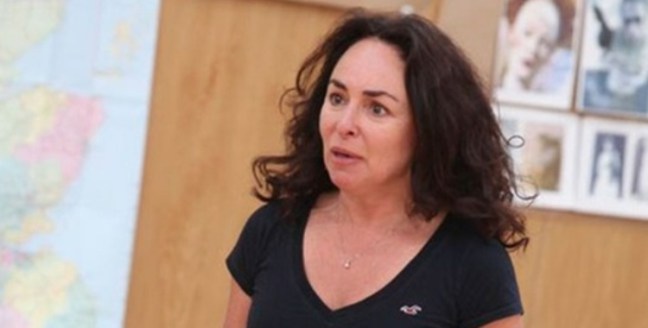
Samantha Spiro has acted in everything from Shakespeare to musical theatre, as well as establishing herself as a familiar face on BBC Two sitcom Grandma’s House. As she prepares to play Lady Macbeth at the Globe, she shares advice on maintaining a healthy career balance and not losing faith…

How difficult was it to make the transition from drama school into the theatre industry?

As far as drama school is concerned, the brilliant thing is that you just get to do lots of plays. I was very lucky that my first job was at the Open Air Theatre at Regent’s Park, so I continued in a similar vein. In those days you got to do two Shakepeare plays and a musical, so I played Third Witch in Macbeth and Peaseblossom in A Midsummer Night’s Dream and everything from a canary to a courtesan in The Boys From Syracuse, which was the musical.

It felt very much like the old days of rep, which I never experienced because there were very few theatres still doing it. I was very lucky to have those opportunities to get into that kind of environment very early on.

You have described the role of Barbara Windsor in Cleo, Camping, Emmanuelle and Dick as one of your big breaks. What impact did that production have on your career?

Because it was at the National [Theatre] and we filmed it, it had the knock-on effect of opening doors. But it didn’t feel like it at the time, it didn’t feel immediate. I don’t feel there’s been any one moment in my life where suddenly everything’s burst into technicolour and everybody has been knocking at my door. It’s been more slowly-but-surely.

How do you maintain a balance between theatre and television work?

I felt for many years that theatre was my main source of employment. But in the back of my mind I knew that there probably was a better balance. Although the worlds do feel very separate, I think that the more you’re seen on television, the more people want to come and see you in the theatre, and the more chances of you getting better roles. It’s only really in much more recent years that I feel as though I’m doing a bit of both. I absolutely love it, but I’m always eager to get back to theatre. 

Is there added pressure with taking on an iconic role like Lady Macbeth?

It is an iconic role, but I think you just have to free yourself of those pressures. Most of my favourite actors have played this part brilliantly, but when you come to it you’ve got to think of it as a new play and pretend that nobody’s played this part before, because otherwise you do drive yourself mad and you’ll lose your nerve.

Do you have any advice for young actors?

Try and work as much as you possibly can and try and create as much as you possibly can. If the acting work isn’t coming in then keep active by writing or by trying to get in on the production side of things. Just keeping at it if you’re passionate about doing it is the best thing, because there’s no logic. As long as you’re part of the business, I think things can happen at any moment. To not lose faith.

In Focus: Creating a back story for Lady Macbeth

Joe Millson – who’s playing Macbeth – and I agreed very much on what our back story is. The back story for us is about having had a child who died within the first few weeks of its life. 

I’m approaching playing Lady Macbeth as a woman who had post-natal depression and had evil thoughts about her baby, and then the baby does die, so she’s left with this huge, gaping hole in her life. And her husband feels guilt towards her and wants to try and help her out of this.

Going through birth, going through post-natal depression, and then going through the loss of a child has left her with a chasm to fill. That then gives me the springboard or catalyst for what happens in the play.
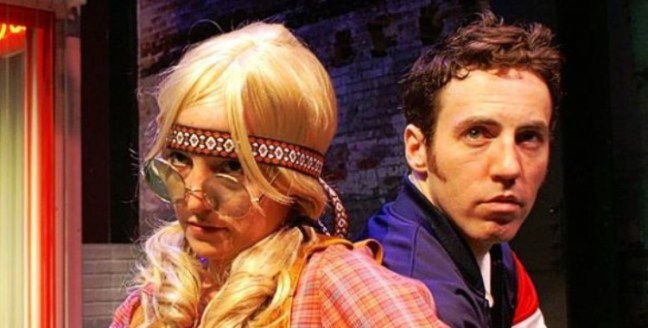
Mission Drift, National Theatre Shed

mission-drift-600x399

Originally written for Exeunt.

How do you tell the story of 400 years of American capitalism? The TEAM approach that seemingly impossible challenge by going right to the heart of what sustains it: mythology. Their searing, sexy, gloriously shambolic voyage through the heartland of the great American Dream takes on one myth with another, using a symbolic saga of American youth, adventure and frenzied acquisition to intelligently skewer an economic system fatally fixated on growth. And there are songs. Brilliant, heart-stopping, floor-shaking songs.

The narrative device driving this gorgeous, chaotic juggernaut is actually deceptively simple. Using one of the staples of the Hollywood movie – that other great cornerstone of American identity – Mission Drift pursues the spirit of capitalism through a pair of intertwined love stories. Catalina and Joris are two immortal Dutch teenagers who travel over on one of the first ships to the New World, forever fourteen as they hungrily chase the frontier, while in post-credit crash Las Vegas, a cocktail waitress and a desert-dwelling cowboy seek shared respite from financial collapse. Playing tricks with temporality, the show effortlessly jumps between these two couples, its fleet-footed narrative overseen by Heather Christian’s captivating songstress Miss Atomic.

The resulting atmosphere in The Shed is somewhere between theatre, gig and cabaret show. It’s thrilling, it’s explosive, it burns with the heat of flashing neon and sun-soaked desert sand. This is unapologetically exciting theatre, giddily romanticising Americana at the same time as dismantling it. Through the furious pace, Christian’s electric music and the astonishing energy of The TEAM’s performers, the audience is bathed in the white heat of financial risk and lightning growth. Its implicit confession is that capitalism is undeniably seductive. This truth is repeatedly acknowledged as Mission Drift races through boom and bust, charting first the unstoppable march of the frontier and then the inexorable growth of Las Vegas, its neon towers thrusting up out of the desert in the ultimate expression of the capitalist dream. And all the while the action is underscored with a greedy, breathless hymn to the pursuit of growth. Bigger, bigger. Better, better. I want, I want.

At the apex of this progress is the atomic bomb: explosive, destructive, yet strangely beautiful, watched by sunglass-clad gamblers during tests at the nearby Nevada Proving Grounds. Here, that violent and seductive presence is wrapped up in Miss Atomic, whose songs blow the place apart with her namesake’s intoxicating cocktail of power and beauty. She is, in a sense, the face (and blistering voice) of it all – the bomb, Las Vegas, the unstoppable force of capitalist desire. But Catalina and Joris, played by the tireless and ever-animated Libby King and Brian Hastert, are also the blazing symbols of the American Dream. A pair of entrepreneurial Peter Pans, these two Dutch adventurers attain an eternal adolescence that hints at both the immaturity and the headiness of their restless greed. They also lay claim to that very American right to reinvention, renaming themselves at each new frontier until those names become meaningless.

The TEAM’s distinctly postmodern version of the USA is one that Jean Baudrillard would instantly recognise, in which signs have replaced reality. The desert of the real is Las Vegas’ sign-littered Neon Boneyard, cradling “the fragile bones of electric dinosaurs”, while history itself has become a theme park ride – set to warp speed and decked in flashing lights. The platform on which the band performs is flanked by tree trunks, the backdrop behind them suggesting the wild, unexplored forests of the frontier, but now that frontier is only an empty image glossed over with the glitter of the casino. It’s all a mirage.

It might all be simulacra, but this breakneck production still dazzles, sweeping us up in its epic scope. Momentum builds and builds, in step with the pioneers and the skyscrapers, leaving the scattered debris of stage mess in its wake. In the words of Miss Atomic, it “grows so fast that you can see it, and feel it, and be afraid of it”. It’s only in the final half hour or so that this pace begins to flag, with music and chaos dropping away in favour of calm, reflective storytelling. While it’s with a hint of disappointment that the pulse-quickening action departs, the lull feels necessary, the sudden shift in aesthetic reflecting the water-treading stasis of recession that we still find ourselves mired in. This structure is, in itself, a sort of warning. No matter how fast you spin it, the roulette wheel always has to stop turning sooner or later.

Photo: Ves Pitts

As You Like It, Royal Shakespeare Theatre

??????????????????????????????????????????????????????????????????????????????

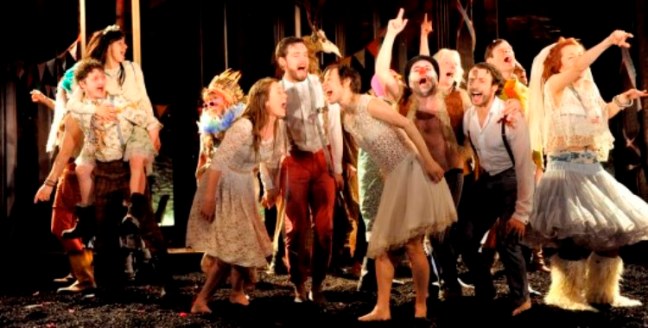
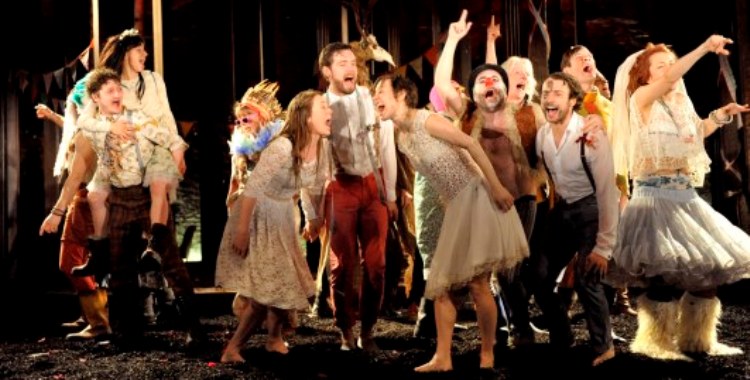
In The Forest and the Field, Chris Goode identifies the forest in Shakespeare as an inherently liminal space. It’s an area where identities blur, gender becomes fluid and appearances deceive; the usual rules are suspended and all bets are off. In an age of concrete jungles, director Maria Aberg has looked around for the equivalent contemporary space for her modern Forest of Arden and landed upon the inspired setting of the festival. In this context – usually with the aid of a few illicit substances – inhibitions drop away, social rules are bent and the real world is momentarily distant. And so it is in Aberg’s joyously liberated As You Like It.

This Forest of Arden is both transporting and transformational. Leaving behind the stylised monochrome claustrophobia of the court, illuminated by harsh fluorescent lighting and presided over by a particularly thuggish Duke Frederick, the transition into the woods is almost a Wizard of Oz moment – a sudden blooming into technicolour. Upon contact with the forest and its merry band of hippies, led by an ageing rocker of an exiled duke, characters experience a sudden, disorientating shift. By establishing this transformational space, Aberg effortlessly navigates some of Shakespeare’s more abrupt plot swerves; here, anything can happen. The only thing that’s hard to believe is why the characters would ever want to leave this woodland paradise.

By offering us Shakespeare’s play in all its untrimmed, anarchic glory, Aberg’s version (running at over three hours but feeling more like one) allows the Forest of Arden to make a strange sort of sense through its stubborn refusal to follow logic. Characters fall in love at first sight or shed personality traits like winter coats, in a plot full of swift handbrake turns. This slippery structure can prove problematic for interpreters, many of whom snip away at the more preposterous elements of the narrative, but Aberg’s approach makes one suspect that those heavily edited productions are sort of missing the point. Arden, this production convinces us, is not meant to make sense. It provides a magical, freeing contrast with the restrictions of the court, its power such that it can remould personalities within moments.

While more extreme reversals occur elsewhere, Pippa Nixon’s captivating Rosalind provides perhaps the most compelling example of the force exerted by the forest’s intoxicating freedom. In court, a gloomy and sinister space succinctly captured in Ayse Tashkiran’s brilliantly unsettling choreography, the exiled duke’s daughter is forced into a role as restrictive as her floor-length black dress – which even in this dark environment has an irrepressible sparkle akin to that of its wearer. In Rosalind’s early scenes and her first encounter with Alex Waldmann’s petulant, hoodie-wearing Orlando, Nixon keeps the character tentative, reined in despite her clear passion. It’s only in the Forest of Arden, where evening wear is exchanged for jeans and bare feet, that she is exhilaratingly freed and her immediate crush for Orlando is allowed to blossom into dizzying, mind-altering love.

Every last element of the production is harnessed to create this sense of giddy liberation that occurs as soon as the characters step through the trees. The wooden frame of Naomi Dawson’s beautifully simple set design initially shuts out the light, fiercely boarding up the court from the natural world outside, before a stunning transformation brings us amid the trees and earth of the forest. James Farncombe’s lighting makes an equally dramatic transition from the stark and anaemic confines of civilization to the warm glow of the wild, while the performers rapidly shed starched suits and rigidly inherited roles. And then there’s the music. Laura Marling’s murderously catchy soundtrack crashes together the folk traditions of an ancient rural England and the messy euphoria of the modern day music festival – two things which, according to Aberg, aren’t all that different. (“I have a hunch that the rural English rituals that are now long forgotten fulfil the same kind of need that we satisfy when we go to Glastonbury,” she says. “I think on some profound level those things are connected”)

While the play is every inch Rosalind’s (and, in this production, Nixon’s), right up to the playfully delivered epilogue, the tangle of interweaving plots offers plenty of work for a strong ensemble. It’s a joy to see Nicolas Tennant on stage again after Three Kingdoms, here embracing another kind of anarchy with his wryly shambolic take on Touchstone and even briefly breaking out of the text to deliver a bit of deadpan stand-up. Waldmann’s initially sulky Orlando offers another dazzling transformation, moving through vain posturing and wide-eyed bemusement before arriving at a true appreciation of Rosalind, while he and Nixon have fizzling chemistry from the off. There’s also impressive support from Oliver Ryan’s other-worldly Jacques and a scene-stealing moment of tenderness from David Fielder as faithful servant Adam.

Yet there remains, for all the sheer joy, a hint of darkness. The frenzied pitch of emotion feels unsustainable, a high that has to be followed by a crashing low – maybe upon return to the court, which this production establishes as a particularly unappealing reality. Given the clear reference point of the festival, it’s tempting to see such events as similar escapes from a bleak and hostile world, hinting at the efforts of a disillusioned generation to ignore the injustice of their society through a haze of drink, drugs and music. I’m not sure this social critique is quite as prominently foregrounded as Matt Trueman credits it with being, but perhaps that’s just because my experience of the production was helplessly dominated by the infectious fun of the closing scenes, to which I found myself willingly surrendering. Maybe it’s just nostalgia for the blissful abandon of the festival, but it was tough to resist the urge to leap around on stage with the cast by the end.

At its fiercely beating heart, As You Like It is really about falling in love, and this version offers us a Rosalind and an Arden to tumble head over heels for. Aberg’s chaotic production might not offer us any answers beyond the space of this ecstatic, muddy celebration, but that’s the essence of the forest. It’s a magical place apart, full of gorgeous anarchy, but – just like the festival – it is essentially a transitory state. While the music lasts, however, it’s impossible to do anything but dance.

Photo: Keith Pattison.

Thinking Outside of the Building

WYP-600x400

Originally written for The Stage.

At Vicky Featherstone’s first Royal Court press briefing, there was an intriguing statement of intent about the theatre’s direction. As well as reaffirming the theatre’s commitment to writers, handing over the keys of the building for a summer season led by the playwrights, Featherstone made a comment with potentially far-reaching implications for the future role of the Royal Court. She said, with a playful grin, “no space should be safe from theatre”.

As the new artistic director went on to explain, she’s interested in utilising different spaces within the building, in taking shows outside the Royal Court’s home in Sloane Square, and in bringing new audiences through its doors. It’s perhaps not surprising that Featherstone, who has led the nomadic National Theatre of Scotland for the last eight years, should want to look beyond the restrictive and arguably exclusive boundaries of the Royal Court’s four walls. What’s more striking is that she’s not alone.

While “audience development” has long been a key part of theatres’ PR arsenal, this can often be just so much empty rhetoric. Now, however, there seems to be a genuine commitment to opening up theatre spaces, venturing beyond bricks and mortar and establishing theatres as a vital part of their surrounding communities. It’s a development that’s sorely needed and one that might, if successful, ensure a future life for theatres within an arts funding landscape that is looking increasingly precarious.

At last year’s Theatres Trust conference on delivering sustainable theatres, Griff Rhys Jones championed the theatre as a place of public assembly in modern day communities, taking on the civic role once occupied by the town hall or community centre. While a vision of the theatre as the beating heart of the community is perhaps a little utopian, there are ways that buildings can connect with local residents through more than just their artistic programme. Just look at Battersea Arts Centre, where experimental performance jostles alongside yoga classes and tea dances. Artistic director David Jubb is keen to retain this diverse make-up of functions, hoping to achieve an overlap between the venue’s two distinct strands of activity, while ongoing improvement works will make the building structurally more open.

Beyond London, this gesture of opening out is even more essential, particularly as other public spaces are threatened. Rhys Jones has pointed to the example of Derry Playhouse, which is open to local people throughout the day, functioning almost like a community centre. There are other similar if not quite so far-reaching examples. Chapter Arts Centre in Cardiff has worked hard to create a welcoming environment that encourages people to drop in, while one of the key pledges made by West Yorkshire Playhouse’s new artistic director James Brining is to open up the building and explore the way the theatre relates to its communities. One of the few things theatres do have is space, much of which lies dormant when not being used for performance. Why not fill it?

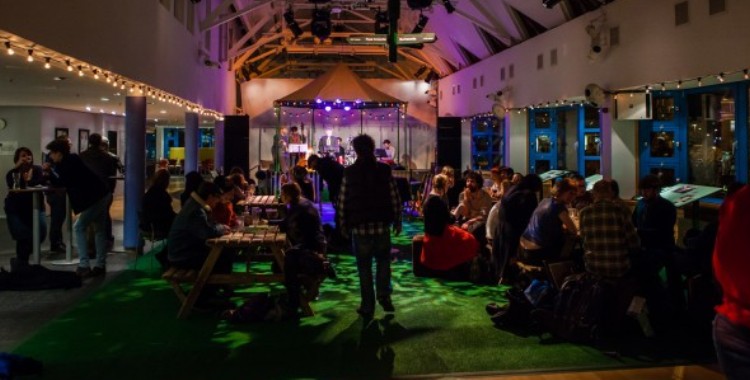
As well as inviting audiences in, establishing theatres as buzzing hubs of the community, venues might look outwards. As buildings hold less prestige than they once did, there is the opportunity for theatres to redefine their identity beyond their own walls. West Yorkshire Playhouse has effectively demonstrated this approach with the city-facing programming of this year’s Transform Festival, including a piece of performance made with local residents and performed outside the theatre. The challenge, of course, is to expand this beyond the fleeting festival context.

But does all this shift the focus away from the art itself? There are clearly potential pitfalls for such an approach – particularly if treated as a careless add-on to tick funding boxes – but the community benefits need not be at the expense of the theatre. At their best, each can positively impact upon the other. Fresh influences enter the building, disrupting and invigorating a process of theatremaking that might otherwise become stultified, while new potential audience members are given the opportunity to encounter the work and be surprised.

None of this is to say that theatres should abandon their core activities; rather, as ever, they need to adapt. Buildings have always been one step behind the performances and audiences they host, running to keep up. Think of the exponential growth in site-specific work over recent years, to the point where the National Theatre is now selling tickets for Shunt and Punchdrunk shows taking place miles away from the South Bank. The need from local communities and potential audiences is there, the only question is whether theatres will step in to fill the gap.

In her recent keynote speech addressing the thorny issue of arts funding, culture minister Maria Miller firmly stated that the arts need to make the case for their ongoing importance in economic rather than artistic terms. It’s a statement that has prompted an understandable backlash, pinpointing many of the dangers and inadequacies of measuring the arts’ value in purely monetary terms. But perhaps theatres’ greatest argument for their survival is the role they might play within their local areas – artistically, economically, and as a central component of the community.

Photo: Richard Davenport

Chimerica, Almeida Theatre

Chimerica-600x374

Originally written for Exeunt.

The photograph has always been something of a paradox; a record of ephemerality, the fleeting present moment arrested for posterity. It is a document of disappearance, the deceptive capture of something already lost, a lie and an irrefutable truth wrapped up in one. In Ways of Seeing, John Berger even suggests that the invention of the camera irrevocably altered our mode of perception, therefore changing the status of the image itself: “the camera isolated momentary appearances and in so doing destroyed the idea that images were timeless”. Yet still we cling to photographs as incontrovertible vestiges of the past, investing one image with the weight of an entire event – an entire ideology, even.

In Chimerica, Lucy Kirkwood fixes her lens on just one of these historically burdened snapshots. In fact, that’s already a lie; there are at least six known versions of the iconic image that provides Kirkwood’s inspiration, implicitly refuting its uniqueness and by extension the irreproachable “truth” it is assumed to offer. The photographic catalyst for Kirkwood’s play is the ubiquitous visual encapsulation of the 1989 student protests in Tiananmen Square and the subsequent massacre by the Chinese military: the image of a man standing defiantly and defencelessly in front of a line of advancing tanks. It’s become one of the most hauntingly familiar images of the twentieth century, a symbol of non-violent protest and of the chilling opposition between the fragility of man and the might of machinery.

Around this one recorded act of heroism and the enduring mystery of the anonymous “Tank Man”, Kirkwood has crafted a taut, complex and nuanced thriller, with exhilaratingly ambitious scope. Her imagined American photojournalist, Joe, is fixated on this unknown icon of defiance who he photographed 23 years ago from the window of his Beijing hotel room. Spurred on by hints from his Chinese friend Zhang Lin and a cryptic clue in a Beijing newspaper, the quest to discover this man and the story behind the photograph quickly takes on the character of an obsession. It’s a detective story, of sorts, but set against the backdrop of a nation developing at frightening, breakneck speed. As one character puts it, this is a country that has gone from famine to Slimfast in the space of one generation.

If the glorious mess of Three Kingdoms queasily exposed the British view of Europe as Other, then Chimerica goes a long way towards skewering the hypocritically exoticising Western view of China. Although the title (borrowed from Niall Ferguson’s study of the economic dominance of this pair of superpowers) might inextricably link China and the USA, the play itself repeatedly demonstrates that we equate the citizens of these two nations at our peril. While consumer insight consultant Tessa highlights the pitfalls of treating Chinese shoppers like their counterparts in the West, Americans bemoan the Westernisation of Chinese culture in the same breath with which they sigh relief that the Chinese are becoming more like their capitalist cousins. They want authentic Chinese cuisine, but only if there’s a credit card machine at the till and a Starbucks round the corner.

The idea of the photograph, beyond providing the plot’s primary impetus, also reflects these strained perceptions that nations cultivate of one another. It’s all about how we see things. This currency of images decorates Es Devlin’s exquisite set, a revolving cube that recalls Tom Scutt’s brilliant design for 13 at the National Theatre and conjures similar ideas of being boxed in – by a restrictive state, by the photographic ghosts of history, by a consumer culture that would slot individuals into neat, easily targeted pigeon-holes. The surfaces of this cube become screens for various projected photographs, creating a constantly shifting backdrop of visual truths, lies and suggestions. These ever-present images also hint at the pervasive infiltration of visual media into our homes and lives, creating a world in which, as Joe cynically puts it, photographs of atrocity are no more than “clip art”.

For all its richly layered interrogation of economics, politics and the culture of images, the play remains motored throughout by a constantly engaging narrative. In his dogged mission to track down “Tank Man”, Joe increasingly jeopardises his job, his friendships and his burgeoning relationship with Tessa, yet somehow his obsessive investigation remains unfailingly compelling. This is largely down to the riveting precision of Lydnsey Turner’s tight production and the absorbing performance of Stephen Campbell Moore, who preserves a shred of empathy for Joe even at his most self-centredly illogical. His argument that “people need to know there’s heroism in the world” is an appealing one, but as journalistic curiosity morphs into unhealthy fixation, Joe’s pursuit is one of a strange kind of personal redemption rather than any real public interest.

As Joe races across New York and racks up his long distance phone bill on the trail of “Tank Man”, his disillusioned friend Zhang Lin, played with compassion and poignant weariness by Benedict Wong, faces mounting difficulties in Beijing. Alongside the central pairing of these two men, Kirkwood and Turner build a sophisticated cast of supporting figures, often achieving vivid characterisations in just a few quick strokes. Claudie Blakley’s blunt, businesslike Tessa has an edge of vulnerability and a nagging but never simplified social conscience, while Joe’s newspaper colleagues resist being wrestled into generic boxes. The evidence of the play itself would seem to counter Tessa’s glib assertion that in the age of mass communication and sophisticated consumer profiling there’s “no such thing as an individual”.

While focus is inevitably drawn to the impressive scope of Kirkwood’s writing, it’s equally hard to deny the visual beauty of Turner’s sleekly revolving production, bringing more excitement to the stage of the Almeida than it has witnessed in years. The staging is striking in a cinematic rather than a visceral sense, however, placed at an elegant remove from the audience. With its rapid succession of often short scenes and its gripping thriller plot, it is easy to see Chimerica working on screen, a medium that this production already seems to have at the back of its mind. If early whispers of a future life are realised – as they deserve to be – it would come as no surprise if a film adaptation is not far behind.

Resisting the cinematic vocabulary of the whole, the production’s one sharp injection of thrilling theatricality comes courtesy of a ghost from the Tiananmen Square massacre. Puncturing the realism of the scene, this figure unfurls from Zhang Lin’s fridge in a way that immediately brings to mind the performer springing from a suitcase in Three Kingdoms, providing a similarly startling physical interruption. At the close of the first act, this fragile, bloodied form bears a glowing red orb, passing the pulsing sphere from performer to performer in a sequence of captivating yet ominous beauty. This lingering moment recalls the poisoned apple of fairytale – a sinister metaphor, perhaps, for a deadly political fruit that Chimerica suggests is just waiting to be bitten into.