Feast, Young Vic Theatre

Young_Vic_Feast_007_Photo_by_Richard_Hubert_Smith-600x399

Originally written for Exeunt.

“A person who does not know his own ancestors does not know his own grandchildren.” One of many small wisdoms passed from mouth to mouth during this patchwork celebration of Yoruba culture, these words are a fitting epigraph for a piece of theatre deeply concerned with identity and its roots in past, present and future. There is a profound sense that for those who are born into this culture, being aware of one’s past is integral to the hybrid cultural identity one forges in the modern world. Co-written by five playwrights from the USA, Cuba, Brazil, Nigeria and Britain, brought together as part of World Stages London, the creation and structure of the piece is an appropriately diverse and fragmented reflection of the Yoruba diaspora, a culture scattered across and filtered through four different continents. It’s a feast in which flavours clash, complement and blend.

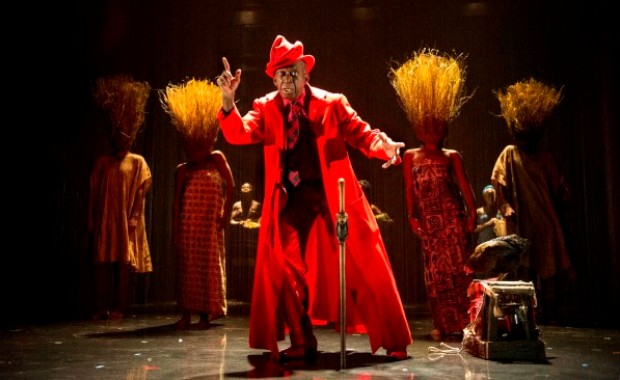
The scraps of scenes from the production’s five writers are loosely stitched together by the recurring presence of four Orishas, Yoruba deities, who appear and reappear in the form of fictional characters from across the past 300 years of Yoruba history. The three female Orishas Yemaja, Oshun and Oya, associated with motherhood, beauty and war respectively, are followed through the ages by Esu, a mischievous, chaos-courting shape-shifter who perpetually straddles the crossroads. Among the snatches we are shown from this huge swathe of history are a vignette on the impact of slave liberation in Brazil, a snapshot of the American civil rights movement and a post-Olympics scene featuring a young British athlete – more fleeting moments than scenes, tiny splinters broken off a story too huge to begin telling.

Conceptually, the shape of the whole is fitting. Any attempt to take a holistic view of a history and a culture that is characterised by its variety would be reductive and misguided; instead this consciously incomplete and fractured image mirrors the dispersed and many times translated and transmuted tradition that it depicts. The resistance to unifying narratives also speaks of a distrust of written history, a history that often – as in the production’s layered projections – writes over its subjects. This project instead attempts to capture something of the oral history that has passed down through generations and across continents, a history focused on storytelling rather than the imposed tyranny of facts. Unfortunately, the delicate fabric of the stories themselves is often not substantial enough to support the ambition of the piece as a whole, with scenes feeling broken or truncated, their jagged edges jammed awkwardly together.

Perhaps because of such difficulties, the production is at its strongest when most reliant on its dazzling visual elements. The slow, mournful dance that narrates the journey of slaves across the Atlantic through the bodies of the performers, upon whose torsos prices are starkly projected and who gradually slip between curtains lit with maps and names, disappearing into their own history, speaks louder than any of the contrived and sometimes clumsy scenes peppered elsewhere. Another powerful moment features a female dancer tugged from side to side, hands snatching at her body and covering her mouth, a physical expression of the violence implicit in being silenced. It is also the visual and aural that lend the show its most joyous moments, offering vivid, celebratory bursts of song and dance.

Of all the striking images that thread their way through this meandering production, one stubbornly repeats again and again, imprinting itself on the eye. As the trickster Esu guides us through the complex tangle of cultural history, he frequently shifts shape behind sliding panels, a slick bit of stagecraft that is tightly married to the questions of identity that the piece keeps returning to. Because if this show is about anything in the sprawling, amorphous history of Yoruba, it is about shape-shifting, both voluntary and enforced, and about how acts of transformation affect not only a culture or belief system, but also the equally complex individuals within them.

The Faction Rep Season

threesisters-600x374

Originally written for Exeunt.

Putting to one side the rep system at venues like the National Theatre, which is more a question of scheduling than essential artistic structure, the idea of the repertory theatre company has all but evaporated from London’s theatre ecology. Which makes The Faction’s rep season at the New Diorama Theatre, its second annual season of this kind at the small theatre in Regent’s Place, both a rarity and an oddity. Interviewing the company last year, ahead of their first foray into the rep system that they hope will one day be their staple, they spoke of their desire to create “big, classical, epic theatre”, looking to the model of European ensemble theatres. Ambition is one quality they certainly don’t lack.

Despite The Faction’s aspiration to the “epic”, however, their work gains much of its power through its intimacy. In the black box studio of the New Diorama, where the company are currently presenting the trio of Three Sisters, Blood Wedding and the UK premiere of Schiller’s Fiesco, their muscular take on classic plays is gripping in its proximity. Just as last year’s heart-pumpingly visceral Mary Stuart ripped audible gasps from me as I sat mere metres away, the vibrations of their percussion-fuelled, passion-drenched Blood Wedding can be felt in the very bones. When the company are at their most thrilling, “big” is not one of the words that jumps to mind; instead it’s their attention to the small and their inventive use of the limited resources at their disposal that most impresses.

Thrilling as their work may sometimes be, there are gaps and falters in the company’s emerging aesthetic that become more evident in this second – and in some senses more ambitious – season. While previously the performers’ own bodies were their main material, with twisting limbs conjuring tempests and confining arms acting as unsettling prison bars, the addition of more external elements to their spare staging has produced mixed effects. The European influence makes itself more conspicuously if not always successfully felt, as animal masks take their ubiquitous but not entirely justified place inFiesco and the playing space forms the canvas for accumulating mess throughout Blood Wedding. Also, by widening the repertoire with their first attempts at Chekhov and Lorca, there is the nagging concern that the company’s desire for new challenges is slightly at the expense of the thematic intelligence that informed their previous triptych.

If one thread can be seen to run through the three plays that The Faction have chosen this time round, it might be identified as passion – both in its pulse-racing presence and deadening absence. In Fiesco, a society poised on the brink of rebellion rests on the personal passions of the eponymous duke, a fickle revolutionary leader for whom selfish desire and pursuit of pleasure are tangled up with political convictions. As realised in this version, that knot of personal and political motivations is reflected in an extension of Schiller’s musical metaphor for revolution, casting the euphoric crescendo of democratic triumph as just another form of self-gratification. Rhythm and dance pulse through the piece, harnessing sharply choreographed movement to evoke the frenzied late capitalist dance of hedonism at the gates of potential apocalypse. These resonant echoes cannot be an accident, reinforced by the use of masks depicting modern day leaders and despots alongside the crowd of blindly pleasure-seeking animals, although this metaphor feels at times stretched.

Looked at one way, the stranded siblings of Chekhov’s Three Sisters can be seen as embodying three equally destructive strains of passion. Masha’s is passion fierily, unsustainably realised; Olga’s is passion thwarted, left to wither under the weight of years and work; and Irina’s is passion tragically unfulfilled, an embryonic desire never given the opportunity of birth. This new translation by Ranjit Bolt comes at a tricky time theatrically, dogged by the recent memory of Benedict Andrews’ invigorating injection of vodka and anarchy into the same text, but while not quite chasing away that memory, it does manage to hold its own. Visually, it is spare but striking. The stage is dominated by chairs that are slowly shuffled into new positions between scenes, somehow implying both movement and stasis – progression of time, but not of change. By the end they are upturned, speaking of disarray and upheaval, yet it is significant that they remain. Lighting is also used simply but sensitively, with one particularly evocative shaft of light from offstage hinting at the distant, unreachable, almost mythical Moscow. The overall effect of the production is at once beautiful and banal, recalling Irina’s words: “if life is beautiful, why doesn’t it seem so?”

If passion can be uncovered in Fiesco and Three Sisters, half-concealed beneath a veil, then it streams in thick, hot rivulets from Blood Wedding. The company take the use of rhythm in Fiesco up by a few notches, weaving pounding percussion and haunting a capella song tightly into the braid of the performance. The pulsing musical heartbeat of the piece is matched by a vivid visual landscape, all scattered sand and red heat. The spreading grains of sand summon Lorca’s world of scorched land, thirsty for blood and tears, while at the same time being used as currency, highlighting the economic dimension of matrimony. The production also presents us with the startling image of the bride wrapped in ropes, a strange enactment of ritual that visualizes the forces that bind and tug her, forces she understandably struggles to free herself from.

As well as inviting thematic connections and reflections, the other immediately evident effect of experiencing the rep season as a whole is on the ensemble itself. With the same company of actors taking on roles in all three plays, comparisons are inevitably drawn and casting decisions are brought more to the fore than might otherwise be expected. It seems apt, for instance, that the compellingly melancholic Derval Mellett take on the roles of Masha in Three Sisters and the bride in Blood Wedding, each time paired with Jonny McPherson as her illicit lover, though elsewhere the choices feel less calculated. There is also something simply and inexplicably satisfying about watching an ensemble across three separate productions, an experience so unusual that it immediately tickles the interest.

The overall picture that is assembled from these three pieces is not quite a complete, persuasive argument for the ensemble rep model, but perhaps its incompleteness is an argument in itself. One of the most appealing aspects of this structure is the breathing room it gives to discovery, allowing a group of artists to work together as a group, rehearsing and performing in rep, learning and building from both continually and simultaneously. For this reason, and for the captivating moments of inventiveness that emerge from The Faction’s process of discovery, the rep model might have some life yet.

Is not Money the Bond of all Bonds?

????????????????????

Originally written for Exeunt.

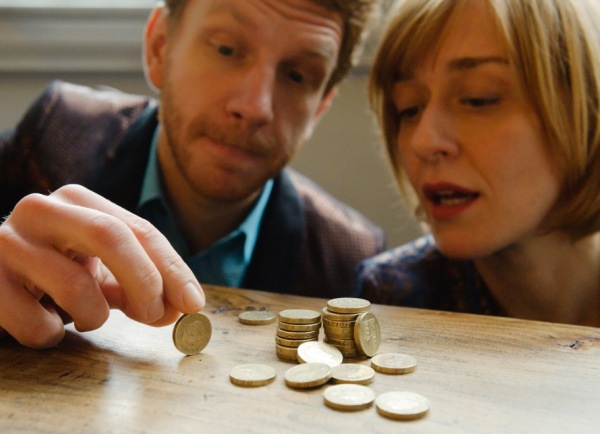
“I really love that they’re the colour of gold.” Writer and director Clare Duffy is speaking about the 10,000 pound coins that she will soon be bravely putting on the stage of the Bush Theatre for MONEY the Gameshow, a piece asking meaty questions about money, the financial crisis and how we understand value. Deliberately eschewing the familiar image of floods of crisp bank notes, Duffy thinks there is something even more profoundly seductive about the materiality of pound coins, something deeply rooted in the way we think about money.

“Why aren’t they purple?” she grins at me across our table in the Bush cafe. “Why aren’t they striped? It’s so interesting how profound that symbolism is, because although we all know it’s not real gold, we like the fact that it’s gold coloured and shiny; it hearkens back to a folk memory of gold standard, when money was directly linked to a standardised value.”

Putting those 10,000 round, shiny objects on stage has a history and a whole host of problems. The idea first arose from an earlier play of Duffy’s, in which a couple put a pound coin in a jar for every day they spend together and are then faced with splitting the amassed sum after their break-up; when it was performed, Duffy placed 500 pound coins in the centre of the playing space, prompting the realisation that this immediately shifted the way in which these objects signify. “What happens when it becomes a prop?” Duffy ponders. “Does it still feel like it has that value? And what kind of performances does it demand from the audience?”

When she won the Arches New Director’s Award in 2011, Duffy identified a way of posing these questions, deciding to put the £6,000 prize on stage and use it to tell the story of the financial crisis. Through the experience of presenting scratches of the piece and developing it again for the Bush, Duffy’s feeling that the environment of the theatre changes the nature of the money on stage has only intensified. While money typically relies on a shared belief in its value, Duffy observes that “when you put it inside a theatre, which is a place of make believe, it sort of becomes something else”. How does an object that is already engaged in a mimetic act – standing in for a value that it does not embody but only represents – transform under another layer of representation?

The money on stage is also influenced by the necessary mechanisms that surround it; as the £10,000 used in the show is a loan, the theatre has had to install CCTV cameras and a security guard to ensure that no audience members are sneakily slipping coins into their pockets. Rather than considering it an irritating practicality, however, Duffy has creatively seized on these intrusions, describing them as “both real and not real at the same time”. It is through such external structures, she believes, that the central notion of money is upheld. It follows that perhaps through revealing and disturbing such structures we might be able to interrogate and displace that notion.

This process of interrogation and displacement is just what MONEY the Gameshow sets out to achieve. Led by two hedge fund managers turned performance artists, played by Lucy Ellinson and Brian Ferguson, the audience are divided down the middle and given the piles of pound coins to gamble with, placing bets and competing to win. The purpose of this involvement, Duffy explains, is to draw the audience into the adrenalin-drenched world in which such individuals operate and to make them complicit in that irresistible excitement.

“You’re given a stake in the risk of the story,” Duffy continues, “aligning the risk of the games with the risk of the story. Because that’s what the story is about, it’s about playing a game and winning or losing.” The story that runs alongside these games is the story of both the former hedge fund managers and the entire financial crisis, tracing the factors that led to collapse and the state of extended resuscitation that has followed, stubbornly reviving what Duffy calls a “zombie economy”. We have all played a losing hand, but we’re still trying to hold onto our chips.

Duffy believes, however, that the current crisis is as much of an opportunity as it is a disaster: “What’s exciting about now and about talking about money now is that anything’s possible and the most crazy ideas should be talked about”. Throughout the process of making the show she has spoken to a number of individuals from the world of finance that she is depicting and has been surprised by the openness of some of their attitudes. “Politically we’re probably coming at these things from very different points of view, but there’s a convergence point,” she says, suggesting that this location of convergence is born from our present state of crisis. “Interestingly, it creates a space where people from really radically different points of view and walks of life can actually meet and talk.”

Getting people talking is, as Duffy recognises, the first step towards any change, but there are a number of barriers to that conversation. As Duffy observes, the financial industries are constructed to keep people out, fenced with technical jargon and barbed with complexities. “It seems to be to be so important and yet so little understood,” she says, admitting to her own ignorance prior to the research undertaken for the show. Her hope is that, as well as shifting audiences’ perceptions of money and value, she can simply make them feel more comfortable talking about it.

The idea of talking about money inevitably leads us into the territory of how money is discussed within the arts. This is a thorny subject, particularly in an atmosphere dominated by cuts, where the effort to defend the arts is often weakened by internal disagreements about the rhetoric in which that defence is to be mounted. Duffy is of the opinion that those working in the arts should take up all the arguments at their disposal.

“I think you just have to make the argument every which way you can, as much as you can,” she says. “I think there’s a lot of value in making as watertight an economic argument as you can. There’s an expression: making your argument in your master’s language. Sometimes you have to make the argument in terms that the people in power will understand or accept. However, at the same time you have to realise that you’re seeding power when you do that, so you have to be making that argument in another way. You have to fight on as many fronts as possible.”

The concern, as I say to Duffy, is that the eloquent economic arguments that are being put forward by some will be at the expense of the arts’ intrinsic value. If we succeed in binding the arts to measurable economic outcomes, this monetary worth quickly becomes the only value that can be ascribed to them. Duffy sees it, however, as a distinction between short term and long term solutions. “Short term sometimes it’s worth making that argument, it feels appropriate to make that argument, but at the same time you have to be making the more important point,” she suggests. Proof of economic worth might win the battle, but it is the search for a non-monetary language about value that is key to the longer term struggle.

“And that is what the show is really passionate about,” Duffy persuasively concludes. “It’s about asking the question: what is money?”

Photo: Simon Kane

Port, National Theatre

port1

Originally written for Exeunt.

There’s a striking moment, towards the end of this nostalgic, grit-flecked portrait of Stockport, when the concrete-clad surroundings perceptibly shift. Protagonist Rachael, back in her home town after several months away, remembers once gazing up at the clocktower as a soaring skyscraper, a local landmark of immense proportions that in adulthood has dwindled to a mere speck on a vast world. It’s a simple moment, but one that speaks to the shifting space in which we play out our lives, the contours that seem to move and blur as we grow older, the once huge monuments that now feel inconceivably small.

Geography – or more accurately psychogeography – is central to this story of growing up in Stockport, which announces its preoccupation with place in its very title. Rachael, who over the course of the play transforms from a gobbily precocious eleven-year-old to a bruised but optimistic woman of 24, fighting fiercely all the while to get out of the place that has spawned her, is trapped in a town populated with ghosts. First Rachael’s mother and then her grandfather make swift exits from her life, leaving behind traces in the frayed urban fabric. Past exists alongside present in a way that is reflected in the circumstances of this production, a revival of the play’s 2002 premiere at the Royal Exchange Theatre headed by the same creative pairing of Simon Stephens and Marianne Elliott, equally haunted by their own memories of the shared home town that shaped them.

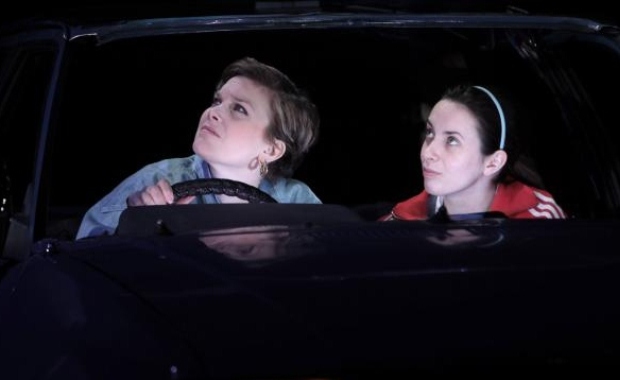
While the naturalistically rendered environment of this nostalgia trip vividly conjures the bus stops, battered cars and hospital waiting rooms of Rachael’s world, the space of the Lyttelton stage is engaged in more than a simple one-way exchange with the piece. Between the play’s collection of snapshot scenes, Lizzie Clachan’s beautifully constructed designs conspicuously dismantle around the perceptive central character as she very deliberately looks on, participating in her own transformation at the same time as the space transforms with her. This is habitat as clothing, old haunts shrugged off like school jumpers; the landscape seismically shifting within the perspective of the protagonist whose eyes we see it through as she struggles with family crises and collapsing relationships. Light, from anaemic fluorescent tubes to a heart-catchingly hopeful sunrise, is more than just illumination – it is frustration and desire.

This eloquent dialogue with the content stretches from the way the production looks into the way it sounds. Just as the concrete pulses with the pop music of a decade that played to the soundtrack of The Stone Roses and Oasis, so the structure of the play as a whole jitters and jumps to an almost musical score. The pace, beginning at a frustratingly slow patter, speeds and slows across the eight distinct scenes, with occasional furious rises in pitch that rip through the rhythm of the drama; repeated themes – home, childhood, fear of death – loop back around in refrains, or perhaps more like tracks that keep returning on shuffle. The whole is sometimes frustrating, sometimes catchy, but with a chorus that climbs insistently into the ear.

Amid all this movement and sound, it’s hardly surprising that Rachael repeatedly refers to the world as “mental”, with the double implication of inconceivable, unjust madness and a psychological dimension to the version of Stockport that we are presented with through her experience. Rachael is a challenge and a gift of a role, a complex, wounded but resolutely optimistic figure, who in the hands of Kate O’Flynn is unceasingly engaging. So captivating is this central presence that the characters around her often feel lightly sketched, faded and drab alongside her vivid outline, barely less ghost-like than the gaping absences in Rachael’s life.

While the grim realities that Port portrays have not evaporated, the nostalgic tint of the production is a reminder that today’s world, more than a decade after Rachael’s closing look at her home town, is in many ways a very different place. There is a heavy sense of this particularly in the play’s build-up to the turn of the millennium, at which Rachael ponders whether this break represents a beginning or an end. Thirteen years later, as this production is inevitably refracted through subsequent events, it’s a question we still seem to be asking. Just as the play’s cyclical structure rewinds the track back to the beginning, we often end up in the same place we started in.

Metamorphosis, Lyric Hammersmith

Metamorphosis

Originally written for Exeunt.

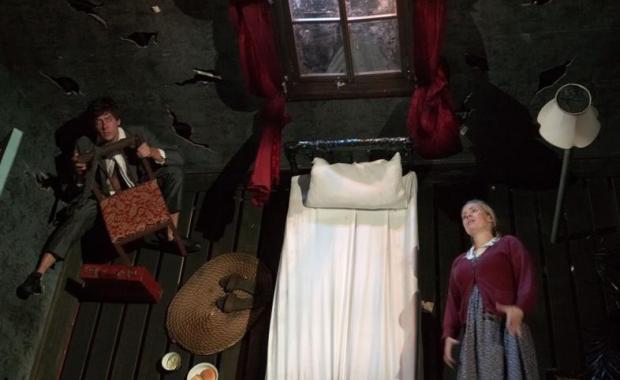
A performer dangles upside down, supported only by the strength of his own body; visual perspectives shift and skew across the split level set, distorting reality; a family home cracks open, metaphorically and literally, at its very centre. There is no question that this production, now six years old and making its fourth visit to the Lyric Hammersmith, remains thrilling in every sense of the word. What is so heart-stopping about the Lyric and Vesturport’s visually virtuosic rendering of Kafka’s nightmarish tale, however, is not the dazzling disbelief that such images be thought to provoke. Instead, the most chilling horror at its core is all too plausible.

Just as the true awe that is inspired by loose-limbed performer Gísli Örn Garðarsson derives from the sheer ease with which he flings himself about the set rather than the gravity-defying spectacle of his acrobatics, the real sting of the piece lies in its incisive diagnosis of the human capacity for evil. In the shell-shocked aftermath of Gregor Samsa’s titular, unexplained metamorphosis, his bewildered family grope around their shattered domestic haven in search of coping mechanisms, slowly surrendering to the most brutal of self-preservation tactics. It is a grim metaphor for society’s fear of the other and its destructive impulse to exterminate perceived threats from within.

Extending this metaphor, Vesturport’s telling of Kafka’s disturbing novella is as much a retrospective dialogue with the tale as it is an interpretation. Armed with the knowledge of twentieth-century European history, parallels with the dehumanising rhetoric of totalitarian regimes readily present themselves; a line such as “work will set us free” uttered today immediately summons the echo of Auschwitz. Most strikingly, David Farr and Garðarsson’s production presents us with a distinctly human Gregor, eschewing any attempt at physical deformity. We know that this character has transformed into a monstrous creature, but all we see before us is a man, making the monstrosity all of our own creation; the audience find themselves complicit in the same horrifying division between human and inhuman that the Samsas finally pursue.

Alongside the production’s thinly veiled allusions to Nazi Germany, money emerges as an equally sinister force. It is less Gregor’s physical state that provokes his family’s disgust than the loss of his income, while the tantalising promise of a wealthy lodger sends the Samsas physically giddy. A human being who is no longer economically useful, this version darkly hints, is no longer considered human. Every creative force at the production’s disposal unites in this act of considered excavation, from Börkur Jónsson’s mind-bending set, physically setting Gregor and his family at opposing, disjointed angles, to the steadily darkening clothing, to Nick Cave and Warren Ellis’ painfully haunting music.

But for all the intellectual and visual inventiveness at play, the piece’s greatest triumphs are also what threaten to soften the devastating punch it seeks. Precise rather than visceral, each movement is so delicately, meticulously calculated – from the contained physical effort of outward domestic perfection to the seductive power that emanates from a wad of bank notes as they are slowly handed over one by one – that the raw intensity of the horror gives way slightly to an unsettling but clinical choreography. As the final, stunning image imprints itself on the stage, however, such objections seem churlish. Mingling beauty with terror, it is in these closing moments that the rotten heart of Kafka’s tale finally bursts from the production’s finely polished chest.