At the Globe to Globe festival, murder has never been such a social event. All of the major scenes in this brashly vibrant Polish production seem to occur at lavish parties, under the watchful if drink-blurred vision of the witches, here recast as a gaggle of gloriously camp transvestites. In these hedonistic surroundings, as a slurring, stumbling Duncan attempts to strip and unapologetically feels up Lady Macbeth, the plot-propelling act of violence seems more of an escalation of well-oiled passions than an act of calculated ambition. This is homicidal guilt figured as one long hangover, as Michał Majnicz’s increasingly dishevelled Macbeth howls his way through murder after murder.
Despite possessing such a familiar plot, little is recognisable about this reimagining of the play. Numerous inexplicable alterations have been made to Shakespeare’s text, including the addition of a scene-stealing witch named Lola, who might well have been inspired by the Kinks track. But while it may bear only a passing resemblance to the Scottish Play that British audiences are used to, this Macbeth has clearly been designed as a visceral experience rather than a linguistic, intellectual one. To overcome the language barrier, Teatrim Kochanowskiego have drawn on pop culture and visual bravado; colourful, explosive images assault our retinas, while music – everything from Michael Jackson to ‘I Will Survive’ – throbs away in the background. It is messily joyous spectacle, tragedy in the style of Steps rather than Aristotle.
Grasping for any overarching metaphorical unity to tame this sensory riot produces empty hands. There are loosely recurring motifs, the most prominent of these being an overt, swaggering sexuality that lends the production its cautious ‘adult content’ warning. Majnicz and Judyta Paradziń as the bloody handed couple crackle with mutual lust, a sexual desire that seems tangled up with their murderous acts, while one witch unexpectedly indulges Macbeth with a blow job following his ascent to the throne. Amid a circus of playful, riotous colour, one of the production’s most genuinely disturbing images is presented in a scene in which Lady Macduff is brutally raped. Yet when reassembled, these strands do not weave into any identifiable shape. If there is a defining texture to the piece, it is one of vague seediness pasted over with sequins and glitter.
No matter how fragile the basis for its interpretation, however, the sheer visual audacity of this production is enough to provoke a wistful yearning for more aesthetic creativity in British theatre. Flaws aside, this is an ideal marriage of production and festival, eventually embracing the party atmosphere that seems to buzz from the Globe. It may not be Macbeth as any of us know it, but this is anarchically beautiful, visually ingenious, vodka-drenched fun.
If it is possible for one piece of theatre to be an argument against the traditional model of theatre criticism, then Three Kingdoms makes that point rather comprehensively over its messy, anarchic, thrilling three hours. Despite wrenching the obligatory, paltry 400 words out of my still slightly dazed brain, a part of me wants to go back smash them apart again. Simon Stephens’ latest play actively resists being weighed up and judged with a neat star rating within a tidy word limit; it sticks two fingers up, as it were, to the well made review.
To be completely honest, I left the Lyric Hammersmith on Tuesday evening in a state of confusion, disorientation and uncertainty. It was as though I had been submerged for three hours in a strange and baffling yet oddly captivating dream, one that frustrated at some turns and delighted at others. If someone had asked me, in the immediate moments after I vacated my seat in the auditorium, whether I liked Three Kingdoms, I would have struggled to answer them. “Like” strikes me as a word from a completely different vocabulary to the one in which this piece of theatre operates. In fact this whole production, directed by Sebastian Nübling in an extraordinary British, German and Estonian collaboration as part of World Stages London, seems to speak a different language to the one we are accustomed to in British theatre.
The strange irony of describing Three Kingdoms as dreamlike – which is the closest I can get to evoking its loopily surreal quality – is that I did in fact dream about the production in anticipation of seeing it. Yes, I was that excited. But my subconscious was incapable of creating anything as bizarre, visually imaginative and downright bonkers as what appeared on the stage of the Lyric Hammersmith. As in the image above, women don deer heads and are pursued by wolf-masked men; a gang of boxers violently pummel the soiled set; a strangely haunting, white-clad figure sings chilling pop song accompaniments; there is more lurid sexual content than you can shake a strap-on at.
I should perhaps point out that within the hallucinatory kaleidoscope of images there is a plot of sorts, and a detective plot no less, but this is far from your average whodunnit thriller. We begin in the middle of a police interrogation, as detective duo Ignatius and Charlie question a young man who has inadvertently thrown a severed human head into the River Thames. The forensic evidence points back to Europe, where the decapitated sex-worker has been trafficked from. With odd suddenness, the two detectives follow the trail back to the pimps and pornographers of Berlin and later – with Charlie inexplicably disappearing from the scene – to an Estonian sex-trafficking gang.
Without knowing much about European theatre – a lack of knowledge that I’m keen to remedy off the back of this – I would ignorantly speculate that the style and tone of the production shifts appropriately with the geographical location. Never is the writing more central than in the early London-based interrogations, reflecting the new writing culture of British theatre, with more than an echo of Pinter in the detectives’ swift back and forth of dialogue. As the action moves to Germany and later to Estonia, we are offered increasingly audacious visual imagery and an escalating physicality, as performers tumble through windows and spring startlingly from suitcases. It certainly feels many miles from British theatre, and bracingly so.
In this way, Nübling manages to create a disorientating visualisation of the dislocation of foreign travel, immersing us in cultures that are strikingly different to our own through the conduit of Ignatius, a man severely lost in translation and persuasively, energetically portrayed by Nicolas Tennant. In this sense, the perplexing surreality of the production is a resonant metaphor for the clash of cultures in an increasingly globalised world, where Europe is both sister and other.
Through the piece, Stephens and Nübling make us aware of our own strangely separate and insular status as an island nation, a culture that is supposedly part of Europe and yet distinctly divided from it. Our perceptions of this continent, and particularly of the still largely alien society of Eastern Europe, are both channelled and challenged. While the practice of sex-trafficking may be this play’s overt subject, the relationship between East and West demands an equally prominent place on the stage.
Related to this, language is another key concern, perhaps surprisingly in a production so anchored by the sensory. The very experience of having to read surtitles for much of the evening already puts a different slant on how this play is received, with the audience having to do the mental leg-work of reading and connecting both spoken and physical language. Translation also throws up its own issues, particularly as Ignatius is forced to rely solely on what German-speaking Charlie chooses to tell him, a potent illustration of the power of words and the fluidity of their meaning. Even when we are dealing only with English, words are important. Ignatius and Charlie verbally play with synonyms before finding the right fit, while a sentence such as “they sawed it not sliced it” (in relation to the woman’s decapitation) is an excruciating demonstration of how a slightly different word can have a vastly different effect.
While Nübling has clearly transformed Stephens’ script into a theatrical creation that is as much his own as it is the playwright’s (the word collaboration here feels fully justified), the words still dazzle on their own. There is a sharp precision to Stephens’ writing, conjuring an incisively perceptive vision of the world that emerges most powerfully through the short monologues that various characters speak. One character’s description of the market economics of sex trafficking is brutally wounding in its calculated logic; the analogy of a toilet to convey the message that “shit doesn’t go away” is a painfully apt one.
Dealing with Stephens’ script also brings me onto the relationship between writer and director, which is here figured strikingly differently to how we are used to it in this country. The respective places of the writer and the director in British theatre demand a whole other blog post, but it is worth briefly pointing out the extraordinary free rein that Stephens has given to Nübling, placing huge levels of trust in the director’s hands. Anyone interested in this area should read Alex Chisholm’s excellent essay for Exeunt, in which she questions the imposed division between “new writing” and “new work”. It is certainly worth considering whether the model posed by Stephens and Nübling could provide a way to bridge this gap in British theatre.
Moving on, in the multi-lingual environment that Stephens has created, pop music emerges as a common language. This clearly reflects Stephens’ own interests, but it also seems an appropriate demonstration of the wide-reaching penetration of some elements of culture and not others. There is a sinister irony to the way in which music is used, with romantic lyrics often clashing with the global commodification of sex and sexual violence that is being portrayed. One particularly haunting rendition of the Beatles’ Golden Slumbers still has yet to release its grip on me.
As heart-pumpingly exhilarating as this production may be, however, I cannot quite offer Three Kingdoms my wholly unfettered praise. My main problem with the piece is the way in which it treats its female victims (a word I use with caution). Is silence the way to give these women a voice? Before criticising, I can wholly appreciate and understand the perspective of this production, which is itself a primarily male product. (To briefly digress, the word “product” here feels significant. As in the sentence I have just written, products are actively created by men – the product is the object, the men the collective subject – while women in this play are referred to by the Estonian sex traffickers as the passive “product” that they trade.)
On one level, it makes perfect sense. Three Kingdoms is shocking in its treatment of women, thereby shocking us as a result. The women in the piece are largely silent because the women they represent are living in enforced silence; it seems appropriate, authentic (another word that is tainted through its particular, unsavoury use by Stephens – see my earlier point about the importance of language?).
But doesn’t this just compound the problem? Here I’d like to refer you to an exchange on Twitter between Chris Goode (@beescope) and Stella Duffy (@stellduffy) that caught my attention before I had even seen the show myself and that sums up pretty comprehensively what I’m trying to get at:
@beescope: Three Kingdoms is hugely impressive, a near-perfect match (collision?) of writer, director and intrepid actors. Still frustrating though that nobody wanting to work in those modes wholly within the British system would ever get past the gatekeepers. Also wish it didn’t revel quite so much in the misogyny it’s describing. @stellduffy: @beescope the difficulty of representing that which we’re trying to counteract/deal with. @beescope: @stellduffy Yeah, for sure. But it’s extra troubling when the work so completely reproduces the malaise that there’s no critical leverage. If you make the victims essentially voiceless you can come awfully close to appearing not to have noticed there’s a problem. @stellduffy: @beescope women are abused in life. re-creating a problem is not the same as creating an alternative. sigh.
(Apologies for the awful formatting of the above, I couldn’t get a decent screenshot)
There is something to be said for exposing an issue in all its brutal ugliness, but it is disturbing and worrying that it is so rarely exposed from the perspective of those upon whom it most impacts. Women are rendered speechless throughout, either by language barriers or by fear. In one of Nübling’s many powerful images, a half-clothed female figure silently irons in the background while men watch porn on a phone screen; another woman is unable to even communicate with the men who viciously insult her.
The production also seems to revel somewhat in the sexual violence it portrays, which is upsetting and troubling on the one hand but intriguing on the other. Such is the level of dazzling visual spectacle that we are invited to become complicit spectators; Stephens and Nübling recruit the audience as a living example of the dark forces within human nature that drive the acts they are depicting. Thought of in such a way, Michael Coveney’s protestation that anyone to enjoy this experience must be “debauched beyond redemption” takes on a slightly defensive air.
Also complicit are the two detectives, whose common gender – while it may exclude greater involvement from female characters – becomes darkly significant. At the same time as doggedly pursuing their case, they are implicit participants in the industries responsible for this murder. In a chilling scene in which they watch a recording of the young woman’s beheading, they become tainted spectators, and their attitude towards the women they encounter on their investigation hints at deeper problems. The concluding twist, which I am still wrapping my head around, seems to enhance Ignatius’ guilty complicity in what he is attempting to destroy; there are no heroes here.
Another potential criticism is the plot’s gradual descent into incomprehensibility, as we are assaulted with unfathomable image upon unfathomable image in a hedonistic Estonian finale that becomes increasingly hard to follow and digest. This frustrates the very British aim of getting to the bottom of what a play is “saying”, but perhaps it is the critical approach that is at fault rather than the production. We can be determinedly blinkered as a theatrical culture and have nurtured a sort of suspicion towards theatre that asks its audiences to feel and experience as much as it asks them to think.
The very lack of meaning here seems to create a new kind of meaning. Stephens has said that Nübling never asked him what he was trying to say in his script, and perhaps we should not ask either (I am aware of the hypocritical irony of making this statement several hundred words into a piece of writing that it is, on some level, doing just that). This is theatre that demands a new way of watching and I found myself feeling hampered by the nagging knowledge that I would have to write a formal review, pestered by the panic-inducing question of how I was going to critique it. I almost wish that I could have experienced this production without the critical handcuffs binding me.
Value judgements are usually, at least by the standards of the conventional review and the purpose it serves, what make a piece of critical writing. Readers want to know whether the reviewer thinks it is “good” or “bad” theatre (note the inverted commas); they want to know whether or not they should buy a ticket, which is a valid expectation to have from a review. In this case, although I obviously did give one in the form of a star rating, I felt to an extent incapable of offering my value judgement, my thumbs up or down. But as for whether others should go to see the show, I can only offer a resounding YES. This is theatre that needs to be consumed on an individual basis, and I suspect that it may be divisive, but it should be experienced. It is made to be experienced.
As if to prove my opening point about Three Kingdoms‘ inherent challenge to mainstream theatre criticism, the majority of the mainstream press have struggled with it and, in some cases, condemned it. This style of theatre is clearly not to everyone’s taste, but it saddens and frustrates me that many of the reviews do not even attempt to engage with it on the most basic level. Instead, there has been a startling dichotomy between the verdicts of what we might call the traditional critics and the response that the production is receiving through Twitter and online critical outlets. Perhaps this heralds the realisation that we need new ways of seeing, of experiencing, of expressing. And perhaps that isn’t such a bad thing.
For some other interesting approaches to Three Kingdoms, try taking a look at reviews by Andrew Haydon and Daniel B. Yates. And for anyone wanting a more visual impression of the production (as only seems appropriate), see the Lyric’s trailer below:
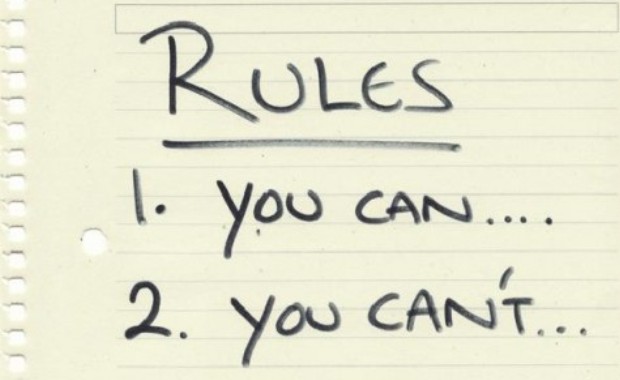
We all know that rules are important. Unless you’re hugely optimistic about human nature, most of us accept that as a species we are unlikely to all harmoniously coexist in a state of complete anarchy. I am also, in everyday life, a sucker for rules. As a child, the very thought of breaking even the pettiest of rules had my palms sweating; on the few occasions I participated in the depressingly stereotypical teenage ritual of underage drinking in the local park, I was in a state of anxiety nearing hyperventilation. But perhaps there are some rules that are meant to be broken.
The Stage recently published a piece offering five essential rules for aspiring reviewers, written by Susan Elkin in response to reading and judging entries to a student theatre reviewing competition. I don’t doubt that these serve a perfectly good purpose for those just starting out and looking for some basic pointers, but I’m always slightly wary of any rigid guidelines for reviewing. I was in fact alerted to the piece thanks to a tweet from Matt Trueman, who followed the link with the statement that “all of these need breaking”. Despite my history as a rule following goody-two-shoes, I find myself inclined to agree.
Having recently read Lisa Goldman’s No Rules Handbook for Writers, which takes all those common “rules” of creative writing and if it does not quite throw them out the window, at least tells writers how to bend them, I’m feeling in a similarly anarchic mood towards this list of reviewing dos and don’ts. The full piece can be read here, but I’ve quoted the main points below:
“The best possible training for any sort of writing is to read as many examples of the genre written by experienced people as you can.”
“As a reviewer, your first task is to assess it as a piece of theatre.”
“Reviewing is a form of journalism.”
“Never use a long word if a short one will do.”
“Get your punctuation right.”
Of course, this is not the first time someone has tried to set out a formal framework for the art of theatre criticism. Whole books have been written on the subject, while each reviewing publication will have its own list of style guidelines and critics themselves have laid out their own opinions on the matter, such as Jo Caird’s blog for What’s On Stage. As I’ve already mentioned, such pointers can be useful to an extent, and the five points above have their obvious applications. No one wants to read a piece that defies all sense through incorrect punctuation, employs malapropism after malapropism and lacks any understanding of theatre as an art form.
But I worry that this culture of rules will fence criticism in. It can already be frustrating enough to work within word limits and star ratings, but when emerging reviewers are made to feel as though they must obey a strict structure of guidelines there is a danger of producing bland, parroting reviews. It was a trap that I found myself falling into when I first started reviewing theatre not all that long ago and one that still occasionally snags me now. When I look back at those lifeless, formulaic reviews, I lose all enthusiasm for theatre criticism as a form.
So I would perhaps add my own cautionary, freeing notes to the rules provided in The Stage:
1. “The best possible training for any sort of writing is to read as many examples of the genre written by experienced people as you can.” – This is a rule that I don’t have too much of a problem with, as it’s something of a no brainer that to get better at writing you must be willing to read, and there are some very skilled critics out there whose writing has certainly provided me with direction and inspiration. A note of warning, though: don’t play copycat. Reading too much by one particular critic can make you subconsciously begin to write like them, which stifles individual voice. I can also affirm from personal experience that an excess of reading can produce a version of what Harold Bloom dubbed “anxiety of influence”, paralysing your writing with the fear that you can never be as good as those who precede you and who you look up to.
2. “As a reviewer, your first task is to assess it as a piece of theatre.” – Again, this piece of advice has its obvious merits. Reviewing a piece of theatre is not the same as reviewing a piece of writing; this is live performance, and to ignore the performance aspect is to miss the point. But on the flip side, reviews that are too focused on this purpose of assessment can become a tediously formulaic checklist: direction – check, acting – check, set design – check. I’m as guilty of writing these uninspiring reviews as anyone else.
Elkin goes on to discourage reviewers from getting too sidelined by the themes and issues of a piece of theatre, but in my opinion such investigation of the ideas at play, particularly when reviewing new writing, represents one of the biggest strengths of great criticism. Someone once advised me not to be afraid of trying to get under the skin of what a piece of theatre is doing or trying to say, and it is one of the most liberating writing tips I’ve ever received. The specifics of the performance are important, but I also want to think more deeply about the shape, purpose and inspiration of a piece.
3. “Reviewing is a form of journalism.” – The point of this rule is that thought should be broken up in a review in the same way as it would in any other piece of journalism, separated into easily digestible sentences and paragraphs. There is a lot to be said for this advice – a long, dense block of text is immensely off-putting as a reader – but there should still be a level of flexibility within this. Complex and varied sentence structure is not always a bad thing, and if theatre can experiment with form then why can’t the writing that is responding to it do the same?
4. “Never use a long word if a short one will do.” – This one is taken from George Orwell and will be very familiar to most writers. It is of course worth remembering that commanding a wide vocabulary does not automatically make you a good writer, but neither are long words automatically bad. The one thing to always make sure of is that a word is used in the correct context and that its definition is fully understood (I’m a compulsive user of dictionaries for this very reason), but two synonyms do not convey exactly the same meaning and a longer word may sometimes be necessary to fully, effectively communicate a certain thought.
5. “Get your punctuation right.” – Punctuation is clearly important, and nothing enrages me more than a misplaced apostrophe. This is the rule that, as a bit of a grammar geek, I find it the most difficult to disagree with, but there are instances where there is room for creativity with punctuation as long as the meaning is not impaired.
As I stated at the beginning of this discussion, rules are important and they are usually there for a reason. In this particular instance, they are certainly worth knowing – as Goldman puts it in her book, you have to know the rules before you can break them. But at a time when writers are reconsidering what it might mean to be a theatre critic and opening up exciting new possibilities (more on that another time), it feels limiting to be shackled to strict guidelines. While rules have their purpose, it is vital that we do not let blinkered adherence to these rules hamper a form that has the potential to be exciting, inspiring and creative in its own right.
“Bereavement is a lonely process,” says Theatre ad Infinitum’s co-artistic director George Mann. It is a simple statement and perhaps an obvious one, but a painful truth nonetheless. This bruising observation is at the heart of Theatre ad Infinitum’s latest show, Translunar Paradise, a delicate journey through grieving and letting go that is embarking on an international tour following outings at the Edinburgh Fringe and the London International Mime Festival.
The Lecoq-trained Theatre ad Infinitum have forged an increasingly distinctive path for themselves in physical theatre and mime since their conception in 2007, with work that resists neat pigeon-holing. The company have experimented with an a capella score inThe Big Smoke, physical solo storytelling in Odyssey and spirited clowning in Behind the Mirror. Translunar Paradise is similarly, refreshingly unwieldy, marrying mime, masks, puppetry and music in a wordless love letter to the relationship between one couple and that relationship’s poignant termination through the intervention of mortality.
“You need a constraint when you create,” is Mann’s artistic mantra. He explains to me over the phone that during the long development process for Translunar Paradise, the first seed of an idea for which was born from the W. B. Yeats poem The Tower that lends the piece its title, he found it unhelpful to think of the story in literal terms. While the basis for the show was the simple premise of an elderly man losing his wife and learning to let go, it was clear from an early stage that this was not going to be a traditional, straightforward portrayal of loss. “I was looking for something that was going to force me to think creatively and do something exciting,” Mann goes on.
This was eventually found in the form of puppetry and masks, both of which have had a heavy influence on the finished piece, but Mann’s approach to these elements has directly clashed with the principles ingrained by his own training. Holding a mask up to the face and, in a similar way, exposing the join between puppet and puppeteer both contradict the aim of illusion, flagging up the artificial. These distancing techniques sat uneasily with Mann’s creative background, but he identified something “poetic” about that distance between puppet or mask and performer, as well as a way of “time-travelling” between old age and youth. By holding up masks to their faces, Mann and his co-performer Deborah Pugh can instantly inhabit their characters’ present, elderly selves, whipping them away to jump into flashbacks.
Mann’s careful, considered description of the creative process behind Translunar Paradise, which he conceived, devised, directed and performs in, conjures an image of a theatrical scrapbook, borrowing fragments from various other art forms and pasting these together into something identifiably his. Another, surprising source of inspiration was Art Spiegelman’s graphic novel Maus and the way in which Spiegelman’s black and white sketches movingly evoke the past. “We started working in a comic book, photographic way,” Mann expands. “We picked out the actions that we wanted to use and started creating the back story of this couple and their life together scene by scene as if we were flicking through photographs.”
Was it always intended that this story would be told without words? Mann tells me that the decision to incorporate masks effectively precluded the possibility of speech in his mind, but there was also a deeper reason for this artistic choice; quite simply, “this is something that is really hard to describe”. Death remains one of the last taboos, and particularly in our culture loss and grief are not topics that are openly discussed. More than this, grieving is an experience that is in many senses divorced from verbal communication. As Mann continues, “it’s a lot about what you feel and experience and remember. I wanted to communicate an experience and I wanted emotion to be part of that experience. I felt that words couldn’t say it as strongly in this case.”
In the absence of words, music has taken on an integral role within the performance. More than simply a soundtrack, Mann and his creative team discovered that the music could function almost as a third character. “It interferes, it stops things, it punctuates moments,” he says. “It made the piece so much richer and the music became the soul of the piece, the heartbeat behind everything.” Much like the rest of the process, however, this musical integration was not something that came easily and was the result of much trial and error. One of the most important decisions to be made was what instrument to use; the eventual choice of accordion has clear resonances. “I wanted an instrument that breathes,” Mann explains. “Breathing is such a big part of emotion and it’s such a big part of life that we sometimes forget.”
Grief affects everyone, lending this piece the universality that has so moved its audiences, but it has particular significance for Mann. While ideas were still taking shape, Mann was forced to deal with the illness and death of his own father, a personal experience of loss that has informed the piece in many ways. Mann is extraordinarily open about the impact of this experience upon Translunar Paradise: “I was with my father when he died and that was very quick, very simple and very beautiful, and it made me realise that was what the piece needed as well.” He admits that creating the death scene, however, was challenging. “I didn’t know how to do that moment and I was scared of not knowing,” he shares. “And then it just came to me very quickly and I realised it wasn’t as complicated as I had thought. It’s actually extremely, painfully, beautifully simple.”
Speaking about his process, which is clearly a painstaking one, Mann expresses irritation at the public perception of devised theatre as being “random” or unconsidered. “For us it really isn’t,” he protests with feeling. “It’s such precise work; it takes a long time and a lot of thought.” Despite Mann’s involvement in all areas of the show, it emerges that this piece is in fact the product of extensive collaboration. The company’s other two co-artistic directors have regularly provided feedback along the way and the production has been honed through various scratch performances, at which Mann was surprised and encouraged by the honesty of their audiences. He admits with genuine frankness, “I really needed that outside perspective and I wasn’t going to pretend for a minute that I could do everything by myself.”
Translunar Paradise’s protracted, precise development appears to be paying off, with early performances spawning a full international tour that will be stopping off in Athens, Jerusalem and Sao Paolo, as well as making trips to various festivals around the UK this summer. Taking the show to new audiences is a prospect that excites Mann: “Because I trained at an international theatre school, I’m very aware that there exists a world beyond British theatre and I wanted to be able to share my work with as many people as possible.” Thanks to its lack of words, the play would seem to naturally lend itself to international audiences, but Mann was still concerned that the gestures and references might be too British – “a big part of the piece is set around drinking and making tea,” he laughs. The emotion of the piece, however, translates all too easily.
It is evident from speaking to him that the gradual process of teasing Translunar Paradiseinto life has been an intensely personal journey for Mann, and he hopes that this journey will be reflected by the experience of audience members. “The audience are connected to the piece through their own loss and that’s what I want people to feel,” he explains as our conversation draws to a close. Mann also hopes that the show he has created, despite grappling with death and grief, will depart with an uplifting sensation of relief. “Life goes on,” he says simply. “Every ending is a beginning.”
Greyscale’s latest work, the first in the Gate’s ‘Resist!’ season, comes with a tongue-twisting disclaimer. This is, as we are told upon entering the auditorium, “a very true story about the revolutionary politics of telling the truth about truth as edited by someone who is not Julian Assange in any literal sense”. If that’s a mouthful, then what we are fed after we take our seats is even harder to digest.
Intertwining the lives of Wikileaks founder Assange and revolutionary nineteenth-century mathematician Evariste Galois, Tenet plays with truth, mathematics, radicalism, power, metaphor, roots and polynomial equations. Keeping up?
At the centre of the piece is the concept of mathematical logic as a radical way of seeing the world. Performers Lucy Ellinson and Jon Foster begin with a familiar mathematical question – how do you find x? – and use this as the basis for questioning our understanding of truth and of the world around us. Like radical genius Galois, we are prodded into finding a new way of thinking. In maths, as arguably in life, the radical simplifies a complex equation; radical thinking, therefore, is demanded if we are to understand and challenge the complicated nature of the status quo. Behind this there is also the issue of Assange’s role as the “editor” of Galois’ life and work, questioning the power and reliability of those who hold the book of facts.
There is a lot going on here, sometimes too much. Despite running at a swift sixty minutes, this is full to the brim with ideas, and difficult ideas at that. As our heads swim with numbers and concepts, it can feel like we, along with the tragically short-lived Galois, are running out of time to work it all out. Fortunately, creators Lorne Campbell and Sandy Grierson never make this feel too much like the classroom; as Ellinson knowingly comments, you can’t make the audience work that hard.
Despite the demanding subject matter, the piece that Campbell and Grierson have assembled is also very funny, and when it gets too hard there are always tea and biscuits helpfully on hand. Maths and theatre, meanwhile, make unlikely but surprisingly comfortable bedfellows. After all, the metaphor that we willingly immerse ourselves in when we watch a performance is just another kind of equation – one thing always stands for another.
The conventions of theatre are also up for analysis in a performance that is sardonically served with a “soupçon of post-modern deconstruction”; we are presented with a set within a set within a set, the performers interrupt the narrative to contradict one another, an explicitly mentioned fourth wall is conjured up and smashed down.
Upon exiting Greyscale’s world, there is a desire to echo Galois’ call for more time and rewind this tightly packed performance in order to mull it over again in all its intricate complexity. Maths may be a straightforward case of black and white, but this intriguing, challenging night of theatre treads the same area of grey occupied by the company responsible for creating it.
~
Some further thoughts on Tenet …
Never does the vicious word count seem more cruel than when attempting to crystallize a piece such as Tenet. During the hour-long performance, I scribbled possibly the most notes I have ever made at the theatre, all the while trying to keep my eyes ahead so as not to miss one minute of the ever-shifting performance. I feel as though I really needed two viewings to fully process everything that was going on – one to take notes and one to simply absorb. Away from the rush and heat of the performance space, my initial impressions have cooled, but there are still a good few more words to peel away from my frazzled brain.
Firstly, I want to write more about Julian Assange’s role as the “editor” of the piece. If we’re getting critical, this is slightly underexplored, but that is perhaps because there is simply so much else going on. Since formulating my own thoughts above, I’ve read other reviews of the play, some of which see Assange as an outlying narrator whose relevance is crowbarred in. While Assange may be less of a central figure than Galois, this was not how I saw it at all. If anything, he functions as an essential conduit for Galois’ story; we see only what he chooses to select from his “book of facts”, further illustrating the reiterated point that knowledge is power. As an individual who demonstrated to the extremes just how powerful knowledge can be and whose actions prompt troubling questions about what knowledge should and should not be released, Assange’s inclusion is anything but arbitrary.
Lucy Ellinson’s Assange protests early on “I am not involvable”, before proceeding to involve himself again and again in the process of storytelling. The two performers frequently interrupt and contradict one another, their voices competing for our attention, Assange overwriting Galois’ own story. It is a potent demonstration before our eyes of the immense influence held by the gatekeepers of history. Who are we meant to believe? What can we trust? For me, Tenet was not only deliciously perplexing because of the complexities of advanced algebra (and maths was never my strong point); Greyscale invite complexity and ambiguity from all angles, a risky but laudable choice. This is theatre which demands engagement from its audience.
Which conveniently brings me onto the second point I wanted to explore further: audience interaction. This has to be possibly the gentlest brand of interactivity to be found on London’s stages – one game audience member was even offered an encouraging hug on press night. With the help of some tea and biscuits, Greyscale seem to have perfected the delicate balance of involving their audience without scaring them off. Yet while the level of performance asked of the audience is relatively minimal, its use prompts intriguing questions about the performer/spectator relationship, the audience dynamic and the wider issue of public protest.
At one point, Jon Foster’s frantic Galois raises us all to our feet, gets us to hold hands and has us collectively, if a little awkwardly, humming “La Marseillaise”. It is a vivid illustration of the power inherent in harnessing an audience. But a moment later we are back in our seats and the balance has shifted back once again to where it was, demonstrating that the wall can be smashed through but it will always quietly reform – a fact that resonates with politics as much as with theatre. As Galois observes, a situation can change, but it can also change back. In another interesting choice, Ellinson and Foster also openly discuss the deliberate choice of the Gate and its typical audience demographic, which opens up a whole other debate about the importance of the type of audience (and their political leanings) to a piece of theatre.
Without seeing this piece all over again, which I’m sorely tempted to do, it is impossible to fully investigate Greyscale’s creation to the level it deserves. Part of my brain is still trying to catch up. Perhaps the best sort of metaphor for Tenet is not an algebraic one but, inspired by the emergency biscuits, a dessert related one. Because really Greyscale’s play is a lot like brain freeze; it makes the head hurt, but it’s more than worth the pain.






 Catherine Love