God/Head, Ovalhouse

If I approach this review in the same way as Chris Goode has attempted to approach his latest show, from a position of total honesty, writing about God/Head presents intrinsic difficulties. As a piece of theatre it is fluid and slippery; resisting a firm grasp, sliding off in different directions, eschewing the “very Radio 4” journey narrative that Goode says he originally thought he would create. Slippery and elusive too are the thoughts that it provokes, darting off in several directions at once as Goode demands us to “link it up”. It is – in as far from negative a way as possible – messy.

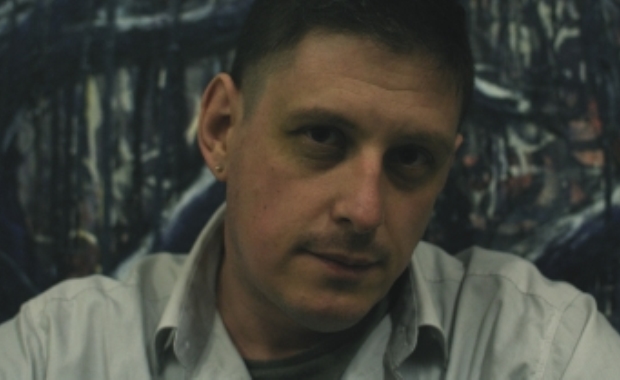
It is this very messiness, however, that fits Goode’s subject matter so well, as he is handling perhaps the messiest thing that any of us ever have to grapple with: belief. The catalyst for this intimate and fascinating piece of theatre was an experience that Goode encountered on an otherwise ordinary day – 21st April 2011, to be exact, as he continually reminds us – while walking home from the supermarket. Suddenly, shopping bags in hand and headphones in his ears, committed atheist Goode became aware of something that he had never felt before. Suddenly, there was God.

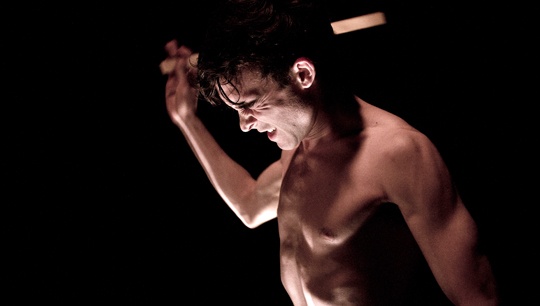
Over the following hour and a half, Goode attempts to unpick this troubling experience, inevitably getting ever more tangled in the process. It is an extraordinarily brave attempt, laying its performer bare – it is not for nothing that the idea of nakedness is a recurring motif. As he invites us into his world, Goode exudes warmth, slowly enveloping us in his candid storytelling. This show, it transpires, is about questions rather than answers and about uncertainty rather than certainty. In a world which so often seems to be a contest of who can shout their certainty loudest, such unapologetic doubt is refreshing. Goode also reveals, almost as a side effect, that atheism can be just as inflexible as religion. Whether an advocate of belief or disbelief, how can we all be so sure?

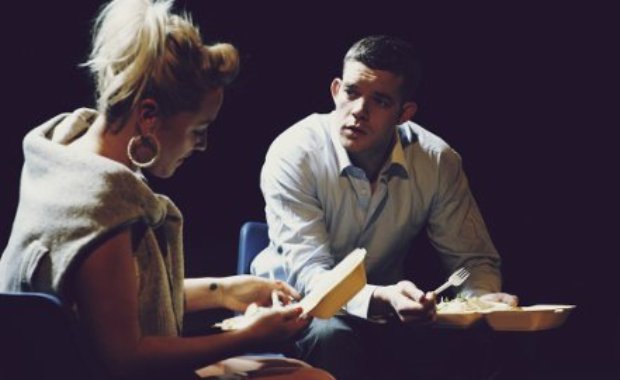
As has already been explained, this is not a journey, and there is no real logic to how Goode’s show progresses. Each night he invites a guest to join him (Greg McLaren on the night I attended), whose own experiences of religion and belief also inform the piece, as well as providing a second presence on stage for Goode to bounce off of and to take on roles in some of the piece’s short scenes. Goode’s technique – although technique itself seems the wrong word – is part storytelling, part dream sequence, part conversation and part sketch, with a good few more elements also thrown into the mix. Appropriately, this piece defies structure and genre.

There are undoubtedly flaws in the evening of theatre that Goode has produced from this probing of his own experience, but that seems almost to be the point. Uncertainty and even distrust in what Goode himself is telling us are actively encouraged at every turn. The sound and lighting deck has been moved into the performance space to, as Goode says with a chuckled Brechtian reference, remind us that what we are watching is a play. The story of his encounter with God is repeated several times over, each time adding details that throw it into doubt: at the time he was listening to a self-help guru who spoke about God, and he had been reading the Bible for a show he was writing.

Artifice and the craft of theatre itself become part of the investigation as the piece goes on. Goode was concerned that by creating a show about his experience he would lose something of it, a possibility that arises through the repeated tellings of his story in this one evening alone. By retelling and retelling the experience, Goode highlights the fallibility of our own experience, something that is compounded by the input of neuroscience and Goode’s own struggles with depression. In another intriguing part of the show, Goode stages a conversation with one of his fictional creations, raising complex and troubling questions about the nature of creating and of power.

Despite this supposedly being a review, I am drawn irresistibly towards the same uncertainty expressed by Goode. It feels almost inappropriate and slightly arrogant to proffer a value judgement on such a subjective experience, both for Goode and his audience members. All theatre is of course different each night, however slightly, but with God/Head there is a true sense that no two performances are the same, not least because of the chopping and changing of guests. Watching this show will also be a different and intensely personal experience for every individual who goes to see it, refracted through their own belief systems and their openness or otherwise to the ideas that Goode is introducing.

But for me at least, the beauty of this strangely captivating and deeply thought-provoking piece is that, in its messiness, it also allows each of us to have our own confrontation with faith and what that might mean for us. As Goode warns his audience, it’s not easy, but as Goode also recognises, it’s usually the difficult ideas that are the ones worth sticking at.

Purge, Arcola Theatre

Estonia’s troubled history is under the spotlight at the Arcola Theatre – and what a harsh, blinding spotlight it is. Flitting between the early years of Soviet occupation in the 1940s and the country’s struggle to cope with the after-shocks of Communism in the nineties, Sofie Oksanen’s violently gripping tale is a vivid portrait both of a besieged country and of two women from very different but similarly afflicted generations. Aliide is from a persecuted ‘kulak’ family and has married a man who repulses her in order to ensure her own survival, while her true passions lie in the direction of the cellar where she hides her deported sister’s hunted husband. Two generations later, Zara is a young Russian girl who has fallen into prostitution and is on the run, a flight that takes her to the now elderly Aliide’s isolated country home.

While the setting is Estonia both during and in the direct aftermath of Soviet occupation, this is a play as much about the abuse suffered by women at the hands of men as it is about a country’s political domination, with both forms of oppression feeding into and informing one another in Oksanen’s script. The harsh irony is that even in supposed peacetime, at the dawn of Estonia’s long-sought independence, women such as trafficking victim Zara remain as helplessly trapped as ever. In the world of the play, women are relentlessly abused, often sexually, and exist as little more than objects to the men who ruthlessly wield the power – just a pair of blue eyes, or a naked body. It is gut-wrenchingly painful yet urgent viewing.

This is difficult, neglected subject matter that is dealt with unflinchingly by Elgiva Field’s brutally intimate staging, creating an atmosphere of terror in which the audience is also prisoner and victim. In the small space of Arcola’s Studio 2, there is nowhere to hide or escape from the horror of the events being exposed. The piece opens with a claustrophobic video projection of one of the secret police’s infamous ‘interrogations’, gripping our nerves in a vice before we even begin and acting as a crucial explanation for Aliide’s actions throughout the play: terrible choices and betrayals that we might otherwise automatically condemn. By showing this horrific experience in flickering film, it becomes a nightmarish, haunting memory, separate from the onstage action yet indelibly imprinted on the walls of Aliide’s home.

From this harrowing opening, however, the pace slackens off and the slow-burner of a first half takes its time to really drag us into its thrall. Although this piece was originally commissioned as a play before being transformed into the better known bestselling novel, Oksanen remains a novelist first and foremost – and it shows. While the play as a whole is far from undramatic, exposition is often clumsy in the absence of the direct psychological illumination available to prose, forcing Oksanen to use the jarring device of having the young Aliide explain her actions to her watching older self. The way in which past and present brush against one another on the stage is a powerful visual reminder of how history lives on in individuals, yet this particular to-ing and fro-ing between Aliide’s present and her memories seems more suited to novel treatment, or possibly to film.

The script’s other key disappointment is its lack of focus on the relationship between Aliide and Zara, a pairing that could have added further nuances to the play’s examination of women but is instead neglected in favour of uncovering the past. One disturbingly violent scene aside, the dynamic between the two women never seems fully realised. But this is not to detract from performances, which deliver a powerful, winding punch. Illona Linthwaite and Elicia Daly are strong as Aliide and Zara respectively, while Kris Gummerus is often heartbreaking in the role of Aliide’s brother-in-law Hans. It is Rebecca Todd as the young Aliide, though, who gives the true knockout performance, achieving a brittle combination of vulnerability and grim resolve and suspending judgement on her character’s violent actions. As terrible as the choices made by the play’s female protagonists may be, Field’s production does its job in making these comprehensible in the context of extraordinary circumstances.

For all that it feels like a novel knocked into dramatic shape, there is one way in which this particular incarnation of Oksanen’s story trumps all others: unlike pages that can be closed, here we are not allowed to look away. Although it may take its time to unfurl, by the time it reaches its compelling final scenes Purge is an emotionally exhausting theatrical experience that is not easily forgotten.

Purge runs at the Arcola Theatre until 24 March.

How to write a prize-winning play

ImageHandler (1)

Originally written for IdeasTap.

Opportunities for budding playwrights are now more plentiful than ever, but how do you make your play stand out from the rest? Catherine Love shares playwriting tips from the winner and runners-up of last year’s Papatango New Writing Competition…

Get inspired

You’ve decided that you’re going to write a play – what now? Dawn King, who won thePapatango New Writing Competition with her play Foxfinder, admits that “once you’ve learnt your craft, having an idea is the hardest bit”. But the worst thing you can do is just stare at a blank Word document waiting for that light bulb moment.

“The main thing is that if you’re trying to have an idea it’s actually quite hard to have one,” says King, “so if I’m trying to have an idea I tend to do something else.” Try taking a break and getting out of the house; you’re far more likely to find inspiration away from the computer screen.

Let your characters drive the plot 

Plenty of advice has been written about plotting plays, but it is best to let the plot be guided by your own characters and ideas rather than by a set of textbook rules. Competition runner-up Matt Morrison prefers to think of a play’s structure “in terms of patterns and permutations”. He explains that one of the best ways to move the plot forward is to make your characters interact with one another in different combinations and scenarios. “A small amount of plotting will actually get you quite a long way.”

Nail the dialogue 

It may sound obvious, but one of the central elements of any play is the words coming out of the characters’ mouths. Well-written dialogue should drive the action and develop your protagonists. Although writing dialogue involves much more than just replicating the way that people speak, Dawn suggests that listening to real speech is a good start. Matt, meanwhile, stresses that making your characters say what’s on their mind is the biggest mistake you can make, adding that “language is a force field to stop characters getting to the truth.”

Know your characters

Your characters are the heart of your play and you should know them better than your bosom buddies. Papatango runner-up Carol Vine believes that it’s “fundamental as a playwright to know what the character wants”. She goes on to explain that the desires of your characters are what keep your play moving forward: “as long as somebody wants something, then the play [and] the characters are active”. Matt agrees that the motivations and decisions of the characters are key. “The most important thing is to show characters making choices,” he advises. “You say, here’s a character, here’s their dilemma – which way are they going to jump?”

Keep trying 

Carol entered her play Rigor Mortis into several different playwriting competitionsbefore it impressed the Papatango judges and emphasises that the judging process is inevitably subjective. “Competitions can be a wonderful platform if you win,” she says, “but if you don’t, given that there are hundreds and sometimes thousands of submissions, it certainly doesn’t mean your play is awful. You have to have guts and champion your own work, as there will be times when no one else will.”

Finally, don’t be discouraged if your play fails to win the first prize or competition you enter. As proved by Carol’s experience, persistence pays off. And most importantly, in the words of competition winner Dawn King, “be tenacious”.

Photo: Garry Lake

Topical or Typical? Responsive Theatre Programming

I think most of us can agree that, when it wants to, theatre as an art form is pretty good at responding. A response can, of course, mean many things, from passive acknowledgement to probing investigation to active retort. Think only of the Tricycle Theatre’s renowned verbatim plays, the most recent example being its analysis of last summer’s riots, or of the nationwide movement initiated by Theatre Uncut following the coalition government’s Spending Review. One thing that theatre is generally considered to be capable of doing and doing well is responding to the world around us.

But I wonder if sometimes it is responding merely for the sake of responding. This is not a thought that has newly occurred to me; I’ve written in the past about the ways in which theatre responds to current events and about whether it exploits topical subjects to create intriguing drama. In that case I concluded that while there may be different ways of writing in response to current events and issues, there is not necessarily anything wrong with using these as a creative springboard and that in fact it can result in thought-provoking, compelling plays. What if, however, self-labelled ‘topical’ theatre is not really responding at all?

I quoted Simon Stephens’ Bruntwood Prize launch speech in that previous article, but it is worth referencing again, not least because Stephens speaks extremely articulately about his craft and about the wider world of theatre. In a climate where theatres could very well take a ‘more tentative approach to programming’, Stephens sees the Bruntwood Prize as an opportunity for playwrights to write those challenging, truly responsive plays that might not otherwise get heard, describing the competition as ‘a clarion call to all playwrights’.

Perhaps the same clarion call ought to be extended to the theatre industry as a whole. It is undoubtedly a difficult time and despite the many challenges faced by the sector there are still lots of interesting, responsive conversations going on. But my worry is that some theatre which is masquerading under the guise of being incisively topical really has little new to say and that its connection to current affairs is being used as a sort of self-congratulating mask (or, if I was to be particularly cynical, that it is piggy-backing on sensationalist hype).

The one current issue that particularly sparked these thoughts was the Leveson Inquiry and the debate about press practices that continues to rumble on. While theatre was extraordinarily speedy in formulating responses to the spending cuts and the summer riots (in the case of the latter, it was quicker even than any official response), the reaction to the phone-hacking scandal has been sluggish by comparison. Although Theatre503’s Hacked and now a revival of Doug Lucie’s media corruption play The Shallow End at the Southwark Playhouse have seized on the subject matter, we have yet to see anything vaguely resembling a full dramatic dissection.

Hacked was perhaps, ironically, hampered by the rapidity of its conception. Put together in the immediate aftermath of the phone-hacking scandal, it used the provocative and novel (if slightly gimmicky) idea of hacking the phones of six volunteers to create six short plays. The brief to the playwrights was vague, but this was a piece that, by the free admission of its curators, did not want to deal too directly with the causes and ramifications of a scandal that was still emerging.

This reticence to begin heavily analysing an issue which was still very blurred is wholly understandable, but there is an argument that this piece of theatre might have been more valuable had it waited a little longer. That said, some of the short plays did grapple with the troubling implications of the News of the World fallout, particularly Matt Hartley’s satirical take on the dangers of interpretation and Dawn King’s entertaining consideration of privacy. Unfortunately, there was a far from consistent focus and an overall sense that this was skirting around the big questions.

The Shallow End, meanwhile, is clearly a different matter, having been written in 1997, long before the phone-hacking revelations. However, I wonder what the thought process was behind reviving this now, aside from its obvious resonance with today’s press. Yes, Doug Lucie’s satire predicted the media corruption that has now been exposed, but it reveals and asks very little about its causes. As I put it in my review, this feels like ‘sloppily topical programming’. The intention behind the revival is understandable, but its effect is ultimately disappointing.

What would be truly interesting, and what theatre has the capacity to do in a way in which other forums don’t, would be to get to the real crux of the matter, the deep-rooted causes behind the faces that get slapped on front covers. What is it that convinces an ordinary person to brutally invade the privacy of another individual? What is the psychological need that drives the insatiable demand for tabloid gossip? The phone-hacking scandal is a frightening phenomenon because so many people are so complicit. This is not just about headlines; this is a deeply human issue that could be intelligently explored by one of the most human of all art forms. But perhaps the play that really scrubs away at the grime to get to the heart of the issue is just too challenging for today.

Returning once again to Simon Stephens, the playwright recently claimed that the recession has made British theatregoers more conservative. Speaking to Aleks Sierz for Theatrevoice, Stephens said: ‘I think people’s taste for theatre, in the past three years, has shifted more towards the commercial and the accessible’. Maybe, in the end, it is this shift in attitude that we have to thank for all this dancing around the real issues. Has the recession and growing conservatism among audiences resulted in an appetite for the topical without the challenging?

Sex with a Stranger, Trafalgar Studios

Originally written for Spoonfed.

The bold title of Stefan Golaszewski’s new play, while undoubtedly attention grabbing, is slightly misleading. Although this comedy’s short, punchy scenes dance around many of the moments leading up to, informing and following the carnal act of its title, the narrative’s climax (pun intended) is never quite reached.

The central one night stand is between Grace, played with pitch-perfect, endearing awkwardness by Jaime Winstone, and Russell Tovey’s equally endearing but romantically clueless Adam. They meet in a nightclub, an encounter followed by all the usual inexpert groping, interminable late night travel and mandatory kebabs that characterise such liaisons. It is the longest, most toe-curlingly awkward display of foreplay imaginable. As a background to this fumbling, fleeting affair, Adam has left at home his long-term girlfriend Ruth, a piercingly poignant bundle of insecurities in the hands of Naomi Sheldon.

With the same shrewd observation deployed in offbeat comedy Him and Her, writer Golaszewski and director Phillip Breen have zeroed in on an unflinching, almost grubby realism. Dialogue revolves around such humdrum topics as Homebase and salad, while the subtlest facial movement from any one of the unfailingly excellent cast conveys a clutch of instantly recognisable thoughts. In the cosy space of Studio 2 such minutiae achieves maximum effect, although the minimalist, close-up focus on the mundane does threaten to dent the play with its own slightness.

The scenes between Adam and his two different partners are chopped up and intersected; fractured moments from flawed relationships that have been roughly thrown about and then separately, delicately held up to the light. Under Emma Chapman’s bright, often stark lighting, these glimpses into the lives of Adam, Grace and Ruth can feel like snapshots, brief bulb-flash illuminations that fade away as quickly as they were captured. The piece resists togetherness and resolution, but its lack of cohesion is symbolically fitting for a play that distils the lack of connection between individuals.

Looked at through the lens of these diced, jagged scenes, Sex with a Stranger reads as a jarring oxymoron: an act of the greatest intimacy juxtaposed with the most fleeting of human connections. But who out of Grace and Ruth is the greater stranger to Adam? While many aspects of these two contrasting relationships differ dramatically, the most striking moments in both are the awkward, strained silences that garner pained laughs of recognition.

Ultimately, what elevates this from the realm of mere observational humour is its unsettling grain of grim truth. Under the veil of comedy, Golaszewski is dishing up for the audience’s guilty consumption our own inability to communicate and connect. Romance may not quite be dead, but the signs of life are hard to find.

Sex with a Stranger runs at Trafalgar Studios until 25 February.