The Fanny Hill Project, Camden People’s Theatre

main

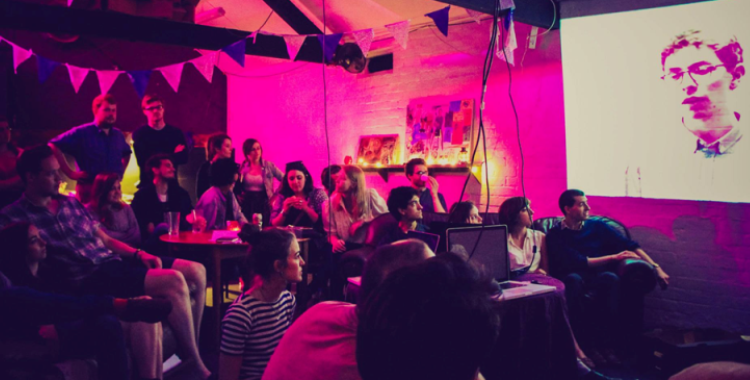
Behind even the most misguided shows, there is usually the nugget – however small – of a good idea. When I first saw The Fanny Hill Project in Edinburgh last year, the good idea at its heart was obscured by the messy, distracted production created around it. TheatreState had paired John Cleland’s erotic novel with the contemporary tale of co-director Tess Seddon’s experience as a model in a foot fetish club in New York, and from there departed into a sprawling exploration of women’s representation in the 21st century. As I wrote in my review at the time, “A feminist piece about modern representations of women is not short of targets, which is perhaps where TheatreState’s fierce but confused satire falls down”. The show had bags of ambition, but precious little focus.

The Fanny Hill Project v2.0, as TheatreState have cheekily christened it, is an impressive transformation, excavating the central idea of the original piece and making it into the show it always had the potential to be. Other than retaining its core concept, the show is unrecognisable, adopting an entirely new structure. Whereas the initial production was all over the place, its madcap scenes loosely strung together, here it has been honed down to its essentials and marshalled into a tight, effective framework. Shedding all the accessories that got in its way first time round, the show is now completely built around its twin narratives of two women – one 18th-century, one 21st-century – who end up selling their bodies.

This structure also allows Seddon and fellow performer and director Cheryl Gallacher to return to the spotlight, whereas previously they were hidden in the background or absent entirely. It’s a wise choice, as the pair have a compelling dynamic and an effortles way of inviting in their audience. In a fun little preamble, they coax us all into playing “I have never”, most beloved drinking game of eager-to-impress students. This quickly becomes a way of introducing Seddon’s shady past, which in this version – unlike before – she takes full ownership of. When Seddon first revealed this secret, she explains, Gallacher was desperate to make a show about it; in return, Seddon dug up Cleland’s novel and presented Gallacher with the challenge of Fanny Hill. There’s eye-rolling reluctance from both parties.

So the two women, Seddon as herself and Gallacher as Fanny, do battle in their attempts to tell their stories, while Jordan Eaton observes proceedings from behind a DJ booth at the back of the stage. Each chapter, linking together events in the lives of the two protagonists, is announced into the microphone by Eaton, wrenching away narrative control from the very people whose narratives are at stake. The quickfire sections are separated by a bell – ding! – with more than a hint of the boxing ring. Women here are repeatedly interrupted and sidetracked in the authoring of their lives, competitively pitted against one another while the audience problematically look on.

Performance is key. Thanks to the knowing structure and the winking self-awareness, we are constantly reminded that this – like the outfits the performers switch between – is all put on. When Seddon and Gallacher throw shapes to David Bowie’s “Let’s Dance”, their moves fiercely mock the “sexy” tropes of contemporary music videos; the artificiality of pillow fight fantasies is gleefully pointed up by the use of a fan to scatter feathers into the air around the two giggling performers. And we begin to wonder whether “Tess” and “Cheryl” – the versions of themselves that the performers present on stage – are also carefully constructed performances. Is the appealing kookiness that they adopt just another role that women are expected to fulfil? (my Manic Pixie Dream Girl alarm starts to go off)

The Fanny Hill Project v2.0 still leaves questions unanswered, but now in a way that feels apt and intentional. The closing scene, rather than departing in bewilderment, leaves a powerfully bitter taste in the mouth. What if, TheatreState suggest, the only way of getting one’s voice heard as a woman in a casually misogynistic culture is to conform to the image that culture insidiously projects? If you can’t beat ’em, join ’em. It’s a troubling thought, and one that hangs in the air long after the feathers have fallen to the ground.


Nothing, NSDF

thumb

*Obligatory disclaimer: I know some of the company pretty well and had heard a fair amount about this show before seeing it, so I can’t claim an entirely distanced position. As far as possible, however, I approached Nothing as I would any other piece of theatre – if perhaps with a little more foreknowledge than the average audience member. Also, for anyone who hasn’t seen the show, it gets a bit spoilery …*

The thoughtful complexity of Barrel Organ Theatre’s Nothing begins right in its title. A gift to pun-happy theatre critics (I direct you to Noises Off‘s excellent selection of headlines), it’s a joke and a statement; a raised middle finger to both theatrical convention and ideological austerity. The single word suggests a void – emotional, ideological, physical. It is also a fierce reference to the current political landscape, in more ways than one: faced with disappearing funding, young companies such as Barrel Organ are forced to quite literally do something with nothing, while nothing is equally a fair description of what these students and recent graduates might feel the world holds for them. The title is an arch reference to the show’s minimal staging and perhaps even a barrier erected against audiences’ quest for meaning.

The multiple layers of suggestion that can be peeled away from these two simple syllables begin to suggest the subtle intelligence of Barrel Organ’s show. Written by Lulu Raczka and created in close collaboration with director Ali Pidsley and the whole company, the deceptively simple structure consists of eight overlapping monologues. Each riffs on a different experience of disconnection in modern society, casually punctuated with sexual and physical violence. This is a world where human shit is gleefully deposited on doorsteps and limbs are hacked off in darkened alleyways. The play’s various transgressions and atrocities, however, demand to be imagined rather than seen. As in The Author, Tim Crouch’s unsettling in-yer-head shocker, we are the ones left manufacturing images of rape and assault, painting nasty pictures in our heads.

The show’s relationship with an audience, however, goes further than this act of mental complicity. In Nothing‘s staging, all physical barriers between performers and audience are dissolved. Unlike in The Author, in which the performers took up residence among the audience, here we are all one amorphous mass gathered together in the space. One by one, the performers reveal themselves, speaking as if seized by a sudden thought. One talks of childhood abuse, another of pointless acts of theft, another of a violent act witnessed on public transport. They are compelled to share, yet awkward in their candour. The monologues are intercut, sometimes by way of interruption, at other times stepping in to fill a silence. When not speaking, each member of the cast retreats into their own sealed bubble, not once acknowledging the speech of one another. These self-conscious outpourings are stubbornly staged as monologues, each addressed to an “audience” rather than to a collection of individuals who might answer back.

While it’s not necessary as an audience member to know the means by which these fractured monologues are constructed, it does shed some additional light on what Barrel Organ are doing and highlight the impressive skill of the ensemble. The piece is significantly different every time it is performed, and the company stress that it is never finished. This is thanks to the fluid order of the monologues, which is not fixed but instead improvised on the spot each night. Performers decide when to speak, when to stop, and in some instances what to say (some performers have learned more than one monologue and only settle on which one to deliver during the performance). Therefore each performance is live in the most unpredictable of senses, generating a tangible charge in the air. It’s a bold, brave, and for the most part brilliant creative choice.

There are, unsurprisingly, some difficulties that come bundled up with this risky staging decision. Containing the audience while also allowing for their input is a challenge, producing the odd stumble, and the rules of interaction are uncertain. But the instability of this performer/audience contract is also what makes this piece so exciting, forcing spectators to remain alert. About halfway through, unusually conscious of my position as an audience member, I begin to regret my default retreat to a chair and wish that I had decided to roam freely around the space as the performers do. It’s striking, as well, how adeptly the eight performers deal with the surprises that this situation inevitably throws up, smoothly absorbing audience responses and environmental noise into the texture of the piece.

In fact, the whole thing comes across as remarkably natural. Raczka has an enviable gift for capturing the cadences of everyday speech in her writing, while the ownership that the performers feel over their monologues is clear in their simple, unaffected delivery. We can almost believe, as a performer fidgets and looks into our eyes, that we really are hearing them spill out their thoughts. At the same time, however, the production sets up a deliberate tension, as the private is aired publicly and isolation is experienced in the middle of a crowd.

Nothing is full of such tensions – between theatricality and authenticity, between rehearsed performance and spontaneity, between alienation and community. It is the latter that is perhaps most significant, constituting the show’s quiet but insistent political intent. The play’s disconnected characters share so much with one another (and, I would suggest, with their young audience at NSDF), but not once are they able to meet eyes, let alone connect. They are, as our society would have them, atomised individuals, bumping against one another without making a dent. Despite the ease and frequency of the text’s jokes, it’s an unblinkingly bleak vision of contemporary Britain, both in form and content.

And yet … there is something innately optimistic about the way in which Nothing is staged. In its arrangement of the audience, its acknowledgement of the community of the theatre, and its emphasis on collaboration, it can’t help but gesture towards the human connection that its characters find so impossible. There are definite echoes of Simon Stephens, and particularly of Pornography, in Raczka’s writing; I am reminded, too, of Stephens’ insistence that theatre is an inherently optimistic art form, no matter how dark its subject matter.

There is also a certain tension in the show’s surroundings. The company describe the piece as “site-unspecific” – it can be staged just about anywhere, and has already been seen in dressing rooms, pubs and car parks – but each performance is absolutely specific to its site in a series of fascinating and unpredictable ways. Of course, I can only discuss those that are particular to the performance I experienced, at the very nerve centre of NSDF in the Spa Complex. I understand that this was the biggest audience that the piece has been performed to, and there is a sense of lost intimacy as a result. Whispered as confessions in a small space, these monologues would suddenly acquire a whole series of different meanings, not to mention a different relationship with their audience. Whereas in a long, cavernous space messily cluttered with people, the show has just the slightest strain of effort, distracting a little from the speeches themselves.

But what is lost in the main set up of this particular staging is brilliantly recouped in its finale. [Here follow the main spoilers] Wisely, the one fixed element of the show is reserved for its conclusion, always closing on the same monologue. In this performance, we are abruptly led outside for the final speech – cue much clattering of chairs and awkward laughter. Ungainly as this transition is, however, it allows for a stunning moment in the Spa Complex’s open-air courtyard, with the sea and the sky adding all the drama and tragedy one could wish for. Against this vast backdrop, the closing speech – beginning with the self-effacing words “nothing ever happens to me” – feels startlingly small in its sad, shrugging attitude to the world. It’s devastating precisely because of its smallness, its inadequacy, its isolation – and its painful familiarity.

Of course, Nothing has its  flaws. The one downside of such thrilling unpredictability is that it must be almost impossible to give the piece dramaturgical shape from performance to performance; its shape emerges in the moment, in response to the conditions in the room, and will inevitably be more effective on some occasions than others. The rules, like the show, need to be constantly remade. But in its malleability, its thoughtful self-awareness, its implicit politics and the natural flair of its writing, this incarnation of Nothing is a tantalising taste of what it – and the company behind it – might go on to become.

Birdland, Royal Court

700x650.fit

“I don’t believe this,” Andrew Scott cries, gaze directed unwaveringly at the audience. “None of this is real. None of this is really happening. This whole thing is made up.”

Reality and its subjective mutability is a persistent theme throughout Birdland, Simon Stephens’ new play for the Royal Court. So too is liveness and its ever-present flipside, mediation. More audience members at a stadium gig today can see the big screens than the miniscule, far-away figures on stage; fans are more eager to snap selfies with their famous idols than to actually speak to them. Our glowing screens are never far from the edges of Stephens’ play, reminding us that it is not only rock stars who are encouraged to shape and enshrine their own image. We are all constantly sharing, editing, performing for our own personal audiences; blurring the lines between the real and the made up.

Birdland opens in the final stages of an international stadium tour, as its unnamed band stop off in Moscow. Lead singer Paul, reeking of charm and boredom, can have and do anything he wants – and he knows it. Stripped of limits and obstacles, the boundaries of his identity are slowly slipping away from him. He is, in every possible way, losing it. The play traces the escalating carnage of his existence as he careers unstoppably towards a personal and professional car crash, gathering the wreckage of other ruined lives around him on the way.

It’s no great stretch of the imagination to believe that Andrew Scott, charisma oozing from every pore, is a worshipped rock star. From the moment he struts on stage as Paul, he fixes the attention in that way that all the best frontmen do, making it almost impossible to look away. It is this magnetism that makes him ceaselessly compelling, even as he royally fucks over all of those close to him. Jenny, a waitress whom Paul whisks off her feet before spectacularly mistreating her, is generous when she describes him as a cunt; Stephens really has crafted an astonishingly despicable, broken character. Though, as Paul coolly retorts to an accusation that he is a “fucking animal”, he is very much human. That’s the terrifying thing.

Equally terrifying is the play’s verdict on the world we currently live in. While Birdland is superficially “about” the world of rock and roll and the personal crisis of one of its demigods, it is also about the bankrupt place in which society now finds itself. Paul, in all his power, disorientation and self-destruction, is the apex of rapacious capitalism and the cult of the individual. Whether he is a rock star or a celebrity of any other breed is less important than the fact of his fame and the value pinned to his personality. He is more commodity than person, displayed every night for the public’s consumption while record label executives gamble on his worth. No wonder he is losing a grip on his own identity, when all he can see in the mirror is a price tag.

Carrie Cracknell’s striking production both amplifies and tussles with these ideas about identity, individualism, celebrity and capitalism. From the very beginning, the space in which she locates Paul’s crisis is non-specific, strange and slightly dislocated from reality. Ian MacNeil’s typically stylish set consists of a shimmering golden archway and a row of electric blue chairs, the sleek simplicity hinting at the corporate sameness of hotel lobbies all over the world. Everywhere looks the same. There is, wisely, no attempt at naturalistic representation of the succession of hotel rooms, bars and restaurants in which the action takes place. Instead, everything happens in a knowingly theatrical arena; other performers remain on the stage when not in a scene, occasionally casting arch looks over their shoulders, while Scott takes time to flirt with the audience.

By starting out with such a deliberately odd and disorientating aesthetic, however, Cracknell is in danger of leaving herself with nowhere to go. An obvious but useful comparison is Three Kingdoms, which despite dodging an audience’s expectations from the off (and starting in a decidedly strange place with Risto Kubar’s haunting singing) managed to establish one reality which could then increasingly unravel throughout Ignatius’ journey to Germany and Estonia. There is a gathering momentum to Paul’s mental turmoil, signalled by ever brighter and more frequent photographic flashes and the rising tides of inky liquid seeping in from the sides of the stage, but this is a jerky breakdown, one that comes in sharp bursts, rather than the sense of spiralling out of control that the narrative seems to be asking for.

That said, in other ways Cracknell finds incisive and imaginative visual metaphors for the story Stephens has written. The cartoonish, plastic quality of the people Paul finds himself surrounded with (perhaps with the exception of down-to-earth band mate and best friend Johnny and the aforementioned Jenny, who reminds him of the girls he used to know at home) enhances his alienation from the world around him, which appears unreal and fantastical through his eyes. Meanwhile, the script’s understated yet unsettling preoccupation with bodies – their illness, disfigurement and inevitable decay – is hinted at by the slowly encroaching black liquid, which might as well be the creep of disease.

Given the subject matter, one of the most surprising things about this rendering of Stephens’ script is that we never hear so much as a bar of Paul’s music. In fact, aside from a couple of stylised movement sequences backed with pulsing beats, there is very little music at all in Cracknell’s production. The other exception is a deliberately terrible rendition of Sam Cooke’s ‘Wonderful World’, sung by one of Paul’s fans at his request and elevated to the same sort of scene-breaking moment as Steven Scharf’s memorable performance of ‘Rocky Raccoon’ in Three Kingdoms. The suggestion, perhaps, is that it is not really Paul’s music that matters – it is his fame, his monetary worth. Still, we never get a real sense of the muscular excitement and visceral thrill of a live rock concert, which feels like a shame. Theatre has overwhelmingly proved that it can offer the same intoxicating buzz as a live gig (see Beats or Brand New Ancients), but we don’t get that here. (It’s especially disappointing having heard Stephens speak at length about his own enthusiasm for rock music, little of which is allowed to come through – but perhaps a certain ambivalence about the world of rock and roll is appropriate given the events of the narrative.)

The plays’ surface message, that celebrity can fuck you up, might not be anything new. But there is so much more to Birdland than this familiar, oft-repeated observation. What it manages to do so well is convey the tortured complexities of Paul’s character, whose messy contradictions only make him all the more real, at the same time as making a sharp, implicitly political point about modern society. The production could push this second aspect further, shining a spotlight on us as much as on Paul, but it still stands as a damning critique of our globalised, brutally individualistic, fame-obsessed world.

Photo: Kevin Cummins.

Banksy: The Room in the Elephant

5623188440_a4ca36eaa3_o

“Ain’t no one want the truth, they want the story.”

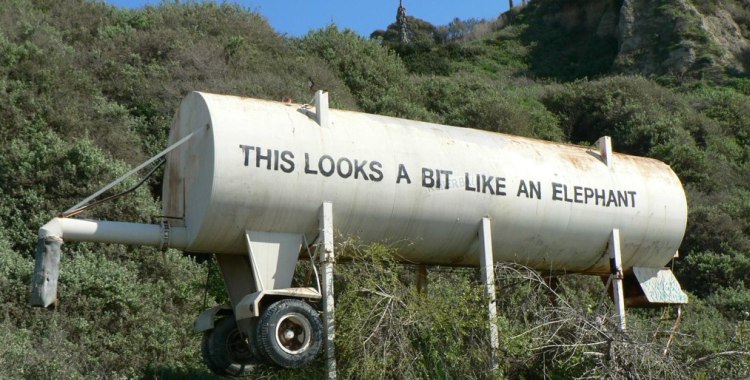
In February 2011, ever-elusive street artist Bansky spray-painted the words “this looks a bit like an elephant” on the side of a water tank in Los Angeles. This tank, abandoned up in the hills, had been a man’s home for the last seven years. Of course, as soon as word spread that there was a new Banksy work on the loose, art dealers quickly swooped in to remove it from its site, with hopes of making a tidy profit. The tank’s inhabitant was left homeless.

It’s a good story. So it is hardly surprising that journalists quickly latched onto it, desperate to find out more about Tachowa Covington, the man who had made the water tank his home. Speculation spiralled around Covington’s life, his residence in the water tank, the circumstances of his eviction and the mysterious intentions of Banksy. One such article in the Independent inspired director Emma Callander, who asked Tom Wainwright to write a play about this series of events. So here was another story, and now that the piece arrives at the Arcola on its latest tour, it is joined by an additional piece in the jigsaw puzzle: Hal Samples’ documentary film Something From Nothing.

I first saw Banksy: The Room in the Elephant at last year’s Edinburgh Fringe, armed with relatively little information about its intriguing subject. Wainwright, who has changed Covington’s name to Titus Coventry for the purposes of the play, has framed the tale within the fictional context of the water tank’s inhabitant telling his own story. Gary Beadle’s Coventry has broken back into the tank, now held in a secure warehouse in LA, and is recording a video of his version of events, with the intention of uploading it to YouTube. The show is careful throughout to remain playful in its handling of truth and fiction, inserting the storytellers into the tale and troubling the narrative it relates (if not always with a subtle hand). We are never entirely sure what to believe.

There is an irony, as Wainwright admits, in becoming part of the “land grab” for Covington’s story at the same time as he implicitly critiques it. Essentially, this play is embarking on the same act of artistic and narrative appropriation committed by both Banksy and the journalists who followed in his wake. Its possible redemption, however, is in its insistent questioning of the stories we tell, how they are told, and who gets to tell them. It’s no accident that Wainwright’s script is drenched in borrowed Hollywood references; I’m reminded of Hannah Nicklin’s comment that capitalism has stolen our stories and is selling them back to us. Everybody here has a story, we are told of LA, but not everyone has the power or the platform to tell theirs. Covington, for one, seems to have been refused the right to his own story.

With all of this in mind, it’s fascinating to watch the show a second time alongside Something From Nothing. The documentary actually pre-dates Banksy’s intervention; filmmaker Hal Samples had a chance encounter with Covington while in LA in August 2008 and began filming him and his eccentric home. After public interest in Covington exploded, Samples continued making the film, which goes on to chart its subject’s life post-Banksy and document his journey to Edinburgh to watch the play (to which he gave his blessing, before starting on some performing of his own).

It’s an engrossing film, but watched through the lens of the preceding play it is seen with wary eyes. For all the assumed authority of the documentary form, this is still, unavoidably, just one part of the story. While Covington might get the chance to speak up and to share the work of art he made out of the water tank long before Banksy came along, his life is nevertheless seen once again from another’s perspective. Leaving the Arcola, interest freshly piqued by this extraordinary character and his attempt to live outside the structures of society, I still feel that I have seen the story, not the truth.

We Are Proud to Present …, Bush Theatre

??????????????????????????????????????????????????????????????????????????????????????????????????????????

For as long as art has sought to represent, the limits of that representation have been pushed and questioned. From Plato’s concerns that representing something betrays its essential truth, to Adorno’s famous claim that to write poetry after Auschwitz is barbaric, it is a debate that has preoccupied artists and thinkers down the ages. Where does one draw the line between what can and can’t be represented? And without representation, how are we to share human experience and history?

In Jackie Sibblies Drury’s sharp, unsettling play, the impulses to represent and to remember repeatedly butt up against one another. Contained within their conflict is an implicit, knotty, unanswered question: is it better to attempt to represent history and risk misrepresentation in the process, or to remain respectfully silent and allow that history to be forgotten?

It is the question, rather than its resolution, that We Are Proud to Present a Presentation About the Herero of Namibia, Formerly Known as Southwest Africa, From the German Sudwestafrika, Between the Years 1884-1915 (titles don’t get much more belligerently unwieldy than that) stages. Drury’s play centres on a group of naive actors, engaged in an ill-judged attempt to address the subject matter of the title. As we are informed in a problematically pithy “overview” at the start, the German settlers in Southwest Africa carried out a brutal genocide against the people of the Herero tribe during the period in question, exterminating 80% of the population. Using the evidence that has been passed down to them – the vast majority of which comes from the German perspective – the six actors (three white, three black) spend the remainder of the show fumbling, arguing and improvising their way through this horrific chapter of colonial history.

The performers stage improvisations around letters home from German soldiers, bicker about how to represent the Herero, and increasingly slide into uncomfortable racial stereotypes. There is much debate about who can represent what – can a white actor portray a black character? and vice versa? – and about what does and does not need to be told. The action reveals as much about theatre as it does about history, lightly mocking popular acting technique (“I don’t know what my active verb is!” cries one character) and the pitfalls of collaborative creation. Through this, however, it approaches the difficult questions at its heart, becoming more and more preoccupied with heritage, identity, race and representation. Whose story is being told? Who has the right to tell it? And where do we draw the line between pretending to do something and actually meaning it?

There is, when discussing a play such as this, a danger of latching onto what it is superficially “about”. Michael Billington’s review in The Guardian, for instance, laments the fact that the show ends up focusing more on the theatrical process than on the genocide that is supposedly its subject matter. But I would tentatively argue that the only way this play can even begin to approach the topic it is nominally about is through a frame which acknowledges the impossibility of ever simply creating a piece of art “about” such subject matter. We Are Proud to Present … is not “about” the Herero, or the German settlers, or the genocide, or the impossibility of representation, or cultural appropriation, or the constructing of history, or the process of theatremaking, or notions of truth, or modern identity politics. It is about all of the above, none of which are easily extricable from one another.

Another issue that rears its head is that of relevance, that quality so beloved of theatre programmers, marketers and critics. There is a nagging desire on the part of the actors involved to relate to the story they are telling and to enhance its relevance for modern viewers – an impulse that many adapters will be familiar with. What this production cleverly manages to do, however, is to problematise that process, implicitly critiquing the drawing of parallels. In one sequence, an improvised encounter between a German soldier and a Herero man segues into a series of different accents, highlighting the similarities between this and other conflicts, at the same time as its distinct edge of discomfort reminds us of the dangers of eliding the historical specificity of each invoked parallel. The homogenising of history, to which Drury’s characters all too often fall prey (“they’re all the same – the names aren’t important”), is cast as a constant, dangerous spectre.

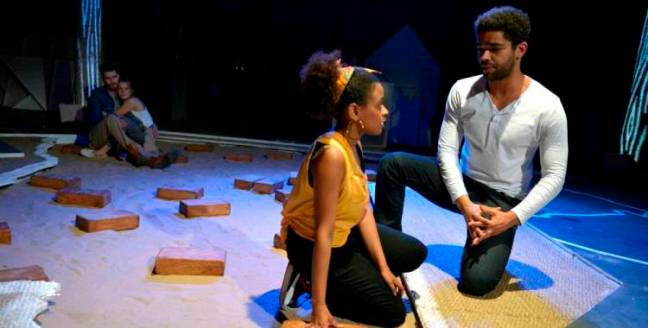
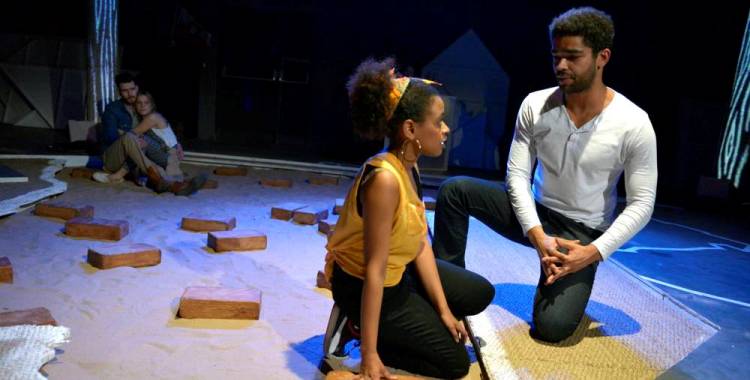
This particular production at the Bush adds an unsettling proximity to Drury’s play, particularly as it reaches its conclusion and we are made increasingly aware of our presence as an audience. Although the majority of the action is carefully scripted and (interestingly) does not stray far from Drury’s text, Gbolahan Obisesan’s direction and the performances of the uniformly strong ensemble manage to effectively evoke the unpredictable spirit of rehearsal room improvisation. Lisa Marie Hall’s set, meanwhile, is a versatile playground for the performers – emphasis on playground. With its movable pieces and gradually revealed sandpit, there is something distinctly childlike about the design, bringing in an aesthetic that jars interestingly with the content. Beyond the design, the playfulness of the whole production is at once wickedly entertaining and decidedly queasy.

But it is only in the final, quiet moments, after the action has reached an overblown, feverish pitch of excitement, that We Are Proud to Present … achieves the impact that justifies its early impishness. While the show’s climax is overdone, its wordless aftermath is a swift, unforgiving punch to the gut, leaving its questions hanging troublingly in the air.

Photo: Keith Pattison.