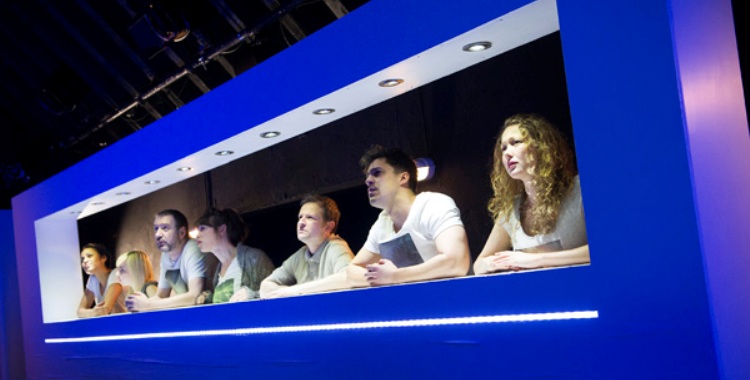
The Ritual Slaughter of Gorge Mastromas, Royal Court

The-Ritual-Slaughter-Of-Gorge-Mastroma-620x340

The repeated central question of Dennis Kelly’s dark allegory, emblazoned in giant letters at the back of Tom Scutt’s set, is a troubling one: “goodness or cowardice?” Are supposedly moral decisions just a case of taking the easy road? Is a decision really the “right” one if no “wrong” alternative occurs to you? Are virtue and fear simply one and the same? But beneath it, running in a thick, throbbing artery through the metabolism of the play, is an even more troubling question: is there really any such thing as truth?

In an interview with Maddy Costa for The Guardian, Kelly states his preference for plays that ask questions over those that provide answers, admitting that he’s “not really sure” what The Ritual Slaughter of Gorge Mastromas is about. I would, for the most part, agree that asking questions is more productive – not to mention more interesting – than offering solutions. A question leaves audiences thinking, while a firm conclusion can immediately alienate those who don’t agree with it. When everything is questioned, however, the provocation to look for answers is neutralised. Why search for a version of the truth if all truths are exposed as relative and ultimately meaningless?

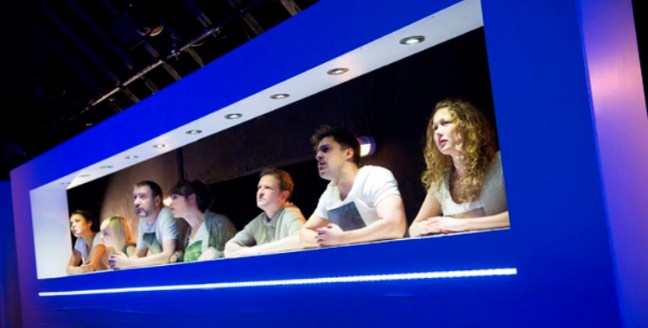
Life’s stark absence of meaning is a revelation that forms the hinge of Kelly’s play. His eponymous protagonist, Gorge Mastromas, starts out as an essentially moral human being. When offered a choice, he takes the decent option, be it standing by a mate at primary school or remaining faithful to hastily voiced promises. Kelly and director Vicky Featherstone offer us this series of early incidents in Gorge’s life via an extended sequence of collective storytelling: the six cast members sit in a line of chairs at the front of the stage, sharing the history of Gorge’s life from the moment of his inadvertent conception. And my use of the word “history” is no accident; this simple but striking opening deliberately foregrounds the construction of historical narratives, offering a fragmented, unreliable and polyvocal account of Gorge’s life, told from a perspective that is never quite acknowledged or qualified.

Our protagonist’s Faust moment arrives when a ruthless businesswoman briskly informs Gorge that life is not what he has until that moment believed it to be – “it is not fair, it is not kind, it is not just”. But if he’s willing to sell his soul to the demons of cutthroat capitalism and merciless self-advancement, he can have whatever he wants: power, money, sex. The trick is simply to lie from the bottom of his heart, heedless of the consequences of those falsehoods. Embracing this new philosophy with only the lightest flicker of hesitation, Gorge is swiftly mounting the ladder to unimaginable wealth and power – an unstoppable capitalist juggernaut. Be it a company, a house or a woman, Gorge always gets what he wants. What follows is acquisition at the expense of all else, painting a sorry picture of our society’s trajectory and the lessons it implicitly instils in us.

It’s an old story, but one that is drenched in the giddily unfettered capitalism of the 80s and 90s, playing on the myth of indefinite growth and the conviction that everything is there for the taking if only individuals are willing to grab it. The main commodity to be traded, however, is not property or shares, but narrative itself. Gorge is a spinner and seller of stories – most explicitly with his fabricated bestselling memoir, but also in the fibs he blithely tells those around him in order to get ahead. And people want to believe these fictions. When speaking of “people”, that necessarily extends to the audience, all of us eager to grasp onto something solid, some narrative structure that makes sense of this world. By drawing attention to this, and to the lies that even our narrators are incessantly telling, the play makes us immediately doubt anything it tells us, as well as doubting our own interpretations of these versions of the truth.

The shifting ground of Kelly’s play is shaken further by this production – if, indeed, we can speak of the two separately, which is always a slightly disingenuous project. The dynamic division of Gorge’s story between the cast, delivered with an edge of irony, is reminiscent of now ubiquitous techniques of poststructural performance, at once bringing to mind the likes of both Forced Entertainment and Martin Crimp (useful reference points for the disruption of meaning and narrative). This engaging, teasing mode of delivery is contrasted with the far less compelling – and often overlong – “scenes” that pepper the play, offering an ever-so-slightly heightened variation on naturalism. Which offers the picture that is closest to the truth is left down to us, as the performance style of each in turn subverts its own stated veracity.

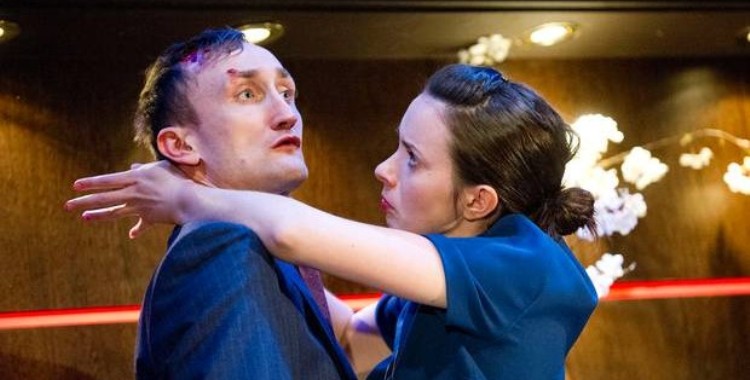
The figure of Gorge himself, meanwhile, is a tight knot of contradictions. When Tom Brooke first shrugs on the role of the anti-hero, he is a quivering, deferential employee, eager to please and anxious of hurting. After offering such a detailed portrait of this meek, decent man, it is difficult to dismiss his ghost, which hovers over all of Gorge’s subsequent deceptions. Never is he quite as convincing as when still in possession of his morals. Alongside the fleshed out emotional detail that Kate O’Flynn’s compassionate performance offers Louisa, the unlucky object of Gorge’s affections, Brooke’s mercenary entrepreneur is a skeleton of a character, at times nearing a caricature of capitalist greed. Yet this thinness seems oddly apt; it could be argued that it shows up the absurdity of this Game Theory style of self-serving logic in both life and drama. Human beings are strange, irrational creatures, and to drain them of that irrationality – be it by a capitalist logic of acquisition or a notion of drama that is built upon clear character motivation – leaves only empty shells.

The empty facade is also a recurring feature of Tom Scutt’s intelligent, thematically excavating design. His self-contained naturalistic spaces, which form the backdrop for the correspondingly “realistic” scenes, always offer a hint of superficiality, from the calculated blandness of a corporate office to the moneyed sheen of a hotel suite. By the time the scene shifts to Gorge’s lakeside palace and a dilemma that will test just how far he’s prepared to go to protect this painted paradise, any attempt at substance is abandoned, leaving only a flat simulacrum of a landscape on a screen behind the actors – the shimmering mirage of Gorge’s life, concealing only emptiness. Elsewhere in the design, the stubborn search for a pattern is offered visual expression: the constellations of a life are brightly dotted on an image of the night’s sky, paper is pinned to the walls in imitation of the detective’s evidence trail, and neon lines are traced over a graph.

Through this kind of detail, The Ritual Slaughter of Gorge Mastromas offers much to chew and puzzle over, for the most part sustaining intellectual vitality over its testing two hour and 45 minutes running time. That hovering question mark over truth, however, niggles at me throughout. While I have other doubts about the piece (it’s far longer than it needs to be, for starters, and Gorge’s moral descent lacks the punch that I suspect it’s reaching for), my main concern is prompted by its political position; or, rather, how it seems to politically let itself off the hook. The questioning of truth is interesting in itself and follows the thread of much poststructuralist/postmodern (depending on how you like to define it) thought in suggesting that there is no foundational reality that we can appeal to, but it is equally in danger of rendering all truths equally invalid, thus making any attempt at morality pointless.

My mind is dragged back to the recent discussion Dan Hutton and I had about hope in theatre, which strayed into similar territory. In that dialogue I borrowed from Liz Tomlin’s new book Acts and Apparitions (a text that I increasingly think could be a vital reference point in navigating post-postdramatic performance practice), and it feels appropriate to return to Tomlin now. Her book traces the postmodern thought mentioned above and considers the possibility of making a radical gesture in theatre today, when any notion of the true or the real has received a thorough battering. To demonstrate how she grapples with this, I want to quote part of the text:

“Accepting that every narrative is implicitly ideological does not equate to the acceptance that any given narrative is thus beyond ideological analysis or distinction. The artist or critic’s choice to propagate one narrative over another will still result in a ‘real’ impact on the artists, the audiences and, to some degree at least, the ideological shape of the historical period in which the work is situated.” (pp.6-7)

In other words, the version of the truth that we choose to tell has an effect, whether or not it can appeal to some original, authoritative, universal truth. This version of the truth might even have the power to change the world, a power about which Gorge Mastromas feels distinctly ambivalent. Individuals such as Gorge can change things, but only for their own gain; beyond the certainty of lying, the universe is portrayed as cold, cruel and chaotic. If we choose to present an image of the world in which there is no truth, only lies, then perhaps there is a responsibility towards the “real” impact of that image. By seemingly refusing that responsibility and falling back on relentless uncertainty, Gorge Mastromas – for all its merits – feels like a bit of a cop out. If the question is “goodness or cowardice?”, I would tentatively suggest that Kelly errs towards the latter.

Photo: Tristram Kenton.

Mirrors, Hope and Transformation

circle_2616054b

What can theatre do?

This isn’t necessarily the central question asked by Circle Mirror Transformation, Annie Baker’s delicate and precisely naturalistic portrait of five broken individuals, but it is the question that I found myself asking as I left the Rose Lipman Building on Thursday evening. Following a steady stream of superlatives on Twitter, I went in with unrealistically high expectations, all underscored with another, slightly resigned expectation of being disappointed. And while I wasn’t disappointed as such, I didn’t find it the most extraordinary, transformative theatrical experience of recent months either. But this heavy burden of expectation, together with the scenario in which Baker’s play places itself, left me thinking about what theatre can do, what it might do and what we hopes we hold for it.

Circle Mirror Transformation is, in a sense, a piece of theatre about theatre, but ‘meta’ is a word that seems completely removed from its vocabulary. No Noises Off-style send-up or self-reflexive meditation on its own medium, Baker’s play is instead about the kind of theatre that remains largely invisible. The whole thing takes place over the six weeks of an adult drama class, in a large, windowless room in a community centre in Vermont – not unlike the large, windowless room in which we find ourselves in the Rose Lipman Building. Each of the scenes, punctuated by sharp blackouts, consists of either the kind of exercise that will be instantly familiar to anyone who’s ever taken a drama class in their life, or the slices of conversation that happen in the room around each session.

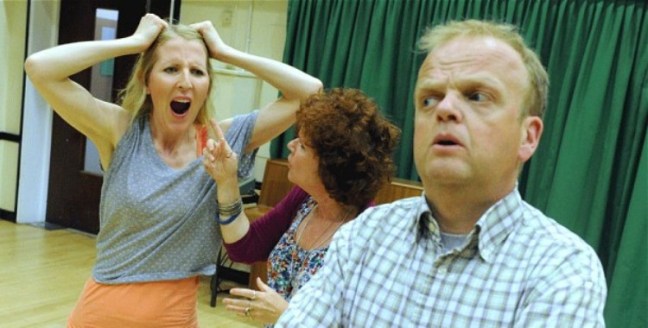
The class is run by hippyish Marty (Imelda Staunton at her quietly expressive best) and attended by her husband James (Danny Webb), recent divorcee Schultz (a brilliantly awkward Toby Jones), once actress and now aspiring acupressure therapist Theresa (Fenella Woolgar) and enigmatic teenager Lauren (Shannon Tarbet). We see fleeting snatches of each of their lives over the course of the six weekly classes, learning enough to feel acquainted with these characters while never being furnished with the full details. Baker’s minimal writing dances deftly around the edges of life, never leaving us in any doubt of the wholeness at its centre – a wholeness that is solidified by the gorgeously nuanced performances of the cast, who execute something of an acting masterclass over the uninterrupted two hours.

The word that most naturally springs to mind when reflecting on Circle Mirror Transformation is “gentle”. This might be applied to James Macdonald’s direction, which handles Baker’s text with kid gloves, trusting it with a slow-burning pace and long, expansive silences. It certainly applies to the interactions between the five characters, which are sometimes awkward, often tender and frequently funny, in the light sort of way that you might expect from a Sunday evening TV comedy drama (that’s not meant as a dig, I should add, but – a couple of uproarious moments aside – it’s not side-clutching, tears-rolling-down-your-cheeks stuff, and I don’t think it’s meant to be). There are a couple of real kicks to the gut in there, but when these arrive they are all the more startling thanks to the calm from which they emerge. This is the placid lake of life as lived from day to day, disrupted by just the occasional ripple.

And within this seemingly uneventful structure, moments of stunning precision and incisive emotional truth emerge. There’s Tarbet’s fascinating stillness and the meaning she can somehow effortlessly invest into silences; the subtle yet devastating poignancy of a fleeting look on Staunton’s face following a kiss between Marty and James, transforming an apparently light moment into one loaded with unspoken turmoil; the simultaneously funny and sad complexity of Woolgar’s Theresa, a woman whose damaging decisions are portrayed with unwavering compassion, wrapped around the yawning loneliness that drives her actions; the painful awkwardness of Jones’ bruised but tender Schultz and the latent frustration of Webb as James. As they progress, Marty’s classes are more therapy than they are theatre, conveying the power of drama without romanticised exaggeration or sentimentality. The six-week experience changes each of its participants, yes, but they still come out at the other end as complicated, flawed and slightly broken people.

In this unapologetic concern with people – people in all their ridiculous, messy, beautiful complexity – Circle Mirror Transformation feels somehow both universal and particular, massive and miniature. It is also, however, somewhat problematic. To merely dismiss the play as inward-looking feels a bit simplistic, as the individuals within it exist very clearly within a world beyond the four walls of the community centre and the supposed banality of their lives reveals odd moments of profundity, but its quiet containment does present a certain view of what it is that theatre does. Drama might transform the lives of the characters, for better or worse, but in this room we are just presented with another set of mirrors. This is life seemingly reflected, held up to us without judgement, refusing to prioritise the big events of life over the seemingly insignificant minutiae. Which is interesting, and makes a certain statement of its own about how our culture assigns value, but it can also feel somehow resigned to the shape of the world. This is how things are.

Hope-23-Tim-Crouch-and-Andy-Smith-by-Mae-Li-Evans

I’m thinking this in part because of two other pieces of theatre I’ve seen in the last month, both fantastic and fascinating collaborations between Tim Crouch and Andy Smith. As they explained with enviable eloquence when I spoke to them recently, their work always has at its heart an interrogation of theatre as an art form in one way or another. In both of the shows in question – Commonwealth (available online as part of the Royal Court’s Surprise Theatre – go watch) and what happens to the hope at the end of the evening – this interrogation is the motor that drives the piece.

Each of these shows is characterised by a shared rhetoric of hope around theatre as a medium; as Crouch puts it, “An engagement with a group of people sitting in a room together is an innately hopeful act”. Commonwealth, written by Smith and performed in this instance by Crouch, is a monologue that meditates directly on the hope that we might bring into a theatre space, telling a story about a theatre a bit like this one and an audience a bit like this audience. What initially seems a little straightforward and repetitive gradually becomes an invitation to deep and probing thought, calling into question the ways in which we respond to our frustrations about the world and positing the theatre as a space where perhaps we can begin to change that. It’s about what we hope to get from the theatre and what the theatre might be able to offer us.

In what happens to the hope at the end of the evening, the ideas explored in Commonwealth are put through the wringer using an opposition between two different approaches to theatre and to the world. It tells the story of one evening in which two old friends meet after a long time apart, at the same time using this as a structure to explore the theatrical event. Smith, to all appearances, plays himself, while his friend is not a version of Crouch but a fictionalised character. Smith reads from a script and directly acknowledges and addresses the audience; Crouch’s character desperately constructs a kind of stage realism, dragging on props to support his fictional world. Smith is controlled and thoughtful; Crouch is impulsive and bent on action.

The piece is rare in achieving an almost perfect balance between narrative and ideas. Its story of a friendship, one in which an almost unbridgeable distance has forced itself between the two friends, is at times deeply moving in its own right. As a vehicle for the show’s meaty ideas, meanwhile, this device is inextricably married to the content it carries; it is all about hope, about connection and separation, about gathering people together in a space. There’s great optimism for the potentially radical quality of a gathering like this, supported by carefully selected snippets of theory, but at the same time doubt is cast on theatre’s potential, while the lack of resolution between the show’s two opposing elements concludes the whole thing on an uncertain note. It’s difficult without apologising for its complexity, but at the same time the ideas being wrestled with are presented relatively simply and accessibly. (I’m reminded of something brilliant that Kieran Hurley said to me recently in an interview: “simplicity and complexity are often two sides of the same coin”)

What is striking about both Commonwealth and what happens to the hope at the end of the evening is their ambition for the space of the theatre and what it might achieve, even as they problematise their hopes for the theatrical event. Like Chris Goode’s The Forest and the Field, this is theatre that helps you think about theatre, that leaves you with a set of questions to mould around the next thing that you go out and see. Which is perhaps why Circle Mirror Transformation, despite its much-celebrated brilliance, left me wanting something more, and perhaps why I typed out that opening question. What can theatre do? I don’t really know, but I think it’s important to keep asking.

One final, positive thing about the relationship between these different pieces. My enthused fascination with the intelligence of recent programming at the Royal Court is probably getting boring by now, but it’s worth noting that Circle Mirror Transformation (part of Royal Court’s Theatre Local initiative) and Commonwealth are positioned alongside and in dialogue with one another, even if they don’t share a building. While it might seem (at least to me) as though there is something slightly lacking in Baker’s play, simply by existing in the same programme as Commonwealth it’s already taking part in a wider discussion.

These two shows also sit within a programme that includes Collaboration, a process which itself prodded at what theatre does and how it does it (and which, as Andrew Haydon points out, might well have been the ideal process to explore an idea like Baker’s), and The Strange Undoing of Prudencia Harta joyous and inclusive instance of theatrical transformation. Add Mark Ravenhill’s Cakes and Finance to that list and you have a theatre that suddenly seems to be thinking a hell of a lot about what it is and what it does. It’s asking that same question – what can theatre do? – and providing a whole range of answers, all implicitly entering conversation with one another. And it feels exciting.

Narrative, Royal Court

?????????????????????????????????????????????????????????????????????????????????????????????????????????????????????????????????????????????????????????????????????????????????????????????????????????????????????????????????????????????????????????????????????????????????????????????????????????????????????????????????

Let’s start at the beginning. Anthony Nielson’s latest work is, the Royal Court website tells us with succinct authority, “a new play about stories”. There’s also an image: a line with a break and the provocative words “form is dead”. And that’s it. The reason for the scant details is partly down to Nielson’s method – the play was written during rehearsals, building on a process of daily workshopping and improvisation with the cast – but it’s also sort of fitting. All the best stories know not to give too much away.

Another beginning. To one side of a sleek white design jewelled with blinking blue LEDs – Apple’s smooth, clean lines extended across an entire theatre set – a screen hosts a projected cave painting. If we’re to believe the authoritatively intoned description of the voiceover, this is the earliest example of human narrative: just a man, a bison and a spear. The implication is of a struggle, though whether man or bison or neither is killed is unclear. The presence or absence of death is important, the voiceover tells us. Without death, there’s no consequence. Without consequence, there’s no narrative; only suspended struggle.

Narrative plays out in that zone of suspended struggle. It’s a story – or, more accurately, a web of interconnecting, overlapping stories – that must continue at all costs, but the consequence it’s reaching towards is always just out of grasp. The spliced-up narratives themselves range from the banal to the bizarre, often in an almost soap opera vein. A paranoid actor keeps being slipped mysterious photos of arseholes; a grieving mother drags around a petition, pathetically begging passersby to sign; a young woman aggressively seeks out her soulmate, while another casually kills her best friend. Just as the opening voiceover is helplessly drawn to creating a story from a few marks on the wall of a cave, we as an audience are left to do what we do best: connect the dots.

As well as making connections, the audience is required to engage in a process of choice, picking out some elements and discarding others. While certain scenes are tightly focused, isolating a monologue or a video (of which there are many, bursting onto the screen throughout the piece), at other times the production relies on a technique of bombardment. The first “scene” proper, for example, works on a collage principle, pasting on layer after layer as one conversation overlaps with another, more and more performers entering the space until all we can make out is a fuzzy cacophony of noise, punctuated by the odd audible word or sentence. At which point, in a puff of dry ice, Zawe Ashton bursts into a sudden, off-key rendition of David Bowie’s ‘Where Are We Now?’ This pretty much sets the tone.

The crowded confusion sounds bewildering, but the ease with which we navigate this flood of theatrical stimuli is just as striking as its over-abundance. Essentially it’s just a staged manifestation of digital noise, noise that we’re now adept at filtering. If the formal experimentation of Caryl Churchill’s Love and Information riffed on one facet of modern experience – the quickfire onslaught of information in the digital age – then Narrative is its exploded, densely networked extension. At times it feels as though it’s occupying the internet; interruptions pop into view, scenes flip from window to window, ad-speak is constantly intruding – there’s even a cheeky nod to the ubiquity of the cat video. It’s theatre for the multi-tab generation.

And yet this is more than just a meditation on the ways that digital technology has rewired our thought and behaviour. As signalled by the opening lecture on cave art and the recurring motif of the bison throughout, these stories we tell are an integral part of our existence, stretching right back to our earliest origins. Narrative is wired into our cultural DNA. Looking not quite so far back, the play is also engaged in a tense dialogue with the particular way in which we tell stories on stage, demonstrating a deep understanding and cutting critique of the often shallow techniques of drama. The small, broken-off splinters of plot that we are given concern themselves with the sort of domestic scenes we are used to seeing represented on stage, particularly at the Royal Court, occasionally marked by the violent caesura of a “dramatic” incident. Often these vignettes are haunted by a kind of narrative dissatisfaction, or they simply don’t work, requiring another surreal interruption to rupture their bland surface. Our old stories are broken.

It’s worth pausing briefly here to also consider Nielson’s process. While he remains very much a writer, his writing happens alongside rehearsals; a new draft gets frantically written each night and brought in the next day to rehearse and improvise around with the actors, prompting yet more re-writes based on the outcome. As I understand it, any improvisation that takes place during this process is very much within the piece that Nielson is already writing, rather than a more free-form method of devising from scratch. It’s a process of generating, gathering and discarding that is particularly apt here, mirroring the way that we refine and retell our own stories, yet always within the narrative limits that our culture has schooled us in and always with reference to the narrative tropes that precede us – storytelling from the inside. In our postmodern, post-structuralist world, truly original narratives are no longer thinkable, but the linear stories we are accustomed to telling are no longer adequate. The answer, as Nielson proposes, is a structure that deconstructs from within, disruptively playing with the cultural material and narrative constructs that we can never quite get outside of.

Just say it and it will be true.

Much like Martin Crimp’s cutting attack on the cult of the personality in In the Republic of Happiness, the modern focus on the individual keeps rearing its head. Mirrors are everywhere, both in the text and dotted around Garance Marneur’s design, most strikingly as a scattering of reflective fragments in a shallow pool of water; in place of costume, the actors wear T-shirts adorned with photos of their younger selves, a statement of identity and personal narrative sitting against their skin. Just as Crimp’s characters stubbornly insist upon their narrative autonomy – “I write the script of my own life” – here the ability to tell one’s own story is depicted as central to contemporary experience. While the situations are often distorted into mad extremes, the very human impulses that drive them are wincingly familiar. We’re always spinning stories, always telling lies to others and ourselves, always making up shit.

The other purpose of telling stories, as Nielson reminds us, is to insulate ourselves from our own mortality. In a ridiculous attempt to divert a break-up – one of many amusing moments in what is often a viciously funny play – one character petitions her indifferent lover with the uncompromisingly bleak observation that “we’re going to die”. Spoken out loud, particularly in Ashton’s gloriously melodramatic tones, it sounds almost laughable, that truth that we all fight against. We will all die. But it also prompts the unsettling realisation that we’re all constantly pretending we won’t. That’s what all this noise really is: distraction.

Another distraction, another mirror, another classic narrative device, is romance. Neilson’s characters are unremittingly obsessed with love. Or, rather, an idea of love; “the big love thing that they fill our heads with”. They’re all looking for “The One”. They’re looking for “it”. They’re looking for their soulmate, the person they’re meant to be with – and when they know, they’ll know.

Whether we’re listening in on a lovers’ row – and they all sound the same – or a conversation between gossiping best friends, the dialogue trills to the echo of a hundred pulped Valentine’s Day cards, channelling the ghost of every second-rate romcom and soap opera romance. This is a world where idealised love is a consumer item, where our romantic relationships are snatched out of our grasp and sold back to us at a price. Stories are stolen and priced-up in the same way, co-opted into advertising (an industry to which the play makes repeated references). Much as Ashton’s soulmate-hunting young woman is resolute in her belief that there is an ideal love waiting for her, we are fed a feeling of entitlement to perfect happiness, but always at a cost.

It’s also no mistake that each of the individuals we encounter is, in their own way, in the business of selling us falsehoods. Whether perpetuating the Hollywood dream of overnight fame, battering us with empty advertising slogans, or telling a lie that they themselves believe in, the characters depend upon peddling untruths – just as the success of the performers beneath, the layers of real and fictional identity messily overlapping, is predicated on creating a fiction.

The last, dissolving vestiges of narrative are desperately clung to, much as the members of Forced Entertainment propel The Coming Storm stubbornly forward with story after story after story. Particularly with the 24-hour epic of Quizoola still seared on the collective memory, Forced Entertainment and their stretching and implosion of the narrative form feels like an apt reference point. There’s the same frenzied impulse to keep going no matter what, the conviction that the show – and the stories – must go on. This work also shares a certain sense of inbuilt failure. Alongside the stories that fall flat on their face or get rudely truncated, the theatrical event itself is deliberately balanced on the point of falling to pieces; as actors refer to one another by their actual names and occasionally read directly from hand-held scripts, the illusion of theatre is always brittle, if not completely smashed.

In negotiating these blurred lines and weaving between the many different fragments of narrative and identity, the cast work brilliantly with the material they’ve been given and had a hand in crafting. There’s a lot of fun to be had with the text that Nielson has produced and the atmosphere is consistently playful, stretching and pushing at its theatrical confines. Ashton, already mentioned, turns in a dazzling comic performance, at once awkward, manipulative and somehow endearing, while the increasingly zany bewilderment of Imogen Doel’s clumsy murderer and Barnaby Power’s despair-drenched audition provide some of the production’s most bleakly hilarious moments.

This bit coming up is the future.

Rather than finishing at the end, I want to conclude by looking both forwards and backwards. I wonder – and here I’m connecting the dots – whether Narrative might join Love and Information and In the Republic of Happiness in a sort of loose trilogy on modern life. As well as sharing many thematic preoccupations, all three attempt to answer the demand, repeatedly echoed by Nielson, for a new dramatic structure, a dramaturgy that responds to a rapidly changing world and digitally wired ways of thinking. As Nielson put it in a recent interview with Matt Trueman: “Plays don’t feel like they’re modern […] That idea of dramatic unity is becoming less relevant. People are sophisticated enough to make quite large leaps of cognition from small amounts of information.”

Interestingly, Dan Hutton suggests that Nielson’s attempt to write work that responds to this experience of modern life “throws into light questions of what we class as ‘written’ text”, occupying a space somewhere between writers’ theatre (the traditional preserve of the Royal Court) and directors’ theatre. Based on the production itself and Nielson’s distinctive workshop method of playwriting, it’s a perfectly reasonable suggestion, and one with exciting implications, hinting at the imminent breakdown of that pesky, persistent barrier between “text-based” and “non-text-based” theatre. At last week’s Royal Court press briefing, however, I was a little surprised to hear Nielson speak approvingly of the “strong authorial grip” and firmly position himself in the lineage of text-based theatre. His words were scribbled in my notebook with a “hmm” and a question mark.

But, aside from my own objections to the notion of authorship in theatre, there is perhaps something fitting about Nielson’s positioning within the lineage of which the Royal Court is so proud. As Narrative itself suggests, we can never fully dissociate ourselves from existing narrative structures. It’s also interesting – and promising for the future output of the Royal Court – that new artistic director Vicky Featherstone has immediately enlisted Nielson to work with a group of writers on new and unconventional methods of playwriting, encouraging ways of working that both continue in the vein of the Royal Court’s writer-led tradition and reach for those forms that speak more effectively to our current moment. Contrary to that sketch on the Royal Court website, there’s rarely – if ever – a complete break; there’s just playful, subverting, disrupting reinvention of what has come before. Making mischief from within.

P.S. Tangled in the knotty mess of trying to analyse what Narrative does with stories and theatrical form, I don’t think I gave a sufficient idea of quite how hilarious the play manages to be while wrestling with all of this material. So just to be clear, it’s bloody funny.

Through the Looking Glass and Inside the Sunset

A round-up of sorts, on Light Show, Peter and Alice, Daniel Kitson, Dirty Hands, Ring, the heart-catching joy of reading John Berger, and everything else I haven’t had time to write about elsewhere …

“I can’t go back to yesterday, because I was a different person then”
– Lewis Carroll, Alice in Wonderland

hayward-light-blue_2465468k

At the Hayward Gallery’s Light Show last Friday, while my retinas were being slowly, dazzlingly fried, a snatch of perfect poetic clarity suddenly broke through the low chatter of fellow visitors. In the first of Carlos Cruz-Diez’s series of interconnecting rooms, each intoxicatingly suffused with a separate colour – red, then blue, then green – a little boy, no more than about seven or eight, said “it feels like being inside a sunset”. And of course he was completely, simply, beautifully right. That was what it felt like, captured inside an intense, burning redness that seemed at first to be unchanging but gradually fluctuated the longer we were in the room, its shades altering with our shifting perception, just as the colours in a sunset slowly transform.

I’m reminded of something Alex Andreou tweeted a couple of months ago: “we are born poets, but it’s squashed out of us”. Listening to this carelessly offered comment in the middle of Light Show, or to the brilliant and often startling descriptions formed by children in Andy Field’s gorgeous audio piece for the Natural History Museum, this artless command of poetry seems to be confirmed. The imagination and simplicity of this particular sliver of poetry followed me quietly around the rest of the exhibition and continued to linger a step behind me in the thoughts that I shaped in the minutes, hours and days afterwards. Because of course none of my self-conscious observations could quite match up to that giddy childish delight – though giddy feels like the right word for Light Show.

As I write this, childhood, and memory of childhood, are particular preoccupations. The other night I went with a friend to see Peter and Alice – partly, it has to be confessed, upon the persuasion of Ben Whishaw’s cheekbones – which, despite its flaws, rekindled a heart-racing, book-gobbling love for children’s literature. Christopher Oram’s design fills the stage of the Noel Coward Theatre with outsized versions of the illustrations that are vividly etched onto my memories of childhood – Captain Hook, the Queen of Hearts, the Mad Hatter. It’s one big picture book, but a theatre too, complete with a cardboard cut-out proscenium arch; this is where fictional worlds of all kinds play out.

But while the production asks many questions about childhood and growing up, fantasies and imagination, loss of innocence and the attempt to return to it, two things tugged at my mind. One was the profound effect that books can have on us as children, as I thrilled in the memory of that heady joy that used to come from jumping into a new story, a new adventure. Alice excitedly leaping down the rabbit hole or through the looking glass. The other was to do with perception, the way we see things and the way we remember. Like the Alice of the play, watching Charles Dodgson (aka Lewis Carroll) developing one of the many photographic portraits he took of her and noting that in the time since the pose was captured she has already changed, we alter from moment to moment, our vision of things shifting constantly.

This chimes with my experience of Light Show, which just a week on I’m already struggling to capture with the same vividness that left me rubbing my eyes on the way out, bright dots scattering across my view of the South Bank. In lots of ways – and perhaps unsurprisingly – this is an exhibition all about perception. Light is, after all, something that we see, something that allows us to see. But the tingle of the skin next to the radiating warmth of Cerith Wyn Evans’ throbbing columns of light, or the almost oppressive sound of tumbling water in Ólafur Elíasson’s discombobulating ‘Model for a Timeless Garden’ – a magic trick of strobe lighting, revealing suspended forms both monstrous and exquisite – is enough to know that the other senses are equally vital here. It’s an exhibition that asks us to feel, in every way.

And there are surprises. Jim Campbell’s ‘Exploded View (Commuters)’ seems at first glance to be a merely pretty clutch of tiny, suspended, lightly flickering specks of light – a cloud of fireflies – but look at it for a moment and shapes begin to emerge. Inside the seemingly random collection of LEDs, figures appear to be moving, briskly striding across the field of vision. I immediately think of an atomised society of people rushing from A to B, all of us as individual dots of light, isolated yet together. In one of the sealed-off rooms that punctuate the exhibition, what initially looks like a single, curved shaft of light slicing through the space slowly bends, confining visitors within a tunnel of light that they pierce with outstretched fingers (Anthony McCall’s ‘You and I , Horizontal’).

24346a4f9aed5d20b060ceff7d3625f4

Then there’s one of my favourites, ‘Magic Hour’ by David Batchelor, an evocation of the colours of a Las Vegas sunset pouring outwards from a structure that is all found metal and exposed wires. For reasons I can’t quite pin down at the time, I think of Tim Etchells writing in Certain Fragments. Something about scavenging and piecing together different scraps of material, perhaps, of leaving the seams unapologetically exposed; also the way in which technology forms a constant backdrop for our lives, the neon lights (Etchells’ own work with this medium coming to mind) bleeding into the pinks and oranges of the setting sun.

Returning to the dazzling red of Cruz-Diez’s installation – another sunset – this brought back a sharp visual memory of a red-drenched scene from the Deutsches Theatre’s production of Dirty Hands, which I caught while on a trip to the face-numbing cold of Berlin last month but still haven’t found time to write about. Although surtitles supplemented my pitiful (i.e. non-existent) grasp of German, the memories I captured in the absence of taking notes are nearly all visual: the set’s astonishing revolving walls, dotted with blinking fluorescent tubes, twisting the protagonist tighter and tighter into a political labyrinth from which there is no escape; a pair of huge, cartoonish hands worn by one of the performers; the grey, solid bleakness of the wall that splits off the front of the stage in the opening scene; that violent red light (this trailer gives a fairly good sense of the aesthetic).

The play itself, written by Jean-Paul Sartre in 1948, sets itself in a fictional Eastern European nation in order to grapple with the political crisis surrounding the latter stages of WWII, revolving around the assassination of a leading figure in the communist party (to crudely oversimplify the intricately complex plot). Hard as it is to summon all the details from my memory now, I remember the experience of watching the production – which both my friend and I loved, by the way, despite his distinct apprehension of European theatre ever since I described Three Kingdoms to him – as being infected by the odd experience of walking around the DDR and Stasi museums earlier that same day. It was a reminder, perhaps all the more vivid for being away from home, of the contexts that inevitably inform our experience of theatre, framing the event in ways that the event itself can’t always anticipate.

But back to the chill and damp of London – almost as face-numbing as the bitter cold of Berlin in the past week or so. On Monday, after walking around the building at least three times and attracting a series of bemused frowns, I found myself in the Live Art Development Agency for the first time, at a Study Room gathering organised by Dialogue and Diana Damian to think about critical writing. For a start, that feels like a misnomer, as several people in the room (myself included) quickly expressed a certain discomfort with the term “critic” and its connotations. Personally I like the suggestion that we think of it not in terms of criticism, an idea associated with meanness, but as something critical – vital for the ecology.

While I mostly listened, people in the group spoke about collaboration, about responsiveness and responsibility, about institutions and sustainability (an ongoing battle), about thinking of the writing we do as creative practice. It’s a start, and an exciting one, but in spite of all its brilliant, impassioned discussion, the session left me punctured with self-doubt and uncertainty. The same questions keep tapping me on the shoulder, the same questions that attach themselves to every piece of criticism (if I’m even calling it criticism) I write: What am I doing? Why am I doing this? What difference is this making? And, always, could I be doing this better?

And then, later this week, by some sheer miracle of frantic web page refreshing that allowed me to get my hands on a pair of tickets, I went to see one of Daniel Kitson’s work-in-progress stand-up shows at BAC. A gorgeous muddle of anecdote, charm, self-consciousness and scattered notes, Kitson’s still nebulous show talks its way through the confused mess of his mid-thirties, a time when the certainty of youth has evaporated, bringing in its wake a crippling surge of self-doubt. I’m still only 23, but I’m not sure I was ever really in possession of that youthful certainty – or maybe I was, just in brief, flash-bulb moments. Existing in an almost permanent state of uncertainty as I do, then, I felt a shiver of recognition, the sort of comforting “me too” impulse that I suspect is part of the reason why so many of Kitson’s fans will sit poised over their refresh buttons at 11am of a morning. We like to feel that we’re not alone in our neuroses. He also spoke about how he’s seen, or might be seen, by other people, and about looking at his own beliefs and questioning them – preoccupations that haunt me more than they probably should. For that alone, my shoulders shaking with the kind of laughter that only comes from grimaced recognition, I probably would have loved the show.

Untitled

I started writing this on Friday, with every intention of clumsily blurting out my love for the Kitson show and leaving it at that. But on Friday night I was back at BAC again, this time to see (or rather hear) Ring. As I’ve been talking a lot about seeing, Ring feels like something of a break, as for most of its duration we actually see nothing at all. The show, conceived by Shunt’s David Rosenberg, situates its audience in a suffocating darkness, a pitch black not penetrated by any dot of light. We’re a long way from Light Show.

The first thing to say is that the technology behind this dark, disorientating experience is utterly, mind-bogglingly extraordinary. The piece uses binaural sound technology, which captures sounds in such a way that the recording exactly replicates the way we hear the world around us; rather than hearing everything as flat, at an equal distance, it can sound like someone is crossing the room, drawing closer, whispering in our ear. Ring is essentially an exploration of this technology, a physiological and psychological experiment that plays with our perceptions based on what we hear – hence the darkness. By plunging us into a world with no visual referents, the astonishing use of sound transports us, makes us create our own images.

It’s cripplingly hard to talk about the show without giving away the surprises on which its chilling grip depends. The set up is a sort of alternative therapy session, a gathering conducted in total darkness where we have come to be “transported”, to “imagine something, together something better”. With headphones covering our ears and the blanket of darkness wrapped tightly around us, every audience member is at the centre of their own experience of the show, positioned – despite the fact that we all sit still in the dark, not required to move – as the protagonist of the piece. It redefines the horribly overused term “immersive”, completely submerging us in a disturbing experience from which we cannot escape (unless, that is, it simply becomes too much and we raise our hand with a cry of “help!”, which one overwhelmed audience member did on the night I attended).

Still struggling to shake it off a full 24 hours later, it strikes me that it’s the sense of invasion which is most unsettling. Flooding our ears and robbing us of our other senses, the piece takes over the whole field of our perception in a way that theatre is not usually capable of doing. For all the talk of the illusion of naturalistic theatre, we can still see the proscenium arch, framing the show within a world that exists beyond it. But here, we are fully inside the piece that Rosenberg and writer Glen Neath have crafted; the seams, if not entirely invisible, can barely be traced.

The content, as a result of revelling so brilliantly in form, suffers a little. This is all about how binaural technology can be used to manipulate our perceptions of the world, but despite its sometimes disappointing content it can’t simply be written off as a case of style over substance, purely because that psychological examination of perception itself is so deeply fascinating, with myriad implications. Perhaps Ring‘s most startling achievement, other than how it deploys the dazzling technology at its disposal, is the way in which it makes us freshly aware of how much of our perception is based on what we don’t see, on what we imagine. And we can’t close our eyes on our imagination.

I want to finish with John Berger and one last sunset. This is partly because Maddy Costa’s latest blog (as well as prompting me to listen to Patti Smith on a loop) has me returning to my heavily highlighted copy of Ways of Seeing while itching to get my hands on more of his writing. But it also feels right for a set of musings that keep returning to “ways of seeing” – seeing art, seeing the world, seeing ourselves. Reading Berger often gives me that pleasurable jolt of someone else expressing an idea I’ve tortuously grappled with in such a way that it suddenly makes perfect sense; a feeling of simultaneous revelation and realisation, uncovering something new but almost half known. So here he is, making sense of our modes of perception far more eloquently than I could ever aspire to:

“It is seeing which establishes our place in the surrounding world; we explain that world with words, but words can never undo the fact that we are surrounded by it. The relation between what we see and what we know is never settled. Each evening we see the sun set. We know that the earth is turning away from it. Yet the knowledge, the explanation, never quite fits the sight.” – John Berger, Ways of Seeing

A brief postscript: since writing this, I’ve gone away and read Matt Trueman’s brilliantly honest reflections on dipping his toe into embedded criticism at Ovalhouse, which feel urgently relevant to some of the questions being asked about criticism at the Study Room gathering. And while you’re there, read the reports from This is Tomorrow, which have been frying my brain and making me painfully envious all week.

The Forest and the Field, Ovalhouse

“Everything is still problematic concerning the real effects of the Theatre” – Jean-Jacques Rousseau

As Tassos Stevens so helpfully puts it, the experience of an event begins for its audience when they first hear about it and only finishes when they stop thinking and talking about it. Therefore the beginning of my experience of The Forest and the Field dates back a while, its very first seeds planted in an idea of theatre that Chris Goode expressed in the eye of the Three Kingdoms storm. Germinating away for almost a year, the thoughts sown at that moment finally broke through the surface in a meandering thought piece that I wrote for Exeunt in anticipation of seeing this show, which feels worth including again here. Not a preview as such, but rather a pre-review. A review in anticipation.

“All the world’s a stage”. It’s an almost meaninglessly ubiquitous snippet of the Bard that, as a theatre writer, I ought to have a dread of opening with. Yet those five painfully over-quoted words carry an intriguing implication. Because if we really do conceive of the world as a stage and our everyday exchanges as another kind of performance upon it, what does that do to theatre itself? And what impact does that understanding of the world have on the relationship between the reality of the theatre and the reality outside?

As these questions might suggest, I’ve been thinking a lot recently about theatre and the wider world – not so much in the sense of whether or not theatre can make a difference in the world beyond the space of its performance, which is an argument so often short-circuited by being debated in disingenuous or misguided terms, but more in the sense of how we imagine theatre’s place within society. This is partly due to a weekly seminar that has had me returning to – and in some cases reading for the first time – the series of relationships between theatre and society that have been theorized over the centuries: Plato, Aristotle, Rousseau, Schiller, to name just a few of the headliners. Whether conceiving of that relationship as vexed or harmonious, the obsession with it is strikingly persistent.

Such thoughts have also surfaced partly in anticipation of Chris Goode & Company’s The Forest and the Field, which I’ll be seeing at Ovalhouse this week. As the Ovalhouse website helpfully informs me, this is “a gently seductive, immersive piece of non-fiction storytelling, which asks its audience to look at themselves, and to consider what we’re all doing when we meet in a theatre space”. Unsurprisingly, it’s that last little bit that most interests me. I didn’t see the piece’s previous incarnation back in 2009, but Chris’s distinction between “the theatre that (thinks it) shows things versus the theatre that (knows it) makes things” has been snagged on my brain long enough to made me hungry to interrogate that idea further, even if – as I suspect – I’m not fully up to the task.

The answer to that question of what we’re all doing in a theatre space might seem staggeringly obvious. Surely we are gathered together in one place, usually under the anonymous blanket of darkness, to watch other people perform. At the end we will probably applaud. We might, hopefully, think about what we’ve seen. The optimist might even insist that we leave the theatre changed in some way, galvanised to meet the challenges of the world outside.

My use of the word “outside” is not accidental. The concept of “outside”, naturally paired with “inside” as its polar opposite, seems to haunt much theatre and the discussion that surrounds it. Inside or outside the bounds of the performance event, part of or on the fringes of traditionally understood definitions of theatre, internal or external to the text. Understood in such dichotomised terms, theatre is always inside, referring to an outside that is ever separate and elsewhere. If all the world really is a stage, then perhaps the theatre is its rehearsal space.

But what my initial, crude description of what theatre does deliberately neglects is any sense of real action or making within the sphere of the event. Something happens in that space between the people who occupy it. It might have a bearing on or a certain understanding of the world beyond those four walls – in fact, it would be fairly impossible for it not to have some kind of relationship, however big or small, with the society in which it exists – but it isn’t simply a suspended act, somehow separate and sealed off from its “real” surroundings. Theatre is always in some way doing and making, perhaps at the same time as representing, and that doing is an act in and of itself, whether or not it offers a model for wider change. When thought of in this way, inside and outside – those troubling ideas that we stubbornly try not to taint with one another – become sort of irrelevant. The theatre event is both and neither and a mashed up mixture of the two.

While these confused and simplified thoughts lack nuance, at the heart of the image of theatre I’m beginning to form is a melting of the divisions drawn by the thinkers I find myself reading each week. Running through many of their arguments, whether for or against theatre and its position within society, is an assumption that theatre does one of two things: create through its form an ideal (or not so ideal, depending on the perspective) version of society within the space of the theatre event, or communicate and thus teach a mode of interacting with one another that is then to be applied to society outside. An either/or situation, not bridged by an “and”.

Although the context and exact terms of these discussions differ, there seems to be – at least to my mind – a certain similarity with Chris’s differentiation between “the theatre that (thinks it) shows things versus the theatre that (knows it) makes things”. Showing versus making, passive representation versus active enactment. What I find myself wanting to ask is whether these two functions can occur at once. Can theatre not be aware of what it’s making within the space and simultaneously offer through a form of showing or representation a new way of looking at the world?

Theatre is constantly and often unhelpfully attended by binaries – entertaining and pedagogical, dramatic and postdramatic, text based and non-text based – the most enduring of which is arguably the line it seems to draw between fiction and reality, play world and real world, whether this line is sketched at the edge of the stage or intersects with the performance itself. It’s perhaps not surprising, therefore, that again and again its purpose has been starkly seen as either demonstrating or doing, acting as performance or acting as action. But is it really so hard to imagine that it might be both?

“I can take any empty space and call it a bare stage. A man walks across this empty space whilst someone else is watching, and this is all that is needed for an of theatre to be engaged” – Peter Brook

First of all, there is no such thing as an empty space. This is important. As soon as our gaze fills the space, it can no longer be empty. It’s the paradox at the heart of Peter Brook’s famous statement, and a starting point of sorts for The Forest and the Field, Chris Goode & Company’s quiet yet powerful meditation on what the hell we’re all doing when we gather together in the theatre. It’s framed as an act of storytelling, but it feels more like a gentle and occasionally troubling dream, vitally prodding at questions that permeate our modern experience of theatregoing. What do we as an audience want? What are we doing when we meet in a theatre space? Can theatre really change anything, or is it indeed theatre and our engagement with it that needs to change?

Talking of starting points, it now feels overwhelmingly apt that I began my musings on theatre and the world with a quote from Shakespeare. Because The Forest and the Field is drenched in the Bard, from the tremulous “oh” that opens Henry V to the intoxicating island of The Tempest, recognising the extraordinary extent to which Shakespeare defines our understandings of theatre. Shakespeare also offers one of the key locations of the title: the forest. This might be an actual forest, as in A Midsummer Night’s Dream or As You Like It, or it could be the island of The Tempest, the chaotic society of Illyria in Twelfth Night, the furious storm that punctures King Lear – liminal spaces, spaces that enact a certain transformation.

That “oh” that I mention from Henry V is just one of many Os dotted throughout the piece: the groaning animal “oh” of wanting; the wooden O of the original Globe theatre; the O of the appropriately shaped Ovalhouse, copied again in the circular, inward facing arrangement of the audience. O is of course also zero, a void, nothing. An empty space.

The Forest and the Field is challenging that empty space, as well as challenging the perceived emptiness of the theatre as a place apart from the rest of the world. It primarily throws open a space – not empty, but full of our thoughts and gazes – for reflecting, a space in which we might reconsider our understanding of theatre and how it works. This mainly takes the form of Chris Goode speaking to the audience as he moves around the space, while fellow performer Tom Ross-Williams adopts the more traditional role of “actor”, reciting speeches from Shakespeare and impersonating a series of figures, from Brook himself to John Cage to O.J. Simpson.

This foregrounding of the practice of acting feels significant within a piece that is deeply concerned with what theatre does, presenting us with a frame in which the idea of the actor and the actor’s role can be seen afresh. The actor is spoken of as appearing as both self and other; as spectators, we thus engage in simultaneous processes of identification and confrontation. Through the dialogue that this “acting” enters with Chris’s more direct address, we are made aware of such processes, forcing our attention on not just how theatre itself works but how we as audience members work with it.

It’s also worth pausing on that notion of the frame for a moment. As already noted, the space is arranged in a rough circle, with audience members seated on a variety of levels and in variety of positions around it. The middle of the room, at the centre of the O, is packed with a thin layer of earth, while pot plants are dotted around the audience and a large tree branch sits at the edge of the performance space. This is an evocation of the forest in the title, perhaps, but it’s a forest that we already seem to be on our way out of, the foliage thinning. Change, it suggests, is already underway. Meanwhile the light that is used throughout the piece, often illuminating the audience and denying distinctions between spectators and performers, is pointedly artificial; we are genially introduced to the technicians sitting on a raised platform in the corner, highlighting their presence. Mechanisms are visible, uncovered – or at least almost uncovered. The clothing is never quite fully stripped away.

“To be naked is to be oneself.
To be nude is to be seen naked by others and yet not recognized for oneself” – John Berger

Nakedness – or rather the idea of nakedness – threads its way throughout the piece. I say the idea of nakedness because, despite the rather wonderful notice on the door warning that “this piece contains nudity and a cat” (the latter seemed to be a bit shy on the night I attended), what we see in the performance is just that – nudity. It is never true nakedness, though nakedness is what it self-declaredly aspires to. Naked body, naked earth, naked desire. The excruciating nakedness of that wide, round “oh” of wanting. As the piece itself asks, what would it take for us to bare our naked desire, to openly say aloud what we want? Can the theatre ever become a space in which this might be possible?

Through such questions, we are repeatedly asked to contemplate what theatre might be capable of achieving. Theatre’s potential is often located in its liveness, a term that we all tend to be very fond of. It suggests something exciting, something immediate, something radically opposed to a culture of distant and deferred digital communication. That notion of opposition might just be key, as it’s arguably only through the rise of a mediated, non-live (depending of course on how we define and understand “live”, a debate far too large and complicated to include here) culture that “liveness” has gained its meaning and its supposedly radical power.

This is something that The Forest and the Field lightly plays with, quietly exploiting our mediatised ways of seeing (the unavoidable echo of John Berger in that phrase feeling utterly apt in the context of this show). At one end of the space, a projector screen is suspended from the ceiling, which Chris explains was built into the show before they decided not to use video. At various points throughout, a light is shone onto the screen and Chris asks us to look at it, imagining the film sequences that are not there. In this way, recorded media – a form that has irrevocably changed our mode of perception and our understanding of the live – is only present in its absence. By pointedly not including such media, we are reawakened to its constant background presence in our lives and the saturation of our culture with its tropes and particular models of perception. This is also, of course, just another empty but not empty space onto which we project our own images.

There are other, less signposted ways in which recorded and digital media seeps into the piece. One thing that struck me about all the external material and references that are used and cited (perhaps as a way of blurring those lines between inside and outside, theatre and world, as well as recalling Barthes’ idea of the text as a “tissue of quotations drawn from the innumerable centres of culture”) was the lack of a structuring cultural hierarchy. A ballad from Carousel sits alongside snippets of Johns Cage and Berger; the plentiful nods to Shakespeare are joined by an extract from O.J. Simpson’s book. Notions of high and low art don’t really enter the equation (although of course they equally never completely disappear, as my noting of these contrasts bluntly demonstrates), which perhaps hints at the breakdown of other hierarchies. It’s all quotation, all part of the fabric of modern life, of which theatre is also a part.

In the series of dream sequences that punctuate the show, using more self-consciously “theatrical” means of expression, media-soaked ways of seeing the world are again brought into play, as are other influences of today’s world. Our subconscious playgrounds take the shape of sensational movie sequences or are filled with row upon row of consumer goods we might buy – endless, tyrannical “freedom of choice”. This conjures the “synthetic wanting” of capitalism, where we can have anything we want but in fact we don’t want anything – a marked and deliberate contrast with that wanting that is so profound it can only express itself through a moaned “oh”, an absence of words. By inserting this plastic desire into the frame of a dream, its permeation is absolute; dreams and reality have become indistinguishable, and the dreaming space of the theatre takes on a strange new identity.

Gazing out of the train window, a tree is just visible over the jagged fences that line the railway, its bare, crooked branches laden with cuddly toys – a grubby menagerie of childhood remnants. Three days later, in the empty yet not empty space of Ovalhouse, another tree, dead and wrenched from nature, glares out at the audience. This tree is draped with a scarf, a plastic doll, one forlorn half of a Christmas cracker. The rescued fragments of performance.

“Performance’s only life is in the present […] Performance’s being […] becomes itself through disappearance” – Peggy Phelan

During one dream sequence, Chris floats the premise that theatre, like so much human ritual, might gain a meaning through its ending. I’m instantly reminded of Peggy Phelan’s insistence on the disappearance of performance, which she claims as the art form’s essential attribute; for Chris, though, this is a problem rather than a liberation, an impossible puzzle of how to cling on to puffs of smoke.

It’s a concern that seems to be validated in the process of writing, itself a kind of performative act. Already the performance is slipping away from me, its memory increasingly clouded in my mind, more so with every moment that passes and every word that I write. But isn’t this thought and writing also a kind of extension of the piece? It’s a remnant of sorts, yes, but also a continuation. And without the one thing ending, the other would not be able to gain shape and meaning.

“We are not free and the sky can still fall on our heads. And above all else, theatre is made to teach us this” – Antonin Artaud

For all its bleak implication, I like the first part of that quote – particularly the image of the sky falling on our heads. It recalls childish fears, summoning those early moments of realisation that the world is capable of collapsing around us. And that childishness seems fitting, as this is something that we first learn as a child, taught by the experience of growing up, but that we later forget and need to be re-taught – if we agree with Artaud – by theatre. It’s at odds with the common idea that theatre is about a fictional elsewhere, that in the theatre we go to hear confessions in the conditional, a world predicated on the “what if”. But today, Chris suggests, theatre might be a space in which to assert the “what is” in the middle of the “what if” that has expanded outwards to swallow all of modern urban life. In the theatre, we need to be reminded of the way the world really is.

There seems, however, to be a certain contradiction in some of what The Forest and the Field is ultimately suggesting. Theatre, if I’ve understood correctly, needs to push against the stultifying “what if” with an assertion of “what is”, a distinction that seemingly makes it separate from the conditionality of the world in which it exists. But at the same time we are told that theatre is “just one small part of everywhere”, in the same way that “dreams are edgeless”. Theatre is and isn’t different to the rest of the world. Or maybe this is in fact doing exactly what I was trying to grasp at in the piece I wrote before seeing the show, confusing that artificial line between inside and outside.

Before I tie my brain in too many knots, I wonder if these are misplaced concerns. Perhaps the most revelatory and intoxicatingly optimistic realisation of the piece is that, as Chris points out, “we haven’t made all the theatre yet”. This isn’t it yet – its yearningly outstretched fingers never quite graze the ideal that Chris is aspiring to – but it also doesn’t have to be. Because of course the accusation that theatre can’t change the world is really just saying that it hasn’t found a way to change the world yet. In a world that’s constantly changing, the accusation doesn’t mean that theatre might not still find a form through which it can initiate that change.

All the way through this response, I’ve kept using the word “piece”. Part of that is just lazy, imprecise writing; as a critic, it’s one of many terms that I use interchangeably when talking about the production in question, even though each of those terms implies something slightly different. But there’s also something a little more precise and considered about that choice of word here.

During a talk at the Bush Theatre’s RADAR season, Chris picked up on this insistent use of “piece” by both the people making theatre and the people writing about it. In response, he posed a challenging series of questions: “If what I make, if what we make, are ‘pieces’, then what’s the whole of which each of those pieces is a piece? And how can I make the work that I share with audiences, and with my fellow artists, representative in every case of the whole of what I want? Socially, politically, sexually. What are the theatrical forms and structures that will enable me to want in public everything I want in private?”

I don’t know the answers to any of those questions, and I’m not entirely sure The Forest and the Field does either. But it’s sort of liberating to think of this show as not just a solitary, isolated piece and instead to think of it as one piece of a larger whole. We haven’t made the whole yet, and perhaps we don’t yet know how to make it, but we can at least make a start on the pieces.

One O, two Os, three Os. A chain, like the interlinked, messily pritt-sticked rings of paper once hung up around the house at Christmas. You can’t make nothing out of nothing. A double negative, recalling the insistent refrain of Kieran Hurley’s Beats: “it doesn’t mean nothing”. It doesn’t mean nothing.

P.S. The photos of various bits of forest dotted throughout are all mine, taken near my parents’ house in Sussex an in the New Forest. As well as feeling appropriate, it seemed only fair to break up the horrendous volume of words with a bit of visual interest.