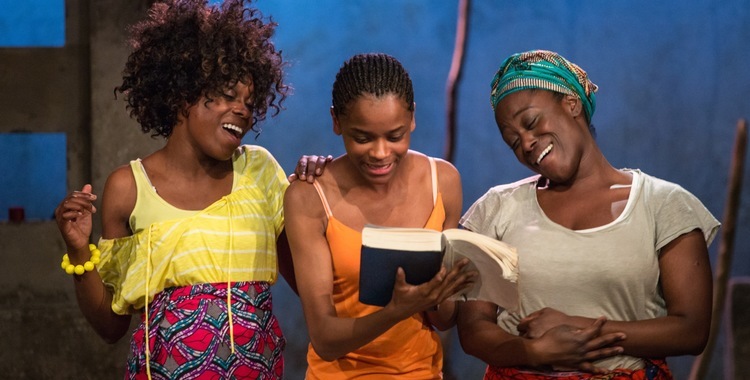
The worst things are always unseen: the bloodshed just off-stage or -screen, the implied atrocity, the imagined worst case scenarios. The same goes for Eclipsed, a violent play in which violence is more a texture than a series of acts. Set in a warlord’s compound during the Liberian civil war in 2003 and focusing on the women scratching out a living there, Danai Gurira’s play and Caroline Byrne’s production keep all of the worst horrors out of sight, but their shadow is ceaselessly cast over everything else.
So we see guns, but we never witness anyone being shot; we see the aftershocks of battle, but never the moment of impact. The daily reality of sexual violence, meanwhile, is gestured towards with little more than the clanging of a door and the sudden, obedient formation of the commanding officer’s “wives” into a line: a ritual as regular as clockwork, broken when one is selected and silently offers her body in exchange for her safety. The microcosm that Eclipsed depicts is a man’s world populated by women, with the forces controlling their lives always just around the corner, their presence oppressive but invisible.
“Violence,” writes Lucy Nevitt in Theatre & Violence (part of Palgrave Macmillan’s excellent Theatre& series), “tells us things about the culture that produced it: the kinds of power relationship on which it is built, the attitudes and values that it takes for granted. A representation of violence can reiterate or challenge normalised social structures.”
This raises a knotty and regularly asked question: does the representation of violence (and especially violence against women) simply reinforce the structures and ideologies that allow that violence in the first place? And is a representation of violence on stage indeed an act of violence in itself? Here, violence has become habitual in the lives of these women, but its destructiveness is never normalised. When a nameless new arrival turns to guns rather than her body as a tool of survival, we feel the full, horrific weight of that (non-)choice, as well as the power structures that force it upon her.
Violence also turns things upside down, unsettling reality. Beneath the routine brutality, there’s a strange tedium to conflict in the experience of these women. Eclipsed brilliantly captures the precarious yet mundane rhythms of their existence, in which war has become a constant, faded backdrop. It’s not the atrocities that demand stage time so much as the long expanses in between, dead hours to be filled with joking and squabbling and reading eagerly from a battered Bill Clinton biography (the States always distant yet near). Humour is punctuated with horror.
Much like Palestinian drama Fireworks (another of the best new plays I’ve seen so far this year), life in Eclipsed has a flat yet brittle texture, one that threatens to be shattered by the yearned-for but terrifying promise of peace. It’s become impossible to imagine a time beyond the conflict – as one character puts it, “I don’t know who I is out of war”. When your identity is so wrapped up in violence and instability, how do you get a hold on who you are?
For all of its vital wider critiques, it’s the five complex female characters who emerge most powerfully from both Gurira’s play and Byrne’s assured, compassionate production. They’re all known by role rather than name: the commanding officer’s wives numbered by rank, the visiting outsider simply identified as one of Liberia’s Women of Peace. Yet in the hands of Byrne and her brilliant cast, each is distinctly and humanely individual. Wives number one and three (Michelle Asante and Joan Iyiola respectively) bury fear and anxiety in affectionate quarrelling, jostling for the CO’s favour. The former discovers a glimpse of herself when she scores her real name – Helena – into the scorched earth; the latter finds meaning in the birth of her daughter.
Lingering on the edges of the compound are Faith Alabi’s diamond-hard wife number two, now going by the name of Disgruntled and toting a gun, and Rita (T’Nia Miller), a woman on a mission for both peace and her missing daughter. But it’s the astonishing Letitia Wright as the new girl – we never learn her name – who leaves the most shattering impact. Tough yet vulnerable, there’s a determined stillness to her suffering, everything contained behind the eyes. When that exterior finally cracks, the shockwaves reverberate long after the curtain call. We don’t need to see what has happened to her to feel the depth of its horror.
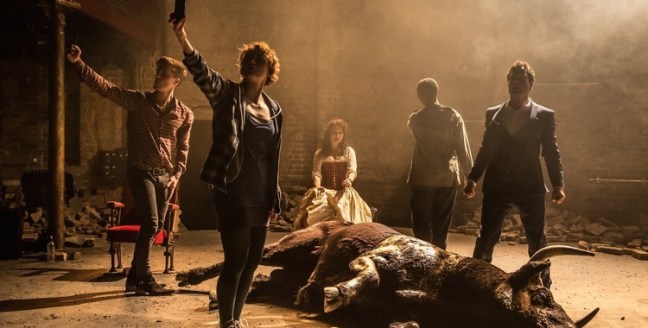
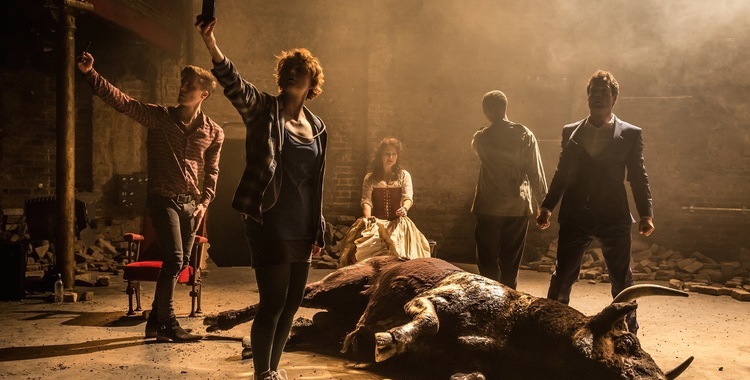
Entering the once again reconfigured Almeida auditorium, those of us with seats in the stalls are directed through dingy backstage corridors, emerging onto a rubble-strewn stage. We’re in a crumbling opera house, winding our way past the huge stricken bull that dominates Lizzie Clachan’s design. It remains there in the centre of the stage – hulking, symbolic, breathing its last – as the fractured lives of Simon Stephens’s play circle it, step over it, snap photos of it on their ubiquitous, glimmering smartphones.
The bullfight metaphor has mileage. In Mike Bartlett’s Bull it provides the entire form for the play, as two suited-and-booted matadors savage their doomed colleague. In Islands, the violent ritual is once again symbolic of capitalism, described in extended, gory detail by a grinning Caroline Horton. Here, the dying animal oozes tar-like blood across the stage, an ever-present image of devastation.
It’s also a reference to the bullfighting backdrop of Bizet’s opera, which Carmen Disruption explodes and pieces back together. There’s a moment right at the start of Michael Longhurst’s production – discordant strains of cello, darkness pierced with splinters of light – which somehow feels like a shattering of glass. The rest of the play is spent gathering those shards, fingers bloodied, jagged reflections glinting off the multiple shiny surfaces. It’s Carmen smashed, Carmen refracted, Carmen disrupted.
At the play’s centre – if it can really be said to have a centre – is an unnamed Singer (Sharon Small). She arrives at an unnamed airport, travels through an unnamed European city, arrives at an unnamed opera house sat on the edge of an unnamed river. All she really knows is that tonight she’s singing Carmen, the role she has performed in multiple productions in multiple cities, each shading into the next. And as she traverses this strange yet familiar urban landscape, the opera becomes more real than the faces and buildings sliding past her, imposing itself on the contours of the city.
Carmen becomes Jack Farthing’s swaggering rent boy, all leather jacket and sex appeal. Don José (the quietly astonishing Noma Dumezweni) is a driver for a shady character, trying to pay off old debts and right old wrongs; Escamillo (John Light) has traded bullfighting for investment banking, with a huge bet riding on the canned beef market in China, while Micaëla (Katie West) is a lost, lonely student. Their lives overlap, intertwine, glide past each other, as they all catch glimpses of a mysterious woman with long, curly black hair.
It’s a lot to take in. Longhurst’s direction is swift and sharp; miss a sentence and you won’t get it back. But while these intersecting stories are occasionally hard to follow, you can’t miss the distinctly 21st-century loneliness that throbs through all of them. Instead of speaking to one another, the broken individuals of the play talk out to us. As in Pornography, or in the never-quite-connecting monologues of Barrel Organ’s Nothing, Carmen Disruption offers a portrait of atomisation. The only respite from solitude and heartache is found in the glowing rectangles of smartphones – “should I look it up on my phone?” Small’s floundering Singer keeps asking, eyes darting wildly – while fleeting identity is invested in the things people buy: shirts, espressos, opera tickets.
There’s a thick vein of alienation and global dislocation running through Stephens’s more recent plays. The Singer is Paul in Birdland. She’s Iggy in Three Kingdoms. The world has fallen away from her, sloughed off by countless airport departure lounges and identical hotel rooms, disappearing along with any sense of self. Directors tell her where to stand and how to move her arms, but “they never tell me who the fuck I’m meant to be”. There’s a line repeated from Birdland: “none of this is real”.
That’s one way of reading Carmen Disruption. None of this is real. But that loss of reality is less to do with the Singer’s disorientated mental state and more to do with the identical, antiseptic spaces of late capitalist cities; the global simulacra of hotel rooms and lobbies and shopping centres. It doesn’t feel real because there’s nothing distinct about any of it. We might as well be anywhere – and in Longhurst’s production we are. This is a shadowy world, one eschewing the shiny coloured surfaces of Carrie Cracknell and Ian MacNeil’s Birdland in favour of the crumbling alternate reality of the opera. Theatre has become more real than life, but even that illusion is dissolving at the edges. The only constant is the low hum of electronic alerts, a peripheral stream of information scrolling on the surtitle screen mounted in the back corner of the stage.
The result is smashed-up and bruised and bloody, but breathlessly beautiful nonetheless. There’s a murky, eroding grandeur to Clachan’s design, with occasional bursts of glitter and dust, while the disjointed monologues are laced with echoes of Bizet’s score courtesy of the two onstage cellists. As that other, shadowy Carmen, glimpsed out of the corners of characters’ eyes, Viktoria Vizin is a haunting presence, her voice layering gorgeously over everything else. In the programme, she’s listed simply as Chorus, and there’s something about her constantly observing presence that seems to anticipate the Almeida’s upcoming season of Greek tragedies.
This tragedy, though, is not one of a fallen individual, but perhaps of a falling continent. No matter what the unspecified country we are in, this is clearly a Europe in crisis, its people worshipping at the feet of money and technology while failing to engage with – or even see – one another. The sadness that seeps into every pore of this production speaks of a wider malaise, a crisis that might be averted if only we were capable of reaching out to one another. There’s an insistent humanity to this scattered collection of characters, who yearn for intimacy while shunning it in the same movement. Again and again, they can’t connect. The tragedy is collective, but the pain is isolated.
Item: Entertainment (Ticket to Everything I Bought and How it Made Me Feel) Cost: One review/response/blog/whatever the fuck we’re calling these now Needs: 20% Esteem, 80% Self-actualisation Affect: Excellent / +7
There’s no star rating but already this feels like a judgement; this decision to value in stark terms an exchange that is both work and not work. I’m not paying to be here and nor am I being paid, but it’s still a transaction. I think, not for the first time, about Megan Vaughan’s three reasons why she doesn’t accept free tickets for reviews and feel a twinge of something like guilt or discomfort or anxiety. How do you reconcile something that you love with an exchange that you hate?
Our lives can be measured out in transactions. The rent, the bills, the grocery shops – all the money we shell out just to keep going. The self-medicating coffees, chocolate bars and glasses of wine. The books and albums and theatre tickets and works of art that offer us identity and fulfilment at a price. The gifts that aren’t about how much money we spent, but sort of are. The building deficit of guilt.
Our lives can be measured out in transactions, and for twelve months artist Harry Giles did just that. On an excruciatingly exhaustive blog, he recorded every last purchase and how it made him feel. As he explains, it was an experiment in asking how consumer capitalism affects us on an emotional level. How does living inside capitalism actually feel? And is it possible to change that through what we buy?
Each purchase, as Giles explains in the show that has now emerged from the project, was logged along with its cost, what it fulfilled according to Maslow’s hierarchy of needs, and the emotion it elicited on a scale of -10 to +10. A picture gradually emerges: of money grudgingly handed over for the essentials, of an ongoing battle between ethical principles and guilty pleasures, of the hundred different ways in which our buying habits affect our wellbeing.
For the data junkies, Giles has put together a detailed annual report of his findings, but the numbers – as so often – are misleading. When he first strides across to the microphone on stage at Camden People’s Theatre, in his slightly-too-big suit and backed by his powerpoint presentation, Giles has the air of a bottom-rung sales rep about to break down some figures for us. Slides flash up on the screen as Giles explains them slightly-too-loudly and slightly-too-enthusiastically. As the piece goes on, though, the initial parodic tone becomes splintered by anxiety and the promised simplicity – “it all adds up,” Giles repeatedly assures us – unravels into more and more complication.
As the administrative litter of capitalism accumulates around him on the stage – receipts upon receipts upon receipts – Giles gives voice to the inner dialogue that underscores so much of our buying activity. That woozy cocktail of guilt, denial, principle and compromise, all delivered with jittering, ever-mounting anxiety, is so familiar at times that it hurts. I think of all the times I’ve shopped at the supermarket chain I hate and all the takeaway coffees I’ve convinced myself I need despite the waste. Giles also sharply captures the dilemma of ethical consuming: it seems necessary, in a harmful system, to make the least harmful choices, but expressing your politics through consumption feels like both a contradiction and a cop-out. In the end, of course, every decision is a sort of defeat.
But Giles also recognises the intense emotional attachments we can form for the things we choose to spend our money on. As I write this, I’m glancing occasionally across the room to my bookshelves. Of everything in our flat, it’s the sight I find most comforting, the collection of things that most roots me in this place. I can feel the glow of all those little, individual purchases: bribes to get myself through a hard day’s work, rewards for miniature achievements, satisfyingly impulsive buys. Unlike pretty much everything else, books are almost guilt-free purchases for me, which begins to explain why I own so many. I know that that erasure of guilt is false in many ways, but I allow myself to feel good about these objects. Money well spent.
So where does that leave us? Ultimately, there are no answers in Giles’ data, and the punishing year he spent tallying up every last penny has not helped him on his way to happiness – be that through frugality or extravagance. If anything, it seems like an oddly masochistic exercise, as does Giles’ intense and exhausting performance. As playful as it often is, Everything I Bought and How it Made Me Feel is difficult to laugh at, its chuckles leaving behind a bitter taste and its restless anxiety spreading from stage to audience.
Watching, though, I feel just the right kind of queasy. The discomfort that Giles has consciously documented is not one that can tell us how to assuage our spending guilt, but by cultivating the same discomfort in his audience he begins to push past the numbers and through to the feeling of money and politics (the two sometimes seeming indistinguishable from one another). And as I’ve reflected before, I think there’s something in how politics feels, something that – when it denies us easy, sentimental catharsis – holds within it a sort of hope. Beyond immediate guilt or gratification, we can’t really change how we feel through what we buy, but perhaps we can start demanding the kind of emotions that aren’t easily bought and sold.
“Our cancerous culture atrophies through the very real lack of a will to live: to idolise death is to reinforce that.” – Jon Savage
I’m reading about Ian Curtis and I’m thinking about death.
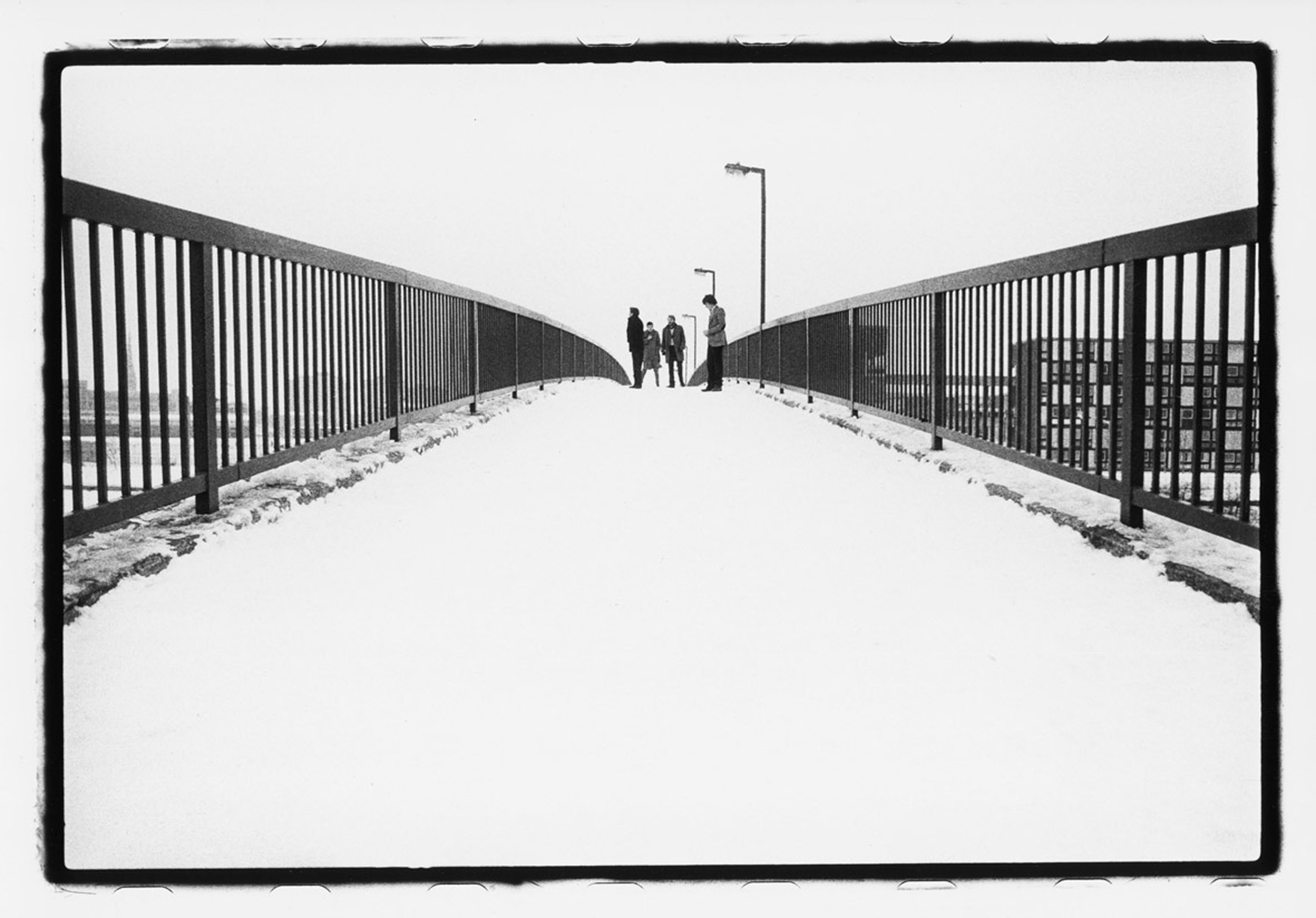
Last week, in a moment of impulsiveness – the kind that always seems to seize me in bookshops – I bought a biography of the Joy Division frontman written by his widow Deborah Curtis. My fascination with the band and its lead singer was reignited by the BBC’s excellent documentary, in which Curtis’s absence gaped like an open wound, and by seeking out Jon Savage’s review of Unknown Pleasures immediately afterwards. Like so much that was written about Joy Division during their short life, it now feels eerily prescient, its question “where will it end?” having been provided with its devastating answer.
As Savage wrote following Curtis’s death in 1980, “Death is romantic, exquisitely sad; it provides an easy package, an easy full-stop”. This is the narrative not just of the rock’n’roll mythology that Savage is critiquing in the aftermath of Curtis’s suicide, but of a whole culture that stretches from Thomas Chatterton in the eighteenth century to the so-called “27 club” in the twentieth and twenty-first. Why else, after all, would I be sitting here writing this? There’s a continuing, irresistible fascination that surrounds all these short-lived figures: Romantic poets Byron, Shelley and Keats, youth icon James Dean, too too many musicians. Their names – Janis Joplin, Jim Morrison, Brian Jones, Jimi Hendrix, Kurt Cobain, Amy Winehouse – have become a roll-call of romance, fame and tragedy.
It’s dangerous, yet alluring. Unlike Curtis, who spoke from his teenage years onwards about dying young, I’m far too giddily in love with life to understand this impulse, but I’m captivated by it nonetheless. There’s a stubborn romantic streak in me which is apparently drawn to the morbid as much as the beautiful. Or maybe it’s just intensely human; a heightened instance of that odd, doubled attitude that we have as a species towards death. I’m reminded of the chilling yet matter-of-fact opening of Karl Ove Knausgaard’s A Death in the Family, in which he writes about “the collective act of repression symbolised by the concealment of our dead” at the same time as death is everywhere in society, decorating newspapers and television screens. We’re fascinated by those who die young, perhaps, because they represent a confrontation with the reality that the rest of us simultaneously stare down and avert our eyes from.
Knausgaard continues: “If the phenomenon of death does not frighten us, why then this distaste for dead bodies? Either it must mean that there are two kinds of death or that there is a disparity between our conception of death and death as it actually turns out to be, which in effect boils down to the same thing: what is significant here is that our conception of death is so strongly rooted in our consciousness that we are not only shaken when we see that reality deviates from it, but we also try to conceal this with all the means at our disposal.”
The reality of death gets covered up by the myth. Premature death becomes cultural immortality.
This contradictory attitude towards life and death is right at the (still beating) heart of 27. I’ve seen and written about Peter McMaster’s show twice now and still it haunts me, the sudden memory of images from it catching me out and leaving me slightly breathless again. It’s full of astonishingly, agonisingly beautiful moments, as the bodies of McMaster and fellow performer Nick Anderson embrace and struggle and support one another. In this physicality, it feels at times as though the show is a demonstration of being alive, together with all the joy and pain that involves.
But it’s also about death. The title is a reference to the “27 club”, the show in part acting as a sort of homage to all those artists. Their music forms the soundtrack, from “Break on Through to the Other Side” to “Back to Black” to the heart-punching “Cry Baby”. And it’s about McMaster, also 27 and teetering between past and future. There’s lots about growing up, letting go, moving on, but also – as McMaster makes explicit early on – about wanting to die. It’s a show about wanting to die and it’s a show about wanting to live.
The signs of death litter the stage, which is carved out as a space of ritual and liberally scattered with ash. McMaster and Anderson begin the show in skeleton bodysuits, a gesture both macabre and playful, before later stripping to their bare skin. For all its fascination with the ceremonies and myths of dying, though, 27 can’t get away from life. In a generous (and often, let’s be honest, squirmingly hilarious) sequence, the two naked performers invite us to touch parts of their bodies, to feel their hearts pounding in their chests. It’s a moment that seems to say “look how alive we all are”. Look how alive we all are, together, in this space.
“I’m a strange new kind of inbetween thing aren’t I not at home with the dead nor with the living” – Antigone
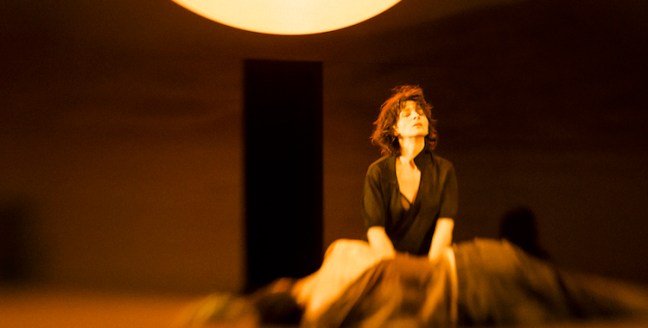
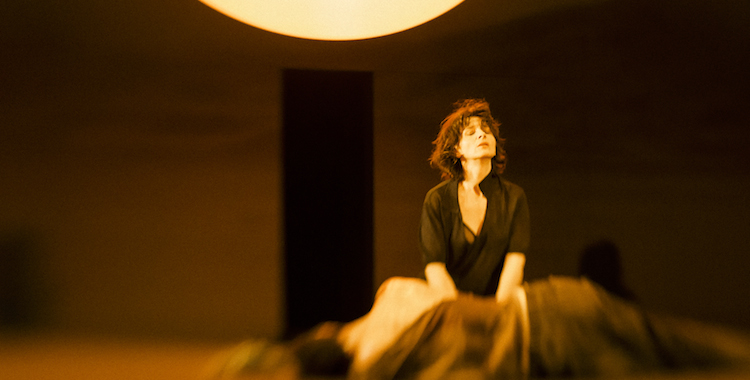
In tragedy, death is a certainty. Throughout Ivo van Hove’s new version of Antigone at the Barbican, though, it’s even more of a constant presence than usual, hanging like a shroud over everything else. Van Hove’s is a production – and a protagonist – half in love with death. In Anne Carson’s precise, poetic translation, Antigone is repeatedly a bride to her grave, wedded to her end even while still alive. Clothed head to toe in black, from the moment she steps on stage Juliette Binoche gives the impression of being not quite of this world, as though she is only passing through on her way to the other side.
At one point, a member of the chorus (who all double interestingly as other players in the action) lingers over the word “uncanny”, pronouncing each syllable with conspicuous care. And this Antigone is uncanny. It feels oddly suspended, hovering on a plane between life and death. Initially, what I take for its cool detachment and flat delivery is distancing and frustrating. Instead of visceral immediacy, van Hove gives us poise and elegiac calm. Even when the outbursts of passion do arrive, as they must, they feel oddly controlled, as if every last word and gesture were carefully measured.
It’s easy to see, then, why it reads as lacklustre, but it’s all too deliberate for that. For me, the distance and control speaks of a shadowy elsewhere, a place saturated with grief and already half swallowed up by death. The cut-out circle at the back of Jan Versweyweld’s sleek, spare design is sun and moon and a bright, gaping portal to the next world. The same sense of ritual that frames 27 pervades Antigone – most obviously when Antigone defiantly buries her brother Polyneikes, but elsewhere too. And in a piece of doubling that is surely not accidental, the dead come back as messengers for the living.
It takes its time, but I find this controlled, funereal approach gradually tightening its grasp, and by the end I’m scrunched forwards in my seat, utterly compelled. But what is it that’s engrossing me? The supposed romance of a woman consumed by grief and obsessed with death? The uncanniness of this meeting between life and death, both painted in beautiful if muted colours? The possibility of taking aesthetic pleasure from something so painful?
There’s something stultifying, if strangely compelling, about this romantic myth of early death. It speaks of a culture in which the only conceivable future is one of oblivion and individual fame, rather than one that people work together to construct.
At the end of Antigone, after the drama has reached its devastating climax, the chorus detach themselves from the tragedy, gradually becoming dispersed individuals. The portal between life and death is closed up and these figures resume the busy, self-contained activities of modern life, oblivious to the suffering of Patrick O’Kane’s Kreon as he writhes on the raised surface of the stage, while the Velvet Underground’s “Heroin” plays hauntingly underneath it all (“I’m gonna try to nullify my life,” Lou Reed sings). It’s a snapshot of atomised 21st-century life: we consume, we forget, we move on. Death is just another form of entertainment.
There’s more ambivalence at work in 27. If Antigone is detached and distanced, McMaster’s show is thrillingly – sometimes claustrophobically – close. We are never allowed to forget that we are in the same space, participating in this strange ritual alongside one another, whereas there’s a sense of a huge gulf between us in the audience and the small figures on stage at the Barbican. 27 doesn’t deny the appeal of dying young or the fascination of all those idolised dead, but it’s wrestling with something that is in many ways harder than that “easy full-stop”: the challenge of living, of moving into the future together.
Writing in response to Unlimited Theatre’s Am I Dead Yet?, I suggested that “if we can get better at dying, maybe we can get better at living too”. Our view of death – the ways in which we confront and conceptualise our inevitable end – says a lot about the culture in which we do our living. Perhaps, in order to really move forward, we need to rethink both.
“Turning around to the next set of lives Wondering what will come next.” – Joy Division, “Passover”
There’s a lot to be said about Nicholas Hytner’s tenure at the National Theatre. Hell, there are probably people already working on books about it. There’s the introduction of NT Live and the use of new spaces in and around the building; there’s the commercial success of shows such as War Horse, One Man, Two Guvnors and The Curious Incident of the Dog in the Night-Time; there’s the NT’s growing association with, for want of a better word, more “experimental” companies creating work beyond its walls. And then there’s the uncomfortable, lingering question about the imbalance of male to female artists, something I’ve written about in the past, which forms part of a much broader set of issues around representation and accessibility – issues of vital importance for a theatre that purports to be “national”.
As fascinated as I am by the narratives that establish themselves around certain theatre institutions and artistic directors, though, I don’t want to go into any of that right now. But what I was struck by yet again reading Michael Billington‘s assessment of the Hytner era (as well as the astonishing statement that the lack of Sheridan revivals is a bigger problem than the under-representation of female writers) was the extent to which theatres in this country are judged by their ability to address “the big issues of the day”. Billington approvingly frames Hytner’s NT as a “forum for debate”, a triumphant statement that is quickly followed by a staggeringly generalised blow to the political credentials of all continental European theatre (“I don’t know of any comparable theatre on the continent […] that feels a need to tackle the crises affecting our daily lives”).
This interests me not just because I instinctively disagree with the narrowness of Billington’s definition of political theatre (more on that later), though I do. It also brings me back to what turned out to be the central question of my MA thesis, which looked at the cultural narratives that have been built around another major, frequently mythologised British theatre: the Royal Court. In that thesis, I suggested that a certain understanding of theatre’s purpose in the world as a (text-based) platform for discussion and debate intersects interestingly with the traditional purpose of theatre criticism, an institution whose history in this country is inextricably tied up, for better or worse, with that of journalism. I wrote that “there is a generally accepted model of writing about new plays, in which the playtext itself is the principal focus of attention and the success of the production rests on the perceived effectiveness of the play’s central ‘argument'”.
I won’t rehearse that whole argument (yes, argument – the irony) again here; it’s in the thesis, for anyone who’s interested, and I’m very open to challenges to my reasoning, as these are ideas that will most likely come into play again later in my PhD. To return to Billington’s article, though, there are two points which are particularly revealing of the role he sees for theatre and for himself as a critic. First is the scepticism and light disdain implicit in his overview of “Hytner’s attempt to redefine what we mean by ‘theatre’,” an endeavour that Billington sums up with the vague, yet also vaguely dismissive, verdict of “artistically mixed”. This is then followed by the observation that two of Hytner’s biggest hits – War Horse and Curious Incident – “have been shows in which text is only one feature of a total theatrical experience”. Erm, doesn’t that essentially describe all theatre?
Secondly, Billington paints the NT’s relationship to the world around it as akin to that of the newspaper or news broadcaster. We have, in line with this idea of the theatre’s role, had shows “about” (I’ll only stop linking to that blog when it stops being relevant) a range of appropriately newsworthy topics: the Iraq War, the financial crisis, climate change, immigration, press corruption. And it’s doubly telling that Billington’s NT article was published by the Guardian just days after Charlotte Higgins‘ long, sprawling piece about political theatre, which departs from some strikingly similar assumptions: “Unlike music, dance and visual art it is theatre’s wordiness – the fact that it likes to place people in a room and have them talk, and disagree – that makes it the artform most closely allied to politics”. Higgins’ article also demonstrates that familiar formulation of theatre as a civic space, pointing back to Athens (where else?) and the central place of theatre in the city-state.
This all points to something that I feel is quite particular to the framing of theatre and its role in the UK. Tom Cornford (who, as an aside, was one of the people I was talking to recently about exactly the kind of narrative-forming that Billington’s article represents) has suggested that most mainstream critics in this country go into shows with “an unthinking expectation of pseudo-realistic form”. I think there’s some truth in that, certainly for some critics, but I’d suggest that it’s even more common for us (and, hands up, I include myself in this) to have the expectation that a piece of theatre will say something; that, explicitly or implicitly, it will articulate some sort of argument, which we will then assess. That’s what we’ve been taught to expect. Those are the terms on which critical discourse has established itself. And if theatre has an argument, that argument is usually expected to spring from the text. It both starts and ends with words.
But performance itself troubles that neat equation. In my current research, which is roughly speaking attempting to theorise the theatre text (emphasis on attempting), I keep encountering this idea of something in performance that is “in excess” of any text. Michael Goldman in On Drama: Boundaries of Genre, Borders of Self, for example, writes that “in drama one finds inevitably an element in excess of what can be semiotically extracted – something that is also neither irrelevant to nor […] completely independent of the text”. Benjamin Bennett, meanwhile, uses the example of Beckett’s famously precise plays in All Theater is Revolutionary Theaterto demonstrate that the meaning of the text and the performance – no matter how detailed and prescriptive the former – can never be identical. Unpredictable human bodies and the evident materiality of the stage will always get in the way of that possibility.
This is a much knottier idea than the above paragraph acknowledges, but I won’t attempt to untangle it here. Instead, a pair of examples serve to begin prodding at and problematising that idea of theatre as argument. In my MA thesis, I turned to Katie Mitchell’s production of Ten Billion at the Royal Court in 2012 – an intriguing example, because it’s about as argument-like as theatre gets. After I’d finished writing that thesis, of course, Ten Billion was followed up by 2071, another show about climate change that was seemingly resolute in its lack of theatricality. Billington unsurprisingly offered high praise to both, but I find the terms of that praise really fascinating.
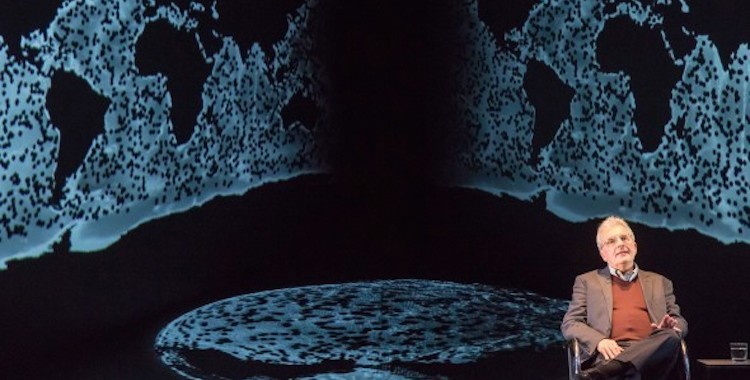
Both Ten Billion and 2071 are explicitly “about” climate change, delivered by scientists (Stephen Emmott and Chris Ripley respectively) and more or less following the format of the lecture. Writing about both shows, Billington acknowledges their questionable relation to theatre in almost identical terms. Reviewing Ten Billion, he writes: “Some will argue this is a lecture, not theatre. But the distinction seems to me nonsensical”. In his review of 2071, he repeats the same point with slightly more force: “Some will argue that this is not really theatre. But the idea that theatre should be exclusively reserved for fiction has been knocked on the head by a surge of documentary dramas and verbatim plays”. He adds, in relation to Ten Billion, that “Theatre is whatever we want it to be and gains immeasurably from engaging with momentous political, social or scientific issues”.
While this tells us a lot about what Billington believes theatre’s purpose to be, there’s little in either review that refers to the theatricality of these events. Most of the space is taken up by relaying and assessing the persuasiveness of the argument in question, with only fleeting mentions of its staging. Going by Billington’s analysis, the facts, figures and conclusions provided by Emmott and Rapley might as well be read in a book. Concluding his five-star review of 2071, Billington surmises that “if we look to theatre to increase our awareness of the human condition” – which he clearly does – “the evening succeeds on all counts”. But in what distinct ways does it succeed (or fail, depending on your opinion) as theatre?
Two other views, each more focused on what Ten Billion and 2071 gain or lose as theatre rather than as pure argument, offer an interesting comparison. Contrary to Billington’s entirely text-focused assessment of Ten Billion, Matt Trueman suggests that Katie Mitchell’s production complicates and problematises Emmott’s argument. “What we watch is 100% lecture and 100% theatre at the same time, and it absolutely thrives on the duality,” Trueman argues. He points to the tension between the naturalism of the staging – a form usually associated with illusion – and the hard facts of Emmott’s lecture, concluding that “we are set in a mode of doubting” as an audience. This built-in doubt, according to Trueman, mirrors the doubt we so often express in response to climate change, burying our heads in the sand when confronted with the stark reality of our planet’s plight. Mitchell, in this view, is doing something extremely sophisticated with her staging; “anyone that dismisses Ten Billion as ‘just a lecture’ is ‘just plain wrong'”.
Stewart Pringle‘s review of 2071 similarly concludes that theatre transforms the argument in question, but to wildly differing effect. Despite acknowledging that what Rapley tells us is all important information and that its presence in the Royal Court Downstairs “is itself a vital political statement”, Pringle argues that placing this lecture in a theatre context “has fatally undermined its utility as anything else”. He writes: “2071 brings something unusual to theatre (the monotonal tedium of a lecture), but theatre has brought next to nothing to it”. Having seen 2071 (I missed Ten Billion), I can agree that it was decidedly untheatrical in its presentation and distinctly dull as a result. As Pringle points out, it’s even less theatrical than most lectures.
In different ways, then, the status of Ten Billion and 2071 as theatre undermines – or at least alters – the arguments they present. The unpredictable “excess” of performance complicates matters. In the case of Ten Billion – if we go with Trueman’s opinion, anyway – the conflicting vocabularies of lecture and stage naturalism create a certain tension in our reception of Emmott’s evidence that would not be present were we reading it from the pages of a book. 2071, meanwhile, suffers from its framing as theatre, making a poor case for the necessity of its place on a stage at the same time as thrusting the theatre’s awkward materiality between audience and content. By actually putting arguments on stage, free from the clothing of narrative and metaphor, these two shows (intentionally or not) point up some of the difficulties around that prevalent “theatre as argument” view.
I want to turn again to a point I made in my MA thesis which feels relevant here: “If theatre – rather than any other public forum – is a uniquely powerful civic space, then surely there must be something it offers in its gathering of bodies that cannot be found in text alone; something in its very theatricality which challenges a critical interpretation of it as the straightforward thesis of the playwright.”
In other words, if there is something uniquely political about theatre – the nation’s “debating chamber”, as Higgins’ article has it – then it has to go beyond text. That’s not necessarily to say that only theatrical form, rather than content, can be political, as that can lead to similarly unthinking reproductions of an existing and supposedly radical set of assumptions. (I’m thinking here about certain formal gestures that were genuinely experimental and radical when they first emerged but have since congealed into their own set of tropes.) But if we limit our understanding of argument or politics to the text, then we ignore something vital about what theatre is and what it can do. After all, as Billington himself puts it, “Theatre is whatever we want it to be”.
—
P.S. As well as itching an intellectual scratch, this blog is something of a tentative experiment in how to connect my academic research with my thinking and writing elsewhere. In practice, of course, my dual existences often overlap, and everything tends to get thrown into a soupy (if frantically colour-coded) mixture of thoughts. But I’m interested in how to share more of my research process with a wider audience, so let me know what aspects of my PhD research you want to hear more about (“none of them” being a completely acceptable answer to that question).




 Catherine Love