It’s quite astonishing how much of your heart you can give to a place.
A memory. I’m holding hands with a stranger on a sunny afternoon in East London. We’re here as part of Walking:Holding, Rosana Cade’s generous and thoughtful walking tour through the city. As we look up at a church, its spire sharply outlined against the blue sky, this particular stranger tells me that this is where she’d like to get married. Then she turns to me. Where would I like to get married? I still don’t really know how I feel about marriage; as an idea, it feels abstract and far away. But somehow, in spite of my ambivalence, I find myself offering an answer. Battersea Arts Centre.
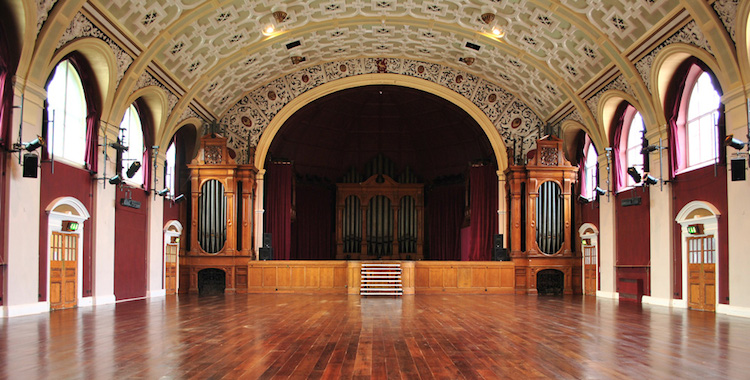
Perhaps it’s because part of me already feels wedded to BAC. Of all the theatres in London, it’s probably the one I spend most time at. There’s not just one thing I love about it. I love the work and the ethos and the people and the beautiful, beautiful building. I love its history as an old town hall and the way it’s built right into the community. And I love all the memories, big and small, that have seeped into its brick and stone over the years.
It’s where friends of mine have been convinced for the very first time that theatre might be something they could love. It’s where I first saw Forced Entertainment and Caroline Horton and Kate Tempest and Little Bulb. It’s the theatre in London where I’ve always felt most at home, whether visiting for a show, a cup of coffee or an evening in the bar. At times, I wanted to become an artist just so I could run away and hide in the bowels of that building for a few weeks.
Yesterday afternoon, a fire broke out at BAC. The extent of the damage still seems to be unclear, but it started in the roof of the Grand Hall, which has been destroyed. When I first saw the news on Twitter, I couldn’t quite breathe. It took about an hour of scrolling through updates, messages of support and devastating images (along with an awful lot of swearing) for it to really sink in.
I feel sure that BAC will carry on, but not alone. If the organisation means even half as much to you as it does to me, please give what you can, be it a fiver, a tenner, or simply a helping hand. Here’s a link to donate, and no doubt in the next few days it will start to become clear how all of us can pitch in to get BAC up and running again.
If there’s any scrap of a silver lining to take from this, it’s how much our theatre and arts spaces really matter, as powerfully demonstrated by the steady outpouring of love and support since yesterday afternoon. And we can continue to offer that support. BAC has captured so many of our imaginations; let’s reimagine its future together.
Despite being a fully grown adult with the extreme good fortune of doing something I love for a living, there are still days when all I really want from life is to go back in time and work on the Lord of the Rings film trilogy. As an awkward, bookish teenager, those movies – and slightly later on the books, in the form of a battered but beloved doorstop-sized volume passed down from my dad – meant everything to me. I spent much of the time I should have been revising for my GCSEs compulsively watching the DVD special features; my best friend and I had regular and passionate debates about who was better, Legolas or Aragorn (Team Aragorn all the way); and my bedroom was littered with dozens of carefully drawn, sub-Middle Earth maps of dreamed-up worlds for all the novels I was constantly planning (and failing) to write.
Looking back, I think it was about more than just an escapist love of fantasy and the sight of Viggo Mortensen wielding a sword (not that either of those things should be underestimated). I think it also had something to do with the idea of making something; of dreaming up an entire, meticulously constructed fictional universe (not to mention whole fucking languages), or of assembling a mind-boggling number of people in New Zealand to somehow haphazardly piece together a hugely ambitious bit of cinema. My unthinking, unprocessed reaction as a teenager was simply “I want that”. I wanted to be one of their gang. I wanted to make something.
—
This weekend, I said goodbye to Secret Theatre. The weekend before, some friends and I spent all of Sunday watching the extended edition Lord of the Rings DVDs back to back (that’s just under twelve quality hours in Middle Earth). And I’ve started to think that perhaps my steadfast, pulse-racing love for the two things isn’t all that different.
I can recognise that not everything about The Lord of the Rings is an unqualified triumph. The books are, if I’m entirely honest, a tad longer than they need to be. As for the films, there are plenty of moments where the pace flags; I never fail to roll my eyes at the is-this-the-end-oh-no-it-isn’t quality of The Return of the King‘s final half hour; and I remain irritated to death by Liv Tyler’s underwritten, maddeningly breathy Arwen. In fact, women in general don’t get much of a look in, an absence that isn’t made up for by Galadriel and Eowyn’s (admittedly cheering) badass moments. Similarly, at times I’ve been critical of numerous elements of the Secret Theatre project, from individual shows to its much-discussed secrecy. That doesn’t mean I’m not still bursting with love for both endeavours.
A lot has been said and written recently about fandom and tribalism. Matt Trueman followed up his column on fan culture last year with a new blog on the subject for WhatsOnStage; Megan Vaughan, whose end-of-the-year fanzine was perhaps my favourite Christmas present (it’s between that and my smoothie maker), penned a kind of parting love letter to Secret Theatre; and Stewart Pringle wrote brilliantly in praise of tribes and head-banging. Tribalism isn’t without its problems, particularly in the small world of theatre. At times it can be blinkered and exclusive, stoking the idea that the art form is the realm of an elite few. But I find myself agreeing with Dan Hutton, in yet another piece on Secret Theatre, that “we need some fucking tribalism now and again”.
Tribalism creates allegiances, it makes you feel part of a community, it means that you have something at stake. When you have something at stake, you can’t just shrug off the disappointment of a Show 6 (I can’t quite pin down why, but it just didn’t work for me) or the anticipatory dread of what look like mediocre, money-spinning prequels (I still can’t quite bring myself to watch the Hobbit films for fear that it’s going to be Star Wars all over again; a girl can’t cope with that kind of heartbreak twice in a lifetime). And as unfashionable as it may be for a critic to be anything approaching a “fan”, if nothing’s at stake then what’s the point?
I’ve just finished reading Hatchet Job, Mark Kermode’s latest book, and while it isn’t about to shatter the foundations of how I think about criticism, it does prompt a refreshing rethink of why on earth any of us bother doing it – not to mention offering a lesson (as most of Kermode’s writing does) on how to be at once entertaining, intelligent and accessible. Though nominally about the cruel pleasure of the scathing critical attack, Kermode’s book is drenched in a sincere and at times unapologetically sentimental love of the art form he writes about. He’s a fan in the true sense of the word, someone who melts at the memory of his favourite films and weeps for days after rediscovering a bit of beloved celluloid that he thought had been lost. At that point I wanted to reach through the pages and hold his hand, or at least say “I know. I know.”
Revisiting my two favourite Secret Theatre shows – A Streetcar Named Desire and A Series of Increasingly Impossible Acts – yesterday felt a bit like that. I hadn’t seen Streetcar since it was first staged by the company, right at the beginning of their journey together, and coming back to it was like greeting an old friend: discovering that you’ve both changed a bit, but that what you have is even better than you remembered. After all that time on tour refining and inhabiting it, the production just feels that bit more confident and that bit less in the hulking shadow of Three Kingdoms. Things that I liked first time round I loved on a second viewing: the coloured lights, the balloons, the sexy blasts of music. Also, who needs Gillian Anderson when you have Nadia Albina? I seriously doubt I’ll ever see a better or more heartbreaking Blanche.
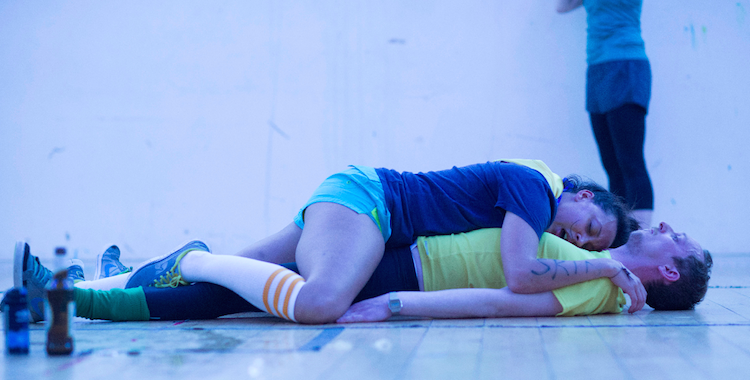
Then there’s A Series of Increasingly Impossible Acts. Deep breath. I’ve adored this show from the start and probably went from critic to ardent fan from the point at which Leo Bill’s name was pulled out of the hat the second time I saw it and I did an involuntary fist-pump, swiftly sacrificing any last shred of professionalism. Yesterday was my fifth time and, rather aptly, Leo was once again the protagonist. So what do I love so much about it? Too many things to list here. But I think the “Proud Mary” moment kind of sums it up. It’s a scene of such bittersweet joy and exhaustion and community and love and sheer, fleeting ecstasy that it manages to capture a whole kaleidoscope of emotion in one brilliantly silly dance. Last night I spent the whole thing with my face stretched in a smile so wide it forbid the tears that sat poised in my eyes, a deluge just waiting to be unleashed.
We try and fail and try and fail and try and fail again. But still we dance. (*wipes tears from eyes*)
—
If teenage me could have seen Secret Theatre, maybe I would have spent those clumsy, formative years following the company on tour, making bad devised theatre with my mates and agonising over who was my favourite between Leo and Sergo (undoubtedly a much harder choice than that between Aragorn and one-facial-expression Legolas). And I really, really hope that thanks to Secret Theatre’s ballsy, glorious, messy existence there’s at least one teenager out there who’s caught that bug, who wants to be part of that gang, who wants to make something. Even if, as a fully grown adult aching with nostalgia, she only ends up writing about it.
Fireworks is an exercise in dislocation. From its first, flashbulb bursts of light, we are shoved slightly off-kilter. With deft simplicity, Dalia Taha’s play and Richard Twyman’s production wrench us into the fear and uncertainty of war-ravaged Palestine, a suspended present moment in which nothing can be relied upon. Violence shades into playground games and make-believe shimmers with menace.
At the same time, we are always set at one remove. We can never forget that we are, after all, just watching, choosing to spend an interval of our privileged lives in this simulated state of precariousness. We can see the clearly demarcated outlines of Lizzie Clachan’s self-contained bunker of a set, a picture frame opening out onto another world. It might as well be the firework display that its title references; an explosive diversion, one that may leave us rattled but that we can walk away from nonetheless.
This closeness and distance, this sense that we walk in the characters’ shoes but can throw them off at any point, is crucial to how Fireworks functions. We need to be there, with the action, but at the same time always uncomfortably aware of the huge chasm that safely separates us from what is being depicted. We can be transported, but only temporarily, conscious all the while that our shaken responses cannot possibly be enough.
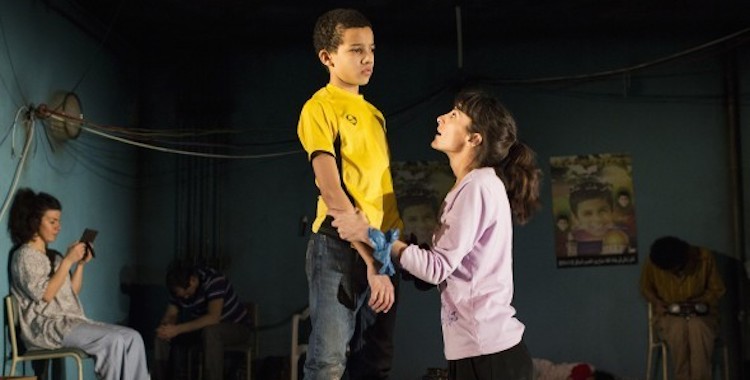
Almost everything happens in the deserted apartment building so vividly represented by Clachan’s design: all exposed pipes and wires, corners cluttered with the detritus of living. The side-by-side existence of two families, eschewing the questionable safety of public shelters for the claustrophobic refuge of home, is here compressed into one space, their lives overlapping and interweaving in the single, dingy room.
Taha’s play is anchored by the two children at its centre, both teetering on the brink of adulthood at the same time as staring down death on a daily basis. The familiar contours of childhood are mapped onto violent, shifting terrain. Like so many other youngsters, Khalil and Lubna play at being soldiers, but their games are unnervingly close to home, throwing back sharp reflections of the conflict they are surrounded by. Khalil’s favourite is the checkpoint game, one played out with chilling brutality.
Adults play too. Khalil’s mother attempts to coax him into childish fantasies, desperate to preserve their brittle shared innocence. The two women find fleeting respite in a game of skipping. Lubna’s father tells her that the rockets lighting up the horizon are just fireworks, a fiction that he seems to take more comfort from than his solemn, perceptive daughter does. Roles are reversed.
Through these playful coping mechanisms and loving deceptions, the lines between reality and fiction become increasingly blurred. Dreams, too, acquire unusual importance, representing a world beyond everyday reality – be that in the afterlife or up among the clouds. With the wall dividing the living from the dead so perilously thin, Taha vividly captures the importance of believing in an existence beyond the final bomb blast or hail of bullets; those lost in the conflict are always martyred, never killed.
If it all sounds a little amorphous, that’s because it is. There is little shape to Taha’s play, which instead lurches from one scene to the next. Given the circumstances, however, it feels utterly apt. The impression created – by everything from the restless performances to Natasha Chivers’ flickering lights – is of delicate moments carved out of an extended, indefinite zone of uncertainty. In the knowledge that everything could come crashing down at any moment, these small exchanges, these little sparks of connection, take on painful, nerve-shattering significance.
Note: the performance I saw was the second preview.
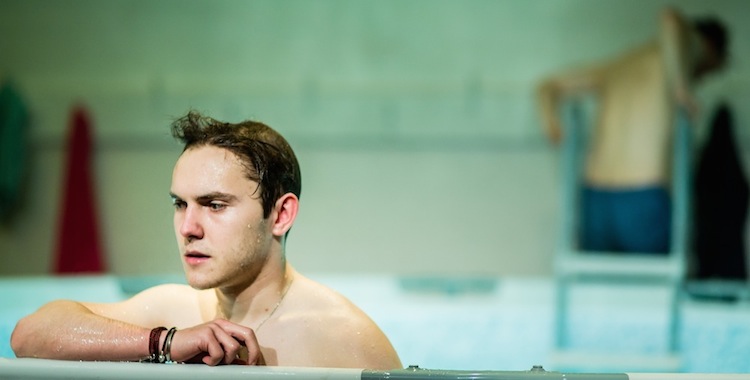
The first thing you notice is the water. The Mikvah Project has plonked a pool – “a massive fucking pool”, to quote Megan Vaughan – right in the middle of The Yard’s stage. It’s so dominating that there’s room for little else in Cécile Trémolieres’ design; just a row of hooks on the back wall and the tatty, functional, scrubbed-clean aesthetic of a public leisure centre.
The pool, tendrils of steam slowly rising from its surface, is the Mikvah of the title. If – like me before reading about the show – you’re wondering what a Mikvah is exactly, it’s a Jewish bath used for ritual immersion. It has associations of cleansing, transformation, rebirth. When Adam was banished from the Garden of Eden, he flung himself in the river that flowed from the perfect world he’d just left, desperately trying to wash away the stains of sin. The first Mikvah was born.
This space, saturated with ritual, religion and tradition, forms the constant backdrop of Josh Azouz’s tender two-hander. It becomes the focal point for the lives of its two male characters, 35-year-old Avi and 17-year-old Eitan, exerting an almost palpable gravitational pull. Even when the narrative positions them elsewhere, the Mikvah is still there.
The tradition, apparently, is to immerse yourself in the Mikvah three times, a nod to the three times it’s mentioned in the Torah. Avi, a man writhing inside his own skin, immerses nine times. He just can’t get clean enough. As for Eitan, well, he’s not sure he wants to wipe away his apparent sins.
Azouz’s play – and similarly Jay Miller’s production – takes its time. It unravels (and unravel feels like just the right word) at an unapologetically gradual pace. We learn a little about the characters: that Avi is married and trying desperately for a baby, that Eitan is still at school and has been kicked out of the synagogue choir. But more importantly we learn about their relationship, a vague acquaintance that through the shared ritual of the Mikvah delicately, almost imperceptibly shifts into something far deeper, far more intoxicating.
It’s immersion by stealth. Watching, at first it feels as though I’m treading water – ticking off items in a mental exposition checklist, trying to decide whether the delivering of lines into microphones is interesting or cliched. But slowly, inch by inch, and without me quite realising until it’s too late, I get dragged under. Soon I’m gulping for air and stretching my water metaphors too far in an attempt to sidestep what I can’t quite articulate.
A lot of it has to do with the understatement and delicacy of the performances. As the older Avi, Jonah Russell flickers with a near-constant edge of discomfort. He is the very definition of unsettled, both by Eitan and by his own reaction to this teenage boy. Oliver Coopersmith’s Eitan, meanwhile, struggles to contain everything he feels, his jittery impulsiveness threatening to overpower Avi’s ruffled sense of propriety. Their conversations carry all of this at the same time as being awkward, halting, weighted down with the baggage of the real world outside the Mikvah. Intimacy can only emerge at intervals. And by the time the orbit of these two men crashes together, we instinctively understand that the sweetness of their collision will be short-lived, painfully intensifying the joy of their coming together.
The whole production is similarly light of touch. On second preview, there are still some moments that unsurprisingly snag – the opening hasn’t quite got the clarity it needs yet, and generally the scenes set outside the Mikvah are less confidently realised than those within its walls – but the overall feeling is one of tender fragility. Unobtrusive projections flicker and ripple insubstantially on the back wall; small, murmured snatches of “Hideaway” and “Wicked Game” and looped, ritualistic humming provide the spare but evocative soundtrack. Then there’s the pool itself: ever-present, with all its heavy suggestions of the faith that binds the two characters, but at the same time playful and kind of joyous.
There’s also an interesting but not quite fully explored sense in which Avi and Eitan are telling their own story, alternately distancing from and drenching themselves in it. Outside the Mikvah, Azouz’s script plays around with the first and third person; at times, both men want to dissociate themselves from their actions and emotions, while at others teller and subject merge into one. These shifts could be exploited more, elaborating on the conflicted and altering attitudes both men feel towards their relationship – a relationship that they might occasionally want to scrub away along with everything else.
But they can’t. The Mikvah yields transformation, for sure, but it can’t cleanse Avi and Eitan of their desire or their pain. Like that very first Mikvah that Adam immersed in outside the boundaries of Eden, it fails to transport them back. Instead they’re left, stranded in this new world and struggling with what that means. Struggling, flailing, trying not to go under.
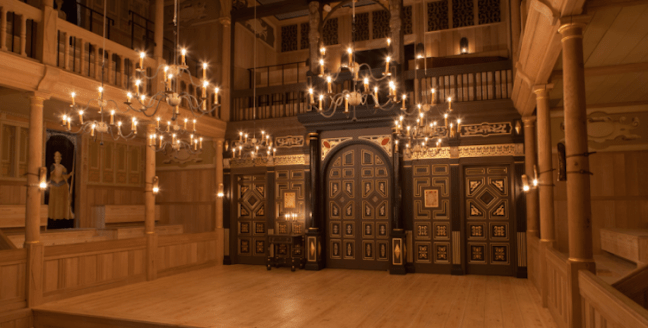
Putting on a play at the Sam Wanamaker Playhouse is the architectural equivalent of heartthrob casting. Forget what’s actually happening on stage; it’s an effort of supreme will just to stop perving on the carpentry and the detail and the candles – oh the candles. Three hours of fragile, twinkling candlelight and I begin to wonder why we ever bother illuminating theatres in any other way (sorry lighting designers).
The building, then, is the immediate star of any show it stages. Dominic Dromgoole’s production of The Changeling, Thomas Middleton and William Rowley’s gloriously bloody tale of murder, lust and deceit (the Holy Trinity of Jacobean drama), lightly accepts this, allowing the space to shine – or flicker – as much as the play that fills it. Pauses to appreciate the flame-pricked gloom or the delicate choreography of lighting the dangling chandeliers are just as important as the action they punctuate. The dim, moody atmosphere of the Playhouse, meanwhile, is forgiving of the gore and excess of Jacobean tragedy. What could be sheer Hammer Horror under the glare of bright lights seems no more than appropriately gruesome in this murky house of shadows.
Still, Dromgoole doesn’t exactly sidestep the more lurid aspects of Middleton and Rowley’s tale. Though a tragedy in name, The Changeling has its share of the ridiculous. The swift about-turns, the riotous madhouse subplot and the sheer volume of asides all lend the play to a blackly satirical, tongue-in-cheek interpretation, one that Dromgoole and co gleefully seize upon. Indeed, you begin to wonder whether The Changeling isn’t one big theatrical joke; a wickedly ironic comedy clothed in dark tragic garb.
When they wrench our attention away from the pillars and chandeliers, Dromgoole and his cast offer us a conspiratorial Beatrice-Joanna, a surprisingly dry Deflores and an unusually uncomplicated chorus of merry asylum inmates. What is the nature of madness, after all, in a fictional world where love seems to make madmen, fools and murderers of everyone? Desire is either a spur to bloodshed, in the case of Beatrice-Joanna and her servant Deflores’ swift dispatch of future hubby Alonzo in favour of new suitor Alsemero, or a cause for counterfeit delusion in that of asylum mistress Isabella’s would-be lovers. The only real constancy is the change of the title.
Dromgoole transforms it all – from the venom-laced insults Beatrice-Joanna hurls at Deflores to the gathering puddles of spilled blood – into comic potential. This Changeling is, first of all and unashamedly, entertainment. The obligatory closing jig, in which the blood smeared corpses rise and playfully skip around with their living counterparts, sneaking grins at one another and the audience, neatly captures the spirit of the whole. The many asides, so easily rendered as clunky interjections, are bursts of irrepressible, almost childish emotion. The often ditched asylum subplot is an unapologetic romp, with joyful turns from Brian Ferguson as fake fool Antonio and Pearce Quigley as a restless, wise-cracking Lollio.
But it’s the production’s take on Beatrice-Joanna that really makes it. Hattie Morahan – always a treat – has the audience on her side from the off. Whether giddy with infatuation after her first meeting with Alsemero, plotting the slaughter of doomed fiancé Alonzo, or wriggling her way out of the labyrinth that murder – and the reward of her virginity demanded by willing assassin Deflores – lands her in, there’s a glint in her eyes that seems to say “you’re with me, aren’t you?” Both her revulsion and attraction to Trystan Gravelle’s shruggingly sardonic Deflores, meanwhile, have a youthful impetuosity, her emotions plastered all over her face. Even when things are at their most desperate, Morahan’s Beatrice-Joanna is apt, like us, to contort her mouth into an awkward smile.





 Catherine Love