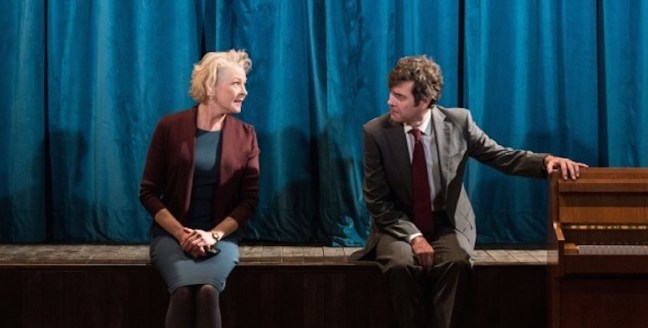
Bull, Young Vic

“Yes, they say nothing comes easy. But if it was easy, it wouldn’t feel this good.”

Bull6web

Forget Patrick Bateman. Housing developer Redrow has reinvented the cold-blooded, psychopathic city hotshot for a rapidly gentrifying London. Their latest advert (scrapped after a hail of online criticism and ridicule) promises the ambitious City boy everything he could want – including one of Redrow’s perfectly proportioned luxury apartments – provided he’s happy to crush the competition. “Make the impossible possible,” the male (naturally) voiceover seductively intones. “To rise and rise.”

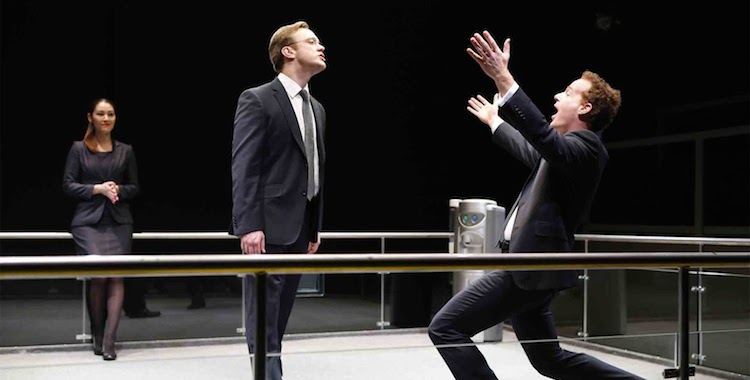
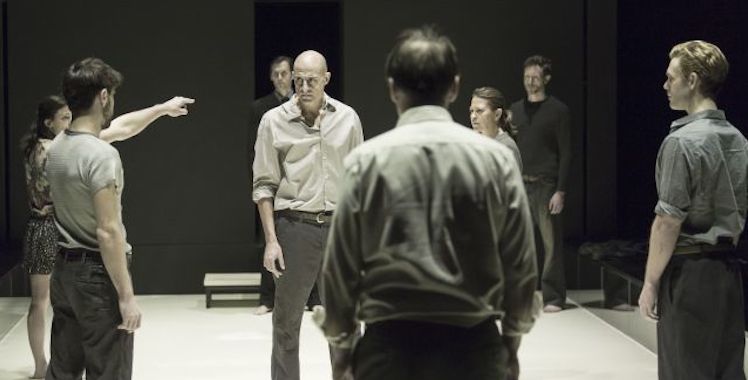
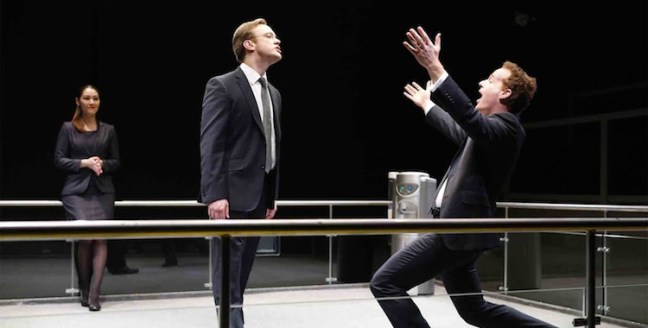
Redrow’s ad is the sleek, aspirational face of a cutthroat post-credit crunch Britain. Mike Bartlett‘s short but bracing play Bull is its grubby underside. The title is a reference to the bullfight: an intricate and bloody display of power. Bartlett’s corporate equivalent, staged by Clare Lizzimore and Soutra Gilmour in a spare, claustrophobic arena formation, is the desperate grapple for jobs in the face of downsizing. Three employees are waiting to meet the boss; only two can return to their desks. It’s the Hunger Games of office politics.

Bleak as it sounds, Bartlett’s play is viciously entertaining, just in the grim, guilty way that The Apprentice is entertaining. Tony, Isobel and Thomas circle one another like animals, sniffing for weaknesses and lashing out with language. The insults are often bitterly funny (“stop shuffling around like an autistic penguin,” Isobel snaps at Thomas), but Bull‘s laughs are just as likely to sour in the mouth. It’s hilarious until it’s not.

As the nervous one-upmanship escalates, it soon becomes clear which employee is primed for the chop. Thomas, ridiculed for everything from his suit to his receding hairline, is the weak one in the pack, and the Darwinian logic of the workplace – like that of the schoolyard – dictates that he has to be brought down. It’s playground bullying, pure and simple, but with higher stakes and sharper uniforms.

In the Young Vic’s taut production, this all unfolds in swift but tense fashion. Lizzimore directs the cruel back-and-forth at a machine-gun rattle, occasionally punctuating the rapid dialogue with precise, painful silences. The verbal equivalent of a staring contest, it’s all about who snaps first. That person is, inevitably, Sam Troughton’s tightly wound, helplessly jittering Thomas, a man on the verge of eruption. As his opponents, Adam Jones and Eleanor Matsuura are hard and shiny as glass, the former doing battle with superficial mateyness, the latter with icy manipulation.

Gilmour’s minimal, antiseptic design is as deliberately impersonal and unspecific as Bartlett’s office setting. The precise nature of the job these three individuals are fighting for doesn’t really matter; what’s important is the lengths they’re prepared to go to. As an audience, meanwhile, we are positioned uncomfortably close to the action, with those standing at the front placed near enough to see the perspiration. We could intervene, but crucially we don’t.

Anything and everything – family, trauma, physical appearance – can be used as a weapon in the armoury of advancement. Make no mistake, Bartlett’s characters are fucking brutal. But worst of all, it’s not just a simple tale of office bullying. Bull is a whole ideology in microcosm; a waking nightmare of ruthless individualism. Scrap that – it’s beyond individualism. This is a world in which, like the hero of Redrow’s video, you need to be “more than individual”.

Bartlett’s play depicts this world in nasty, close-up detail, but the savagery is only ever presented. In a reversal of usual dramatic logic, there is no twist; the inevitable simply ensues, swiftly and excruciatingly. Formally, the production – like the master matadors it places centre stage – doesn’t put a foot wrong. But in its calculated perfection, in its vicious portrayal of a game it leaves unchallenged, it’s both enraging and devastating.

The corporate dystopia of Bull represents the real “aspiration nation”. And those who do rise and rise will find at their feet not the world, as Redrow promises, but the crumpled bodies of the countless Thomases who have to be crushed on the way up. That’s the choice: heel poised to trample those below, or face down by the water cooler.

Well fuck that.

Photo: Carol Rosegg.

Talking About Theatre

Dialogueweb_main_460_325_95_s

In the space of a few weeks earlier this year, I heard two anecdotes about theatre and audiences which have circled my brain ever since. First, during an interview about Fun Palaces, Sarah-Jane Rawlings told me about an encounter she had while running the Royal Exchange’s education programme. After a youth drama session, she asked one of the kids involved if his mum was coming to pick him up from the theatre; he replied no, she wouldn’t know what to wear. Then, at a house event not long after, one of the speakers remembered a man who had to walk around his local theatre three times before he could bring himself to step inside to buy a ticket.

This pair of stories regularly haunts me. As someone who accesses theatre spaces on an almost daily basis, it’s all too easy to forget how intimidating they can be. And right now, those two anecdotes are joined in my mind by a crowd of other statements, stories and assumptions, all making me fitfully turn over my thoughts about theatre, access and audiences.

There’s Maddy Costa, more than a year ago now, making the distinction between “speaking” theatre (with all the specialist vocabulary that implies) and simply talking about it. There’s all the brilliant work that Maddy is doing with Jake Orr over at Dialogue to encourage and facilitate the latter among audiences.

There’s Maddy again, more recently, recalling her encounter with an audience member who suggested that the way she – we – discuss theatre is what makes it seem elitist. Us critics, bloggers, whatever label we go by, are the ones who – to borrow Maddy’s words – “make theatre sound like hard work”.

There’s a similar conversation during a particularly fraught and difficult long table discussion at the festival organised by Dialogue last month. A couple of people go up to the table and say frankly that the conversation that is taking place is intimidating, exclusive and alienatingly intellectual. This sparks a really knotty and sometimes painful debate, during which I wonder repeatedly about whether to take a seat at the table. Aren’t I just part of the problem? Does my voice really need to be heard? In the end, I decide to spend the festival doing more listening than talking, and it feels right.

There’s Tim Walker getting me riled up, not so much with his dismissal of online critics as with his suggestion that theatre and theatre criticism are both products to be sold to the wealthy, middle-class and middle-aged. The implication being that it’s just not “for” most people.

And then there’s Janet Suzman, with her astonishing assertion that “theatre is a white invention”. Beyond the patent and quite frankly racist inaccuracy of that claim, Suzman’s comments seem to me to reveal three things: 1) white privilege still overwhelmingly dictates mainstream cultural discourse, to the extent that someone like Suzman can even begin to believe that theatre is particular to white culture; 2) underlying such a belief, there’s an offensive assumption that cultural tastes – and particularly those of non-white cultures – are homogenous; 3) linked to that assumption, there is too often a simplistic, reductive and patronising attitude towards audience development, epitomised by Suzman’s sweeping remarks about “catering” for certain demographics.

As all those things tumble through my mind, I’ve thought back and forth and back and forth over the last couple of weeks about writing and publishing this (whatever this is turning into). Because – to be brutally honest about my misgivings – who needs another beneficiary of white, middle-class privilege harping on smugly about the need for diversity and inclusion in the arts? Like at the Dialogue long table, I worry that perhaps I’m not the right person to be kicking off about this, that perhaps it might be more useful to listen to and amplify the voices of others (like Naima Khan or Meg Vaughan) who have interesting, urgent, considered thoughts to add to the discussion. At the same time, however – and this is a point that Naima rightly raises – staying silent implies complicity in and wilful ignorance of all those assumptions which continue to haunt and frustrate me and which, more importantly, determine who is included and excluded from certain forms of culture.

As I’ve said before (hard as it might be for me in my enthusiasm for the art form to believe), theatre isn’t necessarily for everyone, in the same way that football isn’t necessarily for everyone. My attitude to the latter is pretty much the rest of my family’s attitude to the former: I’ll happily watch it on the odd occasion, but it isn’t really my cup of tea. And that’s fine. But theatre should be there for everyone: equally available and accessible to all who might – and might not – gain something from it. That means making theatre buildings as welcoming as possible; it means making theatre affordable and easy to access; it means letting people know that it’s happening and that they might be interested in it; it means avoiding lazy, offensive assumptions about different demographics and what they might want to see; it means opening up a dialogue with potential and existing audiences; it means talking about theatre in a way that makes it sound interesting and fun rather than elite and exclusive.

It’s that last point that I’m particularly (sometimes agonisingly) preoccupied with. There is of course work still to be done when it comes to theatre spaces, their accessibility, and who and what gets represented on their stages. But the surrounding discourse feeds into the same set of structures and ultimately influences, in however invisible a way, who gets admitted or shut out by those structures. How is theatre being discussed? Who is discussing it? What is being discussed and what is being ignored? What assumptions is that discussion – knowingly or unknowingly – founded on?

One of the most worrying things about Suzman’s comments is her implication that addressing subject matter that “caters” for different groups – as though everyone of the same race has the same taste, or is exclusively interested in themes related to their own ethnicity – is enough to cultivate new audiences. There is an important argument for representation, but what gets on stage is just one of a complicated web of factors that determine who attends theatre. The assumption that putting on work “about” a particular group (that “about” being a problematic term in itself) solves the problem just lets theatres off the hook, making it possible for people like Suzman and Walker to essentially dismiss the entire endeavour by claiming that only a certain group of (white, middle-class) people will ever be interested. Once you believe that, why would you bother trying to open the doors for anyone else? “Catering” for different audiences is not enough. How theatre is talked about in the wider culture, and thus the popular perception of it, is just as much a part of this matrix of inclusion and exclusion.

So what does that actually mean? In her post, Meg pointed me to something that playwright Vinay Patel said on Twitter in response to the Suzman fiasco: “we need to be talking about theatre like it’s there to be consumed as culture not cherished as art”. The word “consumed” makes me shudder a little bit, but I think he’s absolutely right. Theatre needs to be discussed in a way that makes it seem available, rather than shut away behind a barrier of big, reverent words.

When frustratedly responding to the whole ridiculous Tim Walker thing, I shouted about the need to discuss theatre as if it might actually mean something, always asking the implicit question “why is it important?” As I think more on it, though, I want to add a footnote. Yes, let’s talk about why theatre is important, why it might be relevant to the world outside the auditorium or inside each of its spectators. But perhaps we should also be asking “why is it interesting?” Because “important” can be one of those off-putting words, in the same vein as saying “I really should go to the theatre” (it’s depressing how often I hear that one). That sense of obligation and self-improvement suggests school trips and dull assignments, it suggests the gatekeepers of high art instructing everyone else on what to see. And as I put it at the beginning of the year after seeing Not I and thinking about the discourse of “hard work” surrounding it, framing theatre in this way is only likely to be elitist and alienating.

At the same time, it’s a fine line between opening up the conversation and sounding like a patronising twat. Part of me also instinctively resists the anti-intellectualism that seems to prevail in our culture and society today. Why shouldn’t we dig deeper, think harder, question more? (And yes, if I’m being totally honest, of course it’s nice to occasionally feel intelligent) This is where I regularly tie myself in knots, struggling with two seemingly opposed desires as a writer. Most of the time, I admit, I probably fail at both.

But there’s not necessarily a stark choice between intellectual snobbery and appealing to the lowest common denominator. It’s perhaps not a question of whether or not to engage with those more difficult ideas, but rather of how to engage with those ideas. The best thinkers and writers – at least in my opinion – are those who can take the most complex of concepts and articulate them in the clearest of terms, losing as little as possible along the way. It also, like at that Dialogue event, has to do with both talking and listening: welcoming feedback, being willing to enter into a conversation – however difficult – about what might come across as elitist or excluding.

Something that Stewart Pringle once said has stayed with me. He explained (to badly paraphrase) that the way he thinks of what he does, whether making or writing about theatre, is just as sharing stuff that he thinks is really awesome. I think criticism has other roles too – roles to do with questioning the art form, with sitting somewhere in the blurry space between artist and audience – but I wonder if this is the one that we might all aspire towards more consistently. Because who doesn’t want to hear about awesome stuff?

So there’s a New Year’s resolution – or perhaps more of a challenge. Let’s think more actively about who we’re including and excluding. Let’s stop and ask ourselves who we implicitly suggest that theatre is “for” when we write and talk about it. Let’s try to avoid being elitist without (ugh, another phrase I hate) “dumbing down”. Let’s appreciate the complexity while embracing the fun. I don’t yet know exactly what any of this looks like, and yes I’m bound to fall short a lot of the time, but surely it’s worth a try? And, lastly, let’s hope that we don’t need to write any more of these bloody blog posts about theatre criticism …

Photo: Dialogue’s Talking/Making/Taking Part festival.
Golem, Young Vic

10469371_10152723512523346_2141051808493943962_n

It’s easier, as the popular phrase has it, to imagine the end of the world than it is to imagine the end of capitalism. Perhaps the same now goes for the little glowing rectangles permanently glued to our palms, feeding us an endless diet of information and advertising. The one, of course, is wrapped up with the other, as technology binds us ever more tightly to the corporations that invisibly run our lives: promoted tweets, personalised ads, one-click shopping. All the choice in the world, as long as you don’t want an alternative.

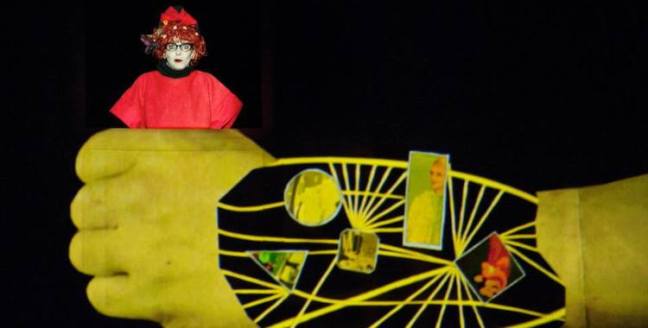
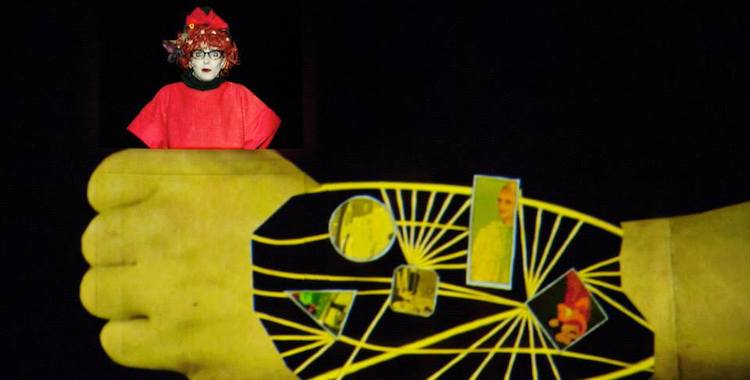
1927’s previous show, The Animals and Children Took to the Streets, was eerily prescient in its anticipation of the 2011 riots. Golem is more responsive than it is prophetic, amplifying an experience of 21st-century living that is – despite the cartoonish cladding – instantly familiar. Instead of iPhones, 1927’s characters have the eponymous golems: clay men designed to do the bidding of their masters. But as with the similarly “time-saving” devices that our lives revolve around, the golems (and the ubiquitous corporation that promptly snaps up the invention) quickly begin to make silent demands of their own.

Ironically, the show itself is founded on the same technology that it regards with suspicion. The stage of the Young Vic is filled with nothing but screens and bodies, which meet seamlessly thanks to the witty detail of Paul Barritt’s projections and the precision of the performances. Awkward nerd Robert – demanding the full, gawky array of Shamira (Little Bulb) Turner’s elastic facial expressions – strides through animated cityscapes, seeming almost to dissolve into the busy backdrop of fast food joints and strip clubs. This is an every-city, a place of crumbling estates, boarded up shops and townhouses owned by absent billionaires.

Robert is, as his narrating sister Annie informs us, a nobody. He was bullied at school, he’s never had a girlfriend and he spends nine to five “backing up the back-up”, drearily pencilling 0s and 1s into ledgers. For fun, he plays in Annie’s band: a ragtag collection of thwarted punk rockers, who would be changing the world if it weren’t for their chronic stage fright. Even the way he stands, shoulders rounded against the world, is unassuming.

Then Robert buys a golem, the latest invention from his would-be entrepreneur friend. The clay man created to serve is borrowed from Jewish folklore, but 1927 are more interested in his 21st-century descendants. Golem doesn’t just cook and clean; he saves money by doing the food shopping online and helpfully suggests which new shoes to buy. Egged on by his new companion, Robert bags himself a promotion and overhauls his image. He’s no longer a nobody, but an everybody. And despite his supposed servility, it is soon the golem who begins to look like master, as Robert and his family fall under the influence of this wonky clay automaton and later his shiny, updated replacement (Golem 2.0).

This is storybook satire: bold, colourful, but not necessarily subtle. 1927’s targets – global corporations, political apathy, freedom sapping technology – loom large and unmissable, with a few potshots at the Daily Mail and anti-immigration rhetoric chucked in for good measure. There are even mentions for Boris Johnson and Benedict Cumberbatch (Robert’s golem is, hilariously, rather taken with the latter).

But if its message is as blunt as the advertising crowding the edges of our screens, Golem gets away with it by dint of sheer ingenuity. There is still something inexplicably joyful about the way in which bodies and images merge on stage, putting to shame the clunky projection seen in so many other shows. It’s the detail, though, that really makes it. From a portrait brought delightfully to life, to Robert’s deliciously Kafka-esque occupation, to a brilliant (and brilliantly observed) sequence on internet dating, nothing is wasted. And when the garish yellow branding of the golems begins to take over, it’s the small and silly quirks that we miss, be they wacky hairdos or idiosyncratic punk lyrics. No golem – or iPhone – can substitute for those.

Photo: Bernhard Müller.

Hope, Royal Court Theatre

590x494.fitandcrop

Local politics isn’t sexy. It’s the support crew that cleans up while the rockstars break out their set list of strained smiles and hollow promises on the next main stage. I still remember, as a child, my dad frustratedly filling us in on the council meetings he attended as a school governor; the high point, if I recall rightly, was a farcical dispute about bins.

Hope, therefore, is not particularly promising as a theatrical premise. A local Labour council struggles to make budget savings? Not exactly thrilling. But actually, Jack Thorne’s play feels like the perfect drama for the present political moment. In the context of the Royal Court’s revolution themed season, it might not be the most rousing call to arms, but it depicts the possibility for change on a level that actually feels within reach. It makes politics ordinary, turning its gaze on the crippling everyday impacts of austerity in a way that most national politicians seem incapable of imagining.

Thorne’s councillors are in an impossible position. With £64 million of savings to make by 2017, it’s a miserable matter of deciding on the marginally lesser of many evils. Should cuts be made to care for the elderly or the disabled? Where can savings be made on Sure Start Centres? As for the local library and museum – forget it.

Thankfully, though, Thorne’s play is not all hand-wringing budget meetings. At its centre is deputy council leader Mark, a tortured would-be idealist who is desperate to be a good man in dire circumstances. After his similarly tormented turn in Utopia, Paul Higgins seems made to inhabit characters crumbling under pressure, hair more dishevelled by the minute and body curling up further and further into his suit jacket. Compounding the difficulty of the cuts, Mark’s ex-wife Gina (Christine Entwisle) gets wind that her day centre for the disabled is going to be slashed and mounts a big, social media-savvy campaign, while his relationships with precociously intelligent son Jake (Tommy Knight) and fellow councillor and sometime lover Julie (Sharon Duncan-Brewster) come under increasing strain.

Like Mark, everyone on the council wants to “do the right thing” – a phrase that becomes more and more fraught as the play goes on. Never was there more proof that the road to hell is paved with good intentions. Stella Gonet’s Hilary is cool and pragmatic, but beneath her armour she’s utterly committed to the town she serves, as is well-meaning, unassuming Lata (Nisha Nayar). At the more idealistic end of the scale are Julie – who also has to juggle the expectations of her council veteran father George (Tom Georgeson) – and recklessly principled Sarwan (Rudi Dharmalingam).

It’s the latter who acts as the catalyst for change, urging his fellow councillors to take a stand. Sometimes, though, principles come at a high price. The fate of the council serves to animate the precarious balance between what is right and what is pragmatic, highlighting the complexity of the decisions currently faced by local government. The choice seems to be a bleak one: either make devastating cuts yourself, or have others make even worse ones for you.

Thorne also turns his attention to the wider predicament of the modern Labour party and the erosion of solidarity by Thatcherite principles of individualism. In a slightly clunky but politically perceptive speech, former council leader George mourns the death of the party he has dedicated his life to and the political fervour that seems to be in retreat: “Idealism is dead. Solidarity is dead. It’s been destroyed by pragmatism and hatred and shame.” At the same time, though, there’s something freeing about this dissolution of past touchstones; “we don’t represent anything any more,” George observes, so perhaps now is the time to make bold decisions for the better.

Theatrically, Hope is not about to set pulses racing, but its plain, sober style feels just right. John Tiffany’s unshowy production contains all the scenes within Tom Scutt’s meticulously realised town hall design, its drab detail a constant reminder of the realities these characters are working within. No giant ball ponds here; this form of political rebellion is not fun (as Russell Brand famously promises) but hard and boring, as real change often tends to be. Revolution is just as likely to be a long slog as a sudden spark of action.

There is, at times, a slight tendency to use characters as mouthpieces for debate. George in particular feels a bit like the weary, battle-hardened voice of old Labour, while Mark and Hilary’s conversation about the advantages or otherwise of principles acts as something of a gloss on the council’s choice of course and its consequences. But however contrived, Hope‘s conclusion somehow, quietly yet insistently – and against all odds – engenders the sentiment of its title. Change probably will be slow and frustrating and involve a hundred painful compromises along the way, and it will probably have a lot more to do with bins and libraries and day centres than the Russell Brands of this world would have us believe, but there’s still the possibility that, if we just try, we might begin to make the world a better place.

Why is it important?

viewbridge

Another morning, another angry-making article about theatre criticism. Today’s harbinger of doom is Tim Walker, recently axed former theatre critic of the Sunday Telegraph, bemoaning “a bloodbath among my fraternity” (what a telling choice of words there). You can probably save yourself the depressing read and guess the gist of what he’s complaining about.

Loathe as I am to treat Walker’s opinion with the seriousness that a response implies, there’s a grain of something in his article that I worry goes deeper. There’s plenty in it to get the blood simmering: the quoting of an anonymous theatre impresario’s dismissal of “young, spotty” critics, the barely veiled contempt for online writers, the suggestion that the Daily Mail “takes theatre criticism seriously” (ha!). As a young and, yes, often spotty theatre critic (my skin doesn’t seem to have received the memo that I’m 25), it’s hardly surprising that I’m a bit irked by it. But there’s one sentence in particular that had me fuming over my breakfast this morning:

“The fact is the serious newspapers and the theatres have the perfect relationship because the demographics of their respective clients are pretty much identical: middle-class, affluent, and, of course, getting on a bit.”

Is this what theatre criticism is supposed to be about? Selling pricey cultural products to the middle-class and middle-aged? Obviously, I don’t think so. But I worry that the picture Walker paints here is not solely his own. This, for many people, probably is what theatre criticism represents: something distant, cosy and irrelevant, hawking a few more tickets for that West End show with whatshername off the telly in it. And it’s not a kind of theatre criticism I really want to be part of.

Also slightly enraging, but on a much more manageable scale, were Sunday night’s Evening Standard Awards. Mostly I think of them as a bit of dressed-up silliness that might better be titled “Most Famous People on Stages This Year”, but it’s still irritating when some of the best productions of the last twelve months don’t even get a look in. Most of my Twitter feed was outraged about the lack of awards for Ivo van Hove’s production of A View From The Bridge, and understandably. Meg Vaughan, however, offered a challenge to those venting their spleen:

“What good is an electrifying night at the theatre if the only effect is to have us all up-in-arms when a bunch of self-serving capitalists on the ‘advisory panel’ at the Evening Standard Awards don’t recognise its greatness as we feel they should? Yeah, they woz robbed. Categorically. But if we can’t protest that decision with anything other than “But… but… but it was just THE BEST innit!” then it’s not worth fucking protesting at all.”

Later in the same post, Meg demands “Why is it important?” And I wonder if that might be a better way of thinking about both theatre and criticism. Why is it important? What does this work of art contribute to the world and my understanding of it? What relevance or impact does it have beyond the plush seats of the auditorium? Why, quite frankly, should anyone bother with this at all?

Because if theatre and the column inches it generates are only really of any interest to the “middle-class, affluent, and […] getting on a bit”, then we might as well hold the funeral now. If that’s the case, then it’s not just theatre criticism that’s dying, it’s theatre too.

Luckily, I think we can put the brakes on the hearse for now. When I look back over the last year, that question “why is it important?” still has an answer. Because an astonishing student production of Road – a play I previously associated (and not flatteringly) with GCSE Drama – made me really fucking furious about the legacy of Thatcherism and the coalition government of today. Ditto Beyond Caring, the washed-out, bleakly hyper-naturalistic aesthetic of which I still think of every time I get angry about zero hours contracts. Because I went on a protest march and found myself thinking about Hannah Nicklin’s A Conversation with my Father. Because I saw three other shows about activism that made me want to take immediately to the streets. Because This Is How We Die made me feel like I’d burst right out of my skin and still gives me tingles every time I think about it and everyone deserves an experience like that. Because I struggle to imagine any kind of therapy more effective than the morning I sobbed and smiled my way through Every Brilliant Thing in Edinburgh feeling as though it was made just for me in that particular moment. Because for a fleeting pause during Am I Dead Yet? I stared the thought of death right in the eyes.

I could go on. But the great thing is, I don’t really need to, because there are loads of brilliant critics out there writing about theatre as if it actually means something. As if it might just be important. And yes, there are problems for us to face and questions for us to answer. At the moment, I very much doubt that this blog or any of the other online platforms I write for reach any of the people who I really want to convince that this stuff matters. But acting as though it matters is a start. And if newspaper criticism as Walker sees it is just about serving a privileged, ageing minority, reinforcing in the process the idea that theatre is not really “for” the majority of the population, then perhaps it’s not such a loss.