Violence and Son, Royal Court

image9-600x337

Originally written for Exeunt.

“Sometimes you start out stupid you end up being nasty.” That seems to be the diagnosis handed out to modern masculinity in Violence and Son, Gary Owen’s knotty new play at the Royal Court. In a society in which aggression and casual sexism are passed down like bad joints, brutality is a fact of life. Misogyny is inherited, violence inevitable. 

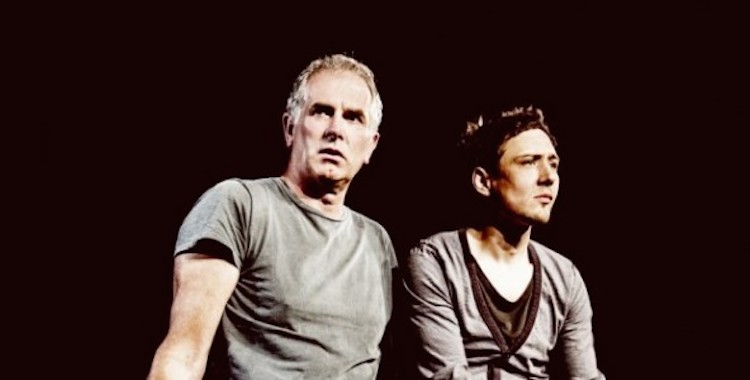
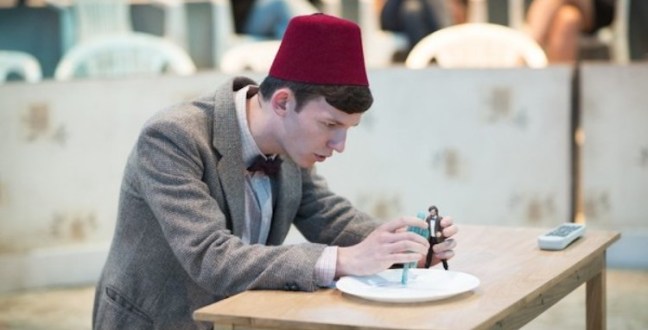
The words are spoken by Rick, whose nastiness has a habit of rearing its head after a few pints. There’s a reason the locals call him Violence (Vile for short). But for the last six months his life in the Welsh valleys with girlfriend Suze has been invaded by Liam, the teenage son he’s never known. On the surface, the pair couldn’t be more different. Liam is gentle, nerdy, prone to sporting a fez à la Matt Smith in Doctor Who. Still mourning for the loss of his mother, he sharpens his wit with sardonic swipes at his dad, avoiding Vile’s fists when he’s had a gutful. They are, as Liam puts it, getting used to one another.

In the confined circular space of Cai Dyfan’s set, ominously reminiscent of the boxing ring, father and son square up. It all starts amiably enough. Home from a Doctor Who convention with schoolfriend Jen – the Amy Pond to his bow-tie wearing Doctor – Liam agonises over their shifting relationship and bats away crude but well-meaning advice from Rick. It’s will-they-won’t-they meets odd couple comedy, peppered with gags and simmering with menace. There’s always the sense of something more lurking underneath, but Hamish Pirie’s canny production keeps the tone deceptively light and playful, the laughs rarely letting up.

Then, of course, comes the flip. It’s one of the oldest dramaturgical tricks in the book, but Owen and Pirie pull it off with gut-punching precision. The hints have all been dropped – the nickname, the undertow of discomfort, the troubling pub punch-up anecdote – but from the moment blood is drawn the mood suddenly turns with a queasy lurch. Rick and Liam’s relationship graduates from good-natured tussling to something altogether nastier, before Liam turns out to have more in common with his old man than we – or he – first thought.

Violence isn’t just the nickname of Liam’s aggressive, booze-dependent dad. It seeps into everything, from piss-ups down the pub to the delicate dynamic between father and son. And in a world in which violence is the norm, consent and complicity become increasingly tangled. Where is the line drawn between what’s acceptable and what’s not? What happens when actions and words are saying two different things? When is it worth standing up for yourself, and when is it better to be quietly complicit in the role of victim?

The play is one of questions rather than answers. Although Owen refuses to blur lines when handling sexual violence and consent, what he does do is place an individual act against a complex backdrop of normalised violence. It’s a risky tightrope to walk, but both play and production manage to withhold judgement at the same time as resisting the position of apologist. No remains no, yet we are dared to fall in love with Liam as a character, complicating our response to his actions. As the 17-year-old protagonist, David Moorst is all defensive wit and squirming awkwardness, his spiky charm covering up the fresh grief of losing his mother. Both in the way he shrinks – sometimes barely perceptibly – from his father and, later, in the stubborn set of his jaw, the scars of masculinity are beginning to show.

Rick, too, is harmed by the same violence he perpetrates. Jason Hughes puts in an astonishing performance as the reluctant father, torn between his habitual aggression and the genuine desire to do right by his newly returned flesh and blood. Even in the most light-hearted of moments, there’s a flicker of danger perpetually behind his eyes, a fuse waiting to be sparked. In one scene, as Rick’s impulse to comfort his son struggles to find any expression other than violence, his shoulders convulse with the effort of wrestling down his emotions. It reminds me of Men in the Cities and Chris Goode’s description of the artwork that gives the show its name: “each man is drawn contorted in a different way, in his own way, flailing”.

Offered such a grim and nuanced look at the state of masculinity in the twenty-first century, it’s easy to underestimate the complexity of the two female characters. Morfydd Clark’s Jen especially is a meticulous study of teenage confusion, forever painfully calculating between what she wants, what she’s been told to want and what society has taught her she will get. It’s terrifying, yet not at all surprising, to witness the extent to which she’s already accepted the sexism that pervades everything from Doctor Who to the local pub where gropes are standard. Being a woman, Jen seems to have worked out, is all about finding and playing the right role. One wrong step can be disastrous. And though the role of Suze is the least developed of the quartet, as played by Siwan Morris we get glimpses of the tension between her instinctive tenderness and the internalised misogyny that makes her loyal to Rick. Men writhe dangerously inside their own skins; women put up with the lesser of many evils. Patriarchy shits on everyone.

Tonally, as well as thematically, Violence and Son is quite a feat, handling the greyest of ethical grey zones with the same deft hand as the opening comedy. In the end, though, Owen pushes the seesaw too far the other way, driving his point into the ground. The pressure of the final plot contrivance threatens to crush the closing scene, making unnecessarily explicit what is up to that point brilliantly subtle. Still, it’s an analysis of masculinity and a portrait of twenty-first-century society that’s hard to shake off.

Photo: Helen Maybanks.

Ponyboy Curtis at The Yard

514x3823

Originally written for Exeunt.

I can’t get the music loud enough.

Huddled on the train, freshly hurled out of Ponyboy Curtis at The Yard and into the cold, jagged, rain-flecked world, I want the music coursing through my headphones to fill me up, to vibrate through my pores. Nothing is loud enough, bright enough, vivid enough, tender enough.

The post-Ponyboy world feels like a grey but – slightly, almost imperceptibly – changed place.

So what is Ponyboy Curtis?

It’s a party.
It’s an intervention.
It’s an ensemble.
It’s a call to revolution.
It’s a fleeting alternative space, precariously carved out of the worlds of late capitalism.
It’s an invitation to intimacy.

It’s sexy.
It’s dangerous.
It’s tender.

It’s a shot to the heart.
It’s a kick to the gut.
It’s a blast to the eardrums.

It’s not quite like anything else.

“The naked actor is often the most powerful person in the room, partly because they’ve got nothing left to hide.” – Chris Goode

Let’s start with the nudity. Because there’s a lot of nudity. In its repeated acts of dressing and undressing, edges of the stage littered with clothes, this piece – show? experience? space? – feels like a thinking through of nakedness on stage. What does it do? How can that unclothedness be both extraordinary and natural at once? What dynamic does it create with an audience – dressed, distant, looking on?

On the clothed side of that divide, it’s not so much the erotic charge of all those naked bodies that I notice. It’s the astonishing expanse of bared skin: the gentle curve of a collarbone, the pulsing movement of a calf muscle. The brush of a finger against a palm, or the sweep of a hand along the small of a back. Small intimacies, not necessarily sexual, but aching with care.

There’s an ease to this near-perpetual nakedness, but also a provocation. Look at me, the performers dare, occasionally meeting our gaze with a challenge in their eyes. At moments, they appear vulnerable; at others, they are diamond-hard, invincible. Stripped to their skin, the shedding of clothes clads them in a different kind of power.

Looking on, it suddenly occurs to me that nearly all of the most heart-stealing, chest-tightening moments I’ve experienced in the theatre in recent months have circled around nudity – around bodies, tender and exposed. Peter McMaster and Nick Anderson struggling and embracing in 27. Jonah Russell and Oliver Coopersmith tentatively reaching out to one another and then drawing apart in The Mikvah Project. These beautiful, ravishingly brave boys at The Yard falling and jumping and kissing and dancing.

The texture of Ponyboy Curtis is one of nakedness and intimacy and radical energy, but also one of boybands and dance music and buddy movies. Like The Ramones, each of the performers has taken on the temporary surname ‘Ponyboy’, but huddled around a microphone, caps slanted at angles on their heads, they’re more like Take That. The polish of the manufactured pop band, but without the perfect, plastic, stage-managed sheen of One Direction.

Boyband. Gang of mates. Lovers. Men embracing to pumping music. Men strutting, naked and clothed and partly clothed. All these different masculinities. It’s hard not to think of all the characters in Men in the Cities – those broken, contorted boys and men. There’s hurt here too, in the bodies that crumple to the ground and the voices that howl, but in so many ways Ponyboy Curtis is a celebration of all the masculinities that the glass and concrete prisons of Men in the Cities disallow. Masculinities that are gentle, fragile, questioning, joyful. Masculinities founded on care rather than aggression.

Very little is said. This is a theatre of bodies and noise and feeling, not a theatre of words. Quotes, read aloud from pieces of paper tacked to the wall, occasionally slice through the pounding soundtrack but quickly become swallowed up by everything else around them, their traces dissolving. The only words that really stay with me are those of the evening’s guest, Hannah Nicklin, whose letter to her big little brother makes me think of my own three big little brothers and all the harm I worry about patriarchy inflicting on them, all the attitudes they easily absorb and reproduce. Her words make me think again about the world outside this flickering, captivating space and the sort of masculinity that is permissible there.

Then I’m out in that world again, the bright lights of Ponyboy Curtis glittering on my retinas and its music humming faintly in my ears. I don’t yet have words – let alone sentences – to describe or respond to it. Even now, I’m only fumbling towards something like that space and what it made me feel. This is a thinking through of how to write about Ponyboy Curtis, just as the performance I saw – sat alongside? inside? – last Thursday night felt like a thinking through of what this collection of people and ideas might or could be.

Thinking through. Feeling at the edges. Pushing at the walls. Starting something.

Common Ground

common_ground1_3985-600x337

Originally written for Exeunt.

Berlin is a city of remembering. Its streets are scarred, marked, tiled with notes from the past. Bullet holes and metal plaques; imposing monuments and gaping voids.

As the eponymous common ground of Yael Ronen’s show, then, Berlin as a place offers countless echoes. In this city inscribed with conflict, Ronen has found and gathered various survivors of another set of conflicts: the break-up of Yugoslavia in the 1990s. All of her performers – save Israeli Orit Nahmias and German Niels Bormann, mirroring the nationalities and backgrounds of Ronen and her dramaturg Irina Szodruch – came to Berlin from various shards of this splintering nation. From Belgrade, Sarajevo, Novi Sad and Prijedor, they have met in Berlin rehearsal rooms to confront their collective pasts, navigating between the oscillating poles of victim and aggressor.

From the shrapnel of guilt, blame and conflicting narratives emerges one repeated truth: it’s complicated. As one performer demonstrates with an attempt to explain his tangled family history, this is a region of Europe that is criss-crossed with different allegiances and antagonisms. Rather than resolving that complication, though, Common Ground slams it centre stage. In its hands it holds two opposing impulses: we want to understand; we can’t understand.

Drawing on a mixture of research and autobiography, Common Ground begins in 1991, racing from there through the chaotic and devastating collapse of Yugoslavia in subsequent years. After a playfully self-aware introduction from Nahmias and Bormann – the two onlookers – the show immediately hits warp speed. Attack follows natural disaster follows hit pop song. The company have created an unruly, overlapping collage of the 1990s, setting civil war in the Balkans against a backdrop of global shifts. In one part of the world people are being slaughtered; in another, Bryan Adams reigns the charts. Atrocity knocks up against banality.

If it’s fevered and anarchic, that’s the point. Scrambling to keep up, we’re left breathless and disorientated, this speeded up chronology feeling more like an assault than a history lesson. Like the conflicts themselves, it’s difficult to piece together. Surrounded by the debris of Magda Willi’s design – all boxes and clutter – the performers then begin the slow and arduous process of rebuilding. Portions of the set are stacked and slotted together, tried in new combinations, as the show itself mirrors the process of these individuals coming together and sharing their experiences.

Common Ground is, explicitly and unapologetically, the combined narrative of its company. Everything here has been generated and shaped by the performers, who press hard on personal bruises. Through this approach, the show deftly dodges many of the pitfalls of the documentary play. Instead of claiming veracity, it presents complexity and the elusiveness of understanding, apportioning and then complicating blame. These are, of course, political stories, but they are personal stories first; there’s never any attempt at a complete history or a diagnosis of where it all fell apart.

Politically, it feels vital to reflect on how we process and package the past. Walking around Berlin for six days, I’m struck by the difference in how cultural memory is constructed here. There’s a rawness to these wounds, whose healing is an ongoing process. In the UK, meanwhile, we have an insidious, poppy-garlanded triumphalism, slyly manoeuvred for political gain. We have “Blitz spirit”, tarted up into austerity and stamped with a “Keep Calm and Carry On” logo. War is, perversely, almost something to be nostalgic about.

If Berlin’s wounds are raw, then those exposed by Common Ground are still dripping with blood. When the company visits Bosnia, the people they meet struggle to talk about what happened two decades ago. As one Sarajevo resident puts it, the war never really ended: it continued within people, poisonously unresolved. Another woman is trapped in a cycle of remembering, retelling and retelling her trauma until the words dry up. These narratives – dropped by the rest of the world as a new conflict pierced the horizon – have never achieved closure, but still they keep being repeated.

So it’s surprising to find humour and optimism here as well as pain and anguish. There’s a respectful lightness of touch to Ronen and Szodruch’s production, which manages to salvage both the hopeful and the ridiculous. It comes down, ultimately, to the relationships among the company, in which the show locates a tentative note of positivity. Difficulty never disappears, but tenderness challenges it, as the common ground of the title gradually multiplies. In that shared territory, that shifting ground beneath the feet of these seven people, there might just be a fragile foundation for hope.

Mother Figures

gods-2-600x300

Originally written for Exeunt.

Selma Dimitrijevic and I first began talking about her play Gods Are Fallen and All Safety Gone almost three years ago. It’s been a long, meandering, stop-and-start conversation, via sitting in on rehearsals, watching performances and dress runs, chatting over coffee in various cafes in various cities. Aptly enough, Gods is also about those conversations that stretch over years: the well-worn family routines that regularly pause, rewind and restart.

The play’s history is even longer. Selma’s delicate depiction of one mother-daughter relationship was originally written as a commission for Oran Mor’s A Play, A Pie and A Pint series back in 2008. Across just four scenes, Gods Are Fallen and All Safety Gone (the title borrowed from John Steinbeck) suggests a lifetime’s worth of love and resentment between thirty-something Annie and her mother, their repeated small talk increasingly charged. It’s a small story, but one that reaches far beyond its two characters.

When it was produced at Oran Mor, Gods got what Selma describes as a “very naturalistic” treatment. Watching it, she felt that something was missing. “It was one of those things when you see a piece of work that you have made and there’s nothing you can say that is wrong with it,” Selma explains, “but the product wasn’t necessarily the kind of thetare that excites me. So I was looking at it and thinking ‘how did I help make this piece of theatre that I wouldn’t be that excited about as a theatregoer?’”

But it was only after encountering a Russian version of the play directed by Viktor Ryzhakov in 2011 that Selma thought of having a stab at it herself. Despite failing to get into the country to see it, Selma later got hold of a recording of the performance and found herself incredibly moved by it. “I saw a video of it and it just made me cry,” she remembers. “It went straight to the heart of what I was trying to do.” Ryzhakov cast two women of the same age as mother and daughter and contained them inside a pen for the length of the play, delivering the dialogue at high speed. Selma saw something in her play that went beyond domestic realism.

But it was only after encountering a Russian version of the play directed by Viktor Ryzhakov in 2011 that Selma thought of having a stab at it herself. Despite failing to get into the country to see it, Selma later got hold of a recording of the performance and found herself incredibly moved by it. “I saw a video of it and it just made me cry,” she remembers. “It went straight to the heart of what I was trying to do.” Ryzhakov cast two women of the same age as mother and daughter and contained them inside a pen for the length of the play, delivering the dialogue at high speed. Selma saw something in her play that went beyond domestic realism.

“Once I saw that, I thought actually I want to do my own attempt,” says Selma, explaining that her intention was to approach it “just as a piece of writing”. She got this opportunity through her company Greyscale, who were offered a spot in the 2012 Almeida Festival. Now, eight years after first writing the play, she tells me that the text of Gods feels oddly distant. “I kind of keep forgetting that I wrote it,” she laughs.

What’s most distinctive about Selma’s version of Gods – at least at first glance – is her decision to cast male actors Sean Campion and Scott Turnbull as mother and daughter. At the time when the Almeida Festival opportunity arose, Selma was working with the pair on Greyscale’s Theatre Brothel and something about their relationship resonated with the relationship in the play. It was, as she puts it, an artistic choice that came from the gut rather than the head.

“I’m a big believer, as a writer, that my subconscious is a better writer than I am,” Selma says by way of explanation. “So when things just come out, they’re usually much better than when I think about it. And the same thing as a director: I bring a lot of things into the rehearsal room that are instinctive. I can’t explain why.”

She’s been reluctant, therefore, to identify any intention behind the cross-gender casting, preferring to keep readings open. And while on the page this casting choice is what grabs attention, in performance it becomes almost irrelevant. Once accepted, the fact that these two female characters are being played by men seems perfectly natural. After all, theatre is always asking us to believe that one thing stands for something else. There’s no attempt by Sean and Scott to ape femininity; these are demonstrably two men, but also two women.

As I put it to Selma during that initial rehearsal period, the production’s non-naturalistic casting somehow frees it from the burden of specificity. Because these two men are clearly not attempting to represent two “real” women, the piece is allowed to speak through and with them, elevating it to something far more wide-reaching than the bare bones of the script might suggest. Discussing the casting now, Selma’s stance is simple and equivocal: “It just feels right, and as long as it feels right and interesting and exciting, and people react to it in an interesting way, we’ll keep doing it.”

Looking back on audience’s reactions to the casting during their latest tour, Selma draws attention to one response in particular. “This really interesting thing happened: there were a couple of men who mentioned that they don’t know if they would come and see it if it was just a show about a mother and daughter, and that they might not have connected with it personally if it was just a real mother and daughter and two actresses on stage. I don’t know how to feel about that.” It points to how, culturally, we still see narratives of female relationships as being aimed primarily at women, whereas narratives of male relationships are read as universal. As Selma puts it, “if it’s one, it’s a minority narrative, and if it’s the other then it’s for everyone”.

Other responses to Selma’s casting choice were more indignant. “A lot of people asked me how did the writer feel about me messing with their play,” she says, “which always makes me laugh.” For Selma, this complaint has a familiar ring, revealing much about the differing attitudes towards writers and directors in British theatre. “It feels a little bit like yes, you can do things to my play, but only if you do them well,” she continues. “Well of course, I wouldn’t be suggesting things otherwise. My intention is to do it well; I can’t promise I will.”

Selma’s other intriguing creative choice in directing Gods was to put a real mother and daughter on stage with Sean and Scott, quietly looking on from the back of the stage. Selma describes the pair as a kind of “amplifier” for the performance: “We’ve never had mother and daughter react in any emotional way if either audience or actors weren’t genuinely vibrating with emotion. But if it it is an emotional show, they make it a bit more emotional, and if it’s a funny one then them laughing on stage makes it even funnier.”

And although Selma insists that she doesn’t make “theatre with an agenda”, she has noticed over the life span of the show that it is also capable of making small changes in the lives of the mothers and daughters who take part. “They get to spend an hour looking at each other, talking to each other afterwards, as two adults, and see each other slightly differently after the show,” says Selma. Having lost her own mother before directing the play – “I’ve completely missed that opportunity” – these small moments of connection are particularly precious.

As much as Selma insists on the importance of instinct and chance in her work, with Greyscale she has been working hard over the last few years to give those instincts as much breathing space as possible. “It’s a combination of us being lucky,” she says of choices like the casting in Gods, “but also being good at creating circumstances in which things like that can happen.”

That means spending time together, sharing creative experiences, seeing other theatre. Selma explains that she, Sean and Scott have seen and talked about several shows together and have participated in a range of different workshops, giving them a shared toolkit and vocabulary. “We’ve filled the last twelve months with things for us to do together that have to do with art but don’t need a result and just allow space to be together and to talk about things,” she says. It is, she adds, “the poor man’s way of trying to do the ensemble thing”.

After three years of working on the play on and off, it’s now “properly like family”. Like the mother and daughter in her play, Selma and her team have a shared history, shared conversations and shared irritations – so much so that she suggests it’s barely acting for Sean and Scott anymore. “They’ve been repeating it for three years, so now when mother or daughter gets annoyed about things happening over and over again, they have it in their core, because they’ve done it so many times – they don’t have to pretend that they’re annoyed.”

Product, Arcola Theatre

Originally written for Exeunt.

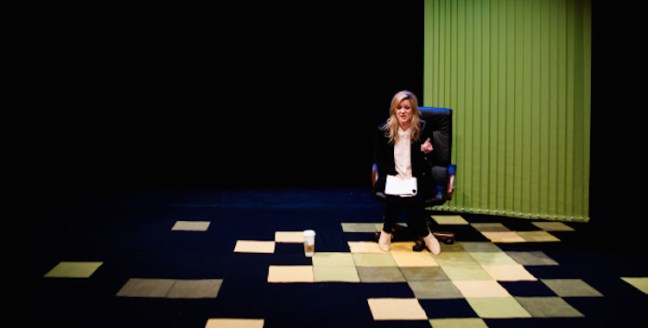
There’s something behind Olivia Poulet’s eyes. It might be steely pragmatism. It might be desperation. It might be suppressed disbelief at the spectacularly awful script she is determinedly trying to sell. It might, worse, be genuine passion for the regurgitated tropes she’s trotting out. It might even be dollar signs, if the starlet she’s pitching to gives the nod.

Mark Ravenhill’s monologue is a witty parody of the film-studio hard sell, the product of its title a slice of syrupy Hollywood cliché – the kind that rots your teeth. Girl meets boy. Girl goes on journey. Love over all else. It’s sharp, clever, self-satisfied. Only in the (nervously gesturing) hands of Poulet does it become something more than that. As a riff on the cynical, opportunistic practices of movie executives, Product is arch and entertaining. As an essay on shit-shovelling desperation, it’s blackly depressing.

Poulet is Leah, the producer charged with getting a star name on board for a new project. Problem is, the project in question is Mohammed and Me, a post-9/11 mash-up of romcom and jihadism with a cameo from Osama Bin Laden (yes, really). Sitting in for Julia, the actor selected to save this rapidly sinking ship, we’re treated to Leah’s increasingly frantic pitch as she takes us on the emotional journey of “three-dimensional” lead Amy. “I would love to see you play three-dimensional,” she croons at us, smile fixed.

Folding the War on Terror into classic chick-lit formula, Mohammed and Me is the doomed love story of a 9/11 widow and a suicide bomber – or, in appearance-obsessed Hollywood-speak, a Versace-clad businesswoman and the “tall, dusky fellow” she finds herself sat next to on a flight. Step aside Romeo and Juliet; this is a star-crossed romance like no other. Leah walks us through the movieland Holy Trinity of attraction, separation and reunion, with bomb threats and prison break-ins thrown in for good measure. “This is the world of the heart,” she earnestly intones, with all the persuasion of one who’s never had call for the organ.

It’s clearly tripe, with Ravenhill using the godawful script in Leah’s hands as a vehicle for taking pops at everything from Hollywood’s casual misogyny to its obsession with sex and violence (the two often barely distinguishable from one another). There’s a transformation montage scene, a blandly identikit mother/aunt/neighbour figure – “she’s too old to fuck, too old to kick ass, but we still have a place for her in our world” – and a suitably slushy soundtrack. Tick, tick, tick.

But what Poulet does in Robert Shaw’s production is give the money-making behemoth of Hollywood human context. Darting her eyes from side to side, appealing to us with her ever-moving hands, narrating the plot of Mohammed and Me with desperate abandon, Leah has the look of a woman possessed. What she’s possessed with, exactly, is ambiguous. At moments, she seems swept away by the story, eyes closed in its telling. At others, she’s practically gagging on this material, correcting herself mid-sentence: “This material is fab – is going to be fabulous once it’s punched up”. Either way, there’s a constant undertow of desperation and self-deceit, hinting at all the things we force ourselves and others believe in the name of self-interest.

Having the monologue spoken by a woman (it was originally performed by Ravenhill himself) also twists it in intriguing directions, glazing the misogyny with an even sourer coating. When Leah patronisingly says that she “cried like a woman” and jokingly refers to her listener as a “bitch”, you sense that she really means it. Especially in Shaw and Poulet’s interpretation, this isn’t just about the movie industry; it’s about all those oppressive internalised narratives – of sexism, of racism, of greed – that twenty-first-century capitalism shoves down our throats. The scariest suggestion is that we might just end up swallowing them.

Photo: Richard Davenport.