Light Shining in Buckinghamshire, National Theatre

image8-600x337

Originally written for Exeunt.

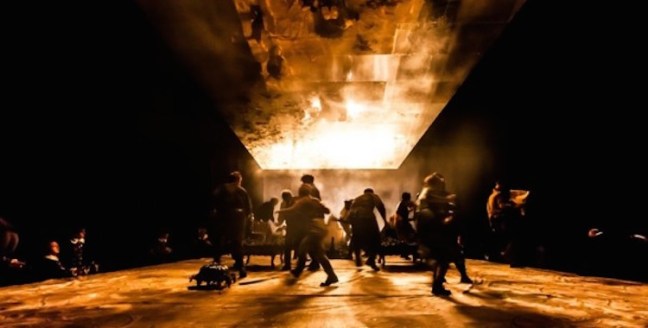
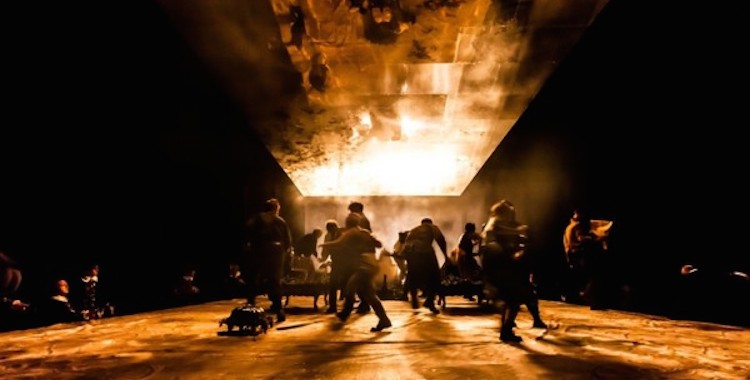
Light Shining in Buckinghamshire begins with a feast. In the National Theatre’s new production, the safety curtain opens to reveal a vast table heaving with food. Overstuffed pies; plates spilling over with fruit; a whole, glistening pig. An obscene bounty. Around the edges, heedlessly stuffing their faces throughout the people’s battles and declarations, sit a shadowy host of figures in gowns. The poor scrabble while the rich gorge.

It’s one hell of a metaphor – and one hell of a table, at that. Es Devlin’s raked design spreads greedily across the stage of the Lyttelton Theatre, occupying our entire field of vision. Above, a huge slanted mirror reflects back the candlelit opulence, while a gilt throne looms at the back of the stage. This is what the impoverished idealists and revolutionaries of Caryl Churchill’s Civil War play, dwarfed by the finery that surrounds them, have to contend with.

Eschewing textbook Cavaliers and Roundheads for a focus on the radical far-left groupings of the Levellers, Diggers and Ranters, the sympathy of Churchill’s play lies with those dismantling the banquet. Her history is one of workers persuaded to fight by a fervent belief in the imminent arrival of Christ on earth; of radical thinkers and penniless hopers; of the heady possibilities of a nation without a monarch; and, finally, of those who would freely distribute rights to speech and land being crushed by those unwilling to relinquish their power. In this telling, it’s a war fought on heavenly promises for ultimately earthly spoils.

That’s where, again, the central metaphor comes in. Bit by bit, the opening feast is stripped back to the earth from which it came, as Devlin’s set undergoes an extraordinary transformation. But while the people may till that newly uncovered soil, it soon returns to the hands of a small elite. As revealed by the Putney Debates of autumn 1647, slap-bang in the middle of the play, the Civil War quickly becomes a battle not for freedom but for land. For Oliver Cromwell and his allies, this is the sticking point; democracy is not to come at the price of their privileged property rights.

Churchill’s is a play full of proclamations, of speeches grand and simple. We, the audience, are very deliberately addressed, positioned almost as witnesses. During the pivotal Putney Debates, the house lights are gently raised, daring us to speak up. Later, Steffan Rhodri’s butcher stares right out at us, refusing to sell us any more meat. We’ve had more than our fill.

All that speaking, though, doesn’t always make for compelling drama. Lyndsey Turner’s production is a gorgeous thing to look at, with all the light, shade and careful composition of a series of paintings, yet like paintings the scenes too often feel static and poised. The rawness of anger and revolution has been given a pretty, polished sheen. There are some briefly breathtaking moments of theatricality – the voluminous tablecloth taking on a life of its own, or the wooden slats of the table being made to give way to the soil beneath – but for the most part it’s all talk and backdrop.

There are obvious, though not forced, resonances. We live in a time that feels similarly on the brink of an apocalypse – though one heralded by climate change rather than Christ – and we’re approaching the most genuinely unpredictable general election in decades. Again, we face both possibility and despair. And seeing the show on St George’s Day, the nationalist rhetoric tugs on the ear, speaking of all the ways in which pride for one’s country has been – and continues to be – used to mobilise people. But “for England” (or Britain) only ever really means for a select few.

In a subtle touch, Soutra Gilmour’s costumes suggest that the distance of rulers from ruled is temporal as well as economic. While the aristocratic chorus are got up in period gowns, the non-specifically scruffy Diggers, Levellers and Ranters could have been plucked out of various points in history – right up to the present day. One would-be revolutionary even pulls out a thermos. This has been going on for hundreds of years, Turner’s production seems to be saying, and those at the top still have yet to change.

This plays out on an epic scale, with the already large cast (Leo Bill, Joshua James, Trystan Gravelle and Adelle Leonce all stand out from the considerable crowd) supplemented by a community company of more than 40. There are an awful lot of bodies on stage. This is less the fragmented experience of war suggested by the play’s many small scenes and vignettes and more of a mass event, with a crowd of other players always lurking in the background. While this breadth can give a powerful sense of “the people”, however, the sheer size and ambition of the production – like the lavish spread it opens with – all feels a bit much. It’s a plea for the earth coming from the heart of the feast.
“The Director as God is Bullshit”

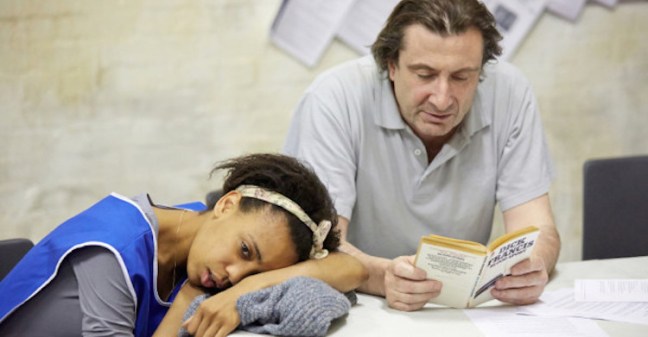
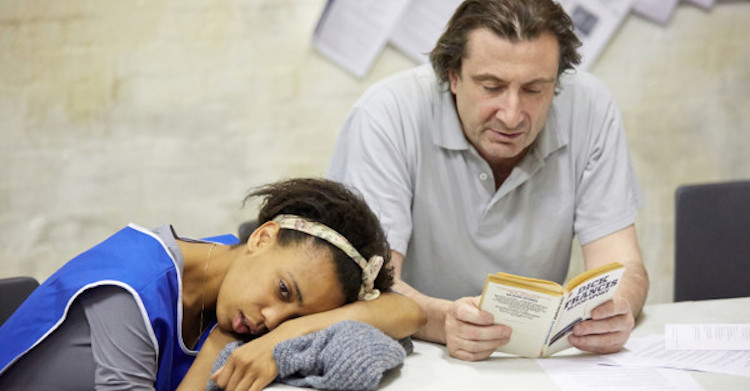
Jpeg-1.-Janet-Etuk-as-Grace-and-Sean-OCallaghan-as-Phil-in-Beyond-Caring.-Photograph-by-Mark-Douet-I80A4988-600x400

Originally written for Exeunt.

At times, Alexander Zeldin sounds more like a composer than a director. In his rehearsal room, “rhythm” is a popular word, as is “beat”. I’m watching Zeldin and his cast return to Beyond Caring, the hyper-realist snapshot of precarious labour that is transferring into the National Theatre’s temporary theatre following its premiere at The Yard last year. The show is an act of making visible – or perhaps audible. Zeldin stages the fractured daily routines of a group of zero-hours cleaners, with a musicality that draws as much on silence as it does on sound. It’s the ordinary textures of life woven into a theatrical score.

“I think in life there’s already quite a lot of theatre,” Zeldin says later as we sit in the foyer of the National Theatre, watching the everyday performances of passersby. “The theatre is a chance to be ourselves.” This is what’s so disorientating and eventually disarming about Beyond Caring, which refuses to fit human behaviour inside the stage conventions we are so used to seeing. “I think if you don’t do something that’s disturbing – I mean that in the best possible sense – you don’t really have an opportunity to be honest,” the director explains. “You need to create the conditions in which we can really exchange and we can really look at life.”

Zeldin struggles, though, to express the thinking behind this way of working, an approach that is perhaps best witnessed through the work itself. “If we could grasp it, there’d be no need to make the theatre, right?” he points out. I suggest a distinction made by Katie Mitchell between realism and naturalism, two words often used interchangeably to describe theatre. But according to Mitchell, realism is a mode based on recognisable conventions – representations of real behaviour – while naturalism attempts to precisely replicate that behaviour as seen in the world beyond the auditorium. Beyond Caring is in a similar mould, taking care over the minute gestures, pauses and phrases that make up a human life. A head is turned just so; a silence is rehearsed over and over.

Zeldin quotes a Chinese proverb: “don’t think about doing, just do”. Just doing, though, is “a very powerful, very complicated thing”. He continues: “everything I’m trying to do is just creating the conditions in which we can just do. And then we sculpt.” In creating these conditions, his role blurs between writer, director and member of a devising company, hierarchies constantly forming and dissolving. “The distance between the writer and director I feel is a little artificial,” he reflects on the slicing up of roles in much British theatre-making. “If you’re a director, inevitably you want to go and write, and if you’re a writer inevitably you’re going to want to write in the language of presence, space, rhythm.”

His role in the creation of Beyond Caring has strayed into both territories. While it was Zeldin who originated the idea and came into rehearsals with material he had already written, the show is very deliberately described as “written through devising with the company”. The piece has been shaped and reshaped over the years in close collaboration with a group of actors, as well as drawing on extensive research that started with Florence Aubenas’s book The Night Cleaner, an undercover investigation of precarious shift work in France.

For Zeldin, though, research is about experience and individual human interactions rather than about presenting a series of facts. “If you present your research on the stage, why don’t you just give the book out?” he says. “Because it’s going to be more clearly expressed.” Instead, the “meticulous” research undertaken by Zeldin and his cast – including stints working as cleaners – is subtly integrated at the level of character. One of the workers they met, for instance, talked about sleeping on a park bench, planting the seed for a character in Beyond Caring who sleeps in the factory where she works. “I’m not putting a park bench on the stage – that’s the verbatim version,” Zeldin distinguishes.

This, he insists, is where the politics of the show is located: in its form. Beyond Caring is about a controversial political issue – one that is proving to be a key point of debate in the pre-election hubbub – but its take on zero-hours contracts invites audiences to simply look and empathise rather than to engage with a series of facts and opinions. Inevitably, though, the current political context will colour its reception. “It’s a little awkward for me,” Zeldin admits, “because I’m doing a play about zero-hours contracts in the lead up to the election. I care passionately about the political issues at stake, but I hate politicians and politics.”

But he maintains that the style of the piece remains the most important expression of its politics. “I think it’s Tim Crouch who said that theatre happens in the head, not on the stage,” he says by way of explanation. “That’s such a powerful statement. And it happens in the heart; you just touch people, it’s not very complicated. I think we overthink things too much. Theatre is a precious space where we don’t need to overthink.”

Alongside music, another key aesthetic influence on the piece is photography. Zeldin explains that one of the initial inspirations for Beyond Caring was a series of photographs by Paul Graham – “it’s a kind of tribute, in a way” – and in the show he hopes to capture life in the same way that early twentieth-century photographers were able to. “August Sander, who was a photographer in the 1920s, used to go round before people knew what a camera was, so he’d point this thing at them and he’d capture them unaware,” Zeldin tells me. “There’d be a moment when you’d really see somebody, because they didn’t know how to behave in front of this strange contraption. That’s exactly what I’m interested in trying to do in the theatre.”

Achieving this involves precise and extended work with actors. “For me the root of everything I’m doing is the work with the actor,” says Zeldin. The question he is constantly asking of the performers he works with is “what’s at stake?” and his ultimate ambition is for them to achieve “presence”, a word he finds difficult to define. “What does it mean?” he asks, referring to the cliched statement that someone has stage presence. “Let’s be more specific. I think presence is something you can learn. You can develop it, you can train it.”

Beyond Caring, for instance, has been a long time in the making, and Zeldin has been working with some of the actors in the show for five years now. He characterises their process as completely collaborative, describing all of the performers as “massive contributors” to the show. “Hierarchy is dead,” Zeldin states unequivocally. “The director as god is bullshit, it doesn’t work. We’re in a room, we’re making it together, it’s got to be like that otherwise it’s a waste of time.”

“Theatre has to be alive in every second,” Zeldin continues, unforgiving in his expectations of the art form. “How can you do that? You need to create the conditions in the work where there’s a constant interrogation.” He recalls the experience of assisting Peter Brook – his greatest influence and inspiration as a director, as he stresses more than once – and being told to change something in the production every night while on tour. “It was about finding a readiness, an alertness.”

None of these working practices find a natural home in the British theatre industry, with its freelance culture and typically short rehearsal periods. For this reason, Zeldin – who is currently associate director at Birmingham Rep – aims to one day start his own company. “My ambition is to keep a group of actors together for ten, fifteen, twenty years,” he explains, brushing aside the audacity of this aspiration. His answer to practical obstacles is, perhaps, the best expression of his approach to theatre-making: “I think you have to do things that seem impossible.”

Photo: Mark Douet.

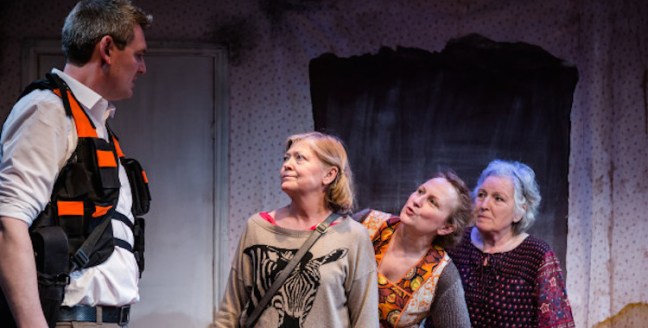
Animals, Theatre503

Animal Production Photos at Theatre 503

Originally written for Exeunt.

It’s 2046 and utility is the watchword. In Emma Adams’ dystopian satire, the current rhetoric of strivers and scroungers has snowballed into a society in which each last member is judged on their usefulness. Fit, docile, unquestioning adults are in; the ill, the curious and the elderly are out.

In this nightmare world of bubble-wrapped children and door-to-door euthanasia, lapped by the steadily rising tides of a planet out of control, Adams homes in on three resourceful older women. Tough, forbidding Norma (77 posing as 37), her ageing home help Joy and their drug-stashing neighbour Helen scratch out an existence through a mixture of cheerful blackmail and steely pragmatism, always taking what they can get. That includes Maya, the wide-eyed, over-protected girl who unwittingly disrupts the fragile peace of their lives. Teetering on the brink of adulthood, and with a father responsible for the “clearance” of those judged useless, she’s either the answer to their prayers or the catalyst of their destruction.

As dystopias go, this is an intriguing one. Rather than being precipitated by violent upheaval or nuclear apocalypse, the crisis here is positioned as a brutal extension of austerity logic, going one better than cutting benefits by cutting the people dependent on them. This is a society with no room for the ageing or unproductive, spurring on a chilling Darwinian drive in its citizens. Terminate or be terminated.

Trouble is, it’s too specific and yet not specific enough. Dystopias on stage bring with them a nightmarish burden of exposition, demanding the swift yet subtle illumination of an entire world. There’s a hint of Philip Ridley to Adams’ set-up – think Mercury Fur – but with none of the menace of the withheld. In Ridley’s plays, surreal landscapes shift indistinctly in the background, never fully revealing their logic. Here, however, detail upon detail about this imagined future world is uncovered, but without the accumulating information ever quite forming a consistent fictional universe. There are still dangling loose ends and big, yawning gaps.

The tone, too, fails to cohere. It feels like a Sunday-night sitcom dropped into a Philip Ridley fantasy dropped into a political dystopia, with all the disconnect such a combination implies. Lisa Cagnacci’s production is also something of a hodgepodge, struggling to get a grip on the slippery world that Adams has written. Max Dorey’s suitably time-(and water-)stained design neatly separates inside and outside, but the transitions between these two spaces are invariably clunky, while absolutely nothing is added by Max Pappenheim’s future-meets-videogame soundtrack or by the sparse and superfluous use of video projection. If this is what the future looks like, it’s a mess – though perhaps not in the way Adams intended.

The real problem with Animals, though, is that it’s a play about capitalism that wants to simultaneously be a play about ageing. Trying to do both, it succeeds at neither. Cheering as it is to see such meaty roles being written for older women – something Adams has been rightly vocal about – this intention finds itself tussling with the play’s conceit. We get fascinating glimpses of a society in which relationships have become coolly detached transactions and language is being steadily corporatised, but the sharp edges of this satire are blunted by the largely unchallenged and all too familiar tropes of old age. There’s plenty to be said here – about austerity, about capitalist logic, about the way society sees older women. But in trying to say too much of it, Animals ties its tongue in knots.

So It Goes, Shoreditch Town Hall

So It Goes Production Photos

Originally written for Exeunt.

So It Goes is about the unspeakability of grief. About those wounds so raw they resist words.

Strike that. Start again.

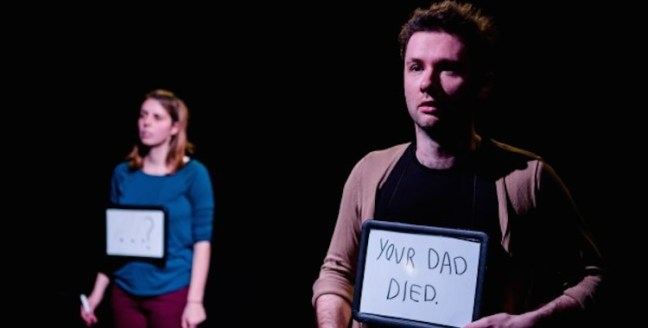
So It Goes is about Hannah Moss. When Moss was 17, her dad died. For a long time, she didn’t talk about it. In the show she has made with David Ralfe, she doesn’t talk about it either. Or at least not out loud.

Recognising that some things are impossible to speak, So It Goes reaches for other forms of communication. Instead of talking to us, Moss tells her story in written fragments, holding up placards and scribbling on whiteboards strung around her neck. Childlike in its simplicity – reflecting, perhaps, the early memories of her dad that Moss gleefully reenacts for us – the spirit of this central device extends to the cartoonish, storybook aesthetic of the whole show. Backdrops are outlined in bold sweeps of felt-tip pen and props come in the form of cardboard cut-outs.

Actions, replacing as they do words, are similarly broad-stroked. There’s a silent-film-meets-Lecoq influence to Moss and Ralfe’s use of movement, whether in energetic running montages or endearingly gawky dance sequences. At times, this style animates Moss’s story in ingenious and surprising ways. A reconstruction of the moment Moss’s parents met is gorgeous and bittersweet, while the sudden revelation of her dad’s illness slices abruptly through the carefully constructed whimsy that surrounds it. At others, though, the form feels forced, hampering rather than driving the narrative.

On the one hand, words can only say so much. The beauty of the show’s concept is that it places a light but poignant emphasis on the unsaid and the unsayable. At her dad’s bedside, Moss struggles to fit her feelings in the limited space she has given herself, repeatedly scrubbing out half-started sentences. In the end she just settles for “goodbye dad”. A chorus of “oh”s in the doctor’s office is all that needs to be – or can be – said, while the power of those six terrifying letters, “CANCER”, is even more suffocating in stark back and white.

On the other hand, words can only say so much. Especially when those words are limited to the surface of a small whiteboard. Often, there is the sense of one idea being stretched to fill an entire show, limiting its scope in the process. The form puts brakes on the content, short-circuiting complexity. The feelings that both Moss and the piece are grappling with are big and messy, but presented like this they become deceptively simple and neat-edged, like the hand-drawn scenery they play out against. Sentimentality trumps complication.


The Father, Trafalgar Studios

95088

Originally written for Exeunt.

For August Strindberg, love is war. It’s apt then, that the protagonist of The Father is an army Captain, a man who can only see marriage in military terms. His wife – all women, in fact – is the enemy, and married life is a series of conflicts, long campaigns broken up with sudden assaults. The Captain and his spouse Laura are “natural antagonists”, locked in a brutal Darwinian battle. Only the fittest can be allowed to survive.

In Abbey Wright’s swift and taut new production at Trafalgar Studios, we get an action close-up of this battleground. Crowded around three sides of the small studio space – sparsely populated in James Turner’s design other than the mocking Christmas tree – the audience is claustrophobically close to a play more usually seen on bigger stages, lending extra spark to the dramatic pyrotechnics. When the Captain explodes, we can taste his rage and see the gleaming whites of his eyes.

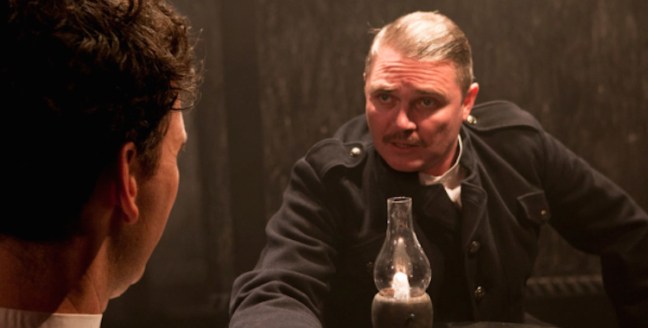
Strindberg’s play captures a family in breakdown. The Captain and Laura’s marriage, under strain for years, finally splinters apart around a pre-paternity test dilemma. How, the Captain begins to ask himself, can he be sure that he is the father of his daughter? With no Jeremy Kyle to solve the mystery, this doubt begins to sour, and Alex Ferns’ bullish, shouty Captain – face dredging up nasty memories of his run as EastEnders baddie Trevor – slowly falls apart, his straight-backed military arrogance gradually unravelling over the course of the action.

While the Captain is at the black heart of the tragedy, there’s a tougher task for Emily Dobbs as slippery, scheming Laura. Although the programme notes are keen to absolve Strindberg of out-and-out misogyny, it’s definitely Laura who comes out of this worse. The Captain might attempt to keep his wife on a tight leash, but it is Laura who intercepts his mail, convinces their new doctor that he is going mad and plants insidious doubts in his mind about the paternity of her daughter Bertha, the helpless bargaining chip shunted between the two. Both partners might be unpleasant, but it seems clear whose side the play is ultimately on.

Dobbs plays Laura as manipulative but frustrated, a caged creature who will do anything to get out. There are moments when she lends the role real bite, as when she furiously retorts “I’m not supposed to want anything, am I?”, but more often she appears as the snake her husband paints her as. It’s problematic, no doubt, and though Wright’s direction, together with Laurie Slade’s new version, creates a certain tension around Strindberg’s often misogynistic portrayals of his female characters, it shies away from confronting these difficulties head on.

Trouble is, to complain that it’s ugly is to miss the point. Strindberg’s players aremeant to be ugly, and no one escapes with an unstained character. Still, though, it’s painful to watch. Wright’s production lightens the mood by drawing out some of the plot’s more ridiculous aspects, with the action even feeling faintly farcical at moments, but it’s hard going nonetheless. Like so many of Strindberg’s characters, these aren’t people you feel inclined to spend much time in the company of, and when the curtain call arrives – as at the end of a wearying battle – it brings with it a slight exhalation of relief.