WINK, Theatre503

WINK-Theatre503-10-March-4-April-courtesy-of-Savannah-Photographic-6-600x399

Originally written for Exeunt.

What if you could become somebody else? As part of Battersea Arts Centre’s Scratch Online programme, artist Deborah Pearson is currently working on a digital project called Another You, which asks just that question. For one participant, the artwork offers a glimpse into an alternate life; a digital collage of paths not taken and things that might have been.

WINK explores a similar possibility. Phoebe Eclair-Powell’s debut play incorporates two generations of digital natives: the twenty-something teacher, who measures his life through his Facebook profile, and the teenage student whose after-school existence is lived almost entirely online. John is already discontented and nostalgic, indulging in a miserable affair and clicking through photographs from his university days. Mark just wants to get away, away from school and family and the grief that seeps poisonously through his home life.

These two characters’ lives, connected only in the most superficial of ways, come crashing together online. Jealous of what he believes to be his teacher’s perfect lifestyle – job, girlfriend, holidays – Mark invents a toned and loaded Facebook alter-ego: the brilliantly (and perhaps knowingly) named Tim Walker, lover of cat memes, Banksy and The Inbetweeners. Believing the fabricated Tim to be everything he isn’t, John accepts him as a friend on his girlfriend’s Facebook account and proceeds to pose as the woman Mark fantasises about. Without knowing it, both men are talking to lies.

Eclair-Powell and director Jamie Jackson have John and Mark tell their stories directly to the audience, only occasionally acknowledging one another’s presence on the small stage. Each is alienated from the other and from the outside world, to a dangerous and unpleasant degree in the case of Leon Williams’ laddish and frequently unlikeable John, while the disconnection of Sam Clemmett’s Mark has a lonely, mournful edge. For both of them, the online world is becoming more real than its physical counterpart. Their desire for intimacy is palpable but frustrated.

As ever, the internet proves difficult to represent on stage. Plenty have tried to engage theatrically with this shaping force of 21st-century life, but too often these attempts are strained and quickly dated, while those that do succeed tend to eschew technology altogether and rely on theatre’s analogue qualities – think Chris Goode’s Hippo World Guest Book. Jackson’s production turns to choreography, recruiting movement director Isla Jackson-Ritchie to conjure an abstract virtual environment with just the bodies of the two performers. Inside Bethany Wells’ sleek, white, Apple-esque design, Williams and Clemmett twist and turn, arms swiping through an online cornucopia of content.

At times, this device is striking. In a moment of online confrontation, each character concealed inside an internet alias, the choreography pulses with aggression; later, as Mark encounters the internet’s uglier side, Clemmett reels from imaginary punches, the online world delivering invisible body blows. More often, though, the movement feels separate from the rest of the production, tacked on rather than integral. There’s occasionally a similar feeling of effort in the text’s allusions to the online world, as though Eclair-Powell were racking up points for each social network or internet craze given a fleeting mention – Twitter, Facebook, Instagram, Tinder, Snapchat.

In the end, it’s all just a little too contrived, neglecting both character and plausibility in order to make its points. The play’s climax, instead of providing the high drama it’s so clearly aiming at, feels overblown and unlikely. In trying so hard to be about the internet, WINK – like John and Mark – loses its way in the online labyrinth.
Doing Things with Bodies

Forest-Fringe-photo-by-Jemima-Yong-600x337

Originally written for Exeunt.

Bodies on stage constantly surprise me. The ways in which they tumble, contort and embrace; their capacity to startle and to move – in all senses of the word. The way they both betray and are betrayed. The small movements that become saturated with meaning. Watching contemporary dance – an art form I don’t see nearly enough of – I’m just as likely to be struck by the odd twist of a hand or flick of a head than by the overall execution of the choreography, about which I’m almost entirely ignorant. I find myself drawn instead to gesture and interaction; to the way that bodies meet, part and respond to one another in the space.

So how does a writer with a love for but embarrassing ignorance of dance respond to a programme of performance that is flirting with dance vocabularies in a venue usually dedicated to contemporary dance?

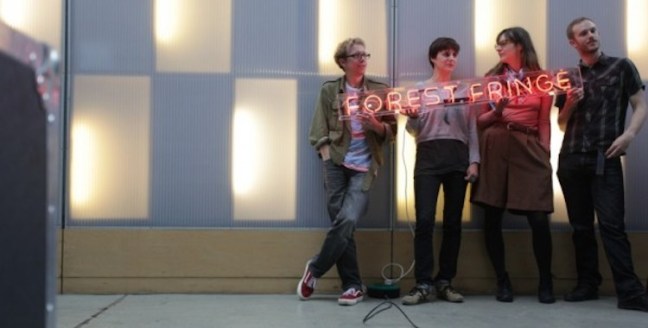
Forest Fringe’s fleeting residency at The Place is an intriguing meeting of performance practices, an inter-disciplinary experiment in curation and audience engagement. Over two nights, the organisations have co-curated a range of performances and installations that dance delicately around genre distinctions, standing at the intersection(s) between theatre, live art, contemporary dance, performance and participation. It’s both dance and not-dance.

In watching, I can only react to the bodies. I’m reminded, aptly, of the words of Forest Fringe’s Andy Field: “Theatre is a space in which we can ask questions that only our bodies can answer.” Theatre does thingswith bodies just as much as it does things with words. And the same goes for the performances I see at The Place: they do things with bodies.

In Gillie Kleiman’s DANCE CLASS: a performance, our bodies as audience members form the material of the piece. After being ushered into the room in darkness, we close our eyes and are invited to inhabit our own bodies more fully – specifically, our hands: their connection with the floor, their movement, the bones and muscles that form them. It feels part meditation, part piss-take, Kleiman delivering everything with her tongue more or less firmly in her cheek. Despite the lightly mocking flavour, though, it’s oddly relaxing. I find my fingers tingling as they press down into the ground or flex in the air.

Before long, though, our bodies are found to be wanting. Leading her strange, ever-shifting dance class, Kleiman is brisk and occasionally bullying, leaving no doubt as to who is in control here. She teaches; we try, we fail. Reflexes are too slow, muscles reluctant to mimic the moves demonstrated by Kleiman. Whose bodies are really important in this space? the piece begins to ask between laughs. Whose show is this? Lightly, playfully, tongue still planted in cheek, Kleiman prods at interaction and its often obscured power dynamics. Our bodies might be the raw material, but who in the end is sculpting them?

If 27 is also (intermittently) playful, that’s where its similarities with DANCE CLASS: a performance end. The relationship with dance in Peter McMaster’s tender, bruising show is less explicit, but nonetheless it is overwhelmingly about bodies – bodies that live and love and die. This is all wrapped up in a structure that resembles nothing so much as ritual, from its slowly burning incense sticks to its ceremonial scatterings of ash. The two bodies on stage in front of us – McMaster’s and fellow performer Nick Anderson’s – are here, visibly and thrillingly alive, in order to think together about death.

The title refers to the “27 club”, that morbidly romanticised group of musicians – including Jim Morrison, Janis Joplin, Jimi Hendrix, Brian Jones, Kurt Cobain and Amy Winehouse – who all died at the same age McMaster is now coming to terms with. Death, then, is a constant and in some ways alluring presence in 27, but so too is life in all its joy and heartbreak and messiness. In contrast to all the unthinkingly mythologising responses to those “live-fast-die-young” icons, 27 is complex and personal and humane, acknowledging the appeal of the myth while fusing it to material that is at once autobiographical and outward looking.

It’s the second time I’ve seen the show and the same moments knock the breath out of me all over again. They all have to do, I realise, not with design or words or even fully articulable ideas, but with just these two performing bodies. There’s a sequence in which McMaster struggles again and again to escape from Anderson’s half-embracing, half-smothering grasp, straining out of his arms over and over, all underscored by the devastating soundtrack of Janis Joplin’s “Cry Baby”. Both men are naked by now – a nakedness that feels as gentle and generous as it is exposing – and their bare skin is lightly coated in the ash that clouds the air. Death hangs on them, yet they are so so alive.

Later, in one of the most powerfully simple gestures I’ve seen on a stage, the two men fall repeatedly into one another, stepping gradually further and further apart as they do so. Shoulder smacks into chest; arms grip arms. You can almost see the bruises blossoming in real time. There’s such trust in it, a trust and cooperation tinged at the same time with pain and a kind of heavy, unspoken grief. Each time their bodies slam into one another, it’s all I can do not to gasp with the bruising beauty of it. Bodies, at once sturdy and fragile, embracing, catching, supporting one another.

To talk about embodiment is often to be misleading. We aren’t brains in jars, we’re blood and muscle and sinew, and so everything is embodied – from sitting and reading a book to me typing these words, the smooth surface of the keys sliding under my fingertips. Still, there’s something about live performance that almost imperceptibly changes how we see and understand both the bodies on stage and, perhaps, our own, whether in our seats or up on our feet. And time and again, as at Forest Fringe, I find myself surprised.

Photo: Jemima Yong.

Peddling, Arcola Theatre

peddling-facebook-ad

Originally written for Exeunt.

Harry Melling has an ear for the poetic and an eye for the gritty. His debut play has a little of both. It opens with him swinging from a lamppost, body straining upwards while coloured lights pulse around him. A moment later, he’s on the ground and in the dirt, gathering up the detritus of the night before. These two images capture in miniature the existence of Melling’s nineteen-year-old door-to-door salesman: a boy reaching upwards but forever pushed down. 

Peddling is a slippery, shimmering thing, its wordy, meandering text requiring concentration but rewarding the attention it demands. There are moments when both rhythm and language are briefly reminiscent of Kate Tempest, with that same delicate skill of spinning lyricism from the urban and everyday. Melling’s pedlar boy, a young offender set to work hawking j-cloths and loo rolls (“life’s essentials”), could be a brand new ancient; a trampled god of 21st-century London, flinging poetry and unexpected wisdom into the unheeding night air.

Inside the gauze walls of Lily Arnold’s set, the action of Peddling appears hazy, as if trapped behind the gloom and smog and anonymity of a city seething with people. Traipsing through London with his wares – “professional doorstep-hopping” – Melling’s protagonist bears witness to a stratified urban landscape, where the cosy, affluent households of Hampstead and Muswell Hill sit in stark contrast to those who come knocking on their doors. For all the fancy postcodes he names – those telling little combinations of letters and numbers, freighted with social significance – in Steven Atkinson’s production the Boy (he’s never named) stamps in circles around the same sorry patch of earth. Round and round.

In one of those comfortable houses with its comfortable postcode, the Boy comes across a ghost in the form of a woman in the form of a social worker. She doesn’t recognise him, but he recognises her. This sudden, destabilising encounter offers opportunity for destruction, answers and redemption, with the Boy seeking out a little of each. Melling has us follow him as night melts into day and day melts into night, tracing the winding path he takes on the search to understand his past, his present and his future.

What Melling is strongest on is the sheer, crippling indignity of not being recognised as a fellow human being. His protagonist is denied a name and a place to lay his head, cast out onto the uncaring streets with just a badge on his chest and a box of items for sale. His life is reduced to transactions. He knocks on doors. He sells dishcloths and buys fags. He receives the sum of his life in a box full of papers, thrust into his arms with the words “this is you”. Just a series of notes and records, the traces of his long exchange from hand to hand, institution to institution; “a long list of yesterdays”. When he begs for his name to be acknowledged, crying “I am something made of flesh and blood”, it rings out with rage and desperation.

Elsewhere, though, Peddling can be a little heavy-handed with both its points and its symbolism. When we get a glimpse of the Boy’s childhood, the loss-stained memory of innocence feels all too familiar, recalling a trope seen many times before. A long interlude describing a dream, meanwhile, shows the strain of reaching for profundity in a way that the rest of the play doesn’t need to, leading the attention to drift. The real poetry here is in the pedestrian, its power generated by a distinctly and devastatingly everyday despair. And through it all Melling’s restless, intermittently explosive protagonist prowls like a caged thing, stamping down the dirt and blinking up at a city sky that has swallowed all the stars – “a punishment for not taking good enough / care of one another”.

This Room, Battersea Arts Centre

tumblr_inline_n8axax3tRw1r4vduw

Originally written for Exeunt.

Twice in the last twelve months, I’ve taken a mental health questionnaire – not in the office of a doctor or psychologist, but in the theatre. 

At one point in Are You Lonesome Tonight?, Ellie Stamp’s playful but urgent interrogation of mental health, creativity and the perils of diagnosis, she reads out a list of statements and asks us to lower our arms – which are raised at the start of this exercise – as soon as we hear one that describes our experience. Mine is down like a shot; before long, everyone’s hands are back in their laps. And the statements? They describe the symptoms of a recognised mental disorder.

There’s a similar device used in This Room, which takes an affecting look at the treatment of mental illness and what it really means to “get better”. At the start of the show, theatre-maker Laura Jane Dean reads from a list of unwanted, “intrusive” thoughts, later gently asking us which of these thoughts we’ve ever had. They range from worrying that the door has been left unlocked to the sudden, unwelcome, unnerving thought of slitting your wrists or throat when looking at a sharp knife (yep and yep).

Both question the idea of some kind of mental “norm” and divergences from that norm. Both trouble the dichotomy of “ill” and “well”. Both create a space where we can look at ourselves and each other and maybe, just maybe, collectively admit that we’re not OK. And that’s OK.

In This Room especially, well and not well are allowed to sit alongside one another. The room of the title is a doubled, overlapping space, referring both to Dean’s bedroom, where her crippling anxiety began, and to the room where she underwent cognitive behavioural therapy following her diagnosis of obsessive compulsive disorder. These are spaces at once comforting and terrifying, safe and perilous. No more powerfully is this the case than when Dean recalls the time her therapist accompanied her home, permeating the divide between the two rooms, and urged her to confront her fear of hurting herself in her sleep.

Meanwhile the room of the performance, haunted by the presence of those two other rooms, feels like an archive of anxiety. Dean’s medical notes, from which she reads at several points, are housed in boxes and blu-tacked to the walls. From another box, Dean produces a handful of tights, bundled away out of fear that she would use them to hang herself in the middle of the night. As she clutches them in tight fists, holding them out to us, these everyday objects take on an almost alien quality, the fear they represent becoming tangible and heavy in the room.

This Room is full of moments like this, when worry seems to vibrate through the air and tingle on the skin. Dean reads from her case notes into a microphone, her speech faster and faster and faster, skipping along at the pace of her anxieties. She stands on a chair and gazes out at us in a long, suspended moment. The lightbulbs suspended from the ceiling flare and flicker like neurons firing in the brain. All the while, Melanie Wilson’s lightly throbbing soundscape gives voice to the background buzz of unease, its constant hum occasionally bursting into crescendos of panic and fear.

As a viewer, it’s impossible not to be present in the room – this room – and be uncomfortably aware of that presence. At times, as in the vacuum cleaner’s raw and affecting show Mental, the intimacy almost feels too much. Should we really be here? Is it right for these delicate experiences and thoughts to be relived for us? As a result, the power dynamic between performer and audience is one that is always in flux, creating a sense of shared responsibility for this space we’re all in, a space where we might not all be OK.

The questions “am I OK?” and “are we OK?” are ones that are left open. This Room feels like a searching, reaching gesture rather than one that ever reaches a destination or closes a fist around its object. There can be no neat resolution, no satisfying arrival. Because when the thing that harms you is part of how your brain works, how do you get away from that? Where does the illness end and the person begin? And if being “ill” is who you are, then what does it mean to get better?


Harajuku Girls, Finborough Theatre

image7-600x337

Originally written for Exeunt.

On paper, Harajuku Girls is an intriguing prospect. Francis Turnly’s play promises to examine the social and economic pressures on young Japanese women through the journey of two friends from innocent cosplay to less-than-innocent image clubs in twenty-first century Tokyo. The marketing blurb’s emphasis on image and fantasy, when I first read it, strikes me as having lots of mileage: it poses implicit questions about who is looking, whose desires are really being indulged, who is in control. Plus, it’s directed by Jude Christian, whose assured and striking production of I’d Rather Goya Robbed Me of My Sleep Than Some Other Arsehole at the Gate last year immediately grabbed my attention.

Which makes it all the more disappointing when it struggles to land. Expectations can be dangerous things and unfair markers against which to judge a production, but Harajuku Girls is muddled by any measure. To its credit, it is trying to do a lot – too much, perhaps, causing it to wobble under the weight of its own ambitions. Through the story of best friends Mari and Keiko, Turnly casts his gaze on various of Tokyo’s less savoury aspects, from panty shops to love hotels, while at the same time attempting to tackle big questions around agency, tradition, family, freedom, sexual politics, consumerism … the list goes on and on.

At the centre of this web of ideas is Haruka Abe’s naive but determined Mari, a would-be actress who is quickly persuaded to put her talent for role-play to profitable use when her parents refuse to support her through drama school. Her rebellious trajectory might be familiar, but her particular brand of teenage defiance opens up underexplored avenues. Spurred on by Keiko, Mari joins her friend in working at an image club, where the two one-time cosplayers once again don outfits, this time to act out the sexual fantasies of a constant parade of men. They claim to be calling the shots, but bit by bit their grasp on events slips away from them. As a counterpoint to this murky underworld, meanwhile, we see odd glimpses of Mari’s strict, concerned parents and her childhood friend Yumi, whose dead-end job offers little argument for pursuing more legitimate employment.

For all the themes knocking around, though, it’s sometimes hard to locate the critique – by no means obligatory in a piece of theatre, but it feels strangely lacking in a play that’s so clearly aiming its fire on something. Is it the exploitative, unseen owners of the image clubs who are to blame? The pressures from family and culture that send Mari and Keiko to one of these establishments? The entire industry of illicit sex? The continuing vein of misogyny and discrimination that runs through the society of both play and audience? All of the above? By the end, I’m still not sure. Acknowledging complexity is one thing, butHarajuku Girls seems, like its protagonists, to progressively lose its way, not helped by a production that is just as unsure.

After so vividly capturing the bright, plastic, grubby allure and repulsion of modern capitalism in Goya, Christian’s depiction of Tokyo’s seedy underside is oddly diluted. What should be garish, flashing neon is instead muted watercolour. It all just feels a bit lacklustre, from the tentative performances to Cécile Trémolières’ ungainly, laborious set design. As the actors shift around bits of furniture between scenes, their attempts to keep up momentum with bursts of “aren’t we all having such fun?” laughter and dancing are increasingly strained – apt, maybe, but awkward to watch. If this absence of colour and animation is the point – as well it could be given the subject matter – then the production lacks the confidence to fully make it, instead leaving that promising premise mired in a tangle of question marks.

Photo: Alexander Newton.