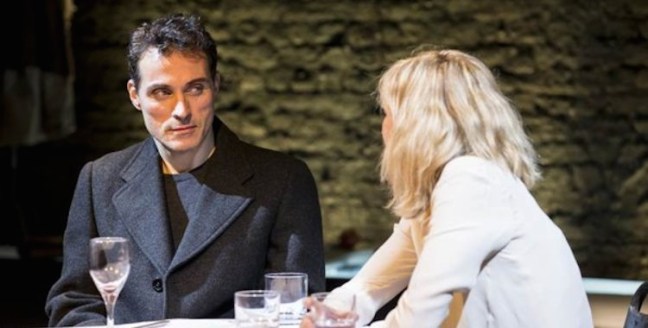
Closer, Donmar Warehouse

DWcloser2015JP-03922-Edit-600x400

Originally written for Exeunt.

There’s one image that jumps out from the text of Closer, punching me right in the same organ it describes. Surprisingly, it comes from the mouth not of posturing writer Dan but of the dermatologist with whom he repeatedly crosses swords in pursuit of passion. “Have you ever seen a human heart?” Rufus Sewell’s Larry snarls, furiously eyeballing his rival across his desk. “It’s like a fist wrapped in blood.”  

This is love as Patrick Marber paints it: fierce, aggressive, violent. And selfish. Watching the four characters circle around and collide with one another, I’m oddly reminded of the ruthless corporate matadors in Mike Bartlett’s play Bull. Here, though, the prize is not a job but the equally fragile promise of love, of companionship, of The One.

But romcom happy endings are in short supply here. People are as likely to fall out of love as in it, twisting the knife on their way out of the door. First, Dan falls in love with Alice, a self-styled free spirit just returned from the States. After chewing Alice up and spitting her life out into a novel, Dan switches his affections to photographer Anna. Spurning him, Anna meets and dates Larry before finding her way to Dan’s bed all the same. Partners change and change again, cheating and lying along the way. Swap, hurt, repeat.

Again, like in Bull, appearances are important. Manipulation, Marber realises, is all about surface; it’s not what you do, but how you do it. Oliver Chris’s whining, wheedling Dan exemplifies this, clothing his selfishness and malice in a mixture of charm and feebleness. For all that he seems a bit wet, you get the impression that beneath his Hugh Grant-style dithering he possesses a steely, unforgiving determination to get what he wants. If Larry’s ugly side sits closer to the surface in Sewell’s grimly compelling performance, he’s no less schooled in getting his own way, while Nancy Carroll’s deceptively warm Anna has the talent of making manipulation look blameless. It’s just a shame that this version lets Rachel Redford’s Alice off the hook, going heavy on her vulnerability and light on the ways in which she uses her sexuality and air of mystery to her advantage.

Meanwhile, the world these characters move within – unfussily though not quite seamlessly shifted from the late nineties to the present day – is an all-encompassing advert for instant gratification. Love and sex might as well be consumer products, picked off the shelf or, as in the famous chatroom scene, ordered on the internet. It’s astonishing now how prescient Marber’s 1997, pre-Tinder play looks, anticipating the ways in which romance was to become packaged and monetised in the digital age.

This is a thread that David Leveaux’s production pulls on to the point of unravelling. Bunny Christie’s swish set, with its column of coloured lights and its large screen periodically adorned with Finn Ross’s busy video projections, all feels a bit much. The point may be that we live in an information saturated, image obsessed world, but by straining to apply this gloss the production paints over some of the raw brutality that makes the play lodge uncomfortably like a bur in the mind. What lingers is the very human capacity to hurt and be hurt.

The title, of course, is just another of the play’s cruel deceptions. No one really gets close to anyone else here; these characters are as allergic to intimacy as they are addicted to it, only able to reveal one part of themselves by concealing something else. Secrets are divulged not out of love but as a way of scoring points. Sex is as much a weapon as it is an act of passion. And even the most seemingly naive of the quartet turns out to be an elaborate fiction of her own making.

More than sex or lies or cruelty, though, Closer is obsessed with death, a fixation that is brought to the fore here. Marber’s is a play that fully subscribes to fellow playwright Simon Stephens’s description of dramatic action’s driving force: “Because we know we die, we want stuff”. The memorial stones that Christie keeps fixed to the back wall throughout are as stark a reminder of mortality as the obituaries that Dan writes for a living, a threat that sends each of the characters seeking that promised greener grass. In the spectre of death, though, perhaps lies the play’s one minuscule scrap of optimism. Because we know we die, we want stuff, but we also stubbornly keep searching and keep hoping. For all the characters’ brutality, maybe next time they’ll get it right.

The Coming Storm

10959678_897667936943924_3104337664882259698_n-600x400

Originally written for Exeunt.

Droplets of rain hammering the floor, at first light and then deafening.

Clouds of mist rising, obscuring, shifting the landscape.

Bodies finding shelter in one another.

Enter the storm.

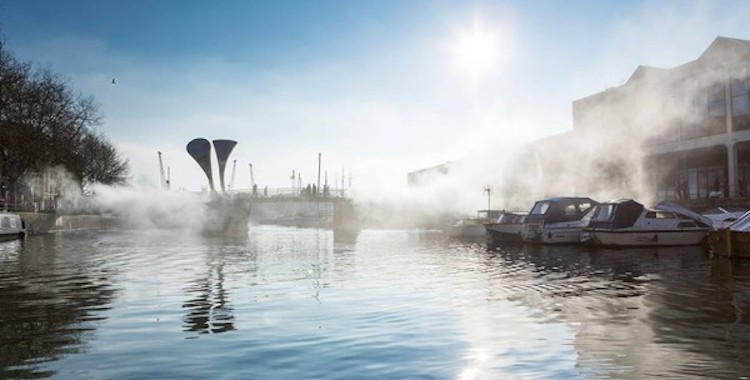
It begins on Pero’s Bridge, a slender strip of metal suspended over the water at Bristol’s harbourside. At intervals, Fujiko Nakaya’s fog sculpture envelops the bridge and the surrounding water, billowing in whichever direction the wind catches it. From a distance, figures hover insubstantially, as though walking on clouds; stepping across feels like a small act of trust, as the mist blurs the view ahead.

Mostly it’s an interruption in the architecture of the city, an instance of surprising, unexpected public art. Passersby pause to take photographs, while others linger in the fog that clings to hair and clothes. It’s a novelty, an attraction, an invitation.

Placed in the context of Bristol’s status as European Green Capital, however, it acquires more significance. Considered alongside the potentially catastrophic changes occurring to our climate, Fog Bridge feels anticipatory, its delicate beauty foreboding. It might be fog today, but what will it be tomorrow?

This is just the calm before the storm.

Teenagers are often seen as something of a gathering storm themselves, anarchically brewing trouble. But Canadian company Mammalian Diving Reflex ask us to see them – and ourselves – differently. On Saturday evening, following a coach journey into the dark, a group of teens lead us on a sprawling and chaotic roam through streets and fields, powerless to do anything but follow them. The usual power dynamic is flipped.

As with Fog Bridge, there’s a sense of event. Our large group of walkers swells through the streets, observed by curious figures through parted curtains. It’s an unruly disruption, but not of the kind we’re used to associating with urban teenagers. Nightwalks with Teenagers is rebellious but gentle, riotous yet tender. We are instructed to hold hands, to hug one another, to gather close. From the beginning, a fragile sense of community is created.

This begins to break apart as we trundle through suburban streets and along treacherously muddy paths. The audience is large and spread out, inhibiting the intimacy that the event seems to be reaching for. It’s full of individual moments, though, that are both striking and bizarre: a panoramic view of the city laid out below us, lights twinkling in the gloom; an invitation to dance; a rowdily improvised bit of storytelling; and, perhaps strangest of all, a detour to a house with a Mini Cheddar-loving pet duck. Our adolescent guides revel in it all, taking up the reins with glee.

If this generation are the coming storm, then bring on the downpour. 

Rumblings of thunder shudder through True West, Lone Twin’s unique take on and around Sam Shepard’s domestic play. Gregg Whelan and Gary Winters are Shepard’s pair of brothers, locked in bitter and often absurd rivalry, while a chorus sat around a table stand in for all the other roles. It’s small and low-fi, but somehow oddly explosive.

There are gloriously naff sound-effects, showers of multi-coloured confetti, overflowing cans of beer and a brilliant moment with a golf club and an ill-fated toaster. For all the stuff, though, it feels more like a story about stories: how we tell them, who tells them, how our culture has encouraged us to shape them. Delivered deadpan by Whelan and Winters, lines from the “authentic” Western one brother is writing leap out in all their ridiculous beauty.

In their programme note, Lone Twin describe True West as a “cover version” of Shepard’s play. It’s an appealing way of describing their relationship with the text, which is as irreverent as it is admiring, riffing playfully on Shepard’s lines. It’s also apt, as music – country pop specifically – threads its way through the piece. It’s there throughout the festival too, right down to the listening recommended in the programmes, offering space to think and feel and explore. The curious are welcome here.

Music also throbs throughout O, as lightning repeatedly threatens to strike. There’s a suspended feeling of discomfort all the way through Project O’s show, leaving us braced for the storm to break even as we laugh in our seats. Performers Alexandrina Hemsley and Jamila Johnson-Small ask us to watch and to notice ourselves watching, unsettling us with the anticipation of how our responses might be turned back around. It’s our collective gaze that really feels under the spotlight.

The two Os most in question here seem to be objectification and othering, both of which are obliquely referenced by Hemsley and Johnson-Small’s alternately playful and aggressive dance moves, which in turn reflect the reductive presentation of black female bodies in popular culture. It’s often funny, very funny, but laughs escape only uncertainly and in the knowledge that the whole thing could flip on its head any moment. With small gestures, the mood suddenly changes; the weather shifts.

The storm clouds converge on Saturday night over The Old Fire Station. A tornado of pulsing music and flashing lights rages at the heart of the festival, along with showers of glitter and the occasional crash of thunder. 

The festival party, framed as an immersive club night, sits alongside Fog Bridge as one of the most public-facing aspects of this year’s In Between Time. Festival regulars are joined by hundreds of fabulously dressed party-goers, decked out as clouds, lightning bolts, poncho-clad stormchasers. It’s a real event. Peppering partying with art, it shows how this kind of work can connect with a wider local audience, who seem to be largely absent from the festival’s daytime offerings.

How can that invitation be extended even further?

After the storm, the flood. There’s a post-apocalyptic flavour to Jo Hellier’s Flood Plans, which hints at an all too probable weather-ravaged future. Rather than narrative, though, it relies on feeling and evocation. Submerged in darkness, we’re pelted with deluges of sound: rain falling, waves crashing, wind howling. The volume rises and rises until the noise rattles through each last sinew of the body.

The aural onslaughts are punctuated with moments of human fragility, survival and connection. Isolated on the bare, black stage, Hellier and fellow performer Yas Clarke appear brittle and insubstantial, voices whistling weakly into the void. It is those bodies, though, that offer the most memorable and affecting moments. Hellier and Clarke first struggle and then embrace, their limbs surprising us with all the new ways two people can fit around one another. Against the force of storm and flood, they wrap themselves together.

There’s a different sense of aftermath to Ishimwa’s Niyizi, which takes on the character of searching. History, culture and identity both intertwine and clash, as the performance tests out ways of reconciling self and heritage. Through the separation of video and live performance, Ishimwa suggests both dislocation and simultaneity, his movements in the room frequently mirroring those on the screen, but always just the tiniest fraction of a second out of time.

In the first filmed dance sequence, blown up on the big screen at the back of the stage, Ishimwa sits in profile, twisting and turning. He writhes as if in an effort to crawl out of his own skin, a skin that he then – like the series of dresses he wears – gets more and more comfortable in. There’s a sense of struggle to it, but also of ritual and finally of celebration.

Peter McMaster’s 27 is ritual too, at times morbid and at times joyous. It offers two visions of the post-storm world: one of death and one of hope. These two forces tussle throughout the performance, as the experience of getting older and finding one’s place in the world veers between destructive despair and a liberating gesture of letting go.

The title is a reference both to McMaster’s age and the age at which Jim Morrison, Janis Joplin, Jimi Hendrix, Brian Jones, Kurt Cobain and Amy Winehouse – whose music weaves its way through the show – all died. Death, whether in the skeleton bodysuits that McMaster and Nick Anderson open the show wearing or the ash that is scattered ceremonially over floor and bodies, is thus a constant presence.

While there are moments when it stutters, the whole piece is so open and tender that it begs forgiveness for any flaws. If anything, the flaws feel necessary, colouring its heart-aching sincerity and vulnerability. Stripped bare, both literally and figuratively, McMaster and Anderson share with us their bruises. And as in Flood Plans, bodies interact in unexpected ways, resisting, embracing, leaning against and catching one another.

There is a storm coming, no doubt about it. But perhaps the response, as 27 begins to intimate, lies in the connections we are able to forge.

Photo: Max McClure.

Finding The Words

©Richard Davenport 2012. London UK. Chris Goode Publicity Images

Originally written for Exeunt and the Bruntwood Prize for Playwriting.

I’m sat on the edge of my bed, postponing the moment when I need to leave for work, staring with feverish intensity at the glowing rectangle of my phone. In these stolen minutes at the start of the day I’m reading every last word I can about Three Kingdoms, the new production at the Lyric Hammersmith that has sparked a long, sprawling critical debate. My own words are also out there, somewhere in the tangle of online criticism, and for the first time since releasing my opinions into the virtual world I feel as though I’m part of a real conversation.

I walk out of This Is How We Die at Ovalhouse with ears ringing and skin prickling. I don’t have the words to describe what I just experienced, and I’m not sure I ever will, but the search for them feels like the most important thing in the world in this moment. On the bus home, hands still shaking a little, I type an inadequate, sweary tweet on my phone and wonder if a piece of theatre will ever leave me this exhilarated again.

It’s late. Far too late. Far too late – or rather too early – to still be tapping away at my laptop with a full day’s work waiting for me in the morning. But I just can’t stop. I’m writing about Chris Goode’s The Forest and the Field, a gently mind-stretching essay of a show, and wrestling at the same time with some of the really big, essential questions about this art form that I love. What is theatre for? Why do we make it or see it? What really happens when we all gather in a room together to experience a show?

Who knew theatre could be so epic, so thrilling, so sexy? It takes about five minutes for The TEAM to steal my heart and squeeze it tight with the gorgeous, adrenaline-fuelled juggernaut that is Mission Drift, their warp-speed race through 400 years of American capitalism. Later, catching my breath and staring at a blank Word document, my only thought is: how do I possibly write something even a fraction as exciting as what I just saw?

These experiences are rare. In a lifetime of faithful theatregoing, they appear as sporadic, fleeting flashes on an otherwise calm horizon. It’s the promise of such moments, however, that keeps me going through all the boredom and mediocrity. It keeps me hopeful and it keeps me questioning, two vital qualities for anyone who wants to write about theatre with any kind of passion. No matter how many awful shows I’ve seen, the words constantly on my lips – like a much less glamorous version of Liza Minnelli in Cabaret – are “maybe this time”.

I find it hard to think of any one piece of theatre that set me on a course towards criticism. Writing about theatre, like so many other things in life, was essentially a bit of an accident. As an undergraduate student I kind of liked theatre, I kind of liked writing and I kind of wanted to start a blog – it wasn’t any more interesting or exciting than the serendipitous alchemy of those three things combined. Instead, what I find easier to pin down are the shows that subsequently kept me on that strange, coincidental path.

When first writing about Three Kingdoms and still feeling a little dazed, I suggested that “we need new ways of seeing, of experiencing, of expressing”. This is what the best theatre provokes. There’s a line that I love in Irving Wardle’s book Theatre Criticism: “In the midst of an earthquake, the critic is no better a guide than anyone else”. It’s a slightly embarrassing thought for critics, but an inspiring one for theatre-makers. They trace new contours in the world; we scrabble around to redraw the map.

Or, to put it another way, the theatre that I most want to write about is the theatre I don’t yet have the words for.

Boa, Trafalgar Studios

13boa1002a-600x399

Originally written for Exeunt.

Clara Brennan seems to have a direct line to an audience’s tear-ducts. The playwright’s last offering, the doubly devastating Spine, left barely a dry eye during its soggy, sniffly Edinburgh run. Boa, which is similarly small-scale but wide-ranging, also produces its fair share of tear-stained cheeks by the end. At one point during the performance I see, there’s an audible gulping back of tears; the evening’s customary applause is followed by the no less appreciative rustling of tissue packets.

But where Spine effortlessly intertwined the personal and the political, dragging up sobs with both its ideas and its characters, Boa shows the strain of trying to replicate that feat. Again, there’s a relationship at its heart, though this time it’s a romantic one. Harriet Walter, all black-clad sophistication and brittle emotion, is the Boa of the title. Or rather, that’s her nickname, a childish contraction that stuck. Sometimes like the feather variety, at others more of a constrictor, she clings passionately to Guy Paul’s wry, brooding Louis as their lives are catapulted through the last few decades of world history. Love and marriage play out against a backdrop of war and devastation.

The story of the couple’s life together is told in economical but contrived reminiscences, flashing backwards and forwards through years of infatuation, excitement, anger, regret, depression, reconciliation, contentment, grief … Both Boa and Louis pursue livings that push them to extremes: the former as a dancer, contorting her body into constant, punishing pain, and the latter as a war correspondent in the ravaged south-east Asia of the latter quarter of the 20th century. Boa loses her faith in her body; Louis loses his in humanity.

The couple’s dissection of their shared history, placed in a present day context that remains indeterminate until the final moments, verges on the masochistic. Both are determined to isolate where things went wrong – in their relationship, in their careers, in the world – at the same time as reluctantly acknowledging that “you can’t fix the past”. But still they rake it over and over, stirring up old soil until you want to shake them and tell them to stop. Leave it alone.

The point is that they can’t. Hannah Price’s simple, intimate production captures something of the frenetic movement of these memories, snapping the action back and forth through time with the absolute minimum of fuss. Eventually, the two seem to bleed into one another, the past leaving its indelible stain on the present. We see this too in Walter and Paul, whose gorgeously layered performances feel shadowed in each individual moment by the characters’ past and future selves.

In an attempt to stop this obsessive scab-picking from getting too painfully introspective, Boa also casts its gaze outwards. The world intrudes both through Louis’ work, forever offstage and unseen but leaving its bloody mark nonetheless, and in Boa’s guilty, complicated preoccupation with the lives of those less fortunate. “I’m drawn to people’s suffering,” she admits, “it makes me feel.”

The handling of this confrontation of privilege and deprivation could be whereBoa gets more interesting, in the way Spine did with its angry yet unforced engagement with contemporary politics, but instead it turns out to be something of a missed opportunity. Boa and Louis are a walking parade of first world problems and they know it. Boa laughs at herself – and we laugh knowingly along with her – when she compares her rage at poverty and injustice with her no less forceful anger upon cutting into an over-ripe avocado, but Brennan rarely digs deeper than this sort of familiar and ineffectual middle-class guilt.

More convincing than the play’s nods to the wider world are the multiple ways in which its two protagonists fall apart and clumsily put each other back together again. “We’re all lovely fucking fuck-ups,” says Boa at one point, a bitter laugh on her lips. Between them, the haunted, hard-drinking couple offer plentiful proof of this over the years, but still they keep returning inexorably to each other’s arms, finding both retreat and redemption in one another. And what better reimagining of the old “warts and all” than the line “I love the piss and shit of you”? This is love not in spite of but because of every flaw, every ugliness, every mistake. That sentiment, if nothing else, can begin to make the eyes prickle. Because aren’t we all just lovely fucking fuck-ups?

Little Light, Orange Tree Theatre

Cast : Lorna Brown (Alice) Paul Rattray (Teddy) Yolanda Kettle (Clarissa) Paul Hickey (Simon)

Originally written for Exeunt.

Families are made from memories. Soft-focus, hard-edged, ossified by nostalgia. Collections of human beings linked by little more than blood and shared history reconstitute themselves through telling, unfurling mothballed reminiscences over the festive detritus of wine glasses and chocolate boxes. Remember the time your uncle got drunk at that wedding. Remember when granny mixed up the pies for dinner. Remember that year little Catherine sang the “Twelve Days of Christmas” for everyone. With all the actions.

In Little Light, those memories are painfully loaded, groaning under the weight of stultified tradition and unspoken grief. In a house by the sea, a couple make careful preparations for a once-a-year ritual of remembering. Teddy is desperate to let in the light, ripping down staircases and smashing through walls, while Alison clings stubbornly to the shadows. When her younger sister Clarissa arrives, heavily pregnant and with boyfriend unexpectedly in tow, the strange ceremony is ready to begin. But this year it’s not going to plan.

Alice Birch’s play – her first, though not performed before now – is an extended exercise in tension-building. On the evening I see the production I’ve come straight from a screening of Whiplash, which had me white-knuckled throughout its 90 minutes of sweat, blood and cymbals. What writer/director Damien Chazelle does with drumming, Little Light does with the dinner party. It’s a format freighted with dramatic history, but in the hands of Birch, director David Mercatali and the excellent cast of four it feels fresh, fleet-footed and horribly nerve-fraying.

As Teddy, Alison, Clarissa and Simon clink glasses and break bread, they commence a routine that is at once familiar and unsettling. All the codes of a shared family language are there: the repeated anecdotes, the practiced looks, the choreographed passing of dishes and wine bottles. But there’s something far more odd and sinister lurking beneath the repetition. Stories are told with blank eyes and laughs jump cheerlessly from strained throats. Remembrances are aimed like daggers under the ribs; a matted lump of hair turns up in someone’s fish pie.

The effect is one of discomfort tinged with horror. Imagine the feeling of anticipatory dread in a scary film: that extended moment of sickening tension just before you know something bad is about to happen. Now imagine that stretched out across more than an hour. Because Birch and Mercatali manage to leave us groping around in the dark, keeping everything in the gloom until the final minutes. The rehearsed interactions of the characters clearly mean something of horrible importance to them, but we are robbed of the means to decipher them, forced instead to remain puzzled and on edge.

While it may not have the same kind of breathless, rule-breaking, fuck-you audacity as Birch’s searing Revolt. She said. Revolt again, Little Light still manages to repeatedly trip an audience’s expectations, deploying the same playfully serious manipulation of form. I was reminded briefly of Martin Crimp’s In the Republic of Happiness, which takes an Ayckbourne-esque domestic set-up and mercilessly rips it apart at the seams, except Birch’s unnerving dinner party gnaws at its own format from within. What looks familiar enough at first glance turns out to be chewing on something a lot more grisly.

The performances, too, keep us guessing. As Alison, Lorna Brown is distant, icy and cruel, until suddenly she’s not. Yolanda Kettle’s Clarissa gulps down the bitter medicine she’s fed by her older sister, the implicit shades of guilt, resentment and reluctant loyalty in her brittle acceptance of the situation suggesting the jagged edges of so many sibling relationships, while Paul Hickey makes an appropriately disoriented newcomer as her boyfriend Simon. And Paul Rattray’s Teddy, hands quivering at his sides, seems forever on the brink of explosion or collapse.

Finally, the play too has to either erupt or crumble with the weight of its building, pervasive menace. It turns out to do a little bit of both. But even climax and catharsis do not unfold as we might expect, offering far more lyricism and far less resolution than the domestic dramas that Little Light takes its lead from. The scab that Birch picks at might finally break loose but, as in so many families, the wound remains open.

Photo: Richard Davenport.