How a Man Crumbled, Mimetic Festival

moustachemenweb-600x400

Originally written for Exeunt.

Clout Theatre are experts in the grotesque. In the first show of theirs that I saw, The Various Lives of Infinite Nullity, they took morbid curiosity into new territory, setting grisly murders and suicides on repeat. The company’s earlier show How a Man Crumbled, back as part of the Mimetic Festival, puts the emphasis on the absurd but with the same relish for the monstrous and distorted. Limbs are twisted into alien shapes; arms pop out from suitcases and lungs are torn from chests.

Clout Theatre’s starting point for their surreal grotesquerie on this occasion is Russian absurdist writer Daniil Kharms, who faced Soviet censorship in his lifetime and many of whose works remained unpublished until after his death. That perhaps accounts for the built in difficulties that surround Clout Theatre’s frenetic storytelling. Narrative is interrupted and confounded, the central story – Kharms’  ‘The Old Woman’ – becoming muddied or obscured. The writer loses control of his boisterous creation.

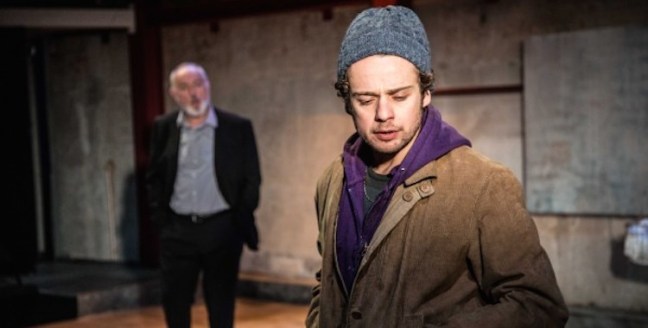
As in The Various Lives of Infinite Nullity, performers Sacha Plaige, Jennifer Swingler and George Ramsay adopt clown-like personas, though here they are more playful than sinister (but not without an edge of the latter). The bouffon-esque trio seem eager to entertain us and competitive in their attempts to alternately convey and derail the narrative at hand, whether that’s by telling swirling, nonsensical anecdotes or whacking one another over the head with vegetables. This performance style could quickly become wearing, and there are moments when it briefly grates, but Clout Theatre have enough charm and ingenuity to just about pull it off.

If these clowning interludes entertain with their wackiness, the narrative sequences themselves are strangely beautiful. The story of ‘The Old Woman’ – in which a writer finds his life disrupted by the mysterious figure of the title – is told through a DIY silent film aesthetic, fully exploiting the elastic expressivity of Clout Theatre’s performers. Ramsay in particular manages to access the full emotional range with just his impressively flexible facial muscles, while Plaige contorts herself into an extraordinary array of positions.

If theatre were solely about isolated stage images, Clout Theatre would be some of the best artists around. Startling snapshot follows startling snapshot. A creature formed of screwed-up paper stirs in the corner of a writer’s office; a recalcitrant corpse is frantically bundled into a suitcase; bodies wrestle and writhe; figures suddenly appear and disappear. Music also plays an integral role, with an inspired use of Shostakovich’s String Quartet No. 8.

But the same reservations that I had about The Various Lives of Infinite Nullityalso apply to How a Man Crumbled. Both shows are brilliant vehicles for the (clearly abundant) skills of their performers, yet I can’t fight the feeling that there’s something missing. The aesthetic is there, but the purpose and drive behind the succession of striking images is not quite apparent. Like the writer they show frustratedly scribbling on page after page, Clout Theatre seem to be grasping at something just out of reach.

Village Halls, Village Voices

unnamed-2-600x395

Originally written for Exeunt.

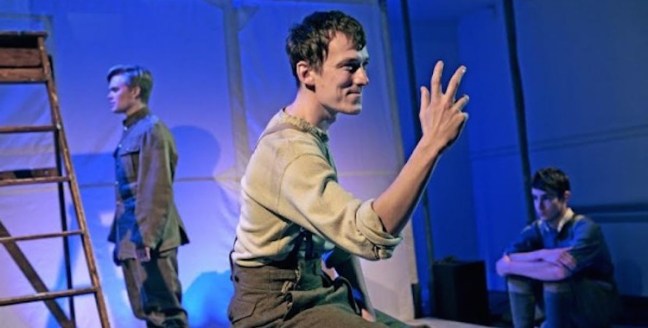
A robin perches, quivering, on a line of barbed wire. Sun dances across the snow. Uniformed men run, smile, play football and shake hands; one slips a bar of chocolate into the pocket of another. And a message flashes up on the screen: “Christmas is for sharing”.

“Everything looks great in that Sainsbury’s advert,” says playwright Rory Mullarkey, voice stained with a mixture of anger and disbelief. We’re chatting in a corner of the pub in Tirril, our conversation drifting towards the familiar iconography that has been rolled out for the centenary of the First World War. This advert, Rory comments wryly, represents the “Disneyfied” version of the conflict. It’s not an image that he or his play Each Slow Dusk – which we’re in Tirril to see – is interested in.

“I feel like there’s a perceived World War I narrative that you can see from War Horse all the way through to the Sainsbury’s advert,” says Rory, naming all the tropes that we’re familiar with from our stages and screens. “You’re not ever getting any closer to what the First World War actually was, you’ve just experienced a traditional narrative except that the obstacle has been the First World War.” To get underneath that perception, to scratch away at what the legacy of that war actually means, he suggests that it’s necessary to move beyond this sanitised remembrance. The real picture, of course, is far from beautiful.

“It was mud, it was blood, it was guts, it was horror.”

The sky is a brightening grey when I arrive in Tirril earlier the same day, wan sunlight just tickling the edges of the clouds. The darker grey and black of the Reading Rooms stands out against it, the inscription “1914” on the building’s facade eliciting a little shiver. Talking to local promoter Jimmie Reynolds once inside, he explains that the coinciding of the hall’s 100th birthday with the centenary of the First World War was one reason for wanting to bring in Each Slow Dusk. And it’s important for people to think about these things, he adds later over a cup of tea.

Tirril, a small village at the edge of the Lake District, is just one of the many rural areas Each Slow Dusk is visiting on its tour with Pentabus. The piece has been designed specifically for village halls, from the initial commission to the direction and design. Rachael Griffin, Pentabus’s managing director and my guide for the weekend, explains that this process allows the company to tailor the shows they produce for rural venues and audiences. Pentabus sketch the initial outline, then the writer is given freedom to fill it in. For Rory, the constraint is a creative one.

“It sounds like a slightly mystical thing to say, but I believe that the piece of work or the play is always out there somewhere and it’s my job to make a series of decisions to allow it to come to me and be present. If you know something like how many actors it is, how long it has to be or whatever, that’s a parameter that can significantly aid your creative thinking.”

As part of the writing process, Rory also visited some of the village halls the show might tour to – an opportunity to “imbibe” their atmosphere. The village hall as a building has a distinct identity, one caught up in history, community and nostalgia. Stepping into Tirril’s chilly, high-ceilinged Reading Rooms, I’m immediately hit by memories of my own village hall growing up: Christmas fairs, bring and buy sales, bad discos spent slugging Panda Pops.

The get-in is almost a performance itself. After a much-needed cup of tea – problems on the road have contributed to the company’s general exhaustion – rigging, lights and set are swiftly hauled out of the Tardis-like van. A month into the tour, this is a slick operation by now, but still one involving a precarious amount of kit to be installed on the hall’s compact stage. On the first night, one of the actors tells me in the pub later, it took a good few hours to dismantle everything after the production; now it requires just one.

When I grab a few minutes to talk to Jimmie, he explains that Each Slow Dusk is a relative risk for the Reading Rooms, which is more likely to receive music and live entertainment. People just want a good night out, he says. There’s also a danger, given the outpouring of art to mark the centenary, that audiences have “First World War fatigue”. Speaking to Rory later in the afternoon, though, I have a feeling that Each Slow Dusk may well challenge the narrative with which we’ve all become so familiar over recent months.

“I thought I would try and write the most open thing I possibly could,” Rory tells me, just a couple of hours before I see Each Slow Dusk. On the page, the first act barely even looks like theatre. Rather than dialogue, it consists of a long series of poetic stage directions. All action, no talk. It’s easy to see both how it represents a risk for promoters like Jimmie and how it fulfils Pentabus’s aim, articulated to me by Rachael, to bring rural audiences work which is ambitious in form and content.

Staged, however, it soon makes perfect sense. The actions belong to three different soldiers: a Captain, a Corporal and a Private, played by David Osmond, Lee Rufford and Sam Heron respectively. All are the same age – nineteen and a half – and all have been sent out on night patrol. The Captain is reluctant, the Corporal pumped with excitement, the Private terrified but determined to prove he’s not a “fucking coward”. Not directly interacting with one another, the three performers instead direct their lines to the audience, describing their actions in the present tense. The style takes a while to settle, but then it grabs a firm stranglehold on the audience.

The writing is more prose than drama and might at first glance be dismissed as novelistic. Yet it soon becomes clear that there is something intensely theatrical about both the rhythm of the lines and the terrible forward movement of the actions they describe. Despite the simplest of stagings from Elizabeth Freestone, subtly enhanced by Adrienne Quartly’s sound design, there’s something incredibly dynamic about it all. And, problematically, it’s kind of thrilling. The play asks us, guiltily, to acknowledge that there might be something exciting about the heat of conflict, even in the midst of all its undeniable horrors.

The three unnamed soldiers also offer a complex picture of the First World War and those who fought and died in it. The absence of names plays with the way in which soldiers have been “loaded with the freight of social commentary,” in Rory’s words, while at the same time refusing to allow each of these characters to be reduced to the mere symbol of “soldier”. The Corporal in particular challenges our collective idea of the First World War soldier as saintly victim. Here is a soldier who revels in what he does, who is proud of his skill in fighting and killing, and who would happily take the battlefield over a lifetime of picking potatoes.

“There are as many kinds of soldier as there are kinds of person,” says Rory, skewering – as his play does – the popular image of identical, “lovely lads” sent off to be slaughtered. “Those ‘lovely lads’ were just exactly the same as any lad is nowadays; they were just as likely to swear, just as obsessed by sex, just as violent, just as moody. They were human beings, and it felt like it was important to write something which didn’t cast them in the mode of victim the whole time – that they had agency and dignity.”

As the audience move around the hall during the interval, chatting to neighbours and buying raffle tickets, there’s a definite sense that we are in their space. This is first and foremost a place for community rather than one for theatre, and it shows. The size and warmth of the audience – a far cry from small-scale tours which often struggle to fill half the seats in a studio theatre – feels like a vindication of the idea that you really get theatre to talk to people’s lives by taking it to them. But entering an audience’s midst rather than extending them an invitation requires a different creative thought process.

“You’re making a very different kind of statement if you’re going to someone’s home with a show and you’re bringing it to them,” Rory suggests, stressing that he wanted to write a play that “would feel generous and warm and alive to a village hall audience”. So while Each Slow Dusk might be challenging in lots of ways, it was important for everyone involved that it speaks to the audiences it is going out to.

Rachael and Rory talk about the directness that feels right for these village hall spaces, but there is also something around proximity. The actors are right there, barely separated from the audience, and available for a chat in the small gap between the end of the performance and the get-out. On this particular night, the presence of the playwright adds an extra ripple of excitement and Rory finds himself, to his slight bemusement, signing playscripts.

Before I leave the following day, a cup of tea and a chat with Sue Hayward – the seasoned promoter in nearby Arnside – sheds some more light on the programming of this and other events. Many of her comments confirm what I see during the interval: audience members relish the intimacy, the opportunity to have professional performers come right to their doorstop and hang around for a conversation afterwards. Theatre is demystified.

One thing that I hear about repeatedly is the level of loyalty that rural audiences have for their village halls. In a way that most venues can only dream about, they trust in and care about the space and will attend performances more for the location than the specific offer. This then allows the volunteer promoters, who are often embedded at the heart of the communities they programme for, to take risks. Sue can take a punt on contemporary dance, inviting Compagnie T d’U to Arnside for the first time next year. And Jimmie can welcome Pentabus to Tirril, where a full audience sit rapt for an hour and a half in front of Each Slow Dusk.

“We’ve got a real remembrance industry,” Rory observes during the course of our conversation about the First World War. The second half of his play, fast-forwarding 100 years, takes us to the heart of that industry: the battlefields tours of France. We are now addressed by a female speaker (Joanna Bacon) who is grappling with the meaning of remembrance in the same way as those of us in the audience. How do you come to terms with the events of a century ago? How are you supposed to feel about the distant dead?

“I was sad when I thought about them, I don’t know,” says the (again unnamed) speaker. “I was sad, I guess.” Her uncertainty is our uncertainty; her ambivalence reflects every time the two minutes silence has felt like an empty obligation rather than a meaningful act of remembrance. As she speaks, showing photographs of her trip across the battlefields, I think not just of the monolithic memorials flashing up on the screen, but also of the sea of poppies surrounding the Tower of London. I think about how the act of remembering has become distanced, abstract and aestheticised, utterly divorced from the mud and blood and entrails so vividly described in the first half of the play. It has also become big money: the tourist routes, the themed cafes and restaurants, and, yes, the Sainsbury’s advert.

Once again, appearances deceive. The second act seems at first like a major departure from the first, but eventually the two halves meet as echoes resonate across the interval. Together, the two acts acknowledge how, whenever we look back at the First World War, we are inevitably seeing it through the lens of the present. And Each Slow Dusk demands that we think about that present as much as we think about the past. Or, as this contemporary speaker asks, “Where are we now?”

Photos: Richard Stanton.
Am I Dead Yet?, Bush Theatre

block-600x400

Originally written for Exeunt.

There’s a strange paradox at the heart of our treatment of death. On the one hand, we’re surrounded by it. 24 hours news channels spew out the numbers, names and circumstances of the dead; an endless stream of murders, casualties, epidemics. But on the other hand, death as a reality unmediated by a screen is shrouded in silence and ritual. Death is everywhere and nowhere.

This is the backdrop to Am I Dead Yet? Making a show “about” death opens up a vast range of possibilities; as someone commented to me after the show, it’s like making a show “about” life. Wisely, then – and a tad ironically, given their name – Unlimited Theatre have established limits to their scope. Their starting point is twofold. Firstly, they acknowledge that particular tight-lipped uneasiness that surrounds death and its invisibility while in plain view. Secondly, they fasten onto the idea that, thanks to advances in medical science, death might now be better thought of as a process – and, increasingly, a reversible process – than as a single moment in time. If our idea of death is changing, they reason, then we’d better start talking about it.

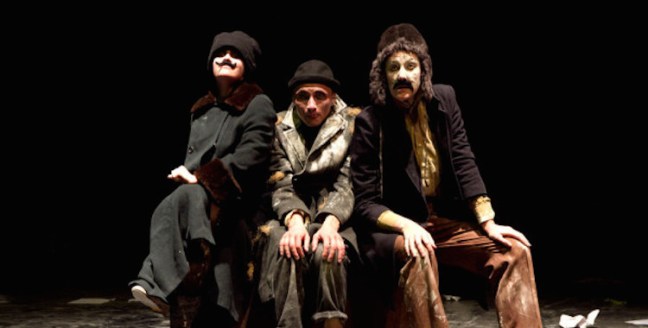
Double act Chris Thorpe and Jon Spooner have multiple strategies for starting that conversation. Part Grim Reaper, part storyteller, part clown, each performer approaches the subject of death with both humour and seriousness. The structure, for the most part, is governed by a pair of interlaced stories and a series of musical interludes. Electric guitar snarls defiance towards death; voices gently, lyrically tell of two coppers finding a severed head, or of a little girl slipping unobserved through a sheet of ice. In between, Thorpe and Spooner offer facts about the process of the body shutting itself down and a guest paramedic performs the best CPR demonstration you’re likely to witness.

The science that Unlimited draw on, while sometimes sounding far-fetched, is – either brilliantly or terrifyingly, depending on your perspective – steeped in research. It is now technically possible to raise people, Lazarus-like, from the dead. But rather than looking too closely at the science itself, Unlimited are more interested in what this might mean for us as human beings – not medically, but psychologically, socially, politically. Most compellingly, they raise the all too plausible possibility of a society stratified according to access to life-extending technology. What happens when death is no longer a reality for one portion of humanity?

Rather than penetrating much deeper into any of the ideas they raise, however, Unlimited leave the extra mental legwork to us. Small details open up spaces for thought: the involuntary laugh of a policeman clutching a human head prompts reflections on our often unpredictable emotional responses to death, while the possibility of snatching people back from the dead provokes an unspoken question about what happens to that part of ourselves that makes us who we are. It’s refreshing – if a little scary – to have the room for this kind of thinking created in public.

Still, some of the individual threads could be pulled a little further; as it currently exists, certain elements of the show feel as though they stop just short of the idea they are reaching towards. Or perhaps that’s the point. There is, however, something appealing and surprisingly optimistic about creating a communal space in which we might be able to begin confronting and talking about death. And if we can get better at dying, maybe we can get better at living too.

Longwave, Shoreditch Town Hall

3673-600x400

Originally written for Exeunt.

For the last week, in just about every snatched moment I can grasp hold of, I’ve had my head buried in the first book of Karl Ove Knausgaard’s Min Kamp series. It’s utterly gripping, with the intensity that I forget novels can possess until I tumble headlong into another one. And yet it’s so ordinary. Described as an “autobiographical novel”, it charts little more than the day to day fluctuations of its author’s life, from youth through adolescence to adulthood, all in meticulous, banal detail. Whole pages are devoted to cleaning or eating; one long section laboriously outlines a clumsy teenage attempt to smuggle beer into a party.

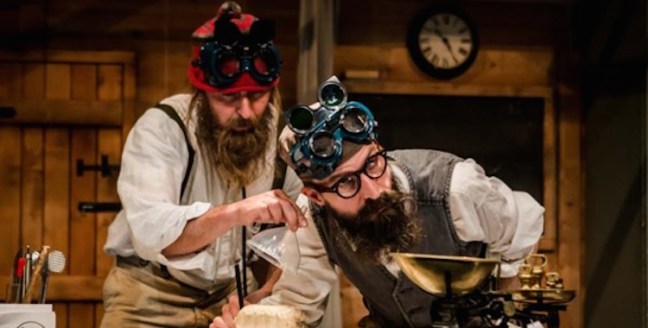
In a very different way, Chris Goode and Company’s Longwave achieves a similar sort of compelling simplicity. As with the Knausgaard, it’s hard to pin down just what captures the attention and refuses to let it go. The show, first made in 2006 and now reincarnated for a new tour, consists of two men, one radio and no dialogue. There are plenty of words, but none of them are shared between the pair of living, breathing characters. Instead, they belong to the inanimate (or perhaps not as inanimate as the men might hope) third protagonist, humming away menacingly in the corner of the room.

For reasons never made clear, the two men are away from home, holed up together in a shed in what appears to be a cruelly inhospitable landscape. We first see them in bright yellow protective gear, retrieving and proceeding to conduct experiments on an unresponsive, haggis-shaped object. We are instantly in the realm of physical comedy, with performers Jamie Wood and Tom Lyall making a sublimely silly double act. They poke, they prod, they throw. The subject of their experiment is rolled, jabbed, sent into the air with a mini parachute – Lyall even tentatively licks it. The lab isn’t all that different from the playground.

But Longwave is about much more than straightforward tomfoolery. As the piece goes on, we witness the regular rhythm of the men’s shared life, from the lucky dip of each evening’s tinned dinner – Lyall invariably ends up with the raw deal – to the little rituals they indulge in either side of the curtain that provides their only privacy. Lyall sketches delicate outlines of birds; Wood clumsily unfolds a massive map of the world. Both long for elsewhere.

And it’s that silent sense of longing, along with the wacky but utterly charming companionship they find in one another, that really makes the piece sing – or crackle, as the mood of the wireless dictates. As the radio takes on a life of its own and this little isolated world the pair have made for themselves begins to collapse in on itself, forcing them to either step into the unknown or stay behind, Goode and his collaborators reveal themselves to be expert manipulators of the stage’s affective technologies. We know little about these men beyond the small routines of their daily life, yet our hearts begin to crack open for them.

The whole thing is gorgeously offbeat, from the shed’s ragtag array of objects to the strange and ambiguous scenario in which the two central characters find themselves, but actually it’s the ordinariness that turns our emotional machinery. It’s the human bond, it’s the moments of hidden yearning and loss, it’s the way in which a shared routine establishes itself even in the oddest of circumstances. And it’s how even the most hackneyed and familiar of cheesy love songs can suddenly kick us full in the guts.

Jonah and Otto, Park Theatre

Jonah-and-Otto-by-Robert-Holman.-Peter-Egan-Otto-and-Alex-Waldmann-Jonah.-Photo-by-Jack-Sain-2-600x400

Originally written for Exeunt.

– Robert Holman’s plays are conversations.

– That’s an obvious thing to say. Aren’t all plays conversations?

– Well, yes; they’re a conversation between characters, between the artist and the audience, between sets of ideas. But in Holman’s plays you get the sense that people – often strangers – are reallytalking to one another. So often we don’t really talk to other people; we speak, but we don’t communicate. Holman’s plays, or at least the ones I’ve encountered, tend to put individuals on a journey towards genuine communication.

– And as you say, they’re usually individuals who have no pre-existing relationship, people who simply encounter one another and discover, often via antagonism, an incredible shared intimacy and honesty. At the beginning ofJonah and Otto it certainly feels like it could go somewhere else, somewhere more aggressive – there’s a definite taste of danger there – and what’s so startling is the dissolving of all that aggression into tenderness.

– It feels significant as well that the relationship in this play is between two men, two men of different ages. The play offers these men a space to be vulnerable, their toughened edges sanded down, while at the same time constantly switching the power dynamic between this ageing, lonely clergyman (Otto) and the spiky but bruised not-quite-boy-not-quite-man he runs into on the street (Jonah). Both haunted; one overwhelmed by what has passed, the other by what is ahead. And somehow, in just 24 hours, they come to truly know one another. It’s easy to feel that Holman’s characters exist in a bubble of ideas and emotions, sealed off from the world, but there’s a sort of insistent politics to the presentation of this surprising and ultimately gentle male friendship. Particularly at this moment in time, the simple foregrounding of care, of taking notice of the human beings around you, can’t help but be political.

– You talk about how gentle the relationship between the two men is, but there’s also something slightly strange about it. Not strange bad, just … odd. But odd in a compelling way.

– I think that compelling quality has a lot to do with the performances. Peter Egan brings a sort of comforting gravity to Otto, an appropriately priestlike – vicar-like? – quality, with a wounded, desperate energy writhing just under that composed outer skin. But it’s Alex Waldmann as Jonah who claws at the heart, bringing both unpredictable danger and trembling anxiety to the role. The simple restlessness of his performance reveals so much about this character, the world that has shaped him and the relationship that quietly transforms him.

– But it’s just talking, isn’t it? Gentle, thoughtful, expansive talking, but talking nonetheless. Nothing really happens.

– What do you want, a fucking firework show?

– Well, maybe. Or something, something to make us all sit up and pay attention.

– “Love is paying attention”.

– Huh?

– That’s what Otto says: “love is paying attention”. And Holman asks us to do the same, doesn’t he? We have to slow down, listen, tune in. Pay attention. The whole point is that it’s quiet. No fireworks.

– Like that other one they did at the Donmar a couple of years ago, Making Noise Quietly.

– Yes. That seems to me what Holman’s plays specialise in: making noise quietly. There’s something muted and tender about them, something unobtrusive, yet they have this cumulative emotional volume. They deal in what Otto calls the “drip, drip” of life, in people and relationships, but with an injection of something else – magic, maybe?

– Well Jonah is a magician. In some ways his whole presence in the play, the way in which he interrupts the deadening loneliness of Otto’s existence, feels like a sort of conjuring act. There Otto is, feeling the bricks in the wall – grasping not for real warmth, but the residue it leaves after the sun has already disappeared – and this man materialises like a genie from a bottle.

– And isn’t theatre itself something of a magic trick? A collective conjuring, making something from nothing. It’s one of my favourite ways of thinking about performance, because it suggests that same paradox that theatre entertains. We’re desperate to know how the trick works, to see the strings, but at the same time we want to be taken in and enchanted by the magic. Tim Stark’s production begins to touch lightly on that tension, occasionally reminding us that we are experiencing this together in the space of the theatre, but it allows the two men at the centre of the show to be its simple, singular focus.

– If it is just about these two people and their encounter with one another, then couldn’t the staging be even more spare?

– I thought you wanted fireworks?

– OK, but forget that. If there’s something strange about this space, something isolated from the rest of the world, something almost quietly fantastical, then why do they need all those objects? There’s a hint of the abstract to this world, but then it’s full of these all too solid things. Are the accessories of life really important? 

– Maybe they’re a reminder, a vestige of the real world they’re escaping, the real world they have to return to. I just think that if it’s really about this relationship and about the possibility of revealing yourself more fully to a stranger than to those closest to you, then surely all we need is them. We don’t need the stuff.

– Except the apple. The apple’s good.

– That’s true. And the clothes feel important – as well as allowing for perhaps the most playfully elaborate undressing ever staged. But really, what matters is the two of them.

– Absolutely. There’s something else Otto says that struck me: “If you weren’t here, I’d have to invent you”. It’s a line that speaks so simply to our need for contact and also to our capacity for imagination. Is that why we invent things to believe in? The conversations of Holman’s plays, like that between Jonah and Otto, allow human beings to believe in one another and to speak aloud those fears, anxieties, dreams, guilts that we bury under layers of small talk and distraction. People truly come together. And the coming together has to be followed by a pulling apart; the characters are ultimately left, transformed, hopeful yet sad, to confront the world alone. What do you think?

– Hello?

– Are you still there?

Photo: Jack Sain.