Thatcherwrite, Theatre503

thatcherwrite-600x374

Originally written for Exeunt.

As with its last attempt to address current affairs (emphasis on the current) in Hacked, Theatre503’s night of plays inspired by the legacy of Margaret Thatcher is both aided and hampered by its immediacy. These short pieces aren’t quite dancing on the grave of the Iron Lady, but her death and the potent set of feelings it brought to the surface remain fresh in the collective memory. This adds a certain charge to this range of theatrical responses, which often exploit the rawness of the issues they grapple with, but equally invites some rushed thinking. Arguments made overnight are often flawed ones.

The result, somewhat unsurprisingly, is a spirited but uneven night of political theatre. Despite setting their sights on a wide spectrum of issues thrown up by Thatcher’s death, few of these pieces achieve the same punch as Tim Etchells’ 55 Funerals, an immediate but searing deployment of political anger. The tone here is more often questioning, ironic or pointedly shrewd.

The evening opens in the crowded theatre foyer with Brian Walter’s Apples, a sharp three-part breakdown of neoliberalism that neatly nods to Thatcher’s greengrocer father and threads through the evening as an important if simplified reminder of the mark left on the UK economy by her government. It might lack a little in complexity, but its message remains depressingly relevant. It also offers some great work from Paul Cawley, Rachel De-lahay and James Cooney, including an unlikely but storming version of Will Smith’s ‘Summertime’ courtesy of De-lahay and Cooney.

Also in three parts, lending some structure to what might otherwise be an amorphous bunch of responses, is Kay Adshead’s I Am Sad You Are Dead Mrs T. This takes the form of a trio of eulogies to Thatcher, one from a bigoted ‘yoof’, one from a vile Tory-in-training and one from a resident of the underprivileged communities so neglected by Thatcher’s government. The first two monologues are packed with satirical barbs and the kind of “scroungers” rhetoric still nurtured by the current government, at times coming dangerously close to perpetuating the same stereotypes they seek to skewer, but it’s in the third that Adshead really brings out the fists. This final, deeply moving piece lands a devastating blow to the guts, leaving us in no doubt about just who has suffered and continues to suffer under Thatcher’s grim legacy.

Elsewhere, the responses are decidedly mixed. Dominic Cavendish’s dream-likeTrue Blue strands an unusually sympathetic Maggie on a desert island, clutching onto the departing tide of her deteriorating mind. It’s Thatcher’s individualism pushed to its isolated extreme, as the ultimate survivor finds herself completely alone, cast off from the society she insisted did not exist. Jimmy Osborne’s tight domestic focus on one couple turns the lens on the Falkland Islands, while My Dinnertimes With Clarence by Fraser Grace tackles education and supposed equality of opportunity through the tender friendship between a teacher and student. And never has the bonus culture of banking looked more repulsive than in Ben Worth’s testosterone-drenched Shirt and Tie, following two competitive city boys on a booze and cocaine-fuelled night out.

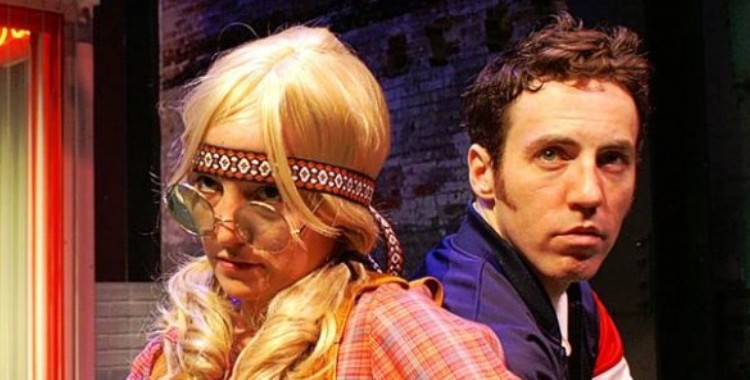
It’s canny programming to conclude this mixed bag of offerings with an absolute gem from Jon Brittain and Matthew Tedford. Margaret Thatcher Queen of Soho, led by a brilliant performance from Tedford dragged up in full wig and pearls, imagines a wrong turn in the 1980s leading to a glittering cabaret career and a brilliantly camp reconciliation with the gay community for a lady who suddenly is for turning. This is deliciously arch fun, cloaking its fangs in sequins and hotpants. And there should be some kind of prize for the line “where there are discos, may we bring harmonies”.

The overall impact of these collected responses, however, is uncertain. A question that often haunts fictional responses to recent events is the repeated chorus of “how soon is too soon?” In the case of a divisive public figure such as Thatcher, political legacy has to be available for discussion, but the question instead shifts to the quality of that debate. Immediacy is all very well, but there’s the risk that speaking too soon produces statements that aren’t worth hearing.

With a few incisive and provocative offerings, Theatre503 just about escapes that fate, but its impetus is worth pausing over. Is this simply a calculated attempt at topicality, or do these statements carry weight beyond the immediate aftermath of the event? Perhaps, even if most of these offerings will rapidly fade away, they have established a lively theatrical debate around a figure who continues to hold huge significance for politics today. In any case, it’s unlikely that theatre is done with the Iron Lady just yet.

Photo: Alistair Muir.
Mission Drift, National Theatre Shed

mission-drift-600x399

Originally written for Exeunt.

How do you tell the story of 400 years of American capitalism? The TEAM approach that seemingly impossible challenge by going right to the heart of what sustains it: mythology. Their searing, sexy, gloriously shambolic voyage through the heartland of the great American Dream takes on one myth with another, using a symbolic saga of American youth, adventure and frenzied acquisition to intelligently skewer an economic system fatally fixated on growth. And there are songs. Brilliant, heart-stopping, floor-shaking songs.

The narrative device driving this gorgeous, chaotic juggernaut is actually deceptively simple. Using one of the staples of the Hollywood movie – that other great cornerstone of American identity – Mission Drift pursues the spirit of capitalism through a pair of intertwined love stories. Catalina and Joris are two immortal Dutch teenagers who travel over on one of the first ships to the New World, forever fourteen as they hungrily chase the frontier, while in post-credit crash Las Vegas, a cocktail waitress and a desert-dwelling cowboy seek shared respite from financial collapse. Playing tricks with temporality, the show effortlessly jumps between these two couples, its fleet-footed narrative overseen by Heather Christian’s captivating songstress Miss Atomic.

The resulting atmosphere in The Shed is somewhere between theatre, gig and cabaret show. It’s thrilling, it’s explosive, it burns with the heat of flashing neon and sun-soaked desert sand. This is unapologetically exciting theatre, giddily romanticising Americana at the same time as dismantling it. Through the furious pace, Christian’s electric music and the astonishing energy of The TEAM’s performers, the audience is bathed in the white heat of financial risk and lightning growth. Its implicit confession is that capitalism is undeniably seductive. This truth is repeatedly acknowledged as Mission Drift races through boom and bust, charting first the unstoppable march of the frontier and then the inexorable growth of Las Vegas, its neon towers thrusting up out of the desert in the ultimate expression of the capitalist dream. And all the while the action is underscored with a greedy, breathless hymn to the pursuit of growth. Bigger, bigger. Better, better. I want, I want.

At the apex of this progress is the atomic bomb: explosive, destructive, yet strangely beautiful, watched by sunglass-clad gamblers during tests at the nearby Nevada Proving Grounds. Here, that violent and seductive presence is wrapped up in Miss Atomic, whose songs blow the place apart with her namesake’s intoxicating cocktail of power and beauty. She is, in a sense, the face (and blistering voice) of it all – the bomb, Las Vegas, the unstoppable force of capitalist desire. But Catalina and Joris, played by the tireless and ever-animated Libby King and Brian Hastert, are also the blazing symbols of the American Dream. A pair of entrepreneurial Peter Pans, these two Dutch adventurers attain an eternal adolescence that hints at both the immaturity and the headiness of their restless greed. They also lay claim to that very American right to reinvention, renaming themselves at each new frontier until those names become meaningless.

The TEAM’s distinctly postmodern version of the USA is one that Jean Baudrillard would instantly recognise, in which signs have replaced reality. The desert of the real is Las Vegas’ sign-littered Neon Boneyard, cradling “the fragile bones of electric dinosaurs”, while history itself has become a theme park ride – set to warp speed and decked in flashing lights. The platform on which the band performs is flanked by tree trunks, the backdrop behind them suggesting the wild, unexplored forests of the frontier, but now that frontier is only an empty image glossed over with the glitter of the casino. It’s all a mirage.

It might all be simulacra, but this breakneck production still dazzles, sweeping us up in its epic scope. Momentum builds and builds, in step with the pioneers and the skyscrapers, leaving the scattered debris of stage mess in its wake. In the words of Miss Atomic, it “grows so fast that you can see it, and feel it, and be afraid of it”. It’s only in the final half hour or so that this pace begins to flag, with music and chaos dropping away in favour of calm, reflective storytelling. While it’s with a hint of disappointment that the pulse-quickening action departs, the lull feels necessary, the sudden shift in aesthetic reflecting the water-treading stasis of recession that we still find ourselves mired in. This structure is, in itself, a sort of warning. No matter how fast you spin it, the roulette wheel always has to stop turning sooner or later.

Photo: Ves Pitts

Chimerica, Almeida Theatre

Chimerica-600x374

Originally written for Exeunt.

The photograph has always been something of a paradox; a record of ephemerality, the fleeting present moment arrested for posterity. It is a document of disappearance, the deceptive capture of something already lost, a lie and an irrefutable truth wrapped up in one. In Ways of Seeing, John Berger even suggests that the invention of the camera irrevocably altered our mode of perception, therefore changing the status of the image itself: “the camera isolated momentary appearances and in so doing destroyed the idea that images were timeless”. Yet still we cling to photographs as incontrovertible vestiges of the past, investing one image with the weight of an entire event – an entire ideology, even.

In Chimerica, Lucy Kirkwood fixes her lens on just one of these historically burdened snapshots. In fact, that’s already a lie; there are at least six known versions of the iconic image that provides Kirkwood’s inspiration, implicitly refuting its uniqueness and by extension the irreproachable “truth” it is assumed to offer. The photographic catalyst for Kirkwood’s play is the ubiquitous visual encapsulation of the 1989 student protests in Tiananmen Square and the subsequent massacre by the Chinese military: the image of a man standing defiantly and defencelessly in front of a line of advancing tanks. It’s become one of the most hauntingly familiar images of the twentieth century, a symbol of non-violent protest and of the chilling opposition between the fragility of man and the might of machinery.

Around this one recorded act of heroism and the enduring mystery of the anonymous “Tank Man”, Kirkwood has crafted a taut, complex and nuanced thriller, with exhilaratingly ambitious scope. Her imagined American photojournalist, Joe, is fixated on this unknown icon of defiance who he photographed 23 years ago from the window of his Beijing hotel room. Spurred on by hints from his Chinese friend Zhang Lin and a cryptic clue in a Beijing newspaper, the quest to discover this man and the story behind the photograph quickly takes on the character of an obsession. It’s a detective story, of sorts, but set against the backdrop of a nation developing at frightening, breakneck speed. As one character puts it, this is a country that has gone from famine to Slimfast in the space of one generation.

If the glorious mess of Three Kingdoms queasily exposed the British view of Europe as Other, then Chimerica goes a long way towards skewering the hypocritically exoticising Western view of China. Although the title (borrowed from Niall Ferguson’s study of the economic dominance of this pair of superpowers) might inextricably link China and the USA, the play itself repeatedly demonstrates that we equate the citizens of these two nations at our peril. While consumer insight consultant Tessa highlights the pitfalls of treating Chinese shoppers like their counterparts in the West, Americans bemoan the Westernisation of Chinese culture in the same breath with which they sigh relief that the Chinese are becoming more like their capitalist cousins. They want authentic Chinese cuisine, but only if there’s a credit card machine at the till and a Starbucks round the corner.

The idea of the photograph, beyond providing the plot’s primary impetus, also reflects these strained perceptions that nations cultivate of one another. It’s all about how we see things. This currency of images decorates Es Devlin’s exquisite set, a revolving cube that recalls Tom Scutt’s brilliant design for 13 at the National Theatre and conjures similar ideas of being boxed in – by a restrictive state, by the photographic ghosts of history, by a consumer culture that would slot individuals into neat, easily targeted pigeon-holes. The surfaces of this cube become screens for various projected photographs, creating a constantly shifting backdrop of visual truths, lies and suggestions. These ever-present images also hint at the pervasive infiltration of visual media into our homes and lives, creating a world in which, as Joe cynically puts it, photographs of atrocity are no more than “clip art”.

For all its richly layered interrogation of economics, politics and the culture of images, the play remains motored throughout by a constantly engaging narrative. In his dogged mission to track down “Tank Man”, Joe increasingly jeopardises his job, his friendships and his burgeoning relationship with Tessa, yet somehow his obsessive investigation remains unfailingly compelling. This is largely down to the riveting precision of Lydnsey Turner’s tight production and the absorbing performance of Stephen Campbell Moore, who preserves a shred of empathy for Joe even at his most self-centredly illogical. His argument that “people need to know there’s heroism in the world” is an appealing one, but as journalistic curiosity morphs into unhealthy fixation, Joe’s pursuit is one of a strange kind of personal redemption rather than any real public interest.

As Joe races across New York and racks up his long distance phone bill on the trail of “Tank Man”, his disillusioned friend Zhang Lin, played with compassion and poignant weariness by Benedict Wong, faces mounting difficulties in Beijing. Alongside the central pairing of these two men, Kirkwood and Turner build a sophisticated cast of supporting figures, often achieving vivid characterisations in just a few quick strokes. Claudie Blakley’s blunt, businesslike Tessa has an edge of vulnerability and a nagging but never simplified social conscience, while Joe’s newspaper colleagues resist being wrestled into generic boxes. The evidence of the play itself would seem to counter Tessa’s glib assertion that in the age of mass communication and sophisticated consumer profiling there’s “no such thing as an individual”.

While focus is inevitably drawn to the impressive scope of Kirkwood’s writing, it’s equally hard to deny the visual beauty of Turner’s sleekly revolving production, bringing more excitement to the stage of the Almeida than it has witnessed in years. The staging is striking in a cinematic rather than a visceral sense, however, placed at an elegant remove from the audience. With its rapid succession of often short scenes and its gripping thriller plot, it is easy to see Chimerica working on screen, a medium that this production already seems to have at the back of its mind. If early whispers of a future life are realised – as they deserve to be – it would come as no surprise if a film adaptation is not far behind.

Resisting the cinematic vocabulary of the whole, the production’s one sharp injection of thrilling theatricality comes courtesy of a ghost from the Tiananmen Square massacre. Puncturing the realism of the scene, this figure unfurls from Zhang Lin’s fridge in a way that immediately brings to mind the performer springing from a suitcase in Three Kingdoms, providing a similarly startling physical interruption. At the close of the first act, this fragile, bloodied form bears a glowing red orb, passing the pulsing sphere from performer to performer in a sequence of captivating yet ominous beauty. This lingering moment recalls the poisoned apple of fairytale – a sinister metaphor, perhaps, for a deadly political fruit that Chimerica suggests is just waiting to be bitten into.

Pastoral, Soho Theatre

600x600.fitdown1

Originally written for Exeunt.

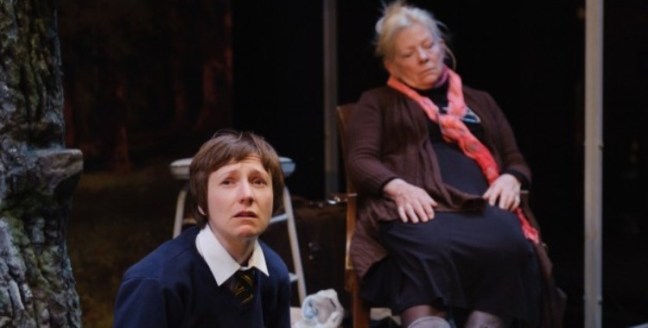
We’re all familiar with the terrifying threat posed against our planet by global warming, but what if it was nature that turned on us for a change? Thomas Eccleshare’s Verity Bargate Award-winning ‘first play‘ imagines just this, offering a madcap mix of mythology, nostalgia and post-apocalyptic narrative tropes. His motley group of protagonists, anchored by the excellent Anna Calder-Marshall as good-humouredly grumbling old spinster Moll, face not nuclear holocaust or zombie apocalypse, but the creeping invasion of grass and trees. Nature, it would seem, is rebelling, thrusting roots through concrete and branches through windows. Saplings are sprouting up in Paperchase and there are deer on the loose in Aldi.

This is catastrophe played firmly for laughs – Day of the Triffids reimagined as a sitcom. As the escape route planned by Moll’s young protectors Manz and Hardy is rapidly cut off, the trio are soon joined by a fleeing family, establishing the confined and somewhat ridiculous conditions conducive to quick-fire comedy. The running gag of flora and fauna taking over the local high street seems at first to promise some cutting comment on fiercely branded consumer culture, but instead it’s just an excuse to make spiky quips using familiar chains. While the long-awaited Ocado man – a late capitalist Godot – is a beautifully witty touch, the laughs can’t quite escape the feeling of being at the expense of ideas. Eccleshare has hit on a promising concept but rapidly submerged it in humour.

This black comedy all plays out in the precarious space of Moll’s flat, which Michael Vale’s skeletal metal design renders immediately open to the plant life that later wrestles its way in. Despite the momentary alarm engendered by the progressively collapsing room, however, there is little peril evident in this environment, even if it does involve some scene-stealing foliage. A creaking tree – not aided on press night by technical difficulties – provides about as much menace as birdsong, its swooping canopy more comical than threatening. While we’re often told about the encroaching danger of nature’s seemingly unstoppable onward march, the danger is never seen, only reported.

Eccleshare also leaves us in the dark as to the cause of this environmental anomaly, a decision that opens the way for interpretation but leaves questions hanging frustratingly in the air. Is the sudden overgrowth to be understood as a punishment for humanity’s thoughtless neglect and abuse of its natural environment? And does the play’s newly green and pleasant land herald a return to a golden age of natural harmony? This is certainly implied by the wistful hints of mythology, encapsulated in the youthful hope of Polly Frame’s bolshy yet faithful Arthur, an eleven-year-old boy with an ancient king as his namesake. Yet such intriguing suggestions still feel slightly underdeveloped, tangled in the swiftly growing branches.

As the play concludes with an outpouring of tongue-in-cheek sentimentality, its attempted archness looks remarkably like maudlin slush, a fate from which it’s just about saved by the simple tenderness of Calder-Marshall’s and Frame’s performances. There’s no denying Pastoral’s appealing ambition and often joyous eccentricity, but in the end it’s all too content to settle for a neat emotional pay-off over genuine complexity.

Photo: Simon Kane

The Contents of a House, Preston Manor

ContentsofaHouse-41-600x400

Originally written for Exeunt.

The title of Peter Reder’s latest guided tour is deliberately misleading. It suggests a series of objects, an inventory, a forensic dissection of Preston Manor through the stuff it has accumulated – art as archaeology. But rather than offering the act of excavation that so appeals to an audience, Reder denies our investigative urges at every turn. Despite appearances, this is no perfectly preserved historical document; it’s an exhibition gallery, manipulated at the mercy of its curators. The building is, as Reder puts it, a “giant dolls’ house”, as much a canvas for the imagination as the delicate structures that house our childhood dreams.

Both imagination and curation are key to what Reder has carefully choreographed through the rooms of this fairly ordinary historical home. Preston Manor is, as Reder himself admits, nothing particularly special. The former home of the Stanfords, a not especially important branch of the landed gentry, it has no real claim to fame, nothing to recommend it to the nation’s memory. As Reder spikily quips, the mysterious case of Kitty – the Manor’s disappearing feline inhabitant – is the biggest thing ever to have happened here. Pride of place in the dining room is a rejection letter from the Merchant Ivory production company – a celebration of a non-happening.

In the place of eminent individuals or memorable events, Reder fills this space with memories and ghosts. The piece’s investigation of place always returns to an investigation of people – both the elusive former owners of the house and the staff who now animate it. Beneath Reder’s gentle, unassuming presence as a performer, guiding us through the building with all the mild enthusiasm of the TV historian, there is a glimmer of archness and a hyper-sensitivity to the form he has appropriated. The latent desire to spin stories from the tattered vestiges of personal history is indulged in, acknowledged and then upturned, as our guide tells us the sensational, speculative stories we want to hear before smashing them apart.

Populating the building with a subtle political undercurrent, Reder quietly exposes the glossy, alluring lifestyle of the late Stanford family to be something of a tourist sham. The modern lust for Downton Abbey style escapism is frustrated by fractured narratives and messily stitched seams. Gilt-edged mirrors and luxurious carpets are succeeded by corridors crowded with the prosaic clutter of a working museum; a projected video sequence of two staff members enacting a typical servants’ hall scene continues rolling as they slip, giggling, back out of character. Eschewing the fetishisation of the aristocracy that first made this place into an attraction, Reder’s fascination is clearly with the “ordinary” individuals who now work there and who provide the life of the house far more than the austere portraits on its walls.

For all my insistence that this is not really a show about objects, Reder’s extensive research has uncovered some curious and extraordinary items. In the private library of one former occupant, a grinningly unearthed French copy of the Karma Sutra asks inevitable questions about what happened behind closed bedroom doors, while one of the novels on display in the family’s drawing room is the astonishingly titled The Mating of Anthea, an unlikely marriage of romance and eugenics. In an anomaly of a room just off the main hall, the antique collection of a nineteenth century theatre designer – all oppressive wood panelling and gleaming silver – has been oddly transplanted into a house that otherwise pretends at authenticity.

In one of the final rooms we visit, Reder draws our attention to a huge bookcase lined with grotesque, grimacing porcelain statues. Apparently this was the personal collection of Lady Ellen Stanford, who we might conclude to be a woman of questionable taste. What is important, however, is not the collection itself, but the impulse to collect. Why, in bizarre magpie fashion, do we gather objects? How do we decide what is of value and what should be discarded? How do we organise the things we accumulate?

These questions are equally applicable to Reder’s show, which is a product of curation if ever there was one. Confronted with such a wealth of material, we can only ever be shown a fragment, but here the process of selection that always colours our reception of history is brought firmly into the foreground. The piece implicitly asks, by its pointed selection of certain material, what narrative it is consciously constructing from these few chosen items. As I linger that moment longer in each room, peering into the shadows, one question insistently remains: what are we not being shown?