Peter Reder

ContentsofaHouse-5-600x400

Originally written for Exeunt.

As I chat over the phone to artist Peter Reder about The Contents of a House, his latest project for this year’s Brighton Festival, I’m on a train, contesting with temperamental mobile signal and occasional off-putting jolts. For a conversation about place, my own location is particularly unstable, shifting and continually disrupted. In a sense, this mirrors the format of much of Reder’s work; guided investigations of sites peppered with detours and interruptions.

“I like that you’re telling this story but there are also all the digressions,” says Reder, musing on his continued fascination with the guided tour format. “Like in a travel book, you might enjoy that you find something out about the author as you go along; you perhaps learn about why they’re on this journey themselves. There’s a lot of potential to mix in quite disparate things.”

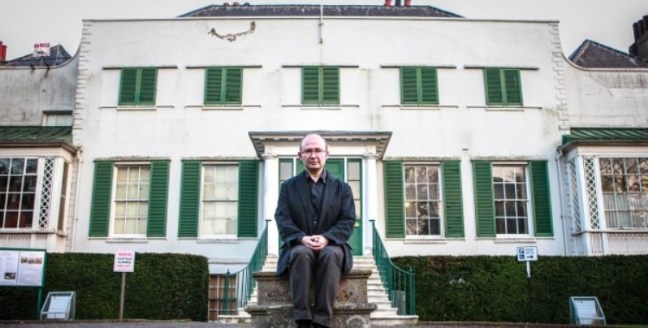
The latest location that Reder is leading audiences on a journey through is Preston Manor, a historic house and museum just outside Brighton. Reder explains that he was drawn to this particular building because it exists “very much on the fringes of everything” – on the outskirts of Brighton itself and at the peripheries of people’s awareness. With a history stretching back to the Domesday Book, the present house is a mixture of a 1738 rebuilding of the 13th century structure and a series of extensions made in 1905. Now functioning as a museum on Edwardian life, the manor is visited mostly by school groups, but is only vaguely known by many residents of the surrounding area. “I was intrigued by this building which is really interesting in its own right, but which is hovering there kind of half-known,” Reder adds. “There’s an air of mystery around the building.”

Reder also feels that, unlike many of the more famous historic homes across the country, Preston Manor has an accessible, tangible aspect. “What’s attractive is that everything’s quite small scale, it’s very intimate on every level,” he says. “Nothing is of huge significance; it wasn’t lived in by anyone that famous, nothing of national importance happened there. It’s interesting as an example of an Edwardian, relatively wealthy home, but it’s not got that grandeur, so in a way it’s very touchable – you feel it’s on a level that anyone could understand.”

Accessibility is also an element of the guided tour set-up, a format that is instantly familiar to audiences. Although this format is one that Reder has kept returning to in his work, it was one that he initially fell into almost by accident. During a period of research and development for a new show at Somerset House, Reder had a number of found objects to show to a small invited audience and naturally found himself presenting them, guiding spectators through his discoveries. “What I really stumbled on is that speaking about these things was a sort of performance,” he remembers. Intrigued by what could be achieved by adopting this presentational style, it quickly spilled over into the finished work and became a recurring technique.

“I’m aware that it’s a very familiar thing and in some ways I rather enjoy that,” Reder says. “It has a comfortable feel; people know how these things operate.” But he’s not content with simply appropriating this format without interrogating it; there’s a desire in the work to gently provoke and subvert, to acknowledge the way that guided tours traditionally “pander to what people want to hear” and dig away at what latent desires people bring to these tours. In this sense, Reder argues, it’s almost “anti-tourism”.

Recalling one production in Edinburgh, in a context surrounded by lots of real guided tours, Reder explains how they used fabrication to reveal what audiences wanted to hear. “In that particular show I always made up a story about a building that was a phantom, that had been in that place before the current building, which sometimes was true in some of the buildings we used, but at other times was entirely fictional. I realise that’s a very strong desire, that there should be something underneath the layers, that people like the idea of a ruin beneath the current building – a sort of archaeology.” It’s a desire that shares a kind of kinship with the experience of watching theatre; the impulse to peel back layers, to reveal something buried and authentic underneath the artifice.

As Reder has gone on, however, he’s had less recourse to fiction in his work. Whereas previously he would seek to change spaces or populate them with imaginary narratives, now he is more interested in “exploring how they already work and trying to see what I see in them as they currently exist”, noting in this a kind of acceptance. “I want to delve into their reality a bit,” Reder explains, adding, “I would go as far as to say that everything I say in the show is true.”

With this particular project, Preston Manor has revealed more than enough material for Reder to work with. After a lengthy and painstaking process of research, the task was to shape that nebulous mass of history and memory into a piece with a negotiable path through it, a process that Reder admits is “a bit mysterious even to me”. “Bit by bit there is some process of natural sifting where certain things feel more essential than others,” he tentatively continues. “But sometimes what seem like irrelevant things can be very vivid, so it’s a bit hard to explain. There’s some natural selection of the ideas that seem to stay with me and others that slightly fall to the wayside.”

Beyond his guided tours, the interest in space bleeds out into much of Reder’s other work; hisCity of Dreams project, for instance, created live performative maps of a number of cities across the world, fleetingly capturing the living memory of a place through the illusionary machinery of theatre. For Reder, however, place is never the primary concern. “I’d say my major preoccupation is probably to do with memory, but I think that’s played out often in experience of a place,” he says. “They’re very hard to divide, because I think so many memories inhabit landscapes of one kind or another, so what’s conjured up in your memory is full of spaces you’ve experienced and the atmospheres of particular spaces. I think that when you enter a space, even if it’s an entirely unfamiliar one, your memory of other places is always in play – otherwise how do you understand anything?”

Memory, of course, is inevitably delicate and personal, leading to the strong presence of Reder in his work, with The Contents of a House being no exception. “This current show is about the history of Preston Manor, and it’s also about me in some way. But it’s only me in relation to Preston Manor; it’s the bits of my own history that have been prompted by the things I’ve seen in Preston Manor. The two strands are completely enjoined and dependent on each other.”

“I have an anxiety with these performances that they don’t just become entirely self-indulgent, me rambling on about my own memory of things,” Reder is quick to add, expressing his desire to widen that circle of memory to include his audiences. “I’m very interested in the overlap with other people’s memories. As much as some of the things I talk about are genuinely quite personal, they’re there because I think other people will share quite similar associations. Maybe the personal can become a bit more publicly shared.”

This is not interactive theatre in the way it’s typically understood – “there’s no obligation for anyone to share anything” – but there is clearly a hope that those who join the tour might find their own memories being stirred by those that are revealed in the building. “It’s very rewarding to see that I’m not just communing with myself, that it does touch people,” Reder says. Returning to Preston Manor’s lack of historical or national significance – what Reder characterises as its “lightweight” quality – he wonders aloud whether ultimately it’s less about the place itself than the offer it extends to those who come to wander through it.

“I think it’s a place of some quiet reflection; maybe it doesn’t really matter what it’s about. It’s a contemplative space.”

Lucy Ellinson

A-Thousand-Shards-of-Glass_Jane-Packman-Company1-600x434

Originally written for Exeunt.

“I think I’ve always been a little bit cross about fourth wall theatre, if I’m really honest,” Lucy Ellinson suddenly admits in the middle of our conversation in the Albany cafe. She’s smiling as she speaks, any crossness buried beneath a warm grin, but a quick glance at her work is enough to confirm this aversion to distanced realism. Her last project was Unlimited Theatre’s Money the Gameshow, a show dissecting the current financial crisis through the interactive format of the TV gameshow, while she’s now appearing in a piece of lightly immersive solo storytelling. Even in the Gate’s thrillingly visceral production of The Trojan Women, in which Ellinson appeared at the end of last year, she had an itching temptation to “sneak under” that invisible barrier, to sit amongst the audience and “do a little agitating”.

“It’s never been part of my understanding of what performance is,” she goes on to explain. “I’ve always felt that it’s a strange condition to set in a room where we’re all clearly present and clearly needing each other to make this thing happen.” For the show she’s currently touring, Jane Packman Company’s A Thousand Shards of Glass, the necessity of this co-presence is not immediately obvious. It’s a show in which everything is told and evoked rather than shown, seeming to share more in common with the radio play than with the rough immediacy of live performance. Yet somehow, as Ellinson is keen to emphasise, the presence of the audience, arranged in a circle, is central to the piece’s effectiveness: “Even though it is a private journey, I feel like there’s a level of engagement that absolutely has to exist in order for the piece to be able to be told.”

The show, described as “a surround-sound adventure which happens mostly in your head”, uses Ellinson’s persuasive storytelling and a vivid soundscape by Lewis Gibson to create an action-fuelled thriller that sprints through the landscape of the imagination, narrating a story of resistance against a dulled corporate world. Despite the relative lack of visual stimulus, its rapid shifting from frame to frame acquires the quality of a graphic novel, just one that’s sketched in the minds of the audience. The graphic novel is also an apt reference point for its invitation to the reader’s imagination, offering just enough to work with. As Ellinson explains, “you look at it, you imagine yourself right into it, but you’re still aware of yourself as a reader, as an outsider – you’re able to do those two things simultaneously, which I really like”. In this sense it’s similar to the radio play, which is “around and inside your mind at the same time”.

I’m reminded of Robert Wilson, who has described his ideal theatre as “a cross between the radio play and the silent movie”; in each genre, both the medium and the imagination are that bit sharper due to the absence of either image or dialogue. Hoping for a similar sharpness, the landscapes that the company wanted to conjure in A Thousand Shards of Glass were always at the forefront of the creative process. “We had a process where we’d talk a lot about the worlds that we were trying to establish; this hyper-realised, capitalist, futuristic world, where all the sensual, visceral elements of life sort of disappeared into this corporate sheen.”

Beyond simply sparking the imagination, Ellinson notes how the show speaks to the current political situation, describing it as “very prescient, very relevant”. This was a piece that felt the impact of both Occupy and the riots, and without reaching for any explicit link, these influences show. For this reason, a level of audience autonomy – “allowing them to take that bit of work on their own shoulders and do something with it” – is essential. Ellinson adds, “it’s much more of an offering, which feels politically more in tune with the themes of the piece”.

There was a similar sense of an offering in Ellinson’s interpretation of her role as the Chorus in The Trojan Women. In Caroline Bird’s new version of the Euripides, the Chorus was pared down to just one individual, an ordinary and ignored pregnant woman. Speaking of the “sense of solidarity” that this device created between the Chorus and the audience, Ellinson describes a “funny little space” that existed between a fourth wall standing and being torn down: “There were moments where the Chorus was asked to laugh – it was scripted ‘the Chorus laughs’ – and the audience would do it, so after a while I sort of let them take that part of me on. It was an interesting blurry line.”

There is a blurry line, too, between the more traditional, text-driven process of The Trojan Women and the collaborative, devised work that is Ellinson’s preferred realm. She reflects that director Christopher Haydon “would have cast me because he knows I’m a deviser and like chirruping up with what I think here, there and everywhere”, before suggesting that collaborative ways of working are becoming more common, regardless of the pre-existence of a text.

“I think it’s just an idea, and then you gather artists around the idea. That certainly seems to be what I’ve encountered in different processes, whether it’s a play or whether it’s a devised piece which becomes a piece of written performance text; the idea is there in the middle, and then I’ve worked with directors who’ve pulled different artists around it. That idea could be an already finished script, or it could be something that we’re going to make. Long may that continue, because then it’s about serving that idea.”

As Ellinson also explains, the artists involved in that process need not all be theatre artists; they could be videographers, jewellery makers, musicians. Making that point, one of Ellinson’s most striking projects over recent months – and the winner of the Arches Brick Award in Edinburgh last year – is Torycore, a furious marriage of austerity politics and death metal music, performed by Ellinson alongside Chris Thorpe and Steve Lawson. Borrowing lyrics from government speeches, the piece is being continually reworked to reflect the latest cuts, with a new outing later this year drawing from the 2013 Budget and the most recent slashes to welfare. As Ellinson bitterly observes, “there’s no end of amazingly, startlingly brutal language coming out of the present government, so there’s lots of text”.

“It’s been really interesting tracking their language,” she continues, mouth stretched in a grim smile. “There’s Iain Duncan Smith saying this is fair, these welfare changes are actually fair, and then there’s this wonderful quote from David Cameron about a year and a half ago saying that ‘we need to redefine the word fair’. It’s been fascinating to me to track the journey of that word in particular and how they’ve used it. They have been absolutely audacious in trying to remould the meaning of the word in the public consciousness in order to open the door for these sorts of ideological cuts.”

In the midst of all this calculated rhetoric, Ellinson recognises that it can be challenging to express one’s own political opinion. This difficulty to speak out is part of the impetus behind another of her ongoing projects, One Minute Manifesto, which will be returning to Battersea Arts Centre in May. Offering participants their very own soapbox and a platform to address as many or as few people as they like, the simple premise is to speak on a chosen subject for 60 seconds. The aim is that it facilitates the airing of those passionate opinions that might otherwise remain unspoken, something Ellinson has grown increasingly galvanised by: “the more I do it, the more I feel it’s really quite an important exercise to do”.

Ellinson tells one story of a woman who was paralysed by nerves during her allotted one minute, unable to wrench out any words before the time was up. Afterwards they went for a walk that lasted over an hour, speaking about this woman’s life, her opinions, her view of the world. She was “hugely articulate”, yet she struggled to believe that her thoughts were worth hearing. For the very reasons illustrated by this example, the conversation that happens around that minute is just as important as the minute itself. “That timing, that 60 seconds, it’s deliberately there to provoke a response to want to continue to talk.”

Ultimately, this seems to be the driving force behind much of Ellinson’s work – getting people talking. As Ellinson drains the last of her tea and I gather my things, we continue chatting; about some recent work Ellinson was involved with at the Women of the World Festival, about getting primary school girls energised by the idea of feminism, about Ellinson’s connection with Forest Fringe and their current residency at the Gate. Even as we’re both glancing at our watches, conscious of the need to continue with our days, the pull of that conversation is hard to resist.

Transform Festival 2013

CRWD13_Transform-D1_168-940x626-600x399

Originally written for Exeunt.

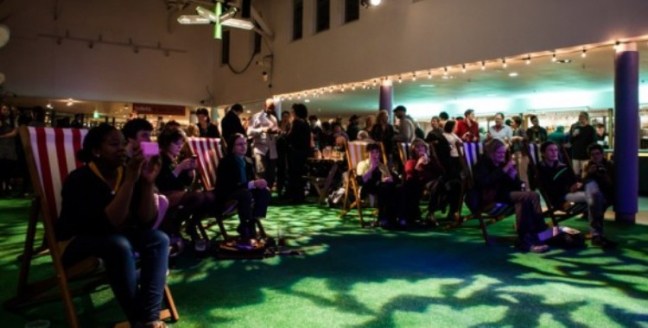
I’m folded into a striped deckchair, grass at my feet and a glass of wine in my hand, watching a performer in a bear costume drag a tied-up man onto a bandstand decked with fairy lights. At the end of my first day in Leeds, this is the unlikely scene in which I find myself in the buzzing foyer of the West Yorkshire Playhouse, suitably reimagined for the theatre’s third annual Transform Festival. I’m in the Park, a slice of the English summer transplanted into the Tardis-like building. The brief for designer-in-residence Hannah Sibai, I’m told, was to bring a bit of Leeds into the Playhouse, creating a welcoming space where visitors can relax, drink, stumble upon some art.

It’s a dialogue with the city that characterises Transform, which this year carries the strapline “my Leeds, my city”. Distinctive among other theatre and performance festivals in a similar mould, many of which host the same nomadic work and artists, Transform is injected with the unique flavour of Leeds as a place. Sites are important, as are people. When I grab coffee, cake and a quick chat with festival producer Amy Letman, she tells me that the programme grew from a scribbled map of the city, a neater version of which now appears in the Transform brochure that sits open on the table between us. Tracing her hands over the different areas of Leeds as she discusses the work, Letman talks me through the connection of each piece and each artist to the city, explaining the desire to take work out of the Playhouse and into unexpected locations.

One of these unexpected locations is the Royal Armouries Tiltyard, an impressive outdoor space situated in the middle of an over-developed ghost town – all sleek apartment blocks and yawning open spaces. Audiences are led here from the West Yorkshire Playhouse – the connecting “hub” of the sprawling festival – via a meandering audio walk through the city’s streets. Navigators, a piece created by Leeds University students following workshops with artists Invisible Flock, is well meaning but hindered by the disruptions and limitations of its physical surroundings, less in dialogue with its site than tussling with it. The evocative collage of voices pumped into our ears has to compete with traffic and early evening urban bustle, its delicate spell too easily broken by the intrusion of today’s city into the mental images it conjures of Leeds’ history.

The piece of theatre that occupies the outdoor space we eventually arrive at, situated at a dynamic nexus between Leeds old and new, is Slung Low’s The Johnny Eck and Dave Toole Show. A show that is mostly about trying to make a show, Dave Toole’s achievements as a dancer and performer are contained within a meta-theatrical structure that attempts to sidestep Toole’s own gruff modesty, while Toole himself just wants to tell the story of American freak show performer Johnny Eck; a show within a show within a show. The strange spectacle of the freak show in this circus-like space is also central to the conceit, complicating the gaze of the audience and the deliberate naivety of the humour. There’s always a slight jagged sense of unease.

With the afterglow of the Paralympics now faded to the stony cold reality of slashes to disability benefits, Slung Low are necessarily unflinching about the reality of ongoing prejudice faced by the disabled community. As well as being playful and celebratory – and, ultimately, uplifting – the piece unleashes an accusatory sting, sneering at the supposed “changing of perceptions” that was achieved by the Paralympics in London. By demonstrating the parallels with Eck’s prejudice-tainted experiences back in the 1930s, the piece suggests that not so much has changed after all. But the show is also about Leeds, about its inhabitants’ own particular brand of self-deprecation and eschewal of “fuss”, about the landscape of past and present that forms the show’s twilit backdrop. It’s a celebration for a city that doesn’t like to shout about its achievements.

Back in the Park space for that night’s Live Art Bistro, what’s striking – other than the heartening numbers turning out for performance art on a weekday evening – is the mix of people in the room. There are students, Playhouse staff, audiences who have wandered in after another show, and a wide range of artists, many of whom are involved with the festival in some way. As several of the individuals I speak to note, the transformation (forgive the pun) of this space has turned it into a place where artists want to linger and chat, immediately forming a relationship with the building through simple proximity. As Letman puts it, Transform has “ignited the enthusiasm of artists in the city”, forging links with the wider artistic community that might not otherwise exist.

The benefits of these links for both artists and theatre are immediately evident in the events taking place around the edges of the festival, including last week’s scratch programme and Emerge night and the playful live art interventions that now dance around the groups drinking and chatting on the surrounding deckchairs and picnic tables. Alongside the bear, there’s a story archive collecting narratives of Leeds; a witty, knowing take on food and gender stereotypes from The Souvenirs; a series of statements about the world punctuated by the knocking back of drinks. Just before I reluctantly leave this indoor bubble of summertime to make my way back to my hotel, one of the lightly swaying performers on the bandstand stage gulps down another shot. One for the road.

rage-600x399

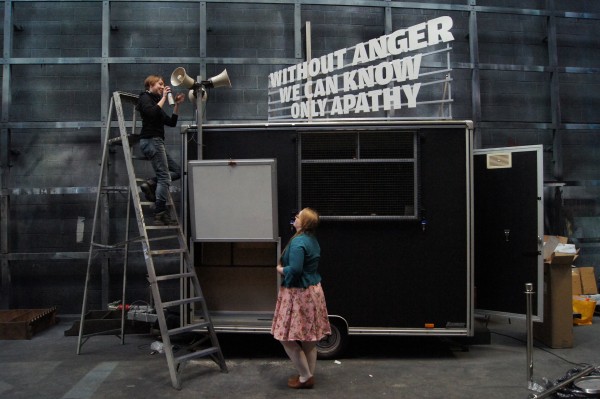
As artist Ellie Harrison recognises, there’s a lot to be angry about right now. On the morning of my journey to Leeds for the Transform festival, Maria Miller delivered her first keynote speech as culture secretary, in which she insisted on the need for artists to make the argument for their economic value. I avoided reading the speech in full, mainly for my sanity and the sake of my fellow train passengers, but the news stories emerging from it and the stream of rage bursting from my Twitter feed were enough to get me riled. So it’s with this sense of political anger – a simmering background frustration that keeps erupting in response to more and more outrageous policies – that I enter Harrison’s installation The Rage Receptacle.

The piece, housed in a compact black box up the road from the West Yorkshire Playhouse on Eastgate, is a lightly playful exploration of the things that make us angry and how we might deal with them. Almost mimicking the automated phone systems that are themselves a regular cause of wrath, recordings offer each participant a series of options and choices, gently prodding at the causes of our everyday frustration. Harrison, who I catch up with in the foyer of the Playhouse, describes The Rage Receptacle as a piece made for “accidental audiences”, those who might wander in off the street with a bit of spare time and curiosity. She speaks of the value of work that offers participants a pause, that gives us the opportunity to step out of our increasingly hectic lives and take a moment for contemplation.

At first glance, The Rage Receptacle seems like a fairly shallow investigation of a complex, knotty emotion, but in fact its unassuming simplicity is one of its greatest strengths. It’s more of an invitation than anything else, providing the questions and leaving the answers up to its audience. How often do we pause to consider our emotions, the stimulus they respond to, and how we choose to cope with them? The Rage Receptacle forms part of Harrison’s longer sequence of work The Grief Series, each of the seven segments exploring a different facet of bereavement in collaboration with different artists, but as much as all of those emotions are ever relevant, anger feels particularly timely. Still only in R&D at the festival, at an embryonic stage in its lifecycle, this particular piece offers up the promise of an intriguing evolution in response to its site and its “accidental audiences”.

One thing that Harrison draws my attention to during our conversation is the prevalence of site-based work in Leeds. This is a city where art happens on the street, where performances aren’t necessarily confined to theatres. Much of this is pragmatic; since the closure of the Leeds Met Gallery and Studio Theatre, artists making work that falls outside the traditional remit of the city’s other theatres have found their projects essentially homeless. With what I’m told is a typical Leeds attitude of “let’s just bloody do it” – another woman I speak to has mounted projects including an underwater exhibition in a swimming pool, while Slung Low characterise their driving force as a “can do” approach – the work has embraced its enforced nomadic status, finding new temporary habitats around the city.

It’s from this large body of site-based work that Transform seems to take its cue. As festival producer Amy Letman explains to me on my first day, another of the areas that the Playhouse identified as a location they wanted to make work with and for was Burmantofts, a community just across the bridge from the theatre but one that the building has previously had little connection with. The piece emerging from this, Burmantofts Stories, takes place in the heart of this community, relating its narratives from within its own space. Drawn entirely from residents, the show is pieced together from the conversations and workshops initiated by theatremaker Pauline Mayers with people in the local area and is performed by seven of the participants.

Burmantofts is a community “mapped with voices” and held together by ritual. Hinting at ancient pagan ceremony and the age-old practice of telling stories around the campfire, the show’s arrangement seats audience members on benches forming a ring around the outdoor performance space, encircled by a string of fairy lights. In the piece itself, repeated, oddly graceful movements gesture to the reiteration of everyday activities, while the drinking of coffee – of particular importance to one of the men involved – is a core ritual bringing members of the community together. Through a careful use of sound, stories and songs drift in and out, sometimes overlapping, sometimes isolated. It can be messy, but no more so than life.

Alongside the narratives Mayers has gently teased out of participants – “I just love people,” she smiles as she describes the process of tirelessly hitting the streets and speaking to residents – her own story is quite extraordinary. With no real prior connection to the theatre, she first encountered Transform in the festival’s first year, when she won a free wristband on Twitter and dropped into Chris Goode’s Open House. By the end of the first day she was deeply embroiled in the process; two years later, Mayers is now an associate artist of Chris Goode & Company. Her interest, similarly to Goode, is in people and their stories; she describes this project as a way of “reframing the human condition”, reminding us that we all have stories worth telling.

Mirroring Mayers’ journey, Transform itself has seen a clear progression since its inception. Letman explains that in the first year the focus was on simply finding work to programme, while a year on the intention was to work more closely and collaboratively with the artists involved; now the circle of collaboration has widened even further, encompassing audiences and the city itself. One of the major impacts of this third festival is the possibility of those itinerant artists mentioned by Harrison finding a longer term home in the Playhouse, as new artistic director James Brining looks to bring various strands together into a varied but connected programme. The festival as an event is naturally exciting, its context inviting an intoxicating, transitory buzz. The real challenge is incorporating that ephemeral sense of artistic community into something wider and more permanent.

The Universal Machine, New Diorama Theatre

Universal-Machine-600x400

Originally written for Exeunt.

Can machines think? It’s a question that captivated mathematician and code-breaker Alan Turing, a life-long obsession with the mechanical that is signalled in the very title of this unlikely but intriguing new musical about his life. Here, the desire for a more machine-like existence – one without aging or change or any of the messy complications of being human – is a central and recurring if not fully excavated theme. The desire might be there, but its full implications resist exploration.

Turing’s life and particularly his complex, pioneering work are not easily reducible to a concise two hour show, making writer and director David Byrne’s careful process of pruning and selection an impressive achievement in itself. He has taken as his focus this wistful fascination with machinery, a fascination that is contrasted with Turing’s few valued human relationships; his mother, portrayed in a moving turn from Judith Paris, is a constant background presence, while a youthful infatuation with close friend Christopher Morcom is shown to haunt the rest of Turing’s life and all his intellectual endeavours. He yearns for the uncomplicated existence of the machine, yet he wrestles with emotion that is far from coldly mechanical. It’s significant that when Turing looks to the future, predicting the rise of artificial intelligence, he speaks of machines that will be capable of love.

Just like Turing, Byrne’s show can’t entirely shun the sentimental in favour of the mechanical, but for the most part this production avoids over-playing the tragic elements of its protagonist’s short life. Instead, attention is given to his extraordinary mind, its workings and its memories scrawled out on the stage of the New Diorama Theatre. Bare black walls, occasionally used to host projections, suggest the scholarly blackboard, while the near-constant presence of desks cements an atmosphere of sometimes feverish concentration. As Turing looks back over his life – a device of speaking across time that provides a useful if occasionally clumsy frame – a carefully selected range of props acquire the traces of memory, hooking the narrative into the next scene.

As so often with the musical form, there’s the danger of a complex narrative being stripped down to a series of neat plot points, significant moments that offer the opportunity to break out into song. Dominic Brennan’s music is at its best when reflecting the mechanical workings of Turing’s mind, clicking along with a rapid pace reminiscent of the turning cogs of both machinery and mind as the Bletchley Park cryptanalysts build the bombe, the machine Turing designed to help break the Enigma code during World War II. Elsewhere, however, its use is not entirely clear, sometimes serving a plot function, sometimes offering emotional illumination – as with Sara Turing’s heart-breaking attempt to come to terms first with her son’s homosexuality and then with his suicide – sometimes simply providing a few laughs. Early on there’s the suggestion that the musical genre could intelligently unpick Turing’s painful difficulty connecting with the world, the song of those around him highlighting his own alienation, but this possibility quickly fades away.

The production does, however, manage to convey a sense of a man out of place in his own time, a man who might well seek solace in machines when the human world disappointed and baffled him. In this central role, Richard Delaney is a quiet, awkward presence, still but for his habitual fidgeting, while the rest of the cast whirl chaotically around him. Turing might be at the centre, but he avoids the spotlight, remaining the fixed focal point of a narrative that becomes just as much about those around him. Fitting as the enigma of Turing’s personality might be, the fictionalised insight that the piece promises remains just out of reach. Turing’s story never fails to compel, but it leaves us frustratedly searching for more.

Table, National Theatre Shed

table11-600x399

Originally written for Exeunt.

It seems appropriate that the first show in the National Theatre’s new, temporary performance space on the South Bank should announce itself just as plainly and unassumingly as its venue. Table, the world premiere christening The Shed, is about just that, using a tough wooden dining table as the focal point for a domestic tale that straddles the generations. Tanya Ronder’s play, tracing 115 years of one family’s tumultuous history, zooms in on the stains that can’t be scrubbed away, the grit that remains lodged in the grooves of the wood and the messages carved indelibly on its surface. Her eponymous piece of furniture is living history, speaking just as loudly as its human owners.

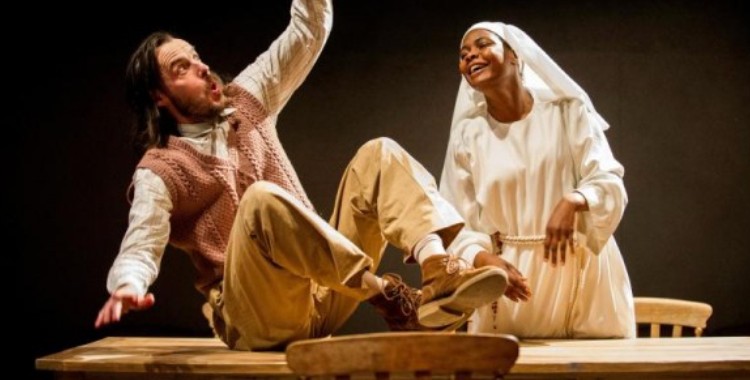
Katrina Lindsay’s design furnishes the intimate interior of The Shed with not one but two tables, the raised wooden space of the stage mirroring the sturdy domestic linchpin that sits upon it. Hewn with love and breathless hopes for the future, this stubbornly resilient item of furniture begins life as the creation of carpenter David Best, made to sit in the home he makes with his wife in late nineteenth-century Lichfield. From here, it is passed down from generation to generation, journeying first to a convent in Africa and then back to England and a hippy commune in Herefordshire, before finally ending up as the battered, beloved centrepiece of a family home in South London. Along the way it witnesses sex and betrayal, deaths and births, the grime and the mess and the joy of human life.

Ronder packs a lot into the play’s two hours and 20 minutes, at times resorting to the crowbar. From troubled nuclear families to a convent of missionary nuns, from a commune dedicated to alternative living to a gay couple with a half-Asian daughter born through a surrogate, there is a determination to portray as many different living arrangements as possible over the span of six generations. While this tactic provides colour and continual interest, the limits of plausibility are occasionally stretched, and some scenes – such as the painfully stereotypical commune, complete with goat’s milk and bed-swapping – seem inserted purely for laughs. The first half of the show is tight and cannily plotted, engaging the emotions with impressive rapidity, but as the narrative goes on the grip progressively slackens.

Although Ronder’s plot may run away from her, Norris’ sensitive, precise direction offers up some heart-catchingly beautiful moments: the presciently precarious, delicate image of David’s short-lived bride ascending a row of chairs in her wedding gown; the use of the table as a womb giving birth to the next generation, from which a protectively curled performer tumbles, Bambi-like, all helplessly flailing limbs; the gorgeous sequences of song that cradle the piece, smoothly linking scenes while nodding to ritual and familiarity. The production also benefits from a set of uniformly committed performances from its cast, who wring extraordinarily vivid characterisations from Ronder’s series of fleeting snapshots.

For all that this journey through the generations might be contrived – and, make no mistake, it is – the slightness of its meandering plot is balanced by a charm that begs forgiveness for its flaws. But when the smile fades, this production still leaves us wondering what it might be saying about the family, a unit of living that receives just as much of a bashing over the years as the table that unwaveringly anchors it. Are we damned by what we inherit, both in terms of the traits passed down to us and the upbringing we receive? Ronder’s generation game would seem to suggest so, as each successive member of the Best family kicks against what has come before but inevitably makes similar mistakes; generation upon generation of children knowingly or unknowingly wronged by their parents. And by the end, even our old friend the table is endangered, at threat of being replaced by a sleekly functional sliver of glass from Ikea. History might be deeply ingrained, but we are all too good at forgetting.