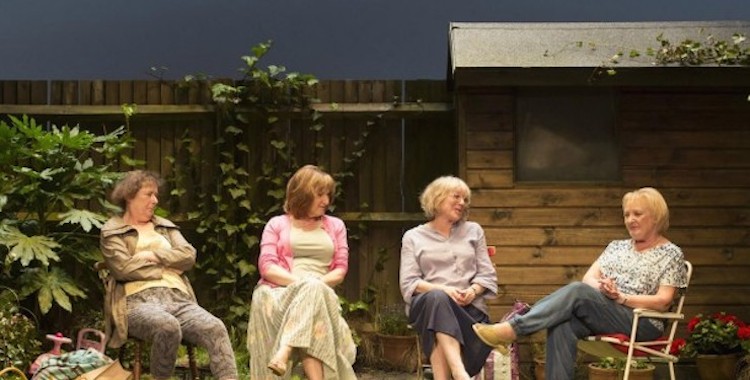
Escaped Alone, Royal Court

Escaped-Alone-600x450

Originally written for Exeunt.

It’s not just the tea that’s brewing in Caryl Churchill’s new play. Beneath the sharing of a nice cuppa, something much nastier is simmering away. While four older women sip from their mugs in a sun-bathed garden, premonitions of catastrophe lurk behind their innocuous chit-chat, breaking through in pitch-black interjections. Over the course of less than an hour, the world ends seven times over: with floods, with disease, with fire. Sugar, anyone?

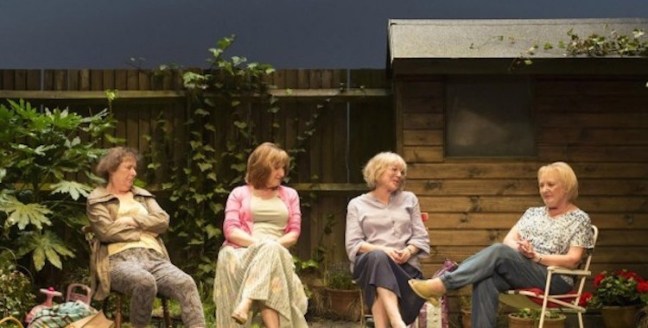
Escaped Alone is a bristling, baffling thing. Running at a brisk 55 minutes, it’s somehow huge and minute all at once. Compared with the formal somersaults of some of Churchill’s previous work, though, the structure is deceptively simple. It’s split into two alternating parts: in one, old friends Sally, Vi and Lena drink tea with neighbour Mrs Jarrett in Sally’s garden; in the other, Mrs Jarrett steps out of the frame of this scenario to deliver bleak missives from humankind’s downfall. Or, as the Royal Court’s blurb pithily puts it: tea and catastrophe.

Churchill’s title is borrowed from the Book of Job (“I only am escaped alone to tell thee”), and there is something oddly Biblical about this play, with its visions of apocalypse and its undercurrents of allegory. Linda Bassett’s affable yet enigmatic Mrs Jarrett plays the unlikely harbinger of doom, sent to warn us all of out-of-control, man-made catastrophes. Or perhaps warn is the wrong word, as these various Armageddons are all relayed in the past tense, laced with the bitter tang of inevitability. There is nothing to be done.

There are nightmarish touches of brilliance to these imagined disasters. In one, we are told – with characteristically surreal Churchill flair – that “the chemicals leaked through the cracks in the money”. Another conjures a world in which food is siphoned off to television programmes, leaving the general public to starve in front of cookery shows. There’s visceral horror, in images of survivors trapped alone underground and people eating rashers of their own fat, knocking up against inky dark humour – even if the gags do feel a little easy at times, airdropping in wry topical references to selfies and property developers.

Churchill is having no less fun in the garden-bound half of the play, in which her female quartet execute scenes of meticulously choreographed gossip. They chat about their grandchildren, about their pasts, about what superpower they’d like to have. This chorus of banalities is all delivered in distinctive Churchill half-sentences, clipped and careful. There’s clearly a shared vocabulary among these old friends. And again it’s rich with terrific moments. In one sequence, the women simply sing The Crystals’ hit “Da Doo Ron Ron” and it’s an absolute joy. Each character also takes their turn to break from the conversation and segue into a strange, disturbing monologue. It’s Sally’s inner voice that startles most, spilling out a breathless and absurd speech about her debilitating phobia of cats. Delivered with mounting intensity by the excellent Deborah Findlay, shoulders rounding protectively while hands nervously flutter, it’s one of the show’s highlights.

It’s the join between the play’s two halves that is more troubling – both interestingly and frustratingly so. You could say crisis and tea are never far apart, but otherwise the relationship between garden and apocalypse is left deliberately opaque. James Macdonald’s taut production at once maintains this ambiguity and gestures towards possible links. The small pauses in conversation – subtle and precise – suggest something more beneath the chatter. Miriam Buether’s design, meanwhile, has more than one nod to the void opened up by Mrs Jarrett’s bleak interludes. The garden, overgrown and vivid and lit by a bright, warm glow, is a sort of idyll, but there’s an odd emptiness to the grey-blue skies above that makes it feel as though it could be the last green refuge in the universe. Looked at this way, its contrast with the blackness that engulfs the intervening scenes, intensified by a flickering red neon surround, seems less stark than it first appears. For all that, though, it’s hard sometimes to fight the suspicion that these are simply two interesting scenarios to riff on, and that the whole is given less attention than its (admittedly intriguing) parts.

Nonetheless, Escaped Alone is never less than watchable, thanks in huge part to its fantastic cast. Much has been made of the fact that this is a play for four women in their sixties and seventies – a demographic still seen with shameful rarity on our stages. While the swift running time means that we can only ever get shards of these characters’ personalities, they’re pretty damn fascinating shards, giving the actors plenty to work with. Alongside Bassett’s slippery Mrs Jarrett and Findlay’s cat-fearing Sally, Kika Markham does delicate work as Lena – introverted yet occasionally spiky (“I do get out,” she indignantly insists) – while June Watson peels back surprising layers in unexpected ex-con Vi.

If there’s anything that holds the piece together, it’s the incessant, latent fear of the present moment that we live in. The paralysing terror that Sally feels when confronted with the idea of cats and the wilful delusion that has become a coping mechanism (“I have to believe there are no cats. And then briefly the joy of that”) might well stand in for any number of twenty-first century threats: ISIS, climate change, global pandemics. Mrs Jarrett’s catastrophes, meanwhile, are a potent cocktail of ancient fears and very contemporary preoccupations. It can often feel that we are living in the end times – or perhaps just on the brink of them – a feeling that Churchill uncannily captures. This is, to quote REM, the end of the world as we know it.

Now then, who wants a cup of tea?

Photo: Johan Persson.

This Will End Badly, Southwark Playhouse

Ben-Whybrow-in-This-Will-End-Badly-3.-Credit-Ben-Broomfield-600x401

Originally written for Exeunt.

The title of Rob Hayes’ latest play is a promise. This will end badly. And not just for the trio of troubled protagonists whose stories his fragmented, three-part monologue rapidly snaps between. The whole male sex, contorted under the pressures of modern masculinity, comes out of this badly. As his portraits of wounded, angry men make clear, it is not only women who suffer under the rigid, oppressive structures of patriarchy. Hayes’ prowling alpha male character, describing tactics for picking up women, puts it most succinctly: “it exists within a framework”.

The framework of the piece itself, however, is often unclear. It begins confusingly: performer Ben Whybrow, intense from the outset, rattles through the words at astonishing speed, clearly speaking from more than one perspective – but whose? Only gradually do three distinct (and sometimes less distinct) voices emerge. One man, reeling from a recent breakup, is suffering from a case of extreme constipation; it’s almost two weeks since his girlfriend left him and he still can’t take a dump. Another is trapped by different forces, confined to his flat by chronic anxiety and OCD, frantically turning switches on and off. And a third is on the hunt for casual sex, in the process of making his latest conquest. If the three are occasionally difficult to distinguish from one another, it’s surely deliberate. These three men represent three jagged shards of modern masculinity, all harmed and harming as part of the same, long-entrenched system.

The central scatological metaphor – immediately signalled by the toilet in one corner of Jemima Robinson’s otherwise sparse set – can’t be missed. A lot of shit has built up here, and it’s not so much hitting the fan as poisonously accumulating. The message may not be subtle, but it lands with force in Clive Judd’s relentlessly fast-moving production. These men are emotionally as well as physically constipated, blocked up by a world that tells them to control their feelings, to project confidence, to dominate others. What we see is a male culture that has little room for vulnerability or tenderness; a culture in which suicide – the statistics of which one character obsessively lists – might seem like the only way out.

There are points of meeting and overlap with Chris Goode’s furious, scaldingMen in the Cities, another collection of voices from men flailing under the violence of patriarchy. Next to Goode’s piece, though, This Will End Badly feels strangely incomplete, stating rather than interrogating its points and at times doing little more than replicating the abuse it examines. It is also, unlike Men in the Cities, overwhelmingly preoccupied with the predicament of the straight white man in today’s society, a choice that sharpens its focus but at the same time narrows its scope.

The pick-up artist – his monologue tellingly titled ‘Meat Cute’ – is in many ways the most interesting and the most problematic of the three men put on stage. He speaks in the plural first person, always ‘we’ and ‘us’, as if acting as a conduit for the entire gender. He could also be a conduit for countless opinion pieces and online comments about sexual politics and consent, mansplaining the media’s impossibly contradictory standards of femininity (“How do you even know what you’re supposed to want?”) and toying dangerously with rape apologism. Hayes’ introduction of these issues is blunt and bludgeoning, especially when knocking up against the humour elsewhere. When occupying this role, meanwhile, Whybrow often delivers lines directly to (always female, as far as I could tell) members of the audience, with an aggression that wavers between the ironic and the downright violent. It raises a serious question, especially with material that may be a trigger for some: when does a representation of harm become simply harmful?

This is not a question that This Will End Badly really attempts to address, instead using these difficult moments as part of its (admittedly formidable) critical arsenal. Still, it’s a disturbing and intense window on the twenty-first century man, its abrupt conclusion leaving behind a lingering sense of unease. The urgent implication, as the whole destructive cycle prepares to start again, is that if something doesn’t change then things will continue to end badly – again and again and again.

Photo: Ben Broomfield.

Nine Lives, Arcola Theatre

010615DAlexChisholmNineLivesProduction-1-0011-600x400

Originally written for Exeunt.

As so often, at the end of last year Philomena Cunk – the brilliantly terrible (or perhaps terribly brilliant) creation of Charlie Brooker and Diane Morgan – spoke the horrifying truth about the media’s portrayal of the refugee crisis. “Now it looked kind of different,” she reflected on the media’s sudden about-turn, “less swarm-y and threatening and more harrowing and urgent and sad. And the clever thing was, it was the same sort of pictures you’d seen earlier, but now you knew the twist about them being humans it seemed totally different.”

Zodwa Nyoni’s monologue attempts to recover the humanity so often denied in tabloid news reports and bile-filled columns. Nine Lives is the story of just one refugee: Ishmael, fleeing homophobic violence in Zimbabwe. Now in the UK, he waits in a mouldy flat in Leeds – emphatically “not home” – his life on pause while he’s suspended in bureaucratic limbo. Everything hinges on a brown envelope on the doormat, a black and white “yes” or “no” to his asylum request. Stuck on the conveyor belt of the UK immigration system, Ishmael is no longer a person but a number, a statistic on a computer screen or the page of a newspaper.

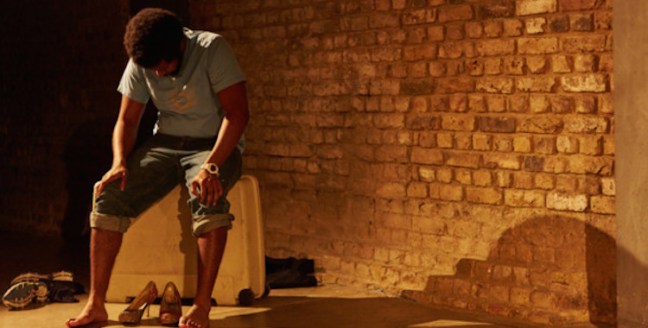
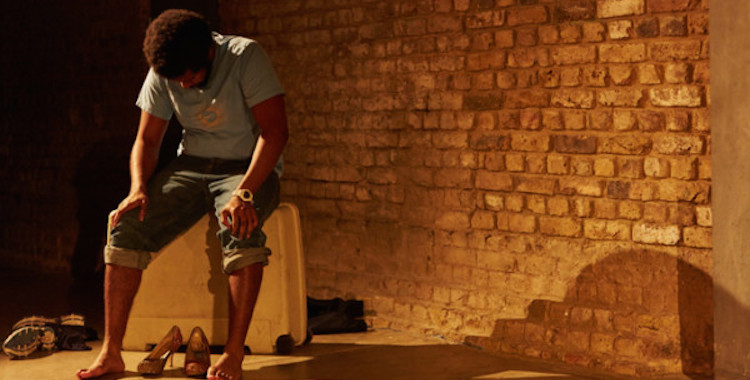
Under a single, stark lightbulb – the bareness of the stage suggesting the bareness of his new life – Lladel Bryant’s restless, lonely Ishmael tells his story. He talks of metamorphosis, of refugees in “concrete cocoons”, and of a hostile, overwhelming city. This jagged day-to-day experience is also punctuated with almost poetic interludes that refer to the wider plight of refugees and asylum seekers. Each beginning “some of us”, they break apart the undifferentiated mass so often shown in the media, reasserting shared yet particular human experiences:

“Some of us were running”.

“Some of us couldn’t recognise ourselves anymore.”

“Some of us were alone.”

“Some of us were begging for a taste of your liberty.”

In keeping with Nyoni’s reclaiming of these stories, the primary focus of Alex Chisholm’s production is the narrative. Aside from the lightbulb, all that joins Bryant on stage is a large, battered suitcase, which has to be both home and past for Ishmael in this temporary new existence. It’s a simple staging that could be even simpler still. Occasional, exaggerated sound effects – the nightmarish ticking of a clock, for instance – hardly seem necessary to communicate what straightforward storytelling does so clearly and compassionately. It’s through being stripped back where headlines are embellished that Nine Lives gains its power.

Implicit throughout, lingering like a bad aftertaste, is the vitriolic media narrative around immigration. Words like “swarm” and “droves” are never used, but they can’t help but haunt Ishmael’s experiences. When he’s targeted in the street, it’s with accusations right out of The Sun or the Daily Mail: he’s seen as a scrounger, an alien, a leech. To his landlady, he’s a source of cash and irritation; to the aggressive teenager who confronts him outside his flat, he’s a convenient figure of blame.

No one talks about the loneliness. Absent from all the news reports is the yawning emptiness of arriving on a foreign shore without family, friends or lovers. While lacking depth and background in some areas, what pierces through both Nyoni’s writing and Bryant’s performance is the terrible enforced solitude and isolation experienced by refugees like Ishmael. Pacing the empty stage and impressively inhabiting the voices of a range of other characters, Bryant can appear at times like a man frantically fighting to fill the void of his loneliness.

At a slender 55 minutes, there are limits to what Nine Lives can achieve. There are few resolutions, either for endlessly waiting Ishmael or for the wider issues that the piece touches on. But as a simple, unadorned plea for common humanity, it’s still depressingly necessary. In one of the play’s tenderest moments, teenage mother Bex – herself discarded and mistreated – reaches out a hand to Ishmael, recognising him for who he is and extending the offer of friendship. It’s an act that, on a much larger scale, Nine Lives implicitly appeals for.

Blank, Bush Theatre

w62uu7CN-600x402

Originally written for Exeunt.

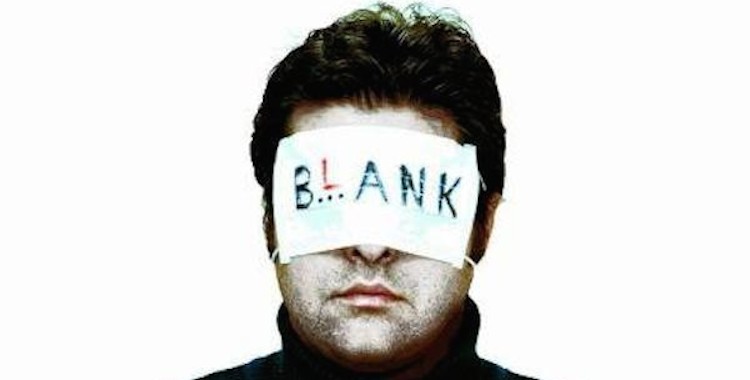
Texts for performance always involve filling in the blanks. No play can ever fully [BLANK] the world of the stage. So the latest play by Nassim Soleimanpour – writer of White Rabbit, Red Rabbit fame, known for scripts that [BLANK] the theatrical conventions of preparation and rehearsal – just takes that to its extreme. The [BLANK] that always takes place in staging a text is put on stage.

Blank is a story machine. Like White Rabbit, Red Rabbit, it requires a different, unprepared [BLANK] for each performance. On this occasion, it’s Hattie Morahan gamely picking up the script with no idea what to expect. She is the [BLANK] of tonight’s story. She begins reading, obediently filling in the gaps. She tells us about her [BLANK]. She answers questions about [BLANK]. As we gain a limited, [BLANK] version of her life and personality, the superficial markers of theatrical character – family, profession, favourite food – quickly become apparent.

Like Tim Crouch’s An Oak Tree, another [BLANK] that inserts an unprepared performer every night, Blank reveals truths about all theatre. These are [BLANK] that always take place when we share in the creation of stage fictions. And what are plays if not story machines? Here, those [BLANK] are just made visible. Stepping onto the stage with [BLANK], Morahan’s lack of rehearsal or prior knowledge [BLANK] the live experience of theatre. She laughs and stumbles her way through the [BLANK], with the audience as her co-conspirators.

And it’s not just Morahan completing the blanks. The audience, too, are [BLANK] to the show. We, the absent voice of the playwright tells us, are integral. We imagine a [BLANK] biography for our imagined writer and later [BLANK] the story of the show’s one-time protagonist, another member of the audience. It’s playful and gently entertaining, particularly as [BLANK] performed by Morahan, all smiling confusion. On this particular night, the show also has the advantage of a [BLANK] participant from the audience, who enters the show in precisely the spirit it asks for.

But blanks, like the blanks in this review, only cede so much control. By showing his hand, Soleimanpour invites [BLANK] of his authorial artistry. It’s a show that prompts responses of “ooh, wasn’t that clever?” Is it really as clever as it [BLANK], though? Unlike An Oak Tree, it’s hard to sense the substance beneath Blank’s surface of gameplay. It’s also [BLANK] to know how robust Soleimanpour’s story machine really is. This time, at least, it’s not really tested. Everyone [BLANK] the game. What would happen, I want to know, if someone really [BLANK] it, really pushed at its edges?

Theatre always happens in the live moment. Texts are always [BLANK] to interpretation. Playwrights are forever in the paradoxical [BLANK] of control and helplessness. Blankintroduces these observations and playfully teases at them, but it struggles to go much [BLANK] than that. In the end, it’s all a [BLANK].


Deborah Pearson

IMG_7259

Originally written for Exeunt.

Deborah Pearson and I are out of time with one another. As our emails ping back and forth, Pearson is in Toronto, Canada, four hours behind me in London. Our attempted interviews are a series of near misses. Eventually, Pearson responds to my questions by email, composing answers in the present for me to read in the future. Time, aptly enough, keeps (or, rather, kept) getting in the way.

Time is a recurring interest in Pearson’s work. Like You Were Before, made in 2010, was built around a video taken on Pearson’s last day in her native Canada five years previously, exploring the gap between her past and present selves. She’s returning to it at Battersea Arts Centre another five years on, with a further gulf of time between all these different versions of herself: the person in the video, the person who made the show, and the person performing it now. After looking backwards in that earlier piece, The Future Show (also returning to BAC this week) directed its attention in the opposite direction. Each fresh incarnation of the performance – rewritten every time – made predictions about the coming minutes, hours and years, looking ahead to the rest of Pearson’s life. And this summer at Forest Fringe in Edinburgh I saw a work-in-progress of Pearson’s latest show, History History History, again concerned with time but this time on a larger – if still personal – scale, exploring all the past events that led to Pearson being here (or rather there, in Toronto, when we speak; or perhaps London or somewhere else entirely by the time you read this) today.

“It’s the thing you can always come back to with an audience,” suggests Pearson, pinning down theatre’s particular affinity with this subject matter. “You are here, and I am here, and we will soon not be here. ‘Here’ being in the theatre together, but of course that also leads on to that eventuality of the bigger ‘here’ – meaning that a lot of work about time ends up becoming about mortality. That should be depressing but it’s actually what makes theatre thrilling I think. The defiance of that eventuality – the decision to sit in a room together while we’re alive and sit, or be bored, or be entertained, but just to share the fact that we are all here together now. It’s such a beautiful defiance and acknowledgement of the passing of time that it always seems a shame to me not to take a moment, while performing, to point it out or remind ourselves of it.”

Over email (speaking to me from a different time zone in the recent past), Pearson wonders whether her fascination with time is born out of her current doctoral research, which is investigating narrative in contemporary performance. “One definition of narrative that I came across somewhere was that narrative is the way that we make sense of our experiences over time,” she tells me. But the interest also goes back much further. “One of my mom’s favourite memories of me as a child is of me telling her, when I was about five years old, that I wished we could all stay the same age forever,” says Pearson. “That nobody in our lives or family would ever get any older or would ever die.”

“There’s a quote by a poet that I really like,” she continues, “which is something about how ‘I keep writing the same poem over and over, just trying to get it right.’ It’s funny – a lot of my work was about memory and nostalgia when I first started out, and then after making Like You Were Before, I didn’t necessarily feel I had definitively gotten it right, but I did feel that I’d gone as far with memory and nostalgia as I wanted to go. I felt that I had kind of internally resolved it as a theme for myself. Then The Future Show came along and it turned out that there was another aspect of time – which I suppose was to do with our orientation in time, and anxiety, and the unknown, that started to really interest me. Then I thought I was finally done with time. But my newest piece that opens next year, History History History, is about our personal relationship to history. So I guess I’m never done with time. It is the most universal theme, I think. It is the one thing that we’re all subject to, that we’re all at the behest of. Whether or not you fear for your own mortality, we are all on this merry go round made of time together.”

There’s also something particular about time, and our changing relationship to it, in the twenty-first century. We’re living in an age in which everything is speeded up and – thanks to the internet and cheap, fast air travel – time and space have become compressed. The emphasis is on the now. “Fredric Jameson talks about the end of historicity in his recent lectures,” says Pearson. “He claims that we’re living through a time where there is no past and certainly no future. We are obsessed with the momentary.” While Pearson has her doubts about some of Jameson’s claims – “it could also be that Jameson is just getting old and nearing the end of his own life” – she thinks “it would be difficult to argue that using the internet as frequently as most people do is not having a profound impact on our understanding of time and on our attention spans”. By comparison, theatre is a slow form in a fast world, forcing us to experience the slipping away of the minutes without the distraction of multiple devices or browser windows.

Over the years, time has also had its effect on how Pearson understands (and will understand) the shows she’s made about its passing. “When people asked what Like You Were Before was about, I used to say that it was about the maddening fact that time keeps going. But having just started dipping my toe into re-learning the script and the show, I think what it’s really about is mourning the passing of a time and place in one’s life – the end of an era, that is only really recognised as an era at all because it ended.” Meanwhile The Future Show has, like all one-time possible futures, become a thing of the past.

“I had to stop re-writing The Future Show,” Pearson explains, “because, just as I had predicted in an early version of the script, it made my obsessive compulsive disorder worse and would give me anxiety about ridiculous things. At some point it was clear that the task of rewriting The Future Show was as unhealthy for me as it was interesting for an audience, and sometimes more unhealthy for me than it was interesting for an audience.” The version coming to BAC, then, is a mix-tape of different imagined futures from the show’s 27 past performances. Reflecting on the show’s life since it was first created in January 2013, Pearson comments that “it does something very strange to one psychologically to have painstakingly thought through all your future actions on that many occasions”.

Following the compilation shows at BAC, The Future Show’s next (and possibly final) outing will be on the page, a medium that – unlike theatre – allows readers to encounter it in multiple different, idiosyncratic parcels of time. This month, Oberon Books are publishing a volume containing a “score” for the piece and past scripts of The Future Show from three different performances in three different time zones: Brighton, Lisbon and Austin, Texas. It’s the latest experiment with the subject that continues to niggle away at Pearson. “I’m really interested in knowing how the scripts are going to work in this form, and whether or not they can give a casual reader who hasn’t seen the show a sense of it,” she says (or rather said, at her computer in Toronto, from a different time zone in the recent past). “I guess time will tell.”