Are We On The Same Page?

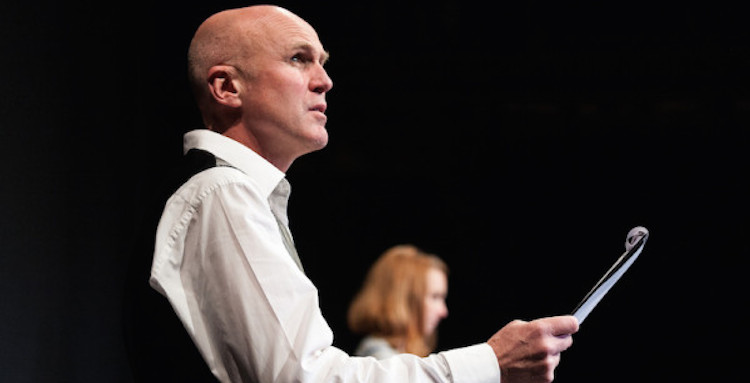
3.-Tim-Crouch-and-Amy-Griffiths-in-An-Oak-Tree_credit-Greg-Veit_-600x399

Originally written for Exeunt.

Back in 2009, Andy Field argued in a post on the Guardian Theatre Blog that “all theatre is devised and all theatre is text-based”. Cutting through arguments about “new writing” and “new work”, he reasoned that “to devise is simply to invent”, whether that inventing is done with words or bodies or any combination of the two. Job done, surely?

Yet the disingenuous “text-based versus non-text-based” debate has rumbled on. It flared up yet again at the beginning of this year, when David Edgar was announced as Humanitas Visiting Professor in Drama at the University of Oxford and raised familiar concerns about the threatened position of playwriting and the playwright, met with retorts from the likes of Lyn Gardner and Andrew Haydon. While Edgar persisted in pitting other forms of contemporary theatre practice against playwriting, others agreed with Gardner that what we need now is “a far wider and looser definition around what we mean by new writing”. Alex Chisholm, writing in these pages over three years ago, argued much the same thing.

But it’s not just about changing industry terminology. Current binaries are based in long-seated assumptions about the nature of the theatre text and the privileged place of the solo-authored play within British theatre tradition. Unsettling assumptions – and by extension the structures and processes that have congealed around those assumptions – is no easy task. It is happening, with the publication of books like Duska Radosavljevic’s excellent Theatre-Making: Interplay Between Text and Performance in the 21st Century and shifts in programming and commissioning at theatres such as the Bush and the Royal Court, but there’s still a way to go.

Shifting understandings around text and performance means shifting the possibilities open to theatre-makers. Writing in the immediate aftermath of this year’s Edinburgh Fringe, where categories like “new writing” and “new work” seem more and more irrelevant each year, Matt Trueman suggested that “a new kind of fusion theatre is emerging”. He pointed to young companies like Barrel Organ and Breach Theatre, who seemingly don’t discriminate between new writing, devising and documentary theatre. He concluded that this slamming of one set of techniques into another creates a healthy and experimental theatrical landscape, in which “the possibilities are endless”.

The picture sketched by Trueman is an exhilarating one, but there are still questions to be asked. Often, the supposed binary between “text-based” and “non-text-based” theatre has rested on larger ideological stakes; “non-text-based” work has frequently been seen as alternative, radical, progressive. But to what extent is that still true? Mightn’t real ideological interrogation, as Liz Tomlin suggests in Acts and Apparitions, lie in looking beyond superficialities of form? And in order to rethink the relationship between text and performance, we also need to think again about what it is the theatre text actually does. Is it a blueprint for performance? A set of tools? Is there really a difference between “open” and “closed” texts, and if not then is there anything that the theatre text makes impossible in performance?

These are some of the ideas that I’m hoping we can address at Are We On The Same Page? Approaches to Text and Performance, a one-day symposium at Royal Holloway on 26th September. Bringing together academics, critics and practitioners, the aim is to erode old binaries and open up genuine, searching discussions, rather than re-igniting old antagonisms.

The day will open with a Q&A with Tim Crouch, whose work as a theatre-maker has repeatedly confounded distinctions between “new writing” and “new work” and challenged our collective understandings of theatre’s representational mechanisms. Field, Radosavljevic and Haydon are all among the panellists who will be speaking later in the day, alongside a range of other theatre-makers and academics whose practice and scholarship has in various ways engaged with some of the questions identified above.

What we hope to generate throughout the day is dialogue in place of dichotomies. It’s about time we ended what Chris Goode calls “the phoney ‘writers versus devisors’ war” and started to interrogate some of the bigger, knottier issues that old battle has served to hide.

HighTide Festival 2015

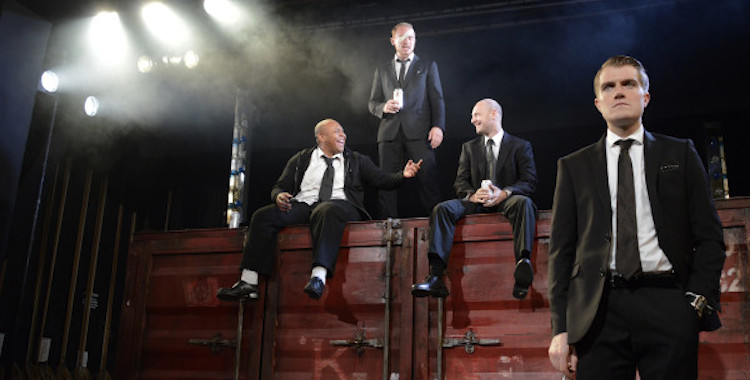
HighTide Festival Aldeburgh Suffolk Sept 2015 So Here We Are by Luke Norris Director/Steven Atkinson Designer/Lily Arnold Lighting Designer/Katharine Williams Kirsty / Jade Anouka Frankie / Daniel Kendrick Dan / Ciaran Owens Smudge / Dorian Jerome Simpson Pugh / Mark Weinman Pidge / Sam Melvin ©NOBBY CLARK +44(0)7941-515770 +44(0)20-7274-2105 nobby@nobbyclark.co.uk

Originally written for Exeunt.

What happens when the person you are turns out not to be the person you want to be – or the person you feel you should be? The three new plays premiering as part of this year’s relocated HighTide Festival all grapple with versions of this same question. Desire, identity and ambition are recurring themes, as is the very idea of performance: the selves we perform for others, and what might lie beneath.

The shingle and seagull cries of HighTide’s new home in Aldeburgh are an apt backdrop for Luke Norris’s latest play So Here We Are, a portrait of grief and disappointment beneath the slate skies and glaring coloured bulbs of Southend. Steven Atkinson’s production opens with four men staring out at the audience, cans of Stella in hand, their long silence as hard-edged as Lily Arnold’s pointedly masculine design of concrete and shipping containers. They don’t know what to say.

They’re mourning the death of Frankie, childhood friend and missing member of their five-a-side team. When they do find words, they talk awkwardly around the gaping black hole of their grief, gags and insults thrown around as aggressive tokens of affection. Norris’s dialogue is brilliant at capturing the everyday rhythms and evasions of speech, particularly between men who would rather crack jokes than confront their emotions. “People need a laugh,” reasons laddish Pidge, but not all of his mates agree. Then there’s a question, tentatively aired, about the nature of Frankie’s death. Was it really an accident?

In the second half, flashing back to the last hours of Frankie’s life, the clues and doubts planted in the first begin to take seed. We see Frankie stuck, restricted to a path he never meant to set out on. “What’s the point?” he asks. There’s no answer. It’s a very ordinary tragedy, of a life confined by wrong decisions and the inflexible expectations of what makes up a “normal” life: wife, mortgage, kids. As the future ghosts the present, watching becomes an exercise in connecting dots. The picture that emerges, though, is disappointingly neat, going needlessly far in its explanations and losing some of the simple impact of the first act. Resolution blunts loss and rage.

Up the road and away from the beach, the eponymous protagonist of BRENDA is also questioning the point of it all. Created by writer E V Crowe and director Caitlin McLeod, this is a real curiosity of a show, as frustrating as it is intriguing. Cannily staged in a local church hall, the piece finds down on their luck couple Brenda (Alison O’Donnell) and Robert (Jack Tarlton) about to make a plea to their community for help. Only before she can introduce herself to others, Brenda needs convincing that she’s even a person at all.

It’s a strange, offbeat watch. Crowe and McLeod stretch insistently at pauses, testing how long it’s possible to stage silent entrances, exits and absences. As they haphazardly rehearse their presentation, O’Donnell and Tarlton move among the audience, talking repeatedly about community while very deliberately ignoring the community of spectators right there in front of them. The fourth wall isn’t exactly broken, but these theatre-makers know how to prod it. Theatricality and the art of performance are central and persistent concerns.

But it’s never quite clear to what ends. With her repeated, insistent statement “I’m not a person”, Brenda’s unnervingly extreme position hints at the rather more ordinary ways in which we all perform coherent selves. There are also distant echoes of government and media rhetoric, insidiously undermining the personhood of those who don’t fit into the “aspiration nation”, but this is never more than a faint resonance. The disturbing final moments suggest something dark yet undiagnosed underneath the play’s slippery surface; what it might be is anyone’s guess.

Even more unsettling than the closing image of BRENDA is the final and most impressive premiere of the festival, Al Smith’s haunting Harrogate. As staged by Richard Twyman, it’s nightmarishly uncanny, its triptych of scenes worming their way further and further into the mind and remaining there in a stubborn tangle. It’s a play of jolts, each the theatrical equivalent of that feeling of missing a step in the moments between waking and sleeping. A scenario suddenly flips, leaving us queasily reeling.

Put simply, Harrogate is an exploration of a father’s uneasy infatuation with his teenage daughter, but with none of the sensation you might expect. Nick Sidi as the middle-aged man struggling with his daughter’s nascent sexuality is a complex and conflicted character, torn agonisingly between nostalgia and desire. He longs for the partner he once had in his youth, rather than the spouse he now shares his life with, while beginning to see the child they have created together from a new and disturbing perspective.

The excellent Sarah Ridgeway is wife, daughter and fantasy – sometimes in separate scenes, sometimes not. In each of the play’s three sections, she appears in a slightly different guise, but casting, text and staging all encourage slippages. From the moment the show first catches us off balance, we can never be entirely sure what we’re watching, while echoes and repetitions reverberate between scenes. It’s disquieting, but never wilfully taboo-busting – quite a feat, given the subject matter.

“What if we’re all paper thin and painted over?” asks the daughter at one point in Harrogate. It’s a description that might fit any of the fragile characters in these three plays, from the men dodging their emotions in So Here We Are to the non-person at the centre of BRENDA. And it’s a fitting coincidence that in the year HighTide reinvents itself, creating a real festival atmosphere as it spreads across the ridiculously picturesque seaside town of Aldeburgh, its programme is also interrogating notions of identity.

Photo: Nobby Clark.

Song from Far Away, Young Vic

image11-600x337

Originally written for Exeunt.

Willem is a man who never listens to music. He clamps headphones over his ears, but all they play back to him is the sound of his own breathing. It reminds me of something Hannah Nicklin wrote after seeing Carmen Disruption at the Almeida: “I put my headphones in with nothing playing which is the closest I get to this city.”

Willem is the speaker and protagonist of Song from Far Away, Simon Stephens’ latest play, and the two cities whose muffled pulse he hears through headphones are Amsterdam and New York. The old world and the new. Returning to Amsterdam following the sudden death of his brother, disillusioned banker Willem is not unlike the alienated figures who wander through Carmen Disruption, experiencing the city of his youth as “a chorus of rattling trams and bewildering underwear billboard posters and cafés and railings shuttering off unfinished building work”. A noisy, meaningless place.

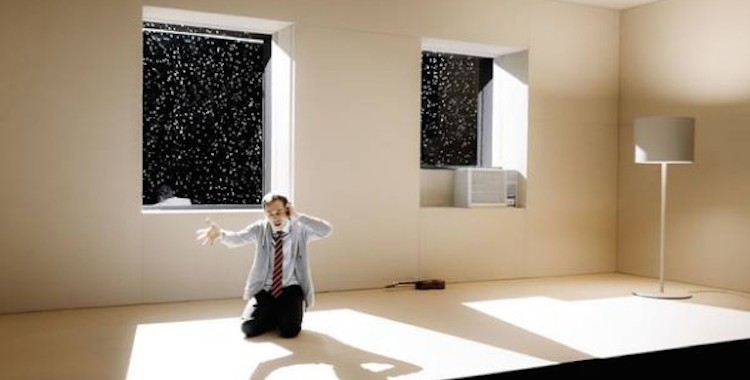
Walking through Amsterdam, Willem repeats a line uttered by the Singer in Carmen Disruption and by self-destructing rock star Paul in Birdland: “none of this is real”. As that echo suggests, Song from Far Away shares many of the themes that recur in Stephens’ recent work: home, disconnection, the hollowness of late capitalist cities. Even Jan Versweyveld’s calculatedly bland design has the perfect clean lines of every antiseptic, impersonal space that threads through these plays. Whether the room on stage is meant to be the elegant hotel where Willem stays in Amsterdam or the apartment that lies waiting for him in New York, it’s a cool, blank canvas of a space.

On that canvas, Willem composes a series of letters to his dead brother, letters that narrate his fraught and awkward homecoming. After leaving twelve years ago with barely a backward glance, he’s forced right into the grieving heart of his family. Numb and remote, all he does is upset them. Delivering the one-way correspondence as a monologue – always addressed to the invisible ghost of his brother, never to us the audience – Eelco Smits is raw and exposed, both figuratively and literally. Shedding his clothes, he stands on stage stripped of everything his new life has clothed him in, back home with nothing to protect him from the cold.

That coolness seeps right through Ivo van Hove’s stylish but distanced staging – and not just in the flurries of snow that fall behind Smits. It’s also a production that’s very still. Incredibly, precisely, frustratingly still. Whereas van Hove’s stunning take on A View from the Bridge turned Arthur Miller’s play into a ticking bomb, all of us holding our breath as we waited for it to go off, any tension bleeds from Song from Far Away. Though Versweyveld’s deft shifts in lighting move us through the hours, the production has the feel of one of those endless, sleep-robbed nights: slow, static, full of thoughts. It’s numbing, just like Willem moves numbly through his grief.

Feeling sneaks in though, often in the mournful, fractured melody of Mark Eitzel’s music. Just one song ribbons through the narrative, first heard in an anonymous bar and then echoing across the days Willem spends in Amsterdam. We hear it in snatches and phrases, like the half-remembered tunes of the past, until finally it forces its way through – a startling shaft of pure emotion, singing “go where the love is”.

Song from Far Away is a play that echoes with emptinesses. The emptiness of grief with no expression. The emptiness of a city that has long ceased being home. The emptiness of hotels and airports and characterless apartment blocks. The emptiness of the promises we build our lives on: the hollow assurance that it will all be worth it in the end. Like the inky blackness that lies behind the set’s two large windows, such promises are shown to conceal a vast nothingness.

But it’s hard to connect with emptiness, on the stage even more so than on the page. Stephens’ play begs to be re-read almost as soon as the curtain call has finished, yet as theatre it has an oddly detached quality. The first time Willem – the man who never listens to music – hears the song of the title, he says it “caught my heart in its hand”. Song from Far Away struggles for the same heart-squeezing grasp. 

Photo: Jan Versweyveld.

Measure for Measure, Shakespeare’s Globe

Measure-006-Captioned-600x390

Originally written for Exeunt.

“Which is the wiser here?” asks Escalus, the Duke’s put-upon adviser in Measure for Measure. “Justice or Iniquity?” It’s a question that Shakespeare’s famously problematic play is constantly asking us. At its centre is a thorny moral dilemma, but often it’s the sinning and corrupt who seem to have the most fun. Is it better to uphold honour and ethics or to grab hold of life’s more earthly pleasures while we can? And in performance, where does the emphasis fall? On solemn debates about justice and morality, or on the lechery that the play’s authorities try and fail to stamp out?

For the most part, Dominic Dromgoole’s production takes the side of debauchery. Even before the play has begun, we’re immersed in a loud, bawdy version of Shakespeare’s Vienna, brimming with colour and sin. This is the liberal, licentious society that the Duke is about to take leave of, shirking the challenge of tightening the law’s reins. Instead, that’s the task of his unforgiving deputy Angelo, left in charge in the Duke’s absence. But Angelo’s crackdown is complicated when the pleas of nun-in-training Isabella, whose brother Claudio has been sentenced to death, are more persuasive than she intends. Faced with temptation, the question falls to Angelo: justice or iniquity?

As a debate on justice, mercy and hypocrisy, Measure for Measure is intellectually and rhetorically rich. To be more than a dramatised essay, though, it needs an injection of theatricality, which Dromgoole finds in Vienna’s less exalted citizens. There’s a delicious – if occasionally overstated – excess to the performances of Petra Massey as brothel owner Mistress Overdone and Brendan O’Hea as her unscrupulous client Lucio, who alongside Trevor Fox’s pragmatic pimp Pompey laugh their way around the newly harsh (and, in the case of Dean Nolan’s clowning constable Elbow, fumbling) law enforcement.

The plot’s creaky moments – the willingness of Mariana to leap into bed with the fiancé who jilted her; the convenient offstage death of a pirate who looks remarkably like Claudio – are likewise overcome with Blackadder-esque comic flourish, never pausing over inconsistencies. There are some darker shades, as women are dragged protesting from the streets between scenes, but on the whole this is a remarkably light Measure for Measure, not dwelling on the threats of death and damnation. The scales, the crucifix and the skull, gathered in small tableaux at the far end of Jonathan Fensom’s simple design, remain in the background.

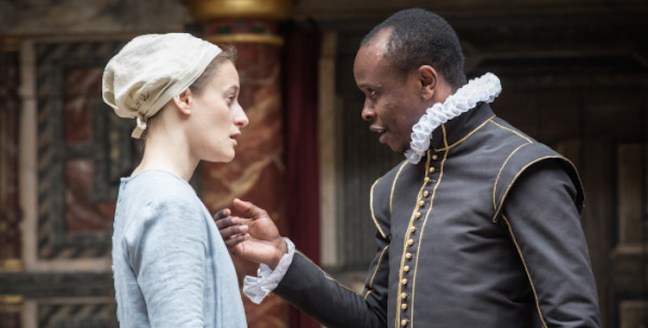
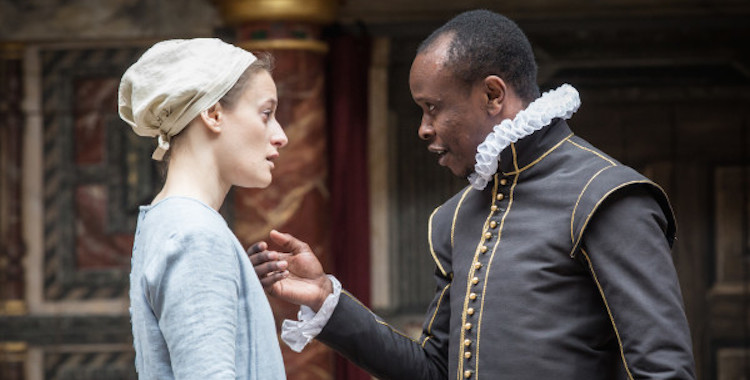
But there’s nothing simple about the characters here. Angelo is no straightforwardly pompous, hypocritical Puritan, and Isabella is far from a saint. As the righteous man undone by desire, Kurt Egyiawan is hard to pin down. At first, his sudden lust for Isabella visibly overwhelms him, but the icy resolve shown in earlier scenes creeps back over him as he covers his tracks. As his unwitting tempter, Mariah Gale’s Isabella is earnest in her protection of her virtue, yet odd moments betray an underlying passion and pride.

And then there’s the Duke, a puppeteer with murky motivations for pulling the strings. It’s a puzzle of a role for any actor. Is this leader a would-be God, testing his subjects while he looks on, or simply a master manipulator out to get what he wants? Dominic Rowan plays him awkward and uncertain, making it up as he goes along, until in the convoluted final scene he steps back into the robes of power with a little too much relish.

There might be no revelation at the heart of Dromgoole’s interpretation, but this is a Measure for Measure that keeps its setting in mind. The Globe is about the groundlings, and this version of the play is about the people – flawed, passionate, pragmatic – who populate it. The problem posed by the play is never quite solved, but it certainly revels in the attempt.

Photo: Marc Brenner.

An Oak Tree, National Theatre

3.-Tim-Crouch-and-Amy-Griffiths-in-An-Oak-Tree_credit-Greg-Veit_-600x399

Originally written for Exeunt.

I’m currently reading How to be Both, Ali Smith’s latest conjuring trick of a novel. Written in two halves that can be read in either order, Smith has talked about how the structure was inspired by Renaissance frescoes. At first glance, the final image appears to be all that’s there, but behind the frescoes are often under-drawings which are completely different. That’s how the book works: one layer on top, the other peeking through in glimpses from beneath, different but connected.

The fresco or palimpsest is a useful way of thinking about An Oak Tree. It’s theatre of multiple layers, sometimes visible, sometimes not. Sometimes it’s a show about theatre; sometimes it’s a show about loss, grief and absence; sometimes it’s a show about transformations and illusions; sometimes it’s a show about what we choose to believe. Sometimes it’s about all of those things at once. And now, ten years on from its first performance, Tim Crouch’s play has grown yet another layer, as many of its audiences come along having already seen or – like me – read it.

Like Smith, Crouch was also inspired by art – specifically, one particular piece of art: Michael Craig-Martin’s ‘An Oak Tree’. The artwork is simply a glass of water on a shelf, alongside text explaining that Craig-Martin has transformed the glass of water into an oak tree. It’s not a glass of water pretending to be an oak tree; it is an oak tree. “The actual oak tree is present but in the form of the glass of water”.

It could be an essay on theatre, where one thing is regularly transformed into another. Crouch both plays with that idea and constructs around it a delicate narrative about another kind of transformation. At the play’s heart – and it does have a heart, for all its conceptual somersaults – is a father who has lost his daughter. Or rather, he’s found her, transformed into an oak tree on the side of the road where she was knocked down by a car.

And now the father is on stage, confronting the second-rate hypnotist who was behind the wheel. No. He’s in a room above a pub, a year from now. But he’s also here, in front of us, at the National Theatre, and we are both an audience of theatregoers and the crowd at the hypnotist’s show. It’s complicated.

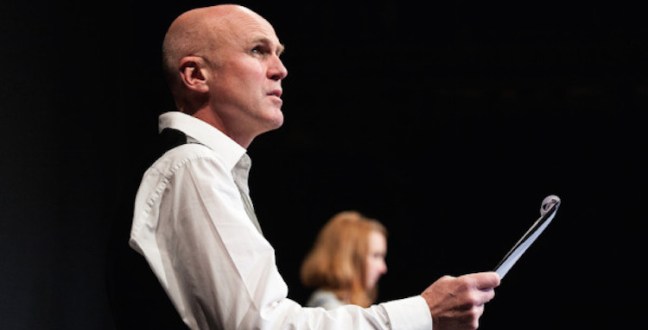
This complex, many layered fiction is all performed by just two actors: Crouch himself, alternately ingratiating and uncertain in the role of the hypnotist, and a second performer as the grieving father. In one of the show’s key devices, the second actor is different every night, brought up on stage with no prior knowledge of the script. This points up all the workings of representational theatre – we can never forget for a moment that someone is being someone else – but also speaks powerfully to the content. As this man coming to terms with huge loss, the second actor (a gentle, softly-spoken Conor Lovett on the night I attend) is appropriately lost and bewildered, feeling their way through the performance.

The play works on two levels, then: the fiction of father and hypnotist, and the theatre of Crouch and his guest performer. But the two registers blur and bleed, blurring in turn the lines between truth and fiction, absence and presence. Is it Crouch the hypnotist or Crouch the writer/performer who is in control, guiding his fellow performer? When the second actor asks of the young girl’s death “is there nothing we can do to stop it happening?”, who is it speaking? And even the framing, as Crouch carefully points out, is all (apart from a couple of ad-libbed asides) scripted. The second actor has no choice in the matter when he/she responds to Crouch’s questions or compliments his writing; it’s all words on a page, pre-determined and yet at the same time not really determined at all.

I often think of theatre as a magician’s trick: we delight in the transformations, but we want to know the secrets of how it’s done. The real magic comes from knowing that it’s not magic at all. Crouch gets that. He lays it bare, riffs on it. Look, his theatre says playfully, it’s just people on a stage pretending, but at the same time it’s something, someone, someplace other. As an audience, we believe and disbelieve the illusion at the same time. Like the punters at a hypnotist’s show. Or like a grieving parent, grasping for a presence inside an absence, searching for something to hold onto.

Photo: Greg Veit.