Theatre goes wild in the country

Wolf's Child Ö WildWorks' show for the Norfolk & Norwich festival.

Originally written for the Guardian.

Across the South Downs, on Brighton beach and deep in the woods in Norfolk, theatre-makers are redefining the relationship between art and nature this spring and summer. For a number of outdoor shows and installations that are exposed to the elements and at the mercy of the unpredictable, the environment is far more than just a backdrop. The recent rise of site-specific performance means that the “where” is becoming almost as important as the “what”.

In the promenade performance Nightingale Walk, audiences will venture across the South Downs late at night in search of the elusive song of the nightingale – “the romantic heartbeat of England”, according to the musician and artist Sam Lee. During the performance, Lee and his musicians play songs that both speak to and celebrate the bird. “We’re not trying to disturb or interfere,” he says of the piece, which is about respecting as much as exploring the surroundings. Audiences might return without actually hearing any nightingales, but Lee suggests that “the sense of the unknown is what makes it so exquisite”.

Birds are also the inspiration for And Now’s Brighton beach installation, Fleeting. Using fire and sound, the artist Mandy Dike hopes to create something that is “in feeling with the landscape”, evoking the starlings that flock around the collapsing West Pier. The installation is also concerned with the place of humans within the landscape. “The pier is a standing symbol of impermanence and change,” Dike says. “It’s not a natural feature, it wasn’t there 200 years ago; it’s something that has been built by man and has gone through an evolution and is now dissolving back into the water.”

Both Nightingale Walk and Fleeting are part of the Brighton festival, which starts on 2 May and offers a range of genre-defying work. Guest director Ali Smith is inviting visitors to “imagine the world seen from the eye of a bird. Migrating birds are born naturally equipped with maps that even newborn birds know how to follow. Imagine maps of landscapes with no border, and birds with nothing but the urge to flock together.”

Other performances at the festival delve further into the wild. The forest has frequently been imagined by artists as a place of transformation – consider the woodland escapes of plays such as A Midsummer Night’s Dream. Burn the Curtain’s adaptation of Angela Carter’s The Company of Wolves immerses audiences in “an edgeland where you feel surrounded by danger all the time”. The performance will transform Stanmer Park into a fairytale landscape of beasts and hunters.

The director Joe Hancock explains that the company wanted to create “a very visceral experience of the outdoors”, something they have achieved by getting audiences on their feet in groups of runners and walkers. Hancock hopes to give theatregoers, as physically active participants, a different point of access to the story. “Antonin Artaud talks about creating a theatre that isn’t a theatre of the intellect, but where instinct is as important as intellect,” he says. “Promenade [theatre] does that very well.”

In The Lone Pine Club, Pentabus theatre company’s new children’s show adapted by Alice Birch from the series of books by Malcolm Saville, young protagonists roam across the landscape with a freedom that few British children now enjoy. The show will tour five National Trust properties this summer, starting at Carding Mill Valley in Church Stretton, Shropshire, in July. Director Elizabeth Freestone describes the original books as “proper Bond-style adventure stories in the countryside”, and hopes the show will rekindle children’s relationship “with being feral and being wild”. In her books Wanderlust and A Field Guide to Getting Lost, Rebecca Solnit likens the human mind to a landscape: thought is a kind of wandering, and musing takes place in “meadowlands of the imagination”. Likewise, for Freestone, “there’s a really direct link between being outside and imagining stuff”.

For WildWorks’ new show, Wolf’s Child, which is part of this month’s Norfolk & Norwich festival, the company’s artistic director, Bill Mitchell, started with a question: “Is it possible to get an audience to look through the eyes of an animal?” Drawing on myth, fairytale and folklore, the show takes audiences into the woods around Felbrigg Hall, exploring a natural landscape that we so often ignore or abuse. “We’re losing our connection with the wild,” Mitchell says. Felbrigg Hall is one of those dreamlike places. Sun-dappled clearings narrow into tree-crowded paths; overhead, branches twist and curl in fantastical formations. In one part of the woods, cedar trees rise up like columns, creating a backdrop more evocative than many a stage set. “We’re trying to honour the space,” he continues. “There’s a phrase: ‘What do you get for free?’ Actually, here you get a hell of a lot that is just given to you.”

Reflecting on the impact of outdoor performances and installations on these landscapes, Dike says: “You leave an energy there, but you’re not leaving big structures or marks or scars.” All of these artworks are about working with what is already there. As Mitchell puts it: “There’s a big difference between doing A Midsummer Night’s Dream in Regent’s Park and actually using the landscape, trying to understand the landscape, and letting the landscape shape the story.”
Oxford’s everyday activists inspire audiences

d4c51c91-309f-4a9b-b3d2-11a948935c16-620x372

Originally written for the Guardian.

Oxford’s residents have a history of taking a stand. Over the years the city has been home to the likes of Emily Wilding Davison, Percy Bysshe Shelley, Tony Benn and John Ruskin. During the English civil war, it had associations with the radical Levellers movement, two of whose members were executed near Gloucester Green. The city’s Ruskin College has long been a symbol of workers’ education, as well as hosting the inaugural Women’s Liberation Movement conference in 1970. But as Oxford celebrated its radical history last year, theatre-maker Chris Goode and the Oxford Playhouse were more interested in what it means to be radical today.

Commissioned for the Playhouse’s Radical Thinking season, the show Stand – now on at Battersea Arts Centre in London – celebrates the ordinary and extraordinary ways in which local people are standing up for what they believe in. For some, that means activism in a familiar form: campaigning, demonstrations, occupations. For others, it’s simply about being a parent. In the show, Goode has captured and told six of these stories.

The Oxford Playhouse asked its community a simple question: when was a moment you stood up for something you believe in? “I feel like the callout set the bar quite high,” Goode reflects. “There’s something nicely self-selecting about it, because it means that the people who want to talk really want to talk.” Having chosen his six storytellers, Goode interviewed them all over a couple of weeks, gathering the material that would later be performed by his cast of six actors.

The stories they found were as varied as the people sharing them. There’s a climate campaigner, a woman who works with refugees, a mother, an activist who campaigned to save the alternative community at Oxford’s Jericho boatyard, one of the founders of the Reclaim Shakespeare Company, and a man in his 80s who has spent most of his life protesting against animal testing.

Isn’t there a danger, though, that these eclectic narratives just end up serving a structure imposed by the theatre-makers? Goode’s answer to that question is to be constantly confronting it. “I just think being really aware is half of the task,” he says. “You have to let go of your agenda quite often, because it has to be about the people rather than about the issues that you’re trying to articulate.” All of the interviewees speak, for example, about their childhoods, offering a portrait of their personalities as much as their acts. “I think one of the virtues of Stand is that you see everyone in quite high resolution,” says Goode. “Hopefully you get a real sense of the details of people’s lives, so that they’re not just mouthpieces for certain points of view.”

That said, Goode admits that he and his team always had the aim of inspiring their audiences, with the hope that they in turn will go on to stand up for their own causes. “I felt like there had to be that call to action embedded in the show,” Goode explains, “quite gently, but definitely there.” For that call to action to be heard, though, the show has to connect with audiences who might feel worlds away from the activists sharing their stories – “you have to feel like you’ve been listening to people like you,” as Goode puts it. That’s where the human detail comes in.

“One of the really nice things about the people we found is that they were all really quick to talk about themselves in ways that pointed at moments where they’d failed, moments when things had gone in an unexpected direction – moments of daftness,” says Goode. Activism has its fair share of the ridiculous alongside the serious – “bizarre situations where they’re superglued to something or they’re wearing a costume in a peculiar place”. And what Stand’s storytellers all share, like so many of us, is a guilty feeling that they could be doing more: “Even among really hardcore activists, there’s always someone who’s more hardcore.”

Stand was also an opportunity to present people’s courage in a new light. “People don’t often see themselves in that way,” says Goode, “they don’t see their own bravery.” One example is Jan Thomas, who wanted to celebrate her adopted daughter’s small stand against injustice, but found to her surprise that Goode was more interested in her story as a mother. “I felt I had done nothing special,” she tells me. Since taking part in the project, though, she has been bolder in taking a stand, joining some of her fellow participants in their campaigning activities. “After seeing Stand and meeting the others I resolved to be much more active in standing up for the things I believe in.”

A big part of the project has been about engaging new audiences with the work of the Playhouse, not least through performing the show in a local community centre. “I think there’s a perception around Oxford Playhouse, as there is around a lot of venues and organisations of that scale, that they’re slightly fortressed,” suggests Goode. “It felt really important to them as well as to us that this was a way of opening up some different doors.” Producers Hannah Bevan and Michelle Walker describe Stand as unlike any other show the Playhouse has ever worked on, adding that “to be bombarded with audience responses ever since the show opened about how joyful and inspiring they found it was nothing short of a dream”.

“I’ve never done anything with quite such a strong local focus,” adds Goode, questioning how that might translate to audiences during its London run at BAC. “There’s definitely a strength in that specificity, but I don’t know whether it’s a crucial strength yet.”

Just days after Goode and I spoke, Battersea Arts Centre’s Grand Hall was hit by a devastating fire, followed by an overwhelming show of support for a venue with a radical history of its own. It seems that in Battersea, as in Oxford, there continues to be a tradition of standing up for what matters.

Photo: Richard Davenport.

New experiments in binaural sound technology

Fiction-@-BAC-c-Alex-Brenner-please-credit-_DSC3979-700x455

Originally written for The Stage.

Binaural sound technology is nothing new. The technique of binaural recording, which creates the sensation of 3D sound for those listening through headphones, has been around in one form or another since the end of the 19th century, when it was used in the transmission of theatre and opera performances over telephone lines. What’s more novel, however, is its use in theatre.

Director David Rosenberg has long been aware of the potential of binaural sound. “I first came across it through my dad,” he remembers. “My dad was a physiologist working in the area of soundand he was doing work with binaural sound when I was about 10.”

The technology was not put to use in Rosenberg’s theatre-making, however, until he and sound designers Ben and Max Ringham started creating experimental scratch performances with theatre company Shunt, of which Rosenberg is a co-founder.

“Ben and I and David developed that interest together,” Max Ringham tells me, recalling their early experiments at the Shunt Lounge under London Bridge station in the mid-2000s. “First of all, we were working with an illegal radio transmitter and we would set up impromptu illegal radio stations to send audio out to people.” From these illegitimate beginnings, the trio gradually refined their use of the technology, eventually putting it to full use in the 2007 show Contains Violence at the Lyric Hammersmith.

In Contains Violence and subsequent shows Electric Hotel and Motorshow, Rosenberg explains that the use of binaural sound was “about trying somehow to bridge the visual gap between the audience and what they were watching”. In each piece, audience members were positioned as onlookers, with the sound pumped through their headphones immersing them in distant spaces, be those hotel rooms or car interiors.

But there are problems with this as a technique. “There’s a hierarchy of perceptions,” says Rosenberg, with sight at the top. “Sight occupies the very safe territory where lots of other sensations then attach themselves to what you see,” he continues, using the example of an experiment in which participants attributed different sounds to the same set of moving lips. “Sound is not a precise thing in the way vision is,” Ringham compares the two senses. “When you look at something you can see the clear relationship between a tree and a car, for example, whereas there’s an element of subjectivity with sound about where things are coming from.”

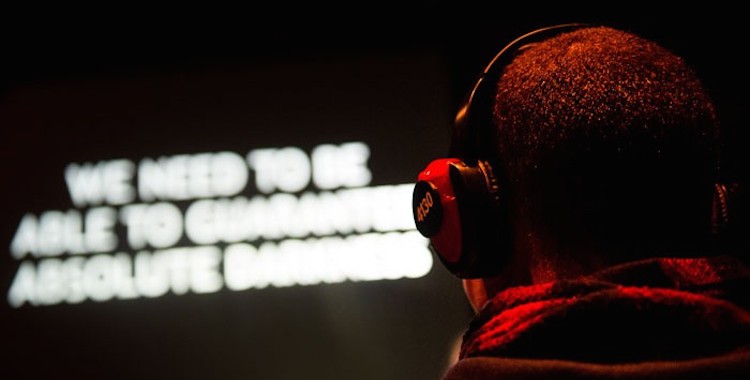
This explains why, for their latest experiments with binaural sound in Ring and Fiction, Rosenberg and his collaborators have plunged audiences into darkness.

“We wanted to completely change that hierarchy and have images created by the sound,” Rosenberg explains their thinking. “Deprived of other sensations, the audience become incredibly sensitive to the sound.”

Ring, created by Rosenberg, Ben and Max Ringham and writer Glen Neath, enveloped audiences in inky blackness and placed them at the centre of an unnerving aural experience. “With Ring, we were really looking at how to expand the role of the audience within this set-up and how to make them the subject of the piece,” says Rosenberg, “so they find themselves deeper and deeper within a performance that they have a role in, that they have a reason to be in.”

While audio performances often raise the question of what qualifies them as theatrical, it was this positioning of the audience that ensured that Ring remained a live experience and one that could not just be listened to at home. “The show for the audience is about being in a room full of people,” says Rosenberg. “You need to be in that situation in order for it to make sense.” Neath agrees, going as far as to claim that this work heightens the liveness of the theatre: “It feels like one of the most live experiences I’ve had in the theatre.”

Robbing the audience of their sight, meanwhile, has given greater scope for the sound. “The darkness is such a massive gift for us,” Ringham says. “It’s brilliant, because it means to start with everyone thinks you’re about 10 times better than you are. Your sense of hearing is so much more heightened in the dark and people’s focus is absolutely on what they’re hearing, because they have nothing else.”

As a sound designer, Ringham relishes the new opportunities that binaural technology allows. “The geek in me really enjoys throwing sounds around,” he says. He remembers a moment during Electric Hotel, in which the audio feed tricked audience members into believing that they could hear people speaking from among them. “Every night, watching 500 people turn around and look over their shoulder to see who was talking behind them when there was no one there, was quite a big thrill.”

Like any technological development, however, it has its challenges. “There are lots more facets to take on board when you’re trying to create it,” explains Neath, as well as lots of theatrical devices that are ruled out by the use of headphones and, in the cases of Ring and Fiction, the complete darkness. “There were so many things that you couldn’t do and you had to find a way round.”

Lessons have been learned along the way, such as the sound designers’ discovery that “people’s perception of things in a space has a limit; people can only hold three separate things in a 3D environment in their head and know where they’re coming from”. Ringham insists, therefore, that it’s important for theatre-makers working with this sound to keep it simple and not attempt to do too much at once. He also stresses that it’s “incredibly important” to use high-quality recording equipment in order to create the best experience. “There’s the KU100, which is the industry standard best and nothing sounds quite as good, to be honest.”

So what makes this technology so exciting for theatre-makers? “The main thing is a question of intimacy,” says Rosenberg. “With all live events we’re trying to create some sort of intimate relationship between the audience and what they’re seeing. How do you keep that intimacy when you have increasingly large audiences?” Binaural sound, which can create the sensation of a performer whispering directly into each and every audience member’s ear, is one answer.

Intimacy also seems to be the lure for audiences. Observing the growing interest in binaural sound across the theatre industry, Ringham suggests that “it’s more and more of interest to people as they’re more interested in an immersive type experience. It’s an incredible way of transporting people and putting them into different environments.”

This sensation of immersion is central to Fiction, the team’s second show using binaural sound and complete darkness. This time, the show puts audiences in two places at once: the room of the theatre, and the dream world that the sound transports them to. “The principal difference is that we’re taking the audience to a lot of different locations and there’s been quite a lot of discussion about how we actually record that,” says Ringham.

The effect of this sound, Neath hopes, is “something magical”, allowing audiences to suspend their disbelief even as they are made aware of the physical space they inhabit. “This is not real, but we challenge you not to believe it.”

Photo: Alex Brenner.

“The Director as God is Bullshit”

Jpeg-1.-Janet-Etuk-as-Grace-and-Sean-OCallaghan-as-Phil-in-Beyond-Caring.-Photograph-by-Mark-Douet-I80A4988-600x400

Originally written for Exeunt.

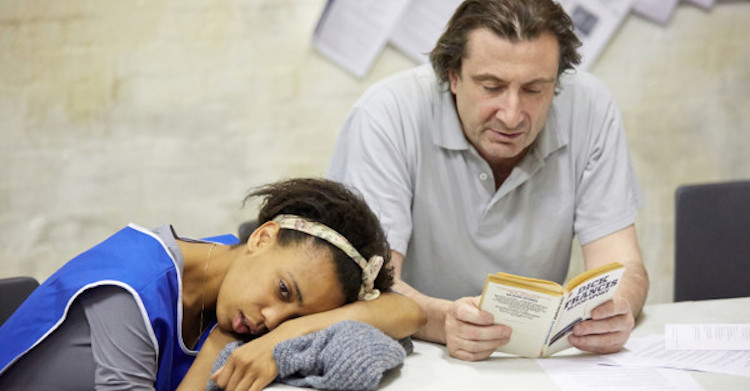
At times, Alexander Zeldin sounds more like a composer than a director. In his rehearsal room, “rhythm” is a popular word, as is “beat”. I’m watching Zeldin and his cast return to Beyond Caring, the hyper-realist snapshot of precarious labour that is transferring into the National Theatre’s temporary theatre following its premiere at The Yard last year. The show is an act of making visible – or perhaps audible. Zeldin stages the fractured daily routines of a group of zero-hours cleaners, with a musicality that draws as much on silence as it does on sound. It’s the ordinary textures of life woven into a theatrical score.

“I think in life there’s already quite a lot of theatre,” Zeldin says later as we sit in the foyer of the National Theatre, watching the everyday performances of passersby. “The theatre is a chance to be ourselves.” This is what’s so disorientating and eventually disarming about Beyond Caring, which refuses to fit human behaviour inside the stage conventions we are so used to seeing. “I think if you don’t do something that’s disturbing – I mean that in the best possible sense – you don’t really have an opportunity to be honest,” the director explains. “You need to create the conditions in which we can really exchange and we can really look at life.”

Zeldin struggles, though, to express the thinking behind this way of working, an approach that is perhaps best witnessed through the work itself. “If we could grasp it, there’d be no need to make the theatre, right?” he points out. I suggest a distinction made by Katie Mitchell between realism and naturalism, two words often used interchangeably to describe theatre. But according to Mitchell, realism is a mode based on recognisable conventions – representations of real behaviour – while naturalism attempts to precisely replicate that behaviour as seen in the world beyond the auditorium. Beyond Caring is in a similar mould, taking care over the minute gestures, pauses and phrases that make up a human life. A head is turned just so; a silence is rehearsed over and over.

Zeldin quotes a Chinese proverb: “don’t think about doing, just do”. Just doing, though, is “a very powerful, very complicated thing”. He continues: “everything I’m trying to do is just creating the conditions in which we can just do. And then we sculpt.” In creating these conditions, his role blurs between writer, director and member of a devising company, hierarchies constantly forming and dissolving. “The distance between the writer and director I feel is a little artificial,” he reflects on the slicing up of roles in much British theatre-making. “If you’re a director, inevitably you want to go and write, and if you’re a writer inevitably you’re going to want to write in the language of presence, space, rhythm.”

His role in the creation of Beyond Caring has strayed into both territories. While it was Zeldin who originated the idea and came into rehearsals with material he had already written, the show is very deliberately described as “written through devising with the company”. The piece has been shaped and reshaped over the years in close collaboration with a group of actors, as well as drawing on extensive research that started with Florence Aubenas’s book The Night Cleaner, an undercover investigation of precarious shift work in France.

For Zeldin, though, research is about experience and individual human interactions rather than about presenting a series of facts. “If you present your research on the stage, why don’t you just give the book out?” he says. “Because it’s going to be more clearly expressed.” Instead, the “meticulous” research undertaken by Zeldin and his cast – including stints working as cleaners – is subtly integrated at the level of character. One of the workers they met, for instance, talked about sleeping on a park bench, planting the seed for a character in Beyond Caring who sleeps in the factory where she works. “I’m not putting a park bench on the stage – that’s the verbatim version,” Zeldin distinguishes.

This, he insists, is where the politics of the show is located: in its form. Beyond Caring is about a controversial political issue – one that is proving to be a key point of debate in the pre-election hubbub – but its take on zero-hours contracts invites audiences to simply look and empathise rather than to engage with a series of facts and opinions. Inevitably, though, the current political context will colour its reception. “It’s a little awkward for me,” Zeldin admits, “because I’m doing a play about zero-hours contracts in the lead up to the election. I care passionately about the political issues at stake, but I hate politicians and politics.”

But he maintains that the style of the piece remains the most important expression of its politics. “I think it’s Tim Crouch who said that theatre happens in the head, not on the stage,” he says by way of explanation. “That’s such a powerful statement. And it happens in the heart; you just touch people, it’s not very complicated. I think we overthink things too much. Theatre is a precious space where we don’t need to overthink.”

Alongside music, another key aesthetic influence on the piece is photography. Zeldin explains that one of the initial inspirations for Beyond Caring was a series of photographs by Paul Graham – “it’s a kind of tribute, in a way” – and in the show he hopes to capture life in the same way that early twentieth-century photographers were able to. “August Sander, who was a photographer in the 1920s, used to go round before people knew what a camera was, so he’d point this thing at them and he’d capture them unaware,” Zeldin tells me. “There’d be a moment when you’d really see somebody, because they didn’t know how to behave in front of this strange contraption. That’s exactly what I’m interested in trying to do in the theatre.”

Achieving this involves precise and extended work with actors. “For me the root of everything I’m doing is the work with the actor,” says Zeldin. The question he is constantly asking of the performers he works with is “what’s at stake?” and his ultimate ambition is for them to achieve “presence”, a word he finds difficult to define. “What does it mean?” he asks, referring to the cliched statement that someone has stage presence. “Let’s be more specific. I think presence is something you can learn. You can develop it, you can train it.”

Beyond Caring, for instance, has been a long time in the making, and Zeldin has been working with some of the actors in the show for five years now. He characterises their process as completely collaborative, describing all of the performers as “massive contributors” to the show. “Hierarchy is dead,” Zeldin states unequivocally. “The director as god is bullshit, it doesn’t work. We’re in a room, we’re making it together, it’s got to be like that otherwise it’s a waste of time.”

“Theatre has to be alive in every second,” Zeldin continues, unforgiving in his expectations of the art form. “How can you do that? You need to create the conditions in the work where there’s a constant interrogation.” He recalls the experience of assisting Peter Brook – his greatest influence and inspiration as a director, as he stresses more than once – and being told to change something in the production every night while on tour. “It was about finding a readiness, an alertness.”

None of these working practices find a natural home in the British theatre industry, with its freelance culture and typically short rehearsal periods. For this reason, Zeldin – who is currently associate director at Birmingham Rep – aims to one day start his own company. “My ambition is to keep a group of actors together for ten, fifteen, twenty years,” he explains, brushing aside the audacity of this aspiration. His answer to practical obstacles is, perhaps, the best expression of his approach to theatre-making: “I think you have to do things that seem impossible.”

Photo: Mark Douet.

Doing Things with Bodies

Forest-Fringe-photo-by-Jemima-Yong-600x337

Originally written for Exeunt.

Bodies on stage constantly surprise me. The ways in which they tumble, contort and embrace; their capacity to startle and to move – in all senses of the word. The way they both betray and are betrayed. The small movements that become saturated with meaning. Watching contemporary dance – an art form I don’t see nearly enough of – I’m just as likely to be struck by the odd twist of a hand or flick of a head than by the overall execution of the choreography, about which I’m almost entirely ignorant. I find myself drawn instead to gesture and interaction; to the way that bodies meet, part and respond to one another in the space.

So how does a writer with a love for but embarrassing ignorance of dance respond to a programme of performance that is flirting with dance vocabularies in a venue usually dedicated to contemporary dance?

Forest Fringe’s fleeting residency at The Place is an intriguing meeting of performance practices, an inter-disciplinary experiment in curation and audience engagement. Over two nights, the organisations have co-curated a range of performances and installations that dance delicately around genre distinctions, standing at the intersection(s) between theatre, live art, contemporary dance, performance and participation. It’s both dance and not-dance.

In watching, I can only react to the bodies. I’m reminded, aptly, of the words of Forest Fringe’s Andy Field: “Theatre is a space in which we can ask questions that only our bodies can answer.” Theatre does thingswith bodies just as much as it does things with words. And the same goes for the performances I see at The Place: they do things with bodies.

In Gillie Kleiman’s DANCE CLASS: a performance, our bodies as audience members form the material of the piece. After being ushered into the room in darkness, we close our eyes and are invited to inhabit our own bodies more fully – specifically, our hands: their connection with the floor, their movement, the bones and muscles that form them. It feels part meditation, part piss-take, Kleiman delivering everything with her tongue more or less firmly in her cheek. Despite the lightly mocking flavour, though, it’s oddly relaxing. I find my fingers tingling as they press down into the ground or flex in the air.

Before long, though, our bodies are found to be wanting. Leading her strange, ever-shifting dance class, Kleiman is brisk and occasionally bullying, leaving no doubt as to who is in control here. She teaches; we try, we fail. Reflexes are too slow, muscles reluctant to mimic the moves demonstrated by Kleiman. Whose bodies are really important in this space? the piece begins to ask between laughs. Whose show is this? Lightly, playfully, tongue still planted in cheek, Kleiman prods at interaction and its often obscured power dynamics. Our bodies might be the raw material, but who in the end is sculpting them?

If 27 is also (intermittently) playful, that’s where its similarities with DANCE CLASS: a performance end. The relationship with dance in Peter McMaster’s tender, bruising show is less explicit, but nonetheless it is overwhelmingly about bodies – bodies that live and love and die. This is all wrapped up in a structure that resembles nothing so much as ritual, from its slowly burning incense sticks to its ceremonial scatterings of ash. The two bodies on stage in front of us – McMaster’s and fellow performer Nick Anderson’s – are here, visibly and thrillingly alive, in order to think together about death.

The title refers to the “27 club”, that morbidly romanticised group of musicians – including Jim Morrison, Janis Joplin, Jimi Hendrix, Brian Jones, Kurt Cobain and Amy Winehouse – who all died at the same age McMaster is now coming to terms with. Death, then, is a constant and in some ways alluring presence in 27, but so too is life in all its joy and heartbreak and messiness. In contrast to all the unthinkingly mythologising responses to those “live-fast-die-young” icons, 27 is complex and personal and humane, acknowledging the appeal of the myth while fusing it to material that is at once autobiographical and outward looking.

It’s the second time I’ve seen the show and the same moments knock the breath out of me all over again. They all have to do, I realise, not with design or words or even fully articulable ideas, but with just these two performing bodies. There’s a sequence in which McMaster struggles again and again to escape from Anderson’s half-embracing, half-smothering grasp, straining out of his arms over and over, all underscored by the devastating soundtrack of Janis Joplin’s “Cry Baby”. Both men are naked by now – a nakedness that feels as gentle and generous as it is exposing – and their bare skin is lightly coated in the ash that clouds the air. Death hangs on them, yet they are so so alive.

Later, in one of the most powerfully simple gestures I’ve seen on a stage, the two men fall repeatedly into one another, stepping gradually further and further apart as they do so. Shoulder smacks into chest; arms grip arms. You can almost see the bruises blossoming in real time. There’s such trust in it, a trust and cooperation tinged at the same time with pain and a kind of heavy, unspoken grief. Each time their bodies slam into one another, it’s all I can do not to gasp with the bruising beauty of it. Bodies, at once sturdy and fragile, embracing, catching, supporting one another.

To talk about embodiment is often to be misleading. We aren’t brains in jars, we’re blood and muscle and sinew, and so everything is embodied – from sitting and reading a book to me typing these words, the smooth surface of the keys sliding under my fingertips. Still, there’s something about live performance that almost imperceptibly changes how we see and understand both the bodies on stage and, perhaps, our own, whether in our seats or up on our feet. And time and again, as at Forest Fringe, I find myself surprised.

Photo: Jemima Yong.