The Body, Barbican

5295

Originally written for the Guardian.

Theatre rarely engages all of our senses. Even the words that refer to us as theatregoers – audience, spectators – emphasise sound and sight alone. But The Body, as its title suggests, is interested in every last muscle and fibre of the live experience. Nigel Barrett and Louise Mari’s show, the recipient of this year’s Oxford Samuel Beckett Theatre Trust award, is theatre that asks us to feel – in every sense of the word.

Narrative, therefore, is abandoned for sensation. Instead of scenes, Barrett and Mari have created a series of fleeting impressions, each as strange and vivid as the last: lights brightly flare; sounds assault us from all angles; images flash on a screen while vibrations shake us in our seats.

The one connecting thread is the constant “thump-thump” of the human heart. We enter designer Myriddin Wannell’s intimate black cube and are instructed to attach heart rate monitors. Performers Barrett and Jess Latowicki whirl in and out through revolving doors, handing each of us a doll that has its own uncanny heartbeat.

This feeling of the uncanny pervades the show, which is littered with dolls – plastic, mechanical and sometimes unnervingly lifelike. Manoeuvred by Barrett and Latowicki, these disturbing synthetic figures are a counterpoint to the messy biology the show explores. They also pose the question of what really makes us human in an age of advancing artificial intelligence.

Arguably more installation than theatre, The Body is bold in its rejection of story and embrace of technology. Those hoping for plot or character will be disappointed, but as a set of images and sensations it’s often breathtakingly beautiful.

The show’s ambition of sensory overload is to interrogate something of what it means to be human and all too briefly alive. Like life itself, The Body is confusing, fragmented and sometimes overwhelming. But, also like life, it’s a strange yet extraordinary experience.

Photo: Richard Davenport.

I Want My Hat Back, National Theatre

1600

Originally written for the Guardian.

The kids’ verdict on the National Theatre’s new family offering comes in early. “This is a funny show!” exclaims one girl about 15 minutes in, giggles erupting around her. It’s hard to disagree.

Narratively speaking, there’s not a lot to Jon Klassen’s laconic picture book. The plot is mostly spelled out in the title: Bear’s hat has gone missing and he wants it back. This simplicity, though, is part of the joy of both book and adaptation. Around the limited framework, director Wils Wilson and her team have built a mischievous, boisterous delight of a show.

Bear (Marek Larwood) loves his red, pointy hat. But when he leaves it unguarded in the forest, opportunistic Rabbit (Steven Webb, with all the hyperactive energy he has brought to the Lyric Hammersmith’s pantomimes) is quick to snatch it up. Bear’s attempts to track it down lead him through a series of encounters with his fellow forest inhabitants.

Wilson’s version lets young audiences in on its tricks, welcoming them on stage at the beginning and making few attempts to hide its make-believe. Fly Davis’s DIY design has pot plants for trees and animal ears for costumes, while the chorus’s rapid changes of character often happen in full view. It’s a production that gets that kids understand pretending.

There’s plenty for the big kids in the audience too, from Arthur Darvill’s genre-hopping music to Joel Horwood’s book and lyrics, which retain Klassen’s concision and offer knowing winks to the adults. Wryly ad-libbing through the vocal responses of younger spectators, Larwood gives a brilliantly deadpan performance, which plays to two levels simultaneously. A show for all ages is a rarer thing than marketing copy tends to suggest, but I Want My Hat Back achieves that aim with ease.

Photo: Richard Davenport.

And Now: The World!, Hackney Showroom

unnamed4

Originally written for Exeunt.

“We’re getting used to a new way of being alone together. People want to be with each other, but also elsewhere, connected to all the different places they want to be.”

I write this with my phone sat next to me. With the slightest move of my arm, I can pick up a call, check for notifications, see if the little email icon is nagging me to clear my inbox. So far today I’ve communicated over phone, text, email, WhatsApp, Twitter, Facebook. Skype is open on my laptop, along with a noisy crowd of different web browser tabs and three separate Word documents. All the information I could ever want is just a click away.

Like.

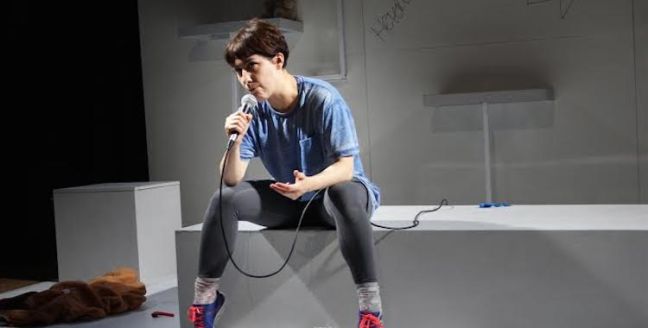
This is the sort of hectic, always-on digital existence thatAnd Now: The World! depicts. A slab of text by Sibylle Berg (here translated by Ben Knight), the play itself is a bit like the overwhelming data streams of the internet, there to be accessed – as the note at the beginning, read aloud, makes clear – by one voice or many. In director Abigail Graham and dramaturg Clara Brennan’s version, this anxious, almost hyperactive stream of consciousness is all spoken by Jennifer Jackson, moving restlessly around Sarah Beaton’s sleek, white, MacBook-style set. Her thoughts – about herself, about the world – are constantly punctuated by beeps and chirps; a distracting digital cacophony of alerts.

Share.

The unnamed speaker of And Now: The World! is sharing. Oversharing, some might say. She’s broadcasting her life (literally to us, virtually to the many eyes and ears of the internet), but with the fear that no one is listening. This is what the internet offers us: both an audience and a gaping void; a desperation to share, yet a feeling that our words and thoughts and emotions are simply entering a vacuum. Breaking repeatedly through Nick Powell’s crowded sound design, and eventually played at length, Sherry Turkle’s famous “alone together” TED Talk acts as a sort of half-mocking key for this production, the protagonist a living demonstration of Turkle’s aphorism “I share therefore I am”.

Favourite.

In narrative terms, the show doesn’t really go anywhere. The monologue loops, repeats, spirals off into transgressions, all separated into social media style nuggets. As delivered by Jackson, the whole thing pulses with anxiety: FOMO writ large. The speaker assiduously avoids venturing out into the world, yet she feels the need to check in with it constantly – if only to shower it with her disillusioned disdain. Zumba, baking, consumer culture – all are met with wry scorn, dismissed as distractions from a dying planet. The critique, though, is a knowingly empty one, delivered by a speaker who prefers to lock herself away from the world with the comforting chorus of her technology. She used to vent her rage by beating up young men in the streets, but now she just sits in her room, selling fake viagra on the internet.

Instagram. #nofilter

In a recent piece in the LRB, Rebecca Solnit describes digital communication as positioning us between solitude and communion, “a shallow between two deep zones, a safe spot between the dangers of contact with ourselves, with others”. We are never truly on our own and yet never truly withanother person, part of us always elsewhere. This is certainly true for Berg’s speaker, who is not content alone or with others. She instead chooses to communicate with all the people in her life electronically – by Skype, by text, even by the now nostalgic digital communication channel of MSN Messenger – but that communication only seems to cause stress. For such a seemingly contained, introverted piece, though, this production is incredibly physical and dynamic. Frantically responding to messages across different electronic platforms, Jackson leaps athletically around the set – a physical manifestation of the mental acrobatics required by today’s atomised forms of sociability. We might be stuck, but we’ve never had to do quite so much moving.

Retweet.

Little about And Now: The World! offers up particularly new insights. The lost, disconnected, screwed-over generation that its speaker represents is now all too familiar on stage, depicted most powerfully in shows like Barrel Organ’s Nothing, while the implicit critique of digital communication finds echoes in pieces such as I Wish I Was Lonely by Chris Thorpe and Hannah Jane Walker. The speaker’s paradoxical blend of anger and apathy, together with the ambivalent portrayal of digital media’s effects on our lives, is very recognisable, as are the many swipes made at shallow, hypocritical twenty-first-century society. For all that familiarity, though, Graham’s production still has some bite. “We’re shattered,” writes Solnit of the impact of today’s technology. “We’re breaking up.” And Now: The World! depicts that shattering in process.

https://embed-ssl.ted.com/talks/sherry_turkle_alone_together.html

Photo: Flavia Fraser-Cannon.
Beasty Baby, Polka Theatre

Screen-Shot-2015-10-27-at-10.32.52

Originally written for Exeunt.

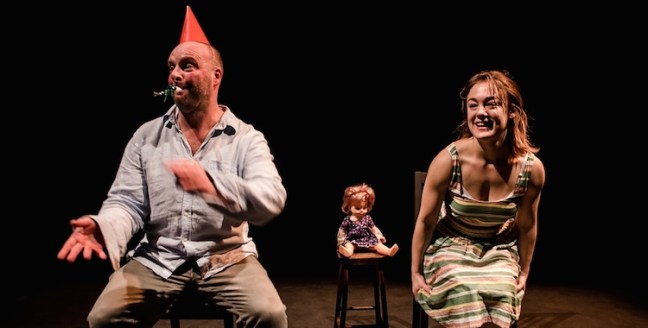
As anyone who’s spent time in the company of a bawling newborn will know, babies are complicated little creatures. That, essentially, is the premise of Theatre-Rites’ brilliantly simple new show for three to six year olds. Sweetly, amusingly, unhurriedly, Beasty Baby offers a series of snapshots of everyday life with these (sometime) bundles of joy, lurching from the adorable to the maddening and back again.

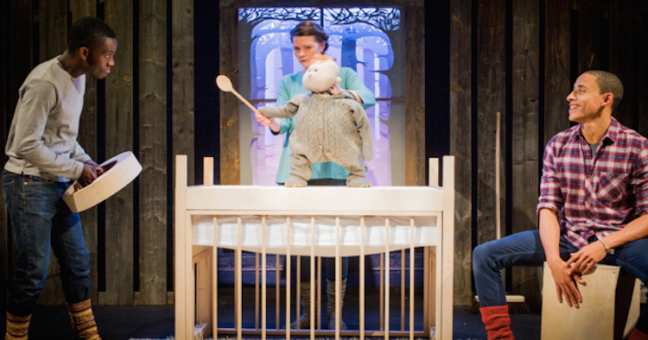
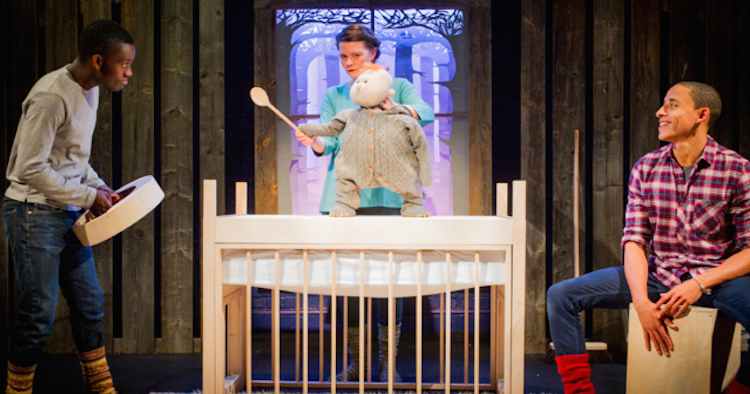
The baby in question is a handheld puppet, deftly manipulated by Theatre-Rites’ cast of three. Isolated in the middle of a wintry landscape, the trio suddenly find themselves landed with this temperamental infant’s care and do the same as all new parents: make it up as they go along. They cradle, they sing, they even do acrobatics trying to keep their new charge happy. As time passes, the unpredictable sprog throws up new challenges, with the grown-ups forever running (often quite literally) to catch up.

It works, then, for adults as much as for kids. Little ones giggle at the cheeky demands of the tiny tyrant, while parents make noises of weary, affectionate recognition. While little really happens, cycles of repetition and change keep the show moving forward, often driven by the seamlessly incorporated live music. Routines are established, repeated and disrupted, accompanied by a playful soundtrack. It’s all carefully calibrated to the attention span of its target audience, while achieving the double feat of keeping us bigger kids captivated at the same time.

Simplicity and clarity extend to every area of the production. The Ikea-esque wooden furniture of Verity Quinn’s design unfussily evokes both home and obstacle course, while there’s a fairytale glow to the landscape of trees and snow beyond the set’s single window. Days melt into nights melt into days again with the aid of Chris Randall’s lighting and the company’s graceful choreography of daily rituals: playing, feeding, burping. Change, as so often in life, sneaks in slowly.

It might not sound like much, but the skill of Sue Buckmaster’s deceptively straightforward production lies in finding both the sublime and the ridiculous in the familiar acts of child-rearing. Over the course of one long night, performer John Leader’s attempts to lull the mewling baby to sleep become a sort of dance, as he tiptoes, pirouettes and eventually levers himself athletically into the cot, infant in hand. The baby itself, meanwhile, is a brilliant comic creation, given cutely gabbling voice by Sian Kidd. As infant becomes toddler, both the noise level and the laughs increase, the naughtiness striking just the tone with the young audience.

In the end, though, the beastliness turns out to be worth it for the beauty – especially in the gorgeous, utterly enchanting finale. Beasty Baby is, ultimately, a celebration of all the chaos wrought by the arrival of a little one, animating for parents and kids alike the complicated joy of what it means to be a family.

Sparks, Old Red Lion

image

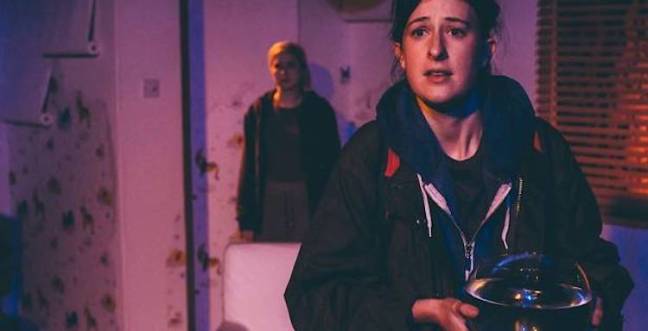
There’s something elemental about Sparks. It’s all water and fire: two opposing forces meeting, like the two sisters at the play’s heart. Jess turns up on Sarah’s doorstep drenched, clasping a fishbowl in both hands. “Soaked,” she says. “All the way through. Think I’ve got. Got wet bones.” Sarah, when she allows herself to dream, dreams of the stars, burning fiercely in the sky. It’s the night before bonfire night, the country prepared to briefly ignite, but for now the water pours steadily down.

This is the tenor of Simon Longman’s play and Clive Judd’s production at the Old Red Lion: lyrical, dreamlike. Pared back to the basics, Sparks might not sound like much. A woman returns home to see the younger sister she abandoned twelve years previously, desperately attempting to turn back time. The domestic drama of the homecoming is hardly anything new. And yet … “transcend” is a word used too frequently and too carelessly, but it feels justified to say that Sparks transcends its premise, becoming much, much more than the sum of its parts.

There is, at first, a spikiness to the situation established by Longman and Judd. Sophie Steer’s Jess, vibrating with anxiety, vomits out a relentless flood of words. She can’t stop talking. Sarah, on the other hand, can barely wrench a single syllable from her throat. As played by Sally Hodgkiss, she’s frighteningly still, paralysed by shock. The older sister dances around the younger, her jittering energy spreading outwards in ripples to the audience. We’re tensed, waiting for the confrontation or revelation that dramatic convention dictates must be just around the corner.

But like Alice Birch’s Little Light – another dagger-sharp and devastating play about families and the passing of time – Sparks keeps us waiting. There’s a lot, in fact, that the two pieces have in common. Both take familiar, arguably even hackneyed dramatic set-ups and delicately subvert them, stretching the expectations of an audience almost to breaking point. And both revolve around the fragile relationship between two sisters, bound together by blood and memories yet ripped asunder by events.

In the case of Jess and Sarah, they are speaking across a gulf, one that only seems to widen for most of the first half. Jess is frantic, speaking to fill up the silence, while Sarah gives her little in return. One speaks in outpourings, the other in clipped half sentences. Yet, perhaps most surprisingly of all, it’s funny. Dark and desperate, yes, but funny all the same. The careful rhythm of the performances highlights the jarring humour of awful situations – that very British tendency to find something to laugh about even from the depths of despair.

Indeed, careful might describe the whole production. No choices feel thrown away. The style is naturalism shot through with memory and, at moments, a little bit of magic. Subtle (and one less subtle, but completely earned) shifts in Mark Dymock’s lighting take us back through time as both sisters gradually pick over the past; likewise Giles Thomas’s sound design, which you hardly notice until suddenly you realise it’s transported you. Jemima Robinson’s design, unfussy and realistic for the most part, uses the tiny but significant detail of peeled back wallpaper to suggest the tearing away of the years. Peeking through underneath, a Winnie the Pooh pattern – the one visual reference to Jess and Sarah’s fraught, shared childhood. And the swapping of the two central roles each night, a device that could be no more than a gimmick (albeit an impressive one), makes complete sense for a play that deals so much with the roles we fall into in a family.

In the end, what matters more than the discovery that we’re primed for – the unexpected twist, or the key to this strained sibling relationship – is simply these two characters in the same space together. I’m reminded, alongside Little Light, of Robert Holman: as in so many of his plays, Sparks is about the people and the conversation. Longman’s dialogue is exquisitely crafted, as accomplished in tense, terse exchanges as in meandering, almost poetic speeches. It doesn’t matter that little really happens to the two protagonists over the course of the play, because so much happens between them. It’s simple, perhaps, but startling nonetheless.

Photo: JKF Man.