Hangmen, Royal Court Theatre

590x494.fitandcrop

I thought of Mark Lawson while watching Hangmen. Mark Lawson, as he made very clear three years ago, is no fan of the scene change. And Hangmen has one of the most drawn-out, deliberate, metamorphic scene changes I’ve witnessed on stage. A big, bold, statement-making scene change.

Martin McDonagh’s new play opens in the dying days of the death penalty. Famed Lancashire hangman Harry and his assistant Syd are just doing another job, getting on with the nine to five. The world, though, is about to change. With the condemned man eventually dispatched, at the end of the first scene Anna Fleischle’s entire detailed prison cell set shudders upwards, slowly disappearing from sight. The hangman’s dangling noose, lit by a single shaft of light, is lifted away.

It’s a stunning transition and a symbolic shift from one age to another. When the lights come up on the Oldham pub run by Harry and his long-suffering wife Alice – just as impressive in its detail – it’s two years later and hanging has just been abolished. Around them, too, the signs of change are creeping in, even if their old-fashioned boozer is still clinging to the past. Rock’n’roll music is everywhere and Harry and Alice’s “mopey” daughter Shirley is a new breed of teenager. The social revolution is on its way.

Before it arrives, though, a spectre from Harry’s body-littered past (233 hangings, he unwisely brags to a local newspaper reporter) is about to return to haunt him and his family. Remember that hanging in the first scene? Well there’s a question mark over the hanged man’s guilt – a question mark that soon marches into Harry’s pub, along with a menacing stranger from the south. Just what is it that this intruder wants, and what has it got to do with the man who died protesting his innocence two years ago?

As expected from McDonagh, Hangmen is a masterclass in plotting, complete with a couple of twists that have the whole audience collectively, audibly gasping. It’s good old-fashioned narrative theatre, full of unexpected turns and vivid dialogue, and brilliantly done in Matthew Dunster’s carefully pitched production. It’s also dark as the pints of Guinness passed over Harry’s bar, full of cruel humour and simmering with the threat of violence. We all know what McDonagh is capable of by now; the grim and grisly never seems far away.

Much of the play’s sinister undertow comes in the form of Johnny Flynn’s Mooney, the peculiar, scruffy-haired stranger who saunters into Harry’s life and Shirley’s affections. David Morrissey is perfectly cast as the reluctantly retired hangman, all no-nonsense bluntness and blokey self-importance, as is the brilliant Reece Shearsmith as Harry’s stuttering and uncertain former assistant Syd. Yet somehow it’s Flynn who stands out, his shifting, swaggering sense of menace as hard to pin down as Mooney’s questionable intentions. Is he a psychopathic serial killer, or just a serial piss-taker?

McDonagh’s a bit of a piss-taker himself, gleefully pastiching British (and particularly Northern) culture of the 1960s and tricking his audience at every turn. And, of course, Hangmen is funny. Very funny. Even if the laughs – prompted by jokes as unapologetically (and sometimes problematically) offensive as you’d expect from McDonagh – sometimes leave the sour aftertaste of a bad pint. This is the unsavoury side of Britishness, suffused with casual racism and misogyny, whose habits and traditions might – like the death penalty itself – be better resigned to the past.

Fifty years on from the abolition of hanging in the UK, Hangmen is not the play to examine the ethical intricacies of the death penalty or the complicated ins and outs of the justice system. It would never want to be. Still, though, between the laughs it shows a nation on the brink of change, as well as the nastiness that can sometimes be wrapped up in nostalgia. The paraphernalia of Harry’s trade might be lifted away, but its ugly traces remain.

Photo: Simon Annand.

Song from Far Away, Young Vic

image11-600x337

Originally written for Exeunt.

Willem is a man who never listens to music. He clamps headphones over his ears, but all they play back to him is the sound of his own breathing. It reminds me of something Hannah Nicklin wrote after seeing Carmen Disruption at the Almeida: “I put my headphones in with nothing playing which is the closest I get to this city.”

Willem is the speaker and protagonist of Song from Far Away, Simon Stephens’ latest play, and the two cities whose muffled pulse he hears through headphones are Amsterdam and New York. The old world and the new. Returning to Amsterdam following the sudden death of his brother, disillusioned banker Willem is not unlike the alienated figures who wander through Carmen Disruption, experiencing the city of his youth as “a chorus of rattling trams and bewildering underwear billboard posters and cafés and railings shuttering off unfinished building work”. A noisy, meaningless place.

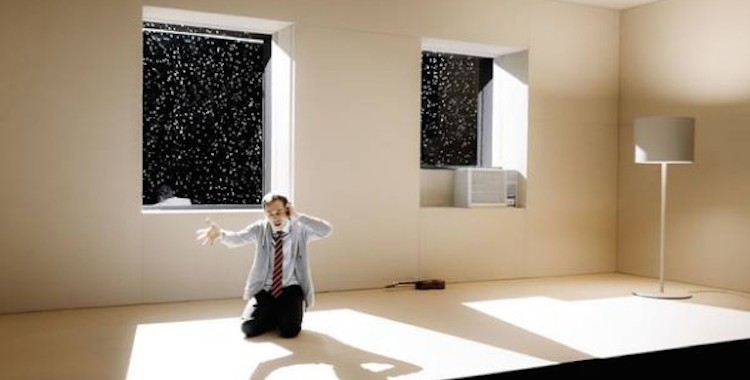
Walking through Amsterdam, Willem repeats a line uttered by the Singer in Carmen Disruption and by self-destructing rock star Paul in Birdland: “none of this is real”. As that echo suggests, Song from Far Away shares many of the themes that recur in Stephens’ recent work: home, disconnection, the hollowness of late capitalist cities. Even Jan Versweyveld’s calculatedly bland design has the perfect clean lines of every antiseptic, impersonal space that threads through these plays. Whether the room on stage is meant to be the elegant hotel where Willem stays in Amsterdam or the apartment that lies waiting for him in New York, it’s a cool, blank canvas of a space.

On that canvas, Willem composes a series of letters to his dead brother, letters that narrate his fraught and awkward homecoming. After leaving twelve years ago with barely a backward glance, he’s forced right into the grieving heart of his family. Numb and remote, all he does is upset them. Delivering the one-way correspondence as a monologue – always addressed to the invisible ghost of his brother, never to us the audience – Eelco Smits is raw and exposed, both figuratively and literally. Shedding his clothes, he stands on stage stripped of everything his new life has clothed him in, back home with nothing to protect him from the cold.

That coolness seeps right through Ivo van Hove’s stylish but distanced staging – and not just in the flurries of snow that fall behind Smits. It’s also a production that’s very still. Incredibly, precisely, frustratingly still. Whereas van Hove’s stunning take on A View from the Bridge turned Arthur Miller’s play into a ticking bomb, all of us holding our breath as we waited for it to go off, any tension bleeds from Song from Far Away. Though Versweyveld’s deft shifts in lighting move us through the hours, the production has the feel of one of those endless, sleep-robbed nights: slow, static, full of thoughts. It’s numbing, just like Willem moves numbly through his grief.

Feeling sneaks in though, often in the mournful, fractured melody of Mark Eitzel’s music. Just one song ribbons through the narrative, first heard in an anonymous bar and then echoing across the days Willem spends in Amsterdam. We hear it in snatches and phrases, like the half-remembered tunes of the past, until finally it forces its way through – a startling shaft of pure emotion, singing “go where the love is”.

Song from Far Away is a play that echoes with emptinesses. The emptiness of grief with no expression. The emptiness of a city that has long ceased being home. The emptiness of hotels and airports and characterless apartment blocks. The emptiness of the promises we build our lives on: the hollow assurance that it will all be worth it in the end. Like the inky blackness that lies behind the set’s two large windows, such promises are shown to conceal a vast nothingness.

But it’s hard to connect with emptiness, on the stage even more so than on the page. Stephens’ play begs to be re-read almost as soon as the curtain call has finished, yet as theatre it has an oddly detached quality. The first time Willem – the man who never listens to music – hears the song of the title, he says it “caught my heart in its hand”. Song from Far Away struggles for the same heart-squeezing grasp. 

Photo: Jan Versweyveld.

Edinburgh 2015

streetperformer22-LST051825

Now that I’ve just about recovered from the Fringe (and the inevitable Fringe cold), here’s my annual round-up of links to reviews and features written over the course of the festival. You know the drill by now.

Exeunt:

The Sunset Five
The Hitchhiker’s Guide to the Family
If I Were Me
Five Feet in Front (The Ballad of Little Johnnie Wylo)
Heartbeats & Algorithms
Citizen Puppet
Hair Peace
O No!
Ringside
64 Squares
The Eulogy of Toby Peach
Going Viral
Paradise Lost (lies unopened beside me)
Current Location
Electric Dreams
E15
The Paradise Project
A Question of Faith (The Christians and The Gospel According to Jesus, Queen of Heaven)
You’re Not Like the Other Girls Chrissy
This Much (or An Act of Violence Towards the Institution of Marriage)
Portrait

Fest:

Speaking Up for Free Speech (feature)
Impossible
A Gambler’s Guide to Dying
I Am Not Myself These Days
Traces
Births, Deaths & Marriages
Tar Baby
The Biggest Marionette Circus in the World
The Modern Lovers (feature)
My Name is… 
Dolls
Penny Arcade: Longing Lasts Longer
Key Change
Happy Birthday Without You
God’s Waiting Room
Fiction
After Freedom: New Rhythms of Soweto
Idiots
Brute
Othello: An All-Female Production
I Got Dressed in Front of My Nephew Today
The Litvinenko Project
Blake Remixed
Titus Andronicus: An All-Female Production
The Church of Malcolm
Wail
Scaramouche Jones
Our Ladies of Perpetual Succour
Quizoola!
Daggers MacKenzie
The Bastard Queen!

Ross & Rachel, Assembly George Square

g6mfYltK9FLX6GgchXBkSiptqUephq6_QTD5KhoBDY0

They’re a package deal. A team. Ross & Rachel. An ampersand permanently between their names. Over the years, though, that innocent bit of punctuation looks less and less like a symbol of love, more and more like a tightening knot. What happens to you as an individual when you’re always part of a pair?

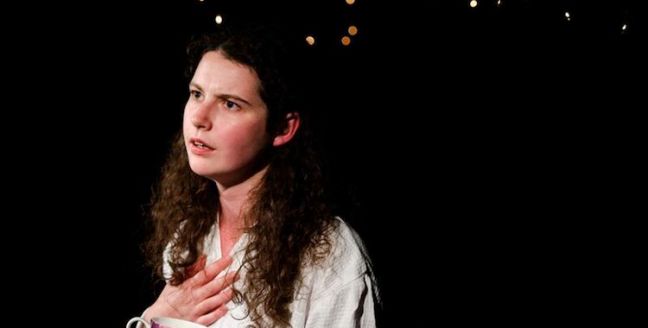
James Fritz’s play picks up after the big reunion and the happy ending. This is ‘The One Where it All Fucks Up’. In this fragmented monologue, two partners – unnamed, but with repeated allusions to the Friends couple of the title – are so tightly intertwined that they have one voice. In Thomas Martin’s beautifully simple production, Molly Vevers performs both halves of the pair, snapping rapidly back and forth. If it’s not always clear who’s speaking, that’s part of the point.

Mere years after finally getting together, the couple are already beginning to drift apart when we join them. For Ross, the language of love is the language of possession. “She’s a prom queen and she belongs to me,” he gloats at parties. Rachel, meanwhile, bristles at this yoking of her identity to his, complaining “I don’t know when people started saying our names together”. She’s toying with the idea of an affair with a work colleague; he’s plastering a forced smile on a relationship that’s far from picture perfect.

Fritz shows relationships as moulded by the expectations of others, whether those others are millions of television viewers or a tight circle of friends and family. There’s always the pressure to resemble the perfect image, to fit into whatever shape society tells us is right. That shape might come from Friends, but it might also come from romcoms or magazines or the great old love stories passed from generation to generation.

The play is canny, then, in not overplaying the Friends references. There are plenty of light nods to the show (even Ross’s infamous “we were on a break!”), but these never overpower a narrative that could just as well be happening to any couple drifting apart in their 40s. And when true disaster strikes, it’s never TV-show dramatic, just sad and shitty and unextraordinary. Suddenly, faced with the prospect of an abrupt full-stop to their relationship, Ross and Rachel are also confronted with their differing ideas of what that relationship was in the first place.

It can be exhausting to watch, as Vevers flickers frantically back and forth between conversations, thoughts and fantasies. Her extraordinary performance somehow allows us to feel these two people uncoupling, to sense the distance between their voices even as they’re spoken by the same person. This gradual breakdown is contrasted with the romantic iconography of Alison Neighbour’s set design: all flickering candles and twinkling fairy lights. Promise butts up against reality.

The play could be accused of a narrow focus, but it knows its targets and strikes hard. Ross & Rachel does a comprehensive job of de-mything romantic love, attacking its language, its imagery and its underlying hints of misogyny. At the same time, it acknowledges how hard it is to let go of that myth and how devastating it can be when the perfect picture shatters. Ultimately, we want to believe in the happy ending, because it’s easier than the alternative.

Photo: Alex Brenner.

Bakkhai, Almeida Theatre

image

As an essay on theatre, Bakkhai has it all. There’s doubling, role-playing, one thing standing in for another. There’s the clash of complex psychological insight and the wild, raw and visceral. There’s dressing up and fluid identities. And there’s the god of theatre himself Dionysos, shrugging on human form for a performance of his own.

As theatre itself, though, it’s another question. It’s not that the Almeida’s production, directed by James Macdonald, is untheatrical. There are some brilliant visual snapshots, usually heralding the arrival of Dionysos and accompanied by Peter Mumford’s vivid bursts of light, while there’s an implicit, self-aware acknowledgement of the audience throughout. That’s not to mention the uncanniness of the whole thing, its determined strangeness. But the driving narrative of Dionysos, in a holy rage and determined to get his own back on the family who snubbed him, often feels oddly underpowered.

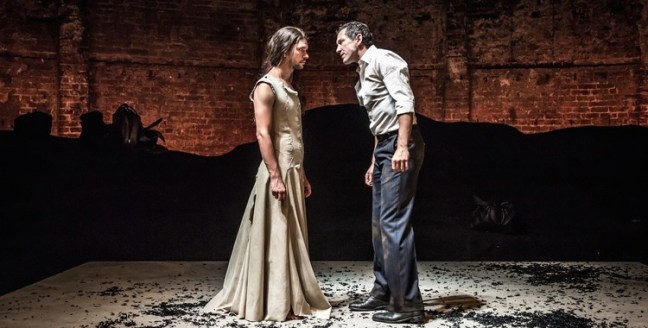
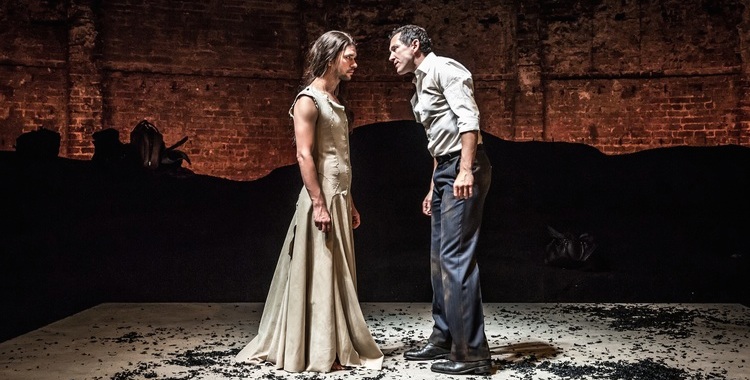
That said, the two central performances are hard to fault. From the moment he saunters on stage, throwing a conspiratorial glance to the audience as he discloses his godly identity, Ben Whishaw is utterly in control. His long-haired Dionysos is sinuous, snake-like, ready to shed this latest skin at any moment. And damn he can rock a dress. This vengeful god-turned-human is slippery and androgynous, oddly delicate in his might. He doesn’t need the borrowed authority of masculine aggression; he is power divine, effortlessly enchanting his scores of female devotees and crushing kings with the lightest flick of his wrist.

One such king is Bertie Carvel’s Pentheus, young leader of Thebes and a politician through and through. Where Dionysos is wild and uninhibited, Pentheus is rational and repressed, as buttoned-up as his immaculate suit jacket. Carvel, however, slips the suggestion of something else beneath Pentheus’s slick exterior, so that he bristles with latent curiosity even as he condemns the frolics of Dionysos’s followers. There’s a delicious scene between him and Whishaw in which the latter – posing as Dionysos’s human messenger – is persuading the disgruntled king to slip on a dress and spy on the bakkhai. Hesitancy barely masks eagerness, while a sly grin curls across Whishaw’s lips.

When Carvel drags up, though, first in disguise to infiltrate the Bakkhic rites, then later as Pentheus’s blood-drenched mother Agave, there are unfortunate echoes of his revelatory Miss Trunchbull in Matilda the Musical. I was half-expecting a cry of “maggots!” as Agave rages in her grief. Whishaw, too, fares less well when he steps into other roles, his distraught and helpless messenger not half as compelling as the scheming god who pulls all the strings. In a nod to the conventions of Greek tragedy, the trio of actors is completed by Kevin Harvey, smoothly metamorphosing from old man Kadmos to younger citizens of Thebes, though often in the shadow of Whishaw and Carvel’s sparring partners.

Then there’s the chorus. At first, the ivy-garlanded crowd of singers are startlingly other-worldly, their piercing, discordant wails a little reminiscent of the sculptural song of Return to the Voice. Just as Whishaw is an effortless deity, they really do sound like beings in communion with some strange elsewhere. After an hour and a half, though, their persistent chanting and spookily synchronised speech grates. There’s simply too much of their musical Dionysian worship, sharply putting the brakes on the momentum built up in each of the scenes between Whishaw and Carvel and never quite integrating with the rest of the action.

The issue is essentially one of tone. Bakkhai is a collision of the civilised and the elemental, of the familiar and the strange. We get that here, but often those two conflicting registers don’t so much lock horns as awkwardly jar. And beyond Whishaw’s performance, there’s never a full, unleashed sense of the wild, whether in Antony McDonald’s tentatively earthy design or in the over-polished (and over-used) chorus. The ideas are all there, but theatrically it lacks the impact it’s straining for.

Photo: Marc Brenner.