We Want You to Watch, National Theatre

Bettrys-Jones-three

Ever since seeing Alice Birch’s searing Revolt. She said. Revolt again last summer, I’ve thought of it as the feminist play for my generation. A generation raised with the base assumption of equality into a world we slowly realise has been cruelly mis-sold to us. A generation oddly cautious about the word “feminism”. A generation that briefly thought maybe the battles had been fought and won, when actually we just have to fight ever more insidious forces. For this generation and the ones immediately following it, this is the play that I want other young women – and men – to discover and have their minds blown by. It’s raw and angry and sad and fierce and funny and lost and searching and hopeless and hopeful.

We Want You to Watch is in the same vein. But where Revolt wrestled with everything it means to be a woman today, from the politics of the bedroom to the ever-present threat of violence, Birch’s new collaboration with performance duo RashDash isolates just one issue: pornography. A deliberate provocation, it starts from an extreme position, as Abbi Greenland and Helen Goalen’s characters set out to ban all porn – the good, the bad and the ugly. As one of the pair puts it, “we want it obliterated”. Rip it up and start again.

Of course, it’s not as simple as that. We Want You to Watch is conscientiously self-aware, problematising its demands at every turn. There are interjections, bathed in sudden, glaring light: “Can we just say we’re completely pro sex”; “This has just been about heterosexual porn – that is a failure. This is not an apology”. Greenland and Goalen’s objections to pornography are met with eloquent defences, turning the argument over and over. What hard evidence is there of a link between violent porn and violent behaviour? How can you control the choices of consenting adults? Isn’t the banning of porn just censorship, pure and simple?

This is all explored in episodic fashion, leaping from one surreal scenario to the next. First, Greenland and Goalen are cops in the interrogation room, trying to prove the connection between torture and murder and the watching of violent porn. Then they’re in ballgowns, petitioning the Queen, then confronting the little boy of today who will be the porn addict of tomorrow. Failure follows failure, while the supply of porn – packaged in value cans, cheap and on demand – constantly renews and multiplies around them in Oliver Townsend’s simple but striking set.

Watching it, I think of the bit in Fleabag where Phoebe Waller-Bridge’s character clicks joylessly through porn, listing all the different genres with empty, staring eyes: gay, Asian, anal. I think of the ‘Porn Girl’ monologue in Nothing and the speaker’s guilty, scared admission that she was turned on by “the bits where something felt wrong”. I think of Bryony Kimmings in Credible Likeable Superstar Role Model, plucking out her niece’s eyes to protect her from seeing all the fucked up nastiness that’s just a swipe and a click away at any moment.

All that and more surfaces in the gaudy metaphor of We Want You to Watch. As ever in RashDash’s work, ideas are expressed as much through bodies as through language. As the subject of Greenland and Goalen’s interrogation rebukes their arguments, the two performers buckle to the ground, limbs contorted in defeat. Later, expressing what watching porn feels like, their bodies thrash violently across the stage, the effect vivid and queasy. The pornography that seeps into everything is never seen, but its imprint leaves an indelible stain on the movement. Birch’s words can bruise too, especially in a heartbreaking speech delivered to the next generation.

The further Greenland and Goalen pursue their mission, though, the more strained and stretched the metaphors become. Eventually, they track down a teenage internet hacker, frantically defending their position while responding to ever more ridiculous demands. There’s only so far the dramaturgy of failure can go, and as the piece goes on it verges dangerously close to tedium, its once fierce arguments now weary and sluggish. There’s an aptness in that, of course, but it increasingly struggles to land. Beginning to feel restless, I wonder if the hard-line starting point is as much of a burden as a provocation.

That said, there’s an appealing boldness in staking out an uncompromising position, in refusing to accept “the shittest consolation prize on the planet”. In the unapologetic yet problematised stance of We Want You to Watch, there are echoes of both Revolt and RashDash’s last show Oh, I Can’t Be Bothered, which tussled just as painfully with the idea of romantic love and the suffocating demand to find “The One”. In the tackling of another feminist issue, I was hoping for a collision of those two approaches, each complex and messy and exhilaratingly theatrical. We Want You to Watch isn’t quite it. But like Revolt, it prises these conversations open, using anger and a stubborn refusal to back down as a way of pushing forward its central debate. And even in its failure, it dares to dream of a new start.

Rip it up and start again.

Photo: Richard Davenport.

Shock Treatment, The King’s Head Theatre

68ac6d4e-e9d2-11e4-_893736c

I’m suspicious of sequels. And prequels. Any attempt, really, to spin out a film’s appeal for more bucks – often to the eternal damage of the adoration nurtured for the original – sets my teeth on edge. Let’s call it the Phantom Menace effect.

So while I’m a big fan of The Rocky Horror Picture Show, I’d never seen Shock Treatment, its much maligned 1981 follow-up. For a start, what could top Tim Curry in fishnets? But maybe I was wrong to avoid this cult offering from Richard Crystal Maze O’Brien (warning: click on that link at your own procrastinating peril). Shrunk down and tarted up at the tiny King’s Head Theatre, with a newly adapted (and apparently more coherent) book from Tom Crowley, Shock Treatment is a jolt (sorry) of ridiculous, kitschy joy.

There’s no Frank N. Furter (boo), but Brad and Janet are back in this sequel, now (un)happily married and living in a suburban landscape of picket fences and anti-depressants. Denton is a waking nightmare of toothy grins and repressed desires, as well as being at the forefront of a now eerily prescient experiment in embryonic reality TV. So instead of working out their marital problems at home, Brad and Janet are dragged in front of the cameras, where they soon fall prey to the exploitation and aspirational hokum of the mass media.

Looked at now, the satire – if a little wonky – is astonishingly ahead of its time. When we arrive, Denton has fallen under the sway of Farley Flavours, a larger-than-life media mogul who uses the town’s television network as an advertising platform for the many other pies he has fingers in. In Brad and Janet, he sees an opportunity to up the ante – and the viewing numbers. Handed over to creepy brother-and-sister doctor duo Cosmo and Nation McKinley, Janet undergoes an X-Factor style makeover, while her unfortunate spouse prepares to fry for the sake of ratings.

The plot still isn’t entirely watertight, but then the appeal of Rocky Horror was never exactly its narrative prowess. Instead, what charms about Shock Treatment is the unapologetic kitsch, the facial acrobatics of the performances, the slightly-shit-but-owning-it quality of the whole gloriously tacky endeavour. Squeezed onto the snug stage of the King’s Head, the action of Benji Sperring’s production is confined to Denton’s television studio, a sterilised world of dazzling white against which the TV stars’ neon outfits and inane smiles are all the more lurid. The aesthetic is Stepford Wives suburbia meets reality television excess.

And it’s the sharp precision of the style – swapping B-movie schlock-horror for uncanny small screen sheen – that lets Shock Treatment hold its own alongside Rocky Horror, if never quite matching up to it. There’s more than a hint of Riff Raff and Magenta to the Doctors McKinley, given just the right edge of the surreal by Nic Lamont and Adam Rhys-Davies, while Mateo Oxley’s closeted TV host Ralph Hapschatt has perfected the stretched grin of the would-be celebrity. Julie Atherton, meanwhile, is brilliant as ever in the role of easily duped Janet, taking to new found fame with just a tad too much relish. Plus, there’s a score of murderously catchy tunes, including the Time Warp-esque “Little Black Dress” – complete (naturally) with dance moves.

It is, oddly, as though Shock Treatment has suddenly found its time. Back in the early eighties, over a decade before The Truman Show, the film’s vision of real lives played out on screen must have seemed as outlandish as the outfits. Now, as Celebrity Big Brother stubbornly trundles on and media giants like Rupert Murdoch tighten their grip on every aspect of our lives, O’Brien’s concept looks chillingly prophetic. Sophisticated social critique it ain’t, but beneath the songs and jokes and slapped on smiles, there’s something altogether more sinister.

Wolf’s Child, Felbrigg Hall

Steve-Jacobs-And-Sophie-E-007

Originally written for the Guardian.

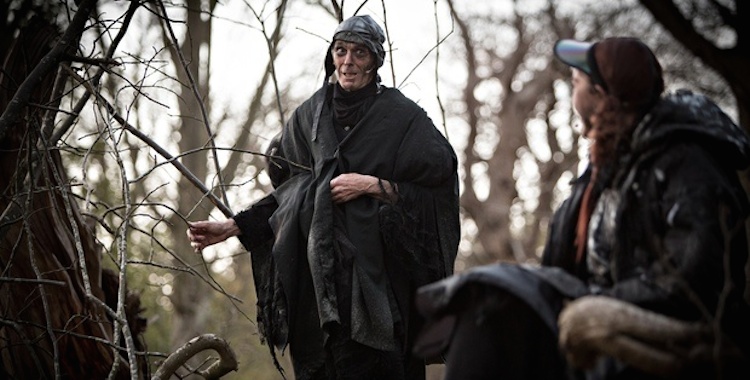
It’s hard to imagine a more atmospheric setting for WildWorks’s latest outdoor show. Stepping inside the grounds of Felbrigg Hall, sun hovering just above the horizon, the woods whisper with promises of magic and transformation. As we depart into the dusk, there’s a warning: we must, like Little Red Riding Hood, stick to the middle of the path. There are wolves here.

Before long, though, WildWorks lead us off the well-worn track. Inspired by the Greek myth of nymph turned bear Callisto and by the extraordinary experiences of Shaun Ellis, who spent two and a half years living with a wolf pack, Wolf’s Child takes its audience deeper and deeper into the wild. Beginning at the hall, the orderly preserve of wolf-hating Mother and her collection of orphan girls, the show follows young ward Rowan as she ventures beyond the neatly manicured garden and into the territory of the beasts. As tends to happen in the woods, she is soon transformed.

We’re led through the twilight by performers in dark, tattered crow costumes, forming the squawking chorus of the show’s large cast. Narrated by our guides, the fable is told in a fairytale fashion, with simple statements and occasionally clunky rhymes. But Wolf’s Child is an exercise in enchantment more than it is in storytelling. Lit evocatively and unobtrusively, nature’s stage – from a platform of tangled branches to an imposing cathedral of trees – is the real star of Bill Mitchell’s production. The performers’ wordless movement offers the most powerful transition from wild to tame and back again, while Victoria Abbott’s soundtrack reverberates hauntingly through the forest. Flames flicker in the distance and lupine howls shred the air.

It’s only in the stomping and shuffling from scene to scene that the spell threatens to be broken. The crows are a smart touch, tending the tale at the same time as marshalling the audience, but there are only so many ways to chivvy people through the trees. In the tussle between civilisation and wilderness, Wolf’s Child can’t quite throw off its human shackles.

Photo: Steve Tanner.

Ponyboy Curtis at The Yard

514x3823

Originally written for Exeunt.

I can’t get the music loud enough.

Huddled on the train, freshly hurled out of Ponyboy Curtis at The Yard and into the cold, jagged, rain-flecked world, I want the music coursing through my headphones to fill me up, to vibrate through my pores. Nothing is loud enough, bright enough, vivid enough, tender enough.

The post-Ponyboy world feels like a grey but – slightly, almost imperceptibly – changed place.

So what is Ponyboy Curtis?

It’s a party.
It’s an intervention.
It’s an ensemble.
It’s a call to revolution.
It’s a fleeting alternative space, precariously carved out of the worlds of late capitalism.
It’s an invitation to intimacy.

It’s sexy.
It’s dangerous.
It’s tender.

It’s a shot to the heart.
It’s a kick to the gut.
It’s a blast to the eardrums.

It’s not quite like anything else.

“The naked actor is often the most powerful person in the room, partly because they’ve got nothing left to hide.” – Chris Goode

Let’s start with the nudity. Because there’s a lot of nudity. In its repeated acts of dressing and undressing, edges of the stage littered with clothes, this piece – show? experience? space? – feels like a thinking through of nakedness on stage. What does it do? How can that unclothedness be both extraordinary and natural at once? What dynamic does it create with an audience – dressed, distant, looking on?

On the clothed side of that divide, it’s not so much the erotic charge of all those naked bodies that I notice. It’s the astonishing expanse of bared skin: the gentle curve of a collarbone, the pulsing movement of a calf muscle. The brush of a finger against a palm, or the sweep of a hand along the small of a back. Small intimacies, not necessarily sexual, but aching with care.

There’s an ease to this near-perpetual nakedness, but also a provocation. Look at me, the performers dare, occasionally meeting our gaze with a challenge in their eyes. At moments, they appear vulnerable; at others, they are diamond-hard, invincible. Stripped to their skin, the shedding of clothes clads them in a different kind of power.

Looking on, it suddenly occurs to me that nearly all of the most heart-stealing, chest-tightening moments I’ve experienced in the theatre in recent months have circled around nudity – around bodies, tender and exposed. Peter McMaster and Nick Anderson struggling and embracing in 27. Jonah Russell and Oliver Coopersmith tentatively reaching out to one another and then drawing apart in The Mikvah Project. These beautiful, ravishingly brave boys at The Yard falling and jumping and kissing and dancing.

The texture of Ponyboy Curtis is one of nakedness and intimacy and radical energy, but also one of boybands and dance music and buddy movies. Like The Ramones, each of the performers has taken on the temporary surname ‘Ponyboy’, but huddled around a microphone, caps slanted at angles on their heads, they’re more like Take That. The polish of the manufactured pop band, but without the perfect, plastic, stage-managed sheen of One Direction.

Boyband. Gang of mates. Lovers. Men embracing to pumping music. Men strutting, naked and clothed and partly clothed. All these different masculinities. It’s hard not to think of all the characters in Men in the Cities – those broken, contorted boys and men. There’s hurt here too, in the bodies that crumple to the ground and the voices that howl, but in so many ways Ponyboy Curtis is a celebration of all the masculinities that the glass and concrete prisons of Men in the Cities disallow. Masculinities that are gentle, fragile, questioning, joyful. Masculinities founded on care rather than aggression.

Very little is said. This is a theatre of bodies and noise and feeling, not a theatre of words. Quotes, read aloud from pieces of paper tacked to the wall, occasionally slice through the pounding soundtrack but quickly become swallowed up by everything else around them, their traces dissolving. The only words that really stay with me are those of the evening’s guest, Hannah Nicklin, whose letter to her big little brother makes me think of my own three big little brothers and all the harm I worry about patriarchy inflicting on them, all the attitudes they easily absorb and reproduce. Her words make me think again about the world outside this flickering, captivating space and the sort of masculinity that is permissible there.

Then I’m out in that world again, the bright lights of Ponyboy Curtis glittering on my retinas and its music humming faintly in my ears. I don’t yet have words – let alone sentences – to describe or respond to it. Even now, I’m only fumbling towards something like that space and what it made me feel. This is a thinking through of how to write about Ponyboy Curtis, just as the performance I saw – sat alongside? inside? – last Thursday night felt like a thinking through of what this collection of people and ideas might or could be.

Thinking through. Feeling at the edges. Pushing at the walls. Starting something.

Common Ground

common_ground1_3985-600x337

Originally written for Exeunt.

Berlin is a city of remembering. Its streets are scarred, marked, tiled with notes from the past. Bullet holes and metal plaques; imposing monuments and gaping voids.

As the eponymous common ground of Yael Ronen’s show, then, Berlin as a place offers countless echoes. In this city inscribed with conflict, Ronen has found and gathered various survivors of another set of conflicts: the break-up of Yugoslavia in the 1990s. All of her performers – save Israeli Orit Nahmias and German Niels Bormann, mirroring the nationalities and backgrounds of Ronen and her dramaturg Irina Szodruch – came to Berlin from various shards of this splintering nation. From Belgrade, Sarajevo, Novi Sad and Prijedor, they have met in Berlin rehearsal rooms to confront their collective pasts, navigating between the oscillating poles of victim and aggressor.

From the shrapnel of guilt, blame and conflicting narratives emerges one repeated truth: it’s complicated. As one performer demonstrates with an attempt to explain his tangled family history, this is a region of Europe that is criss-crossed with different allegiances and antagonisms. Rather than resolving that complication, though, Common Ground slams it centre stage. In its hands it holds two opposing impulses: we want to understand; we can’t understand.

Drawing on a mixture of research and autobiography, Common Ground begins in 1991, racing from there through the chaotic and devastating collapse of Yugoslavia in subsequent years. After a playfully self-aware introduction from Nahmias and Bormann – the two onlookers – the show immediately hits warp speed. Attack follows natural disaster follows hit pop song. The company have created an unruly, overlapping collage of the 1990s, setting civil war in the Balkans against a backdrop of global shifts. In one part of the world people are being slaughtered; in another, Bryan Adams reigns the charts. Atrocity knocks up against banality.

If it’s fevered and anarchic, that’s the point. Scrambling to keep up, we’re left breathless and disorientated, this speeded up chronology feeling more like an assault than a history lesson. Like the conflicts themselves, it’s difficult to piece together. Surrounded by the debris of Magda Willi’s design – all boxes and clutter – the performers then begin the slow and arduous process of rebuilding. Portions of the set are stacked and slotted together, tried in new combinations, as the show itself mirrors the process of these individuals coming together and sharing their experiences.

Common Ground is, explicitly and unapologetically, the combined narrative of its company. Everything here has been generated and shaped by the performers, who press hard on personal bruises. Through this approach, the show deftly dodges many of the pitfalls of the documentary play. Instead of claiming veracity, it presents complexity and the elusiveness of understanding, apportioning and then complicating blame. These are, of course, political stories, but they are personal stories first; there’s never any attempt at a complete history or a diagnosis of where it all fell apart.

Politically, it feels vital to reflect on how we process and package the past. Walking around Berlin for six days, I’m struck by the difference in how cultural memory is constructed here. There’s a rawness to these wounds, whose healing is an ongoing process. In the UK, meanwhile, we have an insidious, poppy-garlanded triumphalism, slyly manoeuvred for political gain. We have “Blitz spirit”, tarted up into austerity and stamped with a “Keep Calm and Carry On” logo. War is, perversely, almost something to be nostalgic about.

If Berlin’s wounds are raw, then those exposed by Common Ground are still dripping with blood. When the company visits Bosnia, the people they meet struggle to talk about what happened two decades ago. As one Sarajevo resident puts it, the war never really ended: it continued within people, poisonously unresolved. Another woman is trapped in a cycle of remembering, retelling and retelling her trauma until the words dry up. These narratives – dropped by the rest of the world as a new conflict pierced the horizon – have never achieved closure, but still they keep being repeated.

So it’s surprising to find humour and optimism here as well as pain and anguish. There’s a respectful lightness of touch to Ronen and Szodruch’s production, which manages to salvage both the hopeful and the ridiculous. It comes down, ultimately, to the relationships among the company, in which the show locates a tentative note of positivity. Difficulty never disappears, but tenderness challenges it, as the common ground of the title gradually multiplies. In that shared territory, that shifting ground beneath the feet of these seven people, there might just be a fragile foundation for hope.