Islands, Bush Theatre

©-Helen-Murray_9937-2000x1333-600x399

Originally written for Exeunt.

Two weeks, two shows about the grimy underside of capitalism, two bullfight metaphors. Bull, Mike Bartlett’s cutthroat dance of competition between employees facing the chop, embodies the bloody sport in its very form, depicting two corporate matadors at their most deadly. In Islands, the tax haven satire devised by Caroline Horton and her company, there’s an extended riff on the same theme. “Mankind’s extraordinary,” Horton concludes her gory description of the ritual, “don’t you think?”

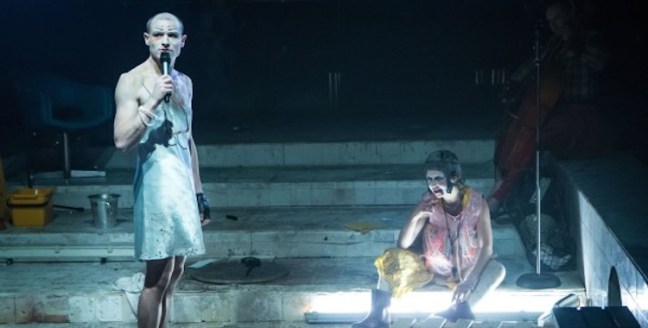
But where Bull is all brutality, Islands is all display. Horton and co’s mucky allegory speaks a visual language of grotesque, glittering excess – an apt enough, if not particularly subtle, vision of the tax-dodging economic elite, who have pumped an estimated $18.5 trillion into tax havens. Despite all the research that has gone into the piece, Islands’ approach is not a documentary one. Instead, it mashes up cabaret, satire and bouffon, casting Horton as a grinningly repulsive god lording over Haven, an island that has broken free of the blighted ‘Shitworld’ below. Along for the ride are gurning sidekicks Agent and Swill and aspirational proles Adam and Eve (geddit?), all intent on protecting their hoard from the outreached hand of the taxman.

If the synopsis sounds baffling, it’s no less perplexing in performance. There’s certainly an argument that money has achieved the status of a deity in the 21st century, with capitalism as the new global religion, but aside from that not-so-shocking insight, Horton’s Biblical references gain little purchase (pun intended). As the all-powerful Mary, Horton herself more resembles the fickle, guzzling gods of ancient Greek mythology, feasting on cherries and indulging in the endless pursuit of pleasure. The ‘fall’ that Adam and Eve experience from this superficial land of bliss, meanwhile, is a decidedly topsy-turvy one.

The metaphors Islands seizes on to make its points are just as confused as its central conceit. Some, like the cherries that Mary hoards, are powerful on their own. They of course stand in for money – everyone wants a piece of the cherry pie – but they also suggest forbidden fruit, loss of innocence (“popping your cherry”), and their punctured flesh drips like blood. Elsewhere, though, imagination comes at the expense of any coherence. It’s all as clear as the muck that surges up from below, mixing religion, gameshow, cabaret, bullfight and, of course, relentless waves of scatalogical humour. After a while, shit jokes are just shit.

As sheer aesthetic, Islands can be briefly, grubbily captivating. Oliver Townsend’s design is gorgeous in a squalid, gaudy kind of way, his sunken swimming pool set suggesting the filth and emptiness sitting just beneath the fantasy of escape, while the talented cast revel in the grotesquerie. But it all seems to obscure rather than illuminate. Reality – in the voices of Thatcher and her present day spawn – intrudes only in splintered fragments, so small as to just enhance the bewilderment of those not already clued up on the subject matter.

There’s more promise in the closing scenes, when it becomes sickeningly clear that even the fallout of economic crisis will leave Mary and her cronies unsullied by the shitstorm down below. Realising they’ve got away with it, Haven’s inhabitants tentatively call for something to “mark the occasion”. What starts out as modest self-congratulation quickly escalates into unbridled gluttony and hedonism – champagne, hookers, “a really small private jet”. There’s no one to stop them.

The trouble is, even in moments like this, the irony and glitter are spread so thick that the critique struggles to peek through. The anger that is the only conceivable response to the situation absurdly depicted by Horton and her cast is finally allowed to break the surface but is itself undermined, leaving few directions available. There’s half an eye throughout on the audience – the people – but our complicity is only cursorily courted. In the end rage, instead of boiling, cools to a sort of helplessness.

Photo: Helen Murray.

Upper Cut, Southwark Playhouse

Upper Cut - Juliet Gilkes Romero - Southwark Playhouse - 14th January 2015Director - Lotte Wakehamcast includes Emma Dennis-Edwards, Akemnji Ndifornyen, and Andrew Scarborough

Originally written for Exeunt.

How do you make politics – or any sphere, for that matter – representative of the population? Do you focus on creating opportunities for minorities? Do you hope that the success of the few will simply inspire the many? Or do you positively discriminate, bringing in quotas and limiting application processes?

There’s also another, specifically theatrical question about representation. In staging just such a debate as the one started above, within the specific context of black representation in British politics, Juliet Gilkes Romero runs into a problem. Factual accuracy and clarity of argument, so important in any other attempt to tell a neglected history, often come at the expense of dramatic dynamism. All exposition and no action rarely makes for compelling theatre.

The difficulty is, there’s a hell of a lot of background to cover before Upper Cut can even begin to land its blows. Gilkes Romero’s play is about the struggle for black MPs in the Labour movement, a battle that threatened to split the already embattled party in the 1980s, and which for that very reason was sidelined in the attempt to get elected under leader Neil Kinnock. Subsequently, the account of that struggle and the Black Sections movement that initiated it has itself been marginalised in the telling of recent British political history. Gilkes Romero’s play is an attempt to remedy that.

Upper Cut goes about addressing this history in reverse, beginning on the eve of Barack Obama’s re-election in 2012 – a handy springboard for discussing how far (or not) we’ve come in terms of representation – and gradually rewinding back to 1986. The arguments in question are dramatised through black activists Michael (Akemnji Ndifornyen) and Karen (Emma Dennis-Edwards); the former, when we first meet him, has gone on to become a career politician and deputy Labour leader thanks to his willingness to compromise, while the latter’s staunch dedication to racial equality has seen her pushed out by the party. Acting as both supporter and antagonist is Labour strategist Barry (Andrew Scarborough), who is more interested in the health of the party than he is in its racial make-up.

Gilkes Romero’s play never makes the mistake of being as simple as black and white, but neither do its varying shades of grey wholly convince. After becoming involved with Black Sections at the same time, Michael and Karen each experience a change of heart – if in different directions – but we are never given enough emotional insight to fully appreciate the weight of these tough political decisions. The suspicion is that these reversals serve the debate rather than the characters, whose motivations are murky at best. Gilkes Romero’s main concession to drama, meanwhile, is a sharp-edged love triangle between its three characters, which does little to animate either the human or the political.

Directing this dramatised editorial, Lotte Wakeham does little to raise the emotional stakes. In a nod to the play’s boxing metaphor, Rachel Stone’s minimal, cardboard box dominated set puts the actors on a raised stage for the duration, but little else about the production gets close to capturing the visceral cut and thrust of the boxing ring or the political arena. The rawness of betrayal and the sting of compromise are never fully felt; there’s plenty of fight, but Upper Cut fails to quite make contact.

Photo: Bob Workman.

The Chronicles of Kalki, Gate Theatre

The-Chronicles-of-Kalki-at-the-Gate-Theatre.-Photo-credit-Helen-Murray-11-600x400

Originally written for Exeunt.

If God did not exist, according to the well-worn Voltaire quote, it would be necessary to invent him. Deities – real or imagined – are at the heart of Aditi Brennan Kapil’s play, which takes Voltaire’s statement as a starting point of sorts. In today’s world, what need have we for divine beings?

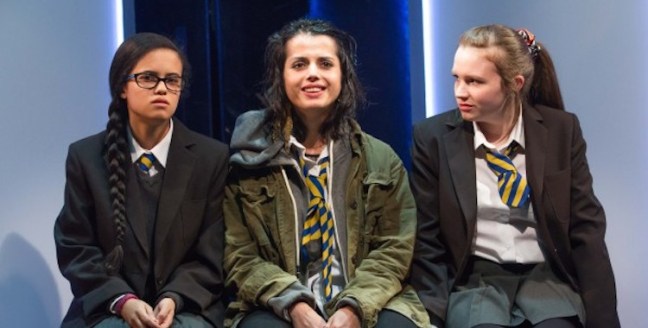
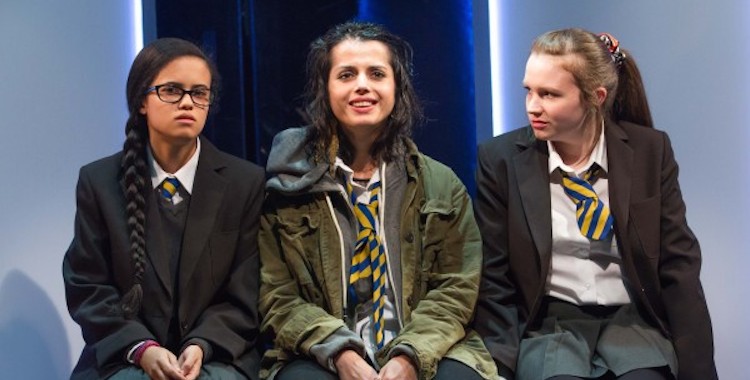
Told in flashback, Kapil’s plot also borrows from the good old dramatic tradition of the newly arrived outsider. Kalki turns up, swift and unexpected as the rainstorm that accompanies her, right in the middle of a religious studies class. Just as rapidly, she befriends two bickering schoolgirls – known only as “Meat” and “Betty”, the nicknames Kalki christens them with – and throws their lives into temporary, gleeful chaos. Then, like the rain, she evaporates. The only difference with this new girl is that she might just be the 10th incarnation of the Hindu god Vishnu.

All this is revealed in snatches, as Kalki’s best friends are questioned by a cop apparently on the hunt for the mysterious girl-cum-god. It’s a play – and a production from Alex Brown – that peels itself back bit by bit. Not given to brevity, Angela Terence and Jordan Loughran’s evasive classmates slowly flesh out their fleeting acquaintance with Kalki, from house parties to cinema trips to schoolyard spats. The drab, bureaucratic surroundings of Madeleine Girling’s set are repeatedly and startlingly split open, as coloured lights usher in Kalki’s dazzling presence.

The teasingly unravelled narrative drops frequent – and not too subtle – hints about the identity of its elusive protagonist. But Kapil’s vision of this final avatar of Vishnu, foretold to destroy all evil at the end of time, seems just as indebted to the comics read eagerly by Kalki’s companions as it is to Hindu scripture. Instead of arriving on a white horse, this harbinger of the apocalypse is an arse-kicking bad girl in ripped jeans and heavy eyeliner – the daydream alter ego, in other words, of every bored and bullied teenage girl.

Ultimately, Kapil’s play feels less about religion and more about the visceral, life-and-death experience of being a teenager, when every day might herald the end of the world. The supposedly life-shattering cosmic force that is Kalki is less vivid than the brutality and asphalt of the school playground. For “Meat” and “Betty”, both cruelly spurned by the cool kids, school is nothing less than a battlefield. Who wouldn’t want a god on their side in that relentless war?

Terence and Loughran make brilliantly believable teenagers, each an endearing mess of bravado, hormones and vulnerability. The problem is that alongside their all-too-earthly confusion, Amrita Acharia’s Kalki comes across as a flat if shimmering mirage of a girl. Not quite human, not quite divine, neither Brown’s production nor Acharia’s performance seems fully convinced by this immortal trickster. Just what are we supposed to make of Kapil’s creation?

The answer never quite arrives. Just as Voltaire’s words hang in the air, so too does the unexplained significance of Kalki’s sudden appearance. Kapil’s play has a certain appealing strangeness – how often do you see teenage angst bumped up against visiting gods? – but its extended riff on fantasy, religion and adolescence fades as quickly and enigmatically as its protagonist.

Photo: Helen Murray.

The Talented Mr Ripley, New Diorama Theatre

Talented-Mr-Ripley

Originally written for Exeunt.

All the best monsters are consummate performers. Think Shakespeare’s Richard III, stylishly murdering his way to the throne, or the deadly flair of Goldberg inThe Birthday Party. Tom Ripley, the brilliant sociopath created by Patricia Highsmith 60 years ago, is no different. He lives or dies on his ability to impersonate, relying on his quick-thinking skill as a performer to quite literally get away with murder.

The Talented Mr Ripley, then, makes for compelling stage material. Tom is essentially a showman, if an awkwardly intense one. We first meet him in a New York bar, head twisting over his shoulder, convinced he’s being watched. It turns out he is, but not by who he expected. Instead, a wealthy businessman offers to pay Tom to bring his son Dickie home from Italy, where he’s run away on an extended European jaunt. Snatching at the opportunity, Tom soon finds himself in idyllic Mongibello, where jealous obsession with charming, carefree Dickie (an effortlessly suave Adam Howden) turns an increasingly murderous shade of green.

The Faction and director Mark Leipacher have wisely fastened on the narrative’s more performative qualities in their new adaptation. Tom, played with fidgeting intensity by Christopher Hughes, is forever trying on new roles, testing a new sweep of the hair or trick of the tongue. We are first of allhis audience, the crowd of attentive eyeballs that he fears and desires in equal measure. The more immersed Tom becomes in his performance, adopting Dickie’s identity bit by bit, the more he revels in the display. As an actor thirsts for the adrenaline rush of the stage, Tom is hooked on pretending.

This emphasis also lends a distanced, theatrical gloss to the protagonist’s cool and unrepentant acts of violence. To him, as to us, the murders he carries out are little more than dramatic punctuation marks. In one intriguing but slightly clumsy device, Leipacher repeatedly positions Tom as the star of his own (presumably imagined) movie, cutting and reshooting crucial sequences in his trajectory. While jarring, it hints economically at Tom’s emotional dislocation from reality; a brutal murder might as well be a thrilling plot twist.

The language of economy is one that characterises The Faction’s storytelling. Their streamlined version of Highsmith’s novel is loathe to waste so much as a second, rattling over the plot’s terrain at sometimes breakneck speed. The upside is that we move at the same pace as Tom’s nervously frenetic mind, seeing the world through his rapidly blinking eyes. Such furious velocity, however, also makes it easy to miss things. Peripheral characters zoom past and the kaleidoscope of European cities in the second half becomes a dizzy haze.

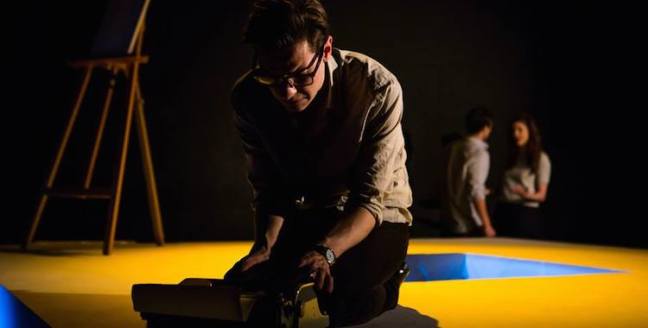
But for those familiar with the often adapted tale, The Faction offer an engaging enough take on this durable material. As ever, the ensemble manage to do a lot with a little, transforming the stylish, stripped back design – just a raised white rectangle, supplemented by Christopher Withers’ evocative shafts of light – into countless different settings. It’s when the focus is on storytelling rather than speed, though, that The Talented Mr Ripley is most absorbing.

Photo: Richard Davenport.

The Diary of a Nobody, King’s Head Theatre

IMG-4507

Hilarity is often found in the banal. How else do you explain the enduring popularity of observational comedy? We enjoy seeing unremarkable aspects of everyday life served up in surprising ways, happily feasting on our own foibles. Be it down to familiarity, reassurance or a fleeting sense of community through habit, the commonplace is a tried and tested route to the funny bone.

There’s a delicate balance, though. Make too mundane an observation and the joke falls flat. Push it too far, on the other hand, and it feels strained. Rough Haired Pointer’s adaptation of The Diary of a Nobody – its attention to the ordinary signalled right there in its title – is in danger of succumbing to the latter.

I admit I’ve not read George and Weddon Grossmith’s original comic serial, but fans seem to locate its humour in the small details of protagonist Charles Pooter’s very human flaws and misfortunes. In director Mary Franklin’s adaptation, these are all crammed into less than two hours, covering several months of the diarist’s humdrum life. Blind to his own pomposity, City clerk Pooter records each last trial and tribulation in his plodding journal, from his son’s irresponsibility to invariably disastrous social engagements. What should tickle is the routine and the minute.

In search of belly laughs over quiet chuckles, Rough Haired Pointer instead choose to inflate the small absurdities of Pooter’s day to day existence. Gently ironic humour takes a back seat to frenetic, non-stop slapstick and meta-theatrical japes. It’s not enough to giggle at Pooter’s self-important delight in another of his terrible puns; a laugh is seemingly not a laugh unless it’s amplified by someone simultaneously falling over a chair and addressing a member of the audience. It all smacks of trying just a bit too hard.

It’s a shame, as there are touches of real ingenuity buried somewhere beneath the relentless gags. Karina Nakaninsky’s design, adapted by Christopher Hone for this revival, is a (mostly) monochrome delight, nodding admiringly to Weedon Grossmith’s original illustrations. And when the action slows down for a moment, it finds time for genuine wit, most inventively in Franklin’s solution to several pages being ripped from Pooter’s diary. The ensemble play a tune while the lost months roll past on placards behind them, varying shades of leaves tumbling down gently on their heads.

Much of the time, though, this adaptation is so busy trying to be clever that it steamrollers its own intelligence. Quips race past before they have time to register; one laugh is still landing when the next follows fast behind, all progressively diminishing in both volume and enthusiasm as they pile up. The all-male cast of four do their best to maintain the pace, but it can’t help but be a bit breathless. This is theatre as treadmill: constantly running, never really getting anywhere.

Photo: Rocco Redondo.