Arrest That Poet/Pete the Temp vs Climate Change

pete-1-600x3371

Originally written for Exeunt.

Theatre about climate change is fast becoming a genre all of its own. Just this month I’ve seen three separate shows on the subject: 2071 at the Royal Court and now a double bill of climate-activism-spoken-word (how’s that for a niche sub-genre?) at the Free Word Centre. Their approaches, however, couldn’t be further apart.

2071, a collaboration between director Katie Mitchell, climate scientist Chris Rapley and writer Duncan Macmillan, opted for lecture-as-theatre. Mitchell seated Rapley to one side of the stage, against a backdrop of scientifically vague and increasingly soporific projections, and got him to talk about the facts behind climate change. And that was it.

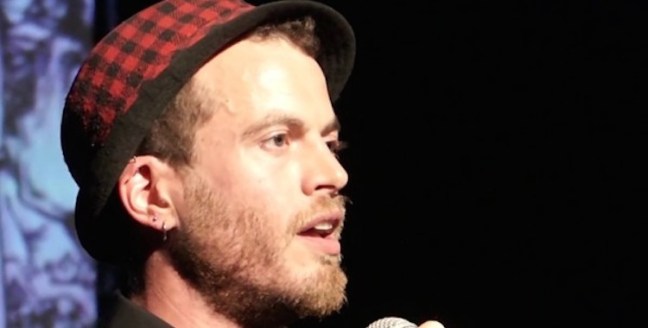
In comparison with the static, dramatically inert set-up of2071, performance poets Danny Chivers and Pete the Temp inject the topic with an invigorating shot of dynamism. Both are responding to climate change from a position of intense involvement – not as scientists, but as activists. Chivers’ show Arrest That Poetcharts his various run-ins with the police, recalling how he became an unlikely criminal in the pursuit of climate justice, while Pete the Temp pits himself (and his mouth) against the huge changes that threaten our planet.

Unlike 2071, which tackled an emotive subject from a position of cool, dispassionate distance, these two shows are soaked in feeling. While this could be problematic, short-cutting the facts with an appeal to emotion, it is instantly more engaging. These two men clearly care about what they’re discussing – and they have the criminal records to prove it. There is no pretence at objectivity (which is, in any case, always impossible) because they are deeply, subjectively invested in this cause. They have chained themselves to railings and staged stunts at energy conferences.

Given the context, however, perhaps this isn’t such an issue. It doesn’t feel particularly controversial to suggest that people who book tickets to see shows about climate change are probably already concerned about climate change. Unless the content is smuggled in under the guise of something else, it will attract a self-selecting audience. In which case, it may be more useful to galvanise audiences and arm them with the tools to create change rather than painstakingly relaying science whose conclusions they are, most likely, already aware of. Instead of using creativity to inform, why not harness it to act?

This is exactly what Chivers and Pete the Temp do. Similarly to Daniel Bye’s How to Occupy an Oil Rig or Mark Thomas’s Cuckooed, they transform protest and direct action from something intimidating into something joyously angry and engaged. Bookish, floppy-haired Chivers exploits the incongruity of his criminal convictions and his innocuous, middle-class, Guardian-reading persona, making us believe along the way that pretty much anyone could end up atop a power station fighting for a better planet – even if, like Chivers, your only skill is a way with words. And words themselves become weapons in this battle, using the mutability of meaning and intention (along with a cheering boost of people power) to upend the language of corporations and government.

Pete the Temp vs Climate Change is a little knottier in its handling of the same subject matter. The title itself is quickly undermined, as Pete recognises the inherent ridiculousness of one individual resisting a vast network of climatic and corporate forces. He also recognises the flaws of various different tactics, from charity campaigning to “armchair activism”, which is dismissed with particular disdain. The implication is that in reality we can only begin to change anything when we act together. If Pete the Temp is sometimes blunter and bleaker in his approach, it is tempered with the same rage-inflected humour that Chivers uses to such great effect. Activism can be both funny and fun – neither of which are words that came to mind while sitting in the stalls at the Royal Court the other week.

But the greatest contrast with 2071 – at least for me – is in the impact made. I left2071 feeling gloomy, small and pretty narked about the quantity of carbon that had been burned in order for me to sit through its sluggish hour and a bit, whereas I left the Free Word Centre’s double bill feeling angry and inspired and galvanised. When I walked out of the Royal Court, about the only thing I was ready for was a moan. But when I walked out of the Free Word Centre, it wouldn’t have taken much to convince me to occupy a power station.
How a Man Crumbled, Mimetic Festival

moustachemenweb-600x400

Originally written for Exeunt.

Clout Theatre are experts in the grotesque. In the first show of theirs that I saw, The Various Lives of Infinite Nullity, they took morbid curiosity into new territory, setting grisly murders and suicides on repeat. The company’s earlier show How a Man Crumbled, back as part of the Mimetic Festival, puts the emphasis on the absurd but with the same relish for the monstrous and distorted. Limbs are twisted into alien shapes; arms pop out from suitcases and lungs are torn from chests.

Clout Theatre’s starting point for their surreal grotesquerie on this occasion is Russian absurdist writer Daniil Kharms, who faced Soviet censorship in his lifetime and many of whose works remained unpublished until after his death. That perhaps accounts for the built in difficulties that surround Clout Theatre’s frenetic storytelling. Narrative is interrupted and confounded, the central story – Kharms’  ‘The Old Woman’ – becoming muddied or obscured. The writer loses control of his boisterous creation.

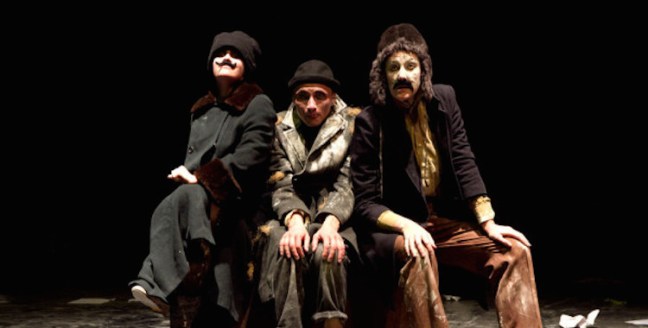
As in The Various Lives of Infinite Nullity, performers Sacha Plaige, Jennifer Swingler and George Ramsay adopt clown-like personas, though here they are more playful than sinister (but not without an edge of the latter). The bouffon-esque trio seem eager to entertain us and competitive in their attempts to alternately convey and derail the narrative at hand, whether that’s by telling swirling, nonsensical anecdotes or whacking one another over the head with vegetables. This performance style could quickly become wearing, and there are moments when it briefly grates, but Clout Theatre have enough charm and ingenuity to just about pull it off.

If these clowning interludes entertain with their wackiness, the narrative sequences themselves are strangely beautiful. The story of ‘The Old Woman’ – in which a writer finds his life disrupted by the mysterious figure of the title – is told through a DIY silent film aesthetic, fully exploiting the elastic expressivity of Clout Theatre’s performers. Ramsay in particular manages to access the full emotional range with just his impressively flexible facial muscles, while Plaige contorts herself into an extraordinary array of positions.

If theatre were solely about isolated stage images, Clout Theatre would be some of the best artists around. Startling snapshot follows startling snapshot. A creature formed of screwed-up paper stirs in the corner of a writer’s office; a recalcitrant corpse is frantically bundled into a suitcase; bodies wrestle and writhe; figures suddenly appear and disappear. Music also plays an integral role, with an inspired use of Shostakovich’s String Quartet No. 8.

But the same reservations that I had about The Various Lives of Infinite Nullityalso apply to How a Man Crumbled. Both shows are brilliant vehicles for the (clearly abundant) skills of their performers, yet I can’t fight the feeling that there’s something missing. The aesthetic is there, but the purpose and drive behind the succession of striking images is not quite apparent. Like the writer they show frustratedly scribbling on page after page, Clout Theatre seem to be grasping at something just out of reach.

Hope, Royal Court Theatre

590x494.fitandcrop

Local politics isn’t sexy. It’s the support crew that cleans up while the rockstars break out their set list of strained smiles and hollow promises on the next main stage. I still remember, as a child, my dad frustratedly filling us in on the council meetings he attended as a school governor; the high point, if I recall rightly, was a farcical dispute about bins.

Hope, therefore, is not particularly promising as a theatrical premise. A local Labour council struggles to make budget savings? Not exactly thrilling. But actually, Jack Thorne’s play feels like the perfect drama for the present political moment. In the context of the Royal Court’s revolution themed season, it might not be the most rousing call to arms, but it depicts the possibility for change on a level that actually feels within reach. It makes politics ordinary, turning its gaze on the crippling everyday impacts of austerity in a way that most national politicians seem incapable of imagining.

Thorne’s councillors are in an impossible position. With £64 million of savings to make by 2017, it’s a miserable matter of deciding on the marginally lesser of many evils. Should cuts be made to care for the elderly or the disabled? Where can savings be made on Sure Start Centres? As for the local library and museum – forget it.

Thankfully, though, Thorne’s play is not all hand-wringing budget meetings. At its centre is deputy council leader Mark, a tortured would-be idealist who is desperate to be a good man in dire circumstances. After his similarly tormented turn in Utopia, Paul Higgins seems made to inhabit characters crumbling under pressure, hair more dishevelled by the minute and body curling up further and further into his suit jacket. Compounding the difficulty of the cuts, Mark’s ex-wife Gina (Christine Entwisle) gets wind that her day centre for the disabled is going to be slashed and mounts a big, social media-savvy campaign, while his relationships with precociously intelligent son Jake (Tommy Knight) and fellow councillor and sometime lover Julie (Sharon Duncan-Brewster) come under increasing strain.

Like Mark, everyone on the council wants to “do the right thing” – a phrase that becomes more and more fraught as the play goes on. Never was there more proof that the road to hell is paved with good intentions. Stella Gonet’s Hilary is cool and pragmatic, but beneath her armour she’s utterly committed to the town she serves, as is well-meaning, unassuming Lata (Nisha Nayar). At the more idealistic end of the scale are Julie – who also has to juggle the expectations of her council veteran father George (Tom Georgeson) – and recklessly principled Sarwan (Rudi Dharmalingam).

It’s the latter who acts as the catalyst for change, urging his fellow councillors to take a stand. Sometimes, though, principles come at a high price. The fate of the council serves to animate the precarious balance between what is right and what is pragmatic, highlighting the complexity of the decisions currently faced by local government. The choice seems to be a bleak one: either make devastating cuts yourself, or have others make even worse ones for you.

Thorne also turns his attention to the wider predicament of the modern Labour party and the erosion of solidarity by Thatcherite principles of individualism. In a slightly clunky but politically perceptive speech, former council leader George mourns the death of the party he has dedicated his life to and the political fervour that seems to be in retreat: “Idealism is dead. Solidarity is dead. It’s been destroyed by pragmatism and hatred and shame.” At the same time, though, there’s something freeing about this dissolution of past touchstones; “we don’t represent anything any more,” George observes, so perhaps now is the time to make bold decisions for the better.

Theatrically, Hope is not about to set pulses racing, but its plain, sober style feels just right. John Tiffany’s unshowy production contains all the scenes within Tom Scutt’s meticulously realised town hall design, its drab detail a constant reminder of the realities these characters are working within. No giant ball ponds here; this form of political rebellion is not fun (as Russell Brand famously promises) but hard and boring, as real change often tends to be. Revolution is just as likely to be a long slog as a sudden spark of action.

There is, at times, a slight tendency to use characters as mouthpieces for debate. George in particular feels a bit like the weary, battle-hardened voice of old Labour, while Mark and Hilary’s conversation about the advantages or otherwise of principles acts as something of a gloss on the council’s choice of course and its consequences. But however contrived, Hope‘s conclusion somehow, quietly yet insistently – and against all odds – engenders the sentiment of its title. Change probably will be slow and frustrating and involve a hundred painful compromises along the way, and it will probably have a lot more to do with bins and libraries and day centres than the Russell Brands of this world would have us believe, but there’s still the possibility that, if we just try, we might begin to make the world a better place.

Am I Dead Yet?, Bush Theatre

block-600x400

Originally written for Exeunt.

There’s a strange paradox at the heart of our treatment of death. On the one hand, we’re surrounded by it. 24 hours news channels spew out the numbers, names and circumstances of the dead; an endless stream of murders, casualties, epidemics. But on the other hand, death as a reality unmediated by a screen is shrouded in silence and ritual. Death is everywhere and nowhere.

This is the backdrop to Am I Dead Yet? Making a show “about” death opens up a vast range of possibilities; as someone commented to me after the show, it’s like making a show “about” life. Wisely, then – and a tad ironically, given their name – Unlimited Theatre have established limits to their scope. Their starting point is twofold. Firstly, they acknowledge that particular tight-lipped uneasiness that surrounds death and its invisibility while in plain view. Secondly, they fasten onto the idea that, thanks to advances in medical science, death might now be better thought of as a process – and, increasingly, a reversible process – than as a single moment in time. If our idea of death is changing, they reason, then we’d better start talking about it.

Double act Chris Thorpe and Jon Spooner have multiple strategies for starting that conversation. Part Grim Reaper, part storyteller, part clown, each performer approaches the subject of death with both humour and seriousness. The structure, for the most part, is governed by a pair of interlaced stories and a series of musical interludes. Electric guitar snarls defiance towards death; voices gently, lyrically tell of two coppers finding a severed head, or of a little girl slipping unobserved through a sheet of ice. In between, Thorpe and Spooner offer facts about the process of the body shutting itself down and a guest paramedic performs the best CPR demonstration you’re likely to witness.

The science that Unlimited draw on, while sometimes sounding far-fetched, is – either brilliantly or terrifyingly, depending on your perspective – steeped in research. It is now technically possible to raise people, Lazarus-like, from the dead. But rather than looking too closely at the science itself, Unlimited are more interested in what this might mean for us as human beings – not medically, but psychologically, socially, politically. Most compellingly, they raise the all too plausible possibility of a society stratified according to access to life-extending technology. What happens when death is no longer a reality for one portion of humanity?

Rather than penetrating much deeper into any of the ideas they raise, however, Unlimited leave the extra mental legwork to us. Small details open up spaces for thought: the involuntary laugh of a policeman clutching a human head prompts reflections on our often unpredictable emotional responses to death, while the possibility of snatching people back from the dead provokes an unspoken question about what happens to that part of ourselves that makes us who we are. It’s refreshing – if a little scary – to have the room for this kind of thinking created in public.

Still, some of the individual threads could be pulled a little further; as it currently exists, certain elements of the show feel as though they stop just short of the idea they are reaching towards. Or perhaps that’s the point. There is, however, something appealing and surprisingly optimistic about creating a communal space in which we might be able to begin confronting and talking about death. And if we can get better at dying, maybe we can get better at living too.

Longwave, Shoreditch Town Hall

3673-600x400

Originally written for Exeunt.

For the last week, in just about every snatched moment I can grasp hold of, I’ve had my head buried in the first book of Karl Ove Knausgaard’s Min Kamp series. It’s utterly gripping, with the intensity that I forget novels can possess until I tumble headlong into another one. And yet it’s so ordinary. Described as an “autobiographical novel”, it charts little more than the day to day fluctuations of its author’s life, from youth through adolescence to adulthood, all in meticulous, banal detail. Whole pages are devoted to cleaning or eating; one long section laboriously outlines a clumsy teenage attempt to smuggle beer into a party.

In a very different way, Chris Goode and Company’s Longwave achieves a similar sort of compelling simplicity. As with the Knausgaard, it’s hard to pin down just what captures the attention and refuses to let it go. The show, first made in 2006 and now reincarnated for a new tour, consists of two men, one radio and no dialogue. There are plenty of words, but none of them are shared between the pair of living, breathing characters. Instead, they belong to the inanimate (or perhaps not as inanimate as the men might hope) third protagonist, humming away menacingly in the corner of the room.

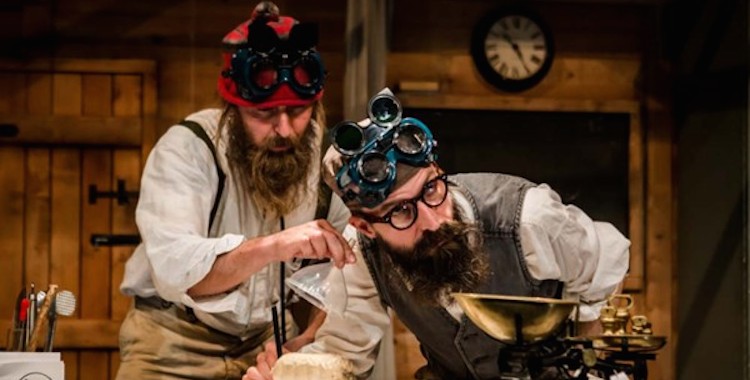
For reasons never made clear, the two men are away from home, holed up together in a shed in what appears to be a cruelly inhospitable landscape. We first see them in bright yellow protective gear, retrieving and proceeding to conduct experiments on an unresponsive, haggis-shaped object. We are instantly in the realm of physical comedy, with performers Jamie Wood and Tom Lyall making a sublimely silly double act. They poke, they prod, they throw. The subject of their experiment is rolled, jabbed, sent into the air with a mini parachute – Lyall even tentatively licks it. The lab isn’t all that different from the playground.

But Longwave is about much more than straightforward tomfoolery. As the piece goes on, we witness the regular rhythm of the men’s shared life, from the lucky dip of each evening’s tinned dinner – Lyall invariably ends up with the raw deal – to the little rituals they indulge in either side of the curtain that provides their only privacy. Lyall sketches delicate outlines of birds; Wood clumsily unfolds a massive map of the world. Both long for elsewhere.

And it’s that silent sense of longing, along with the wacky but utterly charming companionship they find in one another, that really makes the piece sing – or crackle, as the mood of the wireless dictates. As the radio takes on a life of its own and this little isolated world the pair have made for themselves begins to collapse in on itself, forcing them to either step into the unknown or stay behind, Goode and his collaborators reveal themselves to be expert manipulators of the stage’s affective technologies. We know little about these men beyond the small routines of their daily life, yet our hearts begin to crack open for them.

The whole thing is gorgeously offbeat, from the shed’s ragtag array of objects to the strange and ambiguous scenario in which the two central characters find themselves, but actually it’s the ordinariness that turns our emotional machinery. It’s the human bond, it’s the moments of hidden yearning and loss, it’s the way in which a shared routine establishes itself even in the oddest of circumstances. And it’s how even the most hackneyed and familiar of cheesy love songs can suddenly kick us full in the guts.