Wolf Hall / Bring Up the Bodies, Aldwych Theatre

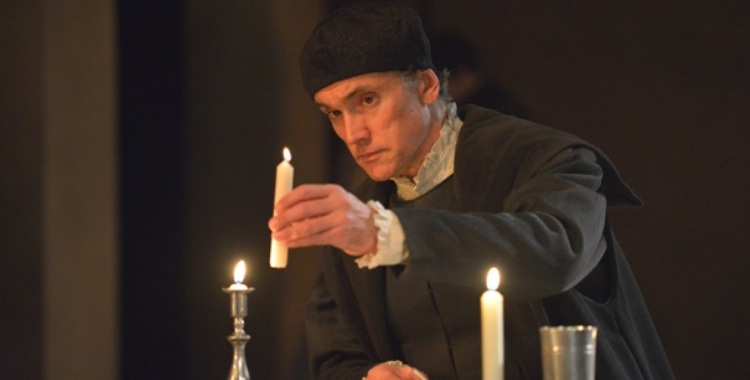
WOLF HALL. Ben Miles (Thomas Cromwell).  Photographer Keith Pattison.

Originally written for Exeunt.

Hilary Mantel begins her literary study of Thomas Cromwell with her protagonist on the ground, his face in the mud. The Royal Shakespeare Company open their version with a dance. On stage, Wolf Hall and Bring Up the Bodies are all delicate political manoeuvring; sly sidesteps covered with graceful flourishes, punctuated by frequent changes of partner. Condensed into six hours of scheming and seducing, what emerges most powerfully from Mantel’s historical narratives is the relentless tension of a world in which putting a foot out of place can mean the end. Murderous games clothed in courtly manners.

What is lost with the jettisoning of Mantel’s potent opening scene is a tangible grasp of Cromwell’s cruel, murky past, and with it the spur for his tireless social climbing. Inevitably, the transfer to the stage has sacrificed an element of the novels’ subjectivity, instead allowing us both inside and outside the protagonist’s mind at once. As he survives the downfall of his patron Cardinal Wolsey to rise steadily to Henry VIII’s side, eventually becoming the King’s most powerful advisor, Cromwell’s position is ever ambiguous. Is he the ultimate working class boy done good, using his influence to do what he can to ensure England’s stability, or just a ruthlessly ambitious bully?

The intricate deals and intrigues of Mantel’s novels, unfolding over some 1,000 pages, are played out with astonishing speed and dexterity by adaptor Mike Poulton and director Jeremy Herrin. The backdrop of Cromwell’s rise inWolf Hall – and arguably his window of opportunity – is the King’s long mission to annul his first marriage to Katherine of Aragon and wed Anne Boleyn; Bring Up the Bodies, no less tumultuously, charts the bloody decline of Henry’s second wife. In both, we see Cromwell clinging onto power with the dirtied tips of his fingers, doing what he must to both satisfy Henry’s fickle desires and secure his own position.

The narrative economy of Poulton and Herrin’s adaptation intensifies the teetering delicacy of Cromwell’s political balance. Solutions must be manufactured in the space of a breath, remedies administered in the sweep of a cloak that divides one scene from the next. Remarkably, however, the action rarely feels rushed. The storytelling of several pages becomes the work of a moment: Cromwell’s wife poignantly slips from his grasp, her death told in a single image; elsewhere, the sight of a row of squabbling advisors stopping to cross themselves at the appearance of a statue of the Virgin Mary succinctly captures the fearful hypocrisy of the age.

While story translates smoothly – some unavoidable streamlining aside – the rich, immersive world of Mantel’s novels is not so easily adapted. For anyone who has read them, the memory of the books’ sumptuous prose colours the gaps left by the narrative juggernauts of the plays, which motor steadily forward. David Plater’s sculpting shafts of light do their best to offer some of the atmosphere that is so vivid in the novels, as does the evocative music and sound design of Stephen Warbeck and Nick Powell respectively. The minimal stone and fire of Christopher Oram’s imposing set design, meanwhile, provides a fitting crucible for the passions of Henry VIII and his courtiers, loomed over at all times by the ghostly presence of the cross.

It is not only religion that haunts in this pair of plays. Poulton and Herrin offer us supernatural visitings of all kinds, rendering the ghosts of Cromwell’s mind visible on the stage. The return of the dead in this way, their figures occupying the same space as the living, hints at the accumulating layers of history – history that, by Cromwell’s hand, can be easily swept aside or manipulated. Often, however, their arrival jars with the action, heralding awkwardness rather than ill omens. If the opening scenes of Hamlet should have taught us anything by now, it’s that ghosts on stage are perilously difficult to pull off.

Although the adaptors have done well in preserving much of Mantel’s narrative and wit, the same cannot always be said for her nuance. Several of the lesser characters are little more than ciphers here, while a complex awareness of the historical debates surrounding the Tudor era is swapped for classroom fact-dropping and occasionally laboured exposition. At times, thanks to the continuing cultural ubiquity of the Tudors, it feels as though an audience are being offered bonus points for historical knowledge and the smug advantage of hindsight. The bleated “I’m nobody, just Jane Seymour” is greeted with a collective, self-congratulatory chuckle, while Wolsey’s confident pronouncement that he has seen the last of Anne Boleyn raises one of the biggest laughs of the afternoon (surpassed only by a comment about the fresh country air in Stoke Newington).

But ultimately, whatever its other strengths and flaws, any version of Mantel’s novels was always going to rise and fall on the shoulders of its Cromwell. Fortunately, Ben Miles is an inspired choice. While we might not get the full picture of his humble origins (repeated cries of “blacksmith’s son” do not a back story make), Miles’ Cromwell is a brilliantly realised charmer, as compelling as he is shrewd. Intelligence, humour and cold calculation all glitter behind his dark eyes, which also occasionally flash with the instinctive violence bred of his days as a soldier. But just as we find our sympathies helplessly aligning with this smoothly pragmatic politician, Miles sharply pivots, unsettling any easy interpretations of Cromwell’s motives.

The rest of the cast shape-shift around him, the majority of performers confidently taking on a collection of different roles. As the King’s successive queens, Lucy Briers, Lydia Leonard and Leah Brotherhead are suitably stubborn, seductive and shy respectively, while adding touches of complexity to the archetypes that history has moulded these women into. Leonard in particular underlines Anne’s sharpness and fatal arrogance with a shade of insecurity, while Brotherhead’s initial, squeaking nervousness gradually mutates into meek but assured grace. And if Nathaniel Parker’s Henry VIII is not quite as dangerously charismatic as history has taught us to expect, his mercurial personality certainly drives those who circle cautiously around him, hoping to keep their place in the precarious dance of power.

Photo: Keith Pattison.
Thebans, London Coliseum

6208-600x397

Originally written for Exeunt.

Sophocles’ trilogy of Theban plays, charting the fall of Oedipus and his doomed offspring, carry their fair share of cultural baggage. They are now more historical documents than dramas, presenting a challenge to modern adapters seeking to inject them with new life, yet the turmoil and tragedy of Oedipus’s famous fate continues to fascinate and inspire.

Julian Anderson’s first opera seizes on this material and gives it a shake, achieving an impressively fresh rendering of this trio of tragedies. Anderson and librettist Frank McGuiness have condensed and reshuffled Sophocles’ three plays, transforming them into three swift acts and disrupting their chronology. First, under the subtitle “Past”, we see the familiar revelations of Oedipus the King, before being catapulted into the “Future” in the second act to witness Antigone’s destruction at the hands of Creon. Finally, the action rewinds to the “Present” and Oedipus’s death at Colonus, closing on an anguished note of lamentation from the daughter soon destined to come to her own bitter end.

Dramaturgically, the episode at Colonus offers a much more satisfying conclusion than that of Antigone, allowing the action to end on a shattering howl of grief. But beyond this dramatic effect, Anderson and McGuiness’s rearrangement of chronology offers an intriguing examination of fate, at times enhancing and at others unsettling the inexorability of events. Themes and emotions periodically resurface, creating the impression less of a tragic slide to destruction than of a viciously repeating cycle. Score and libretto also contain interesting internal tensions, the tussle of voice and music reflecting a struggle throughout between will and destiny.

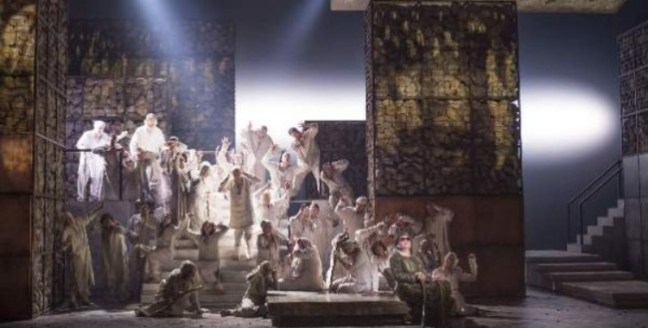
Despite distinct resonances across the acts, Pierre Audi’s production strikingly shifts mood for each episode of the trilogy. The curtain first rises on a classical scene, the white-draped bodies of the chorus held still like statues against Tom Pye’s simple but imposing stone-grey design. White gives way to black in the tense second act, as a militaristic state has been established under Peter Hoare’s Creon (as smoothly persuasive in voice as in politics), its discipline outlined in the sharply uniform movements of its subjects. Colonus, in the final scene, is an other-worldly wasteland, eerily echoing with the disembodied voices of the chorus – for whom Anderson has written by far the strongest part.

It is in its narrative economy, however, that Thebans disappoints. Anderson and McGuiness have hacked away plenty of dead wood from Sophocles’ tragedies, but with it too has gone some of the essential foliage. Shorn down to its bare essentials, the plot loses any prelude to tragedy, failing to forge a connection with the protagonists before their fortunes violently plummet. In the succinct second act especially, character is sacrificed to atmosphere, with Antigone dead before we are offered any opportunity to feel her misfortunes. McGuiness’s libretto, meanwhile, is direct to the point of bluntness in its trimming of Sophocles.

Anderson’s score cannot quite compensate for these gaps in character, rarely communicating the full tragedy and despair of Oedipus’s downfall. It is better instead at conveying unease, be it through the disquieting bass tone of Tiresias’s prophecies or the mounting tension of the second act. Only in the closing moments, as Julia Sporsén’s bereft Antigone devastatingly grieves for her father, does the impact of events finally land its punch – by which time, it is too late.

The Fanny Hill Project, Camden People’s Theatre

main

Behind even the most misguided shows, there is usually the nugget – however small – of a good idea. When I first saw The Fanny Hill Project in Edinburgh last year, the good idea at its heart was obscured by the messy, distracted production created around it. TheatreState had paired John Cleland’s erotic novel with the contemporary tale of co-director Tess Seddon’s experience as a model in a foot fetish club in New York, and from there departed into a sprawling exploration of women’s representation in the 21st century. As I wrote in my review at the time, “A feminist piece about modern representations of women is not short of targets, which is perhaps where TheatreState’s fierce but confused satire falls down”. The show had bags of ambition, but precious little focus.

The Fanny Hill Project v2.0, as TheatreState have cheekily christened it, is an impressive transformation, excavating the central idea of the original piece and making it into the show it always had the potential to be. Other than retaining its core concept, the show is unrecognisable, adopting an entirely new structure. Whereas the initial production was all over the place, its madcap scenes loosely strung together, here it has been honed down to its essentials and marshalled into a tight, effective framework. Shedding all the accessories that got in its way first time round, the show is now completely built around its twin narratives of two women – one 18th-century, one 21st-century – who end up selling their bodies.

This structure also allows Seddon and fellow performer and director Cheryl Gallacher to return to the spotlight, whereas previously they were hidden in the background or absent entirely. It’s a wise choice, as the pair have a compelling dynamic and an effortles way of inviting in their audience. In a fun little preamble, they coax us all into playing “I have never”, most beloved drinking game of eager-to-impress students. This quickly becomes a way of introducing Seddon’s shady past, which in this version – unlike before – she takes full ownership of. When Seddon first revealed this secret, she explains, Gallacher was desperate to make a show about it; in return, Seddon dug up Cleland’s novel and presented Gallacher with the challenge of Fanny Hill. There’s eye-rolling reluctance from both parties.

So the two women, Seddon as herself and Gallacher as Fanny, do battle in their attempts to tell their stories, while Jordan Eaton observes proceedings from behind a DJ booth at the back of the stage. Each chapter, linking together events in the lives of the two protagonists, is announced into the microphone by Eaton, wrenching away narrative control from the very people whose narratives are at stake. The quickfire sections are separated by a bell – ding! – with more than a hint of the boxing ring. Women here are repeatedly interrupted and sidetracked in the authoring of their lives, competitively pitted against one another while the audience problematically look on.

Performance is key. Thanks to the knowing structure and the winking self-awareness, we are constantly reminded that this – like the outfits the performers switch between – is all put on. When Seddon and Gallacher throw shapes to David Bowie’s “Let’s Dance”, their moves fiercely mock the “sexy” tropes of contemporary music videos; the artificiality of pillow fight fantasies is gleefully pointed up by the use of a fan to scatter feathers into the air around the two giggling performers. And we begin to wonder whether “Tess” and “Cheryl” – the versions of themselves that the performers present on stage – are also carefully constructed performances. Is the appealing kookiness that they adopt just another role that women are expected to fulfil? (my Manic Pixie Dream Girl alarm starts to go off)

The Fanny Hill Project v2.0 still leaves questions unanswered, but now in a way that feels apt and intentional. The closing scene, rather than departing in bewilderment, leaves a powerfully bitter taste in the mouth. What if, TheatreState suggest, the only way of getting one’s voice heard as a woman in a casually misogynistic culture is to conform to the image that culture insidiously projects? If you can’t beat ’em, join ’em. It’s a troubling thought, and one that hangs in the air long after the feathers have fallen to the ground.


Nothing, NSDF

thumb

*Obligatory disclaimer: I know some of the company pretty well and had heard a fair amount about this show before seeing it, so I can’t claim an entirely distanced position. As far as possible, however, I approached Nothing as I would any other piece of theatre – if perhaps with a little more foreknowledge than the average audience member. Also, for anyone who hasn’t seen the show, it gets a bit spoilery …*

The thoughtful complexity of Barrel Organ Theatre’s Nothing begins right in its title. A gift to pun-happy theatre critics (I direct you to Noises Off‘s excellent selection of headlines), it’s a joke and a statement; a raised middle finger to both theatrical convention and ideological austerity. The single word suggests a void – emotional, ideological, physical. It is also a fierce reference to the current political landscape, in more ways than one: faced with disappearing funding, young companies such as Barrel Organ are forced to quite literally do something with nothing, while nothing is equally a fair description of what these students and recent graduates might feel the world holds for them. The title is an arch reference to the show’s minimal staging and perhaps even a barrier erected against audiences’ quest for meaning.

The multiple layers of suggestion that can be peeled away from these two simple syllables begin to suggest the subtle intelligence of Barrel Organ’s show. Written by Lulu Raczka and created in close collaboration with director Ali Pidsley and the whole company, the deceptively simple structure consists of eight overlapping monologues. Each riffs on a different experience of disconnection in modern society, casually punctuated with sexual and physical violence. This is a world where human shit is gleefully deposited on doorsteps and limbs are hacked off in darkened alleyways. The play’s various transgressions and atrocities, however, demand to be imagined rather than seen. As in The Author, Tim Crouch’s unsettling in-yer-head shocker, we are the ones left manufacturing images of rape and assault, painting nasty pictures in our heads.

The show’s relationship with an audience, however, goes further than this act of mental complicity. In Nothing‘s staging, all physical barriers between performers and audience are dissolved. Unlike in The Author, in which the performers took up residence among the audience, here we are all one amorphous mass gathered together in the space. One by one, the performers reveal themselves, speaking as if seized by a sudden thought. One talks of childhood abuse, another of pointless acts of theft, another of a violent act witnessed on public transport. They are compelled to share, yet awkward in their candour. The monologues are intercut, sometimes by way of interruption, at other times stepping in to fill a silence. When not speaking, each member of the cast retreats into their own sealed bubble, not once acknowledging the speech of one another. These self-conscious outpourings are stubbornly staged as monologues, each addressed to an “audience” rather than to a collection of individuals who might answer back.

While it’s not necessary as an audience member to know the means by which these fractured monologues are constructed, it does shed some additional light on what Barrel Organ are doing and highlight the impressive skill of the ensemble. The piece is significantly different every time it is performed, and the company stress that it is never finished. This is thanks to the fluid order of the monologues, which is not fixed but instead improvised on the spot each night. Performers decide when to speak, when to stop, and in some instances what to say (some performers have learned more than one monologue and only settle on which one to deliver during the performance). Therefore each performance is live in the most unpredictable of senses, generating a tangible charge in the air. It’s a bold, brave, and for the most part brilliant creative choice.

There are, unsurprisingly, some difficulties that come bundled up with this risky staging decision. Containing the audience while also allowing for their input is a challenge, producing the odd stumble, and the rules of interaction are uncertain. But the instability of this performer/audience contract is also what makes this piece so exciting, forcing spectators to remain alert. About halfway through, unusually conscious of my position as an audience member, I begin to regret my default retreat to a chair and wish that I had decided to roam freely around the space as the performers do. It’s striking, as well, how adeptly the eight performers deal with the surprises that this situation inevitably throws up, smoothly absorbing audience responses and environmental noise into the texture of the piece.

In fact, the whole thing comes across as remarkably natural. Raczka has an enviable gift for capturing the cadences of everyday speech in her writing, while the ownership that the performers feel over their monologues is clear in their simple, unaffected delivery. We can almost believe, as a performer fidgets and looks into our eyes, that we really are hearing them spill out their thoughts. At the same time, however, the production sets up a deliberate tension, as the private is aired publicly and isolation is experienced in the middle of a crowd.

Nothing is full of such tensions – between theatricality and authenticity, between rehearsed performance and spontaneity, between alienation and community. It is the latter that is perhaps most significant, constituting the show’s quiet but insistent political intent. The play’s disconnected characters share so much with one another (and, I would suggest, with their young audience at NSDF), but not once are they able to meet eyes, let alone connect. They are, as our society would have them, atomised individuals, bumping against one another without making a dent. Despite the ease and frequency of the text’s jokes, it’s an unblinkingly bleak vision of contemporary Britain, both in form and content.

And yet … there is something innately optimistic about the way in which Nothing is staged. In its arrangement of the audience, its acknowledgement of the community of the theatre, and its emphasis on collaboration, it can’t help but gesture towards the human connection that its characters find so impossible. There are definite echoes of Simon Stephens, and particularly of Pornography, in Raczka’s writing; I am reminded, too, of Stephens’ insistence that theatre is an inherently optimistic art form, no matter how dark its subject matter.

There is also a certain tension in the show’s surroundings. The company describe the piece as “site-unspecific” – it can be staged just about anywhere, and has already been seen in dressing rooms, pubs and car parks – but each performance is absolutely specific to its site in a series of fascinating and unpredictable ways. Of course, I can only discuss those that are particular to the performance I experienced, at the very nerve centre of NSDF in the Spa Complex. I understand that this was the biggest audience that the piece has been performed to, and there is a sense of lost intimacy as a result. Whispered as confessions in a small space, these monologues would suddenly acquire a whole series of different meanings, not to mention a different relationship with their audience. Whereas in a long, cavernous space messily cluttered with people, the show has just the slightest strain of effort, distracting a little from the speeches themselves.

But what is lost in the main set up of this particular staging is brilliantly recouped in its finale. [Here follow the main spoilers] Wisely, the one fixed element of the show is reserved for its conclusion, always closing on the same monologue. In this performance, we are abruptly led outside for the final speech – cue much clattering of chairs and awkward laughter. Ungainly as this transition is, however, it allows for a stunning moment in the Spa Complex’s open-air courtyard, with the sea and the sky adding all the drama and tragedy one could wish for. Against this vast backdrop, the closing speech – beginning with the self-effacing words “nothing ever happens to me” – feels startlingly small in its sad, shrugging attitude to the world. It’s devastating precisely because of its smallness, its inadequacy, its isolation – and its painful familiarity.

Of course, Nothing has its  flaws. The one downside of such thrilling unpredictability is that it must be almost impossible to give the piece dramaturgical shape from performance to performance; its shape emerges in the moment, in response to the conditions in the room, and will inevitably be more effective on some occasions than others. The rules, like the show, need to be constantly remade. But in its malleability, its thoughtful self-awareness, its implicit politics and the natural flair of its writing, this incarnation of Nothing is a tantalising taste of what it – and the company behind it – might go on to become.

Noises Off

8581 (2)

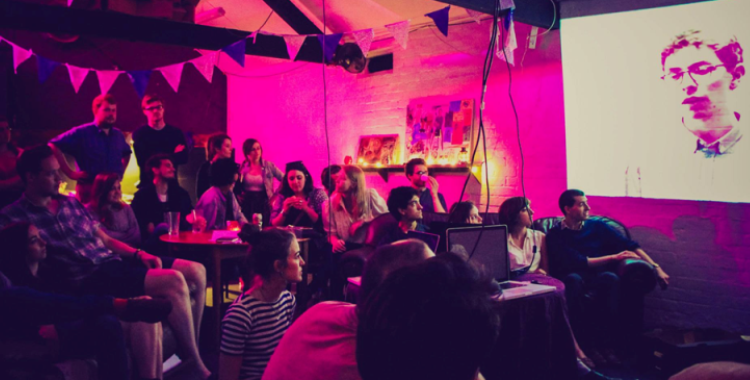
Last week I spent a gorgeous, busy, invigorating few days in Scarborough at my first National Student Drama Festival (NSDF). Thanks to Andrew Haydon, I was lucky enough to be one of the deputy editors of Noises Off, the (mostly online) Festival magazine. This essentially involved seeing lots of student theatre, working with some fantastic writers, and making increasingly inane jokes in the Noffice.

You can read my various musings on the Festival here, and I also recommend that you check out all the other brilliant content on the Noises Off website.

Photo: Giulia Delprato.