Manpower, The Lowry

man-1

Originally written for Exeunt.

Real men. Real jobs. Taking back control. Watching Manpower two days after the US election, the rhetoric has an especially bitter taste. Two Destination Language’s show has the feel of a piece that started being about masculinity and somewhere along the way came to be about Brexit. Watching it now, it inevitably becomes about Donald Trump too.

As I write this, the radio is on in the other room and a reporter is talking to Trump voters in the States. People keep saying the same thing. Trump will create jobs. Trump will be good for business. Trump will get our men back to work. Trump will Make America Great Again™.

The Brexit vote isn’t the same as the Trump vote, of course, but Manpower is grappling with some of the factors that seem to underlie both. Grappling feels like the right word: Two Destination Language are still in the process of wrestling with these ideas, still working through the consequences of our new political realities. The outcome is unsurprisingly but interestingly flawed.

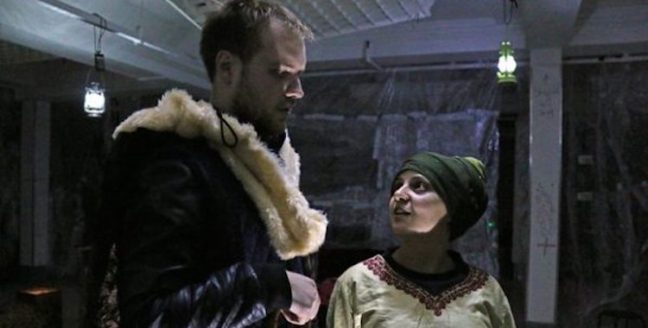
Alister Lownie is a man. Katherina Radeva is a woman. They’re both here to talk to us, in different ways, about work and masculinity. Katherina speaks in the role of outsider, offering us a lecture on our country and its problems over the last 30 years. First the jobs in industry went. Then more men started working in offices, getting soft hands and soft minds. But the real crisis moment for British masculinity arrived with the advent of DIY and B&Q. The only way to feel like a real man anymore was to do a botch job on the new bathroom. But it’s OK: Brexit is here, to help the men take back control.

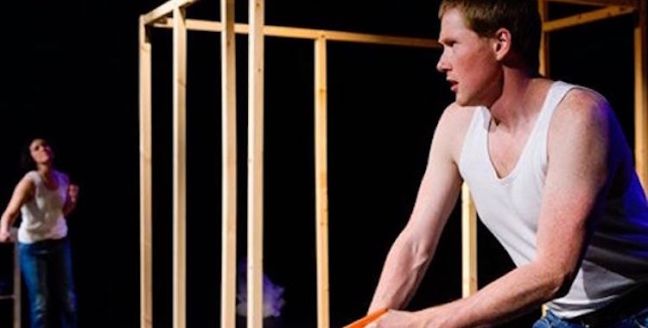
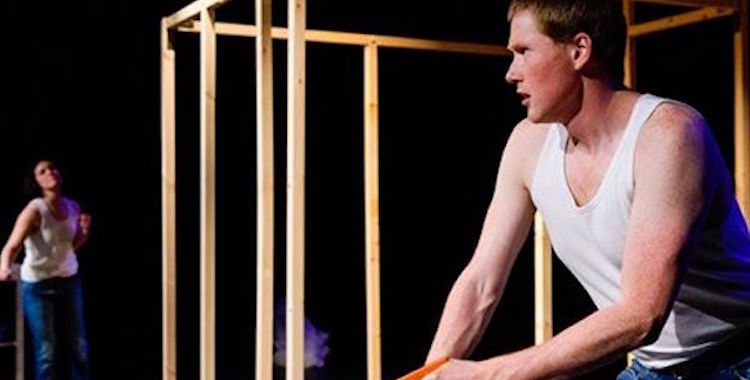
As Katherina takes us on this ironic journey through recent history, to a soundtrack of era-appropriate tracks from Dire Straits and Pulp, Alister is working on his own DIY project behind her. While she talks, he builds, first assembling the wooden skeleton of a shed, then constructing a makeshift wall from the logs scattered across the stage. His masculinity is recovered through the act of erecting a border. At odd moments, meanwhile, the action is punctuated by quiet, dimly lit monologues from Alister: seemingly random interruptions that resolve themselves into subtle blows at political rhetoric.

And rhetoric – from politicians, from the tabloid media – is very much the target here. Towards the end of her lecture, Katherina offers us an apology: she might have got a few things wrong, but if she has it’s only because our newspapers can’t make up their minds. It’s hard to know who to believe anymore.

There’s a difficulty, though, in the way Two Destination Language have chosen to skewer the narratives that led to the Brexit vote (and, now, to Trump being elected president). Irony, as a political tool, just doesn’t feel equal to the task anymore. It can mock, sure, and it’s undeniably appealing as a performance tactic, but there’s a kind of emptiness to it. In the place of hollow rhetoric, there’s very little it can offer.

The show itself even seems to recognise this echoing emptiness. One of Alister’s monologues simply consists of a series of statements, all beginning with “the thing is”. Each is a meaningless cliché, the words drained of all value. The thing is, we’re all in this together. The thing is, there’s no such thing as a free lunch. The implicit question, which Two Language Destination are unable to answer, is how to counter a politics that proclaims to “tell it like it is” while saying anything it needs to in order to win. Neither irony nor apparent sincerity seem to be up to the job.

In the very opening speech, as the lights slowly come up, Alister is talking about the importance of investing in good quality sound technology. You can hear the difference, he tells us. At first, it’s unclear where this is going. Why are we being told about hi-fi systems? Then, gradually, the penny drops. You have to do your research, Alister is saying to us. Because that smiling man in the suit, well he’ll just sell you anything. You have to know what you’re listening to. You have to know what choice you’re making. Because more often than not, smiling rhetoric will sell you sounds that end up deafening you.
North Country, The Wild Woods

3283-600x360

Originally written for Exeunt.

We all know how post-apocalyptic narratives work, right? We’ve seen the films, read the books, watched the TV shows. It’s a genre that only seems to get more popular – a reaction, perhaps, to a world that is itself beginning to look pretty damn apocalyptic.

North Country, though, challenges the post-apocalypse that we know and love to dread. There are familiar tropes – disease, riots, stockpiling canned food – but set in a different frame. For a start, the global catastrophe imagined by Tajinder Singh Hayer is in the very, very near future: his fictional plague takes grip on 5th November 2016, the final date of this production’s run. There’s no doubt that we’re meant to feel our uncomfortable proximity to these events.

But the more striking contrast is in whose stories we hear. As was made painfully clear again recently by Tim Burton’s pitiful defence of his casting practices, the genres of sci-fi, fantasy and horror are whiter than white (and if a non-white character does get a look in, they’re usually the baddie). There are lots of reasons why we should want to change this, but Hayer sets out one of the most compelling in the preface to his play: if people of colour are excluded from sci-fi, then they’re excluded from imaginings of the future.

In this imagining of the future, then, British Asian experiences are central to the aftermath of disaster. As worldwide plague rapidly decimates most of the human population, three Bradford teenagers – Harvinder, Nusrat and Alleyne – find different ways to survive. Harvinder falteringly picks up the medicine practised by his parents; Nusrat forges alliances and makes deals; Alleyne capitalises on his father’s farm and the vital resource of food that it provides. Spanning more than forty years, the play follows a fraught and halting process of healing.

Without the separating veil of screen or page, North Country cannily trades on its nearness – both physically and thematically. It’s staged in the shell of an old M&S in Bradford city centre, a venue suggestive not just of the abandoned buildings of a plague-ravaged world but also of the empty spaces created by a financial apocalypse-of-sorts much closer to home. Huddled around the edges of the makeshift auditorium, we’re right up next to the characters in Alex Chisholm’s production, almost as if we too are in one of the survivors’ camps.

Plague aside, in many ways the play feels unsettlingly close to present events. As illness and panic first break out, immigrant communities become a convenient scapegoat (you can almost imagine the Daily Mail headlines). Quickly, Harvinder and Nusrat are at risk not just from disease, but also from their fellow citizens. And in the fractured communities that begin to emerge once infection has subsided, race becomes a clear dividing line, with white farmer Alleyne at the head of one tribe and Nusrat leading another, in uneasy alliance. As with all versions of the apocalypse, North Country is very much a product of its moment.

There’s plenty to chew over, even if the expression of Hayer’s ideas is not always as interesting as those ideas themselves. With so much happening in just an hour and a bit of performance time, clarity and pacing become issues. There are moments when the confusion is apt – like when we’re plunged into the darkness of a world in which fuel and hope are running out. At other times, though, important plot points or character details race by. There’s so much here about the difficult process of forging new identities, but without the time and space to really know these characters.

The form of the play also brings its challenges. While the three protagonists cross paths at crucial moments, much of the narrative is conveyed through intercut monologues, meaning that the majority of the action is told rather than shown. Chisholm does her best to move the actors around the space and keep the performance dynamic, but at times it can feel like a relentless stream of words and information. Post-apocalyptic fiction is a genre that’s all about thrill and peril, but North Country struggles to quicken the pulse.

For all its flaws, though, it feels important that this is being staged, and particularly that it is being staged now. There’s a line that sticks: “someone looking for a face to blame”. It’s not as though racism emerged overnight after the EU referendum result, but it does feel – terrifyingly – like more and more people are actively and violently “looking for a face to blame”. Hayer’s visions of British Asians being sought out and beaten by those feeling robbed of their lives are not a great leap of the imagination.

There is hope, though. Hayer sees the post-apocalyptic genre as mirroring the migrant narrative: it’s all about finding a new way of being, a new identity in a new world, while the past lingers indelibly in the transformed present. And it’s a genre that reveals the resilience and adaptability of human beings and the possibility, in spite of all the horror, for people to find new ways of living alongside one another. Above all, North Country is about what sort of collective identity we want to create – a question that, since the morning of 24th June, seems more pertinent than ever.

Photo: Maria Spadafora.

Don’t Wake the Damp, The Lowry

dontwakethedamp1-killthebeast-photocredit_andrew-ab_

Originally written for Exeunt.

Damp. The soggy nemesis of Generation Rent, slowly creeping up the walls of rundown, overpriced properties. In Kill the Beast’s new show, though, it has an altogether more murderous edge – and a lot more tentacles. Don’t Wake the Damp is a genre spoof for the housing crisis, at once sending up shonky TV sci-fi, high-rise horror and the onward march of gentrification. Here, the loving mixture of homage and piss-take that the company honed in werewolf romp He Had Hairy Hands is joined by a gentle but undeniable political undercurrent.

All of which, on paper, sounds brilliant. In reality, though, it’s a slight disappointment after the perfectly pitched comedy of He Had Hairy Hands. Kill the Beast’s targets in this follow-up all just feel a little… easy. Camp and kitschy space adventure, cheesy theme tunes, dodgily scripted horror – all this stuff has been pastiched countless times. Even the gags about tower block evictions and luxury new apartment complexes are fairly obvious blows, going for the bitter, readily-offered laughs of all the guilty middle-class liberals in the audience.

That said, there’s still plenty to enjoy about Don’t Wake the Damp, which takes the company’s sharply defined aesthetic and adds a generous dousing of neon. The show opens in the spaceship of intergalactic adventurer Captain Charismo and his sidekick BOOBS (yes, BOOBS – it stands for something, apparently, but that’s not really the point). The vintage Doctor Who wobbliness of the set quickly gives away that we’re inside a budget sci-fi TV show: the gloriously silly Crystal Continuum.

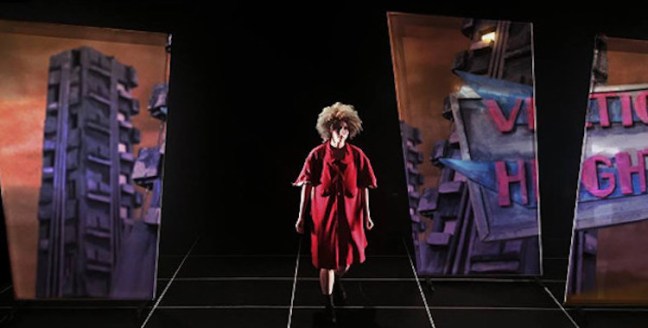
The action snaps forwards. It’s 2035 and former Crystal Continuum star Juniper Berry (aka BOOBS) is bitterly reliving her glory years from the upper reaches of Vertigo Heights, a tower block earmarked for demolition on account of the damp. But as strictly protocol-following council man Terry tries to evacuate the building, June and a couple of stubborn fellow residents (supercilious, teeth-obsessed Devlin and Crystal Continuum super-fan Lexie) insist on staying put. After all, how much harm can a little damp do?

Answer: a lot. The damp of the title, needless to say, threatens much more than a little mould. From this ominous revelation onwards, Kill the Beast pick up the pace, bringing their usual energy to a suitably preposterous plot. Technically, Don’t Wake the Damp is the most ambitious of their shows to date, with the company’s trademark animations projected onto three moving panels and joined by an impressive array of light and sound effects. And as ever, Clem Garritty’s design is accomplished and meticulously realised. You definitely can’t argue with the attention to detail.

Yet, despite all this energy and care, I can’t shake the nagging feeling that there’s something missing. The jokes, though they come thick and fast, are for the most part lightly amusing rather than laugh-out-loud funny, and the response feels muted in comparison with the rowdy enjoyment that greeted He Had Hairy Hands both times I saw it. There’s less verbal dexterity to the humour, perhaps, and less bold originality to the visual gags, while none of the characters can quite match the scene-stealing Whitechapel (who receives an arch nod here, for the company’s fans).

There’s no doubt that Kill the Beast have plenty more to offer, and it should be stressed that few companies at this stage in their development can claim such a clear and compelling identity. From the projections to the painted faces to the wonderfully awful wigs, Kill the Beast have a look that’s all their own and that, impressively, translates across the different genres they affectionately dissect. This time, though, they fall just short of the twisted comedic brilliance of their best.

Kissing the Shotgun Goodnight, Theatre in the Mill


Lots of people talk about community in the theatre. I’m one of them. For the hopeless optimists among us, the communal space of the theatre holds a certain political potential, a certain utopian allure. Here we are, together.

But actually, in a lot of ways, the gig is more communal than the theatre show. In a theatre auditorium you’re (generally) separated from your neighbour by a few inches, a veil of politeness and maybe an armrest. Gigs, on the other hand, are all proximity and excitement and sweat. People moving as one, singing as one. Bodies connected by the vibration of basslines. Here we are, together.

Kissing the Shotgun Goodnight is caught somewhere between the two. We sit in raked seating, keeping polite distances. We are, I think more than once, remarkably still. Yet this is, as Chris Brett Bailey’s scribbled-over marketing copy tells us, “a concert sprinkled with words”. Formally, it’s more gig than theatre show. Bailey and fellow band members Alicia Jane Turner and George Percy play us a haunting, disturbing and eventually ear-splitting post-rock symphony, building up to the volume of a small plane taking off.

Caught in the midst of all this incredible noise, though, we in the audience don’t sway or stamp or mosh. Instead we sit stiffly, disconnected, together but not together. That’s the problem with a lot of recent so-called gig theatre (a label that Bailey and co have – deliberately, I’d guess – avoided): it jettisons too much of the experience of gigs, creating events that feel diluted and frankly just a bit awkward. It tries to bring something of the gig into the space of the theatre without thinking about what the space of the theatre actually does to those inside it.

Perhaps, though, the theatre is the right place for Kissing the Shotgun Goodnight, for all the reasons it seems like the wrong place. Because Bailey’s show doesn’t feel communal. It feels, if anything, sort of atomising. Perhaps that’s because I’m a wimp with bad ears who promptly shoved in my earplugs for all the really loud bits and so felt wrapped in slightly muffled (but still fucking loud) sound for half the show. But it also feels in keeping with the whole gesture of the show that we’re each sucked into an individual vortex of sound, dragged down into our own personal abyss. Even the speech, with its fragmented swirl of death and horror and chaos, is disconnected, spoken not by Bailey in front of us but by his disembodied voice through the speakers.

For Bailey, as he explains in the programme, Kissing the Shotgun Goodnight is the product of a death heavy year. For me – and for many others watching, I suspect – it’s been a heavy year in countless ways. Kissing the Shotgun Goodnight speaks to this year, or at least so it seems to me. I can’t quite shake the urge to compare it to This Is How We Die (because, as much as this is clearly trying to do something different, that previous show was so heart-thumpingly thrilling that it can’t help sticking around in the memory), but actually what feels at first like it’s missing from Bailey’s follow-up is perhaps aptly, intentionally absent. There’s none of the comfort of humour or narrative here, and relatively little language to hold on to. Instead it feels bleaker, more violent.

The words we do get – detached from Bailey, as if directly speaking them to us would be too hard – speak of suicide and catastrophe and the underworld. “This is a hell dream. This is a hell dream. This is a hell dream.” As the audience settle in their seats, the words repeat like a refrain that hangs over everything that follows: the piercing strings, the growl of electric guitar, the subterranean green glow of Lee Curran’s lights (later a hellish red), the tune hammered out on what the programme calls “piano corpses”. Even the instruments are perishing, their screams and howls a protracted, deafening death rattle.

At first, Kissing the Shotgun Goodnight seems to play up to the expectations of This Is How We Die fans, its initial voiceover almost a parody of that earlier show and its Beat-poetry rhythms. From there, though, it moves into much darker and potentially alienating territory, continuing a journey into oblivion that began with that astonishing blast of sound at the end of This Is How We Die. It might not be a show to intensely love, but it’s uncompromising in its own intensity.

And it leaves me feeling oddly isolated from the people around me, even as the same vibrations rattle through our bodies. It suggests the distance of understanding that Bailey alludes to when considering why someone might be drawn towards suicide: “You’ve got no idea what it was like to walk to the fridge in their shoes, let alone a mile.” Sometimes, in spite of all theatre’s capacity for generating empathy, we just can’t understand.

Here we are, together yet alone.

Photo: The Other Richard.

A Streetcar Named Desire, Royal Exchange

maxine-peake-as-blanche-dubois-in-a-streetcar-named-desire-photo-manuel-harlan-8-549x357

Originally written for Exeunt.

Drama thrives on too-small spaces. Pressure-cooker rooms, where conflicts simmer, are the stage for everything from Pinter’s comedies of menace to Alistair McDowall’s domestic-scale sci-fi in X. And in A Streetcar Named Desire, Tennessee Williams adds real to metaphorical heat. It’s a play in which climate is crucial, as the three central characters stew in the stifling humidity of a long New Orleans summer.

The Royal Exchange, with its stage tightly enclosed by the audience, should be the perfect arena in which to evoke the sticky claustrophobia of Stella and Stanley’s two-room apartment, the precarious sanctuary of vulnerable visitor Blanche DuBois. Yet the spatial dynamics of Sarah Frankcom’s production are oddly inconsistent. The stage, partially divided by white fluorescent strip lamps, presents a space of fluid boundaries. The only actual wall, separating off the bathroom where Blanche sequesters herself for much of her stay, is a transparent glass partition. Privacy co-exists with exposure. Inside and outside become tangled up in one another.

It’s a gesture, perhaps, towards the dissolving boundaries of Blanche’s mind and the regular intrusion of past into present – as well as a choice that ushers the wider world into the space of the Kowalskis’ apartment. Because of course Williams’ narrative is not only about this one troubled character; Blanche’s experience resonates with much bigger questions about mental health and sexual politics, both of which remain the subject of heated public discussion.

What this loose spatial interpretation sacrifices, though, is the tension that drives the plot. The suffocating Southern heat of the play need not be portrayed realistically – after all, Williams himself was interested in pushing at the edges of stage naturalism. Productions like the Lyric Hammersmith’s Secret Theatre version (the memory of which is hard to shake) have managed to reject any attempt at creating the illusion of Stella and Stanley’s cramped home while maintaining the same taut tension beneath a new theatrical metaphor. But Frankcom’s production struggles to find a substitute for what it jettisons. When Stanley first explodes and violence ruptures the play, it feels choreographed and clinical rather than charged with real threat, a pattern that is repeated with other moments of conflict. We never really feel the heat or the menace.

The production teems with choices that are intriguing but somehow a little unsatisfying. The smooth green carpet of Fly Davis’ set is evocative of the poker table, lending the same air of chance and risk to the narrative as that of the game Stanley and his friends gather to play in the apartment. This could be read as a world ruled by the whims and gambles of men, although this is more a gentle suggestion than a bold interpretation. The same goes for the haunting Day of the Dead-style apparitions that linger intermittently at the edges of the stage, seen only by Blanche. There’s a distinct air of decay about these figures, clad in black and garlanded in funereal roses, as well as a troubling hint of exoticism. Other than acting as a symbol for the death that Blanche has seen so much of, though, their role remains unclear, and stylistically they feel at odds (perhaps intentionally) with the rest of the aesthetic.

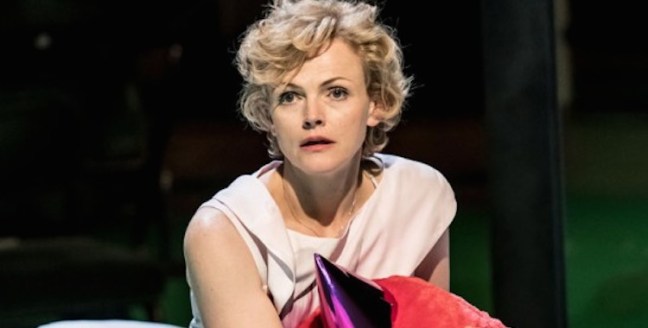
Maxine Peake’s Blanche, like the production around her, is rich with contradictions. The complexities and ambiguities in her performance, though, add nuance rather than clutter. Lesser interpretations can cast Williams’ tragic heroine as a fragile, eyelash-batting Southern belle, always on the trembling brink of breakdown. But this Blanche is capable of being as cold and cutting as she is vulnerable. Dismissing Eunice on her arrival, or trying to persuade Stella to leave Stanley, her drawl drips with irony and scorn. Only the slight quiver of her hands – never overplayed – hints at the emotional turmoil she disguises with liquor and furs.

It’s fascinating to witness the hardness as well as the romance in this imagining of Blanche. We see a woman who, although forced to ask for help and rely on others, has long been fighting a solitary battle for survival. She’s tough, in her own way, even if her toughness takes the form of floral dresses and calculated flirtation. This drive to keep going, though, is at war with her inability to let go of the past. Peake plays Blanche with a brittle poise, the unshakeable ghost of aloof gentility and pretended primness. Even her clothes locate her in a different era from her shorts and vest-clad hosts.

Making up the central trio, there are also surprising touches from Sharon Duncan-Brewster and Ben Batt as Stella and Stanley. While the rendering of their relationship lacks something – that electric pull that Stella talks about doesn’t entirely convince – each interpretation finds new facets in the character. Duncan-Brewster is a disarmingly chirpy Stella, her vast reserves of optimism bolstering her turbulent relationship with Stanley. There’s also a strong sense, though lightly conveyed, of her shared past with Blanche – and a suggestion, in just the hint of a rolled eye, of sibling rivalry and resentment. Batt’s Stanley, meanwhile, is most striking at his most desperate, almost wringing out sympathy as he howls Stella’s name, wrenching up the two syllables from the depths of his gut.

But really, to deploy a tired yet entirely apt phrase, this is Peake’s show. There are moments, towards the end, when even her carefully judged performance veers towards the hysterical – an all-too-familiar choice in Streetcar’s closing scenes. Save that one misstep, though, hers is a compelling and impressively fresh take on an iconic, baggage-laden role. She’s a performer who inhabits a character with every last muscle; sometimes, watching her, you’d swear even her hair was acting. Emotion is conveyed as much by a flicker of the fingers as by a tremor in her voice. It’s hard – as Frankcom’s production, despite all its interest, demonstrates – to discover convincing new stage metaphors for such a well-worn play. Peake, though, finds a way to present Blanche to an audience as if we’d never seen her before.

Photo: Manuel Harlan.