Pastoral, Soho Theatre

600x600.fitdown1

Originally written for Exeunt.

We’re all familiar with the terrifying threat posed against our planet by global warming, but what if it was nature that turned on us for a change? Thomas Eccleshare’s Verity Bargate Award-winning ‘first play‘ imagines just this, offering a madcap mix of mythology, nostalgia and post-apocalyptic narrative tropes. His motley group of protagonists, anchored by the excellent Anna Calder-Marshall as good-humouredly grumbling old spinster Moll, face not nuclear holocaust or zombie apocalypse, but the creeping invasion of grass and trees. Nature, it would seem, is rebelling, thrusting roots through concrete and branches through windows. Saplings are sprouting up in Paperchase and there are deer on the loose in Aldi.

This is catastrophe played firmly for laughs – Day of the Triffids reimagined as a sitcom. As the escape route planned by Moll’s young protectors Manz and Hardy is rapidly cut off, the trio are soon joined by a fleeing family, establishing the confined and somewhat ridiculous conditions conducive to quick-fire comedy. The running gag of flora and fauna taking over the local high street seems at first to promise some cutting comment on fiercely branded consumer culture, but instead it’s just an excuse to make spiky quips using familiar chains. While the long-awaited Ocado man – a late capitalist Godot – is a beautifully witty touch, the laughs can’t quite escape the feeling of being at the expense of ideas. Eccleshare has hit on a promising concept but rapidly submerged it in humour.

This black comedy all plays out in the precarious space of Moll’s flat, which Michael Vale’s skeletal metal design renders immediately open to the plant life that later wrestles its way in. Despite the momentary alarm engendered by the progressively collapsing room, however, there is little peril evident in this environment, even if it does involve some scene-stealing foliage. A creaking tree – not aided on press night by technical difficulties – provides about as much menace as birdsong, its swooping canopy more comical than threatening. While we’re often told about the encroaching danger of nature’s seemingly unstoppable onward march, the danger is never seen, only reported.

Eccleshare also leaves us in the dark as to the cause of this environmental anomaly, a decision that opens the way for interpretation but leaves questions hanging frustratingly in the air. Is the sudden overgrowth to be understood as a punishment for humanity’s thoughtless neglect and abuse of its natural environment? And does the play’s newly green and pleasant land herald a return to a golden age of natural harmony? This is certainly implied by the wistful hints of mythology, encapsulated in the youthful hope of Polly Frame’s bolshy yet faithful Arthur, an eleven-year-old boy with an ancient king as his namesake. Yet such intriguing suggestions still feel slightly underdeveloped, tangled in the swiftly growing branches.

As the play concludes with an outpouring of tongue-in-cheek sentimentality, its attempted archness looks remarkably like maudlin slush, a fate from which it’s just about saved by the simple tenderness of Calder-Marshall’s and Frame’s performances. There’s no denying Pastoral’s appealing ambition and often joyous eccentricity, but in the end it’s all too content to settle for a neat emotional pay-off over genuine complexity.

Photo: Simon Kane

Something Very Far Away, Unicorn Theatre

Untitled

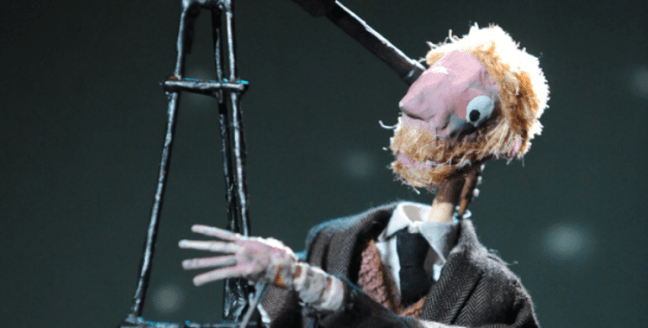
For all those who dream of time travel, that enduring obsession of physicists and sci-fi fans alike, there’s one way in which we already can defy the divisions of past, present and future. Look at the stars and you look back in time. The speed of light dictates that by the time the light of distant galaxies reaches us, what we are looking at is already hundreds of years old. The constellations that we blink up at in the night sky are actually no more than ghosts.

This is the central premise around which the Unicorn Theatre’s Something Very Far Away heart-breakingly revolves. Its star-gazing protagonist Kepler is well aware of the fact that “the deeper into space you look, the further back in time you see”. When his beloved wife is tragically killed in a circus accident, this magical fact of the universe becomes more than just another superfluous piece of knowledge; it becomes a promise, a guiding star for Kepler’s tireless pursuit of lost love. Knocking up his own homemade space rocket and hopping between the planets, telescope in hand, Kepler is constantly chasing the minutes that will inevitably snatch his sweetheart away from him again and again.

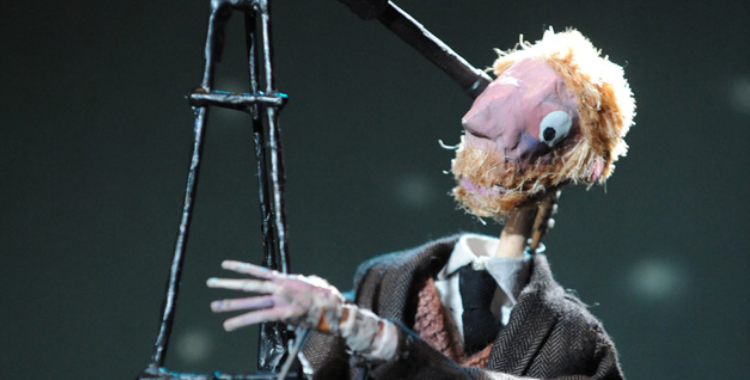
This moving story of a love greater than solar systems is narrated through a wordless combination of puppetry and animation techniques, filmed and projected live before our eyes. Its aesthetic marries the delicate paper manipulations of The Paper Cinema with a low-tech, almost childlike brand of puppetry, the rickety figures carrying a charming air of the homemade. The visibility of its crafting might be expected to detract from the story itself, but instead it only enhances it. As well as the ability to see the work of the performers adding to an audience’s awe at their sheer skill, this artistic choice compounds the narrative’s terrible weight of inevitability. We can always see what is coming next.

Meanwhile, the simple ingenuity of this approach is in many ways more impressive than a slick piece of animation could ever be. An audience is left helplessly, admiringly grinning by the use of water trickling through the bottom of a plant pot to represent rain, or by the intricate movement of slender paper figures against a painted backdrop. And for all its poignancy, the piece also incorporates charming, witty snatches of humour. As Kepler cobbles together his spaceship with nothing more than a hammer and a saw, his neighbours curiously drawn to the strange banging, there are surprising echoes of Wallace and Gromit. It’s A Grand Day Out with none of the cheese but a generous helping of emotion.

And it is this – this unadorned, generous, unapologetic emotion – that ultimately holds the piece together. By trusting entirely in its young audience’s comprehension of the challenging emotions it grapples with, Something Very Far Away effortlessly achieves that rare triumph of equally captivating both children and adults. Love, after all, needs little translation.

Mess, Battersea Arts Centre

DSC_9159_view

Mess, despite its title, isn’t really that messy. And yet, at the same time, it’s extremely messy indeed. I should explain. The delicate subject matter that Caroline Horton’s show bravely and urgently tackles, that of eating disorders and more specifically anorexia nervosa (an illness that Horton has personal experience of), is about as messy as it gets. It’s a topic that’s still something of a taboo and that, even if we know we should be talking about it, has the tendency to make everyone in the room feel distinctly uncomfortable. To overcome this, Horton has created a form that speaks directly to the experience of suffering with anorexia, which is much more about control than it is about food. She has, in the meticulous style of the perfectionist, tidied it up.

This framing is both inspired and problematic. Before explaining why, I might as well admit right now that I came into Mess with a fair amount of critical baggage, which has doubtless influenced my perception of the show. I didn’t see it in Edinburgh, which I greatly regretted at the time, but I was a curious witness to the lively debate that surrounded the piece and its treatment of its subject matter. Several people raised concerns about the whimsy employed by Horton and the company in handling this issue, while Lyn Gardner suggested that responses to the show were sharply divided along gender lines, with men loving it and women expressing reservations. Picking up on this discussion, Matt Trueman brilliantly compared Mess with Cristian Ceresoli and Silvia Gallerano’s The Shit/La Merda – the most stunning show of the whole festival in my book, if in a so-searingly-intense-it-almost-scrapes-your-skin-off kind of way. No whimsy there.

Unlike the literal and figurative nakedness of The Shit, Mess bares only so much, covering the rest with flowers and fairy lights. Horton assumes the persona of Josephine, who together with her friend Boris (Hannah Boyde) and keyboard player Sistahl (Seiriol Davies) is creating a show about anorexia which, by its own admission, aims to “tackle issues and conquer stigma”. This isn’t the “proper” show though, Josephine is keen to emphasise – that will have a bigger stage and a revolve and a full orchestra. Instead, for now, we have to use our imaginations. Therefore a mound covered in thick pile bathmat becomes an “installation” representing anorexia; a light switched on downstage substitutes for a fridge, in which Josephine stores the single apple she struggles to eat for breakfast.

The story that Josephine and Boris tell us, with madcap sound effects and interruptions from Sistahl, is that of Josephine’s struggle with anorexia, her attempts to recover, and the anxious, awkward, but faithful support of Boris. Through gentle, endearing and often very funny touches, common concerns and misconceptions about anorexia are lightly addressed. As Josephine sternly tells us, “it is certainly not about silly girls being vain”. Instead, this is a disease that is inextricably linked with anxiety and control. Faced with the nerve-rattling challenges of life, brittle perfectionist Josephine’s coping mechanism involves colour-coding and spreadsheets, a regimented approach to life that gradually bleeds into her diet. She just wants to keep everything under her control. She just wants to win.

This irresistible desire for control is wittily reflected in the staging, over which Josephine repeatedly asserts her stubborn will. Sistahl is chided for his mischievous interventions, while we are unequivocally told – to Boris’s visible dismay – that this play will have no real beginning and no real end. The overflowing structure is poignantly fitting; it’s hard to determine when an eating disorder starts, and it never quite releases its grip on one’s life. Meanwhile, the precisely arranged prettiness of the production, which has faced criticism from some for its candyfloss lightness, is just another trait of the perfectionist. It’s like the grimace of a smile Horton pastes over Josephine’s fragile, wide-eyed face; a desperate assertion of “I’m OK”.

But for all its elegance and intelligence, Mess‘s perfect marriage of form and content begs a few questions. While the show gradually peels away the layers of Josephine’s illness, revealing the vulnerability beneath, one layer remains; there’s always a light coating of sugar. This reluctance to bare all is understandable, as is Horton’s decision to address a very personal subject through a fictional device, and given the anorexic’s need for control it feels apt that a remnant of the mask remains. Yet still there is the concern that this final shred of theatrical clothing obscures something, drawing attention instead to its own cleverness.

Similarly, the pleasing contrivance of the meta-theatrical structure might gorgeously echo Josephine’s compulsion for organisation – “it would have looked like an accident, but actually it would all be beautifully planned,” she smiles – but it also makes me wonder whether it’s perhaps a little too contrived. While apologising for the makeshift costumes and the lack of a revolve, Josephine assures us that “the real version will be even more real”, archly skewering the hierarchy of reality that is paradoxically imposed on a genre steeped in artifice. Does pointing to this contrivance dilute the truths that the show so vitally exposes within its fictional frame? Or is it in fact just an honest reproach to our self-deceiving fetish for “authenticity”? I can’t quite decide.

Whatever my reservations, though, fears that Horton’s sugary-sweet approach might trivialise its subject matter turn out to be unfounded. Instead, she gently opens it up for discussion. Acutely aware of the difficulties that attend conversations about anorexia, the piece is at pains to set audience members at ease, jokingly acknowledging the discomfort it might provoke. By taking on all the awkwardness, mainly through Boris’s blinking unease in attempting to cope with the situation in which he finds himself, it removes any pressure on those watching. With this possible tension diffused, we can just watch.

At the same time, this tactic does not prevent the show from broaching the darker aspects of its subject. The delicately handled sequence in which Josephine toys with paper-thin slices of apple, unable to put even one in her mouth, is heartbreaking, as is the extended monologue in which she observes another anorexic girl, hating her for the skeletal angularity of her starved body. In the most fearless of the play’s scenes, Josephine even admits that anorexia “feels amazing at times”, rhapsodising about the illness with a distorted logic that is both terrifying and captivating.

The most effective and lasting image of anorexia that emerges from Mess, however, is of its imposition of distance. Josephine describes suffering from the illness as being like snorkelling, or looking down from the top of a tall building; the world is muffled, far away. Anorexia serves, like the white duvet Josephine protectively clings to, as a buffer against the challenges of life. Perhaps it’s only appropriate, then, that the show itself always keeps us just that little bit distanced.
The Contents of a House, Preston Manor

ContentsofaHouse-41-600x400

Originally written for Exeunt.

The title of Peter Reder’s latest guided tour is deliberately misleading. It suggests a series of objects, an inventory, a forensic dissection of Preston Manor through the stuff it has accumulated – art as archaeology. But rather than offering the act of excavation that so appeals to an audience, Reder denies our investigative urges at every turn. Despite appearances, this is no perfectly preserved historical document; it’s an exhibition gallery, manipulated at the mercy of its curators. The building is, as Reder puts it, a “giant dolls’ house”, as much a canvas for the imagination as the delicate structures that house our childhood dreams.

Both imagination and curation are key to what Reder has carefully choreographed through the rooms of this fairly ordinary historical home. Preston Manor is, as Reder himself admits, nothing particularly special. The former home of the Stanfords, a not especially important branch of the landed gentry, it has no real claim to fame, nothing to recommend it to the nation’s memory. As Reder spikily quips, the mysterious case of Kitty – the Manor’s disappearing feline inhabitant – is the biggest thing ever to have happened here. Pride of place in the dining room is a rejection letter from the Merchant Ivory production company – a celebration of a non-happening.

In the place of eminent individuals or memorable events, Reder fills this space with memories and ghosts. The piece’s investigation of place always returns to an investigation of people – both the elusive former owners of the house and the staff who now animate it. Beneath Reder’s gentle, unassuming presence as a performer, guiding us through the building with all the mild enthusiasm of the TV historian, there is a glimmer of archness and a hyper-sensitivity to the form he has appropriated. The latent desire to spin stories from the tattered vestiges of personal history is indulged in, acknowledged and then upturned, as our guide tells us the sensational, speculative stories we want to hear before smashing them apart.

Populating the building with a subtle political undercurrent, Reder quietly exposes the glossy, alluring lifestyle of the late Stanford family to be something of a tourist sham. The modern lust for Downton Abbey style escapism is frustrated by fractured narratives and messily stitched seams. Gilt-edged mirrors and luxurious carpets are succeeded by corridors crowded with the prosaic clutter of a working museum; a projected video sequence of two staff members enacting a typical servants’ hall scene continues rolling as they slip, giggling, back out of character. Eschewing the fetishisation of the aristocracy that first made this place into an attraction, Reder’s fascination is clearly with the “ordinary” individuals who now work there and who provide the life of the house far more than the austere portraits on its walls.

For all my insistence that this is not really a show about objects, Reder’s extensive research has uncovered some curious and extraordinary items. In the private library of one former occupant, a grinningly unearthed French copy of the Karma Sutra asks inevitable questions about what happened behind closed bedroom doors, while one of the novels on display in the family’s drawing room is the astonishingly titled The Mating of Anthea, an unlikely marriage of romance and eugenics. In an anomaly of a room just off the main hall, the antique collection of a nineteenth century theatre designer – all oppressive wood panelling and gleaming silver – has been oddly transplanted into a house that otherwise pretends at authenticity.

In one of the final rooms we visit, Reder draws our attention to a huge bookcase lined with grotesque, grimacing porcelain statues. Apparently this was the personal collection of Lady Ellen Stanford, who we might conclude to be a woman of questionable taste. What is important, however, is not the collection itself, but the impulse to collect. Why, in bizarre magpie fashion, do we gather objects? How do we decide what is of value and what should be discarded? How do we organise the things we accumulate?

These questions are equally applicable to Reder’s show, which is a product of curation if ever there was one. Confronted with such a wealth of material, we can only ever be shown a fragment, but here the process of selection that always colours our reception of history is brought firmly into the foreground. The piece implicitly asks, by its pointed selection of certain material, what narrative it is consciously constructing from these few chosen items. As I linger that moment longer in each room, peering into the shadows, one question insistently remains: what are we not being shown?

Teenage Riot, Unicorn Theatre

mirjam-devriendt-280410-5420-1-lst075212

In many ways, adolescence is an age of slammed doors. Arguments with family are followed by the shudder of wood against frame; the entrance to adulthood, close enough to touch, remains stubbornly sealed, the world behind it distantly alien. In Ontroerend Goed’s Teenage Riot, the second in a trio of pieces the company has made with and about teenagers, this barrier is made material and dumped centre stage. The show’s eight teenage performers, who walk on one by one in dim lighting, lock themselves away in a large wooden box, a hermetically sealed retreat from the encroaching adult world. We want no part in this, the gesture seems to say.

For the remainder of the piece, this box simultaneously acts as a frame, a cage and an escape. It is a frame in the sense that it conspicuously outlines what we do and do not see, as well as framing how we see it. Once the doors are closed, our only glimpses inside this adult-free space are delivered via film projections onto the front of the box, using a mediated form that is in the hands of the teenagers, who are quite literally projecting themselves. We see snatches of them drinking, undressing, dancing, plastering their faces with make-up, the distinction between what is being filmed live and what has been pre-recorded always cleverly blurred. The young performers deliver revealing monologues to camera, offer us slimming tips, mock their adult counterparts with brutally accurate observations.

The statement of shutting themselves off from the world, meanwhile, filters our reading of what these teenagers say, immediately establishing a dynamic of resistance and rebellion that is of course reinforced by the title (which is itself arguably more charged now, particularly for British audiences, than it was when the show was first made). While in some senses this retreat liberates them, they are at the same time trapped in a cage of their own making; they can exercise their individual freedom while within these restraints, but their spitting rage at the world they see through the bars is reduced to impotent protest. This is what constantly lies underneath the pulsing music and gleefully anarchic hedonism. Raw anger spills through the cracks.

Yet, in a sense, the anger isn’t raw at all. The show was first seen in Edinburgh almost three years ago; the then fourteen and fifteen year olds are now seventeen and eighteen, on the verge of adulthood themselves. This is rage repeated, frustration on a loop. But perhaps the time that has elapsed has only intensified the furious impetus at the show’s core. The individuals who rail so passionately against adult defeatism, who chuck tomatoes at images of the audience and deliver us with stark, unflinching accusations, are moving swiftly, inexorably closer to becoming that which they hate and deride. Mirroring the show’s final, poignant action, in which the performers choose either to return to their box or sit among the audience they have been attacking, soon it really will be time for them to make their choice.

For me, despite the challenges offered elsewhere, it is this final, lose-lose decision – to quietly submit to adult acceptance of the world as it is, or helplessly rage against it from within a contained environment – that lands the most bitterly bruising punch. This, I suspect, is largely down to my own position in relation to the piece. I wonder if, as an audience member, my specific age creates something of the uncanny; familiar and unfamiliar all at the same time. Unlike the majority of Ontroerend Goed’s intended audience (despite its current inclusion in the Unicorn’s programme, it was originally made for adults) my teenage years aren’t all that distant. Indeed, it seems my skin still hasn’t quite received the memo that I’m now in my twenties. It’s therefore an age both near and distant, closer at hand yet less accessible than childhood. I can recognise a lot of the anger and frustration that Teenage Riot lays out on stage, but in a way that feels sadly distanced, or else pragmatically suppressed. Their accusations make me feel both defensively prickled – I’m not that much older than them, I’ve inherited the same shit, I’m equally fighting with how to deal with it – and guiltily uncomfortable. I ask myself whether I can still say I’m as angry as a seventeen year old, and I’m not sure I can.

As unsettling as Teenage Riot is, however, it also makes me bridle in a way that’s unrelated to my own piercingly pin-pointed failings and hypocrisies. For all that it repeatedly reinforces the message that this is its teenage performers’ own worldview, spoken in their own voices, I can’t help but ask “really?” In the same way that verbatim theatre’s enshrining of its own veracity instantly brings out the sceptic in me (as I’ve discussed before), anything that proclaims its authenticity inevitably ushers in doubt with the same breath. Apparently, according to numerous interviews with director Alexander Devriendt, the performers really were given control over how they present themselves in the show, but this doesn’t entirely resolve my reservations. The hand of Devriendt in the making of the show must have had some influence, however small, while the very nature of the presentation unavoidably alters its content. These are not just teenagers on stage, they stand in for a wider portrait of teenage experience – transformed, almost unwittingly, into representatives for a whole generation. It all smacks a little, dare I say it, of exploitation.

But then this too contributes to the mechanics of the piece and the discomfort it relentlessly engenders in its audience. There’s always something just a little unsettling about the sort of doubling created by the at once authentic and inauthentic; these are actually teenagers, but they are also in a sense playing teenagers. Further, the performers’ age and the way in which – whether intended or not – their highly subjective statements are recruited into a representation of adolescence, implicitly asks troubling questions. Do they really know the implications of their actions on stage? As (mostly) legal minors, who is responsible for their wellbeing in this situation? Is it OK that we as an audience are watching the events contained within this deliberately private space, positioned as voyeurs? We don’t need the camera to be turned on us to recognise the problematic nature of our gaze.

Without quite intending to, I realise I’ve ended up levelling a lot of criticisms at Teenage Riot. Much of this is simply an attempt to get to the bottom of my own troubled reaction to it, which in itself says something about its power as a piece of theatre. Unlike a lot of the shows I’ve seen this year which, however enjoyable in the moment, have left me fairly quickly, this continues to chip away at me. It’s a piece that manages to be thrilling, reflective, beautiful and disturbing all in the space of an hour, leaving behind a trace that is not easily shrugged off – even after more than 1,000 words of analysis. What is perhaps most haunting is its bleak presentation of the world into which these almost-adults are about to step. In the end, as the performers stare out at the debris of a world that is not of their making but that they will have to navigate a route through, the question is simply: “what are we supposed to do with this?”

Photo: Mirjam Devriendt