God’s Property, Soho Theatre

Gods-Property_Credit_Helen_Maybanks-600x545

Originally written for Exeunt.

Through the door in the back wall of Ellen Cairns’ set, visible in brief, snatched glances as performers slam it open and closed, the world is all askew. The outer walls of a Deptford housing estate unsettlingly loom, threatening and out of kilter, yet at the same time oddly flat. It’s a fitting metaphor for the crooked, broken realm of Arinze Kene’s play, where identities are doubled and conflicted and the world of the protagonists teeters dangerously on a precipice. But despite rapidly rising stakes and an imposed sense of urgency, the play too exists on something of a level plane, never quite achieving the texture that its early scenes tantalisingly promise.

Kene’s premise revolves around the reunion of two mixed-race brothers in 1980s Deptford, at the height of local tensions. Chima returns home from ten years in prison to a cold, aggressive greeting from Onochie, the younger sibling who neither knows nor welcomes him and who stubbornly seeks to reject his own Nigerian heritage. The initial conflict over racial identity that wedges itself between the estranged brothers is quickly joined by the divisive ghosts of Chima’s past, a past whose consequences gradually smash their way into the kitchen where the siblings haltingly renegotiate their relationship.

As the brittle, wary Onochie, Ash Hunter is all youthful bravado and prickly contradiction, a moody wannabe skinhead not yet grown into his bovver boots. Explosions of wounded anger are offset by moments of startling tenderness, particularly when bouncing off girlfriend Holly, the local white girl whose entanglement in the crime for which Chima was accused acts as a catalyst for escalating revelations. Unwittingly caught in the eye of this storm, Ria Zimtrowicz’s Holly is a lightning bolt of teenage attitude and optimism, precisely and hilariously capturing the naivety, awkwardness and bolshily faked confidence of adolescence.

Michael Buffong’s production is at its best when continuing in this observational vein, hitting delicately and often poetically on truths about both human relationships and the knotty process of defining one’s own identity. Through the contrasting experiences of Onochie and Kingsley Ben-Adir’s older, battle-scarred Chima, the question of whether it’s ever possible to choose one’s racial identity is probingly posed. The piece’s structure and characters begin to unravel, however, as the reality of the situation and of Chima’s past is delivered in a series of unnecessarily heavy punches – a blurted name, the discovery of a letter, a furious outpouring of truth.

Throughout this heightened drama, the family kitchen is a room under siege from all angles, on the point of collapsing from the weight of external pressure. It’s a pressure that is reflected in Cairns’ design, a detailed domestic space that crumbles away unevenly at the edges, giving way to a city ruptured by violence. This is the London of mass unemployment and the Brixton riots, an almost apocalyptic urban environment that the production repeatedly reminds us of. The contemporary parallels and resonances are never pointed at, but are ever hauntingly present.

The grim familiarities of this environment also mouth the unspoken question of whether anything has really changed. Onochie may be, as he proudly declares, “made in England”, but Kene’s recurring references to blood – both its inheritance and its spilling – suggest that it’s what runs in the veins that continues to matter in our society. Just as its conclusion remains suspended, the question of change is one that this production decides not to answer, but still it seems to hang in the air, as unresolved and off-centre as the world outside. While the piece as a whole may lose its way, the view framed by Cairns through the doorway says it all.

Photo: Helen Maybanks

Paper Cinema’s Odyssey, BAC

web_paper-cinema_clean_shaven_view

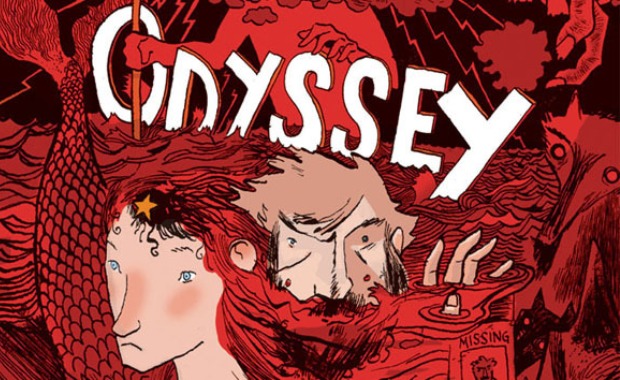
The clue to Paper Cinema’s work is all in the name. Borrowing from film, animation, comic book and puppetry, this is indeed cinema performed through the medium of paper; scenes formed live from hundreds of paper cut-outs and projected onto a sail-like sheet hanging at the back wall of BAC’s Council Chamber. Not quite definable as theatre, film or visual art, it might instead simply be classified as sheer, eye-popping ingenuity.

Using this distinctive method of manoeuvring paper models and drawings in front of mounted video cameras, Paper Cinema wordlessly retell the story of the Odyssey. Simple line drawings and an evocative score are injected with the heroic qualities of Homer’s verse, transporting us to heaving seas and scorched deserts, all lightly coloured by the recognisable iconography of Hollywood. Telemachus’ journey to track down his missing father takes on the character of an American road trip; Hades is a hell of dreamlike 70s psychedelia; the action movie and historical epic are repeatedly invoked. Even the meticulously honed process of framing these scenes imitates the visual movement and camera angles of the movies, rendering afresh the familiar techniques of cinema.

Strikingly – perhaps even more striking than the dazzling artistry itself – the production lays bare all its inner workings. On one side of the stage, two of the company sit surrounded by paper models, swiftly manipulating them in front of two cameras, while on the other side the band energetically dash between various instruments and objects, a live foley team in action. As stunning projections jostle for visual attention with the unveiled, astonishing work of the artists, the eye is torn by a desire to look simultaneously at the images and how they are being produced; at the magic and at the magician. This is not to suggest that the magic is ruined – if anything, the visible labour only makes the illusion all the more extraordinary at the same time as breaking it – but it does tear at the attention, sometimes productively, sometimes frustratingly.

Perhaps it’s churlish of me, given the undeniable wonder that the work excites, but I found a small part of myself always reaching for that extra little insight that the piece never quite offers up. Rippling with charm and beautiful to look at, it’s pulse-quickeningly gorgeous but paper-thin. In between being dazzled by the miniature visual feats of the company’s storytelling, I wonder why, other than the understandable artistic ambition of taking on a work of such epic scale, Paper Cinema have settled on the Odyssey. There is maybe something about the timeless appeal of such narratives and the ways in which they find themselves reflected in forms, such as the Hollywood movie, which persist today. Paper Cinema’s endlessly inventive visual techniques also have a habit of making unfamiliar the ubiquitous narrative archetypes of both heroic literature and modern cinema, although of course this is not necessarily specific to Homer and doesn’t really offer an illuminating new way of reading the tale of Odysseus’ famous journey home.

These, however, are nit-picking objections, complaints that quickly dissolve when confronted with yet another display of artistic virtuosity. Precise, delicate layering of the tiny paper models allows the camera to peek into windows and enter through doorways; flickering torchlight plunges us into a raging storm; the breathless chase of a boar hunt is swiftly summoned by sweeping fragments of scenery. And all the while, married to this skill is a homemade aesthetic that it’s hard not to fall a little bit in love with, recalling childhood paper cut-outs and games of make believe. By the end, whatever its small failings, it’s almost impossible to do anything but grin at the playful, mesmerising joy of invention.

Money – The Gameshow, Bush Theatre

????????????????????

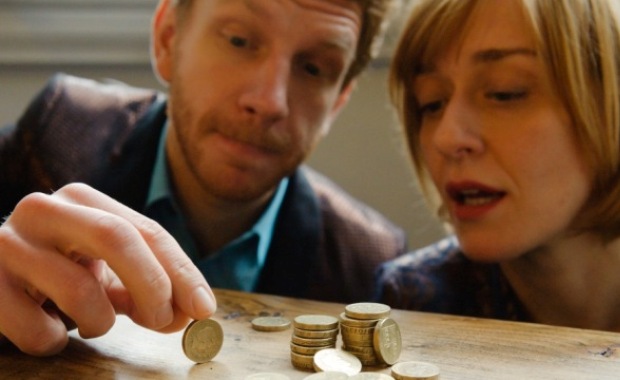
Ever wondered what 10,000 pound coins look like? The immediate answer is not very much. Walking into the main space at the Bush Theatre, configured as a gameshow set complete with flashing lights and garish set decoration, the pile of shiny gold items is disappointingly and surprisingly small. While this underwhelming realisation might not be the intended effect of placing so much cash on stage, it does have a fitting resonance with the performance of money in our society. Like the illusion of theatre, it relies on us believing in it, accepting one thing as standing for another. Except the idea represented by money is a hollow one, divorced even from the gold that the coins’ shiny surface suggests – a sign with nothing behind it, empty simulacra. We’re in the desert of the real and everything is up for grabs.

The function of the cash on stage in Clare Duffy’s show is to explain the financial crash of 2008, with a little help from two hedge fund managers turned performance artists. Queenie and Casino, played by the brilliant Lucy Ellinson and Brian Ferguson, split the audience into two teams and pit us against each other, playing games and placing bets in a bid to win the pile of coins; games fittingly involving bubbles and balloons teach us about long and short bets, dramatising with the help of audience members the culture of risk that led to financial collapse. The other and arguably more powerful effect of these games is to draw us into the adrenaline-fuelled thrill of the trading floor, injecting us with the giddy exhilaration that drives bankers, gamblers and gameshow contestants alike. Between these games, short scenes narrate the story of Queenie and Casino’s own involvement in the financial crisis, a bursting of the bubble that, far from avoiding, they actually placed a high-stakes bet on taking place.

In contrast with the alienating jargon that excludes many from an understanding of financial operations, the games devised by Duffy are pointedly accessible and quickly recognisable, evoking the playground more than the trading floor. Players shout and laugh in excitement, the audience whoops and jeers, Queenie and Casino bicker and tease. This childishness is visually reinforced at every turn, surrounded by bubbles and balloons, buckets and spades. The implication is perhaps that there is something immature and stunted about this way of playing with money, or maybe it is a game that has a primitive appeal to all of us. The riotous fun that is encouraged, however, threatens to undo its own work; as soon as the experience becomes too game-like, the sensation that all this risk-taking is ‘just playing’ becomes once again perpetuated, distancing us from a crisis that we can therefore dismiss.

Similarly, the doubled performance of money, while making these signifiers strangely unfamiliar, also runs the risk of departing so far from the real that it can be consigned simply to fiction. The further we feel from what the money represents, the more we think – like the traders – that what we do with it doesn’t have real effects. It is this flirtation with the performative function of money, however, that is one of the most fascinating aspects of the production. As Queenie and Casino repeatedly assert, money is founded on belief, on faith. But what happens to that belief in a theatre environment? What happens when a mimetic act is folded over on itself? Reflecting on the performance, it suddenly occurs to me that coin is an anagram of icon, with all its connotations of belief and worship but also a suggestion of something ultimately empty, a shiny surface concealing nothing beneath. It’s the exposure of this concealment that the show partly enacts, a stripping away of our socialised belief in money, but by the end the sheen is beginning to return.

The final portion of the show, once the games have been played and the fate of Queenie and Casino decided by which of their teams wins (Queenie’s – my team – on the night I went), there is a jolting gear change. Suddenly plunging us into the bleak reality of our zombie economy, accompanied by an abrupt shift from the flashing lights of the gameshow to a row of stark, blinking fluorescent strips, the piece changes track so rapidly that it’s possible to be derailed. There is a hovering moment at which the audience lurches uncertainly between smiling humour and a tentative suspicion that this is meant to be taken seriously. And it is horribly, gut-twistingly serious. The conclusion, unravelling slightly, but aptly so, reminds us of the situation that we push to the back of our minds, that we paste over with stories and a stubborn belief in shiny, worthless objects. It’s chaotic and terrifying and depressing.

As Queenie and Casino dance a dangerous tango, narrating the process of financial collapse as they twist around the stage, they refer to something known as ‘Roadrunner Syndrome’: “when you run off a cliff so fast that you keep on going on just thin air. It’s only when you notice that the ground isn’t there anymore that you fall.” This is what happened at the start of the crash, as banks ploughed on oblivious to the bubble bursting around them. But in many ways I’d suggest that we’re still treading that thin air, supporting ourselves on a slim but persistent belief in the mimetic structures of money. This production might make us glance down for a moment, maybe drop a couple of feet with a lurch of the stomach, but we don’t quite hit the levelling ground.

Image: Simon Kane.

Feast, Young Vic Theatre

Young_Vic_Feast_007_Photo_by_Richard_Hubert_Smith-600x399

Originally written for Exeunt.

“A person who does not know his own ancestors does not know his own grandchildren.” One of many small wisdoms passed from mouth to mouth during this patchwork celebration of Yoruba culture, these words are a fitting epigraph for a piece of theatre deeply concerned with identity and its roots in past, present and future. There is a profound sense that for those who are born into this culture, being aware of one’s past is integral to the hybrid cultural identity one forges in the modern world. Co-written by five playwrights from the USA, Cuba, Brazil, Nigeria and Britain, brought together as part of World Stages London, the creation and structure of the piece is an appropriately diverse and fragmented reflection of the Yoruba diaspora, a culture scattered across and filtered through four different continents. It’s a feast in which flavours clash, complement and blend.

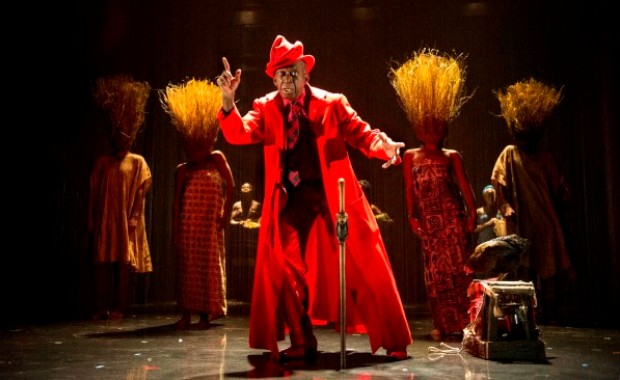
The scraps of scenes from the production’s five writers are loosely stitched together by the recurring presence of four Orishas, Yoruba deities, who appear and reappear in the form of fictional characters from across the past 300 years of Yoruba history. The three female Orishas Yemaja, Oshun and Oya, associated with motherhood, beauty and war respectively, are followed through the ages by Esu, a mischievous, chaos-courting shape-shifter who perpetually straddles the crossroads. Among the snatches we are shown from this huge swathe of history are a vignette on the impact of slave liberation in Brazil, a snapshot of the American civil rights movement and a post-Olympics scene featuring a young British athlete – more fleeting moments than scenes, tiny splinters broken off a story too huge to begin telling.

Conceptually, the shape of the whole is fitting. Any attempt to take a holistic view of a history and a culture that is characterised by its variety would be reductive and misguided; instead this consciously incomplete and fractured image mirrors the dispersed and many times translated and transmuted tradition that it depicts. The resistance to unifying narratives also speaks of a distrust of written history, a history that often – as in the production’s layered projections – writes over its subjects. This project instead attempts to capture something of the oral history that has passed down through generations and across continents, a history focused on storytelling rather than the imposed tyranny of facts. Unfortunately, the delicate fabric of the stories themselves is often not substantial enough to support the ambition of the piece as a whole, with scenes feeling broken or truncated, their jagged edges jammed awkwardly together.

Perhaps because of such difficulties, the production is at its strongest when most reliant on its dazzling visual elements. The slow, mournful dance that narrates the journey of slaves across the Atlantic through the bodies of the performers, upon whose torsos prices are starkly projected and who gradually slip between curtains lit with maps and names, disappearing into their own history, speaks louder than any of the contrived and sometimes clumsy scenes peppered elsewhere. Another powerful moment features a female dancer tugged from side to side, hands snatching at her body and covering her mouth, a physical expression of the violence implicit in being silenced. It is also the visual and aural that lend the show its most joyous moments, offering vivid, celebratory bursts of song and dance.

Of all the striking images that thread their way through this meandering production, one stubbornly repeats again and again, imprinting itself on the eye. As the trickster Esu guides us through the complex tangle of cultural history, he frequently shifts shape behind sliding panels, a slick bit of stagecraft that is tightly married to the questions of identity that the piece keeps returning to. Because if this show is about anything in the sprawling, amorphous history of Yoruba, it is about shape-shifting, both voluntary and enforced, and about how acts of transformation affect not only a culture or belief system, but also the equally complex individuals within them.

The Faction Rep Season

threesisters-600x374

Originally written for Exeunt.

Putting to one side the rep system at venues like the National Theatre, which is more a question of scheduling than essential artistic structure, the idea of the repertory theatre company has all but evaporated from London’s theatre ecology. Which makes The Faction’s rep season at the New Diorama Theatre, its second annual season of this kind at the small theatre in Regent’s Place, both a rarity and an oddity. Interviewing the company last year, ahead of their first foray into the rep system that they hope will one day be their staple, they spoke of their desire to create “big, classical, epic theatre”, looking to the model of European ensemble theatres. Ambition is one quality they certainly don’t lack.

Despite The Faction’s aspiration to the “epic”, however, their work gains much of its power through its intimacy. In the black box studio of the New Diorama, where the company are currently presenting the trio of Three Sisters, Blood Wedding and the UK premiere of Schiller’s Fiesco, their muscular take on classic plays is gripping in its proximity. Just as last year’s heart-pumpingly visceral Mary Stuart ripped audible gasps from me as I sat mere metres away, the vibrations of their percussion-fuelled, passion-drenched Blood Wedding can be felt in the very bones. When the company are at their most thrilling, “big” is not one of the words that jumps to mind; instead it’s their attention to the small and their inventive use of the limited resources at their disposal that most impresses.

Thrilling as their work may sometimes be, there are gaps and falters in the company’s emerging aesthetic that become more evident in this second – and in some senses more ambitious – season. While previously the performers’ own bodies were their main material, with twisting limbs conjuring tempests and confining arms acting as unsettling prison bars, the addition of more external elements to their spare staging has produced mixed effects. The European influence makes itself more conspicuously if not always successfully felt, as animal masks take their ubiquitous but not entirely justified place inFiesco and the playing space forms the canvas for accumulating mess throughout Blood Wedding. Also, by widening the repertoire with their first attempts at Chekhov and Lorca, there is the nagging concern that the company’s desire for new challenges is slightly at the expense of the thematic intelligence that informed their previous triptych.

If one thread can be seen to run through the three plays that The Faction have chosen this time round, it might be identified as passion – both in its pulse-racing presence and deadening absence. In Fiesco, a society poised on the brink of rebellion rests on the personal passions of the eponymous duke, a fickle revolutionary leader for whom selfish desire and pursuit of pleasure are tangled up with political convictions. As realised in this version, that knot of personal and political motivations is reflected in an extension of Schiller’s musical metaphor for revolution, casting the euphoric crescendo of democratic triumph as just another form of self-gratification. Rhythm and dance pulse through the piece, harnessing sharply choreographed movement to evoke the frenzied late capitalist dance of hedonism at the gates of potential apocalypse. These resonant echoes cannot be an accident, reinforced by the use of masks depicting modern day leaders and despots alongside the crowd of blindly pleasure-seeking animals, although this metaphor feels at times stretched.

Looked at one way, the stranded siblings of Chekhov’s Three Sisters can be seen as embodying three equally destructive strains of passion. Masha’s is passion fierily, unsustainably realised; Olga’s is passion thwarted, left to wither under the weight of years and work; and Irina’s is passion tragically unfulfilled, an embryonic desire never given the opportunity of birth. This new translation by Ranjit Bolt comes at a tricky time theatrically, dogged by the recent memory of Benedict Andrews’ invigorating injection of vodka and anarchy into the same text, but while not quite chasing away that memory, it does manage to hold its own. Visually, it is spare but striking. The stage is dominated by chairs that are slowly shuffled into new positions between scenes, somehow implying both movement and stasis – progression of time, but not of change. By the end they are upturned, speaking of disarray and upheaval, yet it is significant that they remain. Lighting is also used simply but sensitively, with one particularly evocative shaft of light from offstage hinting at the distant, unreachable, almost mythical Moscow. The overall effect of the production is at once beautiful and banal, recalling Irina’s words: “if life is beautiful, why doesn’t it seem so?”

If passion can be uncovered in Fiesco and Three Sisters, half-concealed beneath a veil, then it streams in thick, hot rivulets from Blood Wedding. The company take the use of rhythm in Fiesco up by a few notches, weaving pounding percussion and haunting a capella song tightly into the braid of the performance. The pulsing musical heartbeat of the piece is matched by a vivid visual landscape, all scattered sand and red heat. The spreading grains of sand summon Lorca’s world of scorched land, thirsty for blood and tears, while at the same time being used as currency, highlighting the economic dimension of matrimony. The production also presents us with the startling image of the bride wrapped in ropes, a strange enactment of ritual that visualizes the forces that bind and tug her, forces she understandably struggles to free herself from.

As well as inviting thematic connections and reflections, the other immediately evident effect of experiencing the rep season as a whole is on the ensemble itself. With the same company of actors taking on roles in all three plays, comparisons are inevitably drawn and casting decisions are brought more to the fore than might otherwise be expected. It seems apt, for instance, that the compellingly melancholic Derval Mellett take on the roles of Masha in Three Sisters and the bride in Blood Wedding, each time paired with Jonny McPherson as her illicit lover, though elsewhere the choices feel less calculated. There is also something simply and inexplicably satisfying about watching an ensemble across three separate productions, an experience so unusual that it immediately tickles the interest.

The overall picture that is assembled from these three pieces is not quite a complete, persuasive argument for the ensemble rep model, but perhaps its incompleteness is an argument in itself. One of the most appealing aspects of this structure is the breathing room it gives to discovery, allowing a group of artists to work together as a group, rehearsing and performing in rep, learning and building from both continually and simultaneously. For this reason, and for the captivating moments of inventiveness that emerge from The Faction’s process of discovery, the rep model might have some life yet.