Beautiful Burnout, Artsdepot

Originally written for Exeunt.

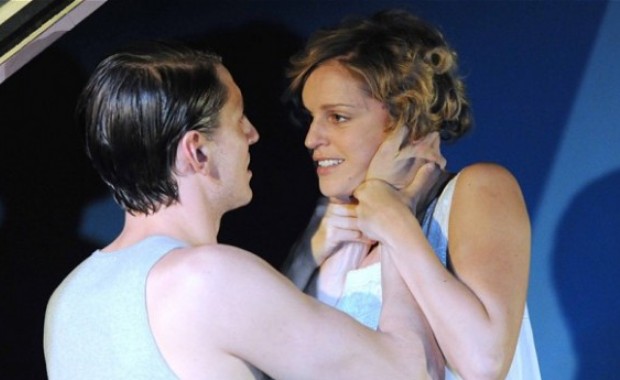
Three minutes. No more, no less. That’s the precise length of a round in professional boxing, a unit of time into which matches, training and Bryony Lavery’s punchy scenes are divided. It’s just enough time to dodge, feint and land the knockout blow. Shifting constantly from foot to foot, Lavery’s play explores the individual impact of a sport dominated by the swinging of the fist and the flash of the camera, an inherently performative spectacle that she reveals to be as much about control and discipline as it is about unbridled aggression.

This study of boxing takes as it object a small gym in Glasgow, where five would-be fighters, each with their own reasons to hit out, see the sport as a way out of the city and circumstances of their birth. Backed by a flickering bank of screens, these hungry, sparring youngsters are continually haunted by the future spectre of fame, their face on a television and their fists clenched around wads of cash. Laura Hopkins’ design places the performers on a raised platform that immediately recalls the boxing ring and that simultaneously holds them up for inspection, lifting them from the ground but not quite raising them up to the bright lights.

For a sport that bears striking if unlikely resemblances to dance – the uniting and separation of bodies, the swift lightness on the feet – Frantic Assembly’s treatment is a fitting and energetic one. Though sometimes lacking in verbal eloquence, through the language of movement the finely tuned bodies of the characters speak, a physical form of communication that is as central to the piece as the words of Lavery’s script. It is by way of this speech that these individuals come to define themselves; as the observing mother of one of the young boxers remarks, “it’s like there’s a smile in their bodies”. This physical language also carries into the use of Underworld’s music, a pulsing soundtrack that echoes both pounding heartbeat and the pounding ofpunches.

Rapid and pounding too is Lavery’s structure of short scenes and monologues, shifting restlessly from one to the next. While this approach keeps the audience on their toes as much as the tireless performers, the swift onwards movement can prevent the punches from being felt before the bell rings in the next round. The blows land, but they don’t always bruise. Any shortfall in the depth of the scenes, however, is compensated for with the sheer force of the performance, more than conjuring the sweat and determination of the ring.

Beneath this thrilling, muscular production there is a barely visible glint of rage at the injustice of a society in which one’s fists might be the only passport out of a dead end life – a rage smothered, like that of the protagonists, in precision and control. Despite the controversy that surrounds professional boxing, Beautiful Burnout embraces both its danger and its ecstasy, acknowledging how fighting can be an escape and a salvation as much as it has the power to destruct. Boxing is a dangerous sport, but so is life.

Ross Sutherland – Every Rendition on a Broken Machine


Originally written for Exeunt.

Man shapes creation in his own image; creation is unruly, rebels, behaves in ways not calibrated by man; man and creation become enemies, locked in a struggle that can only be terminated by death. It’s the stuff of cultural myth, a mutation of Genesis that persists in fiction from Frankenstein through to The Matrix. We are perpetually sowing the arrogant seeds of our own destruction.

In a hyper-connected world, the modern receptacle for such anxieties is, unsurprisingly, the machine. It is these anxieties that poet Ross Sutherland has channelled in his own confrontation with the uncanny capabilities of artificial intelligence, an intelligence with the amassed knowledge of the world at its disposal. Our one comfort in our encounters with these omniscient bundles of wire and code is the certainty that, for all their factual knowledge, they lack the emotional sensitivities that distinguish humanity. But if a computer is capable of writing poetry, the enshrined output of the soul – Wordsworth’s “spontaneous overflow of powerful emotions” – then where does that leave the human spirit?

Sutherland has been collaborating with a machine throughout his career as a poet, from his gleeful seventeen-year-old attempt to mutate Wordsworth’s ‘Daffodils’, to digitally tinkered versions of Yeats and Plath. Filtered through various different languages via the mediator of a digital translator, his resulting poems are the distorted offspring of their iconic parents, barely recognisable riffs on famous lines. It is this process that he explores in his film Every Rendition on a Broken Machine, an exploration of man’s animosity with the machine, the developments of digital translation, and the possibility that a computer might just be a better poet than a human being.

Presenting this documentary accompanied by his own live commentary – a wry nod to the conventions of the DVD – Sutherland adds another knowing dimension to this stand-off between computer and human. Standing next to a screen, it is Sutherland versus the computer multiplied by two. The film also acknowledges throughout the role of the computer in its own creation, tacking together YouTube clips and webcam recordings. As Sutherland states, it as though human and machine have become somehow enmeshed in modern society, the former often indistinguishable from its reliance on the latter.

Through his technique of distorting and remoulding poetry via a process of translation and retranslation, Sutherland speculates that poems might just be “computer programmes of a different order”; what he is embarking upon is a project of transforming technological glitches into something beautiful. There is also something gloriously honest about this process, which lays bare the inescapable fact that writers are always engaged in some level of plagiarism. Preceded by a vast literary history that has seeped, conscious or not, into our cultural identity, writing must necessarily involve quotation and acquisition. This is once again reflected in the form of Sutherland’s film, which borrows from sources as eclectic as J.G. Ballard and Clarissa Explains it All.

Behind everything Sutherland is doing is a series of ingrained cultural assumptions about the nature of poetry. As rigid as the patterns of rhyme and rhythm may be and as meticulously calculated as the craft of poetry often is, there persists a notion, perpetuated by Romanticism’s shrine to the imagination, that this is an art form that somehow offers a window onto the human soul. Perhaps at the root of our natural repulsion to the sort of collaboration Sutherland is proposing is not a fear for the computer’s destruction of the poetic muse, but a fear that the creative potential of the machine will reveal that this worshipped muse never really existed.

Yet there is something inherently creative about Sutherland’s strange craft. While the original words may be those of another poet and it is the computer that is doing the translating, this process is ultimately shaped by Sutherland’s hand; acting as a sort of sculptor, these elements are his materials and tools respectively. As artificial intelligence is sold to us in ever more “organic”, sexy packages, the threat of the machine garbed attractively in smooth lines and pseudo-friendly marketing speak – even given a human voice – that line between us and our gadgets becomes increasingly blurred. But beneath the screens and the apps and the iPoetry, the initial creative catalyst is always wonderfully, fallibly human.

Desire Under the Elms, Lyric Hammersmith

Originally written for Exeunt.

Property is a flimsy, fleeting, yet enduringly seductive object of desire. There is a bitter irony contained in an object over which lives are lost but which, as attested to by proverb, you can’t take with you. This empty basis on which possessions possess is laid startlingly bare by the Lyric Hammersmith’s new revival of Eugene O’Neill’s lust-laden study of ownership and desire, claustrophobically bound within the confines of a farm both built on and fought over with sweat.

The farm in question is under the disputed ownership of Ephraim, an aging but tough espouser of hard work whose joyless mantra is that “God’s hard, not easy”. As elucidated by O’Neill’s script in a laboured collection of expository scenes, this farm has become the subject of squabbling between his three sons, the youngest of whom, Eben, eventually buys out the stake of his two brothers. It is only when Ephraim returns, with pretty but fiercely acquisitive new wife Abbie in tow, that the friction between conflicting desires – material and physical – begins to emit sparks.

While O’Neill’s text is laden with words, lilting to a lazy rhythm that seems born from the slowly emanating heat of the earth, it is the visual landscape of the Lyric’s stage that seduces our attention. Ian MacNeil’s gorgeous design has realised the house at the centre of the characters’ alternately violent and petty disputes as a tellingly insubstantial structure, a plywood skeleton that dismantles into a series of self-contained domestic spaces. Its deliberately flimsy cladding and the abandonment of any pretence to cover its inner workings speak of both fragility and artificiality; the prize at which Ephraim, Eben and Abbie are all grasping is as creakingly hollow as it is ephemeral.

There also seems to be a recognition within Sean Holmes’ intelligent staging of the labour on which this coveted property has been founded, a labour that its “purdy” exterior would seek to elide. The wooden shells that house the various scenes are wheeled around the stage by figures in overalls, pointing to an act of labour by which the inhabitants’ comfort – or discomfort – is secured, an exposure of economic relations which in turn highlights the uneasy exchange that Denis Gough’s increasingly desperate Abbie is engaging in. As she initiates an inevitable affair with Eben, the acquisition at stake might shift from property to love, but payment must still be made.

Recurrent threads around these themes are insistently sewn by O’Neill and plucked at by Holmes’ production: the creeping threats of cold and poison, a “lonesome” chill that creeps through the house, the greedy, lingering promise of “gold in the sky”. The air of O’Neill’s world is as heavy with imagery as it is laced with desire – too heavy, it often seems, for his narrative to support. The melodramatic tint of the unfolding drama allows Gough to tear herself apart in a blistering, ferocious performance, but something in this strange, overburdened play seems to be torn along with her.

This House, National Theatre

Originally written for Exeunt.

The opposing benches in the House of Commons are placed at a calculated distance of exactly two swords’ lengths apart; it is an arena which was, from the very first, built with confrontation in mind. It is also an arena which, conveniently for the purposes of theatre, is no stranger to performance. The focus of James Graham’s new play, however, peels back the overtly theatrical space of ministerial speechifying to take a peek backstage, at the applying of the warpaint and the cracking of the whip.

His subject is a chapter of parliamentary history in which that largely invisible behind-the-scenes discipline was pivotal. The phrase “you couldn’t make it up” – avoided by Graham’s script but ever implicitly present in the farcical political wranglings presented on stage – is arguably more applicable to the parliament of 1974-9 than to any other period in recent political history. With little to no majority, Labour’s precarious position of governing rested on a “tug of war”, determined by who could exert the strongest pull on the “odds and sods” and the wavering backbenchers.

Placed in the heart of this parliamentary battlefield, Jeremy Herrin’s production constructs a compromised version of immersiveness, in which the audience are decidedly located within the sphere of the Commons but at a remove from its machinations. We are privileged observers, but never actors – a lack of agency that forms a fitting reflection of the average citizen’s place at the sidelines of politics. Rae Smith’s design has transformed the Cottesloe into parliament in miniature; the stage is flanked by those familiar, aggressively arranged benches, while the performance space itself is sharply divided into the government and opposition whips’ offices, the scene of scheming, dealing and ruthless backstage manoeuvring. No consensus politics here.

While the padded green benches on which we sit and the near-constant presence of the bewigged Speaker provide the perpetual visual backdrop of the Commons, the power games and posturing at play here might just as easily be taking place in the office or the schoolyard. This latter reference is brought to mind by the blackboard that haunts the government whips’ office, its chalked up political allegiances like marks against Labour’s governing. The schoolboy atmosphere of insecurities and one-upmanship extends into the spiritedly boisterous performances of the largely male cast, dominated by rival deputy whips Philip Glenister and Charles Edwards, who clog the air of both offices with frustrated testosterone.

As fascinating as this bizarre slice of politics is, the production seems also to be engaged with wider concerns. Primarily through the rivalry between Glenister’s and Edwards’ characters, Graham suggests that human nature is both the downfall and the triumph of politics, what gets in its way and what propels it forwards. It is an intriguing idea, but one that is not quite given room to be fully unpacked amid everything else at play. What This House does achieve with smiling clarity is a precise portrait of the foibles of the British political system, a system encumbered with idiosyncratic traditions and described as “creaking” and “diseased”, but a system that is at the same time implicitly compared with the giant clock in whose shadow the seat of power lies; both old, but still ticking away.

While Graham has delicately patched together an intricate and frequently compelling account of this curious caesura in twentieth-century politics, the complexities of these slippery deals and the very nature of the parliamentary stalemate that is its subject form something of a barrier. In the words of one frustrated MP, “this isn’t parliament, it’s a fucking purgatory”. Though at the end of the impasse, as Margaret Thatcher’s disembodied promise of “hope” echoes around the Cottesloe, this production makes it hard not to feel that this state of limbo might have been better than what was to follow.

Dead on her Feet, Arcola Theatre

There is something grotesquely fascinating about the cultural phenomenon of the American dance marathon. A product of giddy freedom and excess in the 1920s, this bizarre event – a strange marriage of leisure and endurance – soon became something of a symbol for the desperation of the Great Depression, as entrants seduced by the cash on offer for the winners and the promise of minor fame would dance for as long as they could, while paying spectators watched for days on end. Following a grimly Darwinian logic, the winners were simply the last ones standing.

Ron Hutchinson’s adoption of the dance marathon craze as a metaphor for the bitter competition of capitalist structures, then, would seem apt. So apt, in fact, that it risks becoming blindingly obvious. Latching onto one imagined smalltown dance marathon at the height of the States’ financial difficulties in the 30s, this new play has none too subtle resonances with the frenzied waltz of a recession-struck modern world, in which we must all keep spinning until we drop. A perceptive comment on our current predicament, perhaps, but nuanced? Not so much.

The dance marathon in question is engineered by Mel Carney, a manipulative ringmaster of sorts who comes to stand unambiguously, and thus rather problematically, for the evils of capitalism. In the goodies corner are a motley collection of contestants, all with their own sob stories and all equally tinged with desperation. There are grey areas, principally in the form of reluctant event bouncer and would-be good guy McDade, through whose eyes the narrative is refracted, but on the whole the lines are drawn with a heavy hand by Hutchinson and director Barry Kyle.

One of the more interesting devices that the piece deploys is a criticism of those who turn up to be entertained by the plight of others less fortunate, a tradition passed down from freak show to television talent contest. Shifting responsibility for the brutal spectacle he is facilitating, Mel appeals to the vicious voyeurism of the public – “the monkeys in the zoo aren’t half as bad as the monkeys on the other side of the cage”. It’s not hard to think of the modern parallel. With the performance space becoming the ballroom floor in Alex Berry’s design and the rows of seats its amassed spectators, we are involved without a full exploration of our complicit role in this kind of “entertaining” exploitation. The audience are implicated, but we’re never really made to squirm.

In much the same way, Hutchinson’s script seems to fire out potentially inflammatory observations while simultaneously backing away with raised hands. There are some incisive suggestions – that government is really just a matter of marketing, for instance, and that capitalism is not a calculated system of profiteering oppression but merely the inevitable manifestation of human nature – but these are explored in such hackneyed terms that they fail to really slice into the institutions and ideas that they are attacking. While it has some sharp moments, the bite always stops short of the bone.

Kyle’s production attempts to add some interesting dimensions to what threatens to be a flat parable of greed and desperation. What earns the dance marathon its particular position of fascination is the grotesque nature of the proffered entertainment, a sense of the grotesque that begins to infect the aesthetic here but feels only half committed to. While Jos Vantyler’s demonic Mel is all sleaze and sweat, a maniacally grinning caricature of capitalist greed, this almost cartoonish approach does not quite extend to the rest of the cast. In a similar way, there are moments during the nightmarish ordeal of the marathon when the production seems poised to play with the performance conventions of circus, with all its potentially exploitative connotations, but this too is only absently toyed with. Settling for somewhere in between naturalism and stylized satire, it doesn’t quite achieve either.

In the end, what turns out to be the most effective – and affecting – trick of the production is Hutchinson’s characters repetitive ringing out of capitalism’s broken refrain of “I really hope I win”, the bland yet quietly desperate maxim of the talent show contestant and the financially flailing worker. Because we all know that losing is the only option here.

~

As a postscript of sorts, I think it’s worth admitting the above as something of a failure. After rambling on in slightly idealistic terms about what I think the role of the critic should and could be and getting excited about this collection and examination of interesting things, I of course immediately saw two productions which, for various reasons, I didn’t find particularly interesting. This was one; the other was Fireface at the Young Vic, which I have inadequately dissected here.

Explaining why you don’t like something is always one of the challenges of criticism, especially when that not-liking takes the form of an indifferent “meh” rather than a passionate disagreement. Strong reactions, either positive or negative, are much more interesting to wrestle into words. When I leave the theatre feeling simply disappointed, I sometimes think it might be better for everyone involved if I just left it at that.

These are problems that Andrew Haydon has dealt with in more detail in relation to Fireface, partly prompting this admission of failure. I’ve tried, in both the review about and in my review of Fireface, to get at some of the reasons why I was less than thrilled by the respective productions, but I haven’t had the time to interrogate my underwhelmed reactions in the detail they perhaps deserve, at least under my own banner of doing criticism better. All I can do is continue trying.