Morning, Lyric Hammersmith

The auditorium is flooded with mangled, discordant screams. Pale fluorescent light creeps across the stage, illuminating a snapshot of horror with the clinical blandness of the hospital ward. And all around me, audience members stifle laughs.

This is the moment from Morning that is etched most vividly on my memory. Being seated in the middle of a group of teenagers, the demographic with which Simon Stephens’ latest, horribly compelling play concerns itself, offers a fascinating perspective on this piece – certainly not one likely to be found on press night (just one reason why it can be helpful to occasionally step out of the herd of ferociously scribbling critics, but that’s a subject for another time). Ripples of discomfort swell through the theatregoers around me as they drink in a cocktail of strangeness and recognition to which the only response is a nervous titter. As one boy put it on his way out, with a hint of awkward admiration, “that was bare weird”.

The “bare weird” show that Stephens and director Sean Holmes have created with the Lyric Young Company centres on Stephanie, a fiercely intelligent but disturbed teenage girl played with terrifying precision by Scarlet Billham. Sick with sadness yet unable to stop smiling, she dispenses viciousness without a flicker of concern. Stranded in an antiseptic suburbia where all the meticulously kept gardens look exactly the same, ennui is a permanent state for Stephanie and her friends – one of whom, Cat, is about to escape for university. Before she leaves, however, Stephanie has recruited unwitting boyfriend Stephen in a scheme for a savage send-off, an escalatingly brutal scene around which the play nauseatingly pivots.

I expect that numerous comparisons will have been made with Punk Rock, another unsettling Stephens play that takes modern youth as its subject. Not wanting to disappoint, I admit that such thoughts did strike me while watching Morning; in many ways these are quite different pieces, but a direct line can be drawn between William Carlisle and Stephanie. In each case, Stephens’ protagonist is startlingly intelligent, an intelligence that acts as an uncanny counterpoint to their respective brutality and apparent emotional detachment. Eschewing the hoodie-clad image that haunts portrayals of contemporary teenagers, Stephens’ portraits of this generation are all the more blackly horrifying.

What strikes me as being particularly important, perhaps for this play even more so than Punk Rock, is the teenage perspective. This is perhaps because my ears are still ringing with the words of Ontroerend Goed’s Alexander Devrient, who said something along the lines of teenagers being at a stage of life in which they can see what is wrong with the world but are not yet able to formulate any remedial ideologies (I’d recommend listening to his full, thoughtful, softly spoken interview for Theatre Voice, in which he speaks eloquently and at length about his work with young people). But what if they only see diagnosis without cure because that is the unacknowledged truth of the world?

Perhaps what we can take from Morning is the incisive awareness of a world in which, in Stephanie’s words, “everything is fucking shit”, an awareness not yet blunted by ideology or philosophy or religion – teenage nihilism three times distilled. But there is a taut, oddly appealing ironic tension between this apparent nihilism and the quotation from Marx that Stephanie prints in bold felt tip: “the philosophers have only interpreted the world; the point, however, is to change it”. The knowledge that this piece has been made specifically for and with the age bracket represented then adds another fascinating layer; how have the astonishingly talented members of the Lyric Young Company influenced this final, unblinkingly bleak vision of the world?

Which brings me neatly, if not uncomplicatedly, onto my next point. As discussions of Stephens’ work tend to veer towards considerations of collaboration, especially in the wake of the extensive critical discussion around Three Kingdoms, and as I’m ever more conscious of the disingenuousness of critically portioning a production into writing, direction, design and so on, it seems apt to reflect on the ways in which the various elements of this piece feed into one another.

In considering the aesthetic of the whole, the words that rise most stubbornly to the surface of my mind are “antiseptic” and “clinical” (neither in a negative sense, I should add, but one that feels crucial to the piece). From stark fluorescent lighting to unsettlingly alienated performances, there is a sterile coating that settles over the production like the shimmering sheets of plastic that shroud Hyemi Shin’s set. The design itself is what first snatches at the attention: the large, half-filled glass tank of water, the industrial fridge containing a single bag of blood, the forensic tent, the assorted lights, the plastic – there’s lots of plastic. This seeps into the plasticity of the performances, a sort of blank, detached distortion of naturalism that could just be taken for stiff acting in the opening moments but that soon emerges as a very particular style, one that is married to the coldly artificial quality of the design and the dislocated realism of Stephens’ text (a misleading and loaded word, as I’ve discussed elsewhere, but one that will do in the absence of a more precise vocabulary).

In place of the domestic settings to which Stephens’ dialogue refers, the production is littered with forensic paraphernalia, an implicit nod to the current ubiquity of the detective narrative, but this is a crime scene in which nothing is solved (a nice example of how a non-literal interpretation can be a more perceptive comment on the text than one which sticks rigidly to its real-world inferences). It also hints at a certain clue-hunting critical approach to theatre, a quest for meaning that Stephens – and indeed the whole production – actively eschews.

Without listing every aspect of this intriguing staging, the other element of the production that merits particular mention is Michael Czepiel’s nightmarishly distorted soundscape, which is produced live on stage with both Czepiel and the sound desk in full view. As well as peeling away the illusions of theatricality, this choice pulls on strands of voyeurism and plants another of the production’s subjects as a permanent presence, the (mostly) silent youth glued to the computer screen.

Returning to nihilism, this multi-layered whole produces an anarchic, punk-inflected void of meaning, a great black gaping hole where we might expect to see hope or redemption or some kind of “message”. Perhaps deflecting some of the criticisms that have been levelled at his work in recent years, the concluding words of Stephens’ script (yes, sorry, I’m attaching elements to single individuals once again, but let’s just assume for sake of ease that these words are purely Stephens’) are a gutting “fuck you” to any demand for an optimistic chink of light. But just to contradict that – and to once again overturn my simplifying attributing of authority to Stephens – the production itself goes on to complicate this appropriately teenaged gesture of rebellion.

Morning is the sort of uncompromising piece that inevitably cleaves opinion, if not perhaps to the same impassioned extremes as Three Kingdoms (which I will, eventually, stop going on about – probably). Potent reactions spill tangibly through the audience throughout the painfully gripping hour of the play’s length and pour out into the packed foyer after the final bow. The one response that is markedly absent from the teenagers around me, however, is shock. Like Stephanie, they emerge smiling. After all, if you know already know that there is nothing but terror, what else is there to do but laugh?

Blink, Soho Theatre

The human eyeball is a lot like a single lens reflex camera. Both have a lens, a focus, a destination where the picture is formed. In the same way, love – at least for Phil Porter’s pair of charmingly strange characters – has a lot in common with voyeurism. The initial jolt of something like recognition, long periods of watching and yearning, a gradual descent into familiar comfort.

Watching is central to Porter’s off-kilter romance, visiting the Soho Theatre fresh from Edinburgh. Sophie feels as though she is slowly disappearing and has a desperate need to be observed. Ever since volunteering as the night watchman for the reclusive religious commune in which he was raised, Jonah likes to watch. It is a match made in Peeping Tom heaven. While playing with the conventions of the rom-com, however, this is distinctly setting itself apart from traditional romantic narratives – less hearts and flowers, more foibles and dysfunction. It is a love story, Jonah is keen to emphasise, but perhaps not the kind we’re used to seeing.

As already established, seeing and being seen are overt themes. A number of Sophie and Jonah’s shared activities involve watching, including a telling level of emotional involvement with a television plot, while it is not insignificant that the most erotically charged moment between them is sparked by an act of joint voyeurism. This atmosphere of covert observation is reflected in Joe Murphy’s direction, which places actors Rosie Wyatt and Harry McEntire at opposite sides of the performance space, stealing looks at one another while directing their separate segments of the same story to the audience. They take turns to watch, switching between spectator and subject, but rarely do their eyes meet in a moment of direct intimacy.

What all this watching hints at, other than a natural human instinct towards nosiness, is rather more interesting. Sophie and Jonah’s relationship, for want of a better description, begins through the mediator of a camera in Sophie’s flat, placing a screen between the pair from the beginning. This immediately leaps out as a symptom of the digital age, an indictment of the lack of real connection engendered by our ultra-connected society, but it’s not quite as simple as that. Although these two characters certainly suffer from an allergy to intimacy, Jonah has been brought up starved of technology, suggesting that our difficulties with relationships and our fondness for the false intimacy of pining from a distance run deeper than the digital sceptics might have us believe.

There is also a link to be drawn between the feeling of being watched and the subtle religious references made by the piece. While Jonah’s fiercely pious upbringing is primarily a source of comedy, the concept of a divine being is not just there for laughs. There is something in Sophie’s poignant desire to be seen that speaks of an inherent impulse to believe in a greater power watching over us, while the knowing adoption of the sort of coincidences typical to the rom-com genre throws around ideas of fate and destiny, once again implied to have more to do with psychological need than any universal master plan.

Far from being the exclusive preserve of a deity who directs our lives, Blink seems to be saying that watching is an intensely human activity. It is also an activity that we as an audience are of course deeply complicit in. This is powerfully felt in a brief moment when Wyatt and McEntire, enacting the joint activity of watching television, sit and stare out at us. What we as an audience are doing, crowded into a dark room with a group of strangers to gawp at a couple of people pretending to be other people for an hour or two, is essentially quite odd, a largely unacknowledged observation that the piece could do more with. In a play so concerned with spectatorship, it neglects to truly dissect the act of spectating that makes the piece possible in the first place.

For all the interest sparked by Porter’s intelligent, multi-layered text, the production is largely made what it is by the appeal of Wyatt and McEntire, in whose hands these weird, lonely characters become almost unbearably endearing. They are both kooky while delicately side-stepping cliche, staying just the right side of twee and occasionally snagging our emotions on moments of gutting, unshowy sadness. If it were possible to capture the overall aesthetic of the performances, they linger somewhere between cute and detached; a sort of dislocated realism that might easily be taken for straightforward naturalistic acting but has just the lightest touch of strangeness.

This strangeness bleeds into Hannah Clark’s set, which begs us to look at it. The Ikea-meets-woodland-meets-kitsch design is made up of a back wall of panels showing a blown-up photograph of a forest scene, a carpet of imitation grass, and a selection of office furniture that is gradually moved around the space. Much can potentially be taken from these intriguing choices, but the most striking comment made by the set is one that is married to this idea of intimacy at a distance. Just as Jonah falls in love with Sophie while watching her on a screen, the “outdoors” that Clark’s design presents us with is pointedly fake and photographic – a distant representation that appears on something very much like a screen.

As much as it eschews the trajectory of the rom-com (how many love stories begin with anecdotes about dissecting eyes or removing teeth?), there are moments when Blink trips up slightly on the tropes it is teasing us with. But just as Porter seems to have relented to the irresistible appeal of his oddball characters and given his audience what they want, this anti-climactic possibility is quietly ripped away. This enchantingly quirky piece is too clever to conform to our expectations, as much as it may flirt with them, but in its subversion it equally takes us by surprise. No jaw-dropping denouement, the final narrative twist is unobtrusive, gentle, with a bleak note of inevitability. It is even sadder for this. A fondant with a heart of bitter chocolate, the beauty of Porter’s creation is that the whimsy is always tempered with something altogether darker.

Blink runs at Soho Theatre until 22nd September at Soho Theatre.

Photo: Sheila Burnett

Brand New Ancients, Battersea Arts Centre

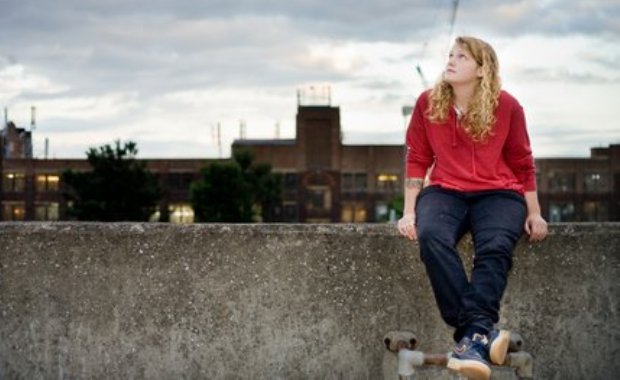
“We are still mythical,” Kate Tempest persuasively tells us, looking around with wide eyes at the crowded space of the Council Chamber at Battersea Arts Centre – historically the most un-mythical of places. Her new show, taking as its basis the ancient use of mythology as humankind’s way of explaining itself, attempts to convince us that the gods are really everywhere; on park benches smoking fags, at the bar pulling pints, in the room around us. All of us have the ability to be mythic heroes.

This clash of the old and the new, of the exalted language of the gods and the lyrical banalities of the modern high street, feels perfectly at home among the gently crumbling architecture and faded charm of BAC. An unexceptional figure in jeans, T-shirt and plimsolls, Tempest commands this space, striking a startling stance between declamatory power and guileless warmth as she paces the stage with her microphone while the air around her crackles.

Part electric spoken word performance and part gentle storytelling, Tempest intricately weaves together the tale of two families, ordinary and alike in their everyday miseries. For her contemporary Oedipuses and Medeas there are marriages and affairs, betrayals and violence, all equally related with a compassionate lack of condemnation. The bond of friendship between two young men demonstrates the capacity for love even when surrounded by abuse and rage, while another boy escapes the dull reality of his life by sketching comic book epics, vivid sagas of those modern day gods known as superheroes. Tempest’s characters struggle and love and hate and regret, all to the evocatively pulsing soundtrack of Nell Catchpole and Kwake Bass’ live score.

Tempest’s style of delivery marries poetry, song, hip-hop, oratory and – ironically appropriate amidst all this talk of gods – something of the preacher. Fittingly both heavenly and earthy at once, she slides from close-eyed, lilting lyricism to bare, stripped down direct address, stepping out of her performative self to offer artless confidences. At odd moments, usually in the wake of a particularly crude observation, she shrugs, as if by way of charming apology for what she has created.

There are undisguised slip-ups in the performance; Tempest mixes up the names of two of her characters, correcting herself with a laughed explanation, before later tripping on one of the wires snaking across the stage. The lack of polish, far from distracting, makes for something much more vital and – crucially for Tempest’s purposes – much more human. We’re all flawed, she seems to be saying without apology, and that’s OK. While in one sense taking up the mantle of tradition and, like many poets before her, adopting the role of chronicling heroes, there are no pretences of poetic perfection here.

For all this easy charm, underneath the fizzing performance and beaming wit there is something urgently furious at the heart of Tempest’s plea for the value of humanity. Between the houses and parks and pubs, Tempest’s vivid brushstrokes capture a world in which “everything’s weighed on the scales of profit” and we fall on our knees before the false idols of fame, Saturday night entertainment and Simon Cowell, that modern day serpent in the grass. In this fame-seduced world, the television recurs as a symbol of loneliness, a poor but addictive substitute for the company of others.

In pleading her case for the gods and heroes all around us, Tempest is arguing for an appreciation of others that does not hinge on money or fame, but a recognition of the capability for love – as much as the vulnerability to hate – that exists in all of us. We might be flawed, but we are still mythical. And these stories that Tempest is telling us, with raw and captivating power, are the new parables.

Brand New Ancients runs at BAC until 22nd September.

The Ugly Sisters, St Stephen’s

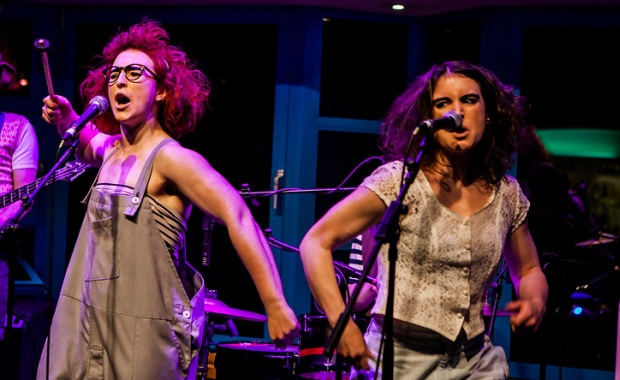
RashDash’s rock-infused cabaret restyling of Cinderella really shouldn’t be as good as it is. Reimaginings of fairytales are hardly original; almost every maligned fictional villain has now had the story retold from their misunderstood perspective. Likewise, there is nothing particularly earth-shattering about RashDash’s scruffy-punk aesthetic or the music of accompanying band Not Now Bernard. So the gloriously anarchic product, transcending its angsty teenage premise, is fairly remarkable testament to the charisma and chemistry of this accomplished performing duo.

The narrative twist that is executed by RashDash throws the Cinderella story into the midst of rabid, fame-obsessed contemporary culture and the distorted world of “reality” television. Dragged up in a world of burned out cars and used needles, twins Emerald and Pearl undergo their own rags to riches transformation when their fortunes are changed by their mother’s marriage to a wealthy single father, but this is no fairytale. As they find themselves increasingly overshadowed by seemingly perfect Arabella – dubbed “Cindy-rella” by Emerald – the girls decide to copy their stepsister by entering You Shall Go to the Ball, a nauseatingly plausible television contest to win the affection of a prince.

But it’s not the gruesome dissection of reality TV that really slices to the bone – we already know that The X Factor is an amplified freak show, the grim voyeurism of the eighteenth-century asylum made-over by the worst excesses of Saturday night entertainment. Instead it is RashDash’s cuttingly perceptive indictment of the roles that women are straitjacketed into by this media-obsessed society that remains most firmly embedded in the mind. In an attempt to match the appeal of materialist, manicured Arabella (ironically represented by a male band member wearing a tiara), the two sisters wriggle into boob tubes and totter on platform heels, pouting with hands on hips in a pose that exemplifies the anxiously conformist vanity of the Facebook profile picture – hilarious but grotesque.

There is also something fairly potent in RashDash’s approach about the nature of narrative and the power held by the storytellers. With the media under a particularly scorching spotlight at present, their turning of the tables is yet another instance of how our perceptions are determined by those clutching the pen – the implication being, of course, that it has always been this way. While such distortions now lie in the hands of profit-conscious TV producers and tabloid editors, the continued currency of fairytales illustrates that there has always been a tendency to paint heroes and villains.

Such musings, however, arose mostly after the event. The show itself carries its audience along on a momentum of charismatic, impressively physical performances and fierce vocals; a sharp and irresistible adrenalin rush of playful, cabaret-style narrative riffing that races past at a furious gallop. The intensely performative confessional of the cabaret show is an appropriate vehicle for telling Emerald and Pearl’s side of the story, but this genre is spliced with other elements. The use of foot pedal looping to create a layered musical narrative, for example, offers one of the performance’s stand-out moments of inventiveness, suggesting the noise of the various voices surrounding this story. RashDash also throw in some cheeky chunks of meta, making knowing nods to the theatrical conventions they are working within and teasing us with the prospect of intimidating audience interaction that often accompanies such performances, without ever fully committing to this strand.

Ultimately, it is perplexingly hard to articulate just why this works. There may not be a great degree of originality or distinctiveness to RashDash’s approach, but in execution it is unfailingly enjoyable. Like the fairytale it takes as its basis, it may be familiar and not all that exciting on paper, but it translates into an undeniably engaging night of entertainment.

A Thousand Shards of Glass, St Stephen’s

Originally written for Exeunt.

Much like the inevitable solo film trilogy, a piece that advertises itself as a one woman action adventure thriller is the sort of theatrical experience usually best avoided at the fringe. It sounds suspiciously as though it might involve a diluted Lara Croft figure and misguided martial arts. Jane Packman Company and consummate storyteller Lucy Ellinson, however, demonstrate that genre can be a tool for reinvention as well as a chain to confine.

The show’s staging, like its premise, is deliciously deceptive. Seats arranged around a circle enclosing nothing more than a ring of lights linked by fat, snaking wires, this would appear to be the height of theatrical minimalism. In a sense it is. As the piece progresses, however, the conceptual care behind each simple creative choice becomes ever more apparent. Nothing here happens by accident.

In the absence of any concession to naturalistic scenery, the tale that Ellinson spins takes place in the vast landscape of our imaginations. Seated in our circle of chairs, gazing across at one another, the audience configuration is reminiscent of the campfire – a forum for fantastical stories since stories began. As spectators, we are also fragmented, separated, identified as individuals rather than as part of an amorphous whole and thus forced to fully engage with the performance. Creeping around this circle, Ellinson conjures a flat, projected world, a Matrix-like illusion in which the human race are trapped and from which she alone can save them.

In this magical realist, two-dimensional space, there is an apt element of the graphic novel to the text’s vivid yet artificial frescos. One of the most vibrant scenes is that in which Ellinson’s character circles around Egypt in a taxi, ticking off colourful scenes of the surrounding market that summon a bustling mental picture, but one which snags uncomfortably on the corners of the mind; like the protagonist, we too can see the edges. Repeated images whirl past in aTruman Show carousel of fakery, seeming real but not quite real enough.

That my references are all to films is no mistake. It is from this art form that Jane Packman Company takes its stylistic cues, borrowing from Hollywood tropes and flitting schizophrenically from scene to scene in the manner of the scissor-happy action movie aesthetic. Lewis Gibson’s evocative soundscape, the piece’s one aid to the imagination other than the loop of flickering lights, is a nod to the surround-sound conventions of modern cinema, as noises emit from speakers dotted throughout the space and two sound boxes are passed between members of the audience.

The influence of film, among the most elaborately artificial and widely reproduced artistic mediums, also seems fitting for an imagined world constituted of signs. This flat world, this “desert of the real”, to borrow – as The Matrix does – a phrase from Jean Baudrillard, becomes an unsettling metaphor for a society which has accepted the flat, airbrushed reality of capitalism. In contrast to this steady stream of simulacra, the tricks of the production are all visible and unmasked, from the protruding wires of the lights to the sound boxes that travel from hand to hand – a method of staging that seems appealingly mutinous in itself. This may only be a story of resistance, but its rebellious sentiment is one that outlives the narrative.

At a festival where epic ambition is often traded in for intimate bite, Jane Packman Company has found a gorgeously simple way to happily marry the two. The literal space occupied by the piece is bare and compact, paced by Ellinson alone. But the cavernous realm of the imagination, unrestrained by practical limitations has far greater epic sweep than even the most immense of stages.