Karagula, Styx

karagula-at-the-styx-600x443

Originally written for Exeunt.

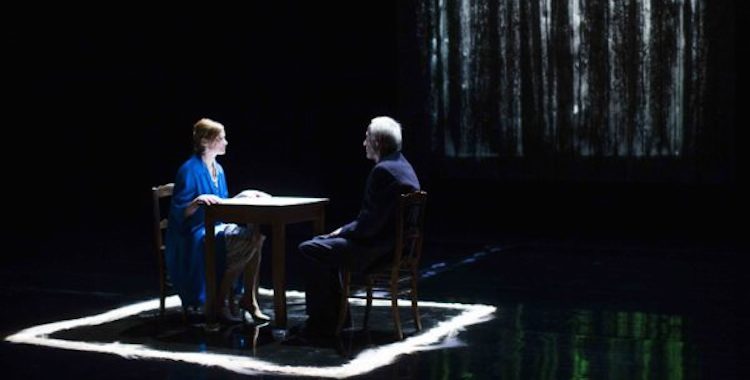
Often, Philip Ridley’s work treads a fine line between reality and fantasy. Monsters dwell in bedsits and the strange erupts from the mundane. In his latest play, though, he abandons himself entirely to the fantastical. Karagula is a messy, sprawling sci-fi epic, spanning hundreds of years and dozens of characters. It’s a long way from the contained, claustrophobic oddness and horror that Ridley is perhaps best known for.

We start, at least, in familiar territory. A young couple kiss in the dusk, talking about the upcoming prom. Soon, though, this hackneyed scenario is subverted. Dean, tipped for prom king that year, is afraid about what happens after he’s crowned. His girlfriend, Libby, romanticises the glory of his forthcoming sacrifice. There’s talk of bullets and blood. Then, while we’re still digesting the sudden change of tone, the play wrenches us somewhere and somewhen else. And somewhere and somewhen else again.

As with his earlier play, Shivered, in Karagula Ridley takes a hammer to his narrative, piecing its splinters back together in non-linear form. To begin with, scenes share little to no relation to one another. We’re dazzled with a baffling array of characters and places and conflicts. Gradually, though, connections appear between what seem like completely different worlds. What looms into view, as we assemble it piece by piece, is a jigsaw puzzle of vast proportions, following one imagined civilisation through upheavals, revolutions and brutal civil wars.

This is ambitious stuff to put on a stage. Sci-fi of this scope tends to be reserved for films, high-budget TV and hefty novels. It’s especially ambitious on a fringe theatre scale (and budget), which is what theatre company PIGDOG have – albeit somewhat wonkily – achieved. There are a huge number of scenes and settings to race through, a feat managed with impressive fluidity thanks to canny use of lighting, sound and space in Max Barton’s production. In a former ambulance depot in Tottenham Hale, the audience are seated along two sides of the action, our attention being dragged swiftly from one end of the space to the other with a dynamism that matches the energy of the fast-moving script. Only after the interval, when the seating switches to an end-on configuration, does it begin to drag a little.

Faith – often misguided – is a recurring theme throughout. In Mareka, the uncanny, pink-tinged replica of 1950s/60s American suburbia where prom kings and queens are annual sacrificial offerings, the worship of milkshakes is an incitement to murder. In other fractured, fragile societies, belief latches onto whatever it can find. I’m reminded more than once of Mr Burns, which traced the post-apocalyptic elevation of fragmented pop culture to semi-religious idol. If Karagula as a whole is “about” anything, then it’s about the stories we tell ourselves to make sense of the world and the lengths those stories can lead us to. Narratives create meaning, but they can also sow the seeds of destruction.

As for Karagula’s narrative, it’s as bloated and baggy as it is ambitious. For every scene that builds the intrigue and increases the tension, there’s another that’s wildly superfluous. The second half, while shorter than the first, feels drawn out – especially a scrappy bunker scene that long outstays its welcome. PIGDOG do their best with it, chucking in a TARDIS-full of visual sci-fi references and pluckily making the best of the budget Doctor Who aesthetic, but what Ridley’s play really needs is streamlining. Epic and ambitious, yes, but not half as haunting as the confined nastiness that Ridley specialises in.

Photo: Lara Genovese.
Without Blood, The Place

without-blood-600x400

Originally written for Exeunt.

Without Blood is a show of contrasts. War and peace. Revenge and forgiveness. Sound and silence. Light and darkness. White chalk footprints on a smooth black floor.

Yet for all those contrasts, all that black and white, it’s essentially a piece about grey areas. It inhabits those murky moral zones that expand during times of conflict, when murder is recruited to the cause of the greater good and the lines between right and wrong look increasingly shaky. A group of men kill in cold blood. A child is caught up helplessly in the violence. The cycle of pain and retribution goes round and round.

Inne Goris’s production is an adaptation of Alessandro Baricco’s novella of the same name, which tells a story of war and its consequences that is deliberately blurred at the edges. The catalytic events – never seen, always heard or described – have taken place during a four-year war, but neither nations nor sides are named. We’re left wondering where this is and what was being fought for, forced to decipher the unravelling narrative with patchy guesswork.

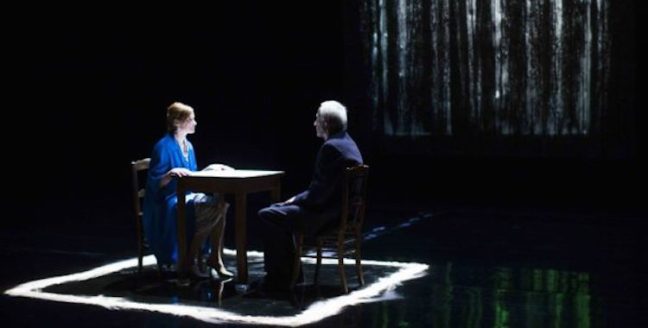
There is, thanks to this deliberate vagueness, something of the allegory to Without Blood. At times in Goris’s version it even seems like a dark fairytale, with its odd, occasionally almost fantastical, storytelling and the haunting presence of a child clad in red. This child is a young girl whose father and brother were killed by soldiers while she hid under the floorboards. Now, 52 years later, her older self sits across the table from one of those soldiers – the one who found her and quietly let her live. Many years after a war that never really ended for either of them, they stare across at one another and tell their stories.

Goris’s approach is all tell, no show. Speaking about themselves in the third person, at one remove from their own traumatic experiences, the two characters narrate the past that we are denied access to. Only in the opening minutes, under cover of darkness, do we get a glimpse of the events that knitted together the lives of the two protagonists, and even then it is through the abstracted forms of music and minimal projected text. There is a sense that war is not something that can be straightforwardly represented.

It ends up feeling, though, like the novella has been simply placed on stage, rather than having been adapted into a distinct theatrical idiom. With so much of the show consumed by slow, static speech, it’s a struggle to maintain the concentration that would be held rapt by the same words in prose. The stories themselves are compelling, but their telling lacks any dynamism.

That’s not to deny that there are some striking touches. Dominique Pauwels’ music opens the show with a jolt of horror, its aftershocks ringing periodically through the quiet conversation that follows. The outline of chalk around the table where the two characters sit, meanwhile, lightly suggests the division of past from present – a division made ever more permeable as the ghostly figure of that girl under the floorboards walks across and through it, trailing white dust.

“You have an odd way of telling things,” says the former soldier to the little girl grown old. The same could be said of this production, whose strangeness and stillness become increasingly frustrating. The pain of war might persist, but Goris and her team never make us feel the sting.

Photo: Koen Broos.

YOUARENOWHERE, Shoreditch Town Hall

YOUARENOWHERE, all one word, can be read two ways. It can be a statement of certainty, of being decisively placed in the world: you are now here. Or it can be a revelation of nothingness, of uncertainty: you are nowhere.

Andrew Schneider’s glitching mindfuck of a show is sometimes one, sometimes the other, sometimes both. It is, in every sense of the word, disorientating. It jolts its audience out of time and space – or maybe it just makes us realise that time and space are one and the same, and that everything is happening all at once.

From the moment we first see Schneider before us, the rules by which we usually order world and stage are violently disrupted. Schneider doesn’t enter; he suddenly materialises. The lights snap on and there he is, shirtless and panting, as if vomited up out of nowhere into this bare white space. In appealing disarray, he begins to talk to us, but the mechanics of the show around him keep interrupting. Coloured lights flash on and off. Huge swells of sound swallow his words. Technology glitches.

You think of time like a line, right? Or like a road, stretching out behind and ahead, you gliding along in the driver’s seat. Wrong. In his quick-fire, cut-up lecture – stories are abruptly truncated, ideas diced up and thrown back together – Schneider rapidly unsettles popular, shared notions of time. The references whizz by so fast it’s almost impossible to grasp them – Einstein’s theory of relativity gets a nod, I’m pretty sure – but the overall sense is of a sudden unmooring from the certainties of seconds, minutes and hours.

It’s about form as much as, if not more than, content. There are moments in the show when we feel time, we note its passage (even if “passage” is just another flawed metaphor for a false, man-made construction). At other points, we can see its signifiers – the clock rapidly counting down, the lights flickering on and off – but feel somehow wrenched out of it. Or at least I do. As Schneider makes clear, different perspectives create different realities.

Death, as well as time, is a constant preoccupation. If there’s any way in which we can individually grasp time, after all, it’s as an inexorable movement towards our eventual demise. What if, Schneider poses, every time you thought about death there was another you, in a parallel reality, who had actually died in that moment? Like a morbid take on Sliding Doors, or a version of Constellations with a rapidly mounting body count.

And there’s more. There’s all this stuff about missed connections, fate, love. The loneliness of being trapped inside your own head, your own existence, trapped outside the perceptions of others. Forever separate. “We exist in each other’s realities,” says Schneider. “But not in the way that we think we do.”

Those words might read as a thesis of sorts, if it were possible to boil YOUARENOWHERE down to anything as simple or straightforward as a thesis. As a demonstration of its own ideas, Schneider’s show refuses to slot into any kind of linear logic, impressing itself on the consciousness as a disconnected series of images and sounds and thoughts. But, whatever physics might say, we humans are meaning-making creatures, and so meaning emerges nonetheless.

Schneider, though, has a few tricks to unsettle that instinctive dot-joining. The second half of the show is a series of dazzling, gasp-out-loud rug pulls, each more audacious than the last. Just as we think we’ve found our footing, Schneider sends us stumbling once again. The last reveal in particular robs me of my breath and makes my stomach fall entirely away. I feel dizzy, discombobulated, as lost as the man on stage.

But what’s really there beyond the trickery? Is it, I ask myself, just a load of superficially clever posturing dressed up in the kind of pulse-raising stagecraft that makes me go giddy? There are definitely bits of YOUARENOWHERE that feel like the “gobbets” Irwin encourages the Oxbridge hopefuls to use in The History Boys: chunks of borrowed cleverness, plundered with little care for their origins. And yet. Whether it’s the startling precision of Schneider’s staging or the cumulative effect of the show’s snippets of physics and philosophy (most likely both), something about YOUARENOWHERE lingers. Days later, its echoes still intermittently rupture the rhythms of the day like a shiver down the spine – or, perhaps, like the unnerving feeling that I’ve been here before.

Presented by Shoreditch Town Hall, Gate Theatre, Notting Hill and LIFT. Part of LIFT 2016.


Handle With Care, Lighthouse Poole

handle_with_care_15_2562195628-600x399

Originally written for Exeunt.

Increasingly, we’re losing our sense of home. As Generation Rent moves from houseshare to houseshare, other things start to take on the meaning that was once contained by four walls: people, habits, objects. We have more and more stuff, invested with more and more emotional value, but less and less space in which to house it.

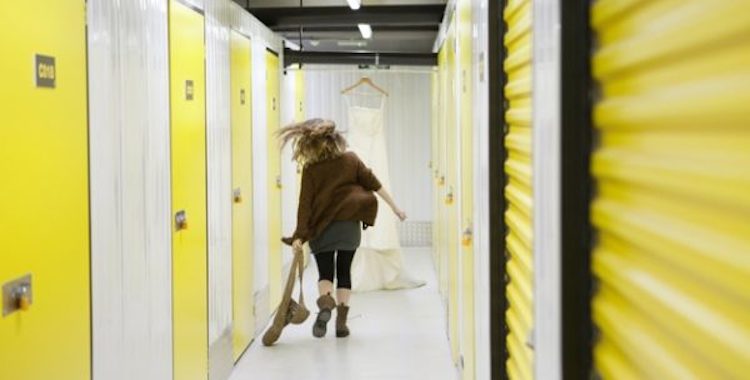
Dante or Die’s new show is interested in all that stuff – the detritus of living, and what it means to us. It’s being performed in some of the many self-storage warehouses that are doing booming business in a nation of space-challenged hoarders. These echoing, artificially cool spaces are odd environments, their impersonal exterior containing sometimes intensely personal artefacts. This contrast is just one of the ideas that Dante or Die play with in Handle With Care, which sees one woman’s life through the things she decides to keep.

We first meet Zoe in 1989, as her brother Miki prepares to go travelling. Together they pack away his belongings and get ready to part ways, a close relationship quickly emerging from this small interaction. Before long, though, Zoe is dashing down the corridor, trailing fragments of her life over the following years: letters, photographs, items of clothing. As unacknowledged flies on the wall, we follow her through other brief yet revealing scenes in this labyrinth of self-storage units. She prepares for new phases in her life, or wades through the debris of failed relationships and stalled adventures. Through reappearing items – a painting, a soft toy, a rucksack – we begin to see what this deliberately ordinary character holds dear.

Handle With Care sits somewhere between narrative-driven theatre and immersive installation, never quite settling on one or the other. The actual moments of packing and unpacking are concrete and usually momentous chunks of life: partings, goodbyes, new starts. But linking these inevitably selective moments (how much of someone’s life can really be spent in a storage unit, after all?) proves more of a challenge. In between the more conventionally dramatic and realistic scenes, we are led through passages and into spaces scattered with more abstract clues to Zoe’s existence. Instead of filling in the narrative blanks between scenes, Dante or Die offer us teasing hints.

This fragmented approach produces some individually striking moments. One room in particular mesmerisingly conveys Zoe’s passage from partying youth to responsibility-filled motherhood, swiftly traversing a number of years. As we walk in, lights and music are pulsing and we are thrust into the middle of a rave. But then, with a slow, hallucinatory progress, our surroundings change their character. The figures dressed in rabbit suits transform from fellow dancers into giant cuddly toys. We begin to notice that the decorations hanging from the ceiling are actually relics of childhood. Disco lights become night-lights. And there’s a beautiful transition from one stage in life to the next, as Amy Dolan’s young Zoe confronts the reflection of her older counterpart, played by Rachael Spence, before the latter seamlessly takes over from the former.

As a whole, though, the theatrical experience of Handle With Care never quite coheres. The scenes themselves are individually engaging, and there’s a certain thrill to exploring this strange, otherwise deserted space, but the audience contract feels confused. For the most part we are steadfastly ignored by the performers, often having to dodge out of their way with stifled giggles. In the sometimes clumsy transitions between scenes, though, Zoe seems to half-acknowledge us, and in the final moments of the show our cloak of invisibility is suddenly removed and we inexplicably become an active (if limited) part of the narrative.

There is, in line with the instruction of the title, a lot of care contained in this production. Zoe’s unremarkable yet moving story is told with tenderness and compassion, giving attention to moments in life that might otherwise be ignored or forgotten. There’s care and precision in the tricky logistics of the show, too, and in the movement of an audience through it. The performers skilfully accommodate spectators without letting them break the fiction, moving playfully close to us – as if to say “we know you’re there really” – but never allowing our two separate worlds to collide. This holds and reassures an audience, who are not intimidated by the possibility that they might be asked to take part in the performance, but it can also maintain a frustrating tension between proximity and distance. What, ultimately, is our role in the performance?

This question is never resolved by Dante or Die, who seem more interested in bringing us close to these scenes than interrogating our presence. Handle With Care is also, ultimately, more caught up in its narrative than in the wider concerns it leaps off from. Perhaps all we can take from Zoe’s story is that stuff is as meaningless as it is meaningful. Without a home or a human to cherish it, it’s all junk in the end.

Voyager, New Diorama Theatre

Voyager-by-Idle-Motion-credit-Tom-Savage-7-600x401

Originally written for Exeunt.

What compels us to explore? It seems, at first, as thoughVoyager – its title a reference to the space probe launched by NASA in 1977, now the man-made object that has travelled furthest away from Earth – might attempt to answer this question. It follows Carrie, an English teacher who applies for a programme that is sending a teacher to Mars. It could be the opportunity of a lifetime. But she might not be able to come back.

Recently, space travel has provided a surprisingly rich theatrical seam. Alistair McDowall’s dizzying X has just finished its run at the Royal Court, while in 2014 Curious Directive addressed the possibility of a manned mission to Mars in the wide-ranging, ambitious Pioneer. The bar has been set high. Voyager, despite its promising premise, falls considerably short. It tantalisingly suggests a glimpse into the psychology of those who reach for the stars, but ultimately its story and its message are frustratingly earth-bound.

Carrie hears about the chance to go to Mars soon after losing her mother to Alzheimer’s. At first, she barely gives it a second thought, but then she discovers a tape left for her by her mother. Space exploration, as it turns out, might just be in her genes. She hears with excitement how her parents met while compiling the Golden Record – an audio-visual document of human life for any extra-terrestrials the probe might encounter – for the Voyager mission in the 1970s. A bit of her mother is still out there somewhere, propelled further and further away from Earth, and suddenly she feels the same pull.

The rest of the show is then a tug of war between Carrie’s impulse to leave and the commitments, especially to her partner Ben, which urge her to stay. This could offer a fascinating insight into the motivations of those who leave behind everything they know and love to explore new worlds, but it never digs quite that deep. We see Carrie’s anguished uncertainty, but not the mechanics behind her furiously whirring mental cogs. The Golden Record also feels like a missed opportunity, dropped into the narrative without being fully explored. And in the close yet shallow focus on Carrie, Idle Motion lose sight of the bigger picture of the complex desires and contradictions behind human space exploration. There’s not enough science for it to be science-driven and not enough character for it to be character-driven.

The plot, meanwhile, relies on some unlikely contrivances. The recorded voice of Carrie’s mother punctuates the story, providing timely revelations and reflections. But why wouldn’t Carrie listen to the whole tape to begin with? The stopping and starting message ends up feeling like a convenient narrative scaffold, diluting some of its emotional impact. The Mars mission likewise becomes little more than a catalyst for Carrie’s dilemma. Providing only the sketchiest of details about this NASA programme, the show leaves many questions maddeningly unanswered.

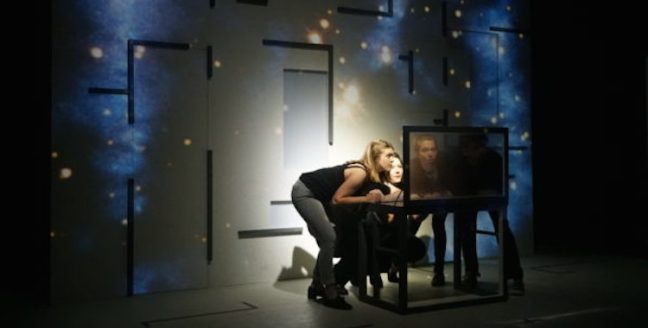
There is, though, a certain charm to Idle Motion’s storytelling that persists from earlier work. Ellen Nabarro’s versatile set, with its stylish geometric backdrop and collection of multi-purpose furniture, is smoothly and sometimes ingeniously used by the cast of five as they propel the story along. There are also some pleasing traces of the company’s physical work, though this movement is not deployed as strongly as it might be. Idle Motion do better with the small: beautifully observed little snatches of classroom conversation or tender moments of connection. Here, the vastness of space and the big ideas it invites about exploration, progress and human legacy elude the company’s delicate aesthetic.

Photo: Tom Savage.