DNA, Unicorn Theatre

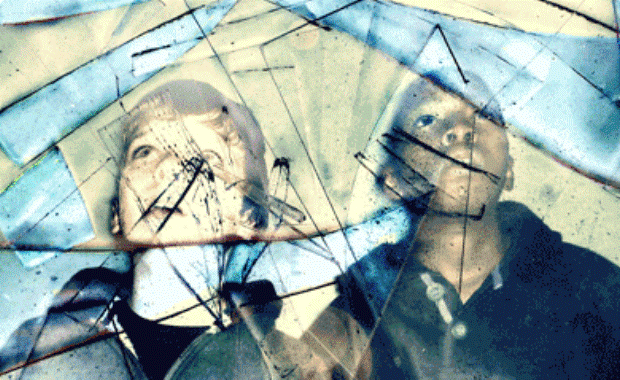
A group of teenagers are in trouble. Big trouble. What began as a playful bit of bullying – ‘a laugh’ – has spun wildly out of control and one of their classmates now lies dead in the woods. The only solution, as it appears to this shocked group of youngsters, is to cover it up. It seems like they might just get away with murder, but the lie that they have fabricated soon becomes bigger than they could have anticipated in Dennis Kelly’s unsettling thriller, originally written for the National Theatre’s Connections programme and now revived by the Hull Truck Theatre.

Unlike some other dramatists targeting troubled youth as their subject matter, Kelly does not patronise his adolescent protagonists, nor does he dwell gratuitously on their violence. The terrible act that binds the group together takes place off stage, as does a subsequent instance of violence, thus refusing to make these shocking events the visual centrepiece of the play. Instead, this incident becomes a springboard to explore this group of teenagers and their relationship to the world and one another, relationships that are heightened by the predicament they find themselves in. The central moral dilemma faced by the teenagers – is it better to come clean or to cover up what they have done for the greater good of the group? – is the hinge of the piece, but is far from the only issue that Kelly is prodding at.

Much of these issues are communicated through the character of Leah, who barely pauses for breath throughout most of the play. In a constant stream of chatter that betrays her brittle insecurity and desperate need to be liked, this waffling yet oddly insightful teenager touches on profound questions of time, meaning and the nature of humanity in a delicately poignant performance from Leah Brotherhead. While the unrelenting talk occasionally verges on the irritating, Kelly has wrapped up in Leah that very teenage contradiction of developing self-awareness and crippling anxiety, and through her seemingly light conversation begins to get close to the truth of what it is to be trapped in the confusion of adolescence.

Leah’s verbal diarrhoea is contrasted with the brooding, indifferent silence of her companion Phil, who seems more intent on his food than on anything she spouts. Crisps, sweets, a waffle meticulously drizzled with jam – rarely has food occupied such a demanding place in centre stage. Despite barely uttering a word, James Alexandrou pulls off the most genuinely disturbing performance of the piece as this determinedly mute yet commanding figure, and when he does open his mouth he formulates a plan to get the group out of trouble with the calm, calculated precision of a psychopath. The most impressive achievement of Kelly’s writing, however, is his lack of condemnation; while we appreciate that what this group of teenagers have done is deeply wrong, we continue to be compelled to care about them and even to an extent to understand the situation that they have backed themselves into. This, we can imagine, is just what a group of panicking teenagers might do when offered what seems to be a way out.

While the young characters themselves are for the most part rendered plausibly – if perhaps a little less foul-mouthed than might be expected under the circumstances – the world that Kelly has created has a nightmarish, surreal quality, with echoes of Lord of the Flies inevitably raising their voices. Before the squirming teenagers know it, they are blocked in behind the bars of their own lie, forced down the increasingly twisting paths of a complex labyrinth of deceit. They have fallen down the rabbit hole and there is no way out. The sense of heightened reality is intensified by the pulsing lights and dazzling projections of this production’s simple but striking design, although the mat of grass that is regularly dragged out for Phil and Leah’s scenes together seems an unnecessary item of clutter in an otherwise effectively minimal set.

For such a darkly atmospheric piece, however, there is a sense in which this feels oddly, paradoxically safe. The description of Adam’s death, while building escalating tension, lacks a chill of horror; we never experience the visceral shiver of shock that ought to accompany the darkening action. This may partly be due to a certain elusive ingredient missing from Anthony Banks’ otherwise impressive production, but I suspect that it might have more to do with the text’s uptake by the GCSE curriculum. I certainly have nothing against introducing schoolchildren to such compelling and challenging work – this is just the sort of thing that we should be encouraging young people to see – but I fear that this revival, which has clearly been created with students in mind, has taken the edge off Kelly’s script. Ironically, it is that very edge that might have really captured the attention of its young audience.

DNA runs at the Unicorn Theatre until 28 April and is then touring until 25 May.

Image: Simon Annand

Shivered, Southwark Playhouse

In this latest piece from seemingly ubiquitous polymath Philip Ridley, form does not so much reflect content as it does context. Ridley’s shattered play is a chillingly appropriate response to an increasingly fractured modern society, with casually engendered violence and careless cruelty glinting back at us from each piercing shard of narrative. It is not quite entirely without hope or brief glimpses of redemption, but the dark, nightmarish landscape of Shivered does evoke the sense that, as disillusioned soldier Alec passionately argues, the world is almost incurably sick.

Ridley’s chopped up story takes as its setting the fictional Essex new-town of Draylingstowe, once upon a time a symbol of hope and prosperity, now a post-industrial playground for violent youth. The derelict car plant that once held the town’s promise is now a shady backdrop for drug-taking, suicide and cruel sexual fantasies, while Draylingstowe’s disenchanted citizens find meaning in conspiracy theories, whispers of extra-terrestrial activity and mysterious canal-dwelling monsters. It is a world that hovers somewhere between fairytale, nightmare and grim reality; grubby concrete illuminated by the garish lights and glitter of the fairground.

This semi-mythical world is vividly conjured by Ridley’s assorted collage of narrative snapshots, cutting and dicing the story of two interlinked Draylingstowe families. Lyn’s family is as fragmented as the play itself, shattered by the loss first of her son Alec, who is brutally beheaded while serving overseas in the army, and then the disappearance of husband Mikey, leaving her with only her younger, UFO-obsessed son Ryan. When the fair arrives in town it brings with it the tantalising promise of sexual excitement, as Lyn meets opportunistic showman Gordy and the pair begin to meet in the disused car plant, her son’s favourite haunt. Meanwhile, Ryan’s friend Jack finds escape from the torment of bullies and the daily drudge of caring for his overweight mother in graphic YouTube videos of sex and violence – one of which happens to be a recording of Alec’s horrific execution.

But none of it is quite as simple as this. The above narrative is the one that we as an audience piece together, filling in the blanks between the scattered series of scenes that Ridley presents before us, making almost subconscious links. It is an ingenious, dazzling exercise in plotting, throwing chronology into chaos without plunging the whole into incomprehensible obscurity, but Ridley’s experimental approach to structure is not a mere demonstration of his startling ability as a writer. Central to the play that Ridley has crafted are questions of how we fight to find meaning and explain our own existence, be it through narrative, religion or superstition.

There is repeated talk of ‘illusory contours’: the patterns we find in unlinked objects, like constellations of stars. This same mental process is one that we are unwittingly forced into, as Ridley coaxes us into making connections before throwing these into doubt. Are these collected scenes really linked in the way we imagine them to be, or are we guilty of the same forced, wilful conclusions as Ryan in his determined hunt for UFOs? What, ultimately, can we believe in? In the dark, slowly rotting world of the play, under the haunting spectre of abandoned industrialisation and rapidly unravelling values, the answer would seem to be very little.

The bare, evocatively lit space of the Southwark Playhouse has never seemed more bleak than in Russell Bolam’s stripped down, almost minimalist production. There is nowhere to hide for either writing or actors – or for audience, for that matter. Ridley’s boldly drawn characters jump out at us, sometimes quite literally in the case of Gordy’s fairground act, performed with effervescent showmanship by the buzzing, charismatic Andrew Hawley. There is impressive work too from a fragile yet cuttingly sardonic and sometimes fiercely wounding Olivia Poulet as Lyn and from Robbie Jarvis as her broken son Alec, who is haunted by unnamed ‘monsters’.

Ridley’s strange, disturbing not-quite-dystopia is never as unsettling, however, as when seen through the eyes of its young protagonists, whose twelve-year-old imaginations the playwright has convincingly penetrated. Ryan and Josh retain barely discernible traces of youthful innocence and optimism, but their existence has been permeated by technology and readily available violence, numbing them to the reality of physical aggression and placing a computer or mobile phone screen between them and all of their experiences. These two troubled and troubling youngsters are convincingly portrayed by the outstanding Joseph Drake and Joshua Williams, who are by turns bitingly funny and uncompromisingly brutal – phrases that could well describe Ridley’s play.

Despite a plot which is, when reassembled into chronological order, comparatively slight, this is meaty fare. Ridley dwells on both startlingly contemporary issues, such as our desensitisation to violence and the very real threats of post-industrial society, and timeless, universal questions of how we find meaning in our lives, with vivid dashes of magical storytelling thrown in for good measure. It is, as the playwright himself has described it, a ‘state-of-the-nation dream play’. The dreamlike is always close to the surface here, featuring dialogue saturated with fantastical references to monsters, aliens and other childhood fears. But the real world, as Ridley unflinchingly demonstrates, is so much scarier.

Shivered runs at the Southwark Playhouse until 14 April.

Pentecost, St Leonard’s Church Shoreditch

Never has art history been more compelling than in David Edgar’s post-Cold War drama, in which a fresco on the wall of a church in Eastern Europe becomes the battleground for clashes between different languages, cultures, religions and ideologies – much like the unnamed post-Communist state of the play has been the scene of invasion upon invasion throughout its troubled history.

After a huge effort of near-compulsive searching, museum curator Gabriela Pecs has unearthed a mural that she believes could completely change the face of art history, proving that the style of painting that set the groundwork for the Renaissance was in fact born not in the West as believed, but in the East. To assist her in her discovery, she enlists English art scholar Oliver Davenport, but their efforts are soon interrupted by the competing objections of the Orthodox and Catholic priests who both lay claim to the church and by the outrage of American art historian Leo Katz, who believes that ancient art should be left alone rather than cosmetically restored to its former glory.

In the fierce debates between Gabriela, Oliver and Leo, Edgar questions both the value and meaning of art. The high art versus low art debate is invoked by the beliefs of Oliver, who argues that we should not distinguish between art and artefact and that we might talk of the Mona Lisa in the same breath as Star Trek. It is an intriguing suggestion, but one that equally renders their restoration efforts almost entirely pointless, a paradox that reveals just how self-serving Oliver’s motivations really are. What Edgar gradually reveals is how this one piece of art of questionable origin is made to mean different things to different individuals, each of whom would impose their own ideology and motives onto this painting.

As well as representing a personal and political battlefield, Edgar questions the easy assumption that art is redemptive and civilising. After all, as one of his characters points out, the guards at Auschwitz listened to Mozart. Any link between art and morality, Edgar illustrates with piercing clarity, is pure wishful fallacy – yet neither is art reduced to a worthless status. The fresco almost becomes a character in its own right, an object whose fate we ultimately care about, achieved mainly through the steely passion of Pinar Ogun’s Gabriela. In order for this piece to truly captivate an audience, Gabriela must infect us with her all-consuming, fevered enthusiasm for her discovery and what it might mean for her nation, a feat that is compellingly accomplished by Ogun, who manages to retain our sympathy even after objecting to her country becoming a dumping ground for the ‘dregs of Europe’, as she disdainfully dubs desperately fleeing asylum seekers.

As integral as art is to the play, however, this is about more than arguments on aesthetics. When, as we move into the second half, the church is invaded by a band of refugees and a thus far intellectual drama escalates into a hostage situation, Edgar is given the opportunity to draw out themes of national identity and the old East versus West divide, a barrier that was not broken down along with the Berlin Wall; the Iron Curtain may have lifted, but a scarcely penetrable veil remains. This is eloquently expressed in confrontations between the simmering melting pot of nationalities brought together in the church and particularly by vitriolic refugee leader Yasmin, who explodes our smug Western stance of superiority.

These expansive ideas and many more are given room to breathe in the large, suitably atmospheric space of St Leonard’s Church, all cold exposed stone and peeling paintwork. The script risks being smothered, however, by a busy, frenetic production from Charm Offensive. The decision to stage this play in this environment is one that makes utter sense, but unfortunately the acoustics are against them, with reverberation draining the sense from many lines – a considerable predicament in a play that is mostly talk. Add to this the sheer amount that is often going on at once, particularly once the refugees arrive on the scene, and Edgar’s beautifully expressed themes are occasionally in danger of floundering.

Director Gavin McAlinden has assembled a rich cast of mixed nationalities, a cultural blend that adds authenticity to a piece in which language, nationality and culture are so vital, though the performances emerging from this mix are uneven. The production remains held together, however, by strong central characterisations from Jonathan Sidgwick as Oliver and from Ogun in the role of Gabriela. As her passion seeps uncontrollably through each stone of the building, it is hard to sweep questions of art and cultural and national identity aside.

Image: Maddy Gasson

The Taming of the Shrew, Richmond Theatre

Ah, that old problem of the Shrew. This most irksome of Shakespeare’s plays is itself resistant to being tamed, often refusing to bend to directorial interpretations that try to smooth its rough, arguably misogynist edges. It is not a play that I can profess to having much personal fondness for and one that I doubt I will ever come to love, but the Royal Shakespeare Company’s latest attempt certainly has a spirited if slightly over-enthusiastic stab at it.

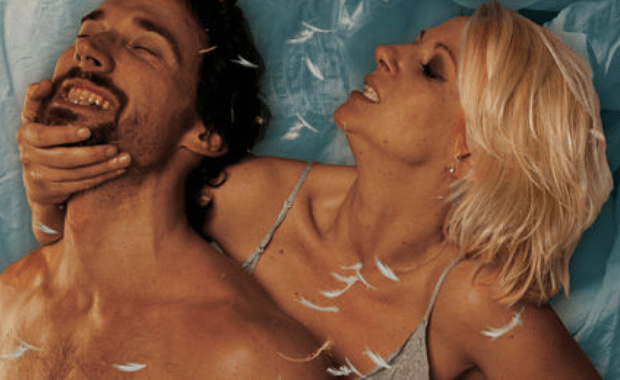
In director Lucy Bailey’s vivid vision of this troublesome play, the battle of the sexes boils down, ultimately, to sex. Bed is not just the setting for consummation of marriage, but the location for Petruchio and Kate’s entire twisted courtship, with Ruth Sutcliffe’s triumphant, sheet-draped set denoting both subtext and end point. The sparring couple’s struggles are, in this context, simply a bizarre and extended form of foreplay. The bed is also the seat of dreams, making it an appropriate stage for the fantasy drunkenly dreamed by Christopher Sly, another man with sex on the mind who is kept present amongst the action throughout in the humorous form of a gamely slurring, staggering and burping Nick Holder.

But this interpretation is not all about crude gestures, winks and nudges and a tumble between the voluminous sheets. Sex is intriguingly associated with money and, by extension, power. When Baptista, after marrying wild Kate off to Petruchio, offers younger daughter Bianca’s hand in marriage to the man who can make the highest offer, her suitors illustrate their wealth and ‘hangings’ with sexually suggestive actions indicative of their generous endowments – financial or otherwise. Meanwhile, the very crudeness of making the bed a public arena stresses the crudeness and cruelty of the marriage market, in which women and sex become commodities. By breaking away from these rigid, narrow-minded practices, Petruchio and Kate finally reach, by comparison, a more natural union.

The central relationship between ‘shrew’ and ‘tamer’ is of course the focus, carrying the burden of the piece. The sparky, wild dynamic between Lisa Dillon and David Caves bears this burden with attitude, as the pair constantly dance around once another, grapple and come to blows. Bailey has cultivated a particularly physical pairing, presenting us with two misfits who can barely stay still; Caves’ Petruchio paces, struts, fidgets and at one point even drops into press-ups, while Dillon’s hands yo-yo from hips to dishevelled hair in conveying Kate’s anger and agitation. Thus, when rare moments of forgetful stillness do arise, a strange sort of understanding seems to leap the gap between them, eventually bringing them together.

For all its bold and sexy swagger, however, Bailey’s production does not quite surmount the hurdle of this play’s undeniably tricky gender politics. Although Dillon delivers Kate’s final submissive speech in mockingly sarcastic tones, she cannot overcome the meaning behind the words, which are not sufficiently explained away by the relationship that Bailey has crafted. To negotiate the plot’s inherent difficulties we are sold a messed up love story, but despite the sexual chemistry it is a romance that struggles to be credible. Both Kate and Petruchio are certainly screwed up outsiders, but their behaviour in this production is often so outrageous that it becomes difficult to care too deeply for them.

This is sexy, brash, vigorous and often very funny fare, but it fails to fully redeem a play that still feels more than a little unpleasant. In the end, Bailey’s striking if not all that subtle bed concept says it all, in a production that gives us a lot of lust without very much love. As Petruchio and Kate finally, ecstatically jump beneath the sheets, we are left in little doubt that the sex will be great, but the morning after looks to be on rockier ground.

The Taming of the Shrew runs at Richmond Theatre until 24 March then continues on tour.

The King’s Speech, Richmond Theatre

The burden of expectation does not come much heavier than when laden down with four Oscars. Adrian Noble’s stage production of the David Seidler script that became a surprising jewel in the crown of British cinema has a lot to live up to, but it approaches this now familiar subject matter with a stylish and almost dogged assuredness, seeming not to suffer from the same tongue-tied difficulties as its protagonist.

Set in the years surrounding the Edward VIII abdication crisis, the play, like the film, follows the relationship between George IV – known as Bertie – and his unconventional Australian speech therapist Lionel Logue, as the pair attempt to overcome Bertie’s inconvenient stammer. While superficially about the less than thrilling subject of speech therapy and less superficially about one man’s personal struggle, this is more meaningfully about responsibility, personal conflict and the nature of the relationship between monarch and subject.

In Bertie’s eyes – at least the Bertie of Seidler’s imagination – a king is there to serve his people just as much as, if not more than, they are there to serve him, an interesting notion of mutual obligation. Such ideas of duty are less important to Daniel Betts’ selfish, sneering David, who is almost more unpleasantly selfish in this depiction than in the film. Following the death of his father King George V and the concern surrounding his mistress Wallis Simpson, he is shown to care for nothing but ‘that woman’ and to expect the country to bend to his whims, a situation of crisis that makes it ever more important for Bertie to find his voice.

Personal motivation versus public duty is also a particularly fascinating battle in light of the story’s political context, which is foregrounded more than in the film but could still be explored further. In a precariously positioned Europe which is, as we are reminded, divided between the two extremes of communism and fascism, where does a monarch fit into the political picture? This is a question which is not really broached by Seidler’s play; the rumbling approach of war serves more as a backdrop for Bertie’s trials and as an agent of urgency than as a topic of historical investigation in itself. When Bertie finally gives his triumphant speech, accompanied by stirring strains of Elgar, historically ill-informed audience members could be forgiven for thinking that this was a deciding factor in our eventual victory.

There is room, however, for some compelling performances. The excellent Charles Edwards is a frustrated, engaging and very human Bertie; his whole coiled body seems also to stammer when he struggles to get his words out, while in another, unguarded moment he displays charming, almost childlike fascination with a model plane. Similarly rich is Jonathan Hyde’s warmly humorous performance as a wonderfully rebellious Logue, caring not a bit for royal etiquette, and there is strong support too from Emma Fielding as a feisty Queen Elizabeth. Anthony Ward’s clever revolving picture frame set, meanwhile, is a star in its own right, by turns framing moments of history and acting as a physical barrier between two men from very different worlds.

There is no doubt that Noble has created eminently watchable, entertaining theatre. It could be argued that entertainment is enough, but when examining such an intriguing chapter of history it is a shame that more of its nuances have not been investigated, a depth of exploration that could have set this stage production apart from its big screen sibling. It is even worth pausing, nit-picking as it may be, to ask whether this stage version is wholly necessary. With the film still fresh in the nation’s collective memory, what purpose is this production serving? Seidler’s script may have started life as a play, but it hardly needs to return to the stage for legitimisation. Likewise, Noble’s incarnation is slickly enjoyable, but it is not quite powerful enough in its own right to vanquish the lingering ghosts of Colin Firth and Geoffrey Rush.

I suspect that it might have more to do with the Royal Family suddenly being back in vogue. Royal Wedding fever had us in its thrall last year, we’ve been assaulted with portrayals of Wallis Simpson left, right and centre, this year sees the Queen’s Diamond Jubilee, and interest in the royals as individuals has rarely been greater. Noble’s first striking image, of a naked king facing the mirror and seeing his royally attired reflection staring back at him, says it all. It is this contrast between the public, trussed up image and the exposed human being beneath, so perfectly realised in Edwards’ Bertie, that sustains the nation’s interest in the Royal Family and ensures that this story continues to capture the imagination.