Licensed to Ill, Camden People’s Theatre

3779

Originally written for the Guardian.

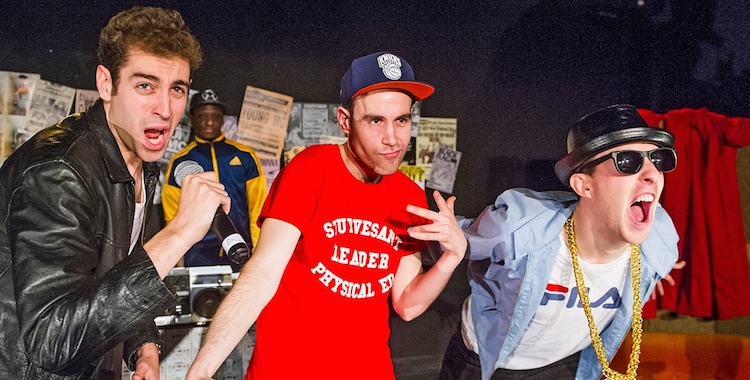
Rolling Stone famously reviewed it with the headline “Three Idiots Create a Masterpiece”. Simon Maeder and Adam El Hagar’s unofficial history of the band, which revels in the haphazard brilliance of these unlikely New York rappers, underlines both their idiocy and their intelligence. The show has all the anarchy and DIY spirit of a fanzine: it’s scrappy, colourful and bursting with unapologetic enthusiasm.

This telling of the Beastie Boys’ rise to fame has the same chaotic, hyperactive energy as the video of Fight for Your Right (which gets its own lo-fi stage re-creation). Licensed to Ill follows the band from wannabe punk rockers to hip-hop superstars, as Michael “Mike D” Diamond, Adam “MCA” Yauch and Adam “Ad-Rock” Horovitz find their way to the top of the charts through a combination of talent, accident and arrogance.

Much like its troublemaking protagonists, Licensed to Ill never takes itself too seriously. Brainstorming names, the band reject one suggestion because “it’s not stupid enough”. A similar logic drives the show, which never accepts a simple staging solution if there’s a sillier one to be found. So there are sequences of physical comedy, relentless one-liners and an extended gag involving a puppet.

But it’s not all laughs. Lurking forever on the periphery of the Beastie Boys’ meteoric rise is the nagging discomfort of misogynistic lyrics and cultural appropriation.

Ultimately, Licensed to Ill is more celebration than critique. Having established such speed in the storytelling, there’s a loss of momentum in the final third, which begins to drag. But what never disappears is an evident love for these three “idiots” and the masterpieces they produced.

Photo: Tristram Kenton.
The Body, Barbican

5295

Originally written for the Guardian.

Theatre rarely engages all of our senses. Even the words that refer to us as theatregoers – audience, spectators – emphasise sound and sight alone. But The Body, as its title suggests, is interested in every last muscle and fibre of the live experience. Nigel Barrett and Louise Mari’s show, the recipient of this year’s Oxford Samuel Beckett Theatre Trust award, is theatre that asks us to feel – in every sense of the word.

Narrative, therefore, is abandoned for sensation. Instead of scenes, Barrett and Mari have created a series of fleeting impressions, each as strange and vivid as the last: lights brightly flare; sounds assault us from all angles; images flash on a screen while vibrations shake us in our seats.

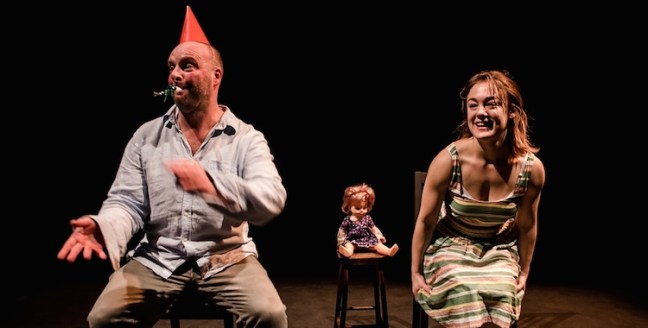
The one connecting thread is the constant “thump-thump” of the human heart. We enter designer Myriddin Wannell’s intimate black cube and are instructed to attach heart rate monitors. Performers Barrett and Jess Latowicki whirl in and out through revolving doors, handing each of us a doll that has its own uncanny heartbeat.

This feeling of the uncanny pervades the show, which is littered with dolls – plastic, mechanical and sometimes unnervingly lifelike. Manoeuvred by Barrett and Latowicki, these disturbing synthetic figures are a counterpoint to the messy biology the show explores. They also pose the question of what really makes us human in an age of advancing artificial intelligence.

Arguably more installation than theatre, The Body is bold in its rejection of story and embrace of technology. Those hoping for plot or character will be disappointed, but as a set of images and sensations it’s often breathtakingly beautiful.

The show’s ambition of sensory overload is to interrogate something of what it means to be human and all too briefly alive. Like life itself, The Body is confusing, fragmented and sometimes overwhelming. But, also like life, it’s a strange yet extraordinary experience.

Photo: Richard Davenport.

I Want My Hat Back, National Theatre

1600

Originally written for the Guardian.

The kids’ verdict on the National Theatre’s new family offering comes in early. “This is a funny show!” exclaims one girl about 15 minutes in, giggles erupting around her. It’s hard to disagree.

Narratively speaking, there’s not a lot to Jon Klassen’s laconic picture book. The plot is mostly spelled out in the title: Bear’s hat has gone missing and he wants it back. This simplicity, though, is part of the joy of both book and adaptation. Around the limited framework, director Wils Wilson and her team have built a mischievous, boisterous delight of a show.

Bear (Marek Larwood) loves his red, pointy hat. But when he leaves it unguarded in the forest, opportunistic Rabbit (Steven Webb, with all the hyperactive energy he has brought to the Lyric Hammersmith’s pantomimes) is quick to snatch it up. Bear’s attempts to track it down lead him through a series of encounters with his fellow forest inhabitants.

Wilson’s version lets young audiences in on its tricks, welcoming them on stage at the beginning and making few attempts to hide its make-believe. Fly Davis’s DIY design has pot plants for trees and animal ears for costumes, while the chorus’s rapid changes of character often happen in full view. It’s a production that gets that kids understand pretending.

There’s plenty for the big kids in the audience too, from Arthur Darvill’s genre-hopping music to Joel Horwood’s book and lyrics, which retain Klassen’s concision and offer knowing winks to the adults. Wryly ad-libbing through the vocal responses of younger spectators, Larwood gives a brilliantly deadpan performance, which plays to two levels simultaneously. A show for all ages is a rarer thing than marketing copy tends to suggest, but I Want My Hat Back achieves that aim with ease.

Photo: Richard Davenport.

Nell Gwynn, Shakespeare’s Globe

1a133560-1dfc-4b00-97b7-947d98ccced7-2060x1236

Originally written for the Guardian.

The first time we see Nell Gwynn, she’s one of us. In the Globe’s rowdy retelling of Nell’s rags-to-riches life, the famous restoration actress starts among the groundlings as just another admiring – if mouthy – spectator. Soon, though, she’s treading the boards herself, first at Drury Lane and then on the nation’s stage, as the favoured mistress of King Charles II.

Both Jessica Swale’s text and Christopher Luscombe’s production are playfully conscious of their theatrical surroundings. Nell Gwynn is a play about theatre as much as anything else: its joy, its artifice and its uneasy marriage of entertainment and education. This Nell is a people’s heroine, playing to the stalls and courting laughs, but she also has bigger concerns, boldly demanding more from the simpering roles she’s cast in.

Swale has bigger concerns too, attempting amid the broad comedy to both reclaim her mythologised protagonist and make some sharp political sideswipes. She meets with mixed success, raising cheers with Charles’s “down with austerity!”, yet pressing a little hard on her vital but overworked points about the representation of women both then and now. The self-aware theatricality can likewise overstate its case at times, though there’s something endearing about the show’s evident love for the art form, even in the very process of sending it up.

As played by the effervescent Gugu Mbatha-Raw, Nell is resolutely and joyfully human, recovering the woman from the legend. It’s her sharp wit that charms audience and court alike, while in her relationships she’s more than a match for leading man Charles Hart (Jay Taylor) and later David Sturzaker’s spirited monarch. She is, like the characters she begs an ineffectual John Dryden (Graham Butler) to write for her, a woman “with skin and heart and some sense in her head”. Three and a half centuries later, we could still do with more of those on our stages.

Photo: Tristram Kenton.

Wolf’s Child, Felbrigg Hall

Steve-Jacobs-And-Sophie-E-007

Originally written for the Guardian.

It’s hard to imagine a more atmospheric setting for WildWorks’s latest outdoor show. Stepping inside the grounds of Felbrigg Hall, sun hovering just above the horizon, the woods whisper with promises of magic and transformation. As we depart into the dusk, there’s a warning: we must, like Little Red Riding Hood, stick to the middle of the path. There are wolves here.

Before long, though, WildWorks lead us off the well-worn track. Inspired by the Greek myth of nymph turned bear Callisto and by the extraordinary experiences of Shaun Ellis, who spent two and a half years living with a wolf pack, Wolf’s Child takes its audience deeper and deeper into the wild. Beginning at the hall, the orderly preserve of wolf-hating Mother and her collection of orphan girls, the show follows young ward Rowan as she ventures beyond the neatly manicured garden and into the territory of the beasts. As tends to happen in the woods, she is soon transformed.

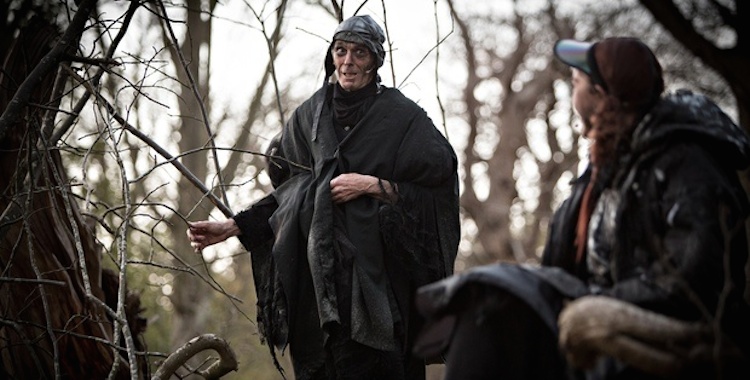
We’re led through the twilight by performers in dark, tattered crow costumes, forming the squawking chorus of the show’s large cast. Narrated by our guides, the fable is told in a fairytale fashion, with simple statements and occasionally clunky rhymes. But Wolf’s Child is an exercise in enchantment more than it is in storytelling. Lit evocatively and unobtrusively, nature’s stage – from a platform of tangled branches to an imposing cathedral of trees – is the real star of Bill Mitchell’s production. The performers’ wordless movement offers the most powerful transition from wild to tame and back again, while Victoria Abbott’s soundtrack reverberates hauntingly through the forest. Flames flicker in the distance and lupine howls shred the air.

It’s only in the stomping and shuffling from scene to scene that the spell threatens to be broken. The crows are a smart touch, tending the tale at the same time as marshalling the audience, but there are only so many ways to chivvy people through the trees. In the tussle between civilisation and wilderness, Wolf’s Child can’t quite throw off its human shackles.

Photo: Steve Tanner.