Ben Kidd

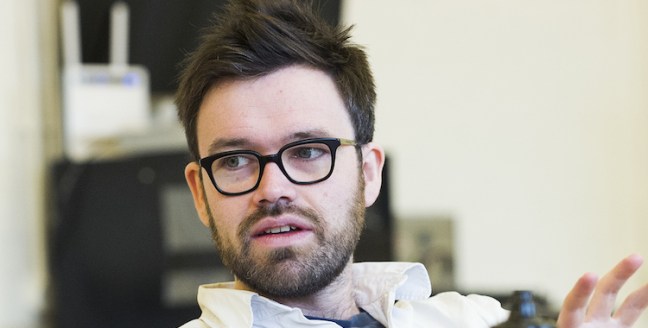
Ben Kidd, co-director of Lippy at the Young Vic. Photo by Tristram Kenton

Originally written for The Stage.

Ben Kidd is puzzling over what it means to be a director. Does it mean being in charge of a production? Is it about getting the most out of actors? Is it to do with serving the vision of another, or being the author of your own work? “Being a director only really consists in making decisions,” he eventually concludes. “You’re trying to assemble as many people as you can who you think are really really good at what they do – designers or writers or actors or whatever – and then you’re basically saying ‘that and not that’.”

We’re chatting in the bar of the Young Vic, something of a spiritual home for Kidd. It’s the theatre where he was given some of his early assistant directing opportunities, where he received the Genesis Future Directors Award in 2012, and where his Dublin-based company Dead Centre are about to present the London premiere of their show Lippy. “The Young Vic was somewhere that I found a like-minded assortment of people who thought about directing as a thing,” he explains.

Kidd arrived at directing via acting after training at Bristol Old Vic Theatre School. While training and working as an actor, he was “schooled in this idea that a director helps actors to connect with the text and delivers the play”, an idea that he has progressively broken away from. “There’s a perception of the director as being someone who is either birthing or yielding somebody else’s vision,” Kidd observes, adding that he is more interested in how directing might involve an element of autobiography.

“When I think back to who my gods were growing up, they weren’t theatre directors,” Kidd says. Instead his idols were writers and musicians – he names Bob Dylan and Patti Smith – who poured something of themselves into their work. “It would have been nonsensical if all their work didn’t bear the hallmark of who they were as people,” Kidd suggests. He believes that the same should be true of directing; he wants to “create a new thing in the world”, a thing that bears his signature as a creator.

“If you go and see a Katie Mitchell play, they basically all look the same and feel the same in a sort of profound way,” he offers as an example. “That’s not a bad thing. That’s because she’s in there, her politics are in there, her concerns are in there, and she’s filtered those concerns through artistic practice. That is what real artists do.”

Mitchell has clearly been a major inspiration for Kidd in the process of discovering what directing means to him. He recalls a workshop during which she demanded of the participants: “What do you want to achieve? Find out what you want to achieve and then find out the best way to achieve it”. Whether working with Dead Centre or freelance directing for the likes of the Young Vic and Headlong, this is advice that Kidd has tried to stick to.

He admits, however, that building a career as a director is “really hard”. Despite winning the Genesis Future Directors Award, directing a main-stage tour of Spring Awakening for Headlong last year and gathering a string of awards for Lippy, Kidd still only directs part-time, a situation that is common among directors in the UK. “It does seem to be that directors’ pay hasn’t kept up with pay elsewhere in the industry,” Kidd says, reflecting on the recent research into directors’ fees. “We subsidise the industry because there are loads of us who really want to do it and will kill for a job.”

On the one hand, this lack of money can be liberating and encourage greater risk-taking. As Kidd puts it, “you gain the bloody mindedness to make what you want because you’re not going to make a living from not doing it, so you might as well do it.” But on the other hand, the financial insecurity of making theatre can restrict who enters the profession and impoverish it as a result. “An art form probably is better if a wider section of society is in it,” says Kidd, “it’s going to have more interesting stories.”

Kidd has another thought about the role of the director. “I think that the job is just about returning an audience to a sensation you had when first read a play, or when you first heard of an idea,” he says. The best shows, he suggests, are built around points when that sensation is briefly captured and the mood suddenly changes – what a friend of Kidd’s describes as “David Bowie moments”. “Great plays often hinge on a moment or a series of moments that are a shift in atmosphere, a shift in emotional resonance, a dropping out of the world. Something happens where the world changes.”

Photo: Tristram Kenton.

Alistair McDowall

Pomona rehearsals - Alistair McDowall 2 (photo Manuel Harlan)

Originally written for The Stage.

Conversation with Alistair McDowall is cluttered with cultural references. Names of books, films and comics all fly off the playwright’s tongue; a rich and varied vocabulary of influences, from Sarah Kane to William Faulkner. “If I’m not working I spend all of my time consuming,” McDowall explains, “reading novels and plays and watching films and TV and listening to music and reading comics – whatever I can get my hands on.”

This passion for culture in all its forms – “generally I’m just a fan,” McDowall enthuses – filters through to his plays, which often marry the mundane and the fantastical. Brilliant Adventures shoved a time machine into a Middlesborough housing estate; in Captain Amazing, an ordinary dad is a reluctant, cape-clad superhero. “I think my plays sometimes feel quite noisy,” McDowall suggests, attributing this background buzz to all the cultural “stuff” that has influenced them.

“I was just obsessed with stories in any form,” he says of the many narratives that fed his creative imagination in his childhood and teens. After years of dreaming about making films, McDowall put on his first play with friends at the age of 16 and discovered a way of immediately bringing his ideas to life. From that point onwards he didn’t stop, continuing to write plays throughout school and university and staging his work in fringe venues after graduating.

The turning point came when Brilliant Adventures won a judges award as part of the Bruntwood Prize in 2011. For McDowall, the timing could not have been better: he had lost his day job in an art gallery the day before the prize was announced. “When I look back at that, the overwhelming feeling I have about winning it is just relief,” McDowall remembers. “I didn’t really have that much time to suddenly get above my station; it was just like yes, I can still eat.”

McDowall is frank about the economic restraints that hamper many would-be theatre-makers, who he describes as being “robbed of their talent” through financial circumstances. “There’s no reason why I should have been able to see this as a career,” he reflects on his own relatively modest background. “I just never really considered doing anything else other than making stories.”

When discussing his own stories, McDowall keeps coming back to their strangeness. Brilliant Adventures, which premiered at the Royal Exchange in Manchester after being recognised by the Bruntwood Prize, is “quite a peculiar play” according to its writer, while he describes his latest play Pomona as “really odd”.

Pomona, which is about to receive a production from McDowall’s fellow University of Manchester alumnus Ned Bennett at the Orange Tree Theatre in Richmond, was born from the place that its title refers to. The playwright describes this desolate strip of land awaiting development in Manchester as a “ghost town” and recalls his desire to capture it on stage somehow, at the same time as being interested in conveying the experience of living in the 21st century.

“I wanted to write something that was more led by a certain kind of state of mind and mood and tone,” McDowall explains. “It feels internet-y in its form and structure and it’s about a certain type of anxiety that seems to me to be very, very contemporary.” And perhaps even more so than his previous work, it is strewn with pop cultural detritus, from TV shows to fast food.

Despite his interest in all the other cultural forms that inspire his work, McDowall keeps coming back to theatre because it’s a medium in which “you can do anything”, a realisation prompted in his teens by binge reading the plays of Sarah Kane, Samuel Beckett and Harold Pinter.

“When I think of the things that had the biggest impact on me, it’s quite often that they reminded me that you can do whatever you want,” says McDowall. “You can do whatever you want, as long as you do it with passion and integrity and craft, you can do anything.”

Theatre is a “collective imagining,” he adds, later going on to describe a play as a magic trick. “I think the magic trick is almost aren’t we all having fun making this magic trick together, rather than actually trying to deceive you that it’s anything other than a magic trick,” he explains, capturing his interest in both narrative and theatricality.

The one thing that theatre-makers have to do, McDowall insists, is justify why their stories belong on stage. There might be no rules, but the question the playwright always asks himself is “does the audience still need to be in the same room for this to happen? And if the action could continue without them, if the equation is complete without them, it just doesn’t feel like it’s the best use of everyone’s time.” Or, putting it another way, “I’ve asked all these people to turn up, so I’d better fucking put on a show.”

Photo: Manuel Harlan.

Jay Miller

jay miller the yard publicity shots-273

Originally written for The Stage.

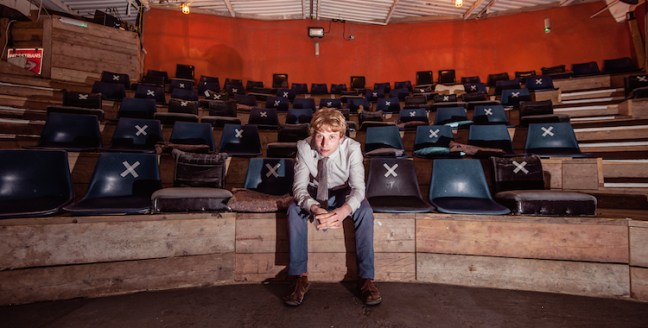
There are few directors who, when faced with a lack of opportunities in their mid twenties, would start their own theatre from scratch. Jay Miller, however, is one of them. In 2011, in the midst of recession, the young director founded a theatre in a draughty warehouse in Hackney Wick. The Yard, built on a shoestring and constructed from reclaimed and recycled materials, was something of a conjuring act: bold, improbable and summoned almost from thin air.

Miller identifies three impulses behind the founding of The Yard: boredom, frustration and anger. “The boredom was with the theatre that I was seeing. The frustration was with an industry and a world that felt quite closed. And an anger because it was the time of the economic crash and I just felt angry that I’d been sold a dream by Tony Blair and graduated and entered into a world that felt like it was a trap.” When combined, this cocktail of emotions generated a determination to “just do something”.

For Miller, doing something meant creating his own alternative. So what was it that he was failing to see elsewhere in London theatre? “I wasn’t seeing a system that developed new artists in theatre,” Miller says. “I was seeing a fringe system that sought to replicate a larger subsidised model of theatre, and when it wasn’t seeking to replicate a larger subsidised model of theatre it was replicating a commercial aspect of the West End.”

Instead, the aim of The Yard was to nurture new work and to focus on the role of space in audience experience. No black box here. Building on a personal interest in architecture and roping in a few friends, Miller designed a theatre that was part warehouse, part Greek amphitheatre.

He explains that the desire was to marry something of the booming immersive theatre scene with a self-consciously theatrical design. “We wanted a space which felt like an experience, which felt inclusive and which felt very live. But we also wanted to in some way acknowledge that it was theatre.” Miller adds that “the friction between that design and its context goes some way to releasing this energy that I was seeking to find in a space”.

Right from the start of his career, Miller knew that he wanted to run theatres, which begins to explain the genesis of The Yard. “I was always really interested in spaces and the effect of spaces on people,” he says. Despite a stint at Lecoq in Paris and a range of acting and directing experience prior to setting up The Yard, he insists that his real training has been on the job. “I didn’t know what I was doing when I started The Yard, so I’ve learned as I’ve gone.”

The Yard started out, Miller admits, with “a worrying lack of planning” and no real business model. “The biggest punt that I ever took in the moment when I thought ‘let’s make this happen’ was gambling that other people would be feeling similar things to what I was feeling, that people would be thinking similar things to what I was thinking,” he recalls.

Since then, both the space and the theatre it presents have evolved, scooping two Empty Space Awards and an Off West End Award in the process. “The programme at The Yard is organic,” says Miller, explaining that each new season has developed out of the previous one. Shows that have been presented as works in progress often return for longer runs, while themes emerge and reappear.

The latest development is a shift towards a mixed programme of four to five week runs interspersed with seasons such as this year’s NOW 14, which offer an opportunity for artists to show work in shorter bursts. The current autumn season, for instance, consists of two four week runs for These are your lives and The Hundred We Are, while submissions are for next year’s NOW 15 are opening later in the month.

Miller confesses, however, that the support The Yard is able to offer artists is restricted by the limited resources that they have to work with. While he insists on the importance of paying artists whenever possible, he adds that “we don’t have huge wads of cash to give out”. Instead, the theatre supports artists in a range of different ways, which often includes taking on a producing role.

The ultimate goal for Miller is “to achieve a real balance between opening our doors, developing and investing our resources in artists, and then putting on what we think is the best work in the UK”. It’s an ambitious set of aims, but one that Miller is confident of the need and desire for among the London theatre community.

“That punt, that gamble that other people must be thinking and feeling similar ways to me, paid off.”

See the person, not the age

Home Sweet Home-6583

Originally written for The Stage.

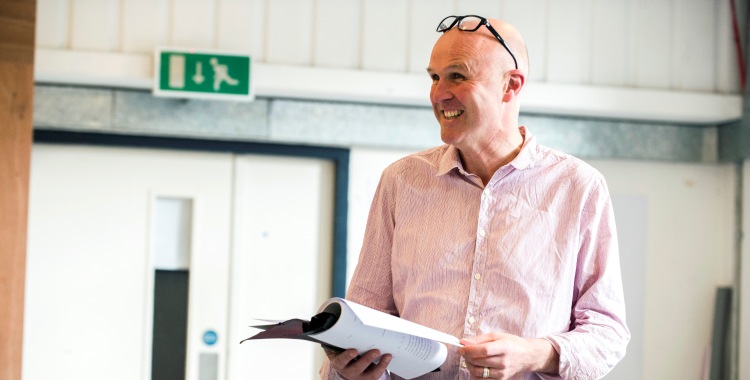
“How can we grow old being valued and respected?” asks David Slater, artistic director of participatory arts company Entelechy Arts. In a country with an ageing population, this is an issue that is set to become ever more urgent.

Home Sweet Home, the new community project that Entelechy has produced in collaboration with Freedom Studios, hopes to begin answering just that question. It takes an honest look at the realities of getting old, discarding media stereotypes and talking to older people themselves about the experience of ageing.

“We wanted to find out about what the experience of being older in contemporary Britain is and how we might interpret that as artists,” explains Deborah Dickinson, creative producer at Freedom Studios in Bradford. The company had previous experience of participatory work from 2011 production The Mill – City of Dreams, but turned to Deptford-based Entelechy Arts for their expertise in working with older people.

While a show was always the intended end point of this partnership, process was just as important as product. Over two years, both organisations ran workshops and interviews with older people from their respective cities. It was also vital that writer Emma Adams and director Tom Wright were involved throughout the journey, allowing them to draw from the experiences being gathered.

“They were absolutely critical in informing the way that we made the piece of work,” Dickinson says of the project’s many participants. “You always end up compromising to a certain extent, but those people’s voices are very much there in the writing.” With work of this nature, there is a question around who really has ownership over the material. Slater admits that “it’s a delicate line to tread,” but one that he believes Home Sweet Home has succeeded in doing.

One priority was to challenge popular perceptions of old age. “A lot of it is to do with the way that other people see you,” says Dickinson, a realisation that led them to adopt the phrase “see the person, not the age”. Slater adds that it was vital to keep the experiences of older people central. “Every other week you pick up a newspaper and you read about the latest crisis to do with neglected older people,” he says. “It’s rarely that you hear their voices at the centre of the discourse.”

For Wright, it was important to bear in mind the potential preconceptions of audiences. “My role has been about imagining myself as that audience member and thinking how can we take them literally by the hand and take them on a journey where they come out the other end having laughed, cried and stamped their feet and dealt with some very difficult issues in a way that was fun and enjoyable.”

The research, which included speaking to academics at Newcastle University and Kings College, London, has also turned up surprises. While many of us think of ageing as an inevitable process, scientists now believe that there is no prescribed way of getting older and that social interaction plays a considerable role in our experience of ageing.

“If we see everybody as a potential agent of change and capable of contributing to society right to the end, then people can carry on being just that for much longer,” explains Wright, adding that the production’s chorus of older community performers are an onstage demonstration of this capability.

81-year-old chorus member Florence Remmer is a perfect example. Explaining that she had always wanted to perform but never had the opportunity, she describes how being involved in the project helped her to engage with the community again after losing her husband. “I never knew anything like that existed,” she says. “It’s opened my eyes.”

The show that has emerged from this two-year process of research and development is designed with older people in mind at every level. As well giving voice to older characters, its staging is intended to be as welcoming and accessible as possible to audiences of all ages. Wright describes it as “a cross between somebody’s living room and the theatre”.

Home Sweet Home will now be performed in both Bradford and Deptford, as well as at ARC in Stockton, which also has an impressive record for including older people in the life of its building. As pensioners make up more and more of the population, this will increasingly become a key consideration for arts centres across the UK.

“The Arts Council has said that they want great art for everyone and I don’t think there is enough work done for the everyone,” suggests Dickinson, referring to both older people and other groups who often feel excluded from theatres. Wright agrees that theatres and arts centres “should be a place for the whole community to come and meet”.

Slater, meanwhile, is unequivocal about the necessity of making work with and for the growing population of older people. “This is something that we have to address as a society. The theatre is one of the places where we’re able to do that.”


Tim Crouch

Adler&Gibb_reh_photoRichardHubertSmith-2252

Originally written for The Stage.

There is something satisfyingly cyclical about Tim Crouch’s work. The theatre-maker’s first play, My Arm, explored ideas about representation and realism through the unlikely story of a boy who raises his arm above his head and refuses to take it down. Throughout the course of the play, this pointless act becomes a source of global fascination, captivating the contemporary art scene.

Now Crouch’s new play for the Royal Court, Adler & Gibb, uses a narrative about Hollywood movie-making to return to similar preoccupations. In it, an actress preparing to play a famed conceptual artist goes to terrifying lengths to achieve authenticity in her portrayal, asking implicit questions about art, acting and appropriation. It is, Crouch suggests, “a very much bigger and more complex version of My Arm”.

Reflecting on the shows he has made over the last ten years, Crouch describes My Arm as the “mothership” of everything that followed. The play emerged as a result of the frustrations that Crouch had felt over several years as a jobbing actor – frustrations both with the mechanisms of the industry and with what he saw as accepted theatrical form. Writing My Arm in his late 30s was, he recalls, a “last ditch attempt” to rekindle his passion for performance.

After graduating from Bristol University, Crouch began his career as a member of a devising cooperative in the city, which was the start of what he describes as “the most extraordinarily intense and wonderful and fulfilling time”. Struggling to find other work in his late 20s, however, Crouch pursued formal training at Central School of Speech and Drama. It was, he feels, a decision that the industry forced him into.

“You would go for auditions or interviews with the traditional sector and everything you had done, no matter how brilliantly creative it was, didn’t seem to have any currency in those interviews,” he remembers. “I would say that’s still the same now. There is a very marked career path and certain jobs or certain venues or certain directors have more points than other jobs and venues and directors, and so it feels like the deal is you get as many points as you can by working in this place or that place.”

As well as resisting this rigid and competitive culture, My Arm kicked back against the dominant form of psychological realism that had informed Crouch’s training. The play is written as a first person monologue, narrating events from the perspective of the character who fatefully decides to thrust his arm into the air. When Crouch performed the piece, however, his arms remained firmly at his sides, immediately challenging straightforward representation.

“I was interested in a different kind of reality,” Crouch explains. The show was also “a provocation to an audience to get involved more”. At the outset, audience members were asked to contribute personal items to the staging of the play, making explicit the necessity of their presence “to complete the experience”.

But while plays like My Arm might act as vehicles for sometimes complex ideas about theatre and the world, Crouch insists that they are absolutely rooted in story. “If I wanted to just ask questions about theatre and representation, I would become an academic,” he says. “I want to make theatre and I think theatre’s strength is narrative, a shared narrative, the passing of narrative. And so all of the pieces that I’ve made have been first and foremost about the story.”

Crouch describes his second show An Oak Tree, for instance, as “a little dance between form and narrative”, but one in which the narrative itself was vital. This show’s central formal device was the use of a different actor every night to perform the two-hander opposite Crouch without any prior knowledge of the play. Unmoored from their usual reference points, this second performer would flounder in the same way that the character, a man whose daughter has been killed in a car accident, is undone by his grief.

“I would want there to be a dialogue between form and content,” Crouch elaborates, pausing to note with a laugh that he sounds like a professor. “But in a very fleshy, pragmatic way, that’s what it is,” he goes on. “There are formal devices in all my plays that are only there because they deepen the telling of the story.”

In ENGLAND, the transplanting of theatre into a gallery space acted as a metaphor for the heart transplant that is central to the play’s narrative, while The Author engaged with its site in an altogether more controversial way. Commissioned for the Upstairs space at the Royal Court, the play was entirely contained within its audience. Performers sat amongst theatregoers in two banks of seating facing one another, and the events they described took place in audience members’ minds rather than on the stage.

“In The Author we are the audience as well, so their temperature is our temperature,” says Crouch of performing the piece. It was a show that pushed audiences into uncomfortable territory, alluding to the Royal Court’s history of shock and violence during the “in-yer-face” period of the 1990s and questioning the ethics of representation. Its disturbing subject matter and exposing focus on the audience provoked a startling range of reactions.

“At times in that show the audience took us to a really difficult place,” Crouch admits. “I had a physical threat in that show; people swearing, shouting, walking out.” This splitting of opinion, however, was encouraging to Crouch – “I’m excited when people either hate it or love it” – and reaffirmed his interest in active engagement with an audience.

“The audience is absolutely fundamental to my thinking,” he says. “They provoke and they incubate the form – they hatch the form”. Crouch is also keen to stress that “immaculate attention” was paid to the audience’s experience during the making of The Author; it was never about provoking for provocation’s sake. “But what you can never do as a theatre-maker is second guess what an audience is bringing to the theatre,” he adds. “By and large I try to keep things open, so it’s all interpretable.”

So central were the audience to The Author that people even began to mistake the title of the show. “A lot of people go ‘I saw your play The Audience’, and I go OK, right,” Crouch laughs. “I really like it when people forget or confuse what it was called, because it could easily be called The Audience. I suppose one of the suggestions in that play is that the audience is the author.”

Although The Author went on to tour elsewhere, it was always set at the Royal Court, intimately responding to the site of its commission and creating a fascinating “slippage between the location and the theatre”, as Crouch puts it. Adler & Gibb, which brings Crouch back to the Court, is less specifically grounded in the theatre’s history and location. While it is “absolutely written for a theatre”, the show speaks to ideas that are common to all theatre spaces: performance, representation, the blurring of truth and fiction.

When I speak to Crouch at the Royal Court, he is nearing the end of the first week of rehearsals. During the morning I spend with them, the cast are playfully exploring the relationships between their characters and with the audience, prodding at realist conventions while grappling with the challenges that Crouch’s script presents. One of these challenges is the onstage presence of two eight-year-old children, who are not characters in the play but remain present throughout.

“I’m excited about their formlessness,” Crouch tries to explain the thinking behind this surprising choice. He adds, in resistance to the instrumentalising of art as a form of education, that “art should be about unknowing something rather than knowing something”. Unlike their adult counterparts, Crouch argues that children are happy with “unknowing” and do not need realistic representation as a spur to their imaginations; “a child doesn’t need to exert anything to transform something into something else”.

It is in Adler & Gibb that Crouch’s recurring interrogation of realism reaches its zenith. At the same time as questioning realist representation in theatre, the new play is deeply interested in the medium of film, which Crouch describes as “the high tide mark of realism”. Recalling Hollywood actors’ lauded transformations into real people – think Meryl Streep’s Margaret Thatcher or Jamie Foxx’s Ray Charles – Adler & Gibb examines the “strange exertions towards reality” that cinema encourages and celebrates.

“It’s a political idea for me,” says Crouch, “in terms of that idea of acquisition; acquiring reality, trying to buy or own reality. And realism to some degree being an attempt to fix something and to own something, which I have a question about.”

Crouch also has a question about the idea of individual genius that this tendency enshrines. Although it happens on a bigger scale in Hollywood – as depicted in Adler & Gibb – Crouch sees it infecting the theatre industry as well, pointing to the recent example of Birdland at the Royal Court and the central attraction of leading actor Andrew Scott.

“It’s an amazing performance by Andrew Scott – what the fuck does that mean? To make a piece of work where we come away and go ‘that’s an amazing performance’ is kind of ignoring the fact that it’s only an amazing performance if it’s serving the piece of work that it’s in. The piece of work is the thing that we should be there for, because that’s the art form.”

Crouch goes on to suggest that “it’s like having a beautiful diamond on a rather dull canvas, and you just go ‘that’s an amazing diamond’, when actually the artist wants you to think about the whole canvas.” Instead, he says, individual theatre-makers “shouldn’t be thought of as geniuses, because it gets in the way of what the work is trying to do”.

For this reason, Crouch is keen to emphasise the close collaboration that has characterised his career as a theatre-maker. “I wouldn’t want anyone to come in going ‘I’m going to see a Tim Crouch show’,” he says. Although his name most frequently gets attached to the work, he is adamant that his shows are the product of collaborative processes, shaped by the input of the rest of the creative team.

“I’m lucky in that I have two very close allies and collaborators and sounding boards in Karl James and Andy Smith and that we have been talking about the work for a long time now,” Crouch tells me, referring to his co-directors. As an actor himself, with bitter experience of all the frustrations that can involve, he also takes care to welcome the thoughts of performers.

“Why would you ignore the presence of the people in their room and their intelligences?” Crouch asks, incredulous at creative processes that do not encourage collaboration in the rehearsal room. “I’m trying to some small degree to challenge some of the practices that I have problems with, or I had problems with when I was an actor,” he adds, returning once again to the impetus of his work. For Crouch, it is vital to stretch the conventions of the industry, encouraging ways of working that nurture creativity.

“It’s about doing the best thing for the work, and the best thing for the work is to create an open space and to allow contributions to the open space,” he says. “Why would that be such a radical idea?”

Photo: Richard H Smith