Sharing Space: Kieran Hurley

Beatspress1

Originally written for Exeunt.

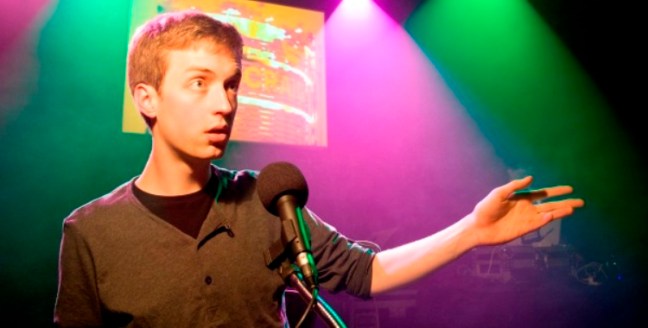
Kieran Hurley has a confession to make. The writer and performer, whose shows include HitchBeats and Chalk Farm, wishes he was in a band. As we chat over the phone about the love for music that has suffused so much of his work, he laughingly describes himself as a “frustrated bass player”. It’s not a unique frustration; playwright Simon Stephens has spoken of his youthful ambition to be a songwriter and once described himself, Sebastian Nübling and Sean Holmes as “three middle-aged men who all wish we were in the Clash”. Hurley even suggests that this band mentality is somehow inherent in collaborative forms of theatremaking:

“I was speaking to someone about this, a fellow theatremaker, and he said that any of us who have ever made theatre in a kind of devised way were just people who wanted to be in a band at school but weren’t really musical. I think there’s a way in which that maybe comes across in some of the work that I make that I perform in.”

This is certainly evident in Beats, the rave-meets-storytelling show that Hurley is about to bring to the Soho Theatre following a second run on the Edinburgh Fringe. For the show, which narrates the coming-of-age story of a young boy in Scotland against the backdrop of the 1990s rave movement, Hurley is joined on stage by a DJ, blending his words with a pulsing score of techo tunes – or, to be more accurate, “mid-90s ambient electronica and a bunch of acid house”. As Hurley explains, the music was an integral part of the piece from the word go.

“With Beats it felt really obvious straightaway that this was going to be a piece that was going to be performed by me and a DJ,” he says. The process of making the show began with Hurley and DJ Johnny Whoop in a rehearsal room together, listening to records and teasing out the narrative. Hurley remembers that there were times when he would find himself “writing to the music”, steering the narrative to meet the emotional pitch of a particular track – “the two were really symbiotic”.

It was also music that provided the first seed of an idea for the show. Hurley recalls thatBeats was born from an interest in the Criminal Justice Act of 1994 – a piece of legislation outlawing public gatherings to listen to music that consists primarily of “the emission of a succession of repetitive beats” – and an intriguing statement included in the sleevenotes of Autechre’s Anti EP. In this note, the group explains that the track ‘Flutter’ has been deliberately programmed to contain no repetitive beats; under the prescriptions of the new law, it could still be legally played at public gatherings.

“I just thought this was a really creative, playful, mischievous response to a really absurd law,” Hurley says. He was equally intrigued by the political echoes of the rave movement and its offspring, which started as a hedonistic movement but became increasingly politicised in the wake of the Criminal Justice Act, feeding into the direct action of Reclaim the Streets and the party protest movement. Hurley therefore describes the impetus behind Beats as a marriage between “a kind of interest in rave culture alongside an interest in direct action activism”.

Although the setting of the show might have attracted some initial doubts – “people were like, ‘why are you doing a show set in the 90s?’” – this choice to focus on the recent past has proved artistically fruitful. As Hurley recognises, there is something fascinating about a time that is not far enough in the past to be considered historical, but is also decidedly divorced from the present. “Certainly that kind of distance is interesting,” he reflects. “It allows you to look at a time and get stuck right into it in a particular way, in a way that’s not always as easy to do with what’s going on immediately around you.”

As well as looking at a particular cultural moment, one that Hurley insists is “ripe for further mythologizing”, Beats uses the context of the rave as a way of exploring ideas of shared space. For Hurley, the show is about “young people claiming space and what that might mean, even when it’s not politically framed” – a theme that he also identifies in Hitch andChalk Farm, which are about an anti-capitalist protest and the London riots respectively.

“The discussion of rave culture is a vehicle for a discussion of sharing space communally – the political power of being able to share space together and look each other in the eye,” Hurley continues. “And theatre is a wonderfully analogous form for exploring the power of community and shared space, because it’s what it is.”

For this reason, the context of the theatre space is vital to the dynamic of the show. “I am dead, dead clear that this has to be a theatre show and happen in a theatre,” Hurley says. “The reason the DJ is interesting, the reason the form is interesting, is because it’s happening in a theatre.” Within a theatre space, there is a certain tension between the real and the imaginary that does not exist at a live music event, a tension that Beats exploits. As Hurley explains, “what the piece can’t do is recreate in real terms the particular type of collective attention that a live music event or even a rave might contain, which is its own beautiful, amazing thing, but what it can do is gesture towards a description of that with a kind of collective attention that we have in the theatre”.

While Hurley might be emphatic about the necessity of performing Beats in a theatre context, the piece has nonetheless – as intended – attracted a young and often non-theatregoing audience. Seeing the show last year during its brief run at the Bush, my thoughts turned to A Good Night Out and John McGrath’s call for a popular theatre. Although his demands, which were in many ways specific to the context of writing in 1979, are not directly translatable to now, there is something in the atmosphere of the gig or the rave that seems to at least partly transcend class boundaries. Perhaps the very attraction of the band for theatremakers like Hurley is that popular music has a way of cutting across divides that theatre often struggles with.

Hurley is clear that it is the music in Beats that is bringing in a broader demographic, arguing that simply the presence of a DJ gives people “a hook to hang something on”. However, this new audience and its differing expectations has brought with it new difficulties for Hurley, difficulties that he is determined to grapple with. “If I’m going to be serious about saying ‘I like the fact that this show might appeal to people who might not normally come to the theatre’, then I have to be able to contain their presence in a way that’s not just about chucking them out because they’re shouting throughout the whole show. That’s been a really interesting challenge.”

In being mindful of his audience, Hurley is also deeply conscious of how his politics translate into his work. He says that he’s “not really that interested in a kind of agit-prop polemic”, although he is adamant that “all theatre is inherently political”. Instead of pursuing a model of theatre as manifesto, the politics in Hurley’s shows finds its expression through storytelling, a form that he confesses to being a little obsessed with.

“I’ve got a whole bunch of opinions about stuff,” Hurley says, “but my work isn’t just a vehicle for me to lecture on that; it’s got to be about a deeper, more complex point of connection and exploration, I think. So that’s where the whole human story comes in.” In a piece like Beats, which is ultimately a personal story about one young boy and his experiences, the narrative is “shot through with some political thinking about the world, but it’s not trying to be polemical”.

While nodding to the long tradition of storytelling – “I think that we, human beings, have always needed stories” – Hurley is firm in refuting any idea that the story form is conservative. The linear storyline is often associated with naturalism, but as Hurley points out, stories are not restricted to this one limiting incarnation. “I don’t think that stories have to be bound up with particular forms,” he says. “What sometimes happens is that narrative and story get conflated with stage naturalism, so people might feel that to reject naturalism is to reject stories.”

This rejection is one that Hurley refuses. Instead, as Beats emphatically proves, storytelling can take various different forms, feeling at once ancient and astoundingly new. Or, as Hurley puts it with typically eloquent simplicity, “stories can look like lots of different things.”

Photo: Niall Walker.

“We’ve a responsibility to widen the net”

NSA_ 0071 Image provided by Creative & Cultural Skills © Briony Campbell

Originally written for The Stage.

In 2011, following years of debate around the growing culture of internships in the arts sector, Arts Council England issued a set of guidelines for employers taking on interns. This document outlined the Arts Council’s determination “to open employment opportunities in the arts to all” and made it clear that interns should be paid the national minimum wage. But has anything actually changed?

On the one hand, it would appear that little has shifted. Once again it is that time of year when those hoping to break into the arts look to the Edinburgh Fringe, which promises a cornucopia of opportunities but little by way of payment. While the Festival Fringe Society does pay its staff, as do a number of the commercial venues such as Underbelly and the Assembly Rooms, many more rely on voluntary or poorly paid labour. C Venues, for instance, hires staff on a “semi-voluntary” basis, offering accommodation and an unspecified “minimal freelance fee”, while even the Traverse Theatre has advertised for unpaid festival placements.

Of course, it is not just on the Fringe that interns receive a raw deal. Many theatres across the country operate unpaid internships the whole year round, often for understandable reasons. For some organisations it is the only economically viable model available to them if they want to stay open, and for interns it can provide opportunities that might not otherwise be available to them. Internships also remain something of a grey area, with the Arts Council’s guidelines admitting that “there is no formal, legal definition of an internship”.

There is, however, a new scheme that seeks to address some of these difficulties. The Creative Employment Programme, funded by a £15 million grant from the Arts Council and delivered by Creative & Cultural Skills, hopes to widen access to careers in the arts by supporting paid opportunities for unemployed people aged between 16 and 24. The programme is offering internships and apprenticeships for both graduates and non-graduates over the next two years.

“The aims are to address youth unemployment as best we can, encourage people into the arts through different and fair access routes, and hopefully to change some of the recruitment practices that are in our sector,” explains Paul Marijetic, head of apprenticeships at Creative & Cultural Skills. He recognises that those who currently enter the industry tend to come from a “small demographic”, so one of the key goals is to widen this pool of recruits.

Through this new initiative, organisations looking to establish paid internships or apprenticeships can apply to the Creative Employment Programme for part wage grants, either as individual institutions or as consortia. In keeping with the aim of widening access, successful employers must then sign up to a Fair Access Principle and advertise the positions through the Job Centre Plus.

“With this programme we wanted to meet people who we don’t normally meet when we recruit,” says Emma Rees of the London Theatre Consortium (LTC), one of the first networks to benefit from the scheme. This group of 13 theatres, including the Royal Court, the Lyric Hammersmith and the Donmar Warehouse, is offering 38 apprenticeships across the two years. “We didn’t advertise through the normal channels,” Rees continues. “We thought about how to find people.”

Another early bid to successfully receive funding was from House, a consortium of theatres across South East and Eastern England which will be offering 16 internships in 11 venues. Gavin Stride, director of Farnham Maltings and one of the key figures behind the consortium, stresses that “we have got a responsibility to try and widen the net in terms of the ways people engage in the sector”, adding that “sometimes you need to be ambitious to make things different”.

Marijetic is keen for others to follow the lead of LTC and House, making it clear that the Creative Employment Programme is welcoming consortium bids. By working together in this way, groups of theatres can offer much more valuable opportunities for interns and apprentices, as well as providing them with a broader overview of the industry. The LTC, for example, will offer apprentices a glimpse at the inner workings of all 13 theatres, leaving them with “a really strong grasp of the broader ecology of London theatre”, while Stride says that he can see interns moving between the different House venues depending on their skills and interests.

There is also the possibility that consortia could offer a sustainable model to take forward after this two-year programme concludes. As Marijetic explains, there is other funding available from government agencies to support these opportunities, but the money is often closed off to smaller organisations. He recognises that funding is going to be vital in sustaining these kinds of initiatives in the long term, describing the Creative Employment Programme as “the catalyst, the financial push to enable [organisations] to make that change”.

The organisations themselves seem equally committed to creating long term change. “We’re really, really keen for this scheme to develop into a viable alternative to university,” explains Rees, “not just reaching those people who might otherwise go to university, but reaching those people who most certainly wouldn’t.” Once again, however, money is the stumbling block. “The will is usually really strong, but this kind of work does need financial investment,” she admits.

If such opportunities are able to continue, there is even the suggestion that they could spark more widespread change. Stride argues that perhaps the most important thing about the Creative Employment Programme is that it will bring in “people who think differently” and who might be able to breathe fresh air into theatre organisations. “We need to be looking outwards, not inwards,” Stride insists. “We’ve got to take down the barricades, because actually they’re not defending us, they’re killing us.”

Photo: Briony Campbell for Creative & Cultural Skills.

Edinburgh 2013

9047152094_eef76e8424_c

You may have noticed that the website has gone a little quiet over the last few weeks. That’s because I’ve been up in Edinburgh for the Fringe Festival, reviewing several shows a day for Exeunt and Fest Magazine. Rather than reposting dozens of reviews on here, I’ve set up links below for anyone interested in what I’ve been seeing and writing about this month.

Edinburgh reviews for Fest Magazine.

Edinburgh reviews for Exeunt:

Dark Vanilla Jungle
If Room Enough
Captain Amazing
Stuart: A Life Backwards
Grounded
Death and Gardening
The Fanny Hill Project
Hamlet
Anoesis
On the One Hand
Banksy: The Room in the Elephant
Ballad of the Burning Star
I’m With the Band
The Poet Speaks
Squally Showers
Cape Wrath
The Bloody Great Border Ballad Project
Fight Night
Dumbstruck
We, Object
Specie
Don Quijote
The Various Lives of Infinite Nullity
The Smallest Light
The Future Show
Freeze!
The Beginning
Whatever Gets You Through the Night
Forest Fringe
There Has Possibly Been An Incident

Photo: Andrew Reid Wildman.

Lack of female role models? Make one up

CB_KitchenSmile

Originally written for The Guardian.

At the last count, there are currently more than 40,000 Disney Princessproducts on the market. It has been estimated that pre-teens now spend seven hours a day staring at a smartphone, computer or TV, and witness many thousands of violent acts online each year.

These are just a few of the startling facts performance artist Bryony Kimmings uncovered during research for her latest project. Part social experiment, part educational project, part theatre show, Credible Likeable Superstar Role Model – now showing at the Edinburgh fringe – is a response to Kimmings’ mounting anger at the commodification of childhood and the pop industry’s objectification of women and young girls. In her attempt to push back, she has recruited an unlikely ally: her niece, Taylor, now 10.

“I was a bit shocked at what was available to her,” Kimmings explains during a break from rehearsals. As the two talked, it became clear that the female role models on offer in the media were worryingly limited, and that they all seemed to offer the same bland version of success. Kimmings names flesh-baring pop stars such as Rihanna and Katy Perry, who perpetuate a similar idea of femininity. As she points out, young people can get “a really limited view of what women are”. So the pair decided to take matters into their own hands – and invent an alternative.

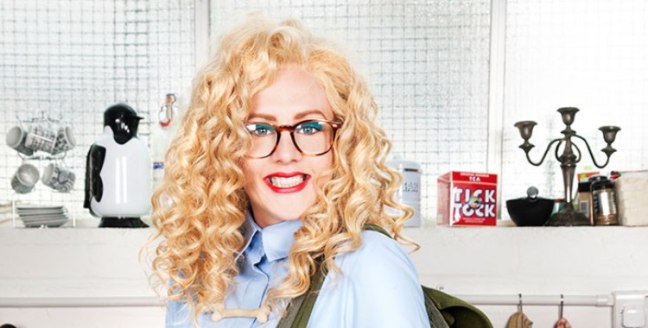
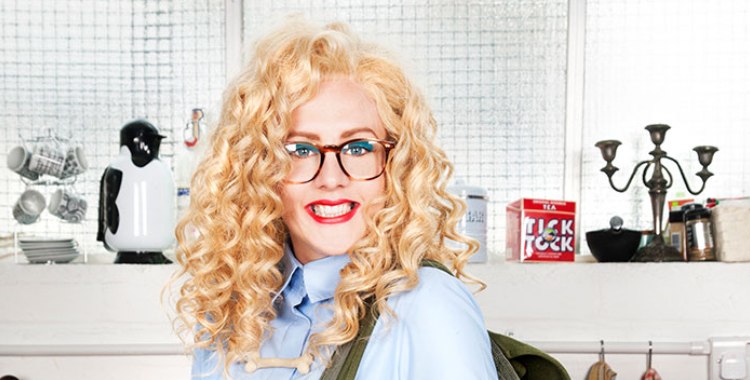
Dreamed up by Taylor and brought to life by her aunt, Kimmings’ new alter ego is a pop star created with a child, for children. Catherine Bennett – CB to her fans – is a dinosaur-loving, bike-riding, tuna pasta-eating hero who squeezes in a pop career around working in a museum as a palaeontologist. As Taylor explains, it was important to make CB “very different” to the female celebrities children usually see. Where most stars straighten their hair, CB wears hers defiantly curly. While other singers opt to bare their flesh, CB’s skirts are kept firmly below the knee.

But, like all pop stars, Catherine Bennett wants to be famous. Kimmings repeatedly refers to the project as “the fame experiment”, approaching it with all the hope and mischief of a kid with a chemistry set. To help Bennett hit the big time, Kimmings has assembled a true pop-star entourage: real-life makeup artists who have worked with Girls Aloud, i-D magazine stylists and a PR company. The team have offered their expertise to turn Catherine Bennett into a viable superstar, giving her the best possible shot at fame. “I just copied what they did with real pop stars,” Kimmings says, noting the enthusiasm and generosity she has met from those in the industry – many of whom feel just as disillusioned about how the system works.

Catherine Bennett’s successes so far include recording two music videos, closing the Children’s Media Conference in Sheffield in July and appearing as part of Yoko Ono’s Meltdown festival at the Southbank Centre in London. For her to be considered truly famous, however, Taylor has decided she needs to achieve a series of “fame aims”, including reaching a million hits on YouTube and making three celebrity friends. But the ultimate target, Kimmings adds, is to spawn a copycat.

While it might be said that the project’s fixation on fame runs the risk of reinforcing dominant definitions of success, it is important to Kimmings and Taylor that their creation makes her mark. If CB’s influence can be seen elsewhere, says Kimmings, the duo will know that they have “changed a bigger thing”.

The theatre show, which debuted as a work-in-progress at the Almeida festival in London ahead of its run in Edinburgh, is rejecting the “show and tell” format of Kimmings’ previous fringe successes, Sex Idiot and 7 Day Drunk, which dwelt, respectively, on Kimmings’ acquisition of an STI and her problematic relationship with booze. Instead, Kimmings is adopting a more “abstract” and “fantasy-based” approach, taking inspiration from the aesthetic of shows such as Game of Thrones to tell a coming-of-age narrative with a twist. “There’s quite a lot of symbolism,” Kimmings says, “but hopefully not in a cheesy way, hopefully in a cool way.” In the show, she and her niece appear together on stage to explore the darker side of growing up, from inappropriate dance routines to internet violence. The version I see is still being developed, but you can expect fake armour and a healthy amount of leaping around.

After Edinburgh, the show will tour until the end of 2014, while the mission to meet the fame aims continues. By the time Kimmings says goodbye to Bennett, she would like “just the tiniest of shifts in the brains of loads of children, or just a couple more cool representations of feminist women in the media”.

Kimmings is realistic about what she and Taylor are up against, but she remains resolutely optimistic. “I’ve got this blind hope that it’s going to happen,” she smiles, making it clear that this latest show is not about to let audiences off the hook. As Taylor adds cheerfully: “It’s a bit like being kicked in the stomach.”

Hunt & Darton Cafe

hunt-and-darton-cafe-0242-photo-christa-holka-sml-1-lst118427

Originally written for The List.

Go looking for a snack in Edinburgh city centre during August and you might just stumble upon some unexpected art. For a second year, live art duo Jenny Hunt and Holly Darton are offering festival-goers food for the stomach and the eyes at the Hunt & Darton Café, their unique pop-up installation on St Mary’s Street.

The idea behind it, Darton explains, was that ‘a passerby might just come in wanting a simple cup of tea and a cake and before they knew it they were involved in the installation’. The café first opened in Cambridge in April 2012 as part of the Cultural Olympiad, and has since visited Edinburgh and East London. The pop-up venue will be back at the Fringe this year, offering the addition of a bar in the evenings and an expanded programme of performances.

‘It became much more political than we realised,’ says Hunt, describing how the café unexpectedly transformed into an alternative, artist-led venue on the Fringe. In 2012, the pair was amazed by the huge response from artists looking for somewhere new to present their work. This year, that demand has been satisfied with a varied evening line-up, which Hunt and Darton hope that they are ‘framing slightly differently by it belonging to the café’.

As well as ‘shamelessly’ programming themselves, the pair have invited shows such as Chris Dobrowolski’s performance lecture All Roads Lead to Rome and Richard DeDomenici’s Popaganda, a piece that’s ‘very much about the now and popular culture’. But the art is by no means confined to the performances.

‘We say that every element of the café is art,’ Darton explains. ‘There are never any paintings on the wall or anything, because we don’t want people to be like – that’s the art!’ So the waiter serving you might be a performer, while everything down to the salt and pepper shakers has been carefully designed. Even the menu is something of a statement.

‘We thought quite long and hard about how creative we wanted the menu to be,’ Hunt admits, explaining that they eventually settled on an aesthetic that reflects their personalities. ‘We’re both born in the 80s and a lot of it references our childhoods,’ says Hunt, while Darton chips in to describe it as ‘comical, performative and kitsch’. Popular dishes include Battenberg cake, bowls of Coco Pops and their signature roast dinner sandwich.

Hunt and Darton describe Edinburgh as ‘a bit more in-your-face’ than the other cities their pop-up café has visited, and they already have plans to make it even more animated this year. As well as the popular return of ‘Christmas Day’ on 25 August, there are other days themed with tongue very much in cheek, including Austerity Day and Health and Safety Day. As Hunt warns, however, visitors have to be prepared to get involved: ‘We really like allowing our customers to perform as much as we perform.’