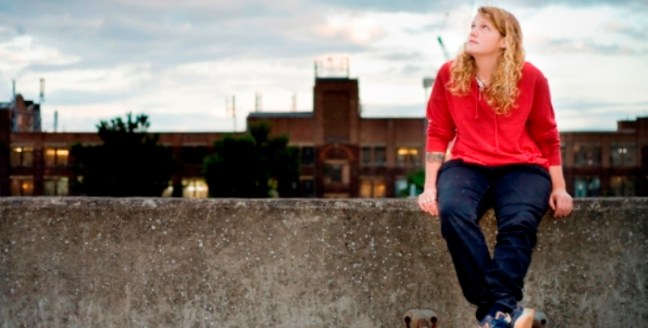
Kate Tempest

Kate-Tempest-02-Katherine-Leedale

Originally written for Exeunt.

When Kate Tempest takes to the stage to perform Brand New Ancients, audiences are offered a transformation. As she smiles a few words of welcome, the poet and performer is charmingly awkward, shy even. But from the moment she launches herself headfirst into her narrative, she is suddenly electric. Tempest is a shape-shifter; a small, unassuming figure in jeans and T-shirt, capable of making the air crackle. Ordinary and extraordinary all at once – just like the characters whose stories she so compassionately tells.

Brand New Ancients is all about looking at people differently. Shifting the focus of mythical narratives from unreachable gods in the sky to the ordinary individuals we walk past every day, Tempest asks her audience to see “real heroes in really normal people”. Her gods are at the bar and in the betting shop, smoking a fag in the street or eating a kebab after a night out. Fighting the false idols of manufactured fame and fleeting celebrity, Tempest argues that everyone is worth our attention.

“This thing about noticing people …” Tempest trails off during our phone conversation, pausing in search of the right words. “You walk around among people all the time without really noticing that they’re other human beings. It blows my head off every time I go anywhere; just looking at people, taking a minute to slow down a bit.”

In keeping with this focus on people, Tempest explains that it was the characters in Brand New Ancients who came to her first, with the form of the piece following as she wrote it. “I’m quite used to thinking about what it is now as a finished piece, but right back at the beginning I don’t think I quite had a handle on knowing what I wanted it to be,” she says. “I just had all these loose narrative threads about these characters.”

These threads eventually became the interweaved stories of two families, whose tale Tempest tells through a fusion of storytelling, poetry and rap. She explains that the finished piece was unlike anything she had done before and is in some ways her most ambitious show to date, featuring the longest sustained narrative and mixing a wide range of artistic influences. In a masterstroke, Tempest’s captivating performance is also accompanied by a soaring live score composed by Nell Catchpole, allowing wordless pauses for “your brain to recover from that onslaught and let the music do the talking”.

Given all these different, overlapping elements to her work, it is almost impossible to pin Tempest down to one genre. While the poetry world has recognised Brand New Ancients with the Ted Hughes Award, the inclusion of the show in the Traverse Theatre’s programme during the Edinburgh Fringe – where it is appearing as part of the British Council Showcase – would also seem to cement Tempest’s association with theatre. It was only last year that Tempest wrote her first play, Wasted, at the same time as continuing to make work by herself and with her band Sound of Rum. Speaking about her experimentation with different art forms, Tempest explains, “I’m now starting to have an idea and be able to choose whether that idea is a story or a play or a rap or a novel.”

The thought of not having a stab at new genres when the opportunity arises seems to be one that has not occurred to Tempest. And when it comes to the risk of failure, her attitude is remarkably relaxed. “Until you’ve got something really wrong you can’t get anything really right,” she reasons. “You’re not quite engaging with the decisions you make unless you’ve made a really bad one.” There’s also a steely streak of determination to Tempest’s character and a formidable work ethic beneath her laid-back persona. She’s particularly emphatic about the need to be constantly moving out of her comfort zone: “Push yourself, do something that’s hard work, do something you’re petrified of.”

It’s certainly a mantra that Tempest has lived by in recent years. As well as continuing to write for theatre, she tells me that she has just finished the first draft of a novel, at the same time as making a new record. And her latest project, from which she is taking a break when we chat, is a musical. Even Tempest sounds a little surprised about that one. “It’s very different,” she says, quickly adding, “and hopefully not shit. That’s all we can ask of any of it – please don’t let this be the thing that’s shit.”

For all the variety in her work, however, Tempest is dismissive of the idea that she might be innovating or crossing boundaries. “It is what it is because it’s what I’ve been doing,” she says simply. “I’ve read novels all my life and I’ve listened to rap music all my life and I love being told stories and I love the people in the place that I’m from, so it’s just very natural; of course it happens like this.”

At the heart of it all is an overwhelming love for stories. Tempest talks with enthusiasm about discovering her characters, about the stories that she and her family and friends are always telling one another, and about her recent trip to a writers’ festival in Sydney, where she met fellow writer and “the most amazing storyteller” Daniel Morden. “There’s just something that I react to, which is the narrator,” she attempts to explain her belief in the power of storytelling. “It’s comforting and it’s like the ultimate form of trust; trusting somebody that they’re not going to lie to you.”

“Here’s a story that Daniel Morden told me, right,” Tempest suddenly bursts out excitedly, abandoning the point she is halfway through making. She recalls a simple but beautifully told narrative about a visit that Truth pays to a town where no one will listen to him. After a few days, Tempest continues, a stranger arrives dressed in extravagant clothes and the townspeople all gather round him to hear what he has to say. When Truth asks the stranger what his secret is, he replies that he is clothed in stories, because “the naked truth is too much for people to bear”.

Falling into her distinctive rhythm, Tempest concludes: “So from that time to this, Truth has gone around dressed in the clothes of stories, and it’s easier for people to hear about themselves.” It feels like a fitting philosophy for the invention, enthusiasm and compassion of Tempest’s work. In the end, it’s all just stories.

Photo: Katherine Leedale.

I Predict a Riot

Originally written for Fest Magazine.

“What makes people act?” Director Clare Quinn’s question sounds simple enough, but its answer is anything but. As her company Gramophones Theatre bring their new show The Smallest Light to the Edinburgh Fringe, the subject of political action feels particularly raw. While television screens beam over images of unrest in Turkey and Brazil, the UK continues to reel from the impact of Occupy and the 2011 summer riots amid a building sense of dissatisfaction with the current government. For Quinn, however, the question of inertia is just as pertinent as that of action.

“I think that we’re actually in a situation now where people believe that protest does not work and so disengage from it,” she explains, partially blaming the way in which protests have been reported in the media in recent years. “Just as the systems of government in this country have failed us, I think traditional forms of protest have as well. I think that protest has been marginalised to the point where it doesn’t really relate to most of our community.”

Gramophones Theatre’s response to this disengagement has been to commit to positive action. Performers Hannah Stone, Ria Ashcroft, Rebecca D’Souza and Kristy Guest have each chosen an issue they care about, from food waste to domestic violence, and set about trying to instigate change. The eventual show will chart their progress. “It’s not very high concept,” Quinn says, almost apologetically. “It’s just about what happens if you try and change something.”

Theatre-maker Daniel Bye agrees with Quinn that the media’s presentation of protest has led to a level of apathy. “There’s a huge amount of misrepresentation of the act of protest, of the people protesting and of the ideas behind the protest,” he says. Of course, as he adds, “the generation of that fear and anxiety is actually quite useful to people who would rather that there wasn’t more widespread protest.”

His new offering, How to Occupy an Oil Rig, finds a solution born from that ubiquitous modern source of both knowledge and frustration: the instruction manual. “For quite a while I’ve been completely fascinated by ‘how to’ videos, instruction manuals, self-assembly kits – all these instructions which purport to make simple the complex,” Bye says. Taking inspiration from ‘how to’ videos on YouTube, the show engages with demonstration both in the political sense and in the sense of explaining how to complete a task.

As well as providing a practical set of instructions about the act of protesting, which exists in constant tension with the irreducible complexity of the issues that protest might be in response to, Bye hopes that this format will begin to demystify political action. “It’s a way of saying this is really a normal thing to do – it’s not an outlandish act.”

This demystifying of protest also takes place in Hannah Nicklin’s A Conversation With My Father, which is just what its title suggests: a conversation between protestor Nicklin and her retired police officer father. While the piece is unavoidably political, Nicklin emphasises that it is personal first. “I’ve always thought it has to be about me and my dad,” she says, “because we can debate the issues, but actually that’s the story only I can tell.”

It is important to Nicklin that this personal narrative is told as simply as possible, because “I didn’t want it to look like it could have been made up.” Her hope is that by relating her own experience as honestly as possible and admitting the complexity of the issues she’s addressing, she might prompt audiences to think and talk about these ideas. Above all, she is emphatic about the power of stories: “I think that storytelling is a vital civic act.”

The work of Kieran Hurley, who had Fringe success last year with Beats, is also steeped in storytelling. “I’m kind of obsessed with stories,” he admits with a slight laugh. This was evident inBeats, which told the tale of a teenage boy caught up in the rave culture of the 90s, and is equally important to the new play he has co-written. Chalk Farm, receiving a new production from Thick Skin for this year’s festival, is a response by Hurley and theatre-maker AJ Taudevin to the “reactionary kneejerk conservatism” of the media’s coverage of the 2011 riots. Through storytelling and empathy, Hurley and Taudevin hope to offer an “alternative perspective” on these events.

“It’s just a story, but simplicity and complexity are often two sides of the same coin,” says Hurley. He describes the riots as the play’s backdrop, explaining that it is more about social class and the demonisation of certain sectors of society. While Hurley thinks that all theatre is inherently political, he’s not interested in what he calls “agit-prop polemic”. Instead, he talks about the power of “collectively sharing a little bit of space and imagining possibilities about how we might relate to each other”, and through this process exploring political alternatives.

Nicklin defines political empowerment as “the ability to re-see, to reflect, and to react to the world around us.” Considering theatre’s potential for offering such empowerment, she suggests that it can achieve the first two through providing a space where the world can be seen anew, but that the third is ultimately out of its control. “I don’t think theatre will ever make anyone act,” she concludes. “I think it will just bring you to the point at which you can choose to if you want to.”

Bye equally believes that is up to the individual to choose to act, expressing a certain queasiness about theatre that hopes to provoke its audience to action. “If guilt is what moves an audience to do something when they leave the room, I’m almost not sure that I want them to,” he says. “I would rather recruit an audience’s genuine positive sense of will to act on something.”

This aim to reposition political action as something positive is echoed elsewhere, contrasting with the negative presentation of protest in the media. “If anything, I’d say what we’re making is a celebration of protest,” says Quinn. After all, as she puts it, “having an opportunity to do something about the things that you feel are wrong in the world is a positive, happy, joyful thing.”

Word Up

27223_large

Originally written for Fest Magazine.

“I don’t really know what it is, spoken word. What the fuck is it?” jokes Kate Tempest, her infectious laughter ringing down the phone. But she has a point. What is spoken word? Despite gaining its own section in the Edinburgh Fringe programme last year and being stamped as a burgeoning cultural scene, the genre straddles a huge range of artistic practices. It’s an artform that revels in mixing influences.

“There’s a lot of snobbery,” Tempest reflects on her own experience of the spoken word label. “If you’re a spoken word poet, you’re not quite a real poet; if you’re a spoken word artist, you’re not quite a rapper; if you’re a spoken word theatre-maker, you’re not quite a theatre-maker.”

Whatever snobbery spoken word might have faced in the past, however, the Fringe is an increasingly welcoming place for performers whose work falls into this boundary-blurring space. As well as an expanded range of offerings in the second year of the spoken word section, 2013 sees two spoken word performances make it into the British Council Showcase: Tempest’s Ted Hughes Award-winning show Brand New Ancients and Inua Ellams’ Black T-shirt Collection.

Despite growing up performing her poems—“it’s never been surprising for me that people stand up and tell their rhymes”—Brand New Ancients marks something of a departure for Tempest. Blending storytelling, poetry and an electrifying live score, the show intertwines the tales of two modern day families, spinning an epic narrative out of ordinary lives. “I’ve never done anything like it,” says Tempest. “I’ve never sustained a narrative for that long; I’ve never tried to tell a story like this.”

Her starting point, she explains, was the idea of myths. “I’ve always found a lot of comfort in reading myths,” she says. “In the myths I recognise friends of mine, recognise my family, recognise myself.” Wondering why these characters that she recognised all around her could not have myths of their own, Tempest set about the task of creating just that. Her heroes are compassionate barmaids and dissatisfied advertising execs; they drink pints down the local and hang out at the betting shop. As Tempest points out, “you don’t really get to hear epic narratives about people who aren’t epic heroes”.

As well as drawing heavily on storytelling and poetry, the live score is central to Brand New Ancients. Music appeals to Tempest because, unlike with poetry, “you’re straight in, there’s no faffing around with language”. Uncharacteristically, she fumbles slightly for the words to express music’s narrative power. “There’s just something that happens when you hear a violin soaring and when you watch a drummer going for it – there’s something that happens to you,” she says.

Inua Ellams equally identifies a range of different influences in Black T-shirt Collection, which combines the simple art of telling a story with poetic and multimedia elements. “I don’t even necessarily think of it as spoken word or as performance poetry,” he says, shaking off the spoken word label as restlessly as Tempest. It’s just a story, he shrugs.

Criss-crossing the globe from Nigeria to Britain to China, Ellams’ story follows two foster brothers—one Muslim, one Christian—who travel the world selling their T-shirts. While Ellams is keen to emphasise the simplicity of the tale, along the way the brothers’ experiences touch on issues as diverse as sectarian violence, homophobia and the ethics of the fashion industry. “The story covers so many things and does so very honestly,” he reflects.

Ellams’ aim, similarly to Tempest’s, is to identify the human narrative at the heart of his subjects. “Whenever I read stories about politics they tend to bore me,” he admits, pointing to the lack of a human connection. “That’s what I try to do,” he continues, “just tell stories about two guys and how the world happens to them.”

As well as being a consummate storyteller, Ellams very much identifies himself as a poet, explaining that the page is usually his first consideration. He describes the range of his work in terms of transformation. “Usually I think of myself as Bruce Banner,” he grins, seizing with glee on the superhero metaphor. “When I write a poem I think of myself as this scientist, this geek with glasses, conducting literary experiments with paper and pen. And then I think of myself reading poems as somewhere in between.” It’s only in his solo shows, when harnessing theatrical elements, that he’s the Hulk – “the monster is entirely unleashed.”

Elsewhere in the spoken word programme at this year’s Fringe, the offerings are equally varied. From the chaotic spontaneity of an ad-libbing show at the Assembly Rooms to a range of one-off talks from speakers such as Jeanette Winterson and Jon Ronson, spoken word is a patchwork genre. Among the highlights are the return of Scroobius Pip, poet John Osborne’s follow-up to the acclaimed John Peel’s Shed, and Luke Wright’s new show Essex Lion.

As Wright explains, his show was born from the inspiration of the false lion sightings in Essex last year and has ended up bringing in a range of poems about the things we want to see. “I think we’re always looking for those things in the next field, those things on the horizon,” he says. “All the poems are quite unrelated in their subject matter, but they’ve all got that at their core; they’re all about longing in some way and wishful thinking and self-deception.”

Discussing the spoken word scene, Wright is more pragmatic about the terms in which it is described. “Labels exist for a reason,” he points out, and he speaks of the launch of the spoken word section in the Fringe programme as “hugely symbolic.” For all these artists, however, the work itself is more important than the words used to discuss it.

“Hopefully there are a lot of writers coming through who are exploring new places and having new ideas and going on this huge adventure with text,” says Tempest. “Whatever form that comes in, if that’s happening we should be really, really, really glad.”

In It To Win It

27452_large

Originally written for Fest Magazine.

Just take a stroll down the Royal Mile and you quickly notice that competition is right at the heart of the Fringe. Flyerers trip over one another to slap their leaflet in your hand, performers all fight for attention and the ultimate prize is the five-star review. Like it or not, there are winners and there are losers.

For two shows at this year’s festival, that competitive element is dragged into the foreground. Made in China’s new show Gym Party, a dark and funny dissection of the desire to win, describes itself as a “three-way battle to the death” between its grimly competitive trio of rivals. In Fight Night, meanwhile, regular Fringe provocateurs Ontroerend Goed pit five performers against one another in a popularity contest where the audience have the final say.

“People have always been competitive and competition is not an inherently bad thing,” says Jess Latowicki, one half of Made in China. What she and fellow theatre-maker Tim Cowbury are troubled by, however, is the extent to which competition now drives our society. “It’s a mindset that has brought the world to its knees in the last few years,” Cowbury observes, pointing to the failure of free market competition in the financial crash and subsequent recession.

While Made in China’s starting point was politics, and in particular David Cameron’s “aspiration nation” speech, Gym Party draws on myriad types of competition. “When you say you’re making a show about competition, people are like: ‘what do you mean?’” Latowicki laughs. “It’s a really, really big topic.” Not aiming to focus on any one type of competition, the show instead critiques the underlying desire that drives it all, bringing in references to everything from competitive sport to television gameshows and talent contests.

Like Gym Party, the initial inspiration for Fight Night was political. Reflecting on the situation in his home country of Belgium, Ontroerend Goed’s artistic director Alexander Devriendt was struck by how far the cult of personality could sway elections and found himself wondering if it might be possible to explore these impulses in a theatrical setting. “I wanted to see what happened if I left behind all party colours and society issues,” Devriendt explains. “What if I take them all out, what do you vote for then?”

The resulting show fills the stage with five performers—or “candidates”, as Devriendt refers to them—who must persuade audiences to keep them in the game. Voting decisions are made based on “their presence, what they believe in, how they look, how they sound”, with Devriendt emphasising that the performers are playing versions of themselves rather than defined characters. Perhaps because of this, there is a genuine desire to compete. “The actors who perform in the show all want to win, because if they don’t win they’re out,” says Devriendt. “I like this real drive of the actors – they really want to perform and they want to win you over.”

The structure of different rounds and the very real element of competition bear certain resemblances with Made in China’s show. As it stands—Latowicki and Cowbury are still in the final stages of making the show when Fest speaks to them—Gym Party moves through three distinct phases of competition. The first offers a playful take on sports day, with performers competing in a series of silly physical tasks, while the second section moves into what Latowicki calls “subjective competition”, asking the audience to become the arbiters. In the third and final segment, the piece takes a dark turn.

Through this grim and admittedly “nasty” material, Gym Party asks just how far we will go in order to win. But Latowicki stresses that what they show the audience is no more shocking than the world around them. “These things happen,” she says. “People are horrible to each other for the sake of getting ahead, and all we’re doing is taking things from real life and framing them in a way that allows the audience to go ‘oh shit.’”

Similarly, Ontroerend Goed hope that there will be a darker political resonance to the competition in Fight Night, unveiling some of the motivations that trigger us as voters. However, it is important for Devriendt that this interpretation is never explicitly defined. “You can see it as a game, but you can see it as a metaphor for what you want,” he says. “I try to leave that open.”

Latowicki and Cowbury agree that they would rather leave the conclusions up to their audiences. “Some people want shows to give answers, but we’d much rather ask questions,” says Cowbury. “Our job is to provoke people to think about things they might not otherwise think about, or challenge their preconceptions and unsettle them.” He pauses. “As well as entertaining them, of course.”

Peeping Behind the Scenes of Peep

99Pic

Originally written for A Younger Theatre.

“There’s something particular about not being watched, not being seen,” muses Donnacadh O’Briain. The director of Natural Shocks, the theatre company behind unique Edinburgh Fringe project Peep, is discussing what he thinks gives this piece its impact. Placing its dramatic action within a sealed box, Peep invites a select audience of spectators into individual compartments, in which they watch the actors through two-way mirrors – peep-show style. They can see the performers, but the performers cannot see them, offering a distinctly voyeuristic experience.

“What’s interesting about the audience experience here is, because you’re unobserved, I feel like there’s an interesting lack of self-censorship happening,” says O’Briain. He insists, however, that his primary concern was always how to interrogate his chosen subject matter rather than how to create a novel experience for audiences. “Peep is really about the exploration of a subject and a theme more than it’s about putting people in private booths and having them watch a two-way mirror – that’s incredibly important and pivotal, but that’s not what it’s about, really, that’s just a means to engage an audience.”

Closely marrying form with content, the peep show set-up provides a space for exploring sex, relationships, intimacy and sexual politics. With a concept born from a conversation about male-female relationships and a desire to spark conversations around sex, O’Briain had already commissioned plays from Pamela Carter, Kefi Chadwick and Leo Butler before deciding to construct a purpose-built space in which these dramas would unfold.

“Peep changed around January last year as we were really looking at Edinburgh seriously,” O’Briain explains. “It changed from an idea for a play to an idea for a much bigger project. From there I began to think about it as a cross-art-form space, a space which was for the conversation about sex and about intimacy, and about what it is to be intimate with someone – our fears of that, our hopes for that – and then also a space for discussion of sexual politics and the body and objectification and voyeurism.”

Taking Peep and its three short plays to the Fringe last year, O’Briain certainly provoked the discussion he was hoping for, creating a buzz of conversation that he did not quite anticipate. “I think because they watch it completely alone, when they come out people tend to want to talk,” he says, “so I ended up having lots of conversations with people about the subject matter, which was great. That was a surprise, I didn’t expect that. Theatre doesn’t normally work like that.”

This year that conversation is being continued on a larger scale, as Peep moves from the Pleasance Courtyard to Assembly George Square Gardens – right at the heart of the Fringe – and opens with an expanded programme. All three plays from last year will be revived, alongside new plays, a dance piece, a spoken word performance, live art segments and a cabaret programme in the evenings. All in all, the space will play host to around seven-and-a-half hours of performance every day throughout the festival, all viewed through the venue’s intimate peep-holes.

“In order to talk about what we want to talk about, there are many, many ways of having that conversation other than text-based theatre,” O’Briain elaborates on his decision to widen the programme. “I wanted to free up the aesthetic this year and open myself as a programmer up to the whole bunch of possibilities for how we can have this conversation.”

O’Briain speaks excitedly about a “beautiful” dance piece by Argentine company Diego y Ulises, “about intimacy and about love and about a physical relationship”, which has been specially adapted for this space, and about Peep’s collaboration with renowned cabaret artist Empress Stah. “One of the things that’s fantastic about Stah is that she’s actually worked in a peep show for real and she works very much on the naughty end of performing arts,” he says. “The pieces that she’s making are really responding to the relationship between art and sex and where the lines are blurred and how that’s changed.”

The variety in the programming plays very much to the festival atmosphere, where visitors are looking to be surprised and are more willing to take a chance on new work than they would be elsewhere. O’Briain explains that he sees Peep as “fundamentally a festival piece”, adding, “I think people are at a festival to experience stuff and we’re offering that”. While he sees the Edinburgh Fringe as a great opportunity for a project like Peep, however, he suggests that it might not be the right destination for all work.

“I had no intention of going back to the Edinburgh Festival unless I had something that absolutely belonged at the Edinburgh Festival, because it’s silly otherwise,” he says. “Things die a death in Edinburgh because they’re not really right for it.” Peep, on the other hand, has been programmed with Edinburgh firmly in mind, and even includes a location-specific collaboration with a live art organisation based in the city.

Whether talking about the specific demands of the Festival or the unique opportunities of the venue he has built, O’Briain keeps coming back to the audience. Although there is a certain dialogue taking place between this year’s diverse range of different acts, he is keen to leave any interpretation of this programme to spectators. “For me those conversations are for the audience,” he says. “I think those conversations are going to be specific to people’s experiences of the programme, which again is really exciting. People will make their own meaning from those interactions. What we’re trying to do is stimulate a conversation in a whole bunch of different ways.”

And O’Briain hopes that festival-goers will come back again and again to continue that conversation, deliberately keeping ticket prices low in the hope of attracting return visitors. “It’s priced in such a way that it encourages people to come back for more – just like a peep show does.”