
“The Director as God is Bullshit”

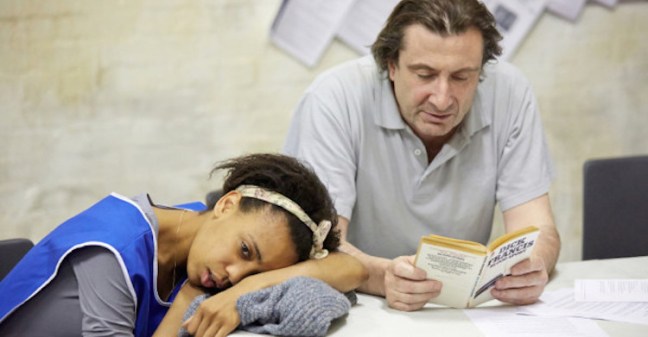
Jpeg-1.-Janet-Etuk-as-Grace-and-Sean-OCallaghan-as-Phil-in-Beyond-Caring.-Photograph-by-Mark-Douet-I80A4988-600x400

Originally written for Exeunt.

At times, Alexander Zeldin sounds more like a composer than a director. In his rehearsal room, “rhythm” is a popular word, as is “beat”. I’m watching Zeldin and his cast return to Beyond Caring, the hyper-realist snapshot of precarious labour that is transferring into the National Theatre’s temporary theatre following its premiere at The Yard last year. The show is an act of making visible – or perhaps audible. Zeldin stages the fractured daily routines of a group of zero-hours cleaners, with a musicality that draws as much on silence as it does on sound. It’s the ordinary textures of life woven into a theatrical score.

“I think in life there’s already quite a lot of theatre,” Zeldin says later as we sit in the foyer of the National Theatre, watching the everyday performances of passersby. “The theatre is a chance to be ourselves.” This is what’s so disorientating and eventually disarming about Beyond Caring, which refuses to fit human behaviour inside the stage conventions we are so used to seeing. “I think if you don’t do something that’s disturbing – I mean that in the best possible sense – you don’t really have an opportunity to be honest,” the director explains. “You need to create the conditions in which we can really exchange and we can really look at life.”

Zeldin struggles, though, to express the thinking behind this way of working, an approach that is perhaps best witnessed through the work itself. “If we could grasp it, there’d be no need to make the theatre, right?” he points out. I suggest a distinction made by Katie Mitchell between realism and naturalism, two words often used interchangeably to describe theatre. But according to Mitchell, realism is a mode based on recognisable conventions – representations of real behaviour – while naturalism attempts to precisely replicate that behaviour as seen in the world beyond the auditorium. Beyond Caring is in a similar mould, taking care over the minute gestures, pauses and phrases that make up a human life. A head is turned just so; a silence is rehearsed over and over.

Zeldin quotes a Chinese proverb: “don’t think about doing, just do”. Just doing, though, is “a very powerful, very complicated thing”. He continues: “everything I’m trying to do is just creating the conditions in which we can just do. And then we sculpt.” In creating these conditions, his role blurs between writer, director and member of a devising company, hierarchies constantly forming and dissolving. “The distance between the writer and director I feel is a little artificial,” he reflects on the slicing up of roles in much British theatre-making. “If you’re a director, inevitably you want to go and write, and if you’re a writer inevitably you’re going to want to write in the language of presence, space, rhythm.”

His role in the creation of Beyond Caring has strayed into both territories. While it was Zeldin who originated the idea and came into rehearsals with material he had already written, the show is very deliberately described as “written through devising with the company”. The piece has been shaped and reshaped over the years in close collaboration with a group of actors, as well as drawing on extensive research that started with Florence Aubenas’s book The Night Cleaner, an undercover investigation of precarious shift work in France.

For Zeldin, though, research is about experience and individual human interactions rather than about presenting a series of facts. “If you present your research on the stage, why don’t you just give the book out?” he says. “Because it’s going to be more clearly expressed.” Instead, the “meticulous” research undertaken by Zeldin and his cast – including stints working as cleaners – is subtly integrated at the level of character. One of the workers they met, for instance, talked about sleeping on a park bench, planting the seed for a character in Beyond Caring who sleeps in the factory where she works. “I’m not putting a park bench on the stage – that’s the verbatim version,” Zeldin distinguishes.

This, he insists, is where the politics of the show is located: in its form. Beyond Caring is about a controversial political issue – one that is proving to be a key point of debate in the pre-election hubbub – but its take on zero-hours contracts invites audiences to simply look and empathise rather than to engage with a series of facts and opinions. Inevitably, though, the current political context will colour its reception. “It’s a little awkward for me,” Zeldin admits, “because I’m doing a play about zero-hours contracts in the lead up to the election. I care passionately about the political issues at stake, but I hate politicians and politics.”

But he maintains that the style of the piece remains the most important expression of its politics. “I think it’s Tim Crouch who said that theatre happens in the head, not on the stage,” he says by way of explanation. “That’s such a powerful statement. And it happens in the heart; you just touch people, it’s not very complicated. I think we overthink things too much. Theatre is a precious space where we don’t need to overthink.”

Alongside music, another key aesthetic influence on the piece is photography. Zeldin explains that one of the initial inspirations for Beyond Caring was a series of photographs by Paul Graham – “it’s a kind of tribute, in a way” – and in the show he hopes to capture life in the same way that early twentieth-century photographers were able to. “August Sander, who was a photographer in the 1920s, used to go round before people knew what a camera was, so he’d point this thing at them and he’d capture them unaware,” Zeldin tells me. “There’d be a moment when you’d really see somebody, because they didn’t know how to behave in front of this strange contraption. That’s exactly what I’m interested in trying to do in the theatre.”

Achieving this involves precise and extended work with actors. “For me the root of everything I’m doing is the work with the actor,” says Zeldin. The question he is constantly asking of the performers he works with is “what’s at stake?” and his ultimate ambition is for them to achieve “presence”, a word he finds difficult to define. “What does it mean?” he asks, referring to the cliched statement that someone has stage presence. “Let’s be more specific. I think presence is something you can learn. You can develop it, you can train it.”

Beyond Caring, for instance, has been a long time in the making, and Zeldin has been working with some of the actors in the show for five years now. He characterises their process as completely collaborative, describing all of the performers as “massive contributors” to the show. “Hierarchy is dead,” Zeldin states unequivocally. “The director as god is bullshit, it doesn’t work. We’re in a room, we’re making it together, it’s got to be like that otherwise it’s a waste of time.”

“Theatre has to be alive in every second,” Zeldin continues, unforgiving in his expectations of the art form. “How can you do that? You need to create the conditions in the work where there’s a constant interrogation.” He recalls the experience of assisting Peter Brook – his greatest influence and inspiration as a director, as he stresses more than once – and being told to change something in the production every night while on tour. “It was about finding a readiness, an alertness.”

None of these working practices find a natural home in the British theatre industry, with its freelance culture and typically short rehearsal periods. For this reason, Zeldin – who is currently associate director at Birmingham Rep – aims to one day start his own company. “My ambition is to keep a group of actors together for ten, fifteen, twenty years,” he explains, brushing aside the audacity of this aspiration. His answer to practical obstacles is, perhaps, the best expression of his approach to theatre-making: “I think you have to do things that seem impossible.”

Photo: Mark Douet.

Theatre as Argument

590x494.fitandcrop

There’s a lot to be said about Nicholas Hytner’s tenure at the National Theatre. Hell, there are probably people already working on books about it. There’s the introduction of NT Live and the use of new spaces in and around the building; there’s the commercial success of shows such as War Horse, One Man, Two Guvnors and The Curious Incident of the Dog in the Night-Time; there’s the NT’s growing association with, for want of a better word, more “experimental” companies creating work beyond its walls. And then there’s the uncomfortable, lingering question about the imbalance of male to female artists, something I’ve written about in the past, which forms part of a much broader set of issues around representation and accessibility – issues of vital importance for a theatre that purports to be “national”.

As fascinated as I am by the narratives that establish themselves around certain theatre institutions and artistic directors, though, I don’t want to go into any of that right now. But what I was struck by yet again reading Michael Billington‘s assessment of the Hytner era (as well as the astonishing statement that the lack of Sheridan revivals is a bigger problem than the under-representation of female writers) was the extent to which theatres in this country are judged by their ability to address “the big issues of the day”. Billington approvingly frames Hytner’s NT as a “forum for debate”, a triumphant statement that is quickly followed by a staggeringly generalised blow to the political credentials of all continental European theatre (“I don’t know of any comparable theatre on the continent […] that feels a need to tackle the crises affecting our daily lives”).

This interests me not just because I instinctively disagree with the narrowness of Billington’s definition of political theatre (more on that later), though I do. It also brings me back to what turned out to be the central question of my MA thesis, which looked at the cultural narratives that have been built around another major, frequently mythologised British theatre: the Royal Court. In that thesis, I suggested that a certain understanding of theatre’s purpose in the world as a (text-based) platform for discussion and debate intersects interestingly with the traditional purpose of theatre criticism, an institution whose history in this country is inextricably tied up, for better or worse, with that of journalism. I wrote that “there is a generally accepted model of writing about new plays, in which the playtext itself is the principal focus of attention and the success of the production rests on the perceived effectiveness of the play’s central ‘argument'”.

I won’t rehearse that whole argument (yes, argument – the irony) again here; it’s in the thesis, for anyone who’s interested, and I’m very open to challenges to my reasoning, as these are ideas that will most likely come into play again later in my PhD. To return to Billington’s article, though, there are two points which are particularly revealing of the role he sees for theatre and for himself as a critic. First is the scepticism and light disdain implicit in his overview of “Hytner’s attempt to redefine what we mean by ‘theatre’,” an endeavour that Billington sums up with the vague, yet also vaguely dismissive, verdict of “artistically mixed”. This is then followed by the observation that two of Hytner’s biggest hits – War Horse and Curious Incident – “have been shows in which text is only one feature of a total theatrical experience”. Erm, doesn’t that essentially describe all theatre?

Secondly, Billington paints the NT’s relationship to the world around it as akin to that of the newspaper or news broadcaster. We have, in line with this idea of the theatre’s role, had shows “about” (I’ll only stop linking to that blog when it stops being relevant) a range of appropriately newsworthy topics: the Iraq War, the financial crisis, climate change, immigration, press corruption. And it’s doubly telling that Billington’s NT article was published by the Guardian just days after Charlotte Higgins‘ long, sprawling piece about political theatre, which departs from some strikingly similar assumptions: “Unlike music, dance and visual art it is theatre’s wordiness – the fact that it likes to place people in a room and have them talk, and disagree – that makes it the artform most closely allied to politics”. Higgins’ article also demonstrates that familiar formulation of theatre as a civic space, pointing back to Athens (where else?) and the central place of theatre in the city-state.

This all points to something that I feel is quite particular to the framing of theatre and its role in the UK. Tom Cornford (who, as an aside, was one of the people I was talking to recently about exactly the kind of narrative-forming that Billington’s article represents) has suggested that most mainstream critics in this country go into shows with “an unthinking expectation of pseudo-realistic form”. I think there’s some truth in that, certainly for some critics, but I’d suggest that it’s even more common for us (and, hands up, I include myself in this) to have the expectation that a piece of theatre will say something; that, explicitly or implicitly, it will articulate some sort of argument, which we will then assess. That’s what we’ve been taught to expect. Those are the terms on which critical discourse has established itself. And if theatre has an argument, that argument is usually expected to spring from the text. It both starts and ends with words.

But performance itself troubles that neat equation. In my current research, which is roughly speaking attempting to theorise the theatre text (emphasis on attempting), I keep encountering this idea of something in performance that is “in excess” of any text. Michael Goldman in On Drama: Boundaries of Genre, Borders of Self, for example, writes that “in drama one finds inevitably an element in excess of what can be semiotically extracted – something that is also neither irrelevant to nor […] completely independent of the text”. Benjamin Bennett, meanwhile, uses the example of Beckett’s famously precise plays in All Theater is Revolutionary Theater to demonstrate that the meaning of the text and the performance – no matter how detailed and prescriptive the former – can never be identical. Unpredictable human bodies and the evident materiality of the stage will always get in the way of that possibility.

This is a much knottier idea than the above paragraph acknowledges, but I won’t attempt to untangle it here. Instead, a pair of examples serve to begin prodding at and problematising that idea of theatre as argument. In my MA thesis, I turned to Katie Mitchell’s production of Ten Billion at the Royal Court in 2012 – an intriguing example, because it’s about as argument-like as theatre gets. After I’d finished writing that thesis, of course, Ten Billion was followed up by 2071, another show about climate change that was seemingly resolute in its lack of theatricality. Billington unsurprisingly offered high praise to both, but I find the terms of that praise really fascinating.

Both Ten Billion and 2071 are explicitly “about” climate change, delivered by scientists (Stephen Emmott and Chris Ripley respectively) and more or less following the format of the lecture. Writing about both shows, Billington acknowledges their questionable relation to theatre in almost identical terms. Reviewing Ten Billion, he writes: “Some will argue this is a lecture, not theatre. But the distinction seems to me nonsensical”. In his review of 2071, he repeats the same point with slightly more force: “Some will argue that this is not really theatre. But the idea that theatre should be exclusively reserved for fiction has been knocked on the head by a surge of documentary dramas and verbatim plays”. He adds, in relation to Ten Billion, that “Theatre is whatever we want it to be and gains immeasurably from engaging with momentous political, social or scientific issues”.

While this tells us a lot about what Billington believes theatre’s purpose to be, there’s little in either review that refers to the theatricality of these events. Most of the space is taken up by relaying and assessing the persuasiveness of the argument in question, with only fleeting mentions of its staging. Going by Billington’s analysis, the facts, figures and conclusions provided by Emmott and Rapley might as well be read in a book. Concluding his five-star review of 2071, Billington surmises that “if we look to theatre to increase our awareness of the human condition” – which he clearly does – “the evening succeeds on all counts”. But in what distinct ways does it succeed (or fail, depending on your opinion) as theatre?

Two other views, each more focused on what Ten Billion and 2071 gain or lose as theatre rather than as pure argument, offer an interesting comparison. Contrary to Billington’s entirely text-focused assessment of Ten Billion, Matt Trueman suggests that Katie Mitchell’s production complicates and problematises Emmott’s argument. “What we watch is 100% lecture and 100% theatre at the same time, and it absolutely thrives on the duality,” Trueman argues. He points to the tension between the naturalism of the staging – a form usually associated with illusion – and the hard facts of Emmott’s lecture, concluding that “we are set in a mode of doubting” as an audience. This built-in doubt, according to Trueman, mirrors the doubt we so often express in response to climate change, burying our heads in the sand when confronted with the stark reality of our planet’s plight. Mitchell, in this view, is doing something extremely sophisticated with her staging; “anyone that dismisses Ten Billion as ‘just a lecture’ is ‘just plain wrong'”.

Stewart Pringle‘s review of 2071 similarly concludes that theatre transforms the argument in question, but to wildly differing effect. Despite acknowledging that what Rapley tells us is all important information and that its presence in the Royal Court Downstairs “is itself a vital political statement”, Pringle argues that placing this lecture in a theatre context “has fatally undermined its utility as anything else”. He writes: “2071 brings something unusual to theatre (the monotonal tedium of a lecture), but theatre has brought next to nothing to it”. Having seen 2071 (I missed Ten Billion), I can agree that it was decidedly untheatrical in its presentation and distinctly dull as a result. As Pringle points out, it’s even less theatrical than most lectures.

In different ways, then, the status of Ten Billion and 2071 as theatre undermines – or at least alters – the arguments they present. The unpredictable “excess” of performance complicates matters. In the case of Ten Billion – if we go with Trueman’s opinion, anyway – the conflicting vocabularies of lecture and stage naturalism create a certain tension in our reception of Emmott’s evidence that would not be present were we reading it from the pages of a book. 2071, meanwhile, suffers from its framing as theatre, making a poor case for the necessity of its place on a stage at the same time as thrusting the theatre’s awkward materiality between audience and content. By actually putting arguments on stage, free from the clothing of narrative and metaphor, these two shows (intentionally or not) point up some of the difficulties around that prevalent “theatre as argument” view.

I want to turn again to a point I made in my MA thesis which feels relevant here: “If theatre – rather than any other public forum – is a uniquely powerful civic space, then surely there must be something it offers in its gathering of bodies that cannot be found in text alone; something in its very theatricality which challenges a critical interpretation of it as the straightforward thesis of the playwright.”

In other words, if there is something uniquely political about theatre – the nation’s “debating chamber”, as Higgins’ article has it – then it has to go beyond text. That’s not necessarily to say that only theatrical form, rather than content, can be political, as that can lead to similarly unthinking reproductions of an existing and supposedly radical set of assumptions. (I’m thinking here about certain formal gestures that were genuinely experimental and radical when they first emerged but have since congealed into their own set of tropes.) But if we limit our understanding of argument or politics to the text, then we ignore something vital about what theatre is and what it can do. After all, as Billington himself puts it, “Theatre is whatever we want it to be”.

P.S. As well as itching an intellectual scratch, this blog is something of a tentative experiment in how to connect my academic research with my thinking and writing elsewhere. In practice, of course, my dual existences often overlap, and everything tends to get thrown into a soupy (if frantically colour-coded) mixture of thoughts. But I’m interested in how to share more of my research process with a wider audience, so let me know what aspects of my PhD research you want to hear more about (“none of them” being a completely acceptable answer to that question).

Here Lies Love, National Theatre

image5-600x336

Originally written for Exeunt.

There are two revolutions currently taking place in the National’s refurbished and newly rechristened Dorfman Theatre (previously the Cottesloe). One is the peaceful People Power protest that ousted the Marcos regime in the Philippines in an astonishing four days in 1986. The other is a small revolution in mainstream musical form, as David Byrne and Fatboy Slim’s pounding, glitter-encrusted take on the life of Imelda Marcos puts audiences right at its pulsating heart.

Or perhaps revolution is too strong. More accurately, what Here Lies Love does is marry elements of immersive performance and gig-as-theatre to the more usually conventional form of the musical. What that means as an audience member – unless you choose to hide away up in the circle – is being thrust under the disco ball and into the action. Inspired by Imelda’s taste for the New York nightlife, Alex Timbers’ staging and David Korins’ design transform the Dorfman into a club of sorts, in which the dramatic action happens not in front of us but around us.

Taking place on stages, platforms and catwalks on all sides, the show breathlessly – and entirely in song – tells the story of Imelda’s rise and fall. We first see her as a simple country girl, singing dreamily about love, but within the swirl of a skirt she is winning beauty contests and setting her sights on Manila, where she meets and quickly weds rising political star Ferdinand Marcos. The whole thing is swift and relentless, its soundtrack beating out plot point after plot point in a series of murderously catchy songs. There’s no time for the attention to waver, let alone to reflect. This is a noisy, glittering juggernaut of a musical, pausing for no one.

As a result, anyone hoping for political insight or analysis of the Marcos era will inevitably be disappointed. The creative team do an impressive job of speedy storytelling, but the rhythm of the show doesn’t allow for the more intricate nuances of power and influence. There are plenty of unanswered questions, both about the Marcoses themselves and the people they ruled. Poverty, corruption and the tangled international threads woven between the Philippines, the US and a number of dubious world leaders all get mentions and little more.

But neither is Here Lies Love built for this kind of political complexity. This is a show about the excitement and intoxication of power rather than about its particular mechanisms. And in this it undoubtedly succeeds, sweeping us up in its heady, irresistible outpouring of booty-shaking joy. It’s loud, brash and occasionally downright ludicrous, but no less giddily enjoyable for any of its flaws.

Participation is key here. (For me, as it turned out, more participation than I’d bargained for.) Part of what makes Here Lies Love so intensely, well, loveable is the experience of moving and dancing with it, helplessly seduced by the glamour and the music. Like the initially adoring public of the Philippines and the leaders all over the globe who fell in love with this Asian answer to the Kennedys, we are utterly taken in, before our involvement later takes on a more uncomfortable and complicit edge.

There’s a clear parallel too between the allure of a glamorous leader and the adoration heaped on the stars of stage and screen. In the lead role, Natalie Mendoza lightly plays with this analogy, making it easy to imagine how she might inspire such hysterical levels of devotion. Much more than a charismatic stage presence and an impressive set of lungs, Mendoza also visibly toughens as the show lurches forward, transforming from the soft Rose of Tacloban to a diamond-hard politician. In her steely gaze and stiff, proud shoulders, we can begin to understand some of Imelda’s motivations.

Perhaps appropriately, however, the woman at the centre of Here Lies Loveremains somewhat elusive. This is not really about offering a new perspective on Imelda’s experience; this is about shining, seductive symbols of power more than it is about those powerful individuals themselves. Instead of seeing Imelda, we see the outfits, the smile, the endless glamour and extravagance, the continued pretence – or maybe a persistent self-delusion – that everything is done out of love. The show’s strapline declares “power to the party” and that’s exactly it. Here Lies Love invites us all to the sparkling, exhilarating, superficial party of the Marcoses rule, and guiltily we – like Imelda – don’t want the party to stop.

Hotel, or Untangling the Knots

tom-rhys-harries-ralph-and-susan-wokoma-nala-88864

Tuesday lunchtime: I’m sat in the Arcola bar, chatting to Danny Braverman and Nick Philippou about the brilliant sounding Wot? No Fish!! They are talking about making a story of a Jewish family speak beyond its immediate community, about the importance of outsider narratives in a political environment that stokes fear around immigration, about bringing an audience together in their difference.

Wednesday night: I’m perched on the edge of my seat in the Pit theatre at the Barbican, shoulders uncertainly shuddering with laughter. The cause of these tentative giggles is Young Jean Lee’s brilliantly unsettling The Shipmentwhich needles me with constant questioning of my own assumptions. How much is my view of the world tinted by race? Is this bit actually funny, or am I just helplessly falling into a trap? And actually – wait a minute – why am I making the experience of watching this show about me?

Friday evening: Partway through a panel discussion on arts criticism at the ICA, a woman in the audience raises the vital issue of diversity. How can critics – a deplorably white, middle-class breed – respond to work from cultures completely removed from their own? Just as I’m mentally firing that question at myself, Matt Trueman responds brilliantly and honestly with an admission of his own discomfort and uncertainty when having to review such shows (I’m really not doing his answer much justice – it was spot on).

Saturday morning: Playing catch-up, I read Andrew Haydon’s post about diversity (or lack thereof) in theatre. I’m particularly struck by two points. One: “A Soap For Every Race *cannot* be the goal for a diverse UK theatre”. Two: “We need to stop thinking that a ‘black actor’ *means* something *about* ‘Otherness’; if critics could stop reading a woman being cast as a man as some sort of comment on the ‘male’ character’s masculinity/effeminacy… That sort of thing”.

Saturday afternoon: I’m catching up again, seeing Polly Stenham’s new play Hotel at the National Theatre Shed (sorry, temporary theatre). And throughout this play about post-colonialism and Western responsibility, as shock follows shock and I hunch further and further down into my seat, I feel increasingly uncomfortable about its attitudes to race. And then I question my discomfort. And repeat.

Two days later and I’m still processing that discomfort. Race is (rightly) a knotty topic at the best of times, and with the conversations and reflections of the last week replaying in my mind I’m finding it increasingly tricky to untangle. Each time I do pick at the knots, my uneasy awareness of my own privilege halts me.

So perhaps privilege itself is a good place to start. I think it would be fair to say that Polly Stenham’s work to date has, among other things, concerned itself with a particularly privileged corner of British society. Her first three plays dissected white, upper-middle-class dysfunction, focusing on complex and often broken relationships between parents and children. First world problems of the highest order.

And Hotel opens in similar territory. A wealthy white family are holidaying on an unspecified desert island, where the fault lines of their relationships are soon exposed. Vivienne has just resigned from cabinet, made a laughing stock by her husband’s online indiscretions, while their teenage children Ralph and Frankie are messily entangled in the sordid affair (very messily, as it gradually transpires). The air is thick with betrayal and prickly with recriminations. And then – bang. The play that Hotel gave every indication of becoming is suddenly blasted to pieces.

On one level, Stenham and director Maria Aberg have done a very clever thing. The opening scenes of the play are one long teaser, playing on the expectations that Stenham’s previous work sets up, allowing the production to sharply pull the rug out from beneath our feet. What looked like a litany of middle-class moaning (played with claustrophobic precision by Hermione Gulliford, Tom Beard, Tom Rhys Harries and Shannon Tarbet) quickly turns into a tense hostage situation, as chambermaid Nala and her locally hired accomplice hold the family at gunpoint.

But this would-be kidnapper is not after money. Instead, her aim is to force an acceptance of responsibility from Vivienne, who was behind a deal that offered aid to Kenya in exchange for opening up unregulated trade. Free market capitalism under the guise of charity.

The point is a fierce and vital one. Exploitation does not just come in the form of colonial invasion, while globalisation closes the gap between action and consequence at the same time as it distances deed and responsibility. There is even a neat metaphorical resonance with the early domestic drama, as virtual transgression mirrors the way in which we in the West deny our complicity in the structures that oppress elsewhere. Just as Aberg’s production rips through the fabric of Naomi Dawson’s sterile white set – all pristine, synthetic luxury – the blind complacency of audience and characters is torn down the middle.

There are, however, some undeniable problems with this rapid shift. Because it comes out of nowhere, the motives for this sudden violence need a hefty bit of exposition, leaving Susan Wokoma’s Nala awkwardly delivering a lecture with gun in hand. Her accusations seek to leave our complicity in no doubt, but Wokoma’s brief, jarring recognition of the audience feels misjudged – a gesture, rather than a real effort of implication. Then the second narrative lurch is even more preposterous, injecting another shot of violence for little more than the shock it jolts through the audience. Sure, it’s gripping, but I can’t help wondering if this undermines rather than strengthens its point. A thriller is just that: thrilling. Which feels more than a little problematic given Stenham’s subject matter.

And so to those knots. Matt Trueman’s review grapples articulately with the possible racism in the piece, although I wouldn’t go as far in my reservations. My main concern lies in the limited representation of the play’s black characters. Nala plays a central role, but her accomplice is a crudely sketched outline, while the other black characters appear only fleetingly, their sole function being to deliver a further blast of violence. The focus remains firmly on the white, Western family, who squirm under the play’s microscope.

Perhaps it’s unsurprising that a play skewering white privilege should concentrate its attention on white characters. Further, it could be reasoned that Stenham is deliberately putting herself in this picture, attacking a position that she feels able to speak from (and, of course, a position that many of her audiences at the National Theatre will share). It would also be difficult to argue that she has no right to deal with these issues, reducing the debate to the level of a question asked at this year’s National Student Drama Festival by a young audience member who was outraged that none of the performers in a show about homophobia in American high schools had ever themselves been on the receiving end of homophobia in an American high school.

Still, there’s something about Hotel that niggles at me. I think again of The Shipment, a play about African-American identity written by a Korean-American. It sounds potentially misguided, but as I noted in my review, Lee’s own struggle with the show’s ideas (developed, significantly, with the all-black cast) somehow allows an audience to acknowledge society’s inbuilt racial prejudices and our own implication in those. To echo Braverman and Philippou, it brings audiences together in their difference – without ignoring or obliterating that difference. Hotel, on the other hand, is in danger of simply reiterating difference, while its use of its subject matter could be seen as the same kind of stealthy colonialism it attacks.

I should stress that I remain uncertain, and I’ve contorted myself through various spasms of discomfort and anxiety in trying to tackle my uncertainty. But maybe that’s no bad thing. Towards the end of the stand-up routine in The Shipment, the black comedian turns his attention to those white people who constantly tiptoe on eggshells, cautious of offending and quick to apologise. But rather than attacking this attitude, as we are braced for, he approves of it. Because what’s wrong with being careful?

Photo: Kwame Lestrade.

Chewing Gum Dreams, National Theatre

chewinggum-600x432

Originally written for Exeunt.

The image of chewing gum is a vivid, evocative primer for Michaela Coel’s miniature powerhouse of a monologue. It’s sweet, insubstantial, the stuff of adolescence; its bubbles, like the dreams of Coel’s teenage protagonist, are light as air. But they are also fragile and punctured at the lightest touch, leaving behind little more than a sticky mess, swiftly discarded and trodden underfoot.

14-year-old Tracey Gordon, Coel’s spiky, outspoken narrator, is the sort of girl who teachers roll their eyes at and adults edge away from on the bus. She passes the journey into school mercilessly taunting her cousin and whiles away maths lessons with talk of tits and condoms. Yet for all her swagger and gobbiness, she is also just a teenager, smarting from the world’s cruelties and buzzing with the experiences it offers up. Life is the sharp slap of a hand and the melting gaze of a boy.

Coel’s giddy, fast-paced narrative is a jumble of contrasts. In one moment, a friendship that has been built over years crumbles in seconds; in the next, a crush explodes into life with firework intensity. These violent shifts in tone, far from derailing Coel’s play, beautifully convey the instability of adolescence and its hormone-fuelled careering from ecstasy to despair. Likewise, Coel is adept at realising the internal contradictions of her young characters, capturing with razor-sharp accuracy both the vicious cruelty and fierce loyalty of teenagers.

The vitality and charm of Coel’s performance more than matches the observational flair of her writing. The central figure of Tracey is sketched with detail and compassion, while the cast of supporting characters are inhabited with a vividness that simultaneously brings them to life in their own right and suggests Tracey’s own talent for mimicry and delight in performing. With her mean turn of phrase and killer comic timing, Coel’s teenager clearly relishes her position in the centre of attention.

What ultimately makes the piece, however, is the vulnerability and lack of self-worth that peeks through the bolshy exterior. Young, black and trapped in a cycle of poverty, Tracey has no illusions about her position in life: “I’m not smart enough to be someone; I’m just smart enough to know I’m no one”. Beneath the broad comic strokes of Tracey’s anecdotes, Coel colours in a world of abuse, neglect and withheld opportunities, where aspirations are barely whispered. Told by her boyfriend that she should aim higher, Tracey responds with blinking incomprehension.

Despite this bleak injection of reality, the dead-end despair is tempered with humour, friendship and a fragile note of optimism. It is rare that a piece of theatre can wear its social critique so lightly and yet with such fierce, damning intent. Coel never lets her targets off the hook, but her characters continue to embrace life in spite of its injustices, stubbornly and good-humouredly getting by. As Tracey would say, chin raised defiantly, “life goes on, innit”.