The Ritual Slaughter of Gorge Mastromas, Royal Court

The-Ritual-Slaughter-Of-Gorge-Mastroma-620x340

The repeated central question of Dennis Kelly’s dark allegory, emblazoned in giant letters at the back of Tom Scutt’s set, is a troubling one: “goodness or cowardice?” Are supposedly moral decisions just a case of taking the easy road? Is a decision really the “right” one if no “wrong” alternative occurs to you? Are virtue and fear simply one and the same? But beneath it, running in a thick, throbbing artery through the metabolism of the play, is an even more troubling question: is there really any such thing as truth?

In an interview with Maddy Costa for The Guardian, Kelly states his preference for plays that ask questions over those that provide answers, admitting that he’s “not really sure” what The Ritual Slaughter of Gorge Mastromas is about. I would, for the most part, agree that asking questions is more productive – not to mention more interesting – than offering solutions. A question leaves audiences thinking, while a firm conclusion can immediately alienate those who don’t agree with it. When everything is questioned, however, the provocation to look for answers is neutralised. Why search for a version of the truth if all truths are exposed as relative and ultimately meaningless?

Life’s stark absence of meaning is a revelation that forms the hinge of Kelly’s play. His eponymous protagonist, Gorge Mastromas, starts out as an essentially moral human being. When offered a choice, he takes the decent option, be it standing by a mate at primary school or remaining faithful to hastily voiced promises. Kelly and director Vicky Featherstone offer us this series of early incidents in Gorge’s life via an extended sequence of collective storytelling: the six cast members sit in a line of chairs at the front of the stage, sharing the history of Gorge’s life from the moment of his inadvertent conception. And my use of the word “history” is no accident; this simple but striking opening deliberately foregrounds the construction of historical narratives, offering a fragmented, unreliable and polyvocal account of Gorge’s life, told from a perspective that is never quite acknowledged or qualified.

Our protagonist’s Faust moment arrives when a ruthless businesswoman briskly informs Gorge that life is not what he has until that moment believed it to be – “it is not fair, it is not kind, it is not just”. But if he’s willing to sell his soul to the demons of cutthroat capitalism and merciless self-advancement, he can have whatever he wants: power, money, sex. The trick is simply to lie from the bottom of his heart, heedless of the consequences of those falsehoods. Embracing this new philosophy with only the lightest flicker of hesitation, Gorge is swiftly mounting the ladder to unimaginable wealth and power – an unstoppable capitalist juggernaut. Be it a company, a house or a woman, Gorge always gets what he wants. What follows is acquisition at the expense of all else, painting a sorry picture of our society’s trajectory and the lessons it implicitly instils in us.

It’s an old story, but one that is drenched in the giddily unfettered capitalism of the 80s and 90s, playing on the myth of indefinite growth and the conviction that everything is there for the taking if only individuals are willing to grab it. The main commodity to be traded, however, is not property or shares, but narrative itself. Gorge is a spinner and seller of stories – most explicitly with his fabricated bestselling memoir, but also in the fibs he blithely tells those around him in order to get ahead. And people want to believe these fictions. When speaking of “people”, that necessarily extends to the audience, all of us eager to grasp onto something solid, some narrative structure that makes sense of this world. By drawing attention to this, and to the lies that even our narrators are incessantly telling, the play makes us immediately doubt anything it tells us, as well as doubting our own interpretations of these versions of the truth.

The shifting ground of Kelly’s play is shaken further by this production – if, indeed, we can speak of the two separately, which is always a slightly disingenuous project. The dynamic division of Gorge’s story between the cast, delivered with an edge of irony, is reminiscent of now ubiquitous techniques of poststructural performance, at once bringing to mind the likes of both Forced Entertainment and Martin Crimp (useful reference points for the disruption of meaning and narrative). This engaging, teasing mode of delivery is contrasted with the far less compelling – and often overlong – “scenes” that pepper the play, offering an ever-so-slightly heightened variation on naturalism. Which offers the picture that is closest to the truth is left down to us, as the performance style of each in turn subverts its own stated veracity.

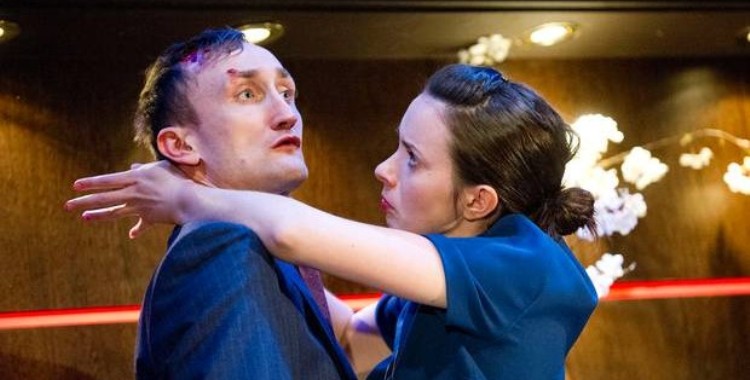
The figure of Gorge himself, meanwhile, is a tight knot of contradictions. When Tom Brooke first shrugs on the role of the anti-hero, he is a quivering, deferential employee, eager to please and anxious of hurting. After offering such a detailed portrait of this meek, decent man, it is difficult to dismiss his ghost, which hovers over all of Gorge’s subsequent deceptions. Never is he quite as convincing as when still in possession of his morals. Alongside the fleshed out emotional detail that Kate O’Flynn’s compassionate performance offers Louisa, the unlucky object of Gorge’s affections, Brooke’s mercenary entrepreneur is a skeleton of a character, at times nearing a caricature of capitalist greed. Yet this thinness seems oddly apt; it could be argued that it shows up the absurdity of this Game Theory style of self-serving logic in both life and drama. Human beings are strange, irrational creatures, and to drain them of that irrationality – be it by a capitalist logic of acquisition or a notion of drama that is built upon clear character motivation – leaves only empty shells.

The empty facade is also a recurring feature of Tom Scutt’s intelligent, thematically excavating design. His self-contained naturalistic spaces, which form the backdrop for the correspondingly “realistic” scenes, always offer a hint of superficiality, from the calculated blandness of a corporate office to the moneyed sheen of a hotel suite. By the time the scene shifts to Gorge’s lakeside palace and a dilemma that will test just how far he’s prepared to go to protect this painted paradise, any attempt at substance is abandoned, leaving only a flat simulacrum of a landscape on a screen behind the actors – the shimmering mirage of Gorge’s life, concealing only emptiness. Elsewhere in the design, the stubborn search for a pattern is offered visual expression: the constellations of a life are brightly dotted on an image of the night’s sky, paper is pinned to the walls in imitation of the detective’s evidence trail, and neon lines are traced over a graph.

Through this kind of detail, The Ritual Slaughter of Gorge Mastromas offers much to chew and puzzle over, for the most part sustaining intellectual vitality over its testing two hour and 45 minutes running time. That hovering question mark over truth, however, niggles at me throughout. While I have other doubts about the piece (it’s far longer than it needs to be, for starters, and Gorge’s moral descent lacks the punch that I suspect it’s reaching for), my main concern is prompted by its political position; or, rather, how it seems to politically let itself off the hook. The questioning of truth is interesting in itself and follows the thread of much poststructuralist/postmodern (depending on how you like to define it) thought in suggesting that there is no foundational reality that we can appeal to, but it is equally in danger of rendering all truths equally invalid, thus making any attempt at morality pointless.

My mind is dragged back to the recent discussion Dan Hutton and I had about hope in theatre, which strayed into similar territory. In that dialogue I borrowed from Liz Tomlin’s new book Acts and Apparitions (a text that I increasingly think could be a vital reference point in navigating post-postdramatic performance practice), and it feels appropriate to return to Tomlin now. Her book traces the postmodern thought mentioned above and considers the possibility of making a radical gesture in theatre today, when any notion of the true or the real has received a thorough battering. To demonstrate how she grapples with this, I want to quote part of the text:

“Accepting that every narrative is implicitly ideological does not equate to the acceptance that any given narrative is thus beyond ideological analysis or distinction. The artist or critic’s choice to propagate one narrative over another will still result in a ‘real’ impact on the artists, the audiences and, to some degree at least, the ideological shape of the historical period in which the work is situated.” (pp.6-7)

In other words, the version of the truth that we choose to tell has an effect, whether or not it can appeal to some original, authoritative, universal truth. This version of the truth might even have the power to change the world, a power about which Gorge Mastromas feels distinctly ambivalent. Individuals such as Gorge can change things, but only for their own gain; beyond the certainty of lying, the universe is portrayed as cold, cruel and chaotic. If we choose to present an image of the world in which there is no truth, only lies, then perhaps there is a responsibility towards the “real” impact of that image. By seemingly refusing that responsibility and falling back on relentless uncertainty, Gorge Mastromas – for all its merits – feels like a bit of a cop out. If the question is “goodness or cowardice?”, I would tentatively suggest that Kelly errs towards the latter.

Photo: Tristram Kenton.
Mirrors, Hope and Transformation

circle_2616054b

What can theatre do?

This isn’t necessarily the central question asked by Circle Mirror Transformation, Annie Baker’s delicate and precisely naturalistic portrait of five broken individuals, but it is the question that I found myself asking as I left the Rose Lipman Building on Thursday evening. Following a steady stream of superlatives on Twitter, I went in with unrealistically high expectations, all underscored with another, slightly resigned expectation of being disappointed. And while I wasn’t disappointed as such, I didn’t find it the most extraordinary, transformative theatrical experience of recent months either. But this heavy burden of expectation, together with the scenario in which Baker’s play places itself, left me thinking about what theatre can do, what it might do and what we hopes we hold for it.

Circle Mirror Transformation is, in a sense, a piece of theatre about theatre, but ‘meta’ is a word that seems completely removed from its vocabulary. No Noises Off-style send-up or self-reflexive meditation on its own medium, Baker’s play is instead about the kind of theatre that remains largely invisible. The whole thing takes place over the six weeks of an adult drama class, in a large, windowless room in a community centre in Vermont – not unlike the large, windowless room in which we find ourselves in the Rose Lipman Building. Each of the scenes, punctuated by sharp blackouts, consists of either the kind of exercise that will be instantly familiar to anyone who’s ever taken a drama class in their life, or the slices of conversation that happen in the room around each session.

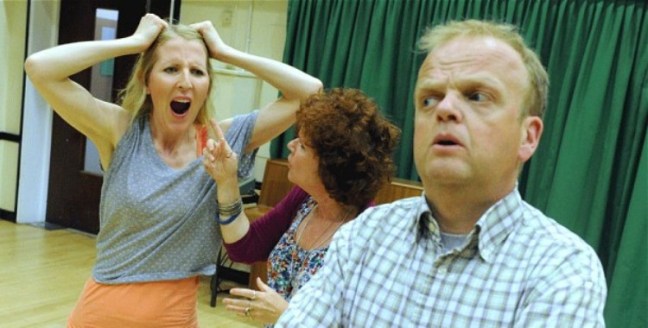
The class is run by hippyish Marty (Imelda Staunton at her quietly expressive best) and attended by her husband James (Danny Webb), recent divorcee Schultz (a brilliantly awkward Toby Jones), once actress and now aspiring acupressure therapist Theresa (Fenella Woolgar) and enigmatic teenager Lauren (Shannon Tarbet). We see fleeting snatches of each of their lives over the course of the six weekly classes, learning enough to feel acquainted with these characters while never being furnished with the full details. Baker’s minimal writing dances deftly around the edges of life, never leaving us in any doubt of the wholeness at its centre – a wholeness that is solidified by the gorgeously nuanced performances of the cast, who execute something of an acting masterclass over the uninterrupted two hours.

The word that most naturally springs to mind when reflecting on Circle Mirror Transformation is “gentle”. This might be applied to James Macdonald’s direction, which handles Baker’s text with kid gloves, trusting it with a slow-burning pace and long, expansive silences. It certainly applies to the interactions between the five characters, which are sometimes awkward, often tender and frequently funny, in the light sort of way that you might expect from a Sunday evening TV comedy drama (that’s not meant as a dig, I should add, but – a couple of uproarious moments aside – it’s not side-clutching, tears-rolling-down-your-cheeks stuff, and I don’t think it’s meant to be). There are a couple of real kicks to the gut in there, but when these arrive they are all the more startling thanks to the calm from which they emerge. This is the placid lake of life as lived from day to day, disrupted by just the occasional ripple.

And within this seemingly uneventful structure, moments of stunning precision and incisive emotional truth emerge. There’s Tarbet’s fascinating stillness and the meaning she can somehow effortlessly invest into silences; the subtle yet devastating poignancy of a fleeting look on Staunton’s face following a kiss between Marty and James, transforming an apparently light moment into one loaded with unspoken turmoil; the simultaneously funny and sad complexity of Woolgar’s Theresa, a woman whose damaging decisions are portrayed with unwavering compassion, wrapped around the yawning loneliness that drives her actions; the painful awkwardness of Jones’ bruised but tender Schultz and the latent frustration of Webb as James. As they progress, Marty’s classes are more therapy than they are theatre, conveying the power of drama without romanticised exaggeration or sentimentality. The six-week experience changes each of its participants, yes, but they still come out at the other end as complicated, flawed and slightly broken people.

In this unapologetic concern with people – people in all their ridiculous, messy, beautiful complexity – Circle Mirror Transformation feels somehow both universal and particular, massive and miniature. It is also, however, somewhat problematic. To merely dismiss the play as inward-looking feels a bit simplistic, as the individuals within it exist very clearly within a world beyond the four walls of the community centre and the supposed banality of their lives reveals odd moments of profundity, but its quiet containment does present a certain view of what it is that theatre does. Drama might transform the lives of the characters, for better or worse, but in this room we are just presented with another set of mirrors. This is life seemingly reflected, held up to us without judgement, refusing to prioritise the big events of life over the seemingly insignificant minutiae. Which is interesting, and makes a certain statement of its own about how our culture assigns value, but it can also feel somehow resigned to the shape of the world. This is how things are.

Hope-23-Tim-Crouch-and-Andy-Smith-by-Mae-Li-Evans

I’m thinking this in part because of two other pieces of theatre I’ve seen in the last month, both fantastic and fascinating collaborations between Tim Crouch and Andy Smith. As they explained with enviable eloquence when I spoke to them recently, their work always has at its heart an interrogation of theatre as an art form in one way or another. In both of the shows in question – Commonwealth (available online as part of the Royal Court’s Surprise Theatre – go watch) and what happens to the hope at the end of the evening – this interrogation is the motor that drives the piece.

Each of these shows is characterised by a shared rhetoric of hope around theatre as a medium; as Crouch puts it, “An engagement with a group of people sitting in a room together is an innately hopeful act”. Commonwealth, written by Smith and performed in this instance by Crouch, is a monologue that meditates directly on the hope that we might bring into a theatre space, telling a story about a theatre a bit like this one and an audience a bit like this audience. What initially seems a little straightforward and repetitive gradually becomes an invitation to deep and probing thought, calling into question the ways in which we respond to our frustrations about the world and positing the theatre as a space where perhaps we can begin to change that. It’s about what we hope to get from the theatre and what the theatre might be able to offer us.

In what happens to the hope at the end of the evening, the ideas explored in Commonwealth are put through the wringer using an opposition between two different approaches to theatre and to the world. It tells the story of one evening in which two old friends meet after a long time apart, at the same time using this as a structure to explore the theatrical event. Smith, to all appearances, plays himself, while his friend is not a version of Crouch but a fictionalised character. Smith reads from a script and directly acknowledges and addresses the audience; Crouch’s character desperately constructs a kind of stage realism, dragging on props to support his fictional world. Smith is controlled and thoughtful; Crouch is impulsive and bent on action.

The piece is rare in achieving an almost perfect balance between narrative and ideas. Its story of a friendship, one in which an almost unbridgeable distance has forced itself between the two friends, is at times deeply moving in its own right. As a vehicle for the show’s meaty ideas, meanwhile, this device is inextricably married to the content it carries; it is all about hope, about connection and separation, about gathering people together in a space. There’s great optimism for the potentially radical quality of a gathering like this, supported by carefully selected snippets of theory, but at the same time doubt is cast on theatre’s potential, while the lack of resolution between the show’s two opposing elements concludes the whole thing on an uncertain note. It’s difficult without apologising for its complexity, but at the same time the ideas being wrestled with are presented relatively simply and accessibly. (I’m reminded of something brilliant that Kieran Hurley said to me recently in an interview: “simplicity and complexity are often two sides of the same coin”)

What is striking about both Commonwealth and what happens to the hope at the end of the evening is their ambition for the space of the theatre and what it might achieve, even as they problematise their hopes for the theatrical event. Like Chris Goode’s The Forest and the Field, this is theatre that helps you think about theatre, that leaves you with a set of questions to mould around the next thing that you go out and see. Which is perhaps why Circle Mirror Transformation, despite its much-celebrated brilliance, left me wanting something more, and perhaps why I typed out that opening question. What can theatre do? I don’t really know, but I think it’s important to keep asking.

One final, positive thing about the relationship between these different pieces. My enthused fascination with the intelligence of recent programming at the Royal Court is probably getting boring by now, but it’s worth noting that Circle Mirror Transformation (part of Royal Court’s Theatre Local initiative) and Commonwealth are positioned alongside and in dialogue with one another, even if they don’t share a building. While it might seem (at least to me) as though there is something slightly lacking in Baker’s play, simply by existing in the same programme as Commonwealth it’s already taking part in a wider discussion.

These two shows also sit within a programme that includes Collaboration, a process which itself prodded at what theatre does and how it does it (and which, as Andrew Haydon points out, might well have been the ideal process to explore an idea like Baker’s), and The Strange Undoing of Prudencia Harta joyous and inclusive instance of theatrical transformation. Add Mark Ravenhill’s Cakes and Finance to that list and you have a theatre that suddenly seems to be thinking a hell of a lot about what it is and what it does. It’s asking that same question – what can theatre do? – and providing a whole range of answers, all implicitly entering conversation with one another. And it feels exciting.

Embrace the Shame: Open Court Collaboration

Photo-by-flickr-user-reid-licensed-via-cc-600x3291

Originally written for Exeunt.

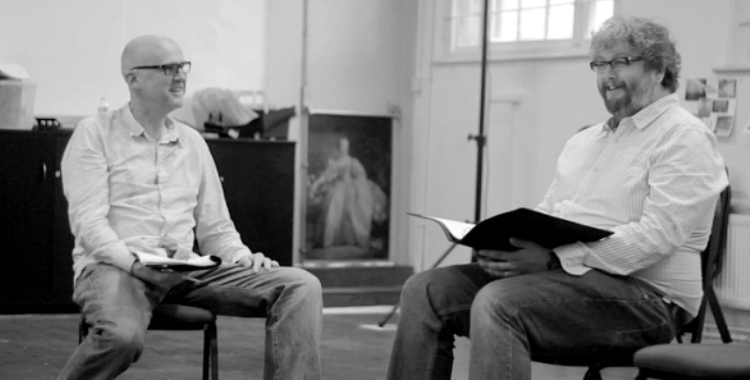
In a bright rehearsal room in Pimlico, to the faint strains of an opera being rehearsed next door, six actors are pretending to be cats. With feline grace they paw investigatively at a series of cardboard boxes of varying sizes, as one by one they attempt to climb inside. On the other side of the room, notebooks diligently in hand, six writers.

This is just one of the more eccentric exercises on the third day of Anthony Neilson’s two-week workshop programme, part of the Royal Court’s Open Court festival. Under the banner of Collaboration, the aim is to facilitate an environment where playwrights and actors can try ideas out together in the same room, establishing a direct and productive dialogue without the mediation of a director. The structure is built on Neilson’s own way of working, which involves an immediate process of testing his writing in partnership with a group of actors and other creatives; the group perform in and around the text during the day and Neilson goes away to write in the evenings.

Vivienne Franzmann – who only two days ago was anxiously declaring her attachment to rules – has an idea sparked by the simple narrative of purpose seen in YouTube videos of Maru the cat (if you’re not familiar with Maru, Google him – you’re in for a treat). Hoping to develop this into the start of a play, she is able to immediately get actors dancing around the idea. Hence the boxes and the crawling around on all fours.

While the cats are one of the more striking examples, there are lots of other, smaller ways in which this process pushes the writers out of their comfort zones. On the first day, as those gathered in the room fight with jangling nerves, Neilson tells everyone that here “you’re allowed to be shit”. The first constraint to be removed is the need to be good. Instead, this is a space of experimentation and exploration, a space to try out ideas and immediately chuck them on the rubbish heap if necessary – often salvaging them later in the process in another form.

I’m reminded of a comment made by The TEAM’s director Rachel Chavkin in Paulette Douglas’ film about the making of Mission Drift. She talks of the “blood of the dead babies” that seeps up through the stage; all those ideas that were tried out and culled, only to come back to life much further down the line and make their way into the final show. While this two-week sprint is a micro version of the painstaking four-year process behind Mission Drift, the same pattern begins to develop. Seemingly disposable results of early improvisation become the unlikely seeds for future work.

On the first day, the emphasis is very much on establishing familiarity and trust – two essential elements for this way of working, and ones that need to be put in place at ten times the speed of any other rehearsal process. While Anthony has chosen a collection of actors he has worked with before, they are mostly unknown quantities to the playwrights taking part. So on day one there are six writers (Vivienne Franzmann, DC Moore, Janice Okoh, E.V. Crowe, Joel Horwood and Robin French) and six actors (Imogen Doel, Noma Dumezweni, Nathaniel Martello-White, Jonjo O’Neill, Richard Pyros and Sophie Russell) who need to get to know each other. And fast.

Neilson’s solution, after a morning of introductions and talking at length about the project, is to pair up writers and actors at random. Each writer picks an actor’s name out of a hat and proceeds to interview them at a table in front of the rest of the room. Actors are allowed to lie, but they have to respond to anything the writer throws at them, while the writer has the freedom to go as personal or as interrogative as they like. To redirect the emerging narratives and to showcase the actors’ abilities, writers can also throw in accompanying emotions or actions – sad, anxious, drunk, dance.

There are unexpected and often hilarious moments. Imogen Doel spins a giggling story about an unrepentant hit and run; Jonjo O’Neill shares his idea of truth through interpretive dance. But it is also extraordinarily intense. The writers take their role as interviewer increasingly seriously, unafraid to delve deep into personal territory, while the lines of truth and fiction in the actors’ responses are repeatedly blurred. Perched at the edge of the room, the absorbed but uncertain observer, I begin to feel a bit like a voyeuristic cheat. Everyone else has to expose themselves in some way, while I just get to watch.

The phrase that soon jokingly attaches itself to the process is “embrace the shame”. Neilson talks of a shame barrier that has to be broken through in order to progress; actors must be unafraid to make fools of themselves in the improvisations, while writers have to unlearn the self-censorship that comes hand in hand with painstaking rewrites. Everything in this room is raw and immediate. After the interviews, which eat up a surprising amount of the afternoon, the writers are suddenly asked to write something in 15 minutes, which will then be read by the actors. The panic is palpable.

While seemingly just workshop exercises – and Neilson admits that he is no workshop leader, explaining that this process is just as revealing and unfamiliar for him as for anyone else – these early bursts of forced creativity prove integral to the plays that eventually emerge. The end point of this short rehearsal period is a half-hour play from each writer, with the six pieces shown over three nights, though Neilson emphasises that this is about process rather than product. The aim is simultaneously to push the writers into new territory, give them a taste of Neilson’s way of working, and argue for wider use of this process.

And it is a process for which Neilson is a persuasive advocate. At first glance this writing method would seem to shift focus away from the writer, creating a collaborative making process more akin to that of devising companies, but Neilson’s understanding of his way of working is deeply rooted in a belief in the centrality of the playwright. There is collaboration, yes, but the playwright always retains authorship – an idea that, through its tendency to elide the collaborative nature of theatremaking, tends to make me feel a little queasy. By removing the director from the process, Neilson explains, the playwright has a direct connection with actors and designers, forging a tighter unity between the vision of the work and its individual parts. While highly valuing the contributions of the actors, Neilson makes it clear that this process is for the writers – the authors.

This notion of authorship becomes a question mark on the very first day, as I make the perhaps foolish decision to openly reveal my concerns about the concept to a room full of writers. But it feels like a productive question mark to leave hanging over the process; after all, a certain amount of self-reflexivity is only appropriate to a project aimed at making writers reconsider the way in which they work. And there’s no doubt that there is a certain ethical question that dogs this methodology, one that is raised again rather more bluntly by playwright Lucy Prebble in the final post-show Q&A. If others in the room have contributed material, at what point should they be offered a slice of ownership? If a play created in this way went on to be hugely successful, what would the financial model be for distributing the royalties?

It’s a dilemma that the process does not seek to solve, but it remains hovering somewhere in the background throughout. At first there is some uncertainty as to how this all works. Do the writers draw directly from improvisations? How much of the work is really theirs and how much comes from the room? At one point Janice Okoh in particular expresses concern about this, to which Doel (who has worked repeatedly with Neilson) responds: “if you choose it, it’s yours”. A ‘finders, keepers’ philosophy of writing. But then isn’t this how most writing works anyway? Inspiration often comes from somewhere external, and the list of influences on a play throughout its life might run to several pages long. A large part of the writer’s role comes down to selection, structuring and dramaturgy.

Over the course of the two-week process, it becomes clear that this way of working rarely involves large chunks of text lifted verbatim from improvisations. For a start, the rawness of the improvised material rarely lends itself to the page. The fragments that get borrowed by the writers are more often images, the germs of ideas, snatches of emotion. Conversations about children during the day one interviews thrust roots into a number of the pieces in various different ways; E.V. Crowe ends up using the workshop itself as a setting for her distinctly meta offering; Joel Horwood says that as much of his inspiration comes from tea break conversations as from the improvisations.

What the use of improvisation does reveal, however, is how close the roles of writer and actor actually are. As Neilson repeatedly insists, actors are essentially writing when they improvise. They are involved in a similar act of creation, only theirs is rough and immediate rather than meticulously constructed over time. The extraordinary ability of the actors in the room becomes more and more evident over the two weeks, as they reveal an instinctive sense for the direction of a piece as they move within it. They can push at a text and occasionally explode it, in the process revealing new facets. It’s a skill that sits close to writing, but works within a completely different time frame and demands a very different way of thinking. Actors feel their way through the action, moment by moment; writers sit structuring it at one remove.

As important as the use of improvisations as a source of material – perhaps even more important – is the knowledge of their actors that the writers are able to gain through this process. Perhaps one of the key features of the project is that none of the plays it produces could have emerged outside of this room. O’Neill’s ukulele playing skills and Sophie Russell’s tap-dancing both get written into the comedy acts in DC Moore’s play Open Mic, for example, while the presence of sound designer Nick Powell contributes a vital element to a number of the pieces, freeing the playwrights to write in songs or sections that rely on sound rather than words.

Robin French hits on a brilliant analogy for the process in one of the post-show Q&As, describing it as Masterchef vs Ready Steady Cook. Like the finalists on Masterchef agonising over which meal to cook, these writers might usually sit at their desks for months or even years carefully crafting a play. This process, however, has been much more akin to Ready Steady Cook. The writers have a defined set of ingredients and a ticking time limit, producing results that might not be perfect but can be entirely unexpected. Working in her usual way, would Franzmann have written an experimental exploration of the internet? Would Crowe have chosen a fragmented investigation of the very act of writing itself?

More so than content, the form of the writing is particularly affected by this way of working, which was another of Neilson’s aims going into the project. At the Open Court press briefing, he discussed his concern that theatre is not keeping up with the world or the nature of our modern consciousness and suggested that perhaps this process could begin to nudge playwriting towards a form more suited to contemporary life – which it perhaps begins to do. It feels as though there is a tipping point in rehearsals, when Horwood comes in on day three with a spliced narrative that experiments with form and asks the actors to give it a playful series of readings, testing out different stylistic approaches. Suddenly the mood of the room shifts and anything seems up for grabs. Play as script morphs into play as playfulness, and form becomes more and more fluid.

No matter how fragmented, though, there is a structure to how the various different pieces are put together. As he guides the rehearsals, stepping in or backing away according to the temperature of the room, Neilson voices two constant questions: “what is the internal logic of the play?” and “what truth are you trying to tell here?” He contests the inherited wisdom that naturalism is the most logical way of conveying a narrative, countering this with the often surreal subjectivity of lived experience, but he insists that each stage world – however far it departs from reality – must be governed by some logic of its own, some truth of its own. This philosophy chimes with my own feeling that naturalism is not suited for telling every story and that each play should find its own form of expression. Why should naturalism be the default setting for British theatre? Why should collaboration between actors and writers be restricted to devised work and kept fenced off from more ‘traditional’ playwrights? These are the kinds of questions that Neilson’s process insistently asks, gently eroding the accepted structures of how theatre works in this country.

Being “embedded” in this process (to borrow a phrase from Andrew Haydon that seems to have stuck) brings questions of its own. Am I a passive bystander, a witness and documenter, or am I as much a part of the evolving work as anyone else in the room? If I do contribute to the exchange of ideas, how do I reconcile that with my role as observer? The first question is not a question for long, as by my second visit to rehearsals it becomes almost impossible to keep my thoughts to myself. The openness of the room fosters collective thought, teasing out contributions almost involuntarily. I’m careful not to impose myself too strongly on the process, but when I have an opinion I’ll share it. Early on in the process, divisions quickly become fluid and everyone’s thoughts are welcome, as the writers feel their way around the emerging pieces of work.

There’s a definite shift, however, once we move into the upstairs theatre at the Royal Court halfway through the second week. Suddenly, sitting in the multi-coloured bank of chairs while the actors move around the stage, I feel like an audience member, quietly placed back on my usual side of the divide. This reflects the difficulties that the plays face when moved to this space, as some of the moments that felt fiercely alive in the rehearsal room suddenly fall flat. Faced with such a tight timescale, it becomes much more about simply getting the plays to a point at which they can be shown rather than playing with new ideas, and I judge that any thoughts I have at this point, beyond the purely practical, would probably be more destructive than helpful.

Negotiating my role within this process as I dip in and out also requires a consideration of ownership on my part. Especially during those first intoxicating days, it’s easy to become attached to certain ideas and seize on them with excitement. When those ideas fall by the wayside or get taken in a different direction, there is an impulse to fight for them – one that I resist, but it’s sometimes tough. Which raises questions about embedded criticism and the level of involvement that it implies. Is it best for the critic to remain silent and simply observe?

And there’s another question around the level of criticism involved in embedded criticism. This emerges almost immediately, as there is some initial discomfort around my presence in the room and an implicit worry that I will be critiquing what goes on. I’m quick to stress that I’m not there as a critic as such – at least not in the same way as I would be on a press night – but I suppose there is a certain act of criticism always taking place. Like the choices of a photographer or a documentary filmmaker, there is an implied and half-conscious form of criticism in what I choose to focus my lens on. Naturally, certain things capture my interest more than others.

Connected to this focusing of attention, there is also the problem of being an occasional rather than a constant presence. Thanks to conflicts of scheduling, I end up seeing more work from some playwrights than others and (to my great frustration) I miss one of the final showings. I try to spend as much time in the room as possible, but really I only see selected snapshots of the process. Am I then qualified to comment on something when I’ve only seen a part of it? After all, I would never review a show that I had missed more than half of.

My solution, following the writers, is to embrace subjectivity. At some point I make the decision not to write about the final pieces produced by the playwrights, because it seems wrong to see them as final. I would probably contest the idea that any piece of theatre is truly finished, but in this instance more than usual it feels disingenuous to write about the work in a way that fixes it. The Collaboration project was always about process rather than product, a set of priorities that it seems only right to honour and reflect. What I can share, reflect on and question is only my experience of that process – a process which, from my point of view, seemed quietly transformational for the writers involved, suggesting exciting possibilities for more open ways of working.

But mine is only one window on the rehearsal room – and a limited one at that. As I consider my lack of objectivity, I’m reminded again of Neilson’s constant guiding question, directed at increasingly exhausted yet exhilarated writers as they reached for what their work might be trying to say. What is the truth? And so I suppose, in a sense, this is my truth.

The Strange Undoing of Prudencia Hart, Royal Court Theatre Local

1069380_10151698714439099_1041612077_n

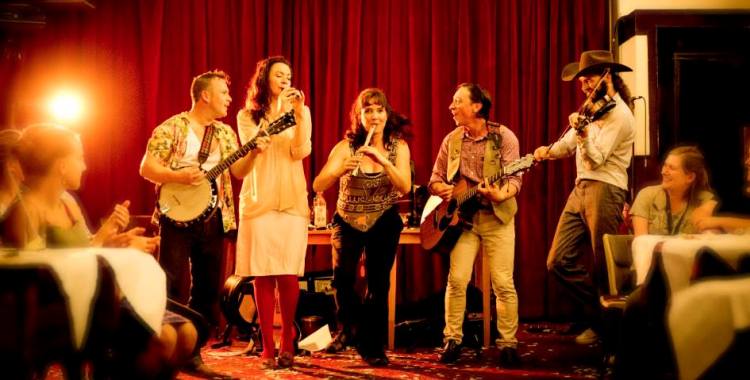
However you do it, there’s something a bit odd about thrusting yourself headfirst into imaginary winter in the midst of sweltering summer heat. As pipe-playing actors stubbornly tell us it is December 2010 while sweat trickles slowly down their foreheads, the prelude to the National Theatre of Scotland’s The Strange Undoing of Prudencia Hart has something of the school play about it; well meaning, big hearted and determinedly blind to its own obstacles – but it’s not fooling anyone. Fans continue to whirr valiantly away, while theatregoers gulp down drinks with a fervour not usually witnessed outside the Edinburgh Fringe.

Then something sort of magical happens. As the actors begin their story, we’re instructed to throw handfuls of improvised paper ‘snow’ into the air, settling on heads and tables and floor. Melody Grove (dressed in so many layers I’m impressed she makes it through the show without fainting) sits atop another performer’s shoulders as a mimed steering wheel, a gleefully waving windscreen wiper, and a tax disc, rearview mirror and two torches held aloft instantly conjure a car. It’s the simplest kind of theatrical illusion, but the rough and raucous spirit in which it’s done brilliantly sets the tone for the show that follows. The heat doesn’t abate, and we’re not quite transported to the snow-blanketed landscape of the Scottish borders, but all of a sudden our sweaty environs seem to matter a little less.

This effervescent little firework of a show is the joint creation of playwright David Greig and director Wils Wilson, joyously embracing both the traditional ballad form and the rowdy pub setting – in this instance, the intimate (and uncomfortably muggy) Welsh Centre bar. Greig’s text takes the form of a ballad about ballads, encompassing everything from lively folk sessions to dry academia, but its knowing self-referentiality never sacrifices a vital sense of fun. At the heart of the piece, effortlessly marrying form and content, is a tension between the purity of tradition and the inclusiveness of a form that morphs to appropriate new cultural phenomena – two camps into which Greig’s bickering gaggle of academics are firmly divided.

One of these academics is the eponymous Prudencia Hart, a prim and reserved traditionalist specialising in the topography of hell, for whom fashionable attempts to intellectualise Facebook statuses and football chants are little short of blasphemy. The story begins at a midwinter conference in Kelso, a small Scottish border town, where Pru’s purism is decidedly in the minority, up against post-post-structuralism and theses on Lady Gaga. Tradition is out of vogue. Adding inconvenience to humiliation, Pru then finds herself stranded with her colleagues in a snow-surrounded pub, trapped somewhere between the drunken locals and the horror of the karaoke machine.

Rattling through academic papers and beer-drenched revelry with equal ease, the first half of the show is mostly hilarious scene-setting, affectionately poking fun at its characters and drawing its audience into the circle of the story. This is narrative at its simplest and most familiar: a yarn down the pub. We are made to feel that the story belongs to everyone, as the narrative is shared and passed between the five performers, who in turn pass through the audience. Actors dance on tables and leap up onto the bar, while several audience members find themselves roped in as props or extras (fellow critic Dan Hutton, incidentally, makes an excellent motorbike). Greig and Wilson find a popular form, populate it and turn it inside out.

The action only begins to drag in an extended sequence featuring four drunken locals, who might be realistically hammered but add little to the gathering story; it’s the one point at which the production feels indulgently overlong. It’s not surprising, then, that Prudencia wants to get away, escaping the drink and drug-fuelled hedonism of the pub for the snow-covered town and a suspiciously friendly B&B owner. Nick, it turns out, collects rare books – and souls. As Prudencia’s academic subject swiftly becomes her reality, it soon transpires that she is the devil’s latest prize, condemned to eternity in a tartan-filled bungalow next to the Asda car park.

Pru’s subsequent ‘undoing’ in the second half offers both a transformational narrative of self-discovery and a movement towards reconciling the two sides of the argument established by Greig in the first part. As the verse that has propelled the story thus far is abandoned in favour of prose, Prudencia learns over several millennia that a life without passion and poetry – no matter how many books you surround yourself with – is no life at all. This section of the show, settling into a quiet rhythm after the raucous first half, is certainly strange. But it’s also sort of beautiful. In one gorgeous, startling sequence, the devil (played by both Paul McCole and David McKay in a slick and surprisingly effective bit of shape-shifting) finally surrenders to poetry, melting together with his captive in a slow and intimate dance.

This section also provides an opportunity for the excellent Grove to become a captivating central anchor for the piece, as her Prudencia gradually reveals an unknown, passionate facet of her otherwise reserved character. Her undoing refers less to a tumble into sin than an unstitching of her distant, sedate exterior. This is paired with Pru’s visual disrobing, as her meticulously neat layers are discarded one by one, leaving her in just slip and tights, while her hair cascades down from its prim bun. Transformation runs through the form, too, as prose gives way to a torrent of poetry and the explosive power of a collective football chant unites the ballad with its modern cousins. There’s even a bit of Kylie thrown in for good measure.

Alongside the production itself, it feels worth pausing to consider its context. Prudencia’s specialist subject might be the topography of hell, but the specifics of this production concern far more earthly locations. Like many of Vicky Featherstone’s early moves as the new artistic director of the Royal Court, this programming has the feel of a statement, and a multi-layered statement at that. Firstly, it’s a bridge of sorts between Featherstone’s role with the National Theatre of Scotland – for whom she commissioned this piece – and her new home at the Royal Court. Secondly, the fact that this show from a theatre without walls is being presented outside the brick and mortar of the Court, as part of its Theatre Local season, suggests a continuation of that gesture of opening up that has so far characterised Featherstone’s tenure. More and more I think that only an artistic director with the experience of not being shackled to a building could give as much thought to what a building really means as Featherstone has already.

Then of course there’s the fact that this show from the National Theatre of Scotland, engaging with Scottish folklore, is being presented at the Welsh Centre in London, England (all that’s missing is a slice of Northern Ireland). And it’s a show about border ballads, in which the narrative itself floats, flitting from performer to performer and only briefly settling. At a time when British identity is increasingly under pressure, this implicit stretching and questioning of nationality feels significant, inviting us to reconsider our connection with our country and our past. It’s also fascinating to see this ahead of Northern Stage’s Bloody Great Border Ballad Project at St Stephen’s in Edinburgh, offering another modern, border-crossing take on this form.

The pub setting, too, is vital to the rowdy sense of community that emerges in the room by the end of the night. As already mentioned, the forms that Greig and Wilson are recruiting to tell this story are very much popular forms, from ballads to folk music to karaoke. There is the sense that, wound together in this way and planted in a familiar social setting (ideally oiled with a few drinks), this marriage of popular forms both old and new offers a new and yet old way to share our stories with a group of people gathered together in a room, breaking through many of the stifling conventions that often hamper theatre. The Strange Undoing of Prudencia Hart is, like the tale round the campfire or the roaring anecdote told over pints at the pub, a basic but accomplished lesson in storytelling. And it’s devilishly infectious fun.

Photo: Johan Persson.

Open Court, Royal Court Theatre

IMG_8404

Originally written for Exeunt.

In each week of the Open Court festival, the downstairs space at the Royal Court is dominated by a huge wooden crate. As the house lights go down on the latest weekly rep offering, Chloe Lamford’s design is a closed box, a sealed-off world within a world. But almost as soon as the action begins, this box tips open, its sides dramatically tumbling down. It’s hard to imagine any better visual metaphor for what is happening at the Royal Court under new artistic director Vicky Featherstone.

Lamford and her design team must also take the credit for much of the transformation elsewhere at the Court, where Featherstone’s giddy promises of playfulness are translated into bright splashes of colour. The bar, once gloomily sophisticated, is now a riot of yellows, blues and greens. One whole wall is given over to an image of a bright green hedge, while paper lanterns glow overhead and the childish mischief of the summer festival finds its expression in a big blackboard covered with multi-coloured magnetic letters. Burgers and chips are the order of the day.

The atmosphere being cultivated in the early weeks of Featherstone’s tenure, in which she has boldly handed the keys to the writers, is one of both opening up and discovery. No longer is the drama confined to the two auditoriums, as yellow and red tags offer up brilliant ‘found plays’ for curious passersby (which can also be discovered online, if you have a few hours to kill). Lost in Theatre, meanwhile, offers a truly new perspective on the Court, inviting audiences into its unexplored nooks and crannies. I have yet to find the time to get lost myself, but the bright circles on the floor enticingly beckon me every time I’m there, calling visitors into the unseen depths of the theatre.

In the work itself, the aesthetic is rough, raw and exciting – and, as a result, slapdash. With the need for polish stripped away, there is the room for both thrilling discovery and messy execution. What I’ve seen of the weekly rep shows is a decidedly mixed bag, unleashing a frighteningly skilled ensemble on a pair of underwhelming plays. Lasha Bugadze’s The President Has Come to See Youcertainly kicks off proceedings in the right spirit, with Featherstone’s production and the excellent cast lending a shambolic energy to this bonkers Georgian satire. It would probably help to be acquainted with the Georgian politics being skewered, but in this festival context the freshness and excitement of it all is just about enough to carry it – even if the references do fall a little flat.

The second rep show, Lucas Hnath’s Death Tax, fares less well. Hnath’s string of dense scenes asks big, uncomfortable questions about an ageing population, but the play as a whole feels uneven and full to the point of bursting. Everyone talks too much. There are important issues being chewed over here, such the consequences of life-extending medicine, the privileges money can buy and the selfishness of what motivates us – “no one does something for nothing”, we are repeatedly reminded – but this could almost be several different plays. The cast, however, do their best to inject some life into the lengthy scenes, and it remains extraordinary what everyone involved has managed to pull together in just a week.

One of the most exciting elements of Open Court is also mixed, but it makes up for its patchy variety with glorious unpredictability. Surprise Theatre is just what it says it is: it offers its viewers a genuine surprise. In an information-saturated age when we are used to going into the theatre armed with endless details, it’s novel and disarming to be confronted with the unknown in this way. The configuration of the Theatre Upstairs (once again, credit to Lamford) also plays with this novelty, continuing the colour that is splattered throughout the building and concealing each night’s surprise behind mocking red velvet curtains.

The first offering, Cakes and Finance, is a bold and exciting gesture, immediately asking questions about what a theatre building is and what it should be. In a verbatim piece of sorts, Mark Ravenhill reads from interviews with a number of playwrights about their ideal theatre – from plush red seats to a building without walls. While none of the subsequent surprises I’ve seen have quite met the brilliance of this opener, there are some genuinely startling moments; Lauren O’Neill’s delivery of the final, punishing monologue in Sarah Daniels’Masterpieces administers a bruising blow to the gut, while scenes of piercing poignancy and fierceness emerge from The Ship’s Name, put together by a collection of writers of Somali and Eritrean descent. As a viewer, there is also something particularly engaging about feeling one’s way through a piece without any props (the supporting kind, though the theatrical kind are also in short supply), demanding an active act of spectatorship.

Just in case the festival as a whole was not already engaging sufficiently with what the Royal Court as a theatre might mean and might be able to say, the weekly Big Idea pushes playwrights into addressing the important questions – sex, age, death. Alongside these timeless themes, a more obviously timely subject is found in PIIGS, the acronym referring to five of the countries hit hardest by the eurozone crisis: Portugal, Ireland, Italy, Greece and Spain. Pairing writers from each of these countries with their British counterparts, the five nights of theatre engage with the realities of everyday life for those living on the front line of austerity.

The offering from Ireland, penned by Deirdre Kinahan and Kieran Hurley, feels terrifyingly close to home – and not just in the geographical sense. While Ireland is suffering more than the UK, the plight and the conversations feel familiar, if heightened. Around two compassionate, funny but ultimately stark pieces by Kinahan and Hurley, about an attempted protest at an Irish school facing cuts and the erecting of fake shop fronts in Northern Ireland during the G8 respectively, the pair have made the powerful choice to incorporate a selection of verbatim interviews. Their interviewees range from a financial journalist who quotes debt figures to make the eyeballs bulge, to a woman reduced to selling everything and uprooting her family’s life to Canada. The numbers baffle, but the stories move.

Coming full circle to that gesture of opening up, it is also important to acknowledge how much of this work is being made available beyond the four walls of the Royal Court. Each of the Surprise Theatre shows is being broadcast live online on Mondays and Tuesdays and left on the website to view on demand, while the Royal Court Soap Opera collides theatre and television in a series of nightly episodes that can be streamed online – not to mention the treasure trove that is the Found Plays website. While such initiatives always carry the potential danger of eroding the live moment, Featherstone’s intention seems to have less to do with the theatrical event than with the building hosting it, a building that appears increasingly open. Perhaps because of her time operating a building without walls with the National Theatre of Scotland, under Featherstone the walls of the Court suddenly seem a lot less containing.

Photo: Helen Murray.