The Violence of Language: Slap Talk, Text and Durational Dramaturgy

OLYMPUS DIGITAL CAMERA

This is the text of a provocation I delivered at the TaPRA Conference last week.

‘Are you ready?’

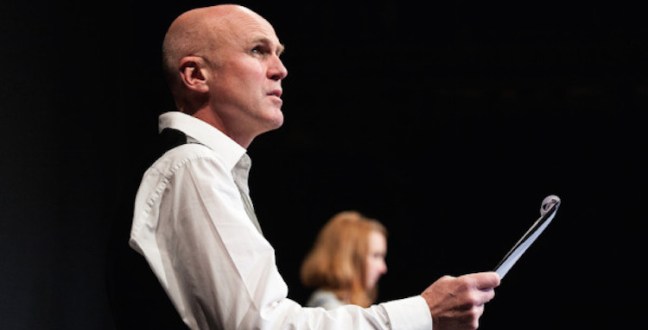
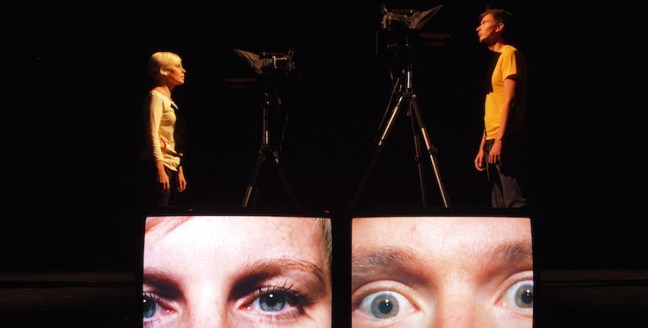
The three words that open Slap Talk, Action Hero’s durational slanging match, are a challenge to both audience and performer. Inspired by the pre-fight trash talk traded by boxers, and by the culture of 24-hour rolling news, the show pits performers Gemma Paintin and James Stenhouse against one another in a relentless battle of words, reading out a barrage of insults from a scrolling autocue while close-ups of their faces are live-streamed on two large screens facing the audience. The piece continues without pause for six hours, with audience members free to come and go at any time.

Throughout the performance, Paintin and Stenhouse are slaves to the text scrolling in front of them – which they have also written – yet the durational format stretches and unsettles the relationships between text, performer and spectator. Today, I want to begin asking how the durational dramaturgy of Slap Talk might emphasise the slippage between text and performance, in the process begging larger questions of the authority of the theatre text and revealing the everyday violence of language.

The violence of language is an ongoing concern in Action Hero’s work. In an interview, Stenhouse told me ‘we’ve been talking a lot about the tyranny of the script, and how in a more conventional theatre structure the script’s pre-written by someone and then they give it to a director and some actors and then they read it out and the audience watch it – what the power structures are within that.’ He later added that the company’s work is interested in ‘the ways in which iconography and image can occupy […] psychic territory, and how then that can dictate how you think and the words you say; how that’s a really violent act’. In another interview, and with specific reference to Slap Talk, Paintin said ‘We were interested in violence within language and how you can make anything sound violent if you wanted’.

In Slap Talk, language is twisted to harness the latent violence contained in multiple aspects of twenty-first-century society: capitalist economics, Hollywood movies, faceless bureaucracy, the dieting and wellbeing industry, government rhetoric, advertising speak. The list goes on. Initially, familiar statements are pushed to their extremes through an escalating game of one-upmanship. ‘I was born ready’ mutates into ‘I was ready before your parents parents parents even thought that they might have kids one day’. Increasingly audacious synonyms and inventive swearing likewise play a large part. Over time, though, anything and everything becomes an insult, from the diagnosis of a therapist to scenes from Apocalypse Now. Often, the language is reminiscent of the endless data stream of the internet, constantly spewing out facts and opinions and cat videos.

The volume and density of this relentless assault of information reflects what John Tomlinson calls the ‘condition of immediacy’: ‘a culture accustomed to rapid delivery, ubiquitous availability and the instant gratification of desires’. This is also a culture in which media and communications play an integral role in our everyday experience of the world; according to Tomlinson, we are now subject to ‘a distinct, historically unprecedented mode of telemediated cultural experience’. His theory responds to a common feeling that the pace of life in the twenty-first century is getting faster and faster; a side-effect of what David Harvey, at the end of the previous century, identified as ‘an intense phase of time-space compression’. New technologies have condensed both spatial and temporal distances, shifting the way we experience and think of time.

This brings me, then, to the significance of Slap Talk’s duration. Edward Scheer suggests that ‘the idea of duration has always been essential to the experience of performance’. Performance is a time-based art. One aspect of performance that is often seen as its defining feature is its liveness: it happens in a particular space and time, and therefore its duration is integral to its identity as performance. As Beth Hoffman puts it, ‘to be live is always to be live in time’.

Often, though, we take this time for granted. What certain live art, performance and theatre practices have done is render that time legible. Hans-Thies Lehmann identifies ‘new dramaturgies of time’, emerging around the 1960s, which ‘suspend the unity of time’ and create a ‘new concept of shared time’ – that is, time shared by both audience and performers. By distorting time, often through durational practices, artists concentrate our awareness on its passing and on the different ways in which it is experienced.

Action Hero achieve this both through Slap Talk’s six-hour running time and through the many slippages made apparent in the performance. The live-streamed close-ups of Paintin and Stenhouse’s faces, for example, split and double their performances, nodding to the role of televisual media in our speeded-up society and drawing attention to the simultaneity of bodies and filmed images. This once again recalls Lehmann, who argues that ‘through the uncertainty of whether an image, sound or video is produced live or reproduced with a time delay, it becomes clear that time is “out of joint” here, always “jumping” between heteronomic spaces of time’. Elsewhere, Paintin and Stenhouse make direct reference to both the duration of the performance and the disjuncture between subjective time and clock time, for example in this exchange about how long they have left:

How long’s left?

About 2 hours

Have you got a clock on your side?

No

How do you know it’s 2 hours left then?

It just told me

What?

It just told me there’s 2 hours left

How do you know it’s telling the truth?

What do you mean?

I mean what if it just said that to make you feel better, maybe there’s actually hours left and its just a mind trick.

Some of the most interesting moments in Slap Talk, meanwhile, are the sequences in which Paintin and Stenhouse appear to go off script, digressing briefly from the deluge of insults to reflect on what they’re saying. ‘That’s too far,’ interjects one performer after the line ‘I’m gonna pour bleach down your throat’, raising the question of where we draw the line in our representations of violence. The rebuke comes a few moments later: ‘I’m just saying what it tells me to say!’

As the piece goes on, though, it becomes clear that even these interruptions are tightly scripted. Take this exchange, which occurs towards the end of the piece.

You know anyone could do what you do, you’re just a puppet. Someone’s telling you what to say.

That’s not true.

It is true.

No it’s not, I say whatever I want to say.

No you don’t, you say what you’re told, because that way you keep everyone’s attention. Everyone looking at you, and you’re telling us you’re going to look after us and meanwhile all hell is breaking loose behind your back, and you’re just a mouthpiece.

That’s not true, I say what I want to say.

That’s bullshit. They’re making you say it!

No.

They’re doing it right now.

Here, and in the lines that follow, Action Hero play with multiple layers of meaning-making, pointing to their roles as both writers and performers and playing with the ways in which text does and does not dictate performance. For Paintin and Stenhouse, their interest in text is ‘fuelled by the ways in which language exists in the live space’. By making the text a visible presence in the form of the autocue and by exerting pressure on the text-performance relationship by elongating the duration of the piece, they repeatedly draw attention to this role that language plays in live performance.

And by placing pressure on the performance text, Action Hero also place pressure on the everyday violence it enacts, the scripting of theatre becoming an implicit analogy for the ways in which various power structures aggressively script our speech. In Slap Talk, language games stretch meaning until it is emptied; initially violent metaphors become tired and ridiculous. Carl Lavery argues that ‘in their exhaustion of the signifier, that supposed token of human mastery, language appears meaningless, hollow, its affective charge dispersed. […] Gemma and James open up the possibility of living differently, of allowing violence to be avoided because it has been expressed, allowed into consciousness – exhausted.’

In speaking about time and durational performance, I’m very aware of my own limited time, which is fast running out. I’ll try, then, to get to the point as quickly as possible. According to Hoffman, ‘time-based art’s task […] is to (re)imagine multiple principles of coherence and connectivity in order to provide an account of the relationship between the movement of time and the experience of meaning-making’. We tend to think of durational performance as revealing something about time and our experience of it; as making an intervention in our accelerating twenty-first century lives. And Slap Talk certainly does this, both replicating and stretching beyond endurance our speeded-up culture of constant information.

But I wonder if durational dramaturgies such as Action Hero’s might also offer an intriguing challenge to how we conceive of the relationship between text and performance. Slap Talk stages the ‘tyranny of the script’, to borrow Stenhouse’s phrase, but also its limits. As time wears on and exhaustion affects Paintin and Stenhouse’s performances, mistakes are made and unexpected moments disrupt the text. As spectators, we can be less and less sure if those apparent slippages are scripted or ad libbed. And because the text is present in the space, we become sharply aware of its role in that relationship between ‘the movement of time and the experience of meaning-making’, perhaps reflecting on how text functions in other performances.

Lavery describes Action Hero’s dramaturgy as ‘a dramaturgy of quotation’. They situate genres, images, gestures and speech acts in new contexts, demonstrating Derrida’s insight that citation always changes that which is cited: ‘Iteration alters, something new takes place’. By placing this particular text – or collection of texts – within a durational performance context, Action Hero alert us not only to the multiple rhythms of time, but to the functioning of text in performance and simultaneously of language in society. Might, then, the durational dramaturgy of simultaneity and slippages explored in Slap Talk productively disrupt the authority of the text in performance?

References:

Action Hero, Action Plans: Selected Performance Pieces (London: Oberon Books, 2015)

Derrida, Jacques, Limited Inc (Evanston: Northwestern University Press, 1988)

Harvey, David, The Condition of Postmodernity: An Enquiry into the Origins of Cultural Change (Oxford: Blackwell, 1992)

Hoffman, Beth, ‘The Time of Live Art’, in Deirdre Heddon and Jennie Klein (eds.), Histories and Practices of Live Art (Basingstoke: Palgrave Macmillan, 2012), pp.37-64

Lavery, Carl, ‘Introduction’, in Action Hero, Action Plans: Selected Performance Pieces (London: Oberon Books, 2015), pp.vi-xxiv

Lehmann, Hans-Thies, Postdramatic Theatre, trans. by Karen Jürs-Munby (London and New York: Routledge, 2006)

Scheer, Edward, ‘Introduction: The end of spatiality or the meaning of duration’, Performance Research: A Journal of the Performing Arts, 17.5 (2012), 1-3

Tomlinson, John, The Culture of Speed: The Coming of Immediacy (London: SAGE Publications Ltd, 2007)
Ross & Rachel, Assembly George Square

g6mfYltK9FLX6GgchXBkSiptqUephq6_QTD5KhoBDY0

They’re a package deal. A team. Ross & Rachel. An ampersand permanently between their names. Over the years, though, that innocent bit of punctuation looks less and less like a symbol of love, more and more like a tightening knot. What happens to you as an individual when you’re always part of a pair?

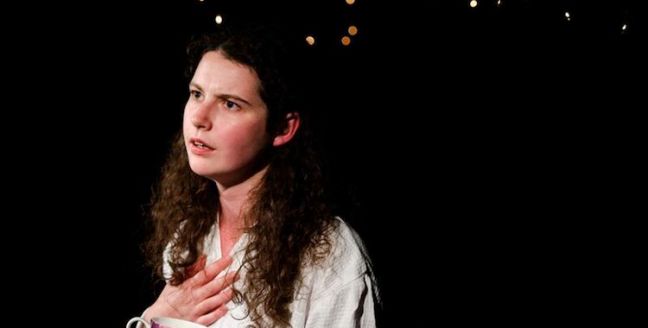
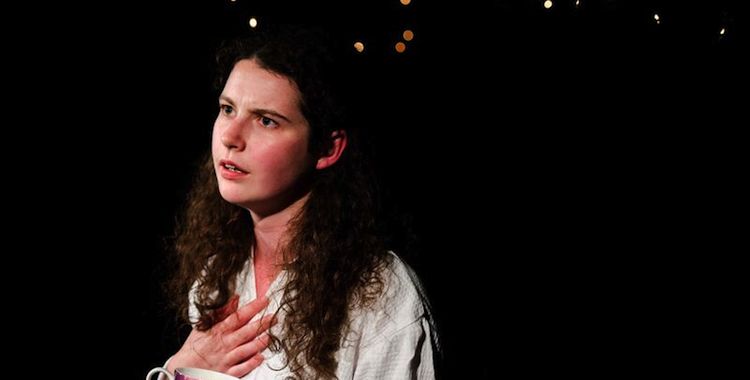
James Fritz’s play picks up after the big reunion and the happy ending. This is ‘The One Where it All Fucks Up’. In this fragmented monologue, two partners – unnamed, but with repeated allusions to the Friends couple of the title – are so tightly intertwined that they have one voice. In Thomas Martin’s beautifully simple production, Molly Vevers performs both halves of the pair, snapping rapidly back and forth. If it’s not always clear who’s speaking, that’s part of the point.

Mere years after finally getting together, the couple are already beginning to drift apart when we join them. For Ross, the language of love is the language of possession. “She’s a prom queen and she belongs to me,” he gloats at parties. Rachel, meanwhile, bristles at this yoking of her identity to his, complaining “I don’t know when people started saying our names together”. She’s toying with the idea of an affair with a work colleague; he’s plastering a forced smile on a relationship that’s far from picture perfect.

Fritz shows relationships as moulded by the expectations of others, whether those others are millions of television viewers or a tight circle of friends and family. There’s always the pressure to resemble the perfect image, to fit into whatever shape society tells us is right. That shape might come from Friends, but it might also come from romcoms or magazines or the great old love stories passed from generation to generation.

The play is canny, then, in not overplaying the Friends references. There are plenty of light nods to the show (even Ross’s infamous “we were on a break!”), but these never overpower a narrative that could just as well be happening to any couple drifting apart in their 40s. And when true disaster strikes, it’s never TV-show dramatic, just sad and shitty and unextraordinary. Suddenly, faced with the prospect of an abrupt full-stop to their relationship, Ross and Rachel are also confronted with their differing ideas of what that relationship was in the first place.

It can be exhausting to watch, as Vevers flickers frantically back and forth between conversations, thoughts and fantasies. Her extraordinary performance somehow allows us to feel these two people uncoupling, to sense the distance between their voices even as they’re spoken by the same person. This gradual breakdown is contrasted with the romantic iconography of Alison Neighbour’s set design: all flickering candles and twinkling fairy lights. Promise butts up against reality.

The play could be accused of a narrow focus, but it knows its targets and strikes hard. Ross & Rachel does a comprehensive job of de-mything romantic love, attacking its language, its imagery and its underlying hints of misogyny. At the same time, it acknowledges how hard it is to let go of that myth and how devastating it can be when the perfect picture shatters. Ultimately, we want to believe in the happy ending, because it’s easier than the alternative.

Photo: Alex Brenner.

Bakkhai, Almeida Theatre

image

As an essay on theatre, Bakkhai has it all. There’s doubling, role-playing, one thing standing in for another. There’s the clash of complex psychological insight and the wild, raw and visceral. There’s dressing up and fluid identities. And there’s the god of theatre himself Dionysos, shrugging on human form for a performance of his own.

As theatre itself, though, it’s another question. It’s not that the Almeida’s production, directed by James Macdonald, is untheatrical. There are some brilliant visual snapshots, usually heralding the arrival of Dionysos and accompanied by Peter Mumford’s vivid bursts of light, while there’s an implicit, self-aware acknowledgement of the audience throughout. That’s not to mention the uncanniness of the whole thing, its determined strangeness. But the driving narrative of Dionysos, in a holy rage and determined to get his own back on the family who snubbed him, often feels oddly underpowered.

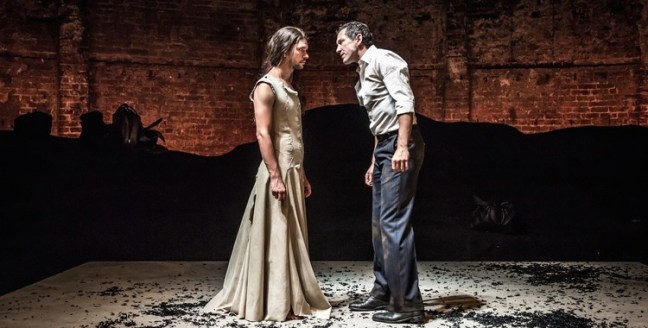
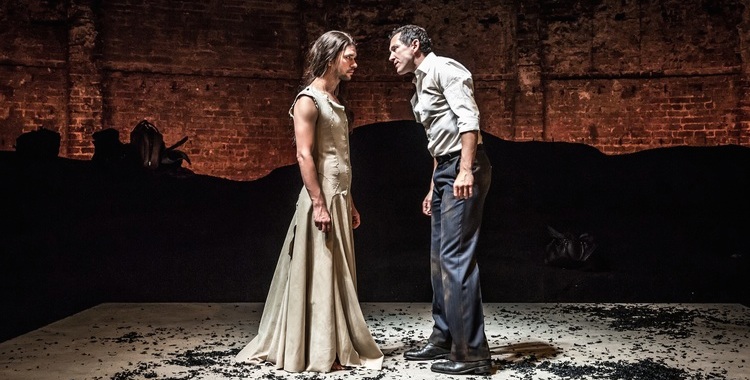
That said, the two central performances are hard to fault. From the moment he saunters on stage, throwing a conspiratorial glance to the audience as he discloses his godly identity, Ben Whishaw is utterly in control. His long-haired Dionysos is sinuous, snake-like, ready to shed this latest skin at any moment. And damn he can rock a dress. This vengeful god-turned-human is slippery and androgynous, oddly delicate in his might. He doesn’t need the borrowed authority of masculine aggression; he is power divine, effortlessly enchanting his scores of female devotees and crushing kings with the lightest flick of his wrist.

One such king is Bertie Carvel’s Pentheus, young leader of Thebes and a politician through and through. Where Dionysos is wild and uninhibited, Pentheus is rational and repressed, as buttoned-up as his immaculate suit jacket. Carvel, however, slips the suggestion of something else beneath Pentheus’s slick exterior, so that he bristles with latent curiosity even as he condemns the frolics of Dionysos’s followers. There’s a delicious scene between him and Whishaw in which the latter – posing as Dionysos’s human messenger – is persuading the disgruntled king to slip on a dress and spy on the bakkhai. Hesitancy barely masks eagerness, while a sly grin curls across Whishaw’s lips.

When Carvel drags up, though, first in disguise to infiltrate the Bakkhic rites, then later as Pentheus’s blood-drenched mother Agave, there are unfortunate echoes of his revelatory Miss Trunchbull in Matilda the Musical. I was half-expecting a cry of “maggots!” as Agave rages in her grief. Whishaw, too, fares less well when he steps into other roles, his distraught and helpless messenger not half as compelling as the scheming god who pulls all the strings. In a nod to the conventions of Greek tragedy, the trio of actors is completed by Kevin Harvey, smoothly metamorphosing from old man Kadmos to younger citizens of Thebes, though often in the shadow of Whishaw and Carvel’s sparring partners.

Then there’s the chorus. At first, the ivy-garlanded crowd of singers are startlingly other-worldly, their piercing, discordant wails a little reminiscent of the sculptural song of Return to the Voice. Just as Whishaw is an effortless deity, they really do sound like beings in communion with some strange elsewhere. After an hour and a half, though, their persistent chanting and spookily synchronised speech grates. There’s simply too much of their musical Dionysian worship, sharply putting the brakes on the momentum built up in each of the scenes between Whishaw and Carvel and never quite integrating with the rest of the action.

The issue is essentially one of tone. Bakkhai is a collision of the civilised and the elemental, of the familiar and the strange. We get that here, but often those two conflicting registers don’t so much lock horns as awkwardly jar. And beyond Whishaw’s performance, there’s never a full, unleashed sense of the wild, whether in Antony McDonald’s tentatively earthy design or in the over-polished (and over-used) chorus. The ideas are all there, but theatrically it lacks the impact it’s straining for.

Photo: Marc Brenner.

Measure for Measure, Shakespeare’s Globe

Measure-006-Captioned-600x390

Originally written for Exeunt.

“Which is the wiser here?” asks Escalus, the Duke’s put-upon adviser in Measure for Measure. “Justice or Iniquity?” It’s a question that Shakespeare’s famously problematic play is constantly asking us. At its centre is a thorny moral dilemma, but often it’s the sinning and corrupt who seem to have the most fun. Is it better to uphold honour and ethics or to grab hold of life’s more earthly pleasures while we can? And in performance, where does the emphasis fall? On solemn debates about justice and morality, or on the lechery that the play’s authorities try and fail to stamp out?

For the most part, Dominic Dromgoole’s production takes the side of debauchery. Even before the play has begun, we’re immersed in a loud, bawdy version of Shakespeare’s Vienna, brimming with colour and sin. This is the liberal, licentious society that the Duke is about to take leave of, shirking the challenge of tightening the law’s reins. Instead, that’s the task of his unforgiving deputy Angelo, left in charge in the Duke’s absence. But Angelo’s crackdown is complicated when the pleas of nun-in-training Isabella, whose brother Claudio has been sentenced to death, are more persuasive than she intends. Faced with temptation, the question falls to Angelo: justice or iniquity?

As a debate on justice, mercy and hypocrisy, Measure for Measure is intellectually and rhetorically rich. To be more than a dramatised essay, though, it needs an injection of theatricality, which Dromgoole finds in Vienna’s less exalted citizens. There’s a delicious – if occasionally overstated – excess to the performances of Petra Massey as brothel owner Mistress Overdone and Brendan O’Hea as her unscrupulous client Lucio, who alongside Trevor Fox’s pragmatic pimp Pompey laugh their way around the newly harsh (and, in the case of Dean Nolan’s clowning constable Elbow, fumbling) law enforcement.

The plot’s creaky moments – the willingness of Mariana to leap into bed with the fiancé who jilted her; the convenient offstage death of a pirate who looks remarkably like Claudio – are likewise overcome with Blackadder-esque comic flourish, never pausing over inconsistencies. There are some darker shades, as women are dragged protesting from the streets between scenes, but on the whole this is a remarkably light Measure for Measure, not dwelling on the threats of death and damnation. The scales, the crucifix and the skull, gathered in small tableaux at the far end of Jonathan Fensom’s simple design, remain in the background.

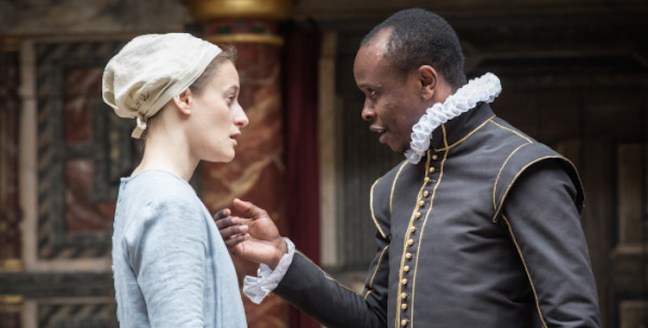
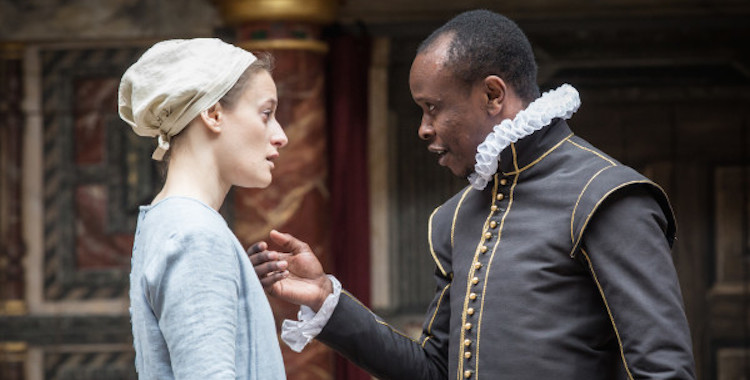
But there’s nothing simple about the characters here. Angelo is no straightforwardly pompous, hypocritical Puritan, and Isabella is far from a saint. As the righteous man undone by desire, Kurt Egyiawan is hard to pin down. At first, his sudden lust for Isabella visibly overwhelms him, but the icy resolve shown in earlier scenes creeps back over him as he covers his tracks. As his unwitting tempter, Mariah Gale’s Isabella is earnest in her protection of her virtue, yet odd moments betray an underlying passion and pride.

And then there’s the Duke, a puppeteer with murky motivations for pulling the strings. It’s a puzzle of a role for any actor. Is this leader a would-be God, testing his subjects while he looks on, or simply a master manipulator out to get what he wants? Dominic Rowan plays him awkward and uncertain, making it up as he goes along, until in the convoluted final scene he steps back into the robes of power with a little too much relish.

There might be no revelation at the heart of Dromgoole’s interpretation, but this is a Measure for Measure that keeps its setting in mind. The Globe is about the groundlings, and this version of the play is about the people – flawed, passionate, pragmatic – who populate it. The problem posed by the play is never quite solved, but it certainly revels in the attempt.

Photo: Marc Brenner.

An Oak Tree, National Theatre

3.-Tim-Crouch-and-Amy-Griffiths-in-An-Oak-Tree_credit-Greg-Veit_-600x399

Originally written for Exeunt.

I’m currently reading How to be Both, Ali Smith’s latest conjuring trick of a novel. Written in two halves that can be read in either order, Smith has talked about how the structure was inspired by Renaissance frescoes. At first glance, the final image appears to be all that’s there, but behind the frescoes are often under-drawings which are completely different. That’s how the book works: one layer on top, the other peeking through in glimpses from beneath, different but connected.

The fresco or palimpsest is a useful way of thinking about An Oak Tree. It’s theatre of multiple layers, sometimes visible, sometimes not. Sometimes it’s a show about theatre; sometimes it’s a show about loss, grief and absence; sometimes it’s a show about transformations and illusions; sometimes it’s a show about what we choose to believe. Sometimes it’s about all of those things at once. And now, ten years on from its first performance, Tim Crouch’s play has grown yet another layer, as many of its audiences come along having already seen or – like me – read it.

Like Smith, Crouch was also inspired by art – specifically, one particular piece of art: Michael Craig-Martin’s ‘An Oak Tree’. The artwork is simply a glass of water on a shelf, alongside text explaining that Craig-Martin has transformed the glass of water into an oak tree. It’s not a glass of water pretending to be an oak tree; it is an oak tree. “The actual oak tree is present but in the form of the glass of water”.

It could be an essay on theatre, where one thing is regularly transformed into another. Crouch both plays with that idea and constructs around it a delicate narrative about another kind of transformation. At the play’s heart – and it does have a heart, for all its conceptual somersaults – is a father who has lost his daughter. Or rather, he’s found her, transformed into an oak tree on the side of the road where she was knocked down by a car.

And now the father is on stage, confronting the second-rate hypnotist who was behind the wheel. No. He’s in a room above a pub, a year from now. But he’s also here, in front of us, at the National Theatre, and we are both an audience of theatregoers and the crowd at the hypnotist’s show. It’s complicated.

This complex, many layered fiction is all performed by just two actors: Crouch himself, alternately ingratiating and uncertain in the role of the hypnotist, and a second performer as the grieving father. In one of the show’s key devices, the second actor is different every night, brought up on stage with no prior knowledge of the script. This points up all the workings of representational theatre – we can never forget for a moment that someone is being someone else – but also speaks powerfully to the content. As this man coming to terms with huge loss, the second actor (a gentle, softly-spoken Conor Lovett on the night I attend) is appropriately lost and bewildered, feeling their way through the performance.

The play works on two levels, then: the fiction of father and hypnotist, and the theatre of Crouch and his guest performer. But the two registers blur and bleed, blurring in turn the lines between truth and fiction, absence and presence. Is it Crouch the hypnotist or Crouch the writer/performer who is in control, guiding his fellow performer? When the second actor asks of the young girl’s death “is there nothing we can do to stop it happening?”, who is it speaking? And even the framing, as Crouch carefully points out, is all (apart from a couple of ad-libbed asides) scripted. The second actor has no choice in the matter when he/she responds to Crouch’s questions or compliments his writing; it’s all words on a page, pre-determined and yet at the same time not really determined at all.

I often think of theatre as a magician’s trick: we delight in the transformations, but we want to know the secrets of how it’s done. The real magic comes from knowing that it’s not magic at all. Crouch gets that. He lays it bare, riffs on it. Look, his theatre says playfully, it’s just people on a stage pretending, but at the same time it’s something, someone, someplace other. As an audience, we believe and disbelieve the illusion at the same time. Like the punters at a hypnotist’s show. Or like a grieving parent, grasping for a presence inside an absence, searching for something to hold onto.

Photo: Greg Veit.