“The Director as God is Bullshit”

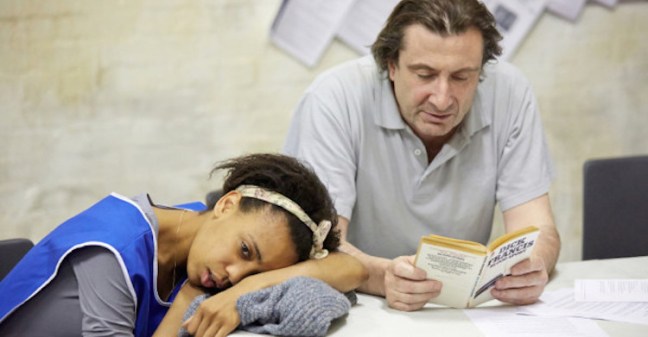
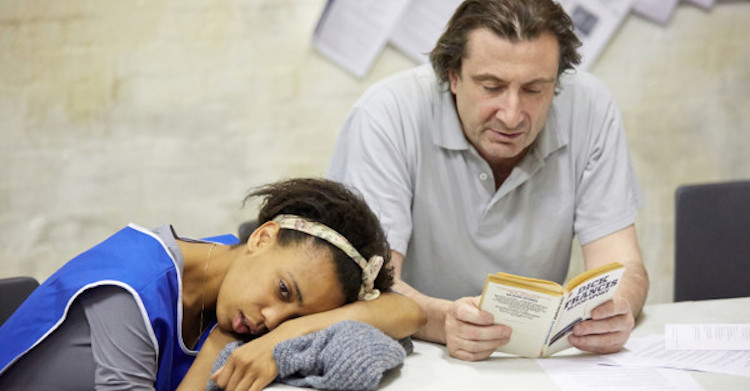
Jpeg-1.-Janet-Etuk-as-Grace-and-Sean-OCallaghan-as-Phil-in-Beyond-Caring.-Photograph-by-Mark-Douet-I80A4988-600x400

Originally written for Exeunt.

At times, Alexander Zeldin sounds more like a composer than a director. In his rehearsal room, “rhythm” is a popular word, as is “beat”. I’m watching Zeldin and his cast return to Beyond Caring, the hyper-realist snapshot of precarious labour that is transferring into the National Theatre’s temporary theatre following its premiere at The Yard last year. The show is an act of making visible – or perhaps audible. Zeldin stages the fractured daily routines of a group of zero-hours cleaners, with a musicality that draws as much on silence as it does on sound. It’s the ordinary textures of life woven into a theatrical score.

“I think in life there’s already quite a lot of theatre,” Zeldin says later as we sit in the foyer of the National Theatre, watching the everyday performances of passersby. “The theatre is a chance to be ourselves.” This is what’s so disorientating and eventually disarming about Beyond Caring, which refuses to fit human behaviour inside the stage conventions we are so used to seeing. “I think if you don’t do something that’s disturbing – I mean that in the best possible sense – you don’t really have an opportunity to be honest,” the director explains. “You need to create the conditions in which we can really exchange and we can really look at life.”

Zeldin struggles, though, to express the thinking behind this way of working, an approach that is perhaps best witnessed through the work itself. “If we could grasp it, there’d be no need to make the theatre, right?” he points out. I suggest a distinction made by Katie Mitchell between realism and naturalism, two words often used interchangeably to describe theatre. But according to Mitchell, realism is a mode based on recognisable conventions – representations of real behaviour – while naturalism attempts to precisely replicate that behaviour as seen in the world beyond the auditorium. Beyond Caring is in a similar mould, taking care over the minute gestures, pauses and phrases that make up a human life. A head is turned just so; a silence is rehearsed over and over.

Zeldin quotes a Chinese proverb: “don’t think about doing, just do”. Just doing, though, is “a very powerful, very complicated thing”. He continues: “everything I’m trying to do is just creating the conditions in which we can just do. And then we sculpt.” In creating these conditions, his role blurs between writer, director and member of a devising company, hierarchies constantly forming and dissolving. “The distance between the writer and director I feel is a little artificial,” he reflects on the slicing up of roles in much British theatre-making. “If you’re a director, inevitably you want to go and write, and if you’re a writer inevitably you’re going to want to write in the language of presence, space, rhythm.”

His role in the creation of Beyond Caring has strayed into both territories. While it was Zeldin who originated the idea and came into rehearsals with material he had already written, the show is very deliberately described as “written through devising with the company”. The piece has been shaped and reshaped over the years in close collaboration with a group of actors, as well as drawing on extensive research that started with Florence Aubenas’s book The Night Cleaner, an undercover investigation of precarious shift work in France.

For Zeldin, though, research is about experience and individual human interactions rather than about presenting a series of facts. “If you present your research on the stage, why don’t you just give the book out?” he says. “Because it’s going to be more clearly expressed.” Instead, the “meticulous” research undertaken by Zeldin and his cast – including stints working as cleaners – is subtly integrated at the level of character. One of the workers they met, for instance, talked about sleeping on a park bench, planting the seed for a character in Beyond Caring who sleeps in the factory where she works. “I’m not putting a park bench on the stage – that’s the verbatim version,” Zeldin distinguishes.

This, he insists, is where the politics of the show is located: in its form. Beyond Caring is about a controversial political issue – one that is proving to be a key point of debate in the pre-election hubbub – but its take on zero-hours contracts invites audiences to simply look and empathise rather than to engage with a series of facts and opinions. Inevitably, though, the current political context will colour its reception. “It’s a little awkward for me,” Zeldin admits, “because I’m doing a play about zero-hours contracts in the lead up to the election. I care passionately about the political issues at stake, but I hate politicians and politics.”

But he maintains that the style of the piece remains the most important expression of its politics. “I think it’s Tim Crouch who said that theatre happens in the head, not on the stage,” he says by way of explanation. “That’s such a powerful statement. And it happens in the heart; you just touch people, it’s not very complicated. I think we overthink things too much. Theatre is a precious space where we don’t need to overthink.”

Alongside music, another key aesthetic influence on the piece is photography. Zeldin explains that one of the initial inspirations for Beyond Caring was a series of photographs by Paul Graham – “it’s a kind of tribute, in a way” – and in the show he hopes to capture life in the same way that early twentieth-century photographers were able to. “August Sander, who was a photographer in the 1920s, used to go round before people knew what a camera was, so he’d point this thing at them and he’d capture them unaware,” Zeldin tells me. “There’d be a moment when you’d really see somebody, because they didn’t know how to behave in front of this strange contraption. That’s exactly what I’m interested in trying to do in the theatre.”

Achieving this involves precise and extended work with actors. “For me the root of everything I’m doing is the work with the actor,” says Zeldin. The question he is constantly asking of the performers he works with is “what’s at stake?” and his ultimate ambition is for them to achieve “presence”, a word he finds difficult to define. “What does it mean?” he asks, referring to the cliched statement that someone has stage presence. “Let’s be more specific. I think presence is something you can learn. You can develop it, you can train it.”

Beyond Caring, for instance, has been a long time in the making, and Zeldin has been working with some of the actors in the show for five years now. He characterises their process as completely collaborative, describing all of the performers as “massive contributors” to the show. “Hierarchy is dead,” Zeldin states unequivocally. “The director as god is bullshit, it doesn’t work. We’re in a room, we’re making it together, it’s got to be like that otherwise it’s a waste of time.”

“Theatre has to be alive in every second,” Zeldin continues, unforgiving in his expectations of the art form. “How can you do that? You need to create the conditions in the work where there’s a constant interrogation.” He recalls the experience of assisting Peter Brook – his greatest influence and inspiration as a director, as he stresses more than once – and being told to change something in the production every night while on tour. “It was about finding a readiness, an alertness.”

None of these working practices find a natural home in the British theatre industry, with its freelance culture and typically short rehearsal periods. For this reason, Zeldin – who is currently associate director at Birmingham Rep – aims to one day start his own company. “My ambition is to keep a group of actors together for ten, fifteen, twenty years,” he explains, brushing aside the audacity of this aspiration. His answer to practical obstacles is, perhaps, the best expression of his approach to theatre-making: “I think you have to do things that seem impossible.”

Photo: Mark Douet.
Animals, Theatre503

Animal Production Photos at Theatre 503

Originally written for Exeunt.

It’s 2046 and utility is the watchword. In Emma Adams’ dystopian satire, the current rhetoric of strivers and scroungers has snowballed into a society in which each last member is judged on their usefulness. Fit, docile, unquestioning adults are in; the ill, the curious and the elderly are out.

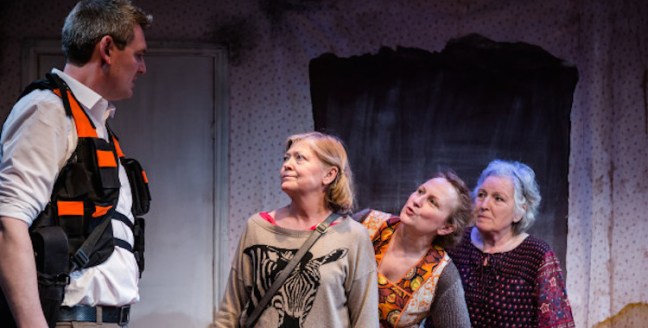
In this nightmare world of bubble-wrapped children and door-to-door euthanasia, lapped by the steadily rising tides of a planet out of control, Adams homes in on three resourceful older women. Tough, forbidding Norma (77 posing as 37), her ageing home help Joy and their drug-stashing neighbour Helen scratch out an existence through a mixture of cheerful blackmail and steely pragmatism, always taking what they can get. That includes Maya, the wide-eyed, over-protected girl who unwittingly disrupts the fragile peace of their lives. Teetering on the brink of adulthood, and with a father responsible for the “clearance” of those judged useless, she’s either the answer to their prayers or the catalyst of their destruction.

As dystopias go, this is an intriguing one. Rather than being precipitated by violent upheaval or nuclear apocalypse, the crisis here is positioned as a brutal extension of austerity logic, going one better than cutting benefits by cutting the people dependent on them. This is a society with no room for the ageing or unproductive, spurring on a chilling Darwinian drive in its citizens. Terminate or be terminated.

Trouble is, it’s too specific and yet not specific enough. Dystopias on stage bring with them a nightmarish burden of exposition, demanding the swift yet subtle illumination of an entire world. There’s a hint of Philip Ridley to Adams’ set-up – think Mercury Fur – but with none of the menace of the withheld. In Ridley’s plays, surreal landscapes shift indistinctly in the background, never fully revealing their logic. Here, however, detail upon detail about this imagined future world is uncovered, but without the accumulating information ever quite forming a consistent fictional universe. There are still dangling loose ends and big, yawning gaps.

The tone, too, fails to cohere. It feels like a Sunday-night sitcom dropped into a Philip Ridley fantasy dropped into a political dystopia, with all the disconnect such a combination implies. Lisa Cagnacci’s production is also something of a hodgepodge, struggling to get a grip on the slippery world that Adams has written. Max Dorey’s suitably time-(and water-)stained design neatly separates inside and outside, but the transitions between these two spaces are invariably clunky, while absolutely nothing is added by Max Pappenheim’s future-meets-videogame soundtrack or by the sparse and superfluous use of video projection. If this is what the future looks like, it’s a mess – though perhaps not in the way Adams intended.

The real problem with Animals, though, is that it’s a play about capitalism that wants to simultaneously be a play about ageing. Trying to do both, it succeeds at neither. Cheering as it is to see such meaty roles being written for older women – something Adams has been rightly vocal about – this intention finds itself tussling with the play’s conceit. We get fascinating glimpses of a society in which relationships have become coolly detached transactions and language is being steadily corporatised, but the sharp edges of this satire are blunted by the largely unchallenged and all too familiar tropes of old age. There’s plenty to be said here – about austerity, about capitalist logic, about the way society sees older women. But in trying to say too much of it, Animals ties its tongue in knots.

So It Goes, Shoreditch Town Hall

So It Goes Production Photos

Originally written for Exeunt.

So It Goes is about the unspeakability of grief. About those wounds so raw they resist words.

Strike that. Start again.

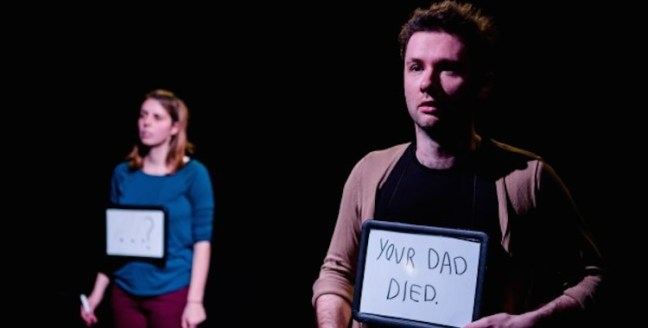
So It Goes is about Hannah Moss. When Moss was 17, her dad died. For a long time, she didn’t talk about it. In the show she has made with David Ralfe, she doesn’t talk about it either. Or at least not out loud.

Recognising that some things are impossible to speak, So It Goes reaches for other forms of communication. Instead of talking to us, Moss tells her story in written fragments, holding up placards and scribbling on whiteboards strung around her neck. Childlike in its simplicity – reflecting, perhaps, the early memories of her dad that Moss gleefully reenacts for us – the spirit of this central device extends to the cartoonish, storybook aesthetic of the whole show. Backdrops are outlined in bold sweeps of felt-tip pen and props come in the form of cardboard cut-outs.

Actions, replacing as they do words, are similarly broad-stroked. There’s a silent-film-meets-Lecoq influence to Moss and Ralfe’s use of movement, whether in energetic running montages or endearingly gawky dance sequences. At times, this style animates Moss’s story in ingenious and surprising ways. A reconstruction of the moment Moss’s parents met is gorgeous and bittersweet, while the sudden revelation of her dad’s illness slices abruptly through the carefully constructed whimsy that surrounds it. At others, though, the form feels forced, hampering rather than driving the narrative.

On the one hand, words can only say so much. The beauty of the show’s concept is that it places a light but poignant emphasis on the unsaid and the unsayable. At her dad’s bedside, Moss struggles to fit her feelings in the limited space she has given herself, repeatedly scrubbing out half-started sentences. In the end she just settles for “goodbye dad”. A chorus of “oh”s in the doctor’s office is all that needs to be – or can be – said, while the power of those six terrifying letters, “CANCER”, is even more suffocating in stark back and white.

On the other hand, words can only say so much. Especially when those words are limited to the surface of a small whiteboard. Often, there is the sense of one idea being stretched to fill an entire show, limiting its scope in the process. The form puts brakes on the content, short-circuiting complexity. The feelings that both Moss and the piece are grappling with are big and messy, but presented like this they become deceptively simple and neat-edged, like the hand-drawn scenery they play out against. Sentimentality trumps complication.


Eclipsed, Gate Theatre

image

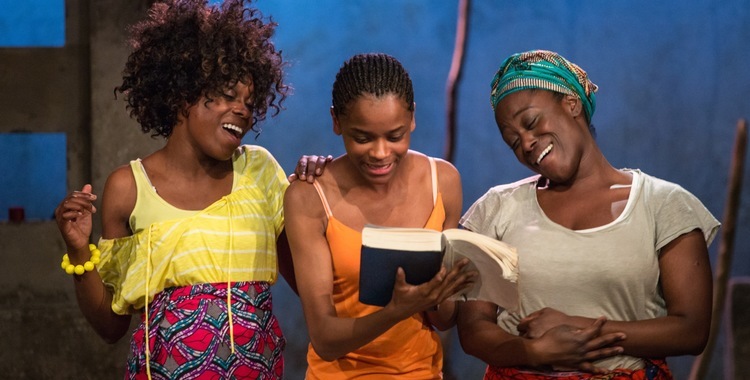
The worst things are always unseen: the bloodshed just off-stage or -screen, the implied atrocity, the imagined worst case scenarios. The same goes for Eclipsed, a violent play in which violence is more a texture than a series of acts. Set in a warlord’s compound during the Liberian civil war in 2003 and focusing on the women scratching out a living there, Danai Gurira’s play and Caroline Byrne’s production keep all of the worst horrors out of sight, but their shadow is ceaselessly cast over everything else.

So we see guns, but we never witness anyone being shot; we see the aftershocks of battle, but never the moment of impact. The daily reality of sexual violence, meanwhile, is gestured towards with little more than the clanging of a door and the sudden, obedient formation of the commanding officer’s “wives” into a line: a ritual as regular as clockwork, broken when one is selected and silently offers her body in exchange for her safety. The microcosm that Eclipsed depicts is a man’s world populated by women, with the forces controlling their lives always just around the corner, their presence oppressive but invisible.

“Violence,” writes Lucy Nevitt in Theatre & Violence (part of Palgrave Macmillan’s excellent Theatre& series), “tells us things about the culture that produced it: the kinds of power relationship on which it is built, the attitudes and values that it takes for granted. A representation of violence can reiterate or challenge normalised social structures.”

This raises a knotty and regularly asked question: does the representation of violence (and especially violence against women) simply reinforce the structures and ideologies that allow that violence in the first place? And is a representation of violence on stage indeed an act of violence in itself? Here, violence has become habitual in the lives of these women, but its destructiveness is never normalised. When a nameless new arrival turns to guns rather than her body as a tool of survival, we feel the full, horrific weight of that (non-)choice, as well as the power structures that force it upon her.

Violence also turns things upside down, unsettling reality. Beneath the routine brutality, there’s a strange tedium to conflict in the experience of these women. Eclipsed brilliantly captures the precarious yet mundane rhythms of their existence, in which war has become a constant, faded backdrop. It’s not the atrocities that demand stage time so much as the long expanses in between, dead hours to be filled with joking and squabbling and reading eagerly from a battered Bill Clinton biography (the States always distant yet near). Humour is punctuated with horror.

Much like Palestinian drama Fireworks (another of the best new plays I’ve seen so far this year), life in Eclipsed has a flat yet brittle texture, one that threatens to be shattered by the yearned-for but terrifying promise of peace. It’s become impossible to imagine a time beyond the conflict – as one character puts it, “I don’t know who I is out of war”. When your identity is so wrapped up in violence and instability, how do you get a hold on who you are?

For all of its vital wider critiques, it’s the five complex female characters who emerge most powerfully from both Gurira’s play and Byrne’s assured, compassionate production. They’re all known by role rather than name: the commanding officer’s wives numbered by rank, the visiting outsider simply identified as one of Liberia’s Women of Peace. Yet in the hands of Byrne and her brilliant cast, each is distinctly and humanely individual. Wives number one and three (Michelle Asante and Joan Iyiola respectively) bury fear and anxiety in affectionate quarrelling, jostling for the CO’s favour. The former discovers a glimpse of herself when she scores her real name – Helena – into the scorched earth; the latter finds meaning in the birth of her daughter.

Lingering on the edges of the compound are Faith Alabi’s diamond-hard wife number two, now going by the name of Disgruntled and toting a gun, and Rita (T’Nia Miller), a woman on a mission for both peace and her missing daughter. But it’s the astonishing Letitia Wright as the new girl – we never learn her name – who leaves the most shattering impact. Tough yet vulnerable, there’s a determined stillness to her suffering, everything contained behind the eyes. When that exterior finally cracks, the shockwaves reverberate long after the curtain call. We don’t need to see what has happened to her to feel the depth of its horror.

Photo: Helen Murray.

Carmen Disruption, Almeida Theatre

image

Carmen Disruption had me at the bull.

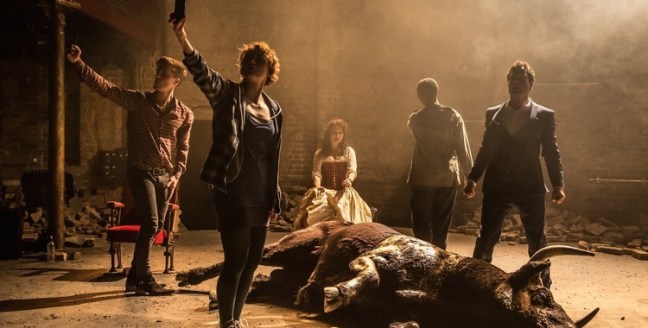
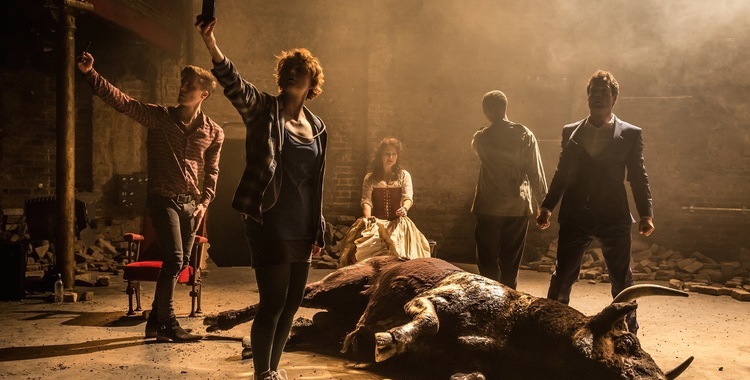
Entering the once again reconfigured Almeida auditorium, those of us with seats in the stalls are directed through dingy backstage corridors, emerging onto a rubble-strewn stage. We’re in a crumbling opera house, winding our way past the huge stricken bull that dominates Lizzie Clachan’s design. It remains there in the centre of the stage – hulking, symbolic, breathing its last – as the fractured lives of Simon Stephens’s play circle it, step over it, snap photos of it on their ubiquitous, glimmering smartphones.

The bullfight metaphor has mileage. In Mike Bartlett’s Bull it provides the entire form for the play, as two suited-and-booted matadors savage their doomed colleague. In Islands, the violent ritual is once again symbolic of capitalism, described in extended, gory detail by a grinning Caroline Horton. Here, the dying animal oozes tar-like blood across the stage, an ever-present image of devastation.

It’s also a reference to the bullfighting backdrop of Bizet’s opera, which Carmen Disruption explodes and pieces back together. There’s a moment right at the start of Michael Longhurst’s production – discordant strains of cello, darkness pierced with splinters of light – which somehow feels like a shattering of glass. The rest of the play is spent gathering those shards, fingers bloodied, jagged reflections glinting off the multiple shiny surfaces. It’s Carmen smashed, Carmen refracted, Carmen disrupted.

At the play’s centre – if it can really be said to have a centre – is an unnamed Singer (Sharon Small). She arrives at an unnamed airport, travels through an unnamed European city, arrives at an unnamed opera house sat on the edge of an unnamed river. All she really knows is that tonight she’s singing Carmen, the role she has performed in multiple productions in multiple cities, each shading into the next. And as she traverses this strange yet familiar urban landscape, the opera becomes more real than the faces and buildings sliding past her, imposing itself on the contours of the city.

Carmen becomes Jack Farthing’s swaggering rent boy, all leather jacket and sex appeal. Don José (the quietly astonishing Noma Dumezweni) is a driver for a shady character, trying to pay off old debts and right old wrongs; Escamillo (John Light) has traded bullfighting for investment banking, with a huge bet riding on the canned beef market in China, while Micaëla (Katie West) is a lost, lonely student. Their lives overlap, intertwine, glide past each other, as they all catch glimpses of a mysterious woman with long, curly black hair.

It’s a lot to take in. Longhurst’s direction is swift and sharp; miss a sentence and you won’t get it back. But while these intersecting stories are occasionally hard to follow, you can’t miss the distinctly 21st-century loneliness that throbs through all of them. Instead of speaking to one another, the broken individuals of the play talk out to us. As in Pornography, or in the never-quite-connecting monologues of Barrel Organ’s Nothing, Carmen Disruption offers a portrait of atomisation. The only respite from solitude and heartache is found in the glowing rectangles of smartphones – “should I look it up on my phone?” Small’s floundering Singer keeps asking, eyes darting wildly – while fleeting identity is invested in the things people buy: shirts, espressos, opera tickets.

There’s a thick vein of alienation and global dislocation running through Stephens’s more recent plays. The Singer is Paul in Birdland. She’s Iggy in Three Kingdoms. The world has fallen away from her, sloughed off by countless airport departure lounges and identical hotel rooms, disappearing along with any sense of self. Directors tell her where to stand and how to move her arms, but “they never tell me who the fuck I’m meant to be”. There’s a line repeated from Birdland: “none of this is real”.

That’s one way of reading Carmen Disruption. None of this is real. But that loss of reality is less to do with the Singer’s disorientated mental state and more to do with the identical, antiseptic spaces of late capitalist cities; the global simulacra of hotel rooms and lobbies and shopping centres. It doesn’t feel real because there’s nothing distinct about any of it. We might as well be anywhere – and in Longhurst’s production we are. This is a shadowy world, one eschewing the shiny coloured surfaces of Carrie Cracknell and Ian MacNeil’s Birdland in favour of the crumbling alternate reality of the opera. Theatre has become more real than life, but even that illusion is dissolving at the edges. The only constant is the low hum of electronic alerts, a peripheral stream of information scrolling on the surtitle screen mounted in the back corner of the stage.

The result is smashed-up and bruised and bloody, but breathlessly beautiful nonetheless. There’s a murky, eroding grandeur to Clachan’s design, with occasional bursts of glitter and dust, while the disjointed monologues are laced with echoes of Bizet’s score courtesy of the two onstage cellists. As that other, shadowy Carmen, glimpsed out of the corners of characters’ eyes, Viktoria Vizin is a haunting presence, her voice layering gorgeously over everything else. In the programme, she’s listed simply as Chorus, and there’s something about her constantly observing presence that seems to anticipate the Almeida’s upcoming season of Greek tragedies.

This tragedy, though, is not one of a fallen individual, but perhaps of a falling continent. No matter what the unspecified country we are in, this is clearly a Europe in crisis, its people worshipping at the feet of money and technology while failing to engage with – or even see – one another. The sadness that seeps into every pore of this production speaks of a wider malaise, a crisis that might be averted if only we were capable of reaching out to one another. There’s an insistent humanity to this scattered collection of characters, who yearn for intimacy while shunning it in the same movement. Again and again, they can’t connect. The tragedy is collective, but the pain is isolated.

Photo: Marc Brenner.