I don’t want realism, I want magic

Screen Shot 2015-03-01 at 17.25.46

Despite being a fully grown adult with the extreme good fortune of doing something I love for a living, there are still days when all I really want from life is to go back in time and work on the Lord of the Rings film trilogy. As an awkward, bookish teenager, those movies – and slightly later on the books, in the form of a battered but beloved doorstop-sized volume passed down from my dad – meant everything to me. I spent much of the time I should have been revising for my GCSEs compulsively watching the DVD special features; my best friend and I had regular and passionate debates about who was better, Legolas or Aragorn (Team Aragorn all the way); and my bedroom was littered with dozens of carefully drawn, sub-Middle Earth maps of dreamed-up worlds for all the novels I was constantly planning (and failing) to write.

Looking back, I think it was about more than just an escapist love of fantasy and the sight of Viggo Mortensen wielding a sword (not that either of those things should be underestimated). I think it also had something to do with the idea of making something; of dreaming up an entire, meticulously constructed fictional universe (not to mention whole fucking languages), or of assembling a mind-boggling number of people in New Zealand to somehow haphazardly piece together a hugely ambitious bit of cinema. My unthinking, unprocessed reaction as a teenager was simply “I want that”. I wanted to be one of their gang. I wanted to make something.

This weekend, I said goodbye to Secret Theatre. The weekend before, some friends and I spent all of Sunday watching the extended edition Lord of the Rings DVDs back to back (that’s just under twelve quality hours in Middle Earth). And I’ve started to think that perhaps my steadfast, pulse-racing love for the two things isn’t all that different.

I can recognise that not everything about The Lord of the Rings is an unqualified triumph. The books are, if I’m entirely honest, a tad longer than they need to be. As for the films, there are plenty of moments where the pace flags; I never fail to roll my eyes at the is-this-the-end-oh-no-it-isn’t quality of The Return of the King‘s final half hour; and I remain irritated to death by Liv Tyler’s underwritten, maddeningly breathy Arwen. In fact, women in general don’t get much of a look in, an absence that isn’t made up for by Galadriel and Eowyn’s (admittedly cheering) badass moments. Similarly, at times I’ve been critical of numerous elements of the Secret Theatre project, from individual shows to its much-discussed secrecy. That doesn’t mean I’m not still bursting with love for both endeavours.

A lot has been said and written recently about fandom and tribalism. Matt Trueman followed up his column on fan culture last year with a new blog on the subject for WhatsOnStage; Megan Vaughan, whose end-of-the-year fanzine was perhaps my favourite Christmas present (it’s between that and my smoothie maker), penned a kind of parting love letter to Secret Theatre; and Stewart Pringle wrote brilliantly in praise of tribes and head-banging. Tribalism isn’t without its problems, particularly in the small world of theatre. At times it can be blinkered and exclusive, stoking the idea that the art form is the realm of an elite few. But I find myself agreeing with Dan Hutton, in yet another piece on Secret Theatre, that “we need some fucking tribalism now and again”.

Tribalism creates allegiances, it makes you feel part of a community, it means that you have something at stake. When you have something at stake, you can’t just shrug off the disappointment of a Show 6 (I can’t quite pin down why, but it just didn’t work for me) or the anticipatory dread of what look like mediocre, money-spinning prequels (I still can’t quite bring myself to watch the Hobbit films for fear that it’s going to be Star Wars all over again; a girl can’t cope with that kind of heartbreak twice in a lifetime). And as unfashionable as it may be for a critic to be anything approaching a “fan”, if nothing’s at stake then what’s the point?

I’ve just finished reading Hatchet Job, Mark Kermode’s latest book, and while it isn’t about to shatter the foundations of how I think about criticism, it does prompt a refreshing rethink of why on earth any of us bother doing it – not to mention offering a lesson (as most of Kermode’s writing does) on how to be at once entertaining, intelligent and accessible. Though nominally about the cruel pleasure of the scathing critical attack, Kermode’s book is drenched in a sincere and at times unapologetically sentimental love of the art form he writes about. He’s a fan in the true sense of the word, someone who melts at the memory of his favourite films and weeps for days after rediscovering a bit of beloved celluloid that he thought had been lost. At that point I wanted to reach through the pages and hold his hand, or at least say “I know. I know.”

Revisiting my two favourite Secret Theatre shows – A Streetcar Named Desire and A Series of Increasingly Impossible Acts – yesterday felt a bit like that. I hadn’t seen Streetcar since it was first staged by the company, right at the beginning of their journey together, and coming back to it was like greeting an old friend: discovering that you’ve both changed a bit, but that what you have is even better than you remembered. After all that time on tour refining and inhabiting it, the production just feels that bit more confident and that bit less in the hulking shadow of Three Kingdoms. Things that I liked first time round I loved on a second viewing: the coloured lights, the balloons, the sexy blasts of music. Also, who needs Gillian Anderson when you have Nadia Albina? I seriously doubt I’ll ever see a better or more heartbreaking Blanche.

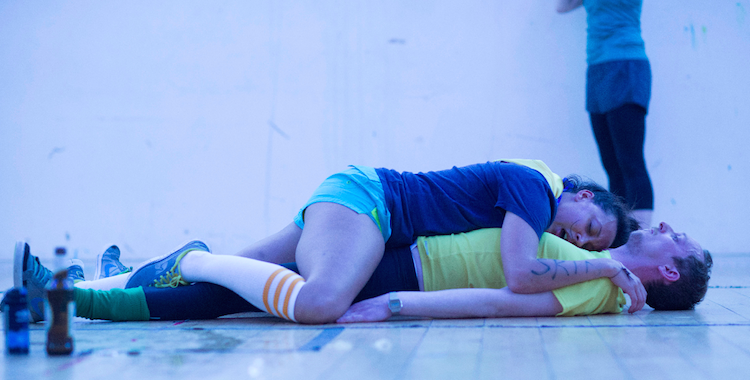
Then there’s A Series of Increasingly Impossible Acts. Deep breath. I’ve adored this show from the start and probably went from critic to ardent fan from the point at which Leo Bill’s name was pulled out of the hat the second time I saw it and I did an involuntary fist-pump, swiftly sacrificing any last shred of professionalism. Yesterday was my fifth time and, rather aptly, Leo was once again the protagonist. So what do I love so much about it? Too many things to list here. But I think the “Proud Mary” moment kind of sums it up. It’s a scene of such bittersweet joy and exhaustion and community and love and sheer, fleeting ecstasy that it manages to capture a whole kaleidoscope of emotion in one brilliantly silly dance. Last night I spent the whole thing with my face stretched in a smile so wide it forbid the tears that sat poised in my eyes, a deluge just waiting to be unleashed.

We try and fail and try and fail and try and fail again. But still we dance. (*wipes tears from eyes*)

If teenage me could have seen Secret Theatre, maybe I would have spent those clumsy, formative years following the company on tour, making bad devised theatre with my mates and agonising over who was my favourite between Leo and Sergo (undoubtedly a much harder choice than that between Aragorn and one-facial-expression Legolas). And I really, really hope that thanks to Secret Theatre’s ballsy, glorious, messy existence there’s at least one teenager out there who’s caught that bug, who wants to be part of that gang, who wants to make something. Even if, as a fully grown adult aching with nostalgia, she only ends up writing about it.

All together now …

Fireworks (Al’ab Nariya), Royal Court

590x494.fitandcrop

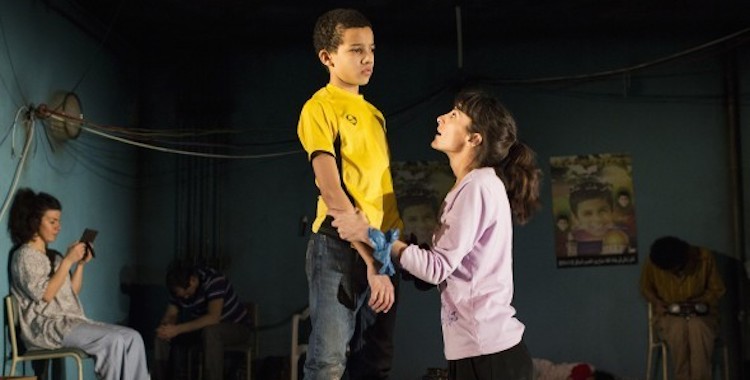
Fireworks is an exercise in dislocation. From its first, flashbulb bursts of light, we are shoved slightly off-kilter. With deft simplicity, Dalia Taha’s play and Richard Twyman’s production wrench us into the fear and uncertainty of war-ravaged Palestine, a suspended present moment in which nothing can be relied upon. Violence shades into playground games and make-believe shimmers with menace.

At the same time, we are always set at one remove. We can never forget that we are, after all, just watching, choosing to spend an interval of our privileged lives in this simulated state of precariousness. We can see the clearly demarcated outlines of Lizzie Clachan’s self-contained bunker of a set, a picture frame opening out onto another world. It might as well be the firework display that its title references; an explosive diversion, one that may leave us rattled but that we can walk away from nonetheless.

This closeness and distance, this sense that we walk in the characters’ shoes but can throw them off at any point, is crucial to how Fireworks functions. We need to be there, with the action, but at the same time always uncomfortably aware of the huge chasm that safely separates us from what is being depicted. We can be transported, but only temporarily, conscious all the while that our shaken responses cannot possibly be enough.

Almost everything happens in the deserted apartment building so vividly represented by Clachan’s design: all exposed pipes and wires, corners cluttered with the detritus of living. The side-by-side existence of two families, eschewing the questionable safety of public shelters for the claustrophobic refuge of home, is here compressed into one space, their lives overlapping and interweaving in the single, dingy room.

Taha’s play is anchored by the two children at its centre, both teetering on the brink of adulthood at the same time as staring down death on a daily basis. The familiar contours of childhood are mapped onto violent, shifting terrain. Like so many other youngsters, Khalil and Lubna play at being soldiers, but their games are unnervingly close to home, throwing back sharp reflections of the conflict they are surrounded by. Khalil’s favourite is the checkpoint game, one played out with chilling brutality.

Adults play too. Khalil’s mother attempts to coax him into childish fantasies, desperate to preserve their brittle shared innocence. The two women find fleeting respite in a game of skipping. Lubna’s father tells her that the rockets lighting up the horizon are just fireworks, a fiction that he seems to take more comfort from than his solemn, perceptive daughter does. Roles are reversed.

Through these playful coping mechanisms and loving deceptions, the lines between reality and fiction become increasingly blurred. Dreams, too, acquire unusual importance, representing a world beyond everyday reality – be that in the afterlife or up among the clouds. With the wall dividing the living from the dead so perilously thin, Taha vividly captures the importance of believing in an existence beyond the final bomb blast or hail of bullets; those lost in the conflict are always martyred, never killed.

If it all sounds a little amorphous, that’s because it is. There is little shape to Taha’s play, which instead lurches from one scene to the next. Given the circumstances, however, it feels utterly apt. The impression created – by everything from the restless performances to Natasha Chivers’ flickering lights – is of delicate moments carved out of an extended, indefinite zone of uncertainty. In the knowledge that everything could come crashing down at any moment, these small exchanges, these little sparks of connection, take on painful, nerve-shattering significance.

Boa, Trafalgar Studios

13boa1002a-600x399

Originally written for Exeunt.

Clara Brennan seems to have a direct line to an audience’s tear-ducts. The playwright’s last offering, the doubly devastating Spine, left barely a dry eye during its soggy, sniffly Edinburgh run. Boa, which is similarly small-scale but wide-ranging, also produces its fair share of tear-stained cheeks by the end. At one point during the performance I see, there’s an audible gulping back of tears; the evening’s customary applause is followed by the no less appreciative rustling of tissue packets.

But where Spine effortlessly intertwined the personal and the political, dragging up sobs with both its ideas and its characters, Boa shows the strain of trying to replicate that feat. Again, there’s a relationship at its heart, though this time it’s a romantic one. Harriet Walter, all black-clad sophistication and brittle emotion, is the Boa of the title. Or rather, that’s her nickname, a childish contraction that stuck. Sometimes like the feather variety, at others more of a constrictor, she clings passionately to Guy Paul’s wry, brooding Louis as their lives are catapulted through the last few decades of world history. Love and marriage play out against a backdrop of war and devastation.

The story of the couple’s life together is told in economical but contrived reminiscences, flashing backwards and forwards through years of infatuation, excitement, anger, regret, depression, reconciliation, contentment, grief … Both Boa and Louis pursue livings that push them to extremes: the former as a dancer, contorting her body into constant, punishing pain, and the latter as a war correspondent in the ravaged south-east Asia of the latter quarter of the 20th century. Boa loses her faith in her body; Louis loses his in humanity.

The couple’s dissection of their shared history, placed in a present day context that remains indeterminate until the final moments, verges on the masochistic. Both are determined to isolate where things went wrong – in their relationship, in their careers, in the world – at the same time as reluctantly acknowledging that “you can’t fix the past”. But still they rake it over and over, stirring up old soil until you want to shake them and tell them to stop. Leave it alone.

The point is that they can’t. Hannah Price’s simple, intimate production captures something of the frenetic movement of these memories, snapping the action back and forth through time with the absolute minimum of fuss. Eventually, the two seem to bleed into one another, the past leaving its indelible stain on the present. We see this too in Walter and Paul, whose gorgeously layered performances feel shadowed in each individual moment by the characters’ past and future selves.

In an attempt to stop this obsessive scab-picking from getting too painfully introspective, Boa also casts its gaze outwards. The world intrudes both through Louis’ work, forever offstage and unseen but leaving its bloody mark nonetheless, and in Boa’s guilty, complicated preoccupation with the lives of those less fortunate. “I’m drawn to people’s suffering,” she admits, “it makes me feel.”

The handling of this confrontation of privilege and deprivation could be whereBoa gets more interesting, in the way Spine did with its angry yet unforced engagement with contemporary politics, but instead it turns out to be something of a missed opportunity. Boa and Louis are a walking parade of first world problems and they know it. Boa laughs at herself – and we laugh knowingly along with her – when she compares her rage at poverty and injustice with her no less forceful anger upon cutting into an over-ripe avocado, but Brennan rarely digs deeper than this sort of familiar and ineffectual middle-class guilt.

More convincing than the play’s nods to the wider world are the multiple ways in which its two protagonists fall apart and clumsily put each other back together again. “We’re all lovely fucking fuck-ups,” says Boa at one point, a bitter laugh on her lips. Between them, the haunted, hard-drinking couple offer plentiful proof of this over the years, but still they keep returning inexorably to each other’s arms, finding both retreat and redemption in one another. And what better reimagining of the old “warts and all” than the line “I love the piss and shit of you”? This is love not in spite of but because of every flaw, every ugliness, every mistake. That sentiment, if nothing else, can begin to make the eyes prickle. Because aren’t we all just lovely fucking fuck-ups?

Little Light, Orange Tree Theatre

Cast : Lorna Brown (Alice) Paul Rattray (Teddy) Yolanda Kettle (Clarissa) Paul Hickey (Simon)

Originally written for Exeunt.

Families are made from memories. Soft-focus, hard-edged, ossified by nostalgia. Collections of human beings linked by little more than blood and shared history reconstitute themselves through telling, unfurling mothballed reminiscences over the festive detritus of wine glasses and chocolate boxes. Remember the time your uncle got drunk at that wedding. Remember when granny mixed up the pies for dinner. Remember that year little Catherine sang the “Twelve Days of Christmas” for everyone. With all the actions.

In Little Light, those memories are painfully loaded, groaning under the weight of stultified tradition and unspoken grief. In a house by the sea, a couple make careful preparations for a once-a-year ritual of remembering. Teddy is desperate to let in the light, ripping down staircases and smashing through walls, while Alison clings stubbornly to the shadows. When her younger sister Clarissa arrives, heavily pregnant and with boyfriend unexpectedly in tow, the strange ceremony is ready to begin. But this year it’s not going to plan.

Alice Birch’s play – her first, though not performed before now – is an extended exercise in tension-building. On the evening I see the production I’ve come straight from a screening of Whiplash, which had me white-knuckled throughout its 90 minutes of sweat, blood and cymbals. What writer/director Damien Chazelle does with drumming, Little Light does with the dinner party. It’s a format freighted with dramatic history, but in the hands of Birch, director David Mercatali and the excellent cast of four it feels fresh, fleet-footed and horribly nerve-fraying.

As Teddy, Alison, Clarissa and Simon clink glasses and break bread, they commence a routine that is at once familiar and unsettling. All the codes of a shared family language are there: the repeated anecdotes, the practiced looks, the choreographed passing of dishes and wine bottles. But there’s something far more odd and sinister lurking beneath the repetition. Stories are told with blank eyes and laughs jump cheerlessly from strained throats. Remembrances are aimed like daggers under the ribs; a matted lump of hair turns up in someone’s fish pie.

The effect is one of discomfort tinged with horror. Imagine the feeling of anticipatory dread in a scary film: that extended moment of sickening tension just before you know something bad is about to happen. Now imagine that stretched out across more than an hour. Because Birch and Mercatali manage to leave us groping around in the dark, keeping everything in the gloom until the final minutes. The rehearsed interactions of the characters clearly mean something of horrible importance to them, but we are robbed of the means to decipher them, forced instead to remain puzzled and on edge.

While it may not have the same kind of breathless, rule-breaking, fuck-you audacity as Birch’s searing Revolt. She said. Revolt again, Little Light still manages to repeatedly trip an audience’s expectations, deploying the same playfully serious manipulation of form. I was reminded briefly of Martin Crimp’s In the Republic of Happiness, which takes an Ayckbourne-esque domestic set-up and mercilessly rips it apart at the seams, except Birch’s unnerving dinner party gnaws at its own format from within. What looks familiar enough at first glance turns out to be chewing on something a lot more grisly.

The performances, too, keep us guessing. As Alison, Lorna Brown is distant, icy and cruel, until suddenly she’s not. Yolanda Kettle’s Clarissa gulps down the bitter medicine she’s fed by her older sister, the implicit shades of guilt, resentment and reluctant loyalty in her brittle acceptance of the situation suggesting the jagged edges of so many sibling relationships, while Paul Hickey makes an appropriately disoriented newcomer as her boyfriend Simon. And Paul Rattray’s Teddy, hands quivering at his sides, seems forever on the brink of explosion or collapse.

Finally, the play too has to either erupt or crumble with the weight of its building, pervasive menace. It turns out to do a little bit of both. But even climax and catharsis do not unfold as we might expect, offering far more lyricism and far less resolution than the domestic dramas that Little Light takes its lead from. The scab that Birch picks at might finally break loose but, as in so many families, the wound remains open.

Photo: Richard Davenport.

The Mikvah Project, Yard Theatre

4_feb_2015_yard_theatre_049-WEB-copy-2

Note: the performance I saw was the second preview.

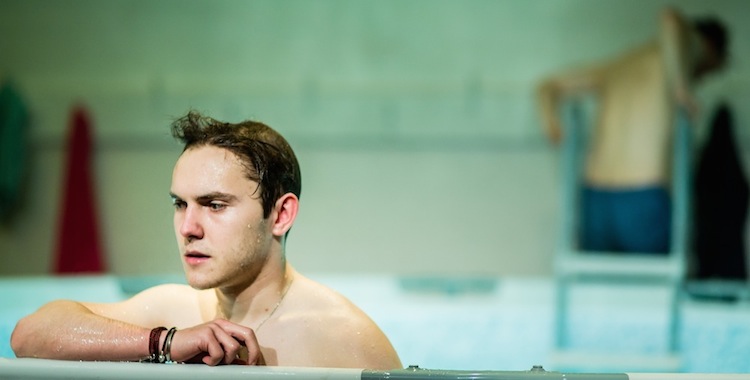
The first thing you notice is the water. The Mikvah Project has plonked a pool – “a massive fucking pool”, to quote Megan Vaughan – right in the middle of The Yard’s stage. It’s so dominating that there’s room for little else in Cécile Trémolieres’ design; just a row of hooks on the back wall and the tatty, functional, scrubbed-clean aesthetic of a public leisure centre.

The pool, tendrils of steam slowly rising from its surface, is the Mikvah of the title. If – like me before reading about the show – you’re wondering what a Mikvah is exactly, it’s a Jewish bath used for ritual immersion. It has associations of cleansing, transformation, rebirth. When Adam was banished from the Garden of Eden, he flung himself in the river that flowed from the perfect world he’d just left, desperately trying to wash away the stains of sin. The first Mikvah was born.

This space, saturated with ritual, religion and tradition, forms the constant backdrop of Josh Azouz’s tender two-hander. It becomes the focal point for the lives of its two male characters, 35-year-old Avi and 17-year-old Eitan, exerting an almost palpable gravitational pull. Even when the narrative positions them elsewhere, the Mikvah is still there.

The tradition, apparently, is to immerse yourself in the Mikvah three times, a nod to the three times it’s mentioned in the Torah. Avi, a man writhing inside his own skin, immerses nine times. He just can’t get clean enough. As for Eitan, well, he’s not sure he wants to wipe away his apparent sins.

Azouz’s play – and similarly Jay Miller’s production – takes its time. It unravels (and unravel feels like just the right word) at an unapologetically gradual pace. We learn a little about the characters: that Avi is married and trying desperately for a baby, that Eitan is still at school and has been kicked out of the synagogue choir. But more importantly we learn about their relationship, a vague acquaintance that through the shared ritual of the Mikvah delicately, almost imperceptibly shifts into something far deeper, far more intoxicating.

It’s immersion by stealth. Watching, at first it feels as though I’m treading water – ticking off items in a mental exposition checklist, trying to decide whether the delivering of lines into microphones is interesting or cliched. But slowly, inch by inch, and without me quite realising until it’s too late, I get dragged under. Soon I’m gulping for air and stretching my water metaphors too far in an attempt to sidestep what I can’t quite articulate.

A lot of it has to do with the understatement and delicacy of the performances. As the older Avi, Jonah Russell flickers with a near-constant edge of discomfort. He is the very definition of unsettled, both by Eitan and by his own reaction to this teenage boy. Oliver Coopersmith’s Eitan, meanwhile, struggles to contain everything he feels, his jittery impulsiveness threatening to overpower Avi’s ruffled sense of propriety. Their conversations carry all of this at the same time as being awkward, halting, weighted down with the baggage of the real world outside the Mikvah. Intimacy can only emerge at intervals. And by the time the orbit of these two men crashes together, we instinctively understand that the sweetness of their collision will be short-lived, painfully intensifying the joy of their coming together.

The whole production is similarly light of touch. On second preview, there are still some moments that unsurprisingly snag – the opening hasn’t quite got the clarity it needs yet, and generally the scenes set outside the Mikvah are less confidently realised than those within its walls – but the overall feeling is one of tender fragility. Unobtrusive projections flicker and ripple insubstantially on the back wall; small, murmured snatches of “Hideaway” and “Wicked Game” and looped, ritualistic humming provide the spare but evocative soundtrack. Then there’s the pool itself: ever-present, with all its heavy suggestions of the faith that binds the two characters, but at the same time playful and kind of joyous.

There’s also an interesting but not quite fully explored sense in which Avi and Eitan are telling their own story, alternately distancing from and drenching themselves in it. Outside the Mikvah, Azouz’s script plays around with the first and third person; at times, both men want to dissociate themselves from their actions and emotions, while at others teller and subject merge into one. These shifts could be exploited more, elaborating on the conflicted and altering attitudes both men feel towards their relationship – a relationship that they might occasionally want to scrub away along with everything else.

But they can’t. The Mikvah yields transformation, for sure, but it can’t cleanse Avi and Eitan of their desire or their pain. Like that very first Mikvah that Adam immersed in outside the boundaries of Eden, it fails to transport them back. Instead they’re left, stranded in this new world and struggling with what that means. Struggling, flailing, trying not to go under.