Talking About Theatre

Dialogueweb_main_460_325_95_s

In the space of a few weeks earlier this year, I heard two anecdotes about theatre and audiences which have circled my brain ever since. First, during an interview about Fun Palaces, Sarah-Jane Rawlings told me about an encounter she had while running the Royal Exchange’s education programme. After a youth drama session, she asked one of the kids involved if his mum was coming to pick him up from the theatre; he replied no, she wouldn’t know what to wear. Then, at a house event not long after, one of the speakers remembered a man who had to walk around his local theatre three times before he could bring himself to step inside to buy a ticket.

This pair of stories regularly haunts me. As someone who accesses theatre spaces on an almost daily basis, it’s all too easy to forget how intimidating they can be. And right now, those two anecdotes are joined in my mind by a crowd of other statements, stories and assumptions, all making me fitfully turn over my thoughts about theatre, access and audiences.

There’s Maddy Costa, more than a year ago now, making the distinction between “speaking” theatre (with all the specialist vocabulary that implies) and simply talking about it. There’s all the brilliant work that Maddy is doing with Jake Orr over at Dialogue to encourage and facilitate the latter among audiences.

There’s Maddy again, more recently, recalling her encounter with an audience member who suggested that the way she – we – discuss theatre is what makes it seem elitist. Us critics, bloggers, whatever label we go by, are the ones who – to borrow Maddy’s words – “make theatre sound like hard work”.

There’s a similar conversation during a particularly fraught and difficult long table discussion at the festival organised by Dialogue last month. A couple of people go up to the table and say frankly that the conversation that is taking place is intimidating, exclusive and alienatingly intellectual. This sparks a really knotty and sometimes painful debate, during which I wonder repeatedly about whether to take a seat at the table. Aren’t I just part of the problem? Does my voice really need to be heard? In the end, I decide to spend the festival doing more listening than talking, and it feels right.

There’s Tim Walker getting me riled up, not so much with his dismissal of online critics as with his suggestion that theatre and theatre criticism are both products to be sold to the wealthy, middle-class and middle-aged. The implication being that it’s just not “for” most people.

And then there’s Janet Suzman, with her astonishing assertion that “theatre is a white invention”. Beyond the patent and quite frankly racist inaccuracy of that claim, Suzman’s comments seem to me to reveal three things: 1) white privilege still overwhelmingly dictates mainstream cultural discourse, to the extent that someone like Suzman can even begin to believe that theatre is particular to white culture; 2) underlying such a belief, there’s an offensive assumption that cultural tastes – and particularly those of non-white cultures – are homogenous; 3) linked to that assumption, there is too often a simplistic, reductive and patronising attitude towards audience development, epitomised by Suzman’s sweeping remarks about “catering” for certain demographics.

As all those things tumble through my mind, I’ve thought back and forth and back and forth over the last couple of weeks about writing and publishing this (whatever this is turning into). Because – to be brutally honest about my misgivings – who needs another beneficiary of white, middle-class privilege harping on smugly about the need for diversity and inclusion in the arts? Like at the Dialogue long table, I worry that perhaps I’m not the right person to be kicking off about this, that perhaps it might be more useful to listen to and amplify the voices of others (like Naima Khan or Meg Vaughan) who have interesting, urgent, considered thoughts to add to the discussion. At the same time, however – and this is a point that Naima rightly raises – staying silent implies complicity in and wilful ignorance of all those assumptions which continue to haunt and frustrate me and which, more importantly, determine who is included and excluded from certain forms of culture.

As I’ve said before (hard as it might be for me in my enthusiasm for the art form to believe), theatre isn’t necessarily for everyone, in the same way that football isn’t necessarily for everyone. My attitude to the latter is pretty much the rest of my family’s attitude to the former: I’ll happily watch it on the odd occasion, but it isn’t really my cup of tea. And that’s fine. But theatre should be there for everyone: equally available and accessible to all who might – and might not – gain something from it. That means making theatre buildings as welcoming as possible; it means making theatre affordable and easy to access; it means letting people know that it’s happening and that they might be interested in it; it means avoiding lazy, offensive assumptions about different demographics and what they might want to see; it means opening up a dialogue with potential and existing audiences; it means talking about theatre in a way that makes it sound interesting and fun rather than elite and exclusive.

It’s that last point that I’m particularly (sometimes agonisingly) preoccupied with. There is of course work still to be done when it comes to theatre spaces, their accessibility, and who and what gets represented on their stages. But the surrounding discourse feeds into the same set of structures and ultimately influences, in however invisible a way, who gets admitted or shut out by those structures. How is theatre being discussed? Who is discussing it? What is being discussed and what is being ignored? What assumptions is that discussion – knowingly or unknowingly – founded on?

One of the most worrying things about Suzman’s comments is her implication that addressing subject matter that “caters” for different groups – as though everyone of the same race has the same taste, or is exclusively interested in themes related to their own ethnicity – is enough to cultivate new audiences. There is an important argument for representation, but what gets on stage is just one of a complicated web of factors that determine who attends theatre. The assumption that putting on work “about” a particular group (that “about” being a problematic term in itself) solves the problem just lets theatres off the hook, making it possible for people like Suzman and Walker to essentially dismiss the entire endeavour by claiming that only a certain group of (white, middle-class) people will ever be interested. Once you believe that, why would you bother trying to open the doors for anyone else? “Catering” for different audiences is not enough. How theatre is talked about in the wider culture, and thus the popular perception of it, is just as much a part of this matrix of inclusion and exclusion.

So what does that actually mean? In her post, Meg pointed me to something that playwright Vinay Patel said on Twitter in response to the Suzman fiasco: “we need to be talking about theatre like it’s there to be consumed as culture not cherished as art”. The word “consumed” makes me shudder a little bit, but I think he’s absolutely right. Theatre needs to be discussed in a way that makes it seem available, rather than shut away behind a barrier of big, reverent words.

When frustratedly responding to the whole ridiculous Tim Walker thing, I shouted about the need to discuss theatre as if it might actually mean something, always asking the implicit question “why is it important?” As I think more on it, though, I want to add a footnote. Yes, let’s talk about why theatre is important, why it might be relevant to the world outside the auditorium or inside each of its spectators. But perhaps we should also be asking “why is it interesting?” Because “important” can be one of those off-putting words, in the same vein as saying “I really should go to the theatre” (it’s depressing how often I hear that one). That sense of obligation and self-improvement suggests school trips and dull assignments, it suggests the gatekeepers of high art instructing everyone else on what to see. And as I put it at the beginning of the year after seeing Not I and thinking about the discourse of “hard work” surrounding it, framing theatre in this way is only likely to be elitist and alienating.

At the same time, it’s a fine line between opening up the conversation and sounding like a patronising twat. Part of me also instinctively resists the anti-intellectualism that seems to prevail in our culture and society today. Why shouldn’t we dig deeper, think harder, question more? (And yes, if I’m being totally honest, of course it’s nice to occasionally feel intelligent) This is where I regularly tie myself in knots, struggling with two seemingly opposed desires as a writer. Most of the time, I admit, I probably fail at both.

But there’s not necessarily a stark choice between intellectual snobbery and appealing to the lowest common denominator. It’s perhaps not a question of whether or not to engage with those more difficult ideas, but rather of how to engage with those ideas. The best thinkers and writers – at least in my opinion – are those who can take the most complex of concepts and articulate them in the clearest of terms, losing as little as possible along the way. It also, like at that Dialogue event, has to do with both talking and listening: welcoming feedback, being willing to enter into a conversation – however difficult – about what might come across as elitist or excluding.

Something that Stewart Pringle once said has stayed with me. He explained (to badly paraphrase) that the way he thinks of what he does, whether making or writing about theatre, is just as sharing stuff that he thinks is really awesome. I think criticism has other roles too – roles to do with questioning the art form, with sitting somewhere in the blurry space between artist and audience – but I wonder if this is the one that we might all aspire towards more consistently. Because who doesn’t want to hear about awesome stuff?

So there’s a New Year’s resolution – or perhaps more of a challenge. Let’s think more actively about who we’re including and excluding. Let’s stop and ask ourselves who we implicitly suggest that theatre is “for” when we write and talk about it. Let’s try to avoid being elitist without (ugh, another phrase I hate) “dumbing down”. Let’s appreciate the complexity while embracing the fun. I don’t yet know exactly what any of this looks like, and yes I’m bound to fall short a lot of the time, but surely it’s worth a try? And, lastly, let’s hope that we don’t need to write any more of these bloody blog posts about theatre criticism …

Photo: Dialogue’s Talking/Making/Taking Part festival.
Golem, Young Vic

10469371_10152723512523346_2141051808493943962_n

It’s easier, as the popular phrase has it, to imagine the end of the world than it is to imagine the end of capitalism. Perhaps the same now goes for the little glowing rectangles permanently glued to our palms, feeding us an endless diet of information and advertising. The one, of course, is wrapped up with the other, as technology binds us ever more tightly to the corporations that invisibly run our lives: promoted tweets, personalised ads, one-click shopping. All the choice in the world, as long as you don’t want an alternative.

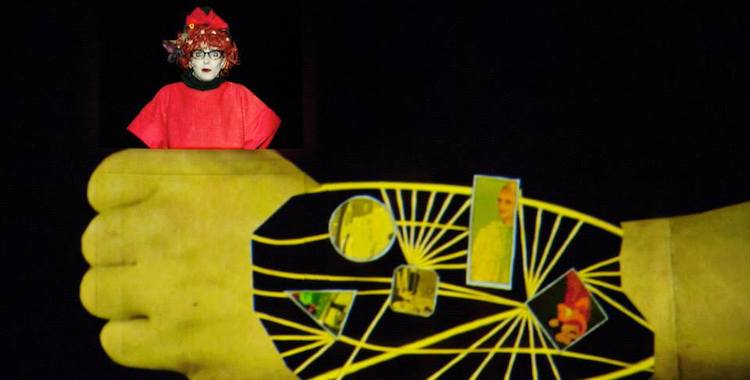
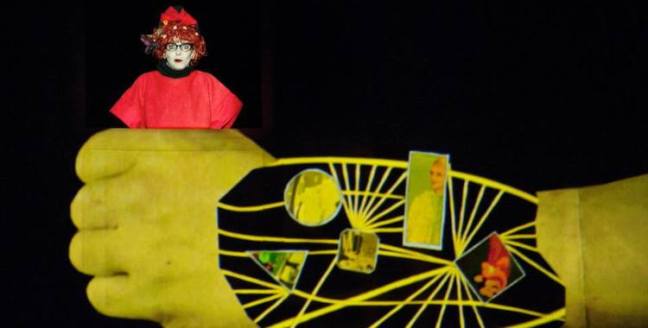
1927’s previous show, The Animals and Children Took to the Streets, was eerily prescient in its anticipation of the 2011 riots. Golem is more responsive than it is prophetic, amplifying an experience of 21st-century living that is – despite the cartoonish cladding – instantly familiar. Instead of iPhones, 1927’s characters have the eponymous golems: clay men designed to do the bidding of their masters. But as with the similarly “time-saving” devices that our lives revolve around, the golems (and the ubiquitous corporation that promptly snaps up the invention) quickly begin to make silent demands of their own.

Ironically, the show itself is founded on the same technology that it regards with suspicion. The stage of the Young Vic is filled with nothing but screens and bodies, which meet seamlessly thanks to the witty detail of Paul Barritt’s projections and the precision of the performances. Awkward nerd Robert – demanding the full, gawky array of Shamira (Little Bulb) Turner’s elastic facial expressions – strides through animated cityscapes, seeming almost to dissolve into the busy backdrop of fast food joints and strip clubs. This is an every-city, a place of crumbling estates, boarded up shops and townhouses owned by absent billionaires.

Robert is, as his narrating sister Annie informs us, a nobody. He was bullied at school, he’s never had a girlfriend and he spends nine to five “backing up the back-up”, drearily pencilling 0s and 1s into ledgers. For fun, he plays in Annie’s band: a ragtag collection of thwarted punk rockers, who would be changing the world if it weren’t for their chronic stage fright. Even the way he stands, shoulders rounded against the world, is unassuming.

Then Robert buys a golem, the latest invention from his would-be entrepreneur friend. The clay man created to serve is borrowed from Jewish folklore, but 1927 are more interested in his 21st-century descendants. Golem doesn’t just cook and clean; he saves money by doing the food shopping online and helpfully suggests which new shoes to buy. Egged on by his new companion, Robert bags himself a promotion and overhauls his image. He’s no longer a nobody, but an everybody. And despite his supposed servility, it is soon the golem who begins to look like master, as Robert and his family fall under the influence of this wonky clay automaton and later his shiny, updated replacement (Golem 2.0).

This is storybook satire: bold, colourful, but not necessarily subtle. 1927’s targets – global corporations, political apathy, freedom sapping technology – loom large and unmissable, with a few potshots at the Daily Mail and anti-immigration rhetoric chucked in for good measure. There are even mentions for Boris Johnson and Benedict Cumberbatch (Robert’s golem is, hilariously, rather taken with the latter).

But if its message is as blunt as the advertising crowding the edges of our screens, Golem gets away with it by dint of sheer ingenuity. There is still something inexplicably joyful about the way in which bodies and images merge on stage, putting to shame the clunky projection seen in so many other shows. It’s the detail, though, that really makes it. From a portrait brought delightfully to life, to Robert’s deliciously Kafka-esque occupation, to a brilliant (and brilliantly observed) sequence on internet dating, nothing is wasted. And when the garish yellow branding of the golems begins to take over, it’s the small and silly quirks that we miss, be they wacky hairdos or idiosyncratic punk lyrics. No golem – or iPhone – can substitute for those.

Photo: Bernhard Müller.

Arrest That Poet/Pete the Temp vs Climate Change

pete-1-600x3371

Originally written for Exeunt.

Theatre about climate change is fast becoming a genre all of its own. Just this month I’ve seen three separate shows on the subject: 2071 at the Royal Court and now a double bill of climate-activism-spoken-word (how’s that for a niche sub-genre?) at the Free Word Centre. Their approaches, however, couldn’t be further apart.

2071, a collaboration between director Katie Mitchell, climate scientist Chris Rapley and writer Duncan Macmillan, opted for lecture-as-theatre. Mitchell seated Rapley to one side of the stage, against a backdrop of scientifically vague and increasingly soporific projections, and got him to talk about the facts behind climate change. And that was it.

In comparison with the static, dramatically inert set-up of2071, performance poets Danny Chivers and Pete the Temp inject the topic with an invigorating shot of dynamism. Both are responding to climate change from a position of intense involvement – not as scientists, but as activists. Chivers’ show Arrest That Poetcharts his various run-ins with the police, recalling how he became an unlikely criminal in the pursuit of climate justice, while Pete the Temp pits himself (and his mouth) against the huge changes that threaten our planet.

Unlike 2071, which tackled an emotive subject from a position of cool, dispassionate distance, these two shows are soaked in feeling. While this could be problematic, short-cutting the facts with an appeal to emotion, it is instantly more engaging. These two men clearly care about what they’re discussing – and they have the criminal records to prove it. There is no pretence at objectivity (which is, in any case, always impossible) because they are deeply, subjectively invested in this cause. They have chained themselves to railings and staged stunts at energy conferences.

Given the context, however, perhaps this isn’t such an issue. It doesn’t feel particularly controversial to suggest that people who book tickets to see shows about climate change are probably already concerned about climate change. Unless the content is smuggled in under the guise of something else, it will attract a self-selecting audience. In which case, it may be more useful to galvanise audiences and arm them with the tools to create change rather than painstakingly relaying science whose conclusions they are, most likely, already aware of. Instead of using creativity to inform, why not harness it to act?

This is exactly what Chivers and Pete the Temp do. Similarly to Daniel Bye’s How to Occupy an Oil Rig or Mark Thomas’s Cuckooed, they transform protest and direct action from something intimidating into something joyously angry and engaged. Bookish, floppy-haired Chivers exploits the incongruity of his criminal convictions and his innocuous, middle-class, Guardian-reading persona, making us believe along the way that pretty much anyone could end up atop a power station fighting for a better planet – even if, like Chivers, your only skill is a way with words. And words themselves become weapons in this battle, using the mutability of meaning and intention (along with a cheering boost of people power) to upend the language of corporations and government.

Pete the Temp vs Climate Change is a little knottier in its handling of the same subject matter. The title itself is quickly undermined, as Pete recognises the inherent ridiculousness of one individual resisting a vast network of climatic and corporate forces. He also recognises the flaws of various different tactics, from charity campaigning to “armchair activism”, which is dismissed with particular disdain. The implication is that in reality we can only begin to change anything when we act together. If Pete the Temp is sometimes blunter and bleaker in his approach, it is tempered with the same rage-inflected humour that Chivers uses to such great effect. Activism can be both funny and fun – neither of which are words that came to mind while sitting in the stalls at the Royal Court the other week.

But the greatest contrast with 2071 – at least for me – is in the impact made. I left2071 feeling gloomy, small and pretty narked about the quantity of carbon that had been burned in order for me to sit through its sluggish hour and a bit, whereas I left the Free Word Centre’s double bill feeling angry and inspired and galvanised. When I walked out of the Royal Court, about the only thing I was ready for was a moan. But when I walked out of the Free Word Centre, it wouldn’t have taken much to convince me to occupy a power station.

How a Man Crumbled, Mimetic Festival

moustachemenweb-600x400

Originally written for Exeunt.

Clout Theatre are experts in the grotesque. In the first show of theirs that I saw, The Various Lives of Infinite Nullity, they took morbid curiosity into new territory, setting grisly murders and suicides on repeat. The company’s earlier show How a Man Crumbled, back as part of the Mimetic Festival, puts the emphasis on the absurd but with the same relish for the monstrous and distorted. Limbs are twisted into alien shapes; arms pop out from suitcases and lungs are torn from chests.

Clout Theatre’s starting point for their surreal grotesquerie on this occasion is Russian absurdist writer Daniil Kharms, who faced Soviet censorship in his lifetime and many of whose works remained unpublished until after his death. That perhaps accounts for the built in difficulties that surround Clout Theatre’s frenetic storytelling. Narrative is interrupted and confounded, the central story – Kharms’  ‘The Old Woman’ – becoming muddied or obscured. The writer loses control of his boisterous creation.

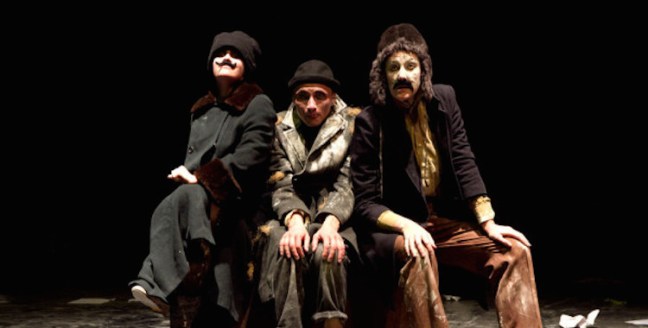
As in The Various Lives of Infinite Nullity, performers Sacha Plaige, Jennifer Swingler and George Ramsay adopt clown-like personas, though here they are more playful than sinister (but not without an edge of the latter). The bouffon-esque trio seem eager to entertain us and competitive in their attempts to alternately convey and derail the narrative at hand, whether that’s by telling swirling, nonsensical anecdotes or whacking one another over the head with vegetables. This performance style could quickly become wearing, and there are moments when it briefly grates, but Clout Theatre have enough charm and ingenuity to just about pull it off.

If these clowning interludes entertain with their wackiness, the narrative sequences themselves are strangely beautiful. The story of ‘The Old Woman’ – in which a writer finds his life disrupted by the mysterious figure of the title – is told through a DIY silent film aesthetic, fully exploiting the elastic expressivity of Clout Theatre’s performers. Ramsay in particular manages to access the full emotional range with just his impressively flexible facial muscles, while Plaige contorts herself into an extraordinary array of positions.

If theatre were solely about isolated stage images, Clout Theatre would be some of the best artists around. Startling snapshot follows startling snapshot. A creature formed of screwed-up paper stirs in the corner of a writer’s office; a recalcitrant corpse is frantically bundled into a suitcase; bodies wrestle and writhe; figures suddenly appear and disappear. Music also plays an integral role, with an inspired use of Shostakovich’s String Quartet No. 8.

But the same reservations that I had about The Various Lives of Infinite Nullityalso apply to How a Man Crumbled. Both shows are brilliant vehicles for the (clearly abundant) skills of their performers, yet I can’t fight the feeling that there’s something missing. The aesthetic is there, but the purpose and drive behind the succession of striking images is not quite apparent. Like the writer they show frustratedly scribbling on page after page, Clout Theatre seem to be grasping at something just out of reach.

Alistair McDowall

Pomona rehearsals - Alistair McDowall 2 (photo Manuel Harlan)

Originally written for The Stage.

Conversation with Alistair McDowall is cluttered with cultural references. Names of books, films and comics all fly off the playwright’s tongue; a rich and varied vocabulary of influences, from Sarah Kane to William Faulkner. “If I’m not working I spend all of my time consuming,” McDowall explains, “reading novels and plays and watching films and TV and listening to music and reading comics – whatever I can get my hands on.”

This passion for culture in all its forms – “generally I’m just a fan,” McDowall enthuses – filters through to his plays, which often marry the mundane and the fantastical. Brilliant Adventures shoved a time machine into a Middlesborough housing estate; in Captain Amazing, an ordinary dad is a reluctant, cape-clad superhero. “I think my plays sometimes feel quite noisy,” McDowall suggests, attributing this background buzz to all the cultural “stuff” that has influenced them.

“I was just obsessed with stories in any form,” he says of the many narratives that fed his creative imagination in his childhood and teens. After years of dreaming about making films, McDowall put on his first play with friends at the age of 16 and discovered a way of immediately bringing his ideas to life. From that point onwards he didn’t stop, continuing to write plays throughout school and university and staging his work in fringe venues after graduating.

The turning point came when Brilliant Adventures won a judges award as part of the Bruntwood Prize in 2011. For McDowall, the timing could not have been better: he had lost his day job in an art gallery the day before the prize was announced. “When I look back at that, the overwhelming feeling I have about winning it is just relief,” McDowall remembers. “I didn’t really have that much time to suddenly get above my station; it was just like yes, I can still eat.”

McDowall is frank about the economic restraints that hamper many would-be theatre-makers, who he describes as being “robbed of their talent” through financial circumstances. “There’s no reason why I should have been able to see this as a career,” he reflects on his own relatively modest background. “I just never really considered doing anything else other than making stories.”

When discussing his own stories, McDowall keeps coming back to their strangeness. Brilliant Adventures, which premiered at the Royal Exchange in Manchester after being recognised by the Bruntwood Prize, is “quite a peculiar play” according to its writer, while he describes his latest play Pomona as “really odd”.

Pomona, which is about to receive a production from McDowall’s fellow University of Manchester alumnus Ned Bennett at the Orange Tree Theatre in Richmond, was born from the place that its title refers to. The playwright describes this desolate strip of land awaiting development in Manchester as a “ghost town” and recalls his desire to capture it on stage somehow, at the same time as being interested in conveying the experience of living in the 21st century.

“I wanted to write something that was more led by a certain kind of state of mind and mood and tone,” McDowall explains. “It feels internet-y in its form and structure and it’s about a certain type of anxiety that seems to me to be very, very contemporary.” And perhaps even more so than his previous work, it is strewn with pop cultural detritus, from TV shows to fast food.

Despite his interest in all the other cultural forms that inspire his work, McDowall keeps coming back to theatre because it’s a medium in which “you can do anything”, a realisation prompted in his teens by binge reading the plays of Sarah Kane, Samuel Beckett and Harold Pinter.

“When I think of the things that had the biggest impact on me, it’s quite often that they reminded me that you can do whatever you want,” says McDowall. “You can do whatever you want, as long as you do it with passion and integrity and craft, you can do anything.”

Theatre is a “collective imagining,” he adds, later going on to describe a play as a magic trick. “I think the magic trick is almost aren’t we all having fun making this magic trick together, rather than actually trying to deceive you that it’s anything other than a magic trick,” he explains, capturing his interest in both narrative and theatricality.

The one thing that theatre-makers have to do, McDowall insists, is justify why their stories belong on stage. There might be no rules, but the question the playwright always asks himself is “does the audience still need to be in the same room for this to happen? And if the action could continue without them, if the equation is complete without them, it just doesn’t feel like it’s the best use of everyone’s time.” Or, putting it another way, “I’ve asked all these people to turn up, so I’d better fucking put on a show.”

Photo: Manuel Harlan.