Long-distance relationships

???????????????????????

Originally written for The Stage.

Look at the programme of any regional receiving house and the line-up is typically scattered with popular musicals, famous faces and hits touring out of or into the West End. But beyond these crowd-drawing headliners, touring is often difficult for other areas of the UK theatre industry.

For those artists and companies working slightly below the radar, without big names or familiar shows to pull in audiences, touring is becoming an increasingly challenging and expensive activity. As everyone feels the squeeze on their funding, touring companies get hit twice, as struggling venues can no longer afford to pay guarantees and instead shift the risk onto those bringing in the work. It is difficult to build a relationship with audiences where engagement is often shallow and fleeting, while theatregoers with shrinking budgets are leaving it later and later to book tickets.

As I discovered in the process of researching a report for theatre producer Fuel, challenges faced by the non-commercial touring sector are manifold, but one particular area of difficulty is around the notion of collaboration – or lack thereof. Many touring companies express frustration about the reluctance of venues to cooperate on marketing strategies and share information about local audiences, with the level of collaboration varying wildly from theatre to theatre. At the ITC’s conference in February of this year, meanwhile, the difficulty of accessing audience data was identified as one of the key barriers for UK touring.

“We don’t always have access to audience data from all the venues,” explains Hanna Streeter, an assistant producer with Paines Plough, “so it makes it difficult for us to build relationships with those audiences.” This same frustration is shared by Jo Crowley, the producer of theatre company 1927, who identifies “how tricky it is as a company to access information around your audience” as one of the primary challenges of touring. Somewhere along the line, relationships between companies and venues are breaking down.

There are, however, those working towards a solution to these problems. Fuel’s New Theatre in Your Neighbourhood project, one of a number of initiatives funded through the Arts Council’s new Strategic Touring Programme, offers one possible model. As part of their aim to strengthen relationships with audiences on tour, the theatre producers are hiring local engagement specialists in each of the areas they visit, who then act as Fuel’s main presence in that region.

These individuals, chosen for their knowledge of the local community and its arts ecology, can serve as a central point to bring together more collaborative relations between Fuel and the venues they work with. In the project’s assessment, this approach and the “camaraderie” it created was identified as one of the key achievements of New Theatre in Your Neighbourhood’s initial six-month research phase, shifting the way in which the way in which the venues in question work with visiting companies.

Going hand in hand with the need for audience data, a number of producers stress the importance of trusting in venues’ knowledge about those who attend their performances. For English Touring Theatre, who are also being funded by the Arts Council’s Strategic Touring Programme to support the roll-out of quality large-scale dramas to regional receiving houses, this is central to the success of their scheme. “Issues with touring, I think, come down to the fact that you’re dealing with such different venues,” says associate producer Caroline Dyott. “It is not the case that one size fits all and so we just slightly have to acknowledge that and trust venues to know their audiences.”

Streeter agrees, explaining that Paines Plough are using their Strategic Touring grant from the Arts Council to build a sustainable base for small-scale touring in close partnership with venues. “It’s a challenge for a touring company to understand the audiences in all of the different places that they’re going to,” she acknowledges. “That’s where the collaboration with the venue is really important, so we don’t just feel like we turn up, we do a show, we leave; we want to have a relationship with the audiences in all the places that we’re going to.”

This sharing with theatres can go both ways, as Crowley suggests: “There’s a huge intelligence and resource that touring companies have that would be really interesting to share.” Instead of acting like competitors, venues and companies might be able to learn more about their respective audiences from one another. Crowley adds: “There needs to be a better conversation between venues and funders and companies about how we work better to collect the information we need and to nurture our audience collectively.”

As Crowley points out, central to the success of these collaborations is a shift in attitude to view the audience as a shared audience. In many cases, this is a shift that is already taking place. Streeter explains, “we’re working with the venues on how we can support them and help them to grow audiences, not just for Paines Plough, but for other touring companies and for the venue and for new work in general.”

Fuel’s co-director Louise Blackwell agrees, expressing her hope that the work Fuel are doing will provide benefits “not only for what we produce but for the wider theatre landscape”. Through closer collaboration and a recognition that venues and companies are ultimately working towards the same goal, perhaps the challenges posed by touring can be collectively overcome.

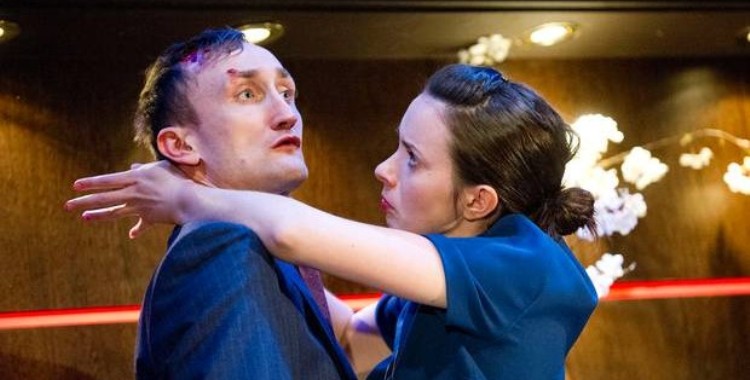
Photo: Lizzy Watts in the Paines Plough production of Wasted. Richard Davenport.

Fleabag, Soho Theatre

Fleabag-at-Edinburgh-2013-DryWrite-courtesy-Richard-Davenport-41-600x399

Originally written for Exeunt.

“It’s not fucking funny,” retorts Phoebe Waller-Bridge at one point in her blistering one-woman show, slicing through the audience’s laughter. But Fleabagis funny. Very funny. A riotous clash of confessional stand-up and exposing monologue, the brilliance of the piece is in its ability to land a joke at the same time as shaking its foundations. It leaves you laughing one moment and questioning your response in the next.

As well as funny, Waller-Bridge’s play is audaciously filthy. Her uninhibited protagonist reels off a giddying litany of wanks, threesomes and one night stands, heedless of boyfriends or menstrual cycles. The eponymous Fleabag – she is never offered another name – flits seemingly carefree from encounter to encounter, always on the lookout for the next no-strings-attached fuck. These brief liaisons are at once joyous and grubby, walking a fine tightrope between sexual liberation and humiliation – and not without the odd wobble.

The real power of all this X-rated content, hilarious as it often is, lies in the surprising lack of shock that Fleabag’s confessions provoke. It’s uncomfortable, yes, and the unflinchingly dirty anecdotes necessitate the odd sharp intake of breath, but there is little that really, substantially shocks. In a mirror image of Waller-Bridge’s disturbingly blank expression as she searches through every last genre of porn – gay, Asian, anal – we have ceased to be surprised by the sex that seeps into every last corner of modern society.

It is this over-sexualised society that Fleabag is the ultimate product of. She might have a distressingly one-track mind (“I’m not obsessed with sex,” she protests, “I just can’t stop thinking about it”), but if she does it is as a direct result of the world in which she has grown up. And if this pervasive presence of sex was not enough, the play also hints at the conflicting roles in which women are cast by society. Sexual freedom is popularly portrayed as a cornerstone of gender equality, in a through line that can be traced straight from Sex and the City to its ironic, grittier younger sister Girls, but at the same time women face criticism for pandering to the sexual fantasies of men. Does being a “slut” or disliking one’s body make a woman by default a “bad” feminist?

This is the sort of question that the piece is careful not to answer – at least not definitively. The complex ambivalence of the tone is personified in Waller-Bridge’s dazzling realisation of her protagonist, an individual who is both defiant and damaged. Beneath the swaggering sexual bravado, we see vulnerable glimpses of grief and loneliness, but as soon as she begins to soften Waller-Bridge complicates matters again with another jagged edge, another comic flourish. Just as the script is scattered with perfectly formed gags, Waller-Bridge’s comic timing is flawless, speaking of an impeccable control that is at odds with the spiralling chaos of the life she narrates.

And in the end comedy is the play’s killer weapon. Waller-Bridge brashly defies any claims that women aren’t funny, but Fleabag’s ability to make others laugh is intimately and troublingly tied up with the gathering wreckage of her personal life. The stylistic nods to stand-up are no accident; this is a woman who makes a stand-up routine out of her life, craving laughter almost as much as she craves sex. Through her relentless joking and her pushing at the boundaries of what can be joked about, Waller-Bridge is finally able to turn the piece on its audience, confrontationally folding a personal narrative outwards to make us squirm in our seats. After all, we’re the ones laughing.

Photo: Richard Davenport.

London Stories: A 1-on-1-on-1 Festival

London-Stories

Originally written for Exeunt.

“We all want to connect, I think,” Richard Dufty muses as we chat in one of Battersea Arts Centre’s many cosy, secluded corners. The last time I was face to face with Dufty was in his company Uninvited Guests’ show Love Letters Straight From Your Heart, as he shook my hand and offered me a glass of sparkling wine on the way into the performance. Now, in a new festival of intimate storytelling, the senior producer at BAC is interested in interrogating just those kinds of theatrical encounters – the moments where the mask slips and a more genuine connection between performer and audience member might just be possible.

“A lot of the performance that we’re interested in here is performance that is reaching for the real,” he says, quickly adding, “whatever that means.” Dufty and his artistic colleagues at BAC are fascinated by “the power of directness and honesty and immediacy”, a power that they have explored through a number of building-wide projects. The One-on-One Festivals in 2010 and 2011 questioned the nature of theatre and the relationship between performer and spectator, offering a series of encounters that shifted participants’ perspectives on the theatrical event. In BAC’s latest foray into intimate performance, however, Dufty and his co-producer Rosalie White are also interested in the intimacy that might be possible between audience members.

“There’s so much talk about the kind of community that you can get in an audience and what happens when you experience things together, and often it feels like a load of guff,” Dufty says frankly. By shrinking this down to an audience of two, the 1-on-1-on-1 Festival will go beyond this empty rhetoric and look at “the intimacy in what happens in a very small audience”. Each audience member will experience the event in the company of a series of strangers, entering each encounter alongside another person. The hope is that this will foster a closeness that is usually absent from larger performances; as Dufty points out, it’s hard to ignore your fellow audience member when they are the only other person in the room.

Another shift from previous One-on-One Festivals is in the nature of the encounters themselves. Rather than commissioning professional artists to create work for the 1-on-1-on-1 Festival, the theatre issued an open call for Londoners willing to share their stories, receiving over 100 responses. Dufty explains that the reasoning behind this approach was driven by the same desire to strip away layers of artifice from the theatrical event.

“There is something exciting about people who are not necessarily trained performers telling their stories,” he suggests. “If you’re interested in the frisson of something feeling like it’s actually happening there and then rather than being perfectly rehearsed, then there’s something to be said for not always working with professional performers.” There was also an attempt on the part of the theatre to tell the stories that we might not usually hear. Dufty recognises that the life experiences of those who make and regularly attend theatre at a venue like BAC are likely to be fairly similar; he and White wanted to open the building up to other stories, issuing an invitation to “come look at the rich variety of lived experience just in this one city”.

And the city itself is key. While the original focus was on stories rather than on place, Dufty and White soon discovered that the narratives they had collected from Londoners were all “saying something quite beautiful about this city”. In a sprawling metropolis where we usually avoid meeting each others’ eyes at all costs, London Stories forces us to take a closer look. Dufty is not expecting audience members to leave and immediately strike up conversations with strangers on the Tube, but he does hope that “you can at least wonder what their back story is, where they come from, how they came to be here, and what happiness and sadness and hope and tragedy is in their lives.”

The festival’s relationship with its city extends to its layout within BAC. The “building-wide adventure” will take audiences on a labyrinthine journey through candlelit rooms and corridors, dimming the light inside to allow some of the world outside to seep in through the windows. “There’s some idea that London is bleeding both ways,” explains Dufty, “from the storytellers out to the city and in again.” In many ways, the old Victorian town hall is the perfect location for this evening of urban storytelling; as Dufty suggests, London Storiescontinues in the building’s tradition of democracy, activism and community.

The stories themselves range from the heart-lifting to the heartbreaking. Dufty tells me that many of the narratives are deeply emotional for the storytellers – “it’s partly therapeutic” – but that in even the bleakest tales there is an element of hope and redemption. In selecting and curating the stories that make up the event, Dufty and White have dedicated thought to the texture and mood of the evening, contrasting the melancholy with the joyous. Dufty admits that “the curating job has been, on a very crude level, about mixing the heavy ones up with the lighter ones, the sad ones up with the funny ones”. There has also been a responsibility towards the storytellers, who are committing themselves to a necessarily exposing series of encounters by sharing their own experiences.

For all his talk of honesty, however, Dufty acknowledges that through the repeated telling of these stories, they will inevitably be transformed into a kind of performance. No matter how intently we tear away at artifice, a thin layer will always remain. Despite his instinct to reach for the real, Dufty cautions that “we shouldn’t be naive about ever being able to reach it”, adding “there are always masks”. But this should not stop us from reaching nonetheless. “Whilst you recognise that getting to absolute honesty is impossible, the pursuit of it is beautiful – the honest, genuine pursuit of it is a beautiful and very human thing.”

While unadorned honesty might be impossible, what London Stories – and intimate performance more widely – does have the potential to do is delicately reconfigure the theatrical contract. In these surroundings, there is a sense that the audience is indispensible and that the event itself “doesn’t feel too pre-determined”. And as Dufty emphasises, there is something fascinating about this not just theatrically, but also politically. “Things don’t have to be like this. It could be different.”

The Ritual Slaughter of Gorge Mastromas, Royal Court

The-Ritual-Slaughter-Of-Gorge-Mastroma-620x340

The repeated central question of Dennis Kelly’s dark allegory, emblazoned in giant letters at the back of Tom Scutt’s set, is a troubling one: “goodness or cowardice?” Are supposedly moral decisions just a case of taking the easy road? Is a decision really the “right” one if no “wrong” alternative occurs to you? Are virtue and fear simply one and the same? But beneath it, running in a thick, throbbing artery through the metabolism of the play, is an even more troubling question: is there really any such thing as truth?

In an interview with Maddy Costa for The Guardian, Kelly states his preference for plays that ask questions over those that provide answers, admitting that he’s “not really sure” what The Ritual Slaughter of Gorge Mastromas is about. I would, for the most part, agree that asking questions is more productive – not to mention more interesting – than offering solutions. A question leaves audiences thinking, while a firm conclusion can immediately alienate those who don’t agree with it. When everything is questioned, however, the provocation to look for answers is neutralised. Why search for a version of the truth if all truths are exposed as relative and ultimately meaningless?

Life’s stark absence of meaning is a revelation that forms the hinge of Kelly’s play. His eponymous protagonist, Gorge Mastromas, starts out as an essentially moral human being. When offered a choice, he takes the decent option, be it standing by a mate at primary school or remaining faithful to hastily voiced promises. Kelly and director Vicky Featherstone offer us this series of early incidents in Gorge’s life via an extended sequence of collective storytelling: the six cast members sit in a line of chairs at the front of the stage, sharing the history of Gorge’s life from the moment of his inadvertent conception. And my use of the word “history” is no accident; this simple but striking opening deliberately foregrounds the construction of historical narratives, offering a fragmented, unreliable and polyvocal account of Gorge’s life, told from a perspective that is never quite acknowledged or qualified.

Our protagonist’s Faust moment arrives when a ruthless businesswoman briskly informs Gorge that life is not what he has until that moment believed it to be – “it is not fair, it is not kind, it is not just”. But if he’s willing to sell his soul to the demons of cutthroat capitalism and merciless self-advancement, he can have whatever he wants: power, money, sex. The trick is simply to lie from the bottom of his heart, heedless of the consequences of those falsehoods. Embracing this new philosophy with only the lightest flicker of hesitation, Gorge is swiftly mounting the ladder to unimaginable wealth and power – an unstoppable capitalist juggernaut. Be it a company, a house or a woman, Gorge always gets what he wants. What follows is acquisition at the expense of all else, painting a sorry picture of our society’s trajectory and the lessons it implicitly instils in us.

It’s an old story, but one that is drenched in the giddily unfettered capitalism of the 80s and 90s, playing on the myth of indefinite growth and the conviction that everything is there for the taking if only individuals are willing to grab it. The main commodity to be traded, however, is not property or shares, but narrative itself. Gorge is a spinner and seller of stories – most explicitly with his fabricated bestselling memoir, but also in the fibs he blithely tells those around him in order to get ahead. And people want to believe these fictions. When speaking of “people”, that necessarily extends to the audience, all of us eager to grasp onto something solid, some narrative structure that makes sense of this world. By drawing attention to this, and to the lies that even our narrators are incessantly telling, the play makes us immediately doubt anything it tells us, as well as doubting our own interpretations of these versions of the truth.

The shifting ground of Kelly’s play is shaken further by this production – if, indeed, we can speak of the two separately, which is always a slightly disingenuous project. The dynamic division of Gorge’s story between the cast, delivered with an edge of irony, is reminiscent of now ubiquitous techniques of poststructural performance, at once bringing to mind the likes of both Forced Entertainment and Martin Crimp (useful reference points for the disruption of meaning and narrative). This engaging, teasing mode of delivery is contrasted with the far less compelling – and often overlong – “scenes” that pepper the play, offering an ever-so-slightly heightened variation on naturalism. Which offers the picture that is closest to the truth is left down to us, as the performance style of each in turn subverts its own stated veracity.

The figure of Gorge himself, meanwhile, is a tight knot of contradictions. When Tom Brooke first shrugs on the role of the anti-hero, he is a quivering, deferential employee, eager to please and anxious of hurting. After offering such a detailed portrait of this meek, decent man, it is difficult to dismiss his ghost, which hovers over all of Gorge’s subsequent deceptions. Never is he quite as convincing as when still in possession of his morals. Alongside the fleshed out emotional detail that Kate O’Flynn’s compassionate performance offers Louisa, the unlucky object of Gorge’s affections, Brooke’s mercenary entrepreneur is a skeleton of a character, at times nearing a caricature of capitalist greed. Yet this thinness seems oddly apt; it could be argued that it shows up the absurdity of this Game Theory style of self-serving logic in both life and drama. Human beings are strange, irrational creatures, and to drain them of that irrationality – be it by a capitalist logic of acquisition or a notion of drama that is built upon clear character motivation – leaves only empty shells.

The empty facade is also a recurring feature of Tom Scutt’s intelligent, thematically excavating design. His self-contained naturalistic spaces, which form the backdrop for the correspondingly “realistic” scenes, always offer a hint of superficiality, from the calculated blandness of a corporate office to the moneyed sheen of a hotel suite. By the time the scene shifts to Gorge’s lakeside palace and a dilemma that will test just how far he’s prepared to go to protect this painted paradise, any attempt at substance is abandoned, leaving only a flat simulacrum of a landscape on a screen behind the actors – the shimmering mirage of Gorge’s life, concealing only emptiness. Elsewhere in the design, the stubborn search for a pattern is offered visual expression: the constellations of a life are brightly dotted on an image of the night’s sky, paper is pinned to the walls in imitation of the detective’s evidence trail, and neon lines are traced over a graph.

Through this kind of detail, The Ritual Slaughter of Gorge Mastromas offers much to chew and puzzle over, for the most part sustaining intellectual vitality over its testing two hour and 45 minutes running time. That hovering question mark over truth, however, niggles at me throughout. While I have other doubts about the piece (it’s far longer than it needs to be, for starters, and Gorge’s moral descent lacks the punch that I suspect it’s reaching for), my main concern is prompted by its political position; or, rather, how it seems to politically let itself off the hook. The questioning of truth is interesting in itself and follows the thread of much poststructuralist/postmodern (depending on how you like to define it) thought in suggesting that there is no foundational reality that we can appeal to, but it is equally in danger of rendering all truths equally invalid, thus making any attempt at morality pointless.

My mind is dragged back to the recent discussion Dan Hutton and I had about hope in theatre, which strayed into similar territory. In that dialogue I borrowed from Liz Tomlin’s new book Acts and Apparitions (a text that I increasingly think could be a vital reference point in navigating post-postdramatic performance practice), and it feels appropriate to return to Tomlin now. Her book traces the postmodern thought mentioned above and considers the possibility of making a radical gesture in theatre today, when any notion of the true or the real has received a thorough battering. To demonstrate how she grapples with this, I want to quote part of the text:

“Accepting that every narrative is implicitly ideological does not equate to the acceptance that any given narrative is thus beyond ideological analysis or distinction. The artist or critic’s choice to propagate one narrative over another will still result in a ‘real’ impact on the artists, the audiences and, to some degree at least, the ideological shape of the historical period in which the work is situated.” (pp.6-7)

In other words, the version of the truth that we choose to tell has an effect, whether or not it can appeal to some original, authoritative, universal truth. This version of the truth might even have the power to change the world, a power about which Gorge Mastromas feels distinctly ambivalent. Individuals such as Gorge can change things, but only for their own gain; beyond the certainty of lying, the universe is portrayed as cold, cruel and chaotic. If we choose to present an image of the world in which there is no truth, only lies, then perhaps there is a responsibility towards the “real” impact of that image. By seemingly refusing that responsibility and falling back on relentless uncertainty, Gorge Mastromas – for all its merits – feels like a bit of a cop out. If the question is “goodness or cowardice?”, I would tentatively suggest that Kelly errs towards the latter.

Photo: Tristram Kenton.

“We’ve a responsibility to widen the net”

NSA_ 0071 Image provided by Creative & Cultural Skills © Briony Campbell

Originally written for The Stage.

In 2011, following years of debate around the growing culture of internships in the arts sector, Arts Council England issued a set of guidelines for employers taking on interns. This document outlined the Arts Council’s determination “to open employment opportunities in the arts to all” and made it clear that interns should be paid the national minimum wage. But has anything actually changed?

On the one hand, it would appear that little has shifted. Once again it is that time of year when those hoping to break into the arts look to the Edinburgh Fringe, which promises a cornucopia of opportunities but little by way of payment. While the Festival Fringe Society does pay its staff, as do a number of the commercial venues such as Underbelly and the Assembly Rooms, many more rely on voluntary or poorly paid labour. C Venues, for instance, hires staff on a “semi-voluntary” basis, offering accommodation and an unspecified “minimal freelance fee”, while even the Traverse Theatre has advertised for unpaid festival placements.

Of course, it is not just on the Fringe that interns receive a raw deal. Many theatres across the country operate unpaid internships the whole year round, often for understandable reasons. For some organisations it is the only economically viable model available to them if they want to stay open, and for interns it can provide opportunities that might not otherwise be available to them. Internships also remain something of a grey area, with the Arts Council’s guidelines admitting that “there is no formal, legal definition of an internship”.

There is, however, a new scheme that seeks to address some of these difficulties. The Creative Employment Programme, funded by a £15 million grant from the Arts Council and delivered by Creative & Cultural Skills, hopes to widen access to careers in the arts by supporting paid opportunities for unemployed people aged between 16 and 24. The programme is offering internships and apprenticeships for both graduates and non-graduates over the next two years.

“The aims are to address youth unemployment as best we can, encourage people into the arts through different and fair access routes, and hopefully to change some of the recruitment practices that are in our sector,” explains Paul Marijetic, head of apprenticeships at Creative & Cultural Skills. He recognises that those who currently enter the industry tend to come from a “small demographic”, so one of the key goals is to widen this pool of recruits.

Through this new initiative, organisations looking to establish paid internships or apprenticeships can apply to the Creative Employment Programme for part wage grants, either as individual institutions or as consortia. In keeping with the aim of widening access, successful employers must then sign up to a Fair Access Principle and advertise the positions through the Job Centre Plus.

“With this programme we wanted to meet people who we don’t normally meet when we recruit,” says Emma Rees of the London Theatre Consortium (LTC), one of the first networks to benefit from the scheme. This group of 13 theatres, including the Royal Court, the Lyric Hammersmith and the Donmar Warehouse, is offering 38 apprenticeships across the two years. “We didn’t advertise through the normal channels,” Rees continues. “We thought about how to find people.”

Another early bid to successfully receive funding was from House, a consortium of theatres across South East and Eastern England which will be offering 16 internships in 11 venues. Gavin Stride, director of Farnham Maltings and one of the key figures behind the consortium, stresses that “we have got a responsibility to try and widen the net in terms of the ways people engage in the sector”, adding that “sometimes you need to be ambitious to make things different”.

Marijetic is keen for others to follow the lead of LTC and House, making it clear that the Creative Employment Programme is welcoming consortium bids. By working together in this way, groups of theatres can offer much more valuable opportunities for interns and apprentices, as well as providing them with a broader overview of the industry. The LTC, for example, will offer apprentices a glimpse at the inner workings of all 13 theatres, leaving them with “a really strong grasp of the broader ecology of London theatre”, while Stride says that he can see interns moving between the different House venues depending on their skills and interests.

There is also the possibility that consortia could offer a sustainable model to take forward after this two-year programme concludes. As Marijetic explains, there is other funding available from government agencies to support these opportunities, but the money is often closed off to smaller organisations. He recognises that funding is going to be vital in sustaining these kinds of initiatives in the long term, describing the Creative Employment Programme as “the catalyst, the financial push to enable [organisations] to make that change”.

The organisations themselves seem equally committed to creating long term change. “We’re really, really keen for this scheme to develop into a viable alternative to university,” explains Rees, “not just reaching those people who might otherwise go to university, but reaching those people who most certainly wouldn’t.” Once again, however, money is the stumbling block. “The will is usually really strong, but this kind of work does need financial investment,” she admits.

If such opportunities are able to continue, there is even the suggestion that they could spark more widespread change. Stride argues that perhaps the most important thing about the Creative Employment Programme is that it will bring in “people who think differently” and who might be able to breathe fresh air into theatre organisations. “We need to be looking outwards, not inwards,” Stride insists. “We’ve got to take down the barricades, because actually they’re not defending us, they’re killing us.”

Photo: Briony Campbell for Creative & Cultural Skills.