Chapel Street, Underbelly

chapel-street-ed-review_540_306_Crop

Originally written for IdeasTap.

On Chapel Street, “every week it’s shit”.

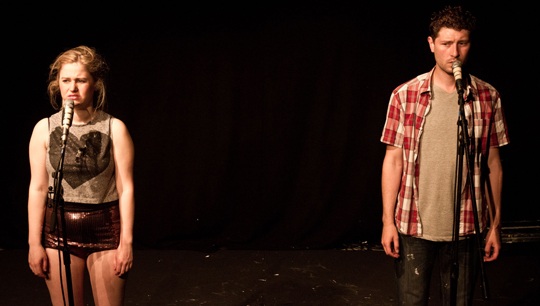
Same people, same bars, same drinks. Or so we’re told by Joe and Kirsty, both out on a Friday night and each with their own reasons to seek oblivion. Through these two characters, Luke Barnes’ viciously funny and quietly devastating two-hander sketches out a searing, booze-stained portrait of the Pro-Plus generation, grabbing at their next energy kick while putting off tomorrow.

In a culture that seems determined to paint its youth as violent rioters and benefit-sponging lost causes, Barnes and his characters are paradoxically both embodying and kicking out against those stereotypes. There are shots, kebabs and smashed glass, but there are also concealed depths peeking through the fake-tan facades. Kirsty, it transpires, has ambitions to go to university and would rather go on holiday to Paris than to Kavos; Joe remains unemployed not through a desire to dodge work, but due to a dread of wasting his life in a soulless office.

Such fragments of personality are revealed through overlapping monologues spoken into microphones at opposite sides of the stage, an initially static set-up by director Cheryl Gallacher that gradually unravels into a frenetic reflection of the characters’ escalating intoxication. Performers Cary Crankson and Ria Zmitrowicz weave and stumble around the small space, making convincing and disarming drunks, yet tempering the humour with a poignant strain of vulnerability. The laughs, of which there are many, have a habit of souring in the mouth.

It is a piece that feels very much of the now, offering grim reality but few solutions. Barnes’ lyrical yet gritty language crystallises the brief euphoria and crashing despair of a whole swathe of young people emerging into a world that seems not to want them, with references to useless master’s degrees and the lie of an Olympic “legacy” that delivers very little opportunity. In a telling touch, we are told that the local church has been converted into a bar – home of the new religion. As Joe and Kirsty argue, with the way things are, you “might as well just get fucked”.

Photo: Jassy Earl

Bitch Boxer, Underbelly

bitch-boxer-edinburgh-review_540_306_Crop

Originally written for IdeasTap.

Every fighter has a reason.

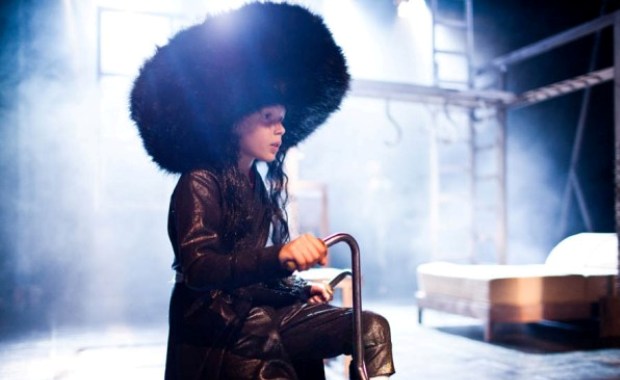
That’s the thinking behind this new show written and performed by Charlotte Josephine, taking a particularly timely dive into the world of female boxing. Chloe has wanted to fight ever since a family betrayal fractured her world, but in the lead up to the London 2012 Olympics – the first Games in which women can compete in boxing – two events once again shift the ground beneath her, tripping her footwork.

With a rough sort of poetry, pounded out to the rhythm of punches, Josephine offers us a glimpse into Chloe’s chalk-outlined world. This is more about the individual at its heart than the sport in which she competes, but boxing forms a constant background drumbeat and a language through which to understand life. For Chloe, romance is a winding “sucker-punch of love”, an emotion, like grief, that she can only understand in terms of a knockout blow. Emotion, in this male-dominated world, feels like a weakness.

Beneath the fighting mentality that permeates Chloe’s character, however, there is something surprisingly tender and charming about this piece. Much of that charm radiates from Josephine herself, who somehow makes an activity inherently reliant on two parties – red corner and blue corner – work as a solo show. Hopping from toe to toe and pacing restlessly around the space, she rarely loses the coiled physicality of the boxer, but she also melts into moments of sudden, startling softness; reading a note from boyfriend Jamie, or smiling at a memory.

The other surprise of the show is its humour. From miming deadpan to Eminem, to a gag about Tesco that will never let you read the slogan “every little helps” in quite the same way again, the piece packs as many laughs as it does punches. Ultimately Bitch Boxer is, like the odd affection inspired by real boxing champion Nicola Adams, a reminder of the very human side of a sport often characterised by aggression. For all that the fighting thrills, it is the moment when a closed fist unfurls into an open hand that is the most compelling.

Photo: Jassy Earl

Collaboration in kind: arts and business partnerships beyond the cheque

Originally written for The Guardian Culture Professionals Network.

In the post-cuts cultural landscape, collaboration has become the new touchstone. Working together is widely regarded as the way for arts organisations to survive in this environment, but what if that involves looking beyond the creative industries? As the ground beneath us shifts, a surprising word is creeping into the vocabulary of emerging artists: entrepreneurial.

This terminology is particularly associated with the work of Theatre Delicatessen, that over the last four years has established a system of what it calls “transactions” – in-kind exchanges of space, resources and services that have allowed them to put on their work and have this year secured them a residency in the old BBC offices in Marylebone. One step removed from traditional philanthropy, this creative thinking is about the engineering of mutually beneficial partnerships, and it’s an approach that is beginning to be more widely adopted.

“It’s not just about writing a cheque,” stresses James Yarker, artistic director of Birmingham-based theatre company Stan’s Cafe, which has a reduced rent agreement on their current space in an unoccupied portion of the AE Harris metal works factory in the city’s jewellery quarter. What the theatre company offers the manufacturer in return is sponsorship, access to their work and a renewed place within the community, not to mention a mutual network of support. As Yarker puts it, the artists are now “part of the company’s life”.

For those proponents of this model, their enthusiasm verges on the evangelical. “It’s absolutely written into our DNA that it has to work both ways,” says Ali Robertson, director of the Tobacco Factory Theatre in Bristol. The theatre, which has been housed in this factory since 1998, secured a 25-year rent-free lease on part of its space in 2009, cementing a long-running relationship with the building and its landlord (and saviour from demolition) George Ferguson.

Despite the financial element to transactions such as these, the real strength of this approach lies in exchanges that are not based purely on money. While Robertson admits that straightforward philanthropy plays a sizable part in the funding of most arts organisations, including his own, he firmly believes that “the healthiest relationships are often based on something a bit deeper than that”.

The foundations of these relationships can be hard to pin down. Artists often benefit landlords through reducing their business rates by occupying empty space, but exchanges can be based on anything from reviving a local area and bringing in footfall, to running workshops for aspiring thespians in the workforce.

At the centre of these collaborations there is typically a sense of community and a simple but unquantifiable commitment to helping one another out on a day-to-day basis. “If you’re writing a cheque for someone, the transaction is quite cold,” observes Yarker. “Relationships and collaborations are much softer and much easier in many ways.”

Steven Atkinson, artistic director of High Tide, agrees. Before the theatre company found their current home in the offices of Lansons Communications in Clerkenwell, they spent a year rent-free in another office building, but the arrangement was not sustainable in the long term because they had nothing to offer in return. Now they have a collaborative agreement whereby they are offered space and infrastructure in exchange for the training and entertainment they provide for the Lansons staff. It’s a system that Atkinson says “always ticks all of the necessary boxes” for both parties.

With the recession leaving acres of empty office space in its wake, Atkinson believes there is the opportunity for more such partnerships. “A lot of companies could offer desk space to not-for-profit organisations and not really feel any drop in their own capacity,” he claims, urging artists to explore these possibilities.

In this spirit, theatre company tangled feet has taken over a floor of office space in central London through a deal brokered by the charity Healthy Planet, opening an arts co-operative along similar lines to the one now operating in Theatre Delicatessen’s Marylebone home. In the retail sector, meanwhile, the Empty Shops Network helps artists to temporarily take over deserted high street units to stage performances, installations and community projects.

What these examples rely on, however, is the negotiating skill of third party organisations – help which many artists are not aware of or lack access to. Atkinson speculates whether a government agency might plug the gap, bringing about more relationships with the business sector in response to the dearth of public funding. But for now at least the onus lies with the arts. So how can artists start up these conversations with potential collaborators?

“It’s about having a non-scary front,” laughs Atkinson, though the point he makes is a serious one. One point of agreement between those who have succeeded in this entrepreneurial vein is that it is vital to be flexible and to present a friendly face to those who might be in a position to help but who might also be intimidated by the arts.

Yarker, meanwhile, simply advises artists to do what they do best. “If artists are talking about their work, they’re naturally enthusiastic and inspiring,” he says. “That’s very seductive.”

Of course, beneficial as these partnerships may be, they are not the answer to all of the challenges currently faced by artists. “It works to a point,” warns Jessica Brewster, co-artistic director of Theatre Delicatessen. Collaborative agreements with businesses can provide space, resources and a safety net of support, but they do not ultimately pay artists’ wages. “You have to be aware that it’s a model that only works so far,” says Brewster. “It’s not a model that will necessarily give you a living.”

And what about the possible ethical implications? There is crossover here with the concerns frequently raised about corporate sponsorship of the arts and how this might compromise the art being made. The artists I speak to, however, are adamant that these relationships – if made with companies sympathetic to the work – needn’t interfere with artistic intentions.

“If you can do it without compromising the art that you’re trying to make, who wouldn’t want to save money in order to spend that money on the art?” says Atkinson, and he has a point. Although they might not be a substitute for funding, approached with the right attitude these in-kind “transactions” can go a long way towards making up the shortfall, as well as developing entire communities as a valuable side-effect. In Atkinson’s words, “it’s something of a no-brainer”.

Photo: Tobacco Factory

Puppet. Book of Splendor, Summerhall

Originally written for Exeunt.

The title of neTTheatre’s hypnotic physical theatre show is a little misleading. There is, throughout this compelling hour and twenty minutes, a distinct scarcity of puppets. Instead, channelling the work of Tadeusz Kantor and excavating dense Jewish scripture, this is a non-linear, disorientating journey through the realms of life and death. Viewing the human condition through the lens of cabalism, director Pawel Passini’s creation is a contorted compendium of dreams, desires and nightmares, as captivating as it is bewildering.

We are given a road map of sorts, a projected schema studded with words such as “beauty”, “justice” and “understanding”, through which the performance can be refracted but never quite clearly seen. This, we are warned, is to be expected. In one of several deft nods to the artifice of theatre, the knowing voice of the director cuts in to tell the audience that we will probably struggle to follow what we are about to see and that we might not enjoy it; this is “sit down tragedy”, not “stand up comedy”.

The piece, however, is as visual as it is intellectual. Rich and sometimes ridiculous images compete for attention, from dreamlike projections to a host of angels in white wigs and hipster glasses. In the midst of Passini’s assault on the eyes, it is the alternately graceful and vicious physicality of neTTheatre’s performers that captures the gaze. A man and woman, cast as Adam and Eve figures, move fluidly as one body, arms hemmed together inside the same shirt; another woman spits the Hebrew alphabet, the letters bodily wrenched from her diaphragm as her torso spasms.

The screaming succession of startling images summons questions, tumbling feverishly one after another. Who is the silent artist figure, seeming to paint the world into creation around him? What is reality and what is dreamed? Does the gaping emptiness of a figure made from clothes – one of the production’s few instances of puppetry – suggest that God too is just a void clothed in empty faith?

Questions, however, are deflected by both text and performance. We are told that “to know is to pose questions”; questions breed questions in the same way as Passini’s baffling imagery, with none of those insistent “why’s” bringing us any closer to understanding or satisfaction. The answers that we seek are repeatedly evaded. In this way, neTTheatre grasp us by the hand and roughly guide us to the relinquishing of linear logic that is required to experience their performance as intended – as an experience.

And as an experience it is exhilarating and exhausting. There is perhaps too much going on, certainly too much to fully absorb both the surtitles and the stage language, but this seems to be the point. A fraction of enlightenment is all that we can hope for. But understanding is not everything. As a Rabbi in the show says of the young daughter who insists on reading from cabalist teachings, “she understands nothing, but it pleases me”.

A Tissue of Quotations: Theatre & Authorship

To state that theatre is an essentially ephemeral art form would seem to be a reiteration of the obvious. The distinct nature of performance lies in its liveness, its specific relationship with a specific set of audience members at a specific moment in time, none of which can ever quite be replicated. At a less specific level, each production is a crystallized present moment, an entity that exists only for the length of its run and is determined by a very particular set of choices and aesthetics. Theatre is, at its heart, a fleeting phenomenon.

Yet we remain, at least in British theatre culture, obsessed with preservation, with legacy, and with the rigidly hierarchical process of pinning a production down to a single authoritative source for the purposes of that preservation. Hence the primacy of the “author”. And I was, initially, as unquestioningly compliant with this notion of authorship as anyone else; it is, after all, easier for the purposes of a review to assume that the content of the piece has been born from the mind of the writer and to conflate all connecting themes, threads and resonances with the intention of the playwright. But such assumptions have been bracingly unsettled by the recent focus on British theatre’s false dichotomy between “new writing” and “new work”, a dichotomy which I would argue has deeply ingrained notions of authorship at its core.

There are many perceived differences underlying this opposition between what has been loosely referred to as text-based and non-text-based theatre, differences connected with narrative, character, aesthetic etc., but it seems to me that the unifying aspect at their centre is the presence or absence of a single author. Text-based work is typically associated with naturalism, linear narrative and a coherent driving “message” because it is supposed to be the creation of one dominant creator, one authorial “voice”, with all other elements of the production harnessed to serve the vision outlined in the text. Non-text-based work, by contrast, is seen as eschewing all of these notions of linearity and coherence because it has been conceived by a devising ensemble and consists of a multiplicity of voices.

Of course, such assumptions are often not the case in practice, but while the moment of performative realisation may be more democratic, it is the author whose name will remain attached to the work long after its production. For this reason, as Kat Joyce eloquently argues in her guest column over at Exeunt, work that does not have a clear hierarchy of authorship and that explicitly depends upon the nature of its liveness risks being obliterated by the very text-based process of historicising, thus perpetuating the supremacy of scripted work. In Joyce’s words:

“At its deepest level, does a system which fixates on individuals and playtexts also radically undervalue the potentials and possibilities of live performance in all its unfixed, unstable, temporary glory?”

It is clear – at least to me – that we need to rethink our rigid definition of authorship if we are not to devalue the moment of performance and neglect a huge swathe of this country’s theatrical output. But this isn’t just about recognising the work of devising companies, because recognition alone does not necessarily smash down the persistent divide between text-based and non-text-based work (undeniably reductive and misleading labels, but ones which are handy for the purposes of this piece). Negotiating that divide and the reasons behind it is much trickier.

It boils down, I think, to an idea of authorship that extends beyond the realm of theatre and performance. We are part of a literary culture which is, as Roland Barthes put it in his seminal essay “The Death of the Author”, “tyrannically centred on the author”. Throughout secondary school, students are encouraged to interrogate texts in order to unveil their “meaning”, as if reading was one long act of detective work, with the author’s intention enshrined at its centre. While university courses in literature explore a much more nuanced approach to textual analysis, there is a general subscription to the prominence of the author in all text-based art forms, an approach that has insidiously crept into understandings of theatre.

Because such an author-centred approach is key to our culture, much talk in theatre has been given over to “serving the text”, “serving the writer”, “staying true to the writer’s intention” etc. Within such a model, all other elements of a production become tools to illuminate the writer’s purpose and the other creatives involved are viewed as little more than vehicles to convey an overarching authorial “message”.

The problems and contradictions inherent in this model can be illustrated by a couple of examples drawn from conversations I’ve had with theatremakers, examples which I’m sure are not unique. Discussing feedback that she’d received about her interpretation of Gods Are Fallen and All Safety Gone, Greyscale’s Selma Dimitrijevic told me that audiences seemed outraged about certain directorial choices that she had made (the most discussed of these being her decision to cast male actors as women) until they became aware that she had also written the play. Apparently directorial interpretation is only acceptable when it originates from the writer. On a slightly different note, Thomas Eccleshare expressed his frustration with the fact that, despite creating work for two years with his company Dancing Brick, it was only when he won the Verity Bargate Award that he earned the label of “writer”, with devised work remaining stubbornly excluded from the narrow category of new writing.

Joyce’s column, which draws partly from her own experiences as the co-artistic director of physical theatre ensemble tangled feet, again expands on the difficulties posed by a culture which places a disproportionate value on the written text, while Hannah Silva has blogged on numerous occasions about the restrictive definition of new writing that prevails in this country and the difficulties of negotiating that definition (I can’t track down the exact piece that I have filed away at the back of my mind, but read her blog for some fantastic reflections and provocations about writing for theatre).

There’s much more to say about how the divide between text-based and non-text-based theatre has been reinforced, particularly through the Arts Council funded new writing drives referred to in Alex Chisholm’s essay for Exeunt, but I’d like to remain focused on this central notion of authorship, its complexities and how it might be reconfigured. Barthes, who I have already quoted, provides one answer to how the false idol of the author might be displaced. He describes the text as “a multi-dimensional space in which a variety of writings, none of them original, blend and clash. The text is a tissue of quotations drawn from the innumerable centres of culture.” In other words, no piece of writing is truly original and all writers are continually quoting their antecedents.

If we accept Barthes’ definition of the text, authorship is at best an act of curation and interpretation – not, really, all that different from directing. In a staunch defence of the writer’s intention in his essay “Interpretation – To Impose or Explain”, playwright Arnold Wesker posited this argument in order to deride it, laughing at the possibility of “interpreting an interpretation”. I would contest, however, that this is not such a ridiculous idea. Not only might a writer produce an interpretation rather than an utterly original source text, but that interpretation might be jointly (re)interpreted by director, performers and entire creative team in collaboration with the writer (or writers), acknowledging that theatre is an emphatically collaborative art form.

It is also worth briefly interrogating the term “text”, which I’ve been carelessly throwing around as if it had one single, fixed meaning. This term is generally interpreted to mean the written text in the form of a conventional script, but it can – and perhaps should – be expanded to include the entire dramatic text, encompassing all elements of a production and its reception, acknowledging a circuit that is completed by the audience. I’m reminded of another discussion with Selma Dimitrijevic, in which there was some consideration of the similarly unstable word “play”; Selma said that she typically interprets this to refer exclusively to the written script, but it is used interchangeably by critics, at some times indicating the script and at other times the whole production.

Bringing critics into the mix flags up their (our?) role in this binary. There is a tendency, conscious or not, to write separately about all the individual elements of a production, isolating writing, direction, design and performance in a sort of criticism by numbers that I know I’ve been guilty of employing. This is often a case of convenience and is to an extent inevitable; without having observed the process, which is another debate entirely, it’s impossible to know who was responsible for each and every creative choice. Yet there is a danger, because criticism again holds a certain lasting currency by virtue of its written format, that a failure by critics to acknowledge the collaborative nature of work will perpetuate the schism. I’m not yet entirely sure how this danger can be overcome, but it’s worth considering.

Having scratched away a little, if only fairly superficially, at the notion of authorship, how might it be possible to rethink the format of the legacising theatrical (written) text? To answer this question, it’s also necessary to answer the question of what a playtext is for. Physical theatre company Square Peg summed it up nicely in a response on Twitter: “Is the script the beginning or the end of a process? A document or an instruction? Can it not be both?” I’d agree that the written element of theatre has a dual role, acting as a (non-fixed) jumping off point and as a form of preservation, though both of these twin roles are slippery.

Some intriguing questions were asked via a recent conversation on Twitter between Bryony Kimmings and Oberon Books, with contributions from others, which was one of the catalysts for nailing down these thoughts. As later blogged by Kimmings, she wanted to explore whether the kind of art she creates could be published as a script, and if so what form that might take. She asked: “How does a live artist that plays in the Cabaret space at Soho Theatre and just did her first stand up gig get her work published … does she need to?”

The need could be quite persuasively argued as a form of documentation and legacy, a way of recording live art in the same way as text-based theatre. The question of format, however, is less easily answered. Would it be a script detailing the original performance, or a DIY kit allowing space for interpretation? It all depends, of course, on whether a work is intended to be produced again. At the risk of banging on about it yet again, here I think it’s interesting to bring in the example of Three Kingdoms (which also, though I won’t discuss it here, provides an interesting challenge to British theatre’s text bias, possibly offering a way to bridge the gap). Here is a playscript that differs so dramatically from Sebastian Nübling’s production that they are really two different texts. Were anyone brave enough to attempt another production, would they start from Simon Stephens’ script or from its collective realisation on stage?

Much more could be written on this thorny issue, but for now I’d just like to bring in one final example that complicates matters even further. In the absence of a space at Edinburgh this year, Forest Fringe have made the fascinating decision to “create a performance space built not of bricks and mortar but paper and ink”. Paper Stages is a book co-authored (again destabilising the concept of a single voice of authority) by a wide range of Forest Fringe artists and made available for festival-goers to perform themselves. There will as a result be multiple dramatic texts, many performed in the absence of audiences and without documentation, giving fluid meaning to ideas of authorship, performance, reception and collaboration.

A script is not fixed or indeed finished until the moment of performance and reception, but perhaps a performance’s documentation is equally unfixed. To come full circle, theatre is ephemeral. While preservation remains an important concern for artists attempting to secure their place within a text-biased culture, there is an argument that to resist the uniqueness of live performance is essentially futile. We should be celebrating liveness, not attempting to solidify it.