Boys, Soho Theatre

Watching as a recent graduate, Ella Hickson’s latest play is both mildly terrifying and depressingly familiar. Her broken, desperately partying characters painfully evoke the rabbit-in-the-headlights panic of confronting life after university, while Chloe Lamford’s precisely detailed design, right down to the cupboard handles (though thankfully excluding the mess), is almost a carbon copy of my own student kitchen. Coupled with the frantic, competitive drinking and the forced irony of fancy dress, Boys induces a heavy and slightly uncomfortable sense of déjà vu. I’ve been here before.

Hickson’s play comes underscored with a quiet cry of “we’re fucked”. Her graduating students, Benny and Mack, are about to go out into a world that doesn’t want or care about them, leaving a childhood that has promised them everything to enter an adult life that will most likely deliver nothing. Meanwhile, one of their housemates, Cam, freaks out in the face of a concert that could change his life, and the other, Timp, stands as a cautionary example of the monotony of getting stuck in a dead-end job. It’s the boys’ last night together before they must all move out and there’s only one thing they’re certain about: they are going to have one hell of a party.

Perhaps unsurprisingly, none of Hickson’s characters want to grow up. From eternally partying Timp, about to enter his thirties with the mentality of an eighteen-year-old, appropriately dressed as Peter Pan, to the students in denial about their swiftly approaching graduation, there is a stunted, childlike atmosphere to this world. It is not insignificant that the fancy dress theme they choose for their end-of-year party is Disney. Nostalgia taints everything in this backward-looking environment, because the future is just too scary; everyone has their heads buried in the sandpit.

While they put off tomorrow, the boys’ riotous embracing of today is frequently hilarious. Once again the déjà vu attacks, as Hickson perceptively captures the banter and bravado of student dialogue, nailing every last reference and successfully distilling that youthful cocktail of forced confidence and crippling insecurity. These contradictory elements both surface too in the utterly convincing performances of the young cast, who paste over fragility with indifference and play wasted with slurring commitment. Much as he did with Headlong’s strikingly youthful Romeo and Juliet, director Robert Icke injects proceedings with an espresso shot of energy, as the youngsters dance on the table and aggressively knock back drinks.

This edges close to a Skins-esque view of “yoof”, all pints, pills and parties, but Hickson is too clever to pigeon-hole her young characters in the same way that the media is so often guilty of. Beneath the bloodshot eyes and strained façades, tenderness blinks through, while the crude harshness of male banter is softened slightly by the presence of Timp’s chatterbox girlfriend Laura and guarded, delicate Sophie, the ex-girlfriend of Benny’s brother. Benny, whose wounds are closest to the surface, feels the need to fix things – perhaps a reaction to his own brokenness, poignantly conveyed by Danny Kirrane. This is set in opposition to Samuel Edward Cook’s tough guy Mack, who aggressively insists that we are all responsible for ourselves and no one else in a particularly unappealing portrait of staunch individualism.

Through such relationships, Hickson grapples with a wide collection of ideas, some with more success than others. The central nugget is this rage at a world in which the future of the generation now graduating is uncertain at best and stark at worst, but plenty more is going on here. The young characters question what it means to be successful, what the purpose of knowledge is, whether we are responsible for others, if it is still possible to have faith in anything. There is a sense of searching, though this can turn into clumsy fumbling. The scope is to be admired, but sometimes the execution is crude and clunky, increasingly so in the meandering second half as external riots intrude into this claustrophobic pressure cooker. Hickson stalls and starts up again, offering what feel like dramatic conclusions before ploughing on, and eventually soothing the sting of her message with sentimental catharsis.

Hickson’s metaphors, like her plot, start out arresting but end up overdone. The pile-up of rubbish bags caused by local strikes (yet another situation familiar to me from my own student days) becomes a repeated symbol of the trash mounted up by previous generations that is now beginning to rot and fester, asking questions about how we clear it up. Do we simply follow suit and dump our mess on others – the “inalienable right to dump your shit on someone else”, as Mack sneeringly puts it – or must we keep it inside with us and let it poison the air we breathe? This returns to the debate between Benny and Mack about responsibility, but is pushed beyond resonant, underlying significance into the glaringly obvious, until the whole kitchen is swamped in rubbish. By the time the characters eventually set about cleaning up, the symbolism has lost all potency through heavy-handed repetition.

While the conclusion may collapse into sentimentality, it is fitting that there are no easy solutions or resolutions offered in the face of a hostile world that the boys are reluctant to enter and approach with a sigh of apathy. Echoes of Mike Bartlett’s Love, Love, Love can be heard in the youngsters’ resigned recognition that they will never achieve or earn as much as their parents, while the laboured metaphor of the ever increasing rubbish repeats the idea that this generation did not create the mess we are now having to clean up. I was also reminded of another Bartlett line, this time from Earthquakes in London: “bad things are happening, let’s bury our heads in the sand”. This is certainly the mentality of Hickson’s characters, who are only briefly able to look their own bleak future in the eye before returning their gaze to the immediate debris.

Reflecting at a slight distance, it occurs to me that while the ending falters, this might just be somehow appropriate, if disappointing. Hickson writes herself into a situation that is difficult to conclude; the generation she writes about (which just happens to be my generation) is finding it equally difficult to envision where we might end up. Not an intentional symmetry, but a strangely apt one. Conclusions are not forthcoming in either case. Perhaps being young is, in Cam’s words, “as good as it ever fucking gets”.  And in today’s world, that is possibly the most depressing idea of all.


Translunar Paradise & Critical Distance

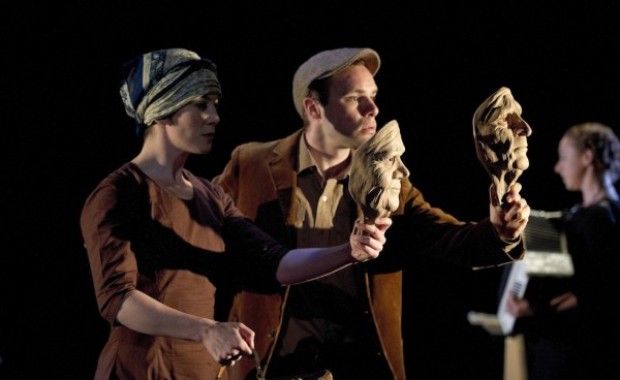
If you’ll forgive the cliché, sometimes less really can be more, as Theatre ad Infinitum prove with their delicate essay on love and loss. The plot is simple, the production accomplished through a blend of simplicity and ingenuity. The elderly male protagonist is coming to terms with the loss of his wife, still taking down two cups from the cupboard instead of one, rifling through suitcases brimming with memories; his wife’s ghost looks on, gently but firmly wrenching herself from his grieving grasp. This is all told, over an hour, with no words. Instead we have the sigh and hum of an accordion, the narrative precision of movement. In a beautifully judged touch, masks are inventively used to convey age, whipped away to transport the couple back to their youth and lightly hinting at the deceptive proximity of these two states.

Through a series of smoothly executed flashbacks, we are given a glimpse into this couple’s life together, from the moment they meet, through their small joys and disappointments, to the little tragedies that touch their existence and eventually wrench them apart. Into this moving story of the lives of one ordinary couple, Theatre ad Infinitum even manage to weave one of the most chillingly evocative visualisations of war and its traumatic psychological scars that I’ve seen on the stage. On real and dreamed battlefields, performer George Mann is pummelled by invisible blasts, painfully contorted, violently tossed about by nightmarish forces. Not all of Spielberg’s mud and gore can quite match it for emotional force.

Speaking of emotional force, while watching I couldn’t help thinking of Lovesong. While these may in many senses be two very different pieces of theatre, there are common elements that immediately leap out: the process of a man coming to terms with the idea of losing his wife, the centrality of physical movement, the melting of past into present. I found, however, that Translunar Paradise was more genuinely moving in its wordless simplicity than Lovesong was in all its none too subtle emotional manipulation. Sobbing is all very well (though not something I’m particularly susceptible to in the theatre, to my immense discomfort as everyone around me at the Lyric Hammersmith sniffed into their tissues) but an excess of tears can blur meaning beyond intelligibility.

While Lovesong sacrificed promising debates about the nature of time in favour of prodding at our tear ducts, here such underlying strands are given more nuanced exploration. Through what is, on the surface, an ordinary tale of two ordinary people, Theatre ad Infinitum delicately investigate the fluidity of time and, linked to this, memory. Form subtly reflects content; the flashbacks emerge as snapshots, flicked through with vivid energy. These elegantly choreographed scenes from the past rather appropriately have the stuttering quality of early film, jumping from action to action, meticulously wrought expression to expression. There is all the frenetic motion of memory and the seemingly speeded up time of youth.

After seeing this moving and beautifully assembled piece, however, I found myself thinking as much about how my impression of the performance had been refracted through my experience of speaking to creator Mann as I was thinking about the show itself. This is not to detract from Translunar Paradise in any way, but perhaps rather to detract from my own abilities and assumptions as a reviewer. As a result, this has morphed from a review into a not-quite-review with a bit of reflection on the distance between theatremakers and critics thrown into the mix.

This issue of distance was not something that had previously worried me. Yes, I sometimes review shows after writing features about those shows, but usually I still feel qualified to form an independent opinion; I don’t know the creators of the theatre well enough from one short interview to be swayed by any personal connection to them, and often there is much about the piece that still remains to be discovered even after discussing it. While it might have put a slightly different slant on those reviews, I hadn’t really thought about it in any great depth until recently.

Then the idea of ’embedded’ critics started getting thrown around. A good place to get started if you’re new to this discussion is Andrew Haydon’s blog, where he has written twice about the idea of embedded criticism, with Daniel Bye’s response making good follow up reading. Distilled down and somewhat simplified, embedded criticism denotes the deeper involvement of the critic in the piece of theatre they are writing about, be that a full immersion in the creative process or more of a surface paddle. There are lots of different ways in which this might function in practice, but the driving idea behind it is that being embedded in the process could provide illumination on both sides: critics bring their outside eye and in return gain insight into the process of making.

I’m not going to discuss embedded criticism and all its benefits and drawbacks here, partly because others have already done so fairly comprehensively and partly because I’m yet to fully make my mind up about it. I’m equally fascinated by, excited about and wary of the idea. Which brings me to the particular wariness I felt while watching Translunar Paradise. I think these concerns arose in relation to this particular production simply because Mann spoke in such eloquent detail about the process of meticulously piecing this show together. Through hearing about creative choices, I felt somehow involved in them, and the end product immediately prompted memories of the process that Mann described to get to this stage. As such, I was unsure whether I could trust my own critical perception of the piece and its effects.

There is always the danger, once you have been told what the intention is behind a certain creative decision, that as an audience member you will be unable to distinguish between whether this decision actually produces the desired effect or whether you are simply reading it in that way because you’ve already been instructed to. There are even occasions, such as I found with Headlong’s confused and frankly bizarre touring production of A Midsummer Night’s Dream last year, when explicit, laboured reasoning is required to explain a production’s concept, which seems something of a failure of the concept itself.

Aware of this danger, doubts insidiously imposed themselves on my reading of Translunar Paradise. Was this really an exercise in precision, or did I simply see precision because I knew about the lengthy creative process? Here I feel fairly confident that yes, Theatre ad Infinitum’s work was beautifully precise, but when it comes to other building blocks of the piece I am less certain. Would I have read quite so much into the choice of accordion accompaniment had Mann not spoken about the importance of an instrument that “breathes”? Would I have picked up on the influences of photography and graphic novels? How much would I have scrutinised the physical embodiment of age had Mann not admitted that it took him a lot of work to perfect the gait of an old man?

But for all my doubts, I also feel immensely grateful for the insight that I gained into the process that made this piece of work. Ultimately I found watching Translunar Paradise a hypnotically captivating experience, which I suspect was a mixture of the show itself and the tiny glimpse I had gained of its loving creation. I also hope that any insight provided by Mann’s words might enhance the experience for other audience members. It’s a lot like the magician and his illusions; magical as it might be to be tricked and dumbfounded, another part of the mind always wants to know how it works, to feel for the cracks. And sometimes being shown the process behind the illusion even makes the illusion itself all the more beguiling.

Image: Alex Brenner

How could technology change theatre criticism for good?

Originally written for The Guardian.

Discussions about the future of theatre criticism seem to be evergreen. It is a debate that continues to impassion bloggers, and one that arose again at the latest instalment of Devoted and Disgruntled back in February, in a session challenging the barrier traditionally erected between theatremakers and critics. One linked but relatively neglected aspect of the conversation, however, is how criticism might fully explore and exploit the growing possibilities allowed by digital developments.

When it comes to digital, I think we’re all still fumbling around in the dark. In the world of theatre comment, this has manifested itself in recurring, sometimes ugly debates between mainstream critics and the blogging community. But what if the technology at our disposal offers more than occasion for conflict? While words alone can create a rich tapestry of critical response, imagine how much richer this might be with the addition of images, video, audio, geotagging, experimental forms such as Pinterest – the list goes on. Despite having such options at their fingertips, the majority of those writing theatre criticism for the web remain trapped in the conventional print review format: a block of text that often tries to avoid spoilers. Myriad possibilities are there, but it seems we’re slow to adopt them.

This is not to dismiss all theatre writers as luddites. Some bloggers and critics are embracing the possibilities of digital criticism and experiments are beginning to take shape. Twitter, for instance, has opened up instant discussion, allowing theatregoers to share their thoughts from the moment they step out of the auditorium. Luke Murphy has taken the trend to another level by aggregating such reviews on one feed – an intriguing idea, but one arguably limited by the tweet’s inherent brevity.

Matt Trueman, meanwhile, played with structure in his clickable review of Constellations earlier in the year, an experiment that had its flaws but asked fascinating questions about how the form of theatre criticism might reflect the form of the theatre being critiqued. A rich and ever-increasing variety of digital formats offer the opportunity to go even further. Might we begin to see purely visual responses to theatre through platforms such as Pinterest, or more video responses along the lines of blogger Eve Nicol’s refreshingly enthusiastic YouTube reviews?

Beyond experimenting with form, and returning to the discussions initiated at Devoted and Disgruntled, the digital space even has the potential to set out a whole new model for how critics might engage with the theatre they write about. Theatre writers Jake Orr and Maddy Costa are beginning to do just this through the creation of Dialogue, an online playground where theatre makers, writers and spectators can open up new conversations. Thanks to the flexibility allowed by online criticism, where page space is not an issue and responses can go further than words, the role of the critic could in future go beyond reviewing to play a greater part in the space between theatre, creator and audience.

The possibilities raised by digital technology pose more questions than they answer, but these are questions that beg to be thrown open for wider debate. How might digital experimentation impact upon mainstream criticism? How can we play with form and structure to create the theatre criticism of the future? And, crucially, what implications does digital innovation have for the evolving role of the critic?

Photo: Julian Stratenschulte/EPA

Revisiting Three Kingdoms

Here we go again …

On Saturday, the final night of the run, I went back for a second viewing of Three Kingdoms. Drowning in superb but brain-frazzling criticism and starting to feel, much like Maddy Costa expresses in her wonderfully honest blog, uncertain which thoughts were my own and which I had accidentally borrowed from others, I needed to see it for myself again. I needed another hit of that visceral punch that can only be gained from the production itself (though Megan Vaughan evokes it pretty forcefully for anyone who wasn’t there).

And it was an ecstatic rollercoaster of an experience, even second time round – perhaps even more so second time round. I surrendered myself to the dream and awoke three hours later, dizzied and wondering where all that time had gone. I also realised how utterly stupid my first impressions of the production were and how much I had missed. There is simply so much going on, and a second viewing only compounded the feeling that it would be futile to attempt to write about the production as a whole. This conceded, I’m not going to make such an attempt, but there are a few points that I feel the need to return to.

Critical response – By now it’s fairly clear that, whether or not you believe Three Kingdoms will change the face of British theatre, it has had an extraordinary response. For me the past couple of weeks have been a brain-melting whirlwind, and I’m still not sure I’ve read everything out there on the internet about this show. I personally have never seen such an overwhelmingly vocal response or such a volume of responses to one show – and this is all despite a fairly dismissive attitude from (the majority of) the mainstream press. I can only echo Maddy in hoping that someone will find the time to collate everything that has been written in one space.

As a result, I feel that much of my own response to the show has been bounced off of what other people have said about it. Which isn’t necessarily a bad thing, as I find it valuable to test my own thoughts against those of others and continue to weigh up my reaction to a show for some time after, but it did make me begin to lose sight of what moved me to engage so much with this production in the first place. For that reason I feel as though a repeat viewing is vital, although even now the intervening hours since that second experience of the show have widened the gap once again between the thoughts that are purely my own and the thoughts that are responding to the opinions of others.

But I’m beginning to think that maybe this is what theatre is all about. I firmly believe that objectivity is a fallacy, because the way in which any of us view a piece of theatre is inevitably coloured by our own identity, experiences and opinions no matter how hard we try to discard these, and perhaps the truly individual response is much the same. Unless we are to view and critique a production in complete isolation, without access to any form of marketing material or even so much as the body language of the audience member sitting next to us, we are going to be influenced, however minutely, by those around us. I’m hardly the first to quote Tassos Stevens on this, but it seems appropriate and helpful to recruit his point here:

“The experience of an event begins for its audience when they first hear about it and only finishes when they stop thinking and talking about it.”

Within this extended experience, as Stevens sees it (and I happen to think he’s hit the nail on the head), there are lots of other voices involved. The marketing material that alerts you to the production, the feature or interview you might read in the paper before going to see it, the programme notes, the background buzz of the theatre bar, the conversation with your friend in the interval. No critic can be completely impervious to this trickle of outside influence.

As long as we do not find our own opinions indistinguishably mingled with those around us, which I have felt is a real danger for me with Three Kingdoms, I’m not sure there’s anything particularly wrong with taking on board the opinions of others. Engaging in dialogue afterwards is fast becoming one of my favourite parts of the theatrical experience and I frequently find myself refreshingly challenged by hearing or reading the responses of others. While I sadly don’t have the time or, quite frankly, the mental capacity to respond to everything else that has been written about Three Kingdoms, I can only jump for joy that so much has been written and that so many people are having these conversations. This is, of course, where online criticism comes into its own.

Text and production – Coming back to the production itself after veering off on that slight tangent, I’m still intrigued by this question of how Three Kingdoms has been pieced together. If you can get your hands on a copy of the playtext (which might be difficult as I nabbed the Lyric’s last one on Saturday night – sorry!) then I would strongly recommend taking a look at it. I’ve yet to read it cover to cover, but a cursory skim is enough to establish that this is a world away from the final production. As well as making it clearer which elements have emerged from the collaborative process with Nübling and the rest of the creative team, it has also made me think a lot about the relationship between text and production and playwright and director.

There are many, many differences between the original text and the final production it has morphed into, but two jump out. Firstly, reading the playtext reveals that Ignatius was originally conceived as a bilingual character, a fact that was only changed to adapt to a casting alteration during rehearsals. I was surprised by this, because Ignatius’ deep sense of linguistic disconnection and cultural disorientation felt absolutely vital to the final production; as an audience, we too are enveloped in the surreal sense of dislocation that he experiences. It would not be the same play without it. Which raises questions about the value we put on deliberate design versus happy accident or fruitful experimentation. Is a play ever really finished until it reaches the stage? (Going further, we might ask if it is ever finished even then.)

Secondly, another integral element of the production does not appear in the written script at all. Here I’m talking about the character listed as ‘The Trickster’, the strange, ethereal, white-clothed figure who lopes on and off stage with his microphone and leaps athletically through windows. Stephens writes in the introduction to the playtext that this character, created by Nübling, was inspired by a figure from European myth who “takes many guises and is able to release the subconscious of those he meets and the underbelly of his world”, a description that fits perfectly with his elusive role in the production. While he may seem incidental to the plot itself, he is central to the way in which we understand it and provides a striking demonstration of how script and production are melted together.

But perhaps it is a false division to keep talking about script and production as though they were two divorced entities. Yes, there exists a playtext version of Three Kingdoms that Stephens sat down and wrote and that we can now read, but it was never intended to be performed in this incarnation. It is misleading to talk about Nübling’s treatment in the same way in which we might describe a radical reinterpretation of a classic text by a maverick director, because Stephens wrote this play for Nübling. As Dan Rebellato so effectively hammers home, this was not the director poaching the text of the writer and running amok; Stephens deliberately left room for the direction and actively collaborated in the rehearsal room process. So really, there is nothing but the production.

Structure – One thing that leapt out and slapped me on the face second time round – apart from the production’s extraordinary visuals – was the overarching structure of the piece. It made me wonder how I could have missed so much of it initially (I’m inclined to blame all the deer heads, strap-ons and full-frontal nudity, which have the tendency to be a little distracting). It also made me doubly frustrated at all the mainstream reviews that point to the piece’s meandering self-indulgence, as beneath all the deer heads, strap-ons and naked actors there is a carefully planned play full of eerie symmetries and striking symbolism, from which all of those supposedly self-indulgent elements essentially spring.

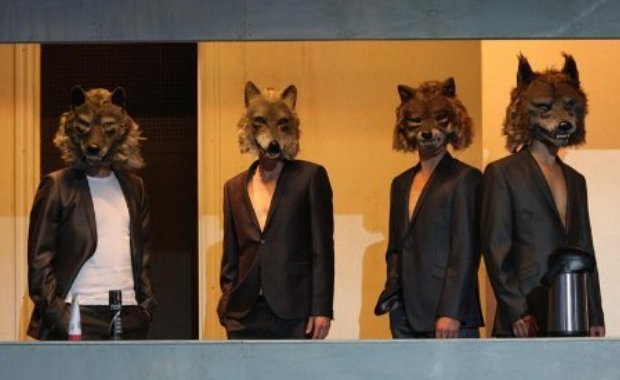
I could go into all of this in detail, but Matt Trueman has beaten me to it, comprehensively and analytically picking apart the structure and the symbolic use of deer, wolves and grass. It is (duh!) the food chain, the cycle of life. The idea that “shit doesn’t go away”, graphically illustrated by the faeces smeared on the set, also slots into this natural, cyclical structure and resonates powerfully with the issues that Three Kingdoms is grappling with. We go through every stage of the cycle and cannot escape it, thus being, as I spoke about before, somehow complicit in the sex-trafficking trade being shown on stage. We are all a part of the system in which this trade operates. It is about demand and supply, with sex becoming a commodity that has a demand as stable and constant as that for food and water. As one of the Estonian gang puts it, “the real advantage in our market is that demand is always, has always been and will always be stable”.

One severely neglected area in my previous write-up was the play’s massive inherent criticism of capitalism and market economics, which I touched upon only in relation to the discussion of the market that takes place during the first scene in Estonia. This was mainly because my mind was taken up by other thoughts at that point, but I feel it should at least be mentioned if not fully unpacked. Because this is what is really at the rotting heart of this tale. The industries of pornography and sex-trafficking that are depicted here are symptomatic of a larger problem, facilitated by a world that is dictated by market forces; again, demand and supply.

By watching one of the pornographic films in which the murdered Vera appeared, the two detectives become not only complicit in the abuse of women (more on this below) but also in the commercial circuit that has allowed this industry to thrive in the first place, a cycle reflected by the cyclical nature of the food chain. And then of course the play is also cyclical, with the interrogation of Ignatius by the Estonian police at the end mirroring the opening interrogation of Tommy – this was clear first time around, but the symmetries are even more resonant than I had initially realised. Three Kingdoms is nothing as tidy as a circle, but it does loop back around in a shape that, going back to mirrors, seems to perfectly reflect the content.

Women – This is the biggie. First of all, I’m using the word women and not misogyny because, despite this being raised by a number of separate individuals in relation to Three Kingdoms, misogyny is not a word I ever used myself and I tend to lean towards Andrew Haydon in thinking that this word has a nasty way of closing down discussion, or at least making it difficult to respond. Also, despite the concerns I raised in my initial write-up, I would certainly not want to make the accusation that anyone involved in this production comes from a misogynistic standpoint, because in fact I believe that the opposite is the case.

Even so, this has been one of the most emotive and pressing issues to crop up around the production. Perhaps the most upsetting blog I’ve read on the matter was Sarah Punshon’s, which articulates a very personal reaction to the violence against women that is depicted throughout Three Kingdoms and subsequently made me question my own experience of the play. Yes, I was troubled and felt the need to raise such concerns when writing about the production, but this was more retrospective than anything. Only on reflection did the majority of my worries rise to the surface, and this was in any case influenced by the conversation that I had already read on Twitter between Chris Goode and Stella Duffy. While watching the play itself, a few grating moments aside, I was mostly swept along in the thrill of the production. Where this places me as a woman and a feminist I’m not sure.

So where to begin when addressing the question of how women are portrayed in Three Kingdoms? Firstly, I think we have to accept that some level of violence against women is inevitable when tackling subject matter such as that presented here. To attempt to deal with sex-trafficking without exposing the abuse at its core would be just as much of a betrayal, if not more than, portraying the victims on stage. Diagnosis, after all, is the first step towards cure. Whether or not it has to be portrayed quite in the way it is here is another question, although the violence is nowhere near as gratuitous as it might have been. This production wisely chooses to leave the majority of the brutality to our imaginations, and it is easy to forget amongst all the concern being expressed that we see far worse on our television screens nightly.

I was initially disappointed that we see so little from the perspective of the women upon whom the sex-trafficking trade being depicted most impacts, but now I am less sure how this would fit into the production that Stephens, Nübling et al have crafted. Although it precludes the possibility of a more even gender balance in the cast (that is if we accept that casting must be done along gender lines, which is a whole other question in itself and one that is particularly interesting in relation to a play in which a male actor at one point takes on the role of a female prostitute), it feels vital to the production that this is a male dominated environment. If one or both of the detectives investigating the case had been female it would be a very different play and perhaps a less powerful one; grubby complicity takes on a big role here.

In dealing with this question, on whatever very basic level on which I am able to do that, I’m aware that I owe a response to Chris Goode, who commented on my original write-up as well as on Andrew Haydon’s blog. If I’m honest, I’m still grappling with his distinction between showing and making in theatre. Do we see theatre as simply depicting a situation or do we take that a step further and accept that theatre is also making that situation? This also goes another step further to what we think theatre is essentially for; is it there to hold up the mirror to life, as Hamlet would have it – to show us the state of things as they are – or to offer an alternative? Theatre can be powerful as a tool for exposing disgusting and unjust situations and making us feel that injustice, but if we’re already aware of those situations then what is the function of a further depiction? I’m asking a lot of questions, because I really don’t know.

Separately but related, Chris also suggested the need for a moratorium on the use of the word “exploring”, in response to marketing material that described Three Kingdoms as “exploring human-trafficking”. It all comes back to the idea I touched on previously about the precision of language, something that I sense Stephens is particularly attuned to in his writing. Exploring can mean a lot and suggests something fairly extensive, while it is questionable to what extent any work can fully “explore” the subject matter presented here. Words such as this are dangerous and I wonder if this is tangled up with the problem (if, that is, we perceive it as a problem) of the representation of women. Seen as an all-encompassing “exploration” of sex-trafficking, Three Kingdoms clearly falls short by denying the women involved a voice. If we view it more precisely as pulling apart the driving market forces and male complicity behind this disgusting trade, it seems a lot more successful.

In this argument I’m neglecting the many aspects of Nübling’s direction that confuse gender and representation further. Men frequently play women (although, as others have asked, why not vice versa?); a male corpse provides the backdrop for the scene in which Vera’s decapitation is graphically described; red herrings are dropped left, right and centre. I’ve also failed to mention that, though they might be outnumbered by men, there were of course women involved in the creation of this production. To simplify it all to the extent to which I am in part guilty of seems to be missing the point somewhat. Nothing in Three Kingdoms is simple, as my aching, slowly unravelling brain can attest to.

Despite the time I’ve given to the above, which is something I feel I should address as it’s become such a big issue and my earlier write-up was pointed to by others in relation to this issue, I worry that it is a reductive argument. This is undeniably an important element of the production and one that deserves our consideration, but not above and beyond everything else that’s going on in Three Kingdoms. It seems deeply unfair to everyone involved that this is what has grabbed arguably the most attention when, as I’ve said before, there is so much going on here. I only wish I had time to address it all in the detail it deserves, although I suspect that would require a book (or several).

[note: since writing the above, Exeunt have produced a much more thorough and intelligent discussion about the gender politics at play in Three Kingdoms, which I’d recommend anyone interested in this issue to have a read of]

~

I realise that this has mostly been a lengthy, meandering failure to articulate and work through thoughts that have been troubling me for the past few days, and that I have no solid answers. All I can say is that certainty is overrated. But I hope it’s clear that Three Kingdoms has got me thinking, thinking harder than I have in a long time, and it’s got plenty of others thinking too. If there is one thing to be certain about, it’s that this is not the end. If this production leaves no other legacy, which is hopefully not the case, it will at least have set a lot of minds into motion. And that alone seems worth celebrating.


Wasted, Roundhouse

Originally written for Exeunt.

If nostalgia is a disease, then poet and rapper Kate Tempest’s explosive debut play is a startling reminder of just how sick we all are. This bitterly funny snapshot of modern life takes as its subject a lost young generation already busy reliving a past when they used to feel something, haunted by untouched dreams and paralysed by indecision. As one character puts it, “we spend life retelling life”.

Ennui plagued twenty-somethings Ted, Danny and Charlotte are marking the tenth anniversary of the death of their friend Tony, to whom they each confess their fears, frustrations and limitations in a series of lyrical monologues. Everyman Ted, played with a groan of recognition by Cary Crankson, is trapped in a tedious, nausea-inducing office job and a comfortable but unexciting relationship. His best friend Danny, a swaggering yet emotionally delicate Ashley George, is his arty antithesis, the eternal dreamer lazily intent on being a rockstar and winning back Lizzy Watts’ frustrated teacher Charlotte. Each is like a fragment of an old friend, the familiar melded with the idiosyncratic.

Much is familiar in Tempest’s evocative ode to modern London, a concrete playground where the routine is as grey as the pavement and streetlamps blink down instead of stars. In the richly textured, quick-fire speech, shot through with distinctive rap-inflected rhythms, the poetic is often found in the pedestrian. The profound and the mundane are never more than a hair’s width apart, as the three characters question over the course of 24 hours whether happiness lies in chasing youthful dreams or in dull yet companionable trips to Ikea. There is a refreshing honesty to Tempest’s earthy writing, which intelligently recognises the penetrating human truths that can be found in ordinary experience. The resulting vision of life’s inevitable disappointments, sharply funny as it often is, hits close and hard.

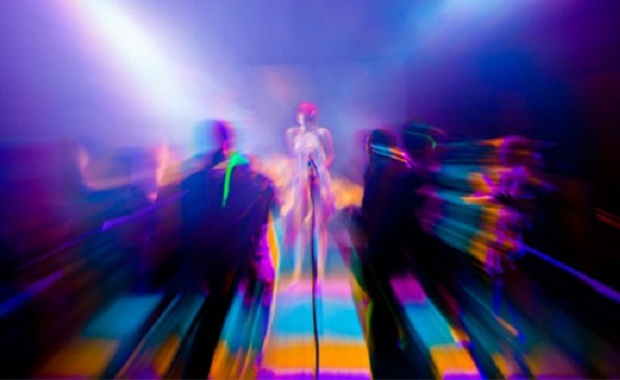
Tempest’s persuasive collision of realism and spoken word gig is given punchily paced direction by James Grieve, who with the excellent performers has tapped into a rhythm that rarely falters. Transporting us to the clubs where Londoners drink to escape, Cai Dyfan’s simple yet striking design is all speakers and boom boxes, redolent of the constant noise that plays over empty lives and that pulses powerfully through the Roundhouse courtesy of Kwake Bass’ soundtrack. In another clever touch, close-up film projections of the actors’ blank expressions accompany their fevered monologues, a reminder of the repetitive boredom that they are desperate to break out of.

While this lean, muscular creation could do with some fleshing out, Tempest’s first foray into theatre is an undoubtedly impressive one. Her words paint a vivid, pulsing mural of a city writhing with its own restlessness and discontent, yet straitjacketed by a numbing sense of inertia. Her broken characters, hands wrapped protectively round microphones, warn us upfront that there will be no incredible truth, no deeper meaning in what they are about to relate. Instead the truth they reveal is all too credible.