Tom Attenborough

Tom-Attenboroughfi

Originally written for Exeunt.

Coming from a showbiz family, for all its downsides, certainly has the odd advantage. While Tom Attenborough, son of Almeida Theatre artistic director Michael and grandson of Richard, backs away from assumptions that directing was a natural career path for him, he does admit, “I was very much exposed to theatre when I was younger”.

The young director, runner-up for the JMK Award in 2011, describes going to the theatre a “huge amount” when he was growing up and remembers theatre being spoken about frequently at home, an influence that has undoubtedly shaped him. But he is also keen to emphasise that “theatre was always very much something that I felt I was passionate about”. Musing about the beginnings of his career, he says, “I sort of fell into it and I don’t know how much was my upbringing and how much was just me and my personal preferences”.

As we discuss this passion for theatre, it emerges that Attenborough’s love affair with the art form was also ignited by the National Theatre’s production of Mourning Becomes Electra, directed by Howard Davies, who he describes as one of his heroes. “It completely changed my life,” he says, without a hint of exaggeration. “It just moved me and affected me so much, even at a young age. I was astonished by the power of theatre as a social event and how it could change hundreds of people in one event.”

Attenborough originally wanted to be an actor, but he reveals that university prompted the “gradual realisation” that he was not good enough to pursue acting as a career. Cambridge, however, was also where he discovered his love of directing when a friend wrote a short play and asked him to direct it. He explains that it was while working on this student production that he realised “there was nothing else that I enjoyed as much or felt as passionate about”.

Since leaving university, Attenborough’s early career has been peppered with assistant directing credits, several of them on large productions. What have these experiences taught him? “Assisting has been where I’ve learnt a lot of my craft,” he tells me, going on to talk about the learning experience of touring with Headlong’s Earthquakes in Londonand his introduction to the West End while working on Butley. “Just watching and working with different directors, different actors, different companies has taught me a huge amount.”

Another learning experience for Attenborough has been the discovery of how difficult it is to stand out as a new, young director. It was this difficulty, he explains, which indirectly led him to set up his theatre company Rhapsody of Words when he wanted to put on Neil LaBute’s play The Shape of Things. “The difficulty was that it had been done before,” he says, “and I didn’t just want to do another run of the mill production.” Attenborough’s solution was to stage the play in the unusual space of The Gallery Soho.

“I started to think about the role of space in theatre today and how we approach it,” he goes on to say. “It’s interesting that a lot of the most successful theatres in London at the moment are in buildings that weren’t initially built as theatres, the Donmar Warehouse being a prime example. Through thinking about that, I wanted to explore a type of theatre that isn’t necessarily site-specific and doesn’t have to integrate the space into the show, but where the space informs the play and makes the audience see it in a new light.”

Venue is also central to Attenborough’s current project, a revival of Conor McPherson’s play Port Authority staged in the Southwark Playhouse’s Vault space. “The amazing thing about the Vault is that it’s so atmospheric,” Attenborough explains. “You walk in there and you can feel the hairs on the back of your neck stand up.” For this very reason, he is keen to let the space speak for itself and is being careful not to do too much to the already evocative setting. This minimalist approach is one that feels appropriate for Port Authority, an intertwined narrative of three monologues that Attenborough loves for “its simplicity and its humanity”.

I suggest that perhaps directing a play that consists purely of monologues is a challenge, a question that provokes a divided response from Attenborough. “It’s easier in some ways in the sense that I don’t have to worry about things like blocking and staging,” he says, “but in another way it’s very difficult because you don’t have actors feeding off each other. I think it has its challenges. It’s about cracking the technique behind the monologue and how to make it as interesting and dramatic and engaging as possible. Once you’ve found that attitude, it’s just about making sure that the story is as clear and as exciting as possible, which is what I do in any show.”

Although projects like Butley and Earthquakes in London are clearly career highlights, along with Rhapsody of Words’ production of The Shape of Things, Attenborough struggles to name a favourite directing project to date. “I’ve enjoyed every job I’ve done in different ways,” he enthuses, and you cannot help but believe him. He also has plenty more to look forward to this year, including directing a new play by emerging playwright Rob Hayes at the Trafalgar Studios in April. But what are his goals for the long term?

Unsurprisingly, I am not the first person to want to know where Attenborough sees his career heading. “It’s a question that you get asked a lot as a young director,” he laughs. Although he says that he is primarily attracted to work that “excites” him, Attenborough does admit that he would eventually like to rise through the ranks to the position of artistic director. “One day I’d love to be part of a building and possibly even run a building,” he tells me. “I’d love to experience how that side of theatre works.”

It is clear from these aspirations that Attenborough is not lacking in ambition. His overriding aim, however, is one of creative satisfaction rather than prestigious status, concluding on the same upbeat note that has prevailed throughout our chat. “As long as I’m doing plays that I really care about in places that I care about with fantastic and talented people, I’m sure I’ll be happy.”
The woman’s part: is single-sex casting sexist?

Originally written for The Guardian.

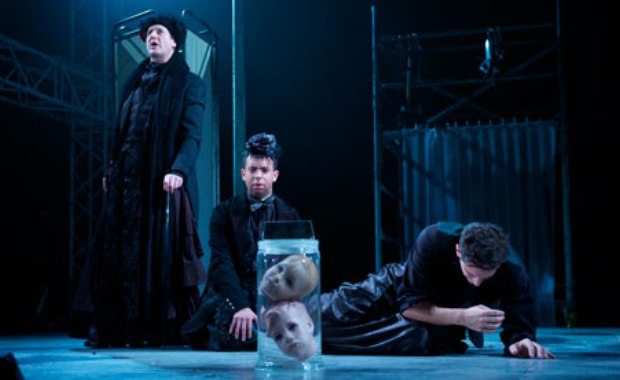
At a performance before Christmas of Propeller’s Henry V – not the funniest of Shakespeare’s works – theatregoers, including myself, were in stitches. The source of our mirth was the scene in which the French princess Katherine and her maidservant attempt to polish their English – a good old-fashioned language gag. But the riotous laughter owed less, I suspect, to the script than to the fact that Katherine had a five o’clock shadow.

Men on stage in dresses, it would seem, hold an eternal fascination. The pantomime dame has become as quintessentially festive as mince pies and tinsel, cross-dressing comedians can raise a belly laugh without even opening their mouths, and all-male casting exercises continue to tickle, intrigue and divide audiences.

Propeller’s decision to be an all-boys’ club has, of course, good historical precedent. Shakespeare wrote with male actors in mind, a fact that becomes relevant to the playful gender games initiated when women disguise themselves as men.

There is, of course, one major drawback to putting men in corsets, even in Shakespeare. As pointed out by Jo Caird in a blog for What’s On Stage, all-male casting filches some of the few great roles written for women. Citing the “chronic under-representation of women on the British stage”, she considers Propeller’s casting policy to be unjustifiable, an argument that carries a lot of clout.

It is difficult to imagine, however, similar objections being raised against exclusively female casts. All-female casting has become almost as common a practice as its male counterpart and is often credited with producing illuminating re-examinations of gender. Just think of Theatre Delicatessen’s exploration of the ways women contort themselves into prescribed roles in their all-female interpretation of A Doll’s House, or the Globe’s experiment a few years back in balancing its all-male productions with The Taming of the Shrew and Richard III performed by casts consisting solely of women.

But if all-female productions can be hailed as delving deep into the tangled gender politics of classic texts, surely the same can be argued of any cross-dressing production. Whether conceived as radical re-interpretation or mere giggle-inducing gimmick, I can’t help but feel that any production that makes a decision so extreme is inherently playing with gender, even if that’s not the primary purpose.

If nothing else, this technique is oddly alienating. In Propeller’s bloody take on Richard III, director Edward Hall and his cast made few concessions to femininity, with not a wig in sight and female attire that was cursory at best. The production’s hulking men in skirts consequently provoked an almost Brechtian jolt, roughly picking up the audience and putting them back down at one remove from the scenes on stage.

By making the familiar unfamiliar and levelling gender differences, single-sex casting can make us look afresh at plays that have become an accepted part of our cultural fabric. This allows audiences to reassess not only the gender relations in these classics, but also the ways in which men and women still treat one another in today’s society.

With Mark Rylance preparing once again to don his petticoats as Olivia in the Globe’s production of Twelfth Night, the theatrical gender-bending shows no sign of waning. It might not always be entirely fair, but single-sex casting remains one of the most effective ways of opening up the gender politics debate in classic plays. Perhaps it’s necessary to be exclusive in order to call for a more inclusive society?

Photo: Manuel Harlan

Lovesong, Lyric Hammersmith

The past may be a foreign country, but we sure like travelling there. In the latest production from Frantic Assembly, past and present share the stage in a tender tearjerker about love, time and memory.

The story itself is seductively simple. An old married couple, Billy and Maggie, are nearing the end of their time together as Maggie’s health steadily deteriorates. Meanwhile they are consumed by the shadows of their younger selves that dance – quite literally – through their home. Through these memories, we are introduced to the couple at the beginning of their marriage, following them from honeymoon glow to the appearance of the first cracks in their relationship. We learn that they have emigrated together to the States, where Billy sets up a dentistry practice and they wait for children that stubbornly refuse to come.

By intertwining the lives of this couple at different ages, playwright Abi Morgan (the prolific writer-of-the moment behind The Hour and The Iron Lady among others) is able to give us a fairly comprehensive picture of their marriage. This is no idyllic portrait of perfect love; we see Billy and Maggie bicker and fight, we experience their frustration at their childlessness and witness them both momentarily waver when faced with the temptation of adultery. But we also see how, in old age, they have come to rely on one another in a marriage that has ultimately survived through the years.

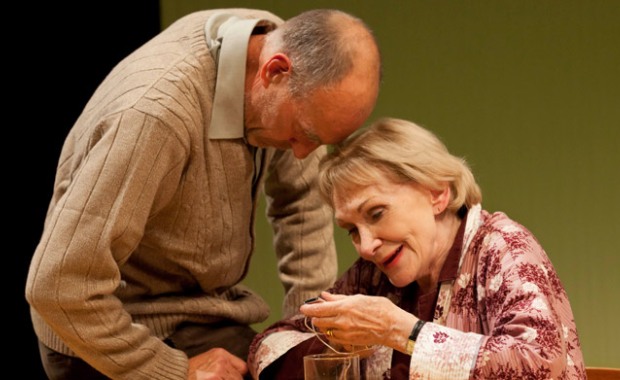
Morgan’s script is brought beautifully and captivatingly to the stage by Frantic Assembly, who unite evocative movement with stunning sound and design. Under the direction of Scott Graham and Steven Hoggett, Billy and Maggie’s past and present selves collide, embrace, dance and separate, all to Carolyn Downing’s moving soundtrack. In one standout moment, the present-day Maggie, heartbreakingly played by Siân Phillips, tries on a treasured pair of shoes from her youth and stumbles through the house. The emotional effect is little short of devastating.

There is no doubt about it, this is meant to make us cry. Frantic Assembly’s production, helped along by an outstanding cast, is unapologetically manipulative, working on our collective tear-ducts with nimble, tender touches until the audience is reduced to a symphony of sniffles. Morgan has cannily tapped into fears that assail us all; we weep not just for Billy and Maggie, but for the inevitability of our own demise and that of our loved ones. Yet, for all that it tugs delicately on the emotions, I can’t help but wish that Lovesong was a little less insistent on leaving its spectators damp-faced.

When not pulling mercilessly at the heartstrings, Lovesong raises some fascinating questions. Far from being merely a eulogy on a love story that is at its imminent end, Morgan’s play prods at some of the deeper concerns that ripple through our existence. How, for instance, do we create our own legacy? As Billy contemplates the end, the optimism of his youth all faded, the only marker of his life seems likely to be his perfectly maintained set of gnashers. The young Maggie’s imagination, meanwhile, is captured by the cave drawings left behind by early humans – drawings that she and Billy later run their hands over together, imprinting these pre-historic images with the story of their own love.

But by far the most intriguing theme to thread through Billy and Maggie’s story is that of time and its linearity or otherwise. The intersection of past and present, while primarily redolent of the potency of memory, asks inherent questions about our conception of time, questions that arise again when Billy introduces different theories of time. Are our lives really lived along a straight line, or is time far more complex than we could imagine? These are ideas that, mirroring Graham and Hoggett’s haunting choreography, are repeatedly caressed and skimmed over, but that this production ultimately loses grasp of.

There is no shame in a piece of theatre about love and death – two of life’s few universal certainties – and especially a piece of theatre that handles these themes as deftly as Lovesong does. Tears, however, have an unfortunate tendency to blur the vision, obscuring the lighter nuances of what Morgan is saying. Exquisitely moving though it may be, in the wake of this strong tide of emotion emerges a yearning for something slightly more clear-sighted.

Lovesong runs at Lyric Hammersmith until 4 February.

Image: Johan Persson

Faction Theatre Company

Faction-Robbers-Richard-Davenport

Originally written for Exeunt.

“The text always comes first.” These emphatic words from artistic director Mark Leipacher might well serve as a creative philosophy for the text-focused Faction Theatre Company. As we chat in one of the rehearsal rooms at the labyrinthine Bridewell Theatre, where the company are poring over Mary Stuart downstairs, I am told that every read-through is conducted “as if we hadn’t read the play before”.

The Faction is an ensemble-based theatre company dedicated to interpreting classic plays, producing their own brand of “big, classical, epic theatre”. When we meet, the company are in the middle of intense rehearsals for their upcoming rep season at the New Diorama Theatre, an ambitious rolling programme of three plays, all incorporating the same cast of ten actors.

Leipacher and executive producer Kate Sawyer recognise that this traditional rep system is one that has largely fallen out of use in the UK. Their artistic inspiration instead comes from across the Channel; they aim to eventually run like a European theatre company, with a permanent ensemble, a home venue and a rolling repertoire of plays. Mounting their first full rep season in January and February is a decisive step in that direction.

“Rather than it being confusing, it actually clarifies things,” replies Sawyer when I ask her about the challenges of rep theatre. She compares the process to writing a university dissertation at the same time as studying additional courses, explaining that the plays all inform one another. Sawyer also believes that a rep season, as well as being more financially sustainable, provides more interest for the audience.

The trio of plays that Faction have chosen to perform in rep – Shakespeare’s Twelfth Night, Schiller’s Mary Stuart and Strindberg’s Miss Julie – are linked by the theme of ‘women and power’ and all three, as Sawyer puts it, “refract each other”. Leipacher explains that while the thematic connection was “not entirely by accident”, the individual plays were selected first before it became clear that there was a gender political thread running through them.

If there is any other key defining element of Faction’s work, other than their attention to classical texts and their revival of the rep system, it is its distinctly physical style. Style, however, is never imposed at the expense of text. “Our style is physical and muscular and very bombastic,” says Leipacher, “but it always comes from the text. This is not a physical theatre piece inspired by a text; this is a production of a text and the aesthetic happens to be physical”.

At a time when there is an increasing focus on new writing, I ask Leipacher and Sawyer what so attracts them to classic texts. The reply is instant and decisive: “there is no better material,” states Leipacher. “If you want a theatrical experience, you need material that has real substance and grit and scope,” he continues. “These texts are still human; they still have universal truths in them.” Sawyer adds that “it might have been written 400 years ago, but it absolutely describes what you went through last week”.

One classic playwright who has had a particular influence on Faction is Schiller, a writer whose work is often neglected in this country. Hoping to turn this around, the company have decided to produce his complete dramatic works, culminating in the first ever London production of William Tell. The aim is to reinvent the public opinion of Schiller’s drama.

“It’s pure guts and passion,” enthuses Sawyer, contradicting the popular opinion of German classics as being heavy and dull. Leipacher goes on to explain that “all of those words that we use to describe our work and everything that excites us about our work, Schiller has those in spades. His characters are impulsive, willful creatures.”

The impression given by Faction, and one that turns out to be overwhelmingly true, is primarily of a hard-working company. There are few other theatre companies that would take on a challenge like the complete Schiller with such tenacity, but hard graft has been something of a philosophy for Faction from the beginning. They have not stopped working since their conception, regularly performing one production while preparing for the next – as Leipacher laughs, “we literally didn’t stop!”

This hard work has recently seen their efforts recognised with the Peter Brook Equity Ensemble Award. Although Faction say that it is too early to measure the real difference that winning this accolade will make to them as a company, Leipacher is quick to admit that “having some sort of marker or validation becomes important” when trying to stand out among the plethora of other young companies.

They attribute a measure of their success, however, to the support they have received, particularly from the New Diorama Theatre. This young theatre in the heart of London has provided a space exclusively for emerging theatre companies of the likes of Faction, who are now an associate company. Leipacher firmly states that “we certainly wouldn’t be at the stage we are at now without their support”.

The creative atmosphere at the New Diorama, I am told, is freeing yet supportive. “They really do enable,” says Leipacher, “it’s not just a case of ‘here’s the auditorium, bye’, they’re with you beyond that”. David Byrne, the theatre’s artistic director, is full of enthusiasm for the company, describing their work as having a “raw, young energy” and explaining that “they’re really dedicated to making sure they do it properly”.

Doing it properly is a concern that seems to be at the centre of Faction’s creative approach. For their next rep season, the company are already asking their audiences what they would like to see, using this input to help them provide what theatregoers are looking for.

As we wrap up our chat, I ask if the company has any tips for other young theatre companies who are just starting out. Leipacher’s response is simple: “just keep working”. After all, it’s a tactic that seems to be working out for Faction.

Photo: Richard Davenport

Matthew Dunster

ImageHandler

Originally written for IdeasTap.

Director, playwright and actor Matthew Dunster is best known as the director of Bruntwood Playwriting Competition winner Mogadishu, the National Theatre’s Love the Sinner and The Globe’s Doctor Faustus, and he is currently directing The Maddening Rain (pictured below) at Soho Theatre. He talks to Catherine Love about juggling disciplines and how he fell in love with theatre…

When did you decide you wanted to work in theatre?

I think I knew from the moment I got on stage – I know it sounds a bit romantic. I was always in and out of trouble for one thing or another when I was at school and it actually got quite messy. Then a very clever teacher asked me to be in Kes and I got to play the bully, so I didn’t feel too exposed. I just remember looking down at my foot when I was on stage one night, I was looking down and sort of twisting my foot on the stage, and all the other kids were just stood still. Then I thought, “I’m good at this”. That was it really, that moment. I just wanted to do it because I thought I’d found something that I was good at.

You’re known for acting and writing as well as for directing. Which came first?

I suppose the acting – I trained as an actor – but I’d always written little bits of plays when I was at school and college. Actually, when I was at college I wrote a play and entered it for a competition at Contact Theatre in Manchester. It won and the prize was a professional production, so my first proper gig was as a writer, but I really came out of college as an actor and that was what I pursued.

I try, as much as I can afford to, to go where the most interesting work is. It’s like the three disciplines are runners on a track and different runners are ahead at different times.

How do you think that the three different disciplines feed into one another?

I particularly hope that the experience of directing might make me a better actor. I’m constantly asking my actors to be simple and do less, not to overcomplicate things, so the few times that I’ve acted over the last few years I hope that I’ve simplified my approach to acting.

Do you direct your own plays?

I’ve got a show of mine on at the Almeida which I’m not going to direct, so that’s going to be really interesting for me. I had to get my confidence back as a writer before I felt that I could pass my plays over to other directors. I used to prefer directing my own work, but I think that when you’re writing for yourself you’re a little bit careful. It’s hard to know if you take risks and if you’ve got the objectivity to keep an eye on it and make sure it doesn’t get out of hand. The play I’ve written for the Almeida, Children’s Children, is the biggest and most unwieldy play and certainly the most political play that I’ve written, so it was important that I got somebody else to make sure it’s guided home safely.

Your latest show, The Maddening Rain, comments on the recent banking crisis. How important do you think it is for theatre to respond to current events?

I don’t think it’s crucial, but I think that it always happens. Whenever you’re working on a play, you always feel there’s something in it that reflects what’s going on in our current world. But there’s an added value with this play in that it sets out to take on a subject that is right at the forefront of all our discussions at the moment.

Do you have any tips for aspiring directors, actors and writers?

I would just say do all three and be a doer. Try to find a way of making sure you’re always doing, because a lot of writers, actors and directors spend the majority of their time in a state of unemployment. It’s so hard to crack it, but the only way to get good is to just keep doing it.