Hard Work? Not I

The following owes a huge debt to Stewart Pringle, who got me turning a lot of this around in my head after a fascinating conversation in the Royal Court bar. It’s also influenced by some of my dim memories of the thinking in Nick Ridout’s fantastic book Stage Fright, Animals and Other Theatrical Problems and the tiny bit I’ve so far read of Passionate Amateurs, which will no doubt add more thoughts to the mix …

Not-I1-600x390

If there’s one thing we all know about Beckett, it’s that it’s hard. Hard for its would-be scholars (as I quickly learned at university), hard for actors, hard for directors held to the strictures of the dead playwright and his famously inflexible estate. We as audience members are encouraged to look upon Beckett’s work as difficult, serious art, while for performers it is a daunting but defining challenge. Apparently, for all involved, it’s hard work.

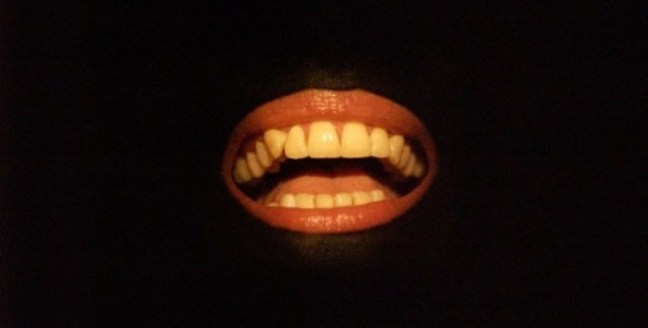
This is certainly the impression that has been generated by the marketing and media coverage heralding the Royal Court’s latest Beckett offering, a trilogy of short plays headlined by breakneck monologue Not I. In a piece for the Guardian, performer Lisa Dwan insists “There is not a single aspect of Not I that isn’t difficult”; a short behind-the-scenes feature on BBC News (see below) is almost exclusively focused on the physically strenuous nature of the performance; headlines have all zoomed in on Dwan’s record time (an admittedly remarkable sub-nine minute verbal sprint); and even the show’s poster frames the performance as an ordeal, with Dwan’s eyes seeming to appeal to us from above the black make-up surrounding that all-important mouth.

http://www.youtube.com/watch?v=-pWQyocKvrg

And yes, the experience of becoming Mouth – the body part that must appear suspended in darkness above the stage for the short length of Not I – sounds fairly horrific. As Dwan describes for both the Guardian and the BBC, the performance requires her to be strapped into a contraption mounted on a high platform, with her eyes and ears covered for the duration. Then there’s the text itself, which loops, jumps and scratches like a record, its frenzied repetitions and rapid stream-of-consciousness construction offering no footholds for the memory. Pair that with the demanded speed and Beckett’s strict instructions for its delivery, and Not I reads like a nigh on impossible feat; it’s not surprising to learn that Billie Whitelaw originally described it as “unplayable”. The role of Mouth might sometimes be described as “the female Hamlet”, but no one is listening to “to be or not to be” with a stopwatch in hand.

All of this emphasis on the “how” of Not I is both striking and slightly paradoxical. Theatre tends to be notable for the erasure of its own work; we are invited to partake in illusions, to forget the labour that has produced what we witness on stage. There are, of course, exceptions to this, but more often than not we view theatre as a place of leisure rather than one of work. It’s strange, then, that the work of producing Not I is what has dominated the discourse around it. And not just the strain of the labour involved, but the mechanics of the illusion – pulling back the magician’s veil to reveal how it’s all done.

In some ways, arguably, this unveiling is appropriate. In his review of Not I, Stewart Pringle suggests that “Dwan’s achievement in delivering such a diamond-dense performance is to shave away a little more of the actor, of the polluting falsity of the theatre”. Beckett’s classic note was “don’t act”, demonstrating his desire to get at something beyond the art (or artifice) of performance. At the same time, however, it seems to me that what Beckett was digging towards in his rejection of the usual flourishes of theatre was a visceral rawness that nonetheless depends upon a very theatrical device. The precision with which the disembodied mouth is imagined underlines its importance as a stage image – one that is bold, uncanny and oddly hypnotic. But it’s slightly less hypnotic when you’re thinking about the make-up Dwan is wearing or imagining the straps holding her hidden body in place.

This is noted by Matt Trueman in his brilliant interrogation of why he failed to “get” Not I. He remembers being distracted throughout the performance by just the kind of mechanics discussed above, noticing occasional flashes of exposed cheek that destroyed the illusion of the disembodied mouth. I didn’t experience that same distraction myself (I might as well admit at this point, at the risk of echoing the rhapsodies of others, that the whole thing exerted an almost hallucinatory power over me), but there was, on some level of my brain that wasn’t preoccupied with the relentless shower of words and the unsettling sense that the tiny, glimmering mouth was swaying in the dark, a dim, unhelpful awareness of the sheer technical achievement of the piece. I would consider this awareness of the show’s construction as an intended effect of Walter Asmus’ production, but every other meticulously calculated element of its staging – in particular the deep, inky blackness that envelopes the audience, focusing our attention exclusively on the hovering mouth – seems intent on immersing spectators in the experience, not setting them at one remove.

I wonder, then, what the obsession with “hard work” in relation to this production might say about popular perceptions of theatre as an art form, about the idea of work in our society, and specifically about the attitude to labour within theatre. Without even getting into the economic intricacies of paying artists, which are currently the subject of much vital discussion, I would suggest that there is a tension around theatre and work that is not easily dissolvable. Going to the theatre is an activity typically associated with leisure time – something to do after work, or at the weekend. As such, audiences don’t tend to like being reminded that this is a workplace too, and the majority of the time theatre obligingly covers up the work that goes into making it. Alongside this, however, is a popular suspicion that making theatre is simply too much fun to count as proper work, met with artists’ ever more desperate protests that they do work hard – honest.

It was a small revelation to read Alex Swift‘s words, in response to the whole artists and money debate, that “work is not a moral good”. He is, of course, right, but we all (myself most definitely included) act as though it is. On the other hand, I don’t believe that the notion of hard work, when uncoupled from monetary value and profit-driven ideas of productivity, is actually a bad thing in itself, but that’s another discussion. The reason I wanted to bring Swift’s comments in here was to highlight something simple but often ignored about how our society is built on a generally unquestioned assumption that hard work equals good work. This assumption is applied to theatre too, but with a tricky double bind: you have to work hard (not too much fun allowed), but you can’t possibly let us know that you’re working hard, because that would just be embarrassing for everyone.

So how does this loop back around to Beckett and the popular take on Not I? This is just an idea – and a rather uninterrogated one at that – but I wonder if it comes back to that distinction between art and entertainment that Andrew Haydon recently discussed. He argued that in this country at the moment we’re “pretty much taught to hate, fear and mistrust art”, while funded theatre is required to succeed as entertainment in order to vindicate the public money that has gone into making it. Looked at from this angle, Not I (and much of Beckett’s work in general) falls into an odd place. It’s not really entertainment, certainly not in the way that War Horse or One Man, Two Guvnors are entertainment, but it’s revered rather than hated as art – though it might well still be feared.

As well as and connected to Beckett’s position in the canon, I want to tentatively suggest that it is precisely the “hard work” of Not I that makes it acceptable as a piece of art. There is, to echo Swift, a sense of “moral good” in the effort that this piece is supposed to require from audiences, who attend in an attitude of self-improvement (one that is, as an aside, problematically tied up with class; Beckett productions are, as Trueman points out, something of a “bourgeois experience”). The punishing labour demanded of the performer, meanwhile, is also something to be admired, something that cannot be mistaken – God forbid – for having fun. Not I soars above the fraught battleground between art and entertainment because it can be seen as a serious, hardworking endeavour for all involved.

For me, though, the experience of watching Not I was far from hard work. Hard, in a sense, maybe, but not in a way that I connect with the slog of work (though of course that depends on the kind of work we’re talking about). Blinking up at the miniscule mouth – you somehow expect it to be bigger, despite knowing that would be impossible – the rest of the world seems to melt away into the darkness. And time dances, sometimes faster, sometimes slower, but never the steady tick, tick, tick of the working day. If anything, the astonishing speed is one of the least interesting things about the production, or at least it is its effects that matter, rather than the record-breaking time it achieves (here I’m reminded of Gatz, which was also framed as “hard work”, and in which the much-discussed length was again less interesting than everything else it was doing).

There are plenty more fascinating and important things to be said about theatre and work, and theatre as a place to contemplate work (see Nick Ridout’s books), but I don’t think that viewing certain productions as something audiences need to work at* is particularly helpful or illuminating – on the contrary, it can be both elitist and alienating, not to mention damaging the case for art by restricting it to work that ticks a certain box marked “difficult”. If we really want to rescue art, I’m not sure an appeal to hard work is the answer.

*Just a note: when I mention shows that audiences need to “work at”, I don’t think I’m talking about the same thing as theatre that makes audiences think – that kind of theatre is often very enjoyable to watch at the same time as it is intellectually stimulating, and feels nothing like hard work. In any case, it’s more a distinction between the ways in which work is discussed than a comment on the work itself.


The Duchess of Malfi, Sam Wanamaker Playhouse

???????????????????????????????????????????????????????????????????????????????????????????????????????????????????????????????????????????????????????????????????????????????????????????????????????????

If there’s one thing a new theatre building is capable of doing, as I noted in a blog earlier this week, it’s to refocus our attention on the space in which performance takes place. We’re all too apt to comment on site only when it is accompanied with the word “specific”, ignoring the fact that every piece of theatre is inflected by its surroundings. In considering the first production at the Globe’s new indoor Jacobean theatre, therefore, I’m inevitably going to end up discussing the venue as much as – if not more than – the show. Here, I’m comforted and encouraged by Matt Trueman’s idea of theatre criticism as a team sport; you’ll doubtless be able to read better commentaries on the play and the performances elsewhere, allowing me to happily riff on architecture, candlelight and acoustics.

On stepping inside the new Sam Wanamaker Playhouse, the first thing you notice is the wood. From seats to stage to pillars, the whole place is fashioned from the stuff. Other than the beautifully painted ceiling, it’s mostly left bare, immediately drawing attention to the materials used. What is also striking upon entering the space is its intimacy. In stark contrast with the Globe’s 1,500 capacity, the Sam Wanamaker Playhouse has seats for just 340, all of which – right up to the top gallery – feel thrillingly close to the compact stage. Under the dim, shimmering illumination of candlelight, the shadowy auditorium is claustrophobic, sometimes almost oppressively so. The closeness is at once exciting and unsettling.

All of which makes John Webster’s The Duchess of Malfi the perfect play to open this space. This is a play in which notions of dark and light, concealment and illumination, are central to both action and themes. It is a play in which closeness of all kinds recurs throughout the plot, and which features a series of enclosed spaces, from the locked chambers of the Duchess and Antonio’s secret marriage to the rooms where the Duchess is later imprisoned and tormented by her brothers. It is also known that The Duchess of Malfi was originally performed indoors, in the Blackfriars theatre on which the Sam Wanamaker Playhouse is partially modelled, and was in all likelihood written for an indoor space. Watching it by the flickering light of candles, this makes perfect sense.

Intrigued as I was by the idea of theatre by candlelight, its effects are far more complex and enchanting than I could have anticipated. “Magical” is a word that seems to naturally leap to the lips of those watching, and it’s easy to see why. Candlelight is adjustable, allowing for far more controlled variation than the temperamental daylight that productions have to work with in the Globe, yet it still has an attractively unpredictable quality. Its unstable glow can throw odd shadows or create momentary illusions, making the Playhouse a gloomy palace of the imagination. There’s something dreamlike about the experience of spectatorship in this light, illuminating the dark passions and rich textures of Webster’s play far more effectively than an over-reaching barrage of sophisticated lighting effects.

It’s tempting to focus on appearances, but the acoustics of this space have just as much of an impact on the theatrical experience as all the candles. While the Globe can take on the character of a booming arena, instantly creating epic scale with the addition of heavy drum beats or clamorous trumpet calls, the aural landscape of the Sam Wanamaker Playhouse is far more delicate, fixing the ear’s attention on all its subtleties. This is in part to do with the enhanced intimacy – there is simply less space for the sound to reverberate around – but it is also an effect of the very fabric of this building. Not knowing a great deal about the workings of sound, it could be the shape of the space, the arrangement of the pillars, or simply all that wood, but whatever it is it creates a wonderfully ghostly soundscape for this production. When the voice of the dead Duchess is heard, echoing Antonio’s words from various positions around the auditorium, it’s easy to believe that these intonations emanate from some supernatural sphere.

So what of the production itself? I’ve touched on some of its effects, combined with those of the space, but it deserves a slightly more thorough assessment. If Dominic Dromgoole’s interpretation has an overall texture it is, in accord with its surroundings, dreamlike, descending increasingly into the nightmarish. In a light that can never really be described as bright and is often reduced to an ominous gloom, Webster’s more outlandish plot devices – the wax figures with which Ferdinand cruelly tricks his sister come to mind – take on the sinister edge that was perhaps originally intended. But this is also a production that is unafraid to highlight the more ridiculous aspects of the play. A grim humour suffuses the piece, while James Garnon’s Cardinal is deliciously, laughably evil, summoning snorts of mirth from the audience even as the corpses fall. Murder, it turns out, is often rather funny.

Gemma Arterton, meanwhile, makes a dignified and deeply feeling Duchess. There is a girlishly rapturous yet vulnerable quality to her doomed passion for Antonio, but when facing imprisonment she is still and stonily composed. The dark, grimy flipside of Arterton’s captivating protagonist is found in her twin brother Ferdinand, here rendered particularly repellent in the able – if sweaty – hands of David Dawson. A quick mention too must go to Alex Waldmann, who I last saw as Orlando in the RSC’s joyous As You Like It, and who here once again offers an earnest, convincing portrait of a man bowled over by love. But what’s really fascinating about watching these performances is their movement through the space, still feeling their way around this new theatrical dynamic, but with a tentative grace. Even the lighting of the lowered chandeliers – a necessary intrusion on the action – has a sort of choreography to it.

The other thing that strikes me is the sheer theatricality of Webster’s play in this context. The playwright’s wit can get forgotten amidst the gore and grotesquerie, but it is present and correct here, presented with a lightly knowing air. I find my attention particularly drawn to small comments in the text that refer to the framework of the theatre, while the simple mechanics of this stage cause performers to implicitly, unfussily acknowledge their doubled status as actor and character, comfortably delivering the potentially awkward asides. This self-awareness feels particularly pronounced in the case of Waldmann’s Antonio, who in the course of a couple of scene changes physically brushes up against the fate that awaits him, casting his eyes towards it with an interesting attitude of resignation.

What most excites scholars about the Sam Wanamaker Playhouse, of course, is its identity as a sort of theatrical time machine. It is a space in which to rediscover plays like Webster’s in their original context – or at least as close to that original context as we’re likely to get. Theatremakers can experiment with the use of candlelight, the style of performance, the musical arrangements, all the while making notes against what we already know about Jacobean theatre. For anyone with even the slightest interest in history, this romantic notion of recapturing the past is undeniably appealing.

I’m fascinated to learn, however, that – unlike the Globe – the Playhouse was not built as a direct reconstruction of any one theatre. It is instead intended as representative of indoor Jacobean theatres in general, while at the same time paradoxically representing a fictional building, one that never historically existed. As well as offering the kind of flexibility that the Globe’s association with Shakespeare will never quite allow, this ambiguous identity makes the Sam Wanamaker Playhouse a theatre of the imagination in every possible sense, revealing as much about our contemporary conception of history as it does about the history it attempts to reanimate. It is itself a performance of the past. And what could be more magical than that?

If you fancy some more reading, the Guardian’s features on the Sam Wanamaker Playhouse by Andrew Dickson and Dominic Dromgoole are both well worth a look, while Dan Hutton’s excellent analysis of space in The Commitments is pretty essential.

Photo: Mark Douet

From Docks to Desktops

Untitled7

What do you know about where you live? The people, the places, the history? My answer to that question would have to be, shamefully, very little. I know the local park where I like to take walks, the cafe that sells the best cakes, the places where you can get your art and your coffee in one revitalising shot. Beyond that, though, I’m fairly detached from any true sense of place, as I suspect many of us are today. In fluid urban landscapes, where home takes on a shifting and provisional character, it’s hard to form meaningful roots.

I open by asking this because it’s a question that implicitly underlies the intergenerational work of London Bubble Theatre Company. Their last show, Blackbirds, collected and told stories about how London Bubble’s local area was affected during the Blitz. Now From Docks to Desktops, which was itself born out of the Blackbirds project, reveals another facet of this community through an exploration of working life and how it has changed over the years. London Bubble’s home in Rotherhithe is at the heart of an area of the city that has seen some of the most dramatic changes to both its landscape and its structures of employment in the last few decades; where once thrived docks and factories is now the home of lucrative property developments and shopping centres. This is the transformation that From Docks to Desktops traces.

Director Jonathan Petherbridge has a particular language for discussing London Bubble’s intergenerational work and it’s a helpful one to adopt. In explaining the process of collecting and curating stories from the local community, he uses the vocabulary of food: ingredients are foraged through a long process of interviews and the findings are prepped by workshop groups before being passed over to professional artists to create a recipe, which will then in turn be tasted and tweaked by everyone involved. It all ends, of course, in a great feast. While this is neat as an analogy, it’s also particularly apt. Preparing and eating a meal together involves an unspoken act of community, one that is also present in this kind of work. It’s a community built on the telling of its own stories.

Untitled3

I recently gave some thought to value judgements and how one goes about critiquing work like this. I should explain at this point that I have a desk in the London Bubble office and have been involved on and off with discussions about From Docks to Desktops since the workshop phase. I’ve attended a couple of rehearsals and a scratch performance, read various drafts of the script and had several conversations about the work. This all constitutes a fairly light and often quite distanced involvement with the show, but nonetheless I’ve been exposed to the process, which is so clearly a huge part of what this piece is doing. Lots of people might only enjoy the feast, but the preparation is just as important – if not more so. Which raises the question, voiced in that earlier piece, of whether it is possible to consider the work without also considering how it was made.

The beauty of From Docks to Desktops, though, is that its process is folded into its product – that’s if the two can even really be separated. The structure of the piece is such that it is framed with its own making, recreating on stage the interview process that yielded all its raw material. The show begins not, as one might expect, in the workplace, but in the home. More specifically, the home of the interviewees, whose words we also hear directly via audio recordings. It is their memories that form the vast majority of the show, but these are presented as a multi-stranded tapestry rather than a flat, straightforward landscape. At some moments we hear their voices, while at others their words come to us through the performers, then at others still their experiences are transformed into poetic abstractions. Unlike many verbatim shows, whose truth claims I nearly always find problematic, here those niggling questions of accuracy and artificiality feel almost irrelevant. Everything is lived experience, passed through more than one subjective filter and viewed through the film of memory. And that’s OK.

It’s in this way that the show recalls ancient oral storytelling traditions, in which the identical reproduction of a tale as it was passed from mouth to mouth was less important than its truthfulness in the moment of telling. There is, of course, a much broader picture also being painted of socio-economic shifts that completely transformed the nature of work in this area, but the piece is as much about the individual and entirely subjective stories it tells as it is about the community they collectively form; in fact, that in itself feels like a false statement, because that community is of course made up of individuals. The other individuals in question here are the performers, many of whom also conducted the interviews that uncovered these stories and whose own working lives are equally given room on stage, binding them in a close relationship with previous generations of workers.

Untitled5

The overarching narrative that can be glimpsed behind the show’s swift succession of anecdotes and workplace scenes is one of change, for better and for worse. The closing of the docks is bitterly mourned in a moving funeral sequence, but we are also asked to witness the hardship of poor working conditions, pay disputes and inequality between men and women. There’s some biting political content (a personal favourite is a scene in which children wearing masks of world leaders play hopscotch, recalling a similar, brilliant moment with a Margaret Thatcher mask in Squally Showers), though this is never at the expense of the stories being told. No place of work is simple; whether dock, factory or office, each is a source of both freedom and confinement, possibility and restriction. It is through this multiplicity of views that the show gains its quiet power, always respecting the place of work in our lives even while questioning it.

The idea of labour is explored at every level of the show, whose stripped back staging makes visible the usually hidden work of making theatre. Scene changes, often involving the conspicuous dragging on and off of materials, are deliberately highlighted rather than concealed with embarrassment. The aesthetic, rather than attempting to polish away its rough edges, instead makes these part of the very fabric of the piece; yes, it can at times be messy or chaotic, but this feels oddly appropriate.

The old, vanished workplace, meanwhile, haunts the senses. London Bubble have not particularly attached From Docks to Desktops to the now fashionable “site-specific” label, but it can lay claim to the true meaning of that phrase more justifiably than many other productions that masquerade under its banner. The show is performed in the old Peek Freans factory, once a major employer in this area and now functioning as a series of offices and studios. Pip Nash’s simple design allows enough of this space to remain visible for audiences to appreciate the history of the site, while also bringing in traces of other workplaces, such as a shipping container that dominates one corner of the stage. The other simple but brilliant touch is to have biscuits baking next door throughout the performance, sending the smells mentioned in the stories wafting evocatively over the audience. (Plus, we’re invited to have a taste at the end of the show – what’s not to love?)

Untitled8

There are, undoubtedly, some flaws. While the rhythm of labour is integral to the piece, this busy hum of activity occasionally threatens to obscure the stories being told, with simply too much happening on stage at once. The most successful moments are often the simplest; in one powerful image of female figures slowly walking into the shadows, for instance, the devastating loss of work and independence for married women is wordlessly conveyed. There is also at times a desire to impress certain messages too strongly upon the audience, demonstrated in particular by a chorus of sorts that threads its way through the piece with mixed success, which seems to be at odds with the subjective plurality and balance exhibited elsewhere.

Whether or not you approve of all the show’s artistic choices, however, it’s difficult to argue with the purpose it has found as both process and product. Through the journey it has taken on its way to the stage and the stories it now shares with its audiences, From Docks to Desktops forms a community that crosses barriers of age and embeds itself firmly within an often neglected sense of place. Petherbridge has coined the term “vernacular theatre” to describe this work; like vernacular architecture, it is “hewn from local material and shaped by local knowledge”. It serves a specific use for a specific community, and its very material is drawn from within that community. Which makes me wonder, as I turn my thoughts again to the question of value judgements: what might vernacular criticism look like?

Images all taken from the gallery on the project’s website.

Gym Party

gym party-163-square

As an audience member, I have a slightly strange relationship with Gym Party. I went to two very early scratch versions, spent over an hour in a rehearsal room chatting about it with Made in China’s Jess Latowicki and Tim Cowbury, and saw a final work-in-progress at the Almeida Festival – before entirely missing the Edinburgh run. Now, catching it at BAC, it’s the fourth time I’ve experienced the show in some form (fifth if you count the extended conversation about it) and each time it’s been significantly different.

What has remained the same in each of these various incarnations, however, is the underlying impulse. Made in China want to talk about competition. It is, as Jess admitted when I spoke to them, a massive, nebulous topic. There are the more obvious types of competition – sporting events and talent contests – but it’s also a drive that motors almost every area of our existence and is deeply embedded within free market capitalism. As Jess says, “There’s always a winner in the free market, whether it’s Hollywood, or whether it’s banking, or whether it’s you got a new car but I got a better new car.” In whatever context it might be, individuals are constantly pitted against one another.

The desire of Made in China (at least, this is the impression I got from our conversation and from the various incarnations of the show that I’ve seen) is to address not the specifics of competition, but its troubling grip on us as a society. The various manifestations of competition, be it X Factor, a political debate or a game of one-upmanship between school kids, are all just symptomatic. What the company is attempting to do, by alluding to all these different varieties of real world competition within the frame of a staged contest that they compete in each night, is to playfully but powerfully draw our attention to how competition determines our interactions and what that might be doing to our society.

With such ambition and scope comes the very real possibility of failure. There is, after all, a hell of a lot to fit in there. What’s been fascinating about seeing the show at various stages of its development is witnessing just how much material has been hacked off, discarded and occasionally recovered along the way. Victims of the process included a scene in which performer Chris Brett-Bailey was tied to the floor, a sub-plot involving the gym party of the title, and a shrine to Hollywood actor Taylor Kitsch, an ardent espouser of hard work and American Dream ideals.

The show at the end of this process follows a smart and surprisingly tight structure, within which there is room for a certain amount of conflict, messiness and digression. Even the material itself sometimes seems engaged in an internal competition, but the rules of the containing contest are clear. The piece is divided – ironically, one might argue – into three parts. Rather than acts, however, these take the form of rounds. Competing in these rounds are Jess (Latowicki), Chris (Brett-Bailey) and Ira (Brand), all dressed in primary school PE-style shorts, T-shirts and plimsolls, with the added gaudiness of brightly coloured wigs. They all want their name up in lights; they all want to win. There are lots of things they’re willing to share, but not the glory of victory.

There is a light balance throughout between anger and playfulness, which is expressed in perhaps its purest form through the rounds of competition themselves. These start out innocuously enough, with a light-hearted blend of sports day activities and party games. Jess, Chris and Ira are up against each other in contests to see who can stuff the most marshmallows in their mouth or who can jump the furthest. It’s silly, entertaining, riotous stuff, even on the fourth viewing.

In the second round, we are taken into more personal territory with a series of votes based, essentially, on nothing but appearances. In this section there are obvious similarities with Ontroerend Goed’s latest show Fight Night (which, incidentally, I paired with Gym Party in an Edinburgh preview feature), but where Fight Night felt slick and smug, here there is an uncomfortable proximity between laughing pretence and very real approval or rejection. It’s often funny, but there are also odd, jolting lurches when the hollow meanness of the task suddenly hits you with horrible force. This feeling is to an extent replicated in the final round, in which the personal is brought right to the fore and the role of the audience is even more integral.

Following each of the rounds – and this is where the anger really bites – are the penalties for the losers. It might all seem like fun and games, but the punishments that ensue leave us in no doubt of the bitter consequences for those who find themselves unable to win. Here too the show carefully tiptoes the line between the fake and the real, the funny and the distressing. The most unsettling of these moments occurs when Jess, one of the losers, strips down to her underwear and stands on a platform while Ira brutally criticises her physical appearance. The genius of it is that Ira’s dry delivery still generates laughs – great guffaws that quickly sour in the mouth. Like so much competition, it’s hilarious and horrifying in the same moment.

The other key strand of the show, alongside the three rounds of competition, is made up of interweaved monologues from the performers. Each of them asks us to imagine them at a key point in their lives, all aged twelve. For Jess, it’s the mortifying aftermath of falling out with a group of friends; for Chris, a moment of betrayal at the school dance; and for Ira, it’s the first time she discovered the victory involved in acts of noble self-sacrifice. Juxtaposed with the frenzied tempo of the contests, these are delivered with captivating stillness, adding interesting shade to the bright and sometimes blinding light of the rest of the piece. This segment also produces one of my favourite moments of the show when the stillness is eventually broken by Chris, who takes up his guitar to perform a haunting rendition of ‘Everlong’.

Although it can sometimes feel as though the show has moved away from the reference point of its title, it is in these monologues that it regains its vital significance. The gym party – a distinctly American term, but one with a clear British equivalent – is one of the first serious competitions in life. The prize might only be to dance with the partner of your choice at arm’s length, but it’s a competition nonetheless – and a cutthroat one at that. The significance of the memories being pinned to the age of twelve, meanwhile, is perhaps that this is the age when we are on the cusp of competition turning nasty, when we are at the tipping point between that playfulness and anger. There is also something striking about the potent anxiety of adolescence, an anxiety that seems to be mirrored in our nagging impulse to compete. What if we don’t fit in? What if we’re lagging behind? What if we’re a failure?

These insistent, troubling questions bubble away beneath the whole piece, uniting what might otherwise seem like disconnected fragments. As well as the competitions and the monologues, we get the desire for fame and beauty; the desperate need for attention; the poison of David Cameron’s “aspiration nation” rhetoric, barely concealed within a blistering speech from Jess. There is also, crucially, a key element of competition being addressed through the relationship with the audience. They are here for us, the performers frequently remind us – to give us “bang for our buck”, as Ira puts it. If it weren’t for us, none of this would be happening.

It strikes me that there are a number of layers to this relationship with the audience. In one sense, we are like the television audience watching contestants being humiliated on talent shows, silently offering our complicit approval simply by choosing to watch. As the performers are keen to point out, our quiet acquiescence can be read as a “consensus”. Linked to this, we are also a necessary presence, both in a theatrical sense (though, interestingly, the knowing references to the theatrical contract have been diluted since earlier showings, wisely abandoning a pointed meta-theatricality in favour of a more all-encompassing construction of the audience’s role) and in a “democratic” sense. We vote and thus we are essential to the outcome. One individual succeeds, but they only succeed via the approval, aid or inaction of the collective, offering another fascinating perspective on how competition functions in our society. After all, what would the success of the individual mean without the presence of the group they outstrip?

They may involve their audience, but equally integral to Made in China’s approach is the desire not to offer us with ready-made answers. As Tim explained to me back in the summer, “the show won’t try and give answers and we never really have”. He went on to say that the company are much more interested in asking questions, in creating a provocation and leaving it up to audience members to go away and form their own opinions. As an audience member and as a critic, this is a tactic that I tend to find far more effective than work that simply tells me what I should think. If you make a straightforward argument, it can be disagreed with and therefore easily dismissed; if you ask a question, it has a habit of lingering for longer.

It’s interesting that this is an explicit aim of Made in China’s work, as there are ways in which some of the earlier versions of the show arguably did come close to offering answers, or at least to implicitly instructing audiences in their response. Without giving too much away, the ending that I saw in the Almeida Festival work-in-progress was far more shocking and confrontational, seeming to actively encourage an intervention from audience members. It was deeply uncomfortable and provoked a number of walk-outs. The final scene that the company eventually opted for in Edinburgh and at BAC, however, tones down the discomfort, still asking for the audience’s involvement but in a way that enables the conclusion rather than interfering with it.

I was intrigued by the dramatic shift in tone between the two different endings and in the different responses they provoked from an audience. At the Almeida, the atmosphere in the audience after the show was one of light shock; it was as if we had been collectively shaken, and were still reeling slightly from the force. At BAC, however, the aftermath was calmer, more thoughtful. On leaving the performance at BAC, my own position on these contrasting conclusions was ambivalent. There was something thrilling and violently galvanising about the original ending, which without doubt had more of an immediate impact than the modified one. On the other hand, the way that Made in China had eventually chosen to conclude the show made more dramaturgical sense, completing a structural circle rather than rupturing it.

Because I found myself torn but fascinated, and because I know Jess and Tim a little from our conversation a few months back, I emailed them the day after seeing the show at BAC to ask about the decision to change the ending. Given how much I talk about dialogue between critics and artists, it seemed like an interesting opportunity to initiate that kind of conversation. I made it clear in my email that I was simply curious, that I appreciated it was a slightly unconventional request from a critic, and that I would completely understand if they didn’t want to share the details.

Happily, though, Tim replied with a brilliantly thoughtful and articulate explanation of the company’s decision. Their interpretation of the reaction to the Almeida showings was that audiences were “getting and digesting our message before the show was finished”, resulting in an intervention within the theatre space rather than outside of it. This touches on a question I frequently find myself grappling with, namely whether action in the theatre can be a spur to action outside the theatre. I still don’t think I have an answer to that one. Made in China, however, “don’t want people to have the catharsis of righting wrongs within the theatre: they should save that for the real world”. Instead of intervening, audiences should leave “cursing their own passiveness and maybe (ideally) the fact that the show, like most of the power structures in our society, sneakily manipulated this passiveness of out them”.

It’s this idea of passivity and manipulation that I’m most intrigued by. Some of the most powerful experiences I’ve had in theatres have involved being uncomfortably torn between action and stasis, feeling the need to do something but not quite able to do it. It’s a feeling that is sickeningly familiar in a world where the structures around us so often reduce us to a state of perceived powerlessness. And it is this feeling, I think, that was missing from Fight Night – a helpful comparison to bring back in at this point.

When I saw the show in Edinburgh, I found myself slightly perplexed by how I could have so much admiration for the show’s intelligence yet be almost completely unmoved by it. Despite the machinations by which it cleverly revealed the failings of modern democracy, I was not left feeling angry or frustrated. There were a couple of moments during the show when the sharpness of its critique sent a slight shiver down my spine, but afterwards I found it all too easy to shrug off. It was so slick, so glib, so seemingly pleased with its own cleverness. Despite the obvious necessity of my presence as an audience member, I never really felt that I had any influence on the outcome – which is of course the realisation that Ontroerend Goed and The Border Project wanted to provoke, but that internal conflict that I described above can only be produced when there seems to be some possibility of making a meaningful intervention, however slim that possibility might be. I felt utterly distanced from Fight Night, in such a way that its impact barely touched me.

By contrast, Gym Party is injected with a certain sense of risk. Yes, we know that it’s theatre, that it isn’t “real”, but there’s somehow something more raw, more rough about it, which allows an audience – perhaps – to feel that their intervention is an actual possibility, that it might change something. The opportunity is there, and the weight of responsibility falls on our shoulders if we fail to take it. This is an extraordinarily delicate balance to strike. The piece must make us feel that we can act, yet at the same time disable that possibility. It has to build in its own failure.

Personally, though it gets far closer than Fight Night, I’m not quite sure the balance has entirely been struck. The first time I saw the ending, I felt horrified by how little action I took, but the event did offer the opportunity for others to intercede. The second time around, intervention was possible and yet not attempted, but the force with which the piece closed was weakened; perhaps the feeling of manipulation was greater, but the guilt was less. The comparison, however, begs an interesting question. Are we more affected by the opportunity to act within the space of the theatre, or by a piece that implicates us through our failure to act? In the spirit of Made in China, I’ll just leave that question mark hanging …

The Various Lives of Infinite Nullity

Web-Infinite-Nullity-Summerhall_view

Revisiting a production for a second viewing is always a slightly odd experience. The performance is strangely haunted, inevitably occupied by the lingering ghosts of that previous encounter. Each movement appears like an echo of its last enactment and each moment is stained with a dreamlike residue of familiarity. The performance is at once the same and different.

This metaphor of haunting is particularly apt for Clout Theatre’s new show, in which the dead do not pester the living so much as the living revisit the dead. The three figures who populate the piece are stranded in a sort of purgatorial state, stuck in a relentless cycle of living and dying; kicking the bucket in ever more ingenious and gruesome ways, in between which they are desperate to achieve the semblance of life. Elements of the lives they have left doggedly return to them – unfinished business that refuses to release its hold.

I first saw The Various Lives of Infinite Nullity on the Edinburgh Fringe this August, in the suitably atmospheric surroundings of Summerhall’s Demonstration Room. Watching the piece then, although able to admire the stunning images crafted by Clout Theatre, I struggled to fully engage with it. That might, admittedly, have had as much to do with the context of Edinburgh as with the show itself. Let’s not pretend that seeing four or five shows a day leaves a critic in the freshest state of mind when approaching new work.

Whatever the reasons, I took a lot more from The Various Lives of Infinite Nullity on this second viewing. Particularly with heavily visual work of this kind, it strikes me that you often almost need two chances to take it all in and process it effectively. There were elements that I missed, had half-forgotten or didn’t fully consider the first time around: the grey wash that repeatedly floods the stage, suggesting the surreal tedium of this existence; the shadowy, ghost-like movements visible behind the set’s plastic shroud; the importance of the childhood motifs that keep popping up.

This final strand was one that particularly struck me when watching the show at BAC. In this second encounter with the piece, the childlike behaviour that often characterises the performances suddenly seemed hugely, glaringly important to the whole thing. There are hints – in the items of school uniform, in the water guns spewing fake blood, in the gurning, exaggerated throes of death – of familiar playground games; playing dead, only here they aren’t playing at all. This recurring element also adds to the heightened and often hilarious tone of the show as a whole, which insistently draws out the ridiculousness of both life and death. It’s at once funny, tragic and grotesque.

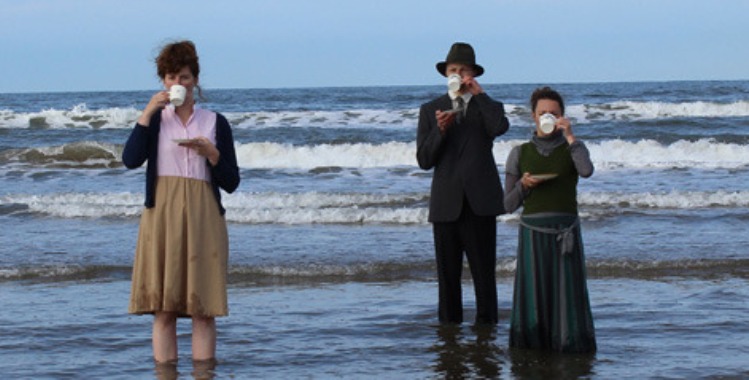
Previously I had complained that the various striking scenes that make up The Various Lives of Infinite Nullity “feel like a string of stage images and little more”. Revisiting this opinion, I still feel that the piece is a little slight, but its images speak powerfully for themselves. Tea cups – ever-present symbols of banality – suddenly slice open throats; fake blood splatters against plastic; an innocuous skipping rope becomes a deadly weapon; a performer’s face is horrifyingly drenched in red liquid.

And then, perhaps, the most effective image of all: a woman lying on the floor, draped in plastic, her incessant, trivial chatter slowly muffled by a downfall of earth. Buried alive and still worrying about what to cook for dinner. Moments like this are when Clout Theatre are at their best, tapping into the essential absurdity of everyday existence and presenting it with a flourish of the surreal.