Sparks, Old Red Lion

image

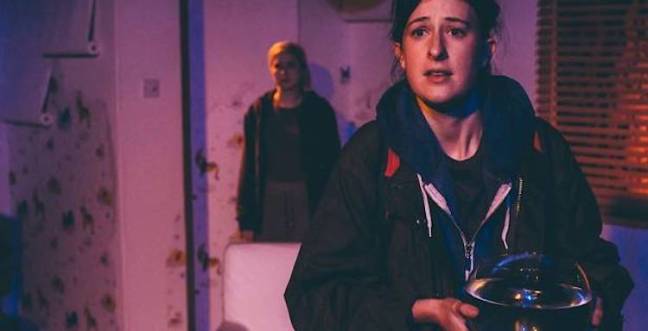
There’s something elemental about Sparks. It’s all water and fire: two opposing forces meeting, like the two sisters at the play’s heart. Jess turns up on Sarah’s doorstep drenched, clasping a fishbowl in both hands. “Soaked,” she says. “All the way through. Think I’ve got. Got wet bones.” Sarah, when she allows herself to dream, dreams of the stars, burning fiercely in the sky. It’s the night before bonfire night, the country prepared to briefly ignite, but for now the water pours steadily down.

This is the tenor of Simon Longman’s play and Clive Judd’s production at the Old Red Lion: lyrical, dreamlike. Pared back to the basics, Sparks might not sound like much. A woman returns home to see the younger sister she abandoned twelve years previously, desperately attempting to turn back time. The domestic drama of the homecoming is hardly anything new. And yet … “transcend” is a word used too frequently and too carelessly, but it feels justified to say that Sparks transcends its premise, becoming much, much more than the sum of its parts.

There is, at first, a spikiness to the situation established by Longman and Judd. Sophie Steer’s Jess, vibrating with anxiety, vomits out a relentless flood of words. She can’t stop talking. Sarah, on the other hand, can barely wrench a single syllable from her throat. As played by Sally Hodgkiss, she’s frighteningly still, paralysed by shock. The older sister dances around the younger, her jittering energy spreading outwards in ripples to the audience. We’re tensed, waiting for the confrontation or revelation that dramatic convention dictates must be just around the corner.

But like Alice Birch’s Little Light – another dagger-sharp and devastating play about families and the passing of time – Sparks keeps us waiting. There’s a lot, in fact, that the two pieces have in common. Both take familiar, arguably even hackneyed dramatic set-ups and delicately subvert them, stretching the expectations of an audience almost to breaking point. And both revolve around the fragile relationship between two sisters, bound together by blood and memories yet ripped asunder by events.

In the case of Jess and Sarah, they are speaking across a gulf, one that only seems to widen for most of the first half. Jess is frantic, speaking to fill up the silence, while Sarah gives her little in return. One speaks in outpourings, the other in clipped half sentences. Yet, perhaps most surprisingly of all, it’s funny. Dark and desperate, yes, but funny all the same. The careful rhythm of the performances highlights the jarring humour of awful situations – that very British tendency to find something to laugh about even from the depths of despair.

Indeed, careful might describe the whole production. No choices feel thrown away. The style is naturalism shot through with memory and, at moments, a little bit of magic. Subtle (and one less subtle, but completely earned) shifts in Mark Dymock’s lighting take us back through time as both sisters gradually pick over the past; likewise Giles Thomas’s sound design, which you hardly notice until suddenly you realise it’s transported you. Jemima Robinson’s design, unfussy and realistic for the most part, uses the tiny but significant detail of peeled back wallpaper to suggest the tearing away of the years. Peeking through underneath, a Winnie the Pooh pattern – the one visual reference to Jess and Sarah’s fraught, shared childhood. And the swapping of the two central roles each night, a device that could be no more than a gimmick (albeit an impressive one), makes complete sense for a play that deals so much with the roles we fall into in a family.

In the end, what matters more than the discovery that we’re primed for – the unexpected twist, or the key to this strained sibling relationship – is simply these two characters in the same space together. I’m reminded, alongside Little Light, of Robert Holman: as in so many of his plays, Sparks is about the people and the conversation. Longman’s dialogue is exquisitely crafted, as accomplished in tense, terse exchanges as in meandering, almost poetic speeches. It doesn’t matter that little really happens to the two protagonists over the course of the play, because so much happens between them. It’s simple, perhaps, but startling nonetheless.

Photo: JKF Man.

Invisible Treasure, Ovalhouse

8Kho0jNuO1twmTGivXeEG0l8aQLAd8WyMMG4REpTHTY,g1TR59h7OG8NWIqbnaeeNbZ1UoGK68NtgflhZX5dRcc

There’s always a promise held somewhere in interactive theatre. There’s the idea, cherished by so many of its makers, that by making the audience physically active we’ll become activated in other ways as well. That by getting us on our feet and interacting with one another, we’ll be shaken out of our stupor and become – however briefly – part of the sort of utopian community that all theatre holds the fragile potential for.

So much interactive theatre, though, has become lazy or cynical or both, trading on a label that suddenly has currency in the “experience economy” we now live in. Far too often, “interactive” (encased suspiciously in quotation marks) means little more than a marketing tick-box. Supposedly unique experiences are deeply derivative and being physically active becomes just another way of being mentally passive.

In their ambitious new show, fanSHEN are attempting to recover some of that essential promise. With no performers but a hefty load of technology, Invisible Treasure is experimenting with what it’s possible for people to do together in a space: how far they are willing to play and to work together, and when they will challenge authority. This is theatre that’s trying in some way to model how we interact in the world beyond these four walls; as the company’s description puts it, it is a world “that feels like the inside of a computer game but yet seems strangely similar to our own”. It is, as I say, ambitious.

And for the moment, at least, fanSHEN fall short of those ambitions. They’ve saddled themselves with a Catch-22 of a project: to develop, Invisible Treasure needs testing with audiences, but that testing requires exposing it in a delicate, unfinished state. It’s still a work-in-progress, then, ironing out flaws and glitches along the way. Writing about it also feels like something of a work-in-progress – an unfinished response to an unfinished show.

The computer game reference point in Invisible Treasure’s blurb is an apt one. Walking into the sleek white box of Cécile Trémolières’ design, all we have to go by is a single screen displaying cryptic instructions. It’s like a puzzle, but one that can only be collectively solved. There are lights, sounds and a colourful, textured floor, as well as a huge, ominous white rabbit looming in the corner (echoes of Alice in Wonderland as we plunge down the digital rabbit hole). A Big Brother-esque figure is watching and our actions as we progress through confusing levels can either please or displease him, as updates on the screen inform us.

Audience involvement requires a careful framework, establishing parameters in which participants can exercise a degree of freedom. It might go against what fanSHEN are trying to do, but audience members – especially awkward, reserved, stereotypically British audience members (*raises hand*) – respond well to guidelines and limitations. As it currently exists, Invisible Treasure is just a bit too baffling and amorphous. Whether or not you choose to play by them, games need rules. The different levels here are often frustratingly opaque, and whether we progress by effort or by default is unclear. It’s hard to know what we are supposed to be achieving or resisting.

That said, in certain moments the piece is skilful in coaxing its audience into involvement and cooperation. The simplicity of manoeuvring our bodies into shapes, reminiscent of school drama exercises, quickly gets everyone working together (if with mixed success). And I loved the dance sequence, in which we are all encouraged first in protective darkness and then in exposing light to boogie in a series of familiar styles (conclusion: I can’t line dance to save my life, but I love a bit of the twist).

After puzzling (often unwittingly) our way through the show’s levels, though, the final reveal (SPOILER ALERT) feels a little unearned. That slightly terrifying rabbit cracks open down the middle and we step through the looking glass into a backstage space, all wires and controls. This is where fanSHEN really frame the intentions of the piece, but it feels like something of a shortcut. On the outside walls of the space we’ve just emerged from, questions are scrawled, asking us about cooperation and resistance both within and beyond the walls of the theatre. Pens invite our responses, but most answers speak of confusion – a common response to the show, it would seem.

Part of the problem, perhaps, is that the complicated motion-sensor technology has eaten up much of fanSHEN’s development time, with the dramaturgy having to take a backseat. What the piece is trying to do – using interaction as a prompt to consider our interactions in the wider world and all of their political implications – is interesting and the set-up of the performance is intriguing, but as an experience it doesn’t yet cohere. Tensions that could be fascinating, such as that between the Big Brother element and the cooperation asked of us in each level, are currently just a bit awkward, while the directness of the questions we are issued with at the end feels as though it is making up for the lack of clarity elsewhere. There’s definitely something here, but it needs more time – and more audiences – to begin realising its ambitions. 

Photo: Cat Lee.

RoosevElvis, Royal Court

590x494.fitandcrop


ELVIS: I always saw my life like it was a movie. Ever since I was a little kid.

Ever imagined your life as a movie? Not the movie of your life, all carefully edited highlights and an actor with much better hair in the lead role. Just day-to-day life seen through celluloid: getting ready in the morning, heading to work, going out for drinks. The banality of routine made exciting through the frame of Hollywood.

It seems only right that The TEAM, a company at once in love with and critical of Americana, should go to the movies. The outlines of Hollywood, so often overlapping with those of the American Dream, were there in Mission Drift, but RoosevElvis takes on that most quintessentially American of film genres: the road trip. Except this road trip is one – as per the title – with Elvis Presley and Teddy Roosevelt: two very different American heroes and two very different versions of masculinity.

I mention Mission Drift because it’s hard not to watch RoosevElvis through the remembered lens of that earlier show. Even just thinking about that production exploding across the stage of (the venue formerly known as) the Shed, all sexy chaos and soul-shattering songs, makes my heart beat a little faster. It was a show that locked horns with the American Dream and the history of capitalism by embracing the messiness, the unruliness, the unencompassable hugeness of its subject matter. It was all excess, bursting at the seams with images and ideas, yet the unrestrained aesthetic felt completely apt.

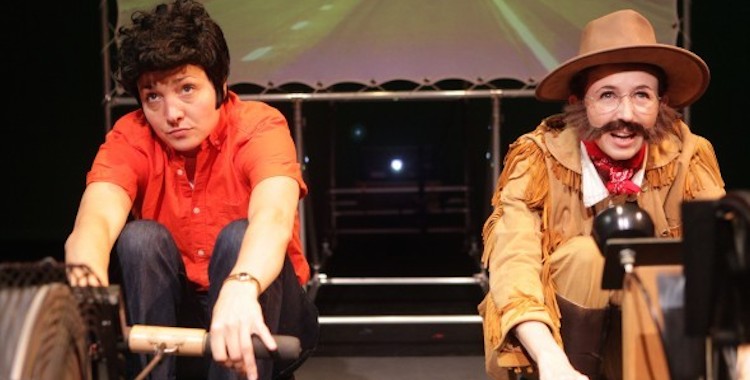
RoosevElvis has just as much going on, but the mash-up is slightly less convincing. It’s grappling with a hell of a lot: gender, sexuality, images of American masculinity, heroes and icons, the mythology of the roadtrip, the intoxication of adventure. As in Mission Drift, there are two main strands: the struggle undertaken by Ann, a lonely and lost 35-year-old in a dead-end job at a meat-processing plant, to find herself on the road to Graceland; and a hallucinatory meeting between Elvis (Ann’s hero) and Roosevelt (Elvis’s own hero in turn). And it’s all performed by two women – The TEAM’s fantastic Libby King and Kristen Sieh – in glorious, pointedly fake drag.

When we first meet Ann, she’s hooking up with Brenda, a visiting taxidermist she met on the internet. Brenda is everything Ann isn’t: self-assured, wisecracking, thirsty for adventure. As she puts it during their three days together, the reserved Elvis fan is “remarkably unbrave”. (That particular choice of words – “unbrave”, not “cowardly” – lands with a surprisingly devastating weight.) As her time with Brenda comes to an abrupt end and she struggles again with her identity, Ann conjures the spirits of Elvis and Roosevelt and the three of them hit the road, making a meandering pilgrimage to Graceland.

This all takes place within a makeshift film set, surrounded by screens playing snippets of Thelma and Louise and a series of movie-like on-location scenes, gorgeously filmed by Andrew Schneider. There’s more than a hint of The Wooster Group to this ubiquitous presence of televisual media, as movies become absorbed into the texture of everyday life. Thelma and Louise is a thematic and aesthetic reference point throughout, in fact, its simultaneous homage to and subversion of the road trip buddy comedy providing a blueprint of sorts for The TEAM. Here, again, two women critique the centrality of very particular ideas of masculinity to the American psyche – only these two women are playing two men.

King and Sieh’s embodiment of the two famous men smashed together in the title is one of the show’s great joys. The aptly named King lends Elvis both swagger and vulnerability; he can entrance the world with a swing of his hips, but yearns for his momma’s love. Also playing Ann, King deliberately blurs the edges of the two roles and the genders they represent, the same submerged melancholy bleeding into both characters. Sieh’s riotous Roosevelt, meanwhile, is a hyperactive pastiche of rugged yet intellectual manliness, burying emotions in books and hunting trips. It’s an incredible comic turn, made all the more impressive by its contrast to the persuasive naturalism of Sieh’s performance as Brenda.

RoosevElvis is a show of fantastic moments. Roosevelt throwing ridiculous punches at projected buffalo on a screen. Roosevelt and Elvis (or “Elvees”, in Roosevelt’s Katherine Hepburn-esque accent) lounging in a motel room, the latter in a monogrammed dressing gown. A finale that flips from the laugh-out-loud to the poignant and contemplative in an instant. Between these moments, though, it often veers from the road, going off into digressions or tipping the absurdity just that bit too far. Teddy and Elvis’s little skits, while ushering in most of the laughs, rarely move the narrative forward. I begin to wonder, as other interesting fragments of ideas around privilege and legacy periodically surface, whether the piece has taken on just a little too much.

But what The TEAM are great at, as ever, is pulling apart the threads of American mythology. In the opening scene of the show, as the two icons at its heart compete for attention like movie stars at a press conference, Roosevelt launches into a segment from one of his speeches. There’s a pause. Then he says, grinning, “what a great quote”. The twenty-first-century portrait of the USA drawn by The TEAM is one of national culture as quotation and national identity as an awkward yet enduring assemblage of freighted symbols.

This all resonates, too, with the construction of personal identity – a fraught ongoing battle for Ann. Whatever the show’s stumbles, there’s something brilliant about the staging of a queer woman’s journey towards self-realisation, in the process hijacking a narrative form that is so often (as the inserted biographies of Elvis and Roosevelt – always gently subverted by the simple fact of the casting – make clear) dominated by (straight, white) men. RoosevElvis might be critical of the traditional markers of American masculinity – guns, aggression, arrogance – but it also opens up the possibility of a new sort of identity, one still connected to but not hemmed in by the long chain of past heroes.

Tribute Acts, Camden People’s Theatre

main

The dad of one of my best friends is a long-time Labour Party member. He’s supported the party for all his adult life and since retiring he’s started getting more involved in local politics. When we were talking about the Labour leadership election, this friend of mine made it clear that her dad wasn’t backing Jeremy Corbyn. I was. So when the vote was announced, she immediately messaged me: “are you happy with the result?”

And I realised, with a little jolt of surprise, that I wasn’t quite sure how to reply.

Hope can be an oddly scary thing. I am, for the most part, a pretty optimistic person. Sure, the world can seem depressingly fucked up a depressingly large amount of the time, but acknowledging that has never stopped me from finding wonderful, beautiful, hopeful things to restore my faith in it. Seeing positives and believing in the possibility of something better, though, is a very different thing from investing hope in a solid person or party or promise. The moment you do that – the moment you shove all your optimism on the shoulders of a Jeremy Corbyn or a Natalie Bennett – you’re opening yourself up to the all-too-likely possibility of disappointment.

Tribute Acts is all about hope, heroes and the heartbreak of being let down. TheatreState’s new show has a fantastic central premise: Cheryl Gallacher and Tess Seddon use their shared disappointment in their once heroic dads as a parallel for the disheartening trajectory of the left. Sam Gallacher and Rodger Seddon, like Tony Blair and Bill Clinton, are men in suits who seem to have all the answers. Cheryl and Tess want to believe in them. They used to believe in them. But betrayal by father figures, whether biological or political, is hard to bounce back from.

On stage, Cheryl and Tess’s dads join them as projected presences, speaking from screens over their shoulders. Each performer has interviewed the other’s father, asking questions about political beliefs and family memories. The two men on screen smile and hesitate, awkward and unsure of what is being asked of them. They tell dad jokes. They struggle to recover memories that are cherished by their daughters. They stick firm to their principles – both are lifelong socialists – but are tellingly unable to locate women in their visions of the future. Asked who they’d want as advisers if they became prime minister, both name a string of men.

We’re invited, then, into the same process of disappointment that has tainted Cheryl and Tess’s relationships with their dads. Gradually, behind the suits and the smiles, we see the repeated failures and the broken promises. Both men left their families, and so the spectres of divorce and adultery still haunt these father-daughter relationships. Even without the experience of a broken family, though, the countless small letdowns that accompany the realisation that your parents are just people, after all – flawed, fallible people – is wrenching. Cheryl and Tess’s performance style riffs on shared silliness and the playful dynamic they have as a duo, yet within that there are startlingly poignant moments.

But what resonates just as much – perhaps more, as I process my ambivalence about Corbyn’s leadership – is the hurt of broken political promises. They might fuck you up, your mum and dad, but so do the false hopes and empty promises of slick, suit-clad politicians. I’m the same generation as Cheryl and Tess. I also remember the heady rush of Tony Blair’s landslide election and the now painfully ironic hubris of the campaign’s blasts of D:ream’s ubiquitous “Things Can Only Get Better”. As a child, not understanding the politics or what the “new” bit of New Labour might mean (everything’s new when you’re seven), that song and the excitement that accompanied the 1997 election had the flavour of prophecy. Things could only get better, surely. (*cue bitter laugh*)

Intertwining those two strands of betrayal – personal and political – is a brilliant idea. First disappointments are always the harshest, and so the slow, painful process of losing faith in parents is a compelling analogy for losing faith in the left. In practice, though, the two halves of the show don’t ever fully knit together. As Cheryl and Tess speak into their microphones about the promises of men in suits with footage of Blair rolling behind them, it’s clear what TheatreState are doing, but this basic conceit isn’t really advanced at all over the course of the show. Instead, the two performers’ family relationships begin to dominate, taking us further and further into the personal while the political lingers like a half-forgotten shadow.

Tribute Acts opens with a reference to one of the iconically naff moments in 90s cinema: Bruce Willis saying his hero’s goodbye to daughter Liv Tyler in the fantastically bad disaster blockbuster Armageddon. As snippets from the movie flicker on screen, Cheryl and Tess enter in ridiculous, billowing space suits (see what I mean about the silliness?), heroes in their own way about to step into the unknown. This daft framing device – nodded to again when both performers don copies of Liv Tyler’s dress – is, oddly, one of the show’s most powerful tactics. It captures, with a distancing dose of hyperbole, what we so often want from parents and leaders alike: someone who will step in and save the day (and possibly, like Bruce Willis, the whole world). Away from Hollywood, though, it’s never quite that easy.

Tonight I’m Gonna Be The New Me, or Who’s in charge of this story?

428Nl3vVPFetgh7eQSytWC9skjrpgctp9aWvDuQfNQk

“It’s nice to be documented,” says Jess Latowicki to the audience, “right?” Over our shoulders, lurking in the shadows, is Tim Cowbury, the other half of Made in China. He’s taking notes: notes on Jess, notes on us. He’s the writer here. Well, sort of, explains Jess. This is his show. Only, at the same time, it’s not.

Who’s in charge of this story?

I’ve always thought of humans as storytellers. As a writer, perhaps that’s no surprise. When Galen Strawson, in a recent article for the ever-brilliant Aeon, quotes Oliver Sacks writing “each of us is a narrative, this narrative is us,” I’m nodding my head. Stories – at least for me – feel like a way of understanding the world, of communicating. Reading Hannah Nicklin on the theory of the “storied self” – the idea that we build and reinforce our sense of identity through stories (the story “I’m a writer” or “I’m a runner”) – I felt a jolt of recognition.

But Strawson questions that truism that we construct ourselves through stories. He argues that it’s “false that everyone stories themselves, and false that it’s always a good thing”. Life as experienced from day to day, he reasons, has neither the shape nor order of a narrative. He throws various spanners into the narrative machinery, from the common experience of a fractured or multiplied self (W Somerset Maugham: “I recognise that I am made up of several persons”) to the fragility and fallibility of memories (James Salter:”There is no complete life. There are only fragments”). The more I think about it, the more I find myself conceding that he might have a point.

Perhaps, instead of using stories to organise our internal memories and experiences, we tell the story/ies of our lives for and through other people. Or, without quite knowing it, they tell their own stories through us. It’s one idea among many that Made in China’s new show, Tonight I’m Gonna Be The New Me, toys with. Jess, on stage in sequinned hot pants, is in one sense being authored by Tim. He’s written the script and he’s manning the lights, controlling how Jess – and, via her, himself – are seen. This is his story.

In reality, of course, it’s a lot more complicated than that. Made in China are a duo, and while it’s easy to identify Jess as performer and Tim as writer, they are very much co-authors of their work. During the performance, too, questions are constantly being raised over authorship and agency. Jess challenges Tim, twists his words, throws the piece off-balance again and again. There’s an uneasiness around the male gaze – Jess wiggling her hips, under the lights controlled by Tim, watched by him and us – but at the same time a playful subversion of it. It’s never anything so simple as the image of a woman being authored by a man, instead engaging that dynamic in order to upend it.

Then there’s the story itself. In between scripted sparring between the couple – the acknowledgement of their real-life relationship sitting (deliberately) uncomfortably beneath the increasingly personal sniping – Jess narrates over and over the fiction of Tim’s heroic death [insert “Death of the Author” gag here]. It’s a strange sort of wish fulfilment, targeting another of the ways in which we inconsistently self-narrativise at the same time as the culture we live in scripts us. This death – written, remember, by Tim – attests to a cultural (and typically masculine) desire to prove oneself, to be the hero, to die young yet live forever in the memories of others. It’s a story we’ve heard before.

But in Jess’s ironic delivery, it’s drained of all heroism. The restless, independent man going off to find himself, the brave confrontation that ends in tragic self-sacrifice – from Jess’s lips it all sounds pathetic, unoriginal, like the script from some old, half-remembered movie. Which, of course, it is, as is the image following it of the grieving hoards and bereft girlfriend at the funeral. And then, as Jess describes in meticulous, ludicrous detail the outfit she wears to mourn Tim, a new script – a new story – breaks through: that of advertising and vacuous women’s magazines and the empty fetishisation of things. Narratives tell Jess and Tim, rather than the other way round.

“Do you ever get the feeling that someone is putting words in your mouth?” asks Jess, eyeballing a member of the audience. “Say yes,” she quickly instructs them.

“Yes.”

That interest in self-narrativising – or unwittingly allowing our lives to be narrated by others – folds into my persistent interest in scripting and authorship, an interest that Tonight I’m Gonna Be The New Me absolutely shares. As well as being (sort of) scripted by Tim, Jess puts words into the mouths of various audience members, asking them questions and feeding them the answers. We have a role here, but it’s tightly controlled – so long as we choose to play along. The fault lines between the scripted and the unscripted visibly shift.

Similarly to the slippages between text and performance that I’ve been thinking about in Action Hero’s work, in Tonight I’m Gonna Be The New Me Jess and Tim also play with the slipping and sliding boundaries between themselves as writers, performers and people. How much of this is scripted? How much of this is them, Jess and Tim the real-life couple, and how much of it is “Jess” and “Tim”? Who’s doing the scripting, and who’s being scripted? Who has the power here?

When I spoke to Jess and Tim just before they took Tonight I’m Gonna Be The New Me to Edinburgh, they joked that they had ended up making the same show as Action Hero. Wrecking Ball (at least from what I’ve seen at work-in-progress stage) has different concerns at its core, but there are some striking similarities. Those similarities also extend to Actress, the latest from Sleepwalk Collective. Three shows made by couples; three shows interested in authorship and performance and the dynamics of the male gaze.

Just as there’s a lot more in those other two pieces, there’s a lot more that Tonight I’m Gonna Be The New Me is also “about” (modern relationships, autobiography, the one-woman show, the representation of romance in pop culture). But there’s something all three shows are doing, in varying ways, that keeps niggling at me. Something about who is controlling the story. Something about all those agency-robbed women written by men. Something about how the cultures and structures we live within insidiously script us, and how we might read those scripts while subverting them.

Because whether or not we understand and organise our own lives through stories, stories are still important; stories are still how we understand the lives of others and how we hope they will understand us in turn. And so asking “who’s in charge of this story?” is never a trivial question.

Photo: David Monteith-Hodge.