Embrace the Problem: Duncan Macmillan

1984

Originally written for Exeunt.

Duncan Macmillan is remembering a piece of advice from Edward Bond that has stayed with him. “He said this brilliant thing,” the writer and director recalls, “which is that there’s a tendency in some directors to solve the problem. You identify the formal problem or the staging problem or something, and then solve it somehow. And he says good dramatists instinctively know that the problem is all you’ve got, that you should never solve the problem.”

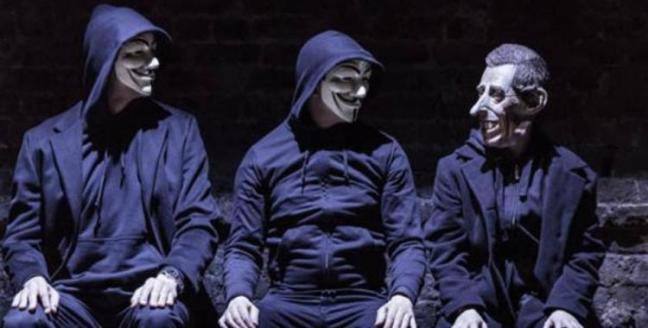
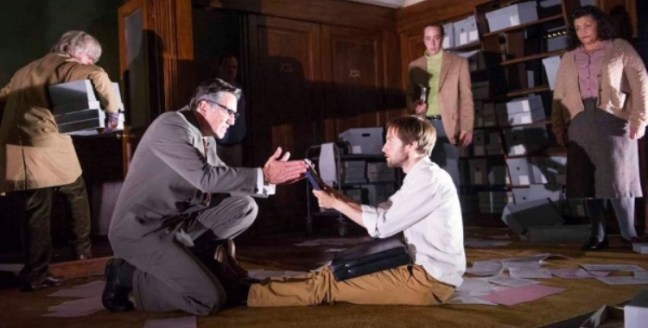
This insight – don’t solve the problem – was something of a starting point for Macmillan and co-adapter Robert Icke’s acclaimed stage version of 1984 for Headlong. George Orwell’s culturally ubiquitous novel is a tangle of contradictions, none of which the pair wanted to unravel. “It seems absurd and a real shame to iron out all the creases,” says Macmillan. “I think there’s something really exciting about going, ‘what do these creases do for the novel, and how do we find a theatrical form in which to communicate those logic bumps?’”

The answer to that question was found in a structure that could simultaneously hold all possible readings of Orwell’s novel – an exemplary instance of doublethink. “There’s a lot in the book that quite deliberately complicates the narrative, and we didn’t want to solve that by undermining it and just opting for one particular reading of it,” Macmillan explains. Every possible interpretation is allowed for.

Central to their complex, cerebral version of the novel is the oft-neglected Appendix, which no previous adaptation has attempted to tackle. Macmillan is adamant about the importance of this seemingly dry, academic postscript, which Orwell himself insisted was integral to the tale. “It’s like telling a really long, convoluted joke and then missing out the punchline and feeling like you understand the joke even though you’ve not heard the punchline yet,” he argues.

What Macmillan and Icke found frustrating about previous adaptations – and what they have studiously avoided – was the tendency to hone the novel down to the narrative of protagonist Winston Smith’s experience, stripping away its philosophical and political content. “There’s a tendency to over-simplify,” Macmillan suggests, going on to insist that “if you present a literal universe on stage, it’s not accurate to the book”.

Instead of opting for a literal narrative, Macmillan and Icke have held onto the subjectivity of the novel, which offers readers intimate access to Winston’s unreliable mind. In doing so, their main reference points have been cinematic – “film can do subjectivity in a way that theatre sometimes struggles with,” Macmillan suggests. He names the likes of Eternal Sunshine of the Spotless MindMulholland Drive (“it’s a deliberate puzzle”) and The Shining.
These pop cultural influences are also apt for one of their target audiences. Macmillan relates how both he and Icke remember a moment in their teenage years when their minds were opened to the possibility that theatre might be just as exciting as films and computer games; one of their ambitions in creating this adaptation was to offer the same revelatory experience to a new generation of youngsters. “We really wanted to blow those kids’ minds.”

As 1984 moves to the West End to embark on its third run, Macmillan’s enthusiasm for the show is remarkably undimmed. He doubts that he and Icke will ever be truly finished with the piece; despite reading the book dozens of times, they keep returning to pore over each last line, making tweaks to their adaptation as they go. Macmillan offers a neat Orwellian analogy: “Each edition of the Newspeak dictionary is smaller and smaller, because they’re eliminating words from it, and we’ve sort of been doing a similar thing.”

Throughout the process, Macmillan and Icke have worked in tandem, equally doling out the duties of writing and directing. “Quite early on we realised that the usual boundary line between being a playwright and being a director just wasn’t helpful and that we’d automatically started parking tanks on each other’s lawns,” says Macmillan. Reflecting on his metaphor, he is quick to add, with a laugh, “that makes it sound more oppositional and more aggressive than it actually was”. In fact, the partnership has been amicable and creatively fruitful, directing both theatremakers towards bolder, sharper ideas. “It’s been a huge amount of work,” Macmillan admits, “but two heads – in this case – have been better than one, and it hasn’t been a messy, grey compromise. We’ve always pushed each other to make the idea better.”

Another great collaborator of Macmillan’s is director Katie Mitchell, with whom he is currently working on a new project for the Saltzburg Festival. Macmillan finds Mitchell “really trusting and empowering”, praising the passion of her involvement with every element of a production. “She has such artistic integrity as a theatremaker,” he says, “and political integrity as well. I found that really, really galvanising.”

Thanks to working with Mitchell, Macmillan is now much more confident about making work with political intent, something that he suggests “we can find very hard to do in Britain”. The pair’s latest show, The Forbidden Zone, has an explicitly feminist agenda, setting out to “reposition our understanding of certain women and women’s roles in the First World War”. The project has involved extensive research, highlighting for Macmillan just how difficult it is to unearth female perspectives in a history written by men. “One of the things we wanted to do was rehabilitate the writing from that period, this fascinating writing done by so many women, and also these really extraordinary female figures who haven’t been given the right kind of attention,” Macmillan says.

He and Mitchell also recently worked together on the German premiere of Macmillan’s playLungs, or Atmen, which continues to play in rep at the Schaubuhne in Berlin. Despite the script’s strict instructions that the play should be staged with no set and no lighting or sound changes, Mitchell has placed the two performers in her production on bicycles, powering the lights throughout the show. This simple, eco-friendly concept acts as a constant visual reminder of the high environmental stakes that provide the backdrop for Macmillan’s two-hander, in which a couple agonise at length over whether or not to have a child.

“She’d understood the gesture of what I was trying to communicate and I think she added something really interesting to it,” Macmillan reflects on Mitchell’s directorial interventions. “In Katie’s production you really get a sense of the time pressure and the physical pressure, and you also get a sense of the environmental pressure because the carbon neutrality of that production is so visible and audible at all times.”

Macmillan has worked in yet another way on Every Brilliant Thing, a project with Paines Plough and Pentabus which goes on tour in its latest incarnation next month. The piece began as a story written by Macmillan, in which a child starts a list of everything that is wonderful in the world as a way of coping with their mother’s suicide attempt. As in the story, the list soon took on a life of its own, welcoming contributions from the public and transforming into an installation created by Paul Burgess and Simon Daw. Now, the story and the installation have been incorporated into a show, performed by Jonny Donahoe of Jonny and the Baptists and involving members of the audience each night.

“That began as sort of a necessity of the time pressure and the formal constraints we set ourselves, and has now become an inherent part of the project,” Macmillan explains the audience involvement. “There’s something about seeing real people responding live in the moment rather than actors pretending to be other people that feels very true to the project. It cuts out all the pretending of it and it just becomes very honest and open and responsive.”

Although Macmillan is looking forward to getting back behind his desk and focusing on his own work again, he anticipates that the various collaborations he has been involved with in recent years will continue to have an effect on the way he writes. “I guess I’m bored with certain approaches to making theatre and I’m really looking for people who inspire me and are prepared to work with a writer in different ways,” he says. “I’m not as interested as I once was in just sitting in an office and sending a play away.”

Rachel Chavkin: Riding the Elephant

??????????????????????????????????????????????????????????????????????????????????????????????????????????????????????????????????????????????????????????

Originally written for Exeunt.

For a theatremaker whose work has a distinctly American flavour, Rachel Chavkin has a surprisingly close relationship with British theatre. The artistic director of The TEAM, a company who have made a name for themselves interrogating modern American identity, was last over here with Mission Drift, which had its first London run at The Shed last summer after premiering on the Edinburgh Fringe in 2011. When we speak, she is in Newcastle for rehearsals of her new stage version of Catch 22 at Northern Stage; other ongoing projects include a collaboration with Chris Thorpe and a new TEAM show being made in partnership with the National Theatre of Scotland.

“It’s the culture of theatre here,” Chavkin explains the continuing appeal. In contrast to American theatres, which rarely have in-house bars or restaurants, she is drawn to the community that gathers around theatres in this country, where people meet to socialise and extend the conversations started on the stage. “The idea that the theatre is a building of culture and life has had a huge influence on my work with The TEAM and my sense of what I want theatre to be doing in the world.”

For her latest project, however, Chavkin is making work for British audiences without the company of The TEAM. The idea of adapting Catch 22 for Lorne Campbell’s first main stage season as artistic director of Northern Stage was first suggested in early conversations about the programme, as it emerged that Chavkin had long nurtured an interest in Joseph Heller’s novel. When they discovered that Heller himself had already written a stage adaptation of the book, Chavkin was the obvious choice for director.

She describes the novel, which follows the nightmarish experiences of Captain John Yossarian during the Second World War, as an “extraordinary piece of philosophy and absurdism”. The novel offers a formidable challenge in its presenting of events out of sequence, mirroring the rule of its title in its circular, repetitive structure. It is the book’s more philosophical strands that Chavkin hopes her production can draw out, conveying the “feeling of existential despair” that the narrative builds to.

“The sense of purgatory, of Yossarian caught in this kind of purgatorial loop, that’s the driving idea behind this production and behind the staging,” Chavkin explains. While Heller’s script brings with it certain limitations, she tells me that “the back story and wealth of worlds that Heller presents in the novel has a profound impact on how we’re able to understand the play”. The novel is informing how she presents the “space around the text” and has influenced an aesthetic which contrasts an atmosphere of celebration and fun with the unremitting devastation of conflict. “War is great, other than the war part.”

The advantage of the novel is that, despite not being able to directly consult the writer about the production, there are pages upon pages of additional material available at Chavkin’s fingertips. In this sense, she suggests, “you sort of do have the writer with you”. Chavkin explains that as a freelance director she is more accustomed to working with writers on new plays, a practice that has increasingly fed into the way she creates work with The TEAM.

“When The TEAM was first beginning to create, and for many years of our company’s life, we would always try to fix problems by rewriting them,” Chavkin recalls. “We always turned to writing first and foremost if something didn’t make sense to us. And actually now I have become much more protective of each individual writer’s contribution within The TEAM. Because as a freelance director I have to protect a new writer or a new play all the time, from both myself and the actors, who just may not understand it yet. Sometimes it means that there should be a rewrite, but very often it means there’s some different logic at work in a play and you just have to work a little bit harder to understand that.”

While Chavkin’s different creative processes have points of convergence, she also discusses contrasts between her work as a freelance director and her projects with The TEAM. Whereas The TEAM’s process tends to be “very gnarly and pretty horizontal”, there is a much clearer hierarchy in place when Chavkin is directing elsewhere, though she stresses that she is still “deeply interested in what the acting company and designers might bring to a show”.

Chavkin is working in a slightly different way again on Confirmation, her current project with Chris Thorpe. It is being written by Thorpe, but as director Chavkin has been deeply involved in the research and development of the show. The piece, which is going up to the Edinburgh Fringe this summer, investigates confirmation bias – the unconscious bias that leads us to interpret the world around us in ways that support our existing beliefs. Chavkin describes it as “a very aggressive force in our lives” and discusses how eye-opening their research has been.

“The image that a lot of the research uses is the rider and the elephant,” she says, explaining that the rider represents the conscious, rational brain, while the elephant is our unconscious. “The elephant is a much, much larger force than the rider, and the idea is that the rider can to a certain degree guide which way the elephant wants to go, but actually in most cases our rational brain exists to try to explain and justify to ourselves why the elephant is doing what it’s doing. The most surprising thing is the degree to which we are governed by our unconscious.”

It is going to be a busy Edinburgh Fringe for Chavkin this year, who is also presenting a workshop performance with The TEAM and the National Theatre of Scotland. The new collaboration between the two companies indirectly approaches the question of Scottish independence, exploring the national mythologies of both Scotland and the USA. Using the Scottish Enlightenment as its starting point, it traces the journey that the ideas emerging out of that era have made over the years, right up to the present day.

“The idea is that America was this place where all the ideas coming out of the Scottish Enlightenment actually got, like a petri dish, to act upon,” says Chavkin. “350 years later, I think America is finding itself in a somewhat bankrupt place with this radical misunderstanding of what Adam Smith wrote as our national religion, in terms of this incredibly unfettered capitalism.”

Talk of unfettered capitalism recalls Mission Drift, which took an epic, breakneck ride through 400 years of American history, from the earliest settlers to the twinkling spires of Las Vegas. There is undeniably a certain continuity that can be traced in The TEAM’s thinking, from the research into disaster capitalism that informed Architecting through to this latest project. “I think that’s a common theme in all our work,” Chavkin admits. “Something that comes up as an idea in one piece ends up developing and shifting and morphing into the germs of what inspire the next piece.”

Chavkin makes it clear that the new show, tentatively titled Scottish Enlightenment Project, is not explicitly dealing with the Scottish independence referendum and will not appear in its finished form until after the vote, which is a very deliberate decision. But again, as with so much of her work, it asks the questions that sit right at the heart of national identity. “Who do we want to be? What kind of democracy do we want to be? What are our values?”

King Charles III, Almeida Theatre

KC3-3894-web-Cast-of-King-Charles-III-by-Johan-Persson

Originally written for Exeunt.

It is apt that King Charles III, Mike Bartlett’s brilliantly ambitious “future history play”, is opening in a week that has seen newspapers plastered with photographs of the Royal Family. As William, Kate and baby George embark on a tour of New Zealand, the media fascination would suggest that the monarchy is far from unwanted. If anything, their stock is up. But does the ceremonial head of state really have any role to play in how we define ourselves as a nation in the twenty first century? Or is monarchy today nothing more than a brand, with Wills and Kate as its glossy poster boy and girl?

It is these questions, and a wide assortment of others, that King Charles III thoughtfully and entertainingly poses. The play opens in the near future, at the funeral of the long-reigning Queen. After a lifetime of waiting in the wings, Charles is finally out of his mother’s shadow and thrust into the glare of the spotlight. But while, as he puts it, “potential holds appeal”, the long-awaited throne is a formidable prospect. Barely hours into the job, Bartlett has the tragic figure of Tim Piggot-Smith’s stubborn Charles take issue with a privacy bill that lands on his desk for royal assent, refusing to sign as a matter of conscience. With the wavering of a pen, a whole nation is suspended in uncertainty, poised between the collapse of Parliament and the overthrow of the monarchy.

Bartlett’s deliciously smart invention is as much about our theatrical heritage as it is about the threatened traditions of monarchy. Taking Shakespeare’s histories as its model, the play’s form is wrapped up in the same contradiction as our Janus-like nation: both new and old, looking backwards and forwards at the same time. His script is a witty amalgam of Shakespearean rhythms and sharp modern colloquialisms, threaded with light allusions to some of the Bard’s greatest hits. We get unyielding royal ambition, a free-spirited, Hal-esque Prince Harry in the form of Richard Goulding (who just wants to live like common people), and a Kate (Lydia Wilson) whose backroom manoeuvring has more than a hint of Lady Macbeth – even if her weapon of choice is more Dolce and Gabbana than sharpened dagger.

Rupert Goold’s assured production is cast in the same mould, delicately attuned to its Shakespearean echoes. History is subtly inscribed on Tom Scutt’s simple set, which marries candles, a wide dais decked in plush maroon carpet, and a fading mural of faces that hugs the exposed brickwork of the Almeida’s curving back wall. The figures who anxiously pace under the glare of these painted eyes have all the poise of Shakespearean heroes and the polish of modern politicians, flitting with ease between elegant blank verse and slick press conference spin. And there’s a glorious bit of Bard spoofing (and Daily Express baiting) with the ghostly appearance of a black-shrouded Diana, a contrivance that is both utterly ridiculous and absolutely faithful to the logic of Bartlett and Goold’s chosen form.

It’s often said that retellings of history reveal more about the time they emerge from than the era in which they are set; the same can be claimed for visions of the future, which have a habit of reflecting contemporary anxieties. Perhaps, then, Bartlett has found the perfect form for grappling with some of the doubts clouding our immediate national horizon. With the referendum for Scottish independence looming, British identity is suddenly up for grabs, and with it the whole hodgepodge of tradition that makes up our national character. King Charles III might not offer any answers, but it’s a compelling start to a fresh national conversation about monarchy, democracy and that most elusive and problematic of qualities – Britishness.

Photo: Johan Persson.

Three Sisters, Southwark Playhouse

three-sisters1-600x399

Originally written for Exeunt.

A clock is ticking in the Prozorov household. Minutes pass loudly, inexorably, mercilessly. When the hour noisily announces itself, each chime a dagger for the siblings who count the seconds of their self-imposed exile, the purgatorial tenor of the Southwark Playhouse’s new imagining of Three Sisters is made immediately clear. The century might have changed, but precious little else has. As Tusenbach would put it, “life is always life”.

Anya Reiss’ updating, which transplants the Prozorovs to the modern day, is more striking for its fidelity than its revision. All the outlines of Chekhov’s play are there; only some of the shades have been altered. The provincial Russian town of the original is swapped for a British Embassy in an unspecified Middle Eastern country, with queasy echoes of colonialism, while the semi-mythical escape of Moscow has been replaced by London. The modernising touches, meanwhile, are all feather light: a mobile phone here, a newspaper there. Reiss’ take on the play is even – more so than most versions – loyal to Chekhov’s often neglected comedy, tugging on some of the more absurd strands of its protagonists’ situation.

So how do you answer for the sisters’ immobility when they could just hop on a plane home tomorrow? Wisely, the barriers that Reiss and director Russell Bolam erect are all psychological rather than geographical, the greater ease of movement heightening the characters’ own deadening apathy. Irina’s cry of “I want to go home” at the end of the first half, delivered with wine glass in hand by Holliday Grainger, is more whining than despairing. Here, more than ever, the sisters’ own self-sabotage and navel gazing jump to the fore.

It helps that Three Sisters is one of those plays that offers new aspects to the view on each return visit. Even without a bold, bracing treatment, the play is constantly teasing out new emphases, different scenes or lines snagging on the mind each time. Placed in a modern context, it is the speeches about work that catch the ear, acquiring new resonances in a political landscape where the idea of hard work has become a tool for dividing those whom the system disadvantages. Class relations (and, as an added dimension, racial tensions) are also sharpened, with the largely invisible locals hovering like a ghostly presence at the edges of the production. As Olga, Masha and Irina blindly wallow in their own misery, you almost wish for a yell of “check your privilege”.

In Bolam’s straightforward but polished production, slight traces of the past cling to performances that are otherwise grounded in the here and now. Paul McGann’s quietly commanding Vershinin, voice dripping with authority, could almost be dropped into any era, his futile philosophising barely interrupted, as could Michael Garner’s mildly grumbling Chebutykin. The sisters, meanwhile, are largely as we expect them, even if they have acquired new gadgets. Emily Taaffe is the most impressive of the trio, as a painfully bored Masha who finds a violent release in her passion for Vershinin, while Olivia Hallinan as Olga and Holliday Grainger as Irina are suitably maternal and dreamy respectively.

But the shift of time and location, while working surprisingly well, seems at a loss for what it has to contribute to Chekhov’s existential questioning. The parallels are neat, but only occasionally illuminating. If the play’s timelessness is its point, then the historical context is almost irrelevant. For this reason, Three Sisters often works best when located in a sort of nowhereland, a setting with suggestions of both then and now. While Benedict Andrews’ striking production at the Young Vic effortlessly unmoored itself from time, the subtle yet insistent modernity of this version does not quite convince, in spite of all the elegance of its execution. The play might time travel with impressive ease in Reiss and Bolam’s hands, but the question that lingers underneath it all is why?

Once, Phoenix Theatre

?????????????????????????????????

Originally written for Exeunt.

Once is a quiet revelation of a film. Running at a brisk 86 minutes, it is a shimmering sliver of a thing, played out in muted, almost documentary style naturalism. While very little happens and even less is said, it quickly but gently grasps at the emotions, stubbornly refusing to let go.

Replicating this subdued and intimate experience on a big proscenium arch stage would be an impossible, thankless task, and it is one that adapters John Tiffany and Enda Walsh have wisely avoided. Instead, delicate watercolours are traded in for broader, brighter brushstrokes, in a production that adds plenty of colour – perhaps too much – to John Carney’s film. Staged entirely in a pub, this bittersweet tale is subjected to lively and occasionally raucous storytelling, helped along by a skilled chorus of actor-musicians.

The plot is simple enough. A Guy and Girl – we never learn their names – meet on the streets of Dublin. He’s a busker and hoover repair man on the point of giving up his music, while she’s a Czech immigrant who plays a mean tune on the piano. In exchange for fixing her broken vacuum cleaner, the Girl prevents the Guy from throwing in the towel, injecting both his music and his life with fresh energy. Inevitably, the two begin to fall for one another, in spite of the Guy’s unfinished business with an ex-girlfriend in New York and the Girl’s daughter and absent husband. In other words, it’s complicated.

While Markéta Irglová in the film was a quietly enigmatic, inscrutable figure, Walsh’s book has added new, vivid lines to the female character, transforming her into the driving motor of the story. Zrinka Cvitešić is an electric presence, charging the Girl with an overflowing, infectious energy, but this new characterisation has more than a touch of Manic Pixie Dream Girl about it. Cvitešić is the kind of kooky romantic interest that has become a Hollywood staple: mysterious, intelligent, daydreamy, and ultimately inserted to enable the male lead to discover his purpose in life. This now feels less like their story, and more like his.

This irritating niggle aside, Tiffany and Walsh’s adaptation makes clever, playful use of the conventions of the stage. The Irish pub, a setting that is also proving effective down the road in The Weir, creates an instantly convivial environment, even inviting audience members on stage with the musicians for a pre-show pint. Smartly embracing the simplicity of the storytelling form, it never pretends that it is anything other than theatre, having fun with the juggling of basic props to transport us from scene to scene. Steven Hoggett’s movement, meanwhile, explores a tender physical language that begins to communicate some of the many things left unsaid in the film, though Walsh’s script still succumbs to the urge to spell things out more explicitly than the quietly reserved original.

One of the main attractions of this particular incarnation of the show is Arthur Darvill, of Doctor Who fame, who has taken over the role of the Guy after a stint in the Broadway production. He makes an expressively awkward male lead, hands frequently stuffed in pockets, packing layers of meaning into a single shrug of the shoulders. And there’s no doubt he can sing, belting out the opening number with the kind of furious intent that instantly dispels any reservations.

Glen Hansard and Markéta Irglová’s Oscar-winning music translates comfortably onto the stage, with some charming, unobtrusive added orchestrations by Martin Lowe. It is still the poignant and rousing “Falling Slowly” that dominates the score, with many of the other folksy, Mumford and Sons-esque tunes fading quickly from the memory. There is a fresh musical highlight, however, in the gorgeous a capella rendering of “Gold”, which weaves a haunting choral tapestry in the second half. As in the film, it is through the music that emotion is most simply and powerfully communicated, with little need for added frills.

And it is the few frills and flourishes that have been added which, for me, let the piece down a little. The need to flesh out the supporting characters is justified enough, but the humorous edges added by Walsh have a tendency to feel forced, while joviality occasionally threatens to smother emotion. It’s hard to protest against Once‘s intoxicating charm, but I could have done with a little more of the film’s sighing wistfulness.