DEFRAG_, Camden People’s Theatre

IMAGE_3282_landscape (2)

I have a confession to make: I hardly ever defragment my laptop hard drive. I know I should, as friends far more conversant in technology than I am repeatedly tell me. But, like that filing system I keep telling myself I’m going to install in my room, it seems like too much hassle, too much time. It’s a fitting metaphor for the endless mental stuff we accumulate, thoughts and facts and ideas all stuffed into dusty corners of our mind and left to languish there, victim to that “maybe tomorrow” attitude that always seems to attach itself to the task of organisation. The thought of sorting everything into neat little packages is appealing, but continually put off.

This is the metaphor that codes its way through DEFRAG_, Tom Lyall’s gently compelling love letter to artificial intelligence and one of a clutch of futuristic visions being presented at the Camden People’s Theatre as part of their Futureshock programme. Half lecture, half something else, Lyall’s solo show is continually surprising in its unapologetically geeky, dryly amusing intelligence. Starting with the appeal of the defrag – the seductive idea that you might be able to realign your thoughts and free up space elsewhere – Lyall’s protagonist is a broken, recovering individual, attempting to reassemble his identity in the same way that a computer retrieves scattered files. Until, that is, he discovers that there might be a computer that could do it all for him.

Both playing on and eschewing the dystopian fear of the computer as ultra-intelligent other, the relationship that DEFRAG_ nurtures with artificial intelligence is an altogether more affectionate one. Lyall speaks to anyone who has ever fallen a little bit in love with a lightning-fast operating system or sexy interface, acknowledging the strange allure of an intelligence governed by reason alone. How appealing to be able to make decisions uninfected by neuroses, to be able to organise thoughts into easily accessible files and folders. There is a sort of fear wrapped up in this too, as acknowledged through the interjecting narrative of a super-computer designed to beat its human competitors in the US gameshow Jeopardy – the fear that the computer might simply be better than we can ever aspire to be. The other can be as seductive as it is threatening.

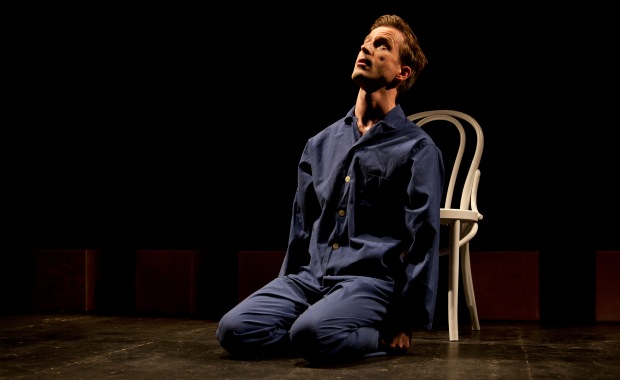
The structure chosen by Lyall is one that neatly reflects this murky division between human and machine. He delivers the first half standing at a lectern, cultivating a genial mode of delivery that sits somewhere between lecture, confessional and storytelling, as he tells us about the gameshow storming super-computer Watson, his relationship with computers, and his growing mistrust of his own internal hard drive following a brain injury. But just as Lyall has lulled us into the rhythm of his narrative, it slides suddenly into sci-fi territory, a canny move that snags our attention as we find ourselves just as dislocated as Lyall’s imprisoned protagonist, with nothing to rely on but a disembodied electronic voice. The piece can thus seemingly be divided along clean lines into the corporeal and virtual, but it is never quite this simple.

No one trick geek, Lyall is as sensitive to the conventions and contrivances of theatre as he is to the jargon of computing. With the house lights still up, he gently mocks the art of representation by “acting” the drinking of a glass of water and acknowledges his artificial surroundings – “I see you’ve met the set” – while also drawing attention to the relationship between theatre and value. Are we getting what we’ve paid for? This is only loosely knitted to the main weave of what DEFRAG_ is doing, but when interrogated more closely, Lyall’s attention to the blurred line between the fake and the real seems ever more integral in its relationship to the content of the piece. The computer, after all, is just another imitation of human faculties.

While DEFRAG_ might fascinate and tickle the secret sci-fi fan in me, it is ultimately the human story weaved by Lyall that becomes the most engrossing. The fears he delicately touches upon, of losing memories or finding one’s sense of self unravelling, are ones that afflict us all. Storytelling is also cast in a central position within our relationship with artificial intelligence; as Lyall’s unnamed protagonist backs up his life onto a super hard drive, stories are passed from file to file in the same way they once travelled from mouth to mouth, the currency of our humanity deposited into a bank that might well have its own agendas. If our stories and memories can be appropriated, what remains to separate us from our machines?

There are no real answers, but that feels right. Because if there’s one thing that sets humans apart from our machine counterparts, it’s that ambiguous area of grey that renders the defiantly black and white process of the defrag impossible.

Image: Rachel Ferriman

Where is the Audience?

Originally written for Exeunt.

The question that forms the title of this column might sound like a strange one. The audience are out there surely, in the dark, occasionally punctuated by the odd surreptitiously scribbling critic. They are a vital part of the circuit, without which theatre and performance would not be able to fire. They constitute theatre’s purpose, its immediacy, the second half of its violently beating heart.

Yet I wonder if the audience, robbed of light, are failing to be seen. On Monday evening I attended the latest Platform event as part of the Bush Theatre’s RADAR festival of new writing, an event entitled “how is critical discourse keeping pace with contemporary theatre?” Perhaps unsurprisingly, given the terms in which this question was framed, the contributions – from Sean Holmes, Andrew Haydon, Ramin Gray and Maddy Costa – were centred on interrogating the directions in which both critical discourse and contemporary theatre might be heading and how they might or might not be in step with one another. And those contributions were thoughtful and nuanced and exciting and made me want to start new conversations.

In all of these many heady conversations that I and others have been participating in over the last few months, however, there is a nagging absence. It acts as a black hole, the latent subject around which all our discussions revolve and to which they are irresistibly drawn, but that does not quite show itself. Just as they find themselves shrouded in darkness in the auditorium, the audience have remained barely visible in these discussions, a constant yet silent presence whose lack of visibility only became fully clear to me after it was raised in two separate conversations following the RADAR Platform. Where is the audience in this dialogue?

Being a big fan of conversation – as my friends can no doubt exasperatedly attest to – the thought that critics and theatremakers might be starting to talk more to one another can only be a good thing. But while we alternate between knocking heads and sharing ideas, the very people for whose benefit we’re loudly wrangling might be hovering awkwardly over our shoulders, struggling to find a way in.

At another panel talk I recently attended, I sat stranded in the tides of discussion, uncharacteristically tongue-tied and unable to navigate a route into the conversation. That wasn’t the fault of anyone speaking, but I’d hate for my own excited immersion within the current bubble of critical discourse to make others feel that same sense of marooned dislocation. The bubble is delicate and beautiful, but it might also be exclusive and eventually stifling. After all, there’s only so much air to go around.

It strikes me as ironic that the Platform at the Bush, in which the audience were curiously quiet, was followed later that same evening by the inclusive powerhouse of Kieran Hurley’s Beats. An exhilarating mash-up of storytelling and techno music set to the backdrop of the rave culture of the early 1990s, Hurley’s play hinges tantalisingly on the idea that a live gathering of people might be something inherently radical. It’s an act of immediate togetherness that seems ever more subversive in an age of digital connection that has both expanded and fractured human relations. Set against the emailing, the tweeting, the blogging, the simple idea of collecting in one physical location to share a fleetingly live experience becomes something that breaks the norm, interrupting the electronic noise at the same time as it contributes to it.

As I felt while watching Beats, a belief in the power of theatre must also be a belief in the potential of the shared space and the collective experience. At an earlier Platform event as part of RADAR, which responded to the provocation “one idea that could change our theatrical landscape”, Chris Goode offered up the possibility of “making the space for something to happen in”. Since being generously invited into rehearsals by Greyscale earlier this year, I’ve come to agree with Chris that the site of process is often more interesting and exciting than the “finished” (note the scare quotes) work. I’m utterly, giddily seduced by the fragile magic of the rehearsal room. Setting aside my own desires, however, perhaps what we ought to be looking for is a space – either literal or figurative – that can include everyone; a space that might, as Chris suggests, “scuff the distinctions between process and product, and artist and audience”. Isn’t that the space that we (in which I include both critics and makers) should be really interested in creating?

But before we all berate ourselves too much, perhaps the kernel of a solution to this issue of including and engaging the audience was already there, in the speeches and provocations at the Bush and the enthusiasm- and wine-fuelled conversations in the bar afterwards. At one point during her contribution, Maddy Costa highlighted the US site Culturebot, its guiding concept of “critical horizontalism” and its dedication to a response that is “the continuation of a dialogue initiated by the artist”. That dialogue that the artist has initiated is surely a dialogue with the audience of the piece, a dialogue in which the critic has a role as both a participant and an enabling force. Critics’ conversations with theatremakers, whatever form those conversations might take, are not exclusive duologues; for the health of the discussion and of the art form, we need to get everyone talking.

Of all the speeches made on the stage of the Bush Theatre on Monday evening, the one in which the audience figured most heavily was given by Sean Holmes. Based on his experience at the Lyric Hammersmith, he spoke of audiences that were hungry, starved of something that British theatre is not currently providing them with – a ravenous desire that is not reflected in mainstream criticism, but that perhaps in fact those audiences don’t mind about not seeing mirrored there. It’s a hunger that theatres and makers should be striving to feed, and that for the most part I think they are striving to feed. But that shouldn’t let theatre criticism off the hook. How do we turn on the lights, get talking and find the food to satisfy that appetite?

Beats, Bush Theatre

Originally written for Exeunt.

The most disturbing aspect of the dystopian nightmare constructed by George Orwell in 1984 is not the unblinking eye of Big Brother, or the children blithely betraying their parents, or even the terrors of Room 101. What really conjures the cold, black grip of dread is the whispered name of the Thought Police, the idea that the final refuge of the mind might be infiltrated and soiled. It is the untamed power of the mind to resist that holds possibly the greatest subversive power, because thoughts are impossible to capture; as Kieran Hurley breathes into his microphone at the beginning of Beats, eyes wide, “they can’t arrest your imagination – yet.”

On the surface, Hurley’s startling piece appears to be simply a surprising blend of storytelling and techno music. These unlikely bedfellows are harnessed to relate the distinctly ordinary narrative of Johnno McCreaddie, a fifteen-year-old boy growing up in Livingstone who becomes entangled in the rave culture of the early 1990s, while at the same time policeman Robert wrestles with the day to day demands of his job and the insistent, disappointed ghost of his father. Yet Beats is, in its own pulsing, unapologetically noisy way, one of the most invigorating pieces of recent political theatre. It’s a strobe-lit love song to the radical potential of the collective act of imagination, the live sharing of thoughts that can’t be clubbed or cuffed.

Although speaking deafeningly to the disillusioned present moment, Hurley’s narrowed focus is 1994 and the Criminal Justice Act’s bizarre outlawing of public gatherings to listen to music that consists primarily of “the emission of a succession of repetitive beats”. Collected in the Bush Theatre to the pounding soundtrack of DJ Johnny Whoop, we are – according to this definition – breaking the law. Hurley, an unassuming but fiercely captivating performer, flirts with this idea of transgression and with the lines drawn between real and imagined in the space of the theatre, playfully suggesting that because it’s not real its criminality doesn’t really count.

While Hurley’s characters are vividly drawn and fleshed out by his morphing voice and physicality, much of the weight that gathers behind this simple narrative is reliant on the sound with which it is intertwined. Audience members become auditors in the most literal sense, as the piece channels the power inherent in music and its force to bring people together against the atomising efforts of those in authority. The integral beats of the title are not just beats of music, but beats of the heart, beats in time, the very stuff of humanity and of history.

From the exhilarating rush and noise of the show Hurley has crafted, one grinningly rebellious anecdote sounds a note above the rest. In the immediate wake of the Criminal Justice Act, one of Johnno’s mates explains how the song blaring from his car speakers has no repetitive beats at all – not one. Each series of beats follows a different rhythm, scattering logic. If they had a rave and only listened to this one track, the boy continues, no one could legally arrest them.

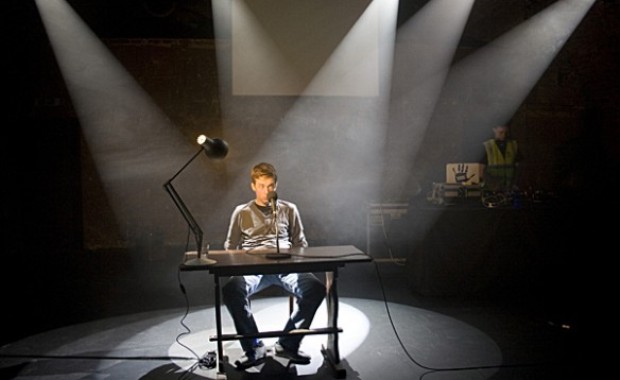
It’s a fitting analogy for the subversively chameleonic nature of resistance, which will constantly find new ways to push against imposed systems from within, often using those systems’ own apparatuses. It also speaks to Hurley’s own recycling and reinvention of the essentially traditional form of storytelling in which he is working, visually hinted at by the rather old-fashioned wooden desk at which he sits and its juxtaposition with the light and sound enveloping it. As Johnno puts it upon entering his first rave, “it’s been done before, but not by me” – a fresh sense of novelty that Hurley manages to inject into his mode of narrative, generating a kind of optimism in the ability of political theatre to shift and evolve at the same pace as its circumstances.

As the pulsing sound and lights finally dim, what Beats leaves us with is a collective conviction that this matters. Hurley’s closing refrain, the piece’s own pulse and repetitive beat, rings out as a subversion of the criticism so often levelled at the seemingly marginal activities of political theatre: it doesn’t mean nothing. A simple, casually deployed double negative delicately inverted to reveal its true meaning. It doesn’t mean nothing.

Shunt’s The Architects

architects-600x393

Originally written for Exeunt.

Shunt have always nurtured an unusual and striking relationship with space. From the theatre company’s initial base in Bethnal Green Arches to their residency in the vaults under London Bridge Station, the site of performance has been integral to their work.

There is something deeply appropriate, then, about the title of Shunt’s new piece. The Architects, a disorientating riff on the Minotaur myth, is the first of their shows to be staged in a space that is not their own, but its name immediately conjures the role that the company have previously taken in constructing the environments in which audiences experience their work. Shunt embrace theatre as event, building entire worlds into which spectators are “immersed” – a term that has since become a fashionable and problematic tag for the kind of work that the company have always been interested in producing.

Central to these precisely assembled fictional worlds is the element of surprise, which makes writing about Shunt’s work a delicate activity. Perched at the edge of their rehearsal room in Marylebone, I feel a slight illicit thrill at peeking inside a process cloaked with secrecy, an outsider flicking through the embryonic blueprints. Later, speaking to company member David Rosenberg during the rehearsal lunch break, it is made clear that the less I reveal about the show the better. The journey that audiences are guided on by Shunt hinges on the unexpected and on knowing as little as possible prior to the event.

“We’re always looking for ways in our work to bring people very much into the moment of where they are in a performance,” says Rosenberg, reaching for adequate words to describe this element of the work. Shunt want audiences fully inside their pieces, fighting the conditioned impulse to be constantly drawing cerebral connections between the performance and the world outside, and encouraging audience members to feel “something that isn’t part of the suspension of disbelief”.

This displacement of the usual relationship between audience and performance relies heavily on moments of surprise and disorientation, moments that shift the atmosphere of the piece and create something from the resulting discomfort. “Points of surprise are points where you begin to imagine that you know the architecture of the space or understand the logic of the space and then that logic changes,” Rosenberg explains. “In that brief period when you’re trying to adjust, that’s a very exciting state to be experiencing a show in.”

For all the care taken over the audience experience, however, there is an intriguing tension in Shunt’s work between a level of freedom not normally enjoyed by audiences and the very orchestrated nature of the experiences they craft. Shattering the usual rhetoric that surrounds this type of work, Rosenberg freely admits that “the audience don’t actually have a lot of choice in our shows”, going on to describe audience members as being “imprisoned” in the worlds that the company create. At the same time, however, he is intent on giving audiences as little instruction as possible, insisting during rehearsals that the performers should not be telling the audience what to do, but instead the shape of the piece should guide their behaviour and interaction. In this way, paradoxically, the more controlled the environment, the freer the audience feel.

This tension between agency and entrapment is likely to also be key to The Architects. Writing about Shunt’s new piece without dropping several clunking spoilers is a problematic task, so my conversation with Rosenberg – at least outside the rehearsal room – remains largely in the realm of the vague. As loudly announced by the bull emblazoned on their marketing material, the show’s basis in the Minotaur myth, a myth that Rosenberg tells me they have been interested in exploring for several years, is no secret. Unsurprisingly, it was the room for interpretation that appealed to the company. “We were interested in taking as a starting point a very short and well known story,” says Rosenberg. “Whatever account you read is barely more than a page, so there are a limited number of elements within it; we could extrapolate a lot from something very simple.”

I wonder whether the unique nature of the myth as a mode of storytelling and its role in the formation and communication of cultures and ideas is significant to Shunt’s appropriation of this form. As acknowledged by Rosenberg, this inspirational springboard marks a departure from the historical starting points of most of the company’s previous work and is thus being utilised and interpreted in a different way. “The fact that this is a myth brings in interesting ideas about the creation of myths and how they can continue to be useful in contemporary narratives.”

Rosenberg’s mention of the contemporary brings us onto the real world resonance that Shunt’s work attempts to achieve even within its sealed-off theatrical worlds. Despite engaging with historical or fictional narratives, the company’s shows are typically informed by the social and political climate of both their conception and their subsequent development throughout performance. Money, performed in the aftermath of the Lehman Brothers collapse, refracted the financial crisis of that specific moment through a tale of past financial failure; the inspiration of the gunpowder plot was married with the anxieties of a post-9/11 world in Dance Bear Dance.

“There is an idea for a show and then there is the current climate in which that show is being made,” Rosenberg makes the distinction. “There are events unfolding throughout the whole time we’ll be making a show, so we try to be a bit permeable to those events.” As for the current significance of the Minotaur and the labyrinth, Rosenberg is more elusive, but it is clear that the piece is heavily coloured by the present moment, with the company hinting at metaphorical links between the audience’s experience and the wider political and economic landscape.

Equipped with only partial information, the glimpse I witness of the rehearsal room is often as disorientating as the finished experience is engineered to be, but one thing I do get a clear sense of is Shunt’s collective method of working. One performer leads an improvisation, to be replaced the next moment by someone else; any hierarchy that might briefly emerge is fluid and ever-shifting. Likewise, while individuals inevitably take on different roles within the company, everything is conceived and credited collectively. As Rosenberg puts it, “when we make the work we aren’t fulfilling the vision of one person. We are all the authors of that work.”

This notion of collective authorship steers the conversation into ideas of legacy. With no sole author, how can a textual trace of the work remain? This question of documentation is one that intrigues Rosenberg, but one that he admits the company have not been particularly good at addressing. Despite the existence of a Shunt archive, the collective are unsure how these documents might translate into a record of the shows they create.

“It’s very difficult to document an audience experience, and that’s the point of the work,” Rosenberg pins down the central problem. “What lingers around afterwards is a mess of different images and snippets of things.” Precisely because of their idiosyncratic melding of history, fiction and the present moment, together with the particular combination of artists who make their work possible, Shunt’s shows exist very much in the moment of their performance. As such, any form of documentation must recognise this.

“The archive could become something that exists in its own right,” Rosenberg muses, “something that isn’t just about a record.”  This too, perhaps, could become a new space, an area carved out by Shunt to offer their audiences yet another way of experiencing their work. As Rosenberg speaks about the possibility of touring next year, a departure from previous ways of working that once again shifts the company’s relationship with the space of performance, Shunt leave the impression that they are still far from finished with manipulating the architecture of theatre.

Photo: Susanne Dietz

The Trojan Women, Gate Theatre

Originally written for Exeunt.

The king is dead, Troy is burning and the “crème de la femme” of the city are imprisoned in the maternity ward of the hospital, awaiting their fate amid teddy bears and pill bottles. The chorus screams while the gods cackle through mounted television monitors, peering down at the anguished humans with hand-rubbing glee. The Gate Theatre’s bold, visceral new realisation of the fall of Troy and the long tumble from grace to which its female inhabitants are subjected is certainly not a tragedy given to moderation.

Caroline Bird’s thrilling, muscular adaptation of Euripides is, as Poseidon sneers down from his distant Olympus, “an artistic impression” of Troy – a contemporary riff on tales indelibly impressed on the collective cultural memory. This allows for an implicit critique of the way such wars and massacres are historicised; an arch, glancing appraisal of the passing of stories from mouth to mouth. “Am I a poem?” asks Lucy Ellinson’s compelling one-woman chorus, begging the question of how individuals are memorialised, be it by Homer or Euripides or the modern media. It is a question that is as relevant to the depiction of perceived “victims” in present day conflicts as it is to the reading of ancient literature.

And Bird certainly isn’t shy about underlining Troy’s contemporary resonances, as she and director Christopher Haydon wrench Euripides’ characters out of the ancient world and into an unspecified modern realm. This Troy may still have gods in the form of Roger Lloyd Pack and Tamsin Greig’s pre-recorded deities, but it also has smartphones, machine guns and anti-monarchy blogs. This tension between ancient faith and modern secularism emerges repeatedly throughout the piece, with the fickle and malicious gods worshipped by the Greeks and Trojans becoming an apt reference point for the shifting, false idols of our age.

Just as the chorus, cannily pared down to Ellinson’s pregnant woman of the people, wonders whether she is merely “the idea of woman”, this interpretation also feels its way around what it means to be a woman caught in the conflict of motherlands. Louise Brealey’s dazzling, chameleonic portrayal of three of Troy’s pivotal female figures – Cassandra, Andromache and Helen – functions to illustrate three different facets of how women have been painted in the Troy legend: as hysterics, helpless victims and temptresses. The clinical surroundings of Jason Southgate’s striking design, meanwhile, define these women through the role of motherhood, mocking them with the hope of offspring that will be ripped from their breasts while childish paraphernalia laughs down from the walls.

But for all its brutally poetic language, searching interpretation and sheer winding power, there is something that grates a little within this reimagining. Rather than teasing out timeless threads from Euripides’ tragedy and applying these to our current predicament, Bird’s adaptation grasps and rips with both hands. As a result, the stubbornly imposed contemporary parallels, such as Talthybius’ use of Western democracy’s rhetoric to justify the Greek invasion of Troy, sit somewhat disjointedly with the Classical references preserved from Euripides. Meanwhile, the pointedly modern gadgets and glib, incongruous video sequences – as predictably enjoyable as Lloyd Pack and Greig’s performances are – have a touch of smugness that threatens to blunt the potency of the whole.

Heavy-handed as it may be, however, it’s hard not to be enthralled by the antiseptic horror and devastatingly intense performances. There is also something profoundly timely in Troy’s excess and destruction that speaks louder than all of the grinningly placed modern references. As the doomed spires of Ilium look more and more like the towering skyscrapers of late capitalism, perhaps this fresh, harrowing vision of Troy is a Cassandra for our times.